
AI Mode vs Traditional Search: Comparing User Experiences and SEO Outcomes
28 May 2025
The evolution of search technology has significantly transformed how users interact with information online. Traditional search engines, like Google, have long relied on keyword-based algorithms to deliver relevant results. However, the advent of Artificial Intelligence (AI) has introduced a new paradigm in search experiences. AI-powered search modes, such as Google’s AI Mode, are redefining user interactions and Search Engine Optimization (SEO) strategies. This article delves into the distinctions between AI Mode and traditional search, examining their impacts on user experience and SEO outcomes.
Understanding Traditional Search
Traditional search engines operate by indexing vast amounts of web content and retrieving results based on keyword relevance and other ranking factors. Users input queries, and the search engine returns a list of links, often referred to as the “ten blue links,” ranked by relevance. This method emphasizes backlinks, keyword optimization, and meta tags to determine page rankings.The Verge
The Emergence of AI Mode in Search
AI Mode represents a shift towards more conversational and context-aware search experiences. Leveraging advanced machine learning models, AI Mode interprets user intent more accurately and provides direct answers, summaries, or even personalized content without requiring users to click through multiple links. For instance, Google’s AI Mode utilizes its Gemini AI model to deliver synthesized responses, enhancing the efficiency of information retrieval.
Comparing User Experiences
Traditional Search:
Interaction: Users input specific keywords and sift through a list of links to find relevant information.
Experience: May require multiple searches and clicks to locate desired information.Wikipedia
AI Mode:
Interaction: Users can ask complex, natural language questions and receive direct, concise answers.
Experience: Streamlined and efficient, reducing the need for multiple searches.
A study comparing ChatGPT and traditional search engines found that users spent less time completing tasks using AI-powered tools, with no significant difference in task performance, indicating enhanced efficiency in AI-driven search experiences.
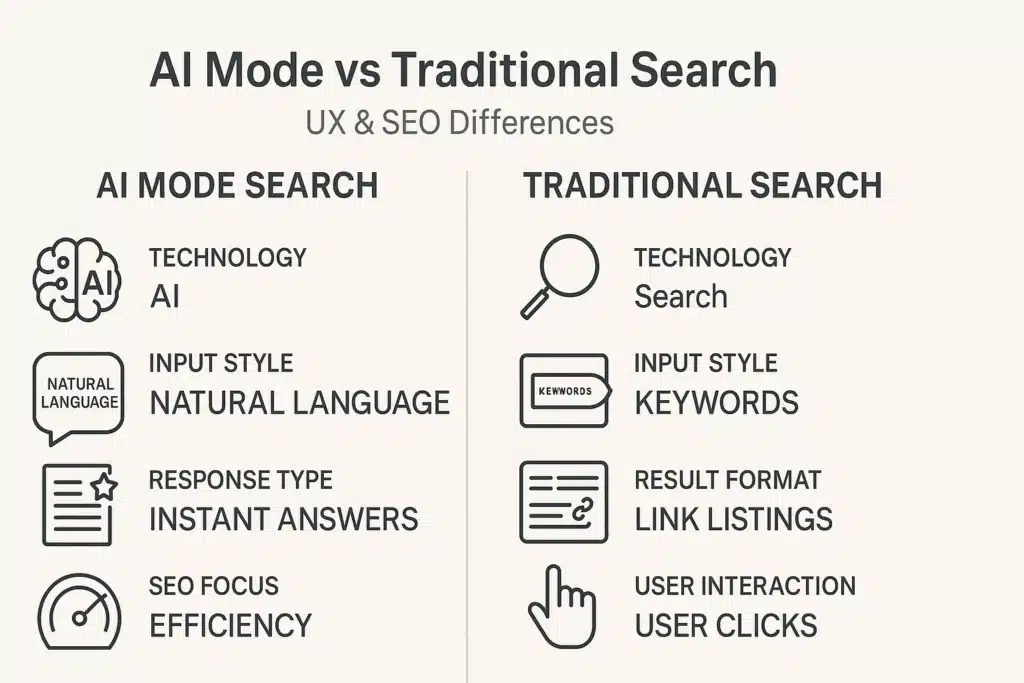
Comparison Table: AI Mode vs Traditional Search
| Feature | AI Mode Search | Traditional Search |
|---|---|---|
| Technology | AI and machine learning-based | Keyword and link-based indexing |
| User Input | Natural language questions | Short keyword phrases |
| Response Type | Direct, summarized answers | List of ranked web links |
| Click Requirement | Low (fewer clicks needed) | High (users must browse multiple pages) |
| SEO Focus | Intent, content quality, structured data | Keywords, backlinks, meta tags |
| Traffic Potential | Can reduce clicks to site | Higher chance of click-through |
| Best Use Case | Quick answers, personalized info | Research, product discovery |
SEO Outcomes: Traditional vs. AI Mode
Traditional SEO:
Focus: Optimizing content for keyword relevance, backlink profiles, and meta descriptions.
Outcome: Higher rankings in search results lead to increased visibility and traffic.
AI-Driven SEO:
Focus: Creating high-quality, context-rich content that aligns with user intent and conversational queries.
Outcome: Enhanced chances of being featured in AI-generated responses, potentially increasing visibility even without top traditional rankings.
However, the shift to AI Mode poses challenges for traditional SEO strategies. As AI-generated answers may reduce the need for users to click on links, websites might experience decreased traffic despite maintaining high rankings. This necessitates a reevaluation of SEO approaches to remain effective in the evolving search landscape.
Adapting SEO Strategies for AI Mode
To thrive in the era of AI-driven search, consider the following strategies:
Focus on User Intent: Develop content that addresses specific questions and provides comprehensive answers.
Enhance Content Quality: Produce well-researched, authoritative content that AI models are more likely to reference.
Utilize Structured Data: Implement schema markup to help AI understand and present your content effectively.
Optimize for Conversational Queries: Incorporate natural language and long-tail keywords that mirror how users speak and ask questions.
Monitor AI Search Performance: Use analytics tools to track how your content performs in AI-generated search results and adjust strategies accordingly.
Conclusion
The integration of AI into search engines marks a significant transformation in how users access information and how websites optimize for visibility. While traditional SEO remains relevant, adapting to AI-driven search modes is crucial for maintaining and enhancing online presence. By understanding the nuances of AI Mode and adjusting strategies to meet its demands, businesses and content creators can continue to reach and engage their target audiences effectively.Wikipedia+2
FAQs
1. What is AI Mode in search engines?
AI Mode refers to an advanced search experience powered by artificial intelligence, where results are generated through context-aware models to answer user queries more directly and conversationally.
2. How does traditional search work?
Traditional search relies on keyword matching, backlinks, and metadata to rank pages. Users receive a list of ranked web links and must click through to find relevant information.
3. Is AI Mode better than traditional search?
AI Mode improves efficiency by offering concise, relevant answers instantly. However, traditional search offers more control and exploration, which some users may prefer.
4. How does AI Mode affect SEO strategies?
AI Mode prioritizes context and content quality over keyword density, requiring SEO strategies to shift toward natural language, user intent, and structured data implementation.
5. Can AI Mode reduce website traffic?
Yes, since AI Mode often provides answers without requiring clicks, it may reduce traffic to web pages, even if they rank well traditionally.

Devyansh Tripathi
I’m Devyansh Tripathi, an SEO strategist and digital growth expert, helps businesses and individuals rank higher and drive organic traffic. Through DevTripathi., he shares cutting-edge SEO insights, content strategies, and marketing hacks. Passionate about digital success, he’s on a mission to make SEO simple, effective, and result-driven!
Posts
- What Google’s New AI Search Documentation Means for SEO Teams
- Google I/O 2026 Search: AI Agents, Gemini 3.5 and the Unified Box
- Google’s AI Optimization Guide: The Technical and Content Checklist
- July 2026 SEO Update: AI Overviews, llms.txt and Search Console
- Prompt Optimization Beyond Page One: The Position-21 Citation Opportunity
Categories
- AI Citation Optimization
- AI Search Optimization (AISEO)
- AI Visibility Tracking
- Answer Engine Optimization (AEO)
- Brand Authority SEO
- Brand SERP Optimization
- Community Signal SEO
- Conversational Search Optimization
- Generative Engine Optimization (GEO)
- Knowledge Graph Optimization
- Modern SEO Strategies
- Multimodal Search Optimization
- Prompt Optimization
- SEO Trends
- Social Search Optimization
- Topical Authority SEO
- Uncategorized
- Video Search SEO
- Visual Search Optimization
- Voice Engine Optimization (VEO)
- Zero Click Search Optimization
Latest News
Text Widget
Empowering brands with insights, strategies, and stories that drive digital growth.