
Google AI Mode: Transforming Search and SEO Strategies in 2025
24 May 2025
Google’s introduction of AI Mode marks a significant evolution in search technology, offering users a more conversational and intuitive search experience. Powered by the advanced Gemini 2.5 model, AI Mode aims to provide comprehensive answers by understanding complex queries and delivering synthesized information directly within the search interface.
What Is Google AI Mode?
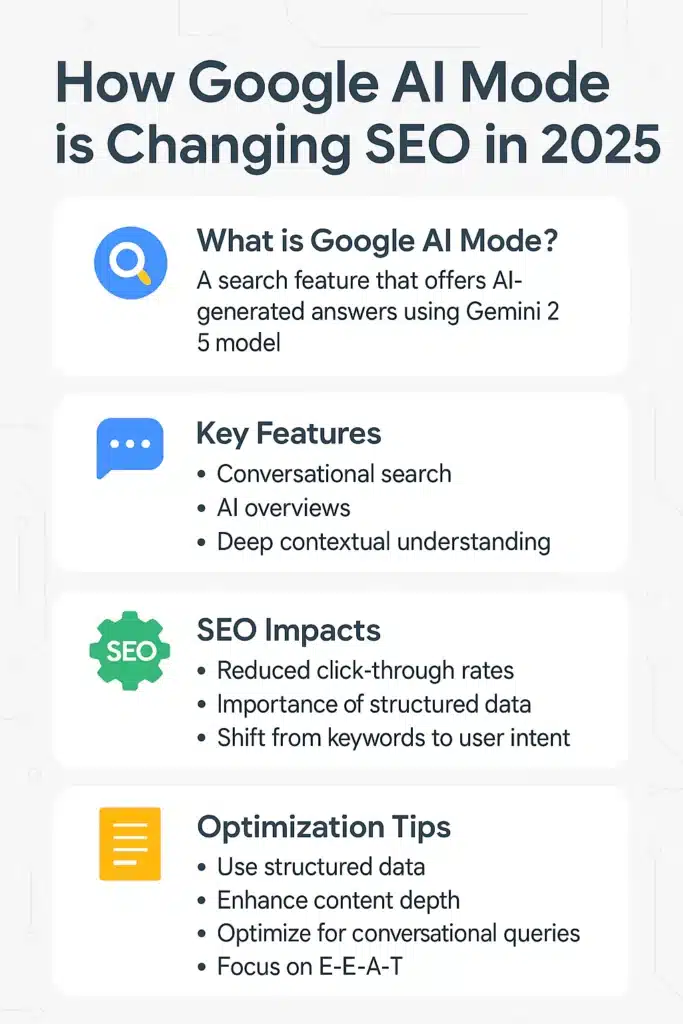
Google AI Mode is an intelligent, context-aware search experience powered by generative AI. Unlike the traditional search results that list links, AI Mode can now generate summarized answers, insights, images, videos, and deep search results directly in the SERP.
At the core of this experience is the Search Generative Experience (SGE), which combines:
Conversational search
AI Overviews
Personalized results
Deep, contextual understanding
🧠 Powered by Gemini 2.5, AI Mode aims to revolutionize user experience by predicting and answering queries—even unasked ones—with detailed summaries and sources.
Understanding Google AI Mode
AI Mode is designed to handle multifaceted questions by breaking them down into sub-queries, enabling a deeper exploration of topics. This approach allows users to receive detailed responses without navigating through multiple web pages. The integration of multimodal inputs, including text, images, and voice, further enhances the user experience .Wikipedia
Implications for SEO
The advent of AI Mode brings forth several considerations for SEO professionals:
1. Reduced Click-Through Rates
With AI Mode providing comprehensive answers within the search results, users may find less need to click through to individual websites. This shift could lead to a decrease in traditional organic traffic .Xponent21
2. Emphasis on Content Quality and Authority
To be featured in AI-generated responses, content must demonstrate high relevance, authority, and trustworthiness. This underscores the importance of creating well-researched and authoritative content that aligns with user intent.Xponent21
3. Importance of Structured Data
Implementing structured data helps search engines understand the context of your content, increasing the likelihood of being included in AI summaries. Utilizing schema markup for articles, FAQs, and other content types is now more crucial than ever.WG Content
Strategies to Optimize for AI Mode
To adapt to the changing search landscape, consider the following strategies:
1. Enhance Content Depth and Relevance
Develop comprehensive content that thoroughly addresses user queries. Incorporate relevant keywords naturally and ensure that your content provides valuable insights.
2. Utilize Structured Data Markup
Implement schema markup to provide search engines with detailed information about your content. This includes using Article, FAQ, and HowTo schemas where appropriate.WG Content
3. Focus on E-E-A-T Principles
Ensure your content demonstrates Experience, Expertise, Authoritativeness, and Trustworthiness (E-E-A-T). This involves showcasing credentials, citing reputable sources, and maintaining transparency.WG Content
4. Optimize for Conversational Queries
Given AI Mode’s conversational nature, tailor your content to answer questions in a natural, dialogue-like manner. This includes using question-and-answer formats and addressing potential follow-up queries.
Conclusion
Google’s AI Mode represents a paradigm shift in how users interact with search engines. For SEO professionals and content creators, this evolution necessitates a reevaluation of strategies to maintain visibility and relevance. By focusing on content quality, structured data, and user intent, you can position your website to thrive in this new AI-enhanced search environment.
FAQs About Google AI Mode
What is Google AI Mode?
It’s an advanced search interface using generative AI to answer queries directly, often without needing users to click links.
Does AI Mode hurt organic traffic?
Yes, it may reduce click-through rates, but quality, structured, and contextual content still performs well.
How can I appear in AI Overviews?
Use structured data, clear headings, factual content, and answer-focused writing.
What keywords should I target?
Focus on long-tail, intent-based keywords like “how Google AI Mode affects SEO” or “optimize content for AI Overviews.”
Is AI Mode available to everyone?
As of now, it’s rolling out in phases and is more prominent in the U.S. and select regions.
Ready to future-proof your SEO?
Check out our Complete SEO Services or contact us for a personalized audit.

Devyansh Tripathi
I’m Devyansh Tripathi, an SEO strategist and digital growth expert, helps businesses and individuals rank higher and drive organic traffic. Through DevTripathi., he shares cutting-edge SEO insights, content strategies, and marketing hacks. Passionate about digital success, he’s on a mission to make SEO simple, effective, and result-driven!
Posts
- What Google’s New AI Search Documentation Means for SEO Teams
- Google I/O 2026 Search: AI Agents, Gemini 3.5 and the Unified Box
- Google’s AI Optimization Guide: The Technical and Content Checklist
- July 2026 SEO Update: AI Overviews, llms.txt and Search Console
- Prompt Optimization Beyond Page One: The Position-21 Citation Opportunity
Categories
- AI Citation Optimization
- AI Search Optimization (AISEO)
- AI Visibility Tracking
- Answer Engine Optimization (AEO)
- Brand Authority SEO
- Brand SERP Optimization
- Community Signal SEO
- Conversational Search Optimization
- Generative Engine Optimization (GEO)
- Knowledge Graph Optimization
- Modern SEO Strategies
- Multimodal Search Optimization
- Prompt Optimization
- SEO Trends
- Social Search Optimization
- Topical Authority SEO
- Uncategorized
- Video Search SEO
- Visual Search Optimization
- Voice Engine Optimization (VEO)
- Zero Click Search Optimization
Latest News
Text Widget
Empowering brands with insights, strategies, and stories that drive digital growth.