
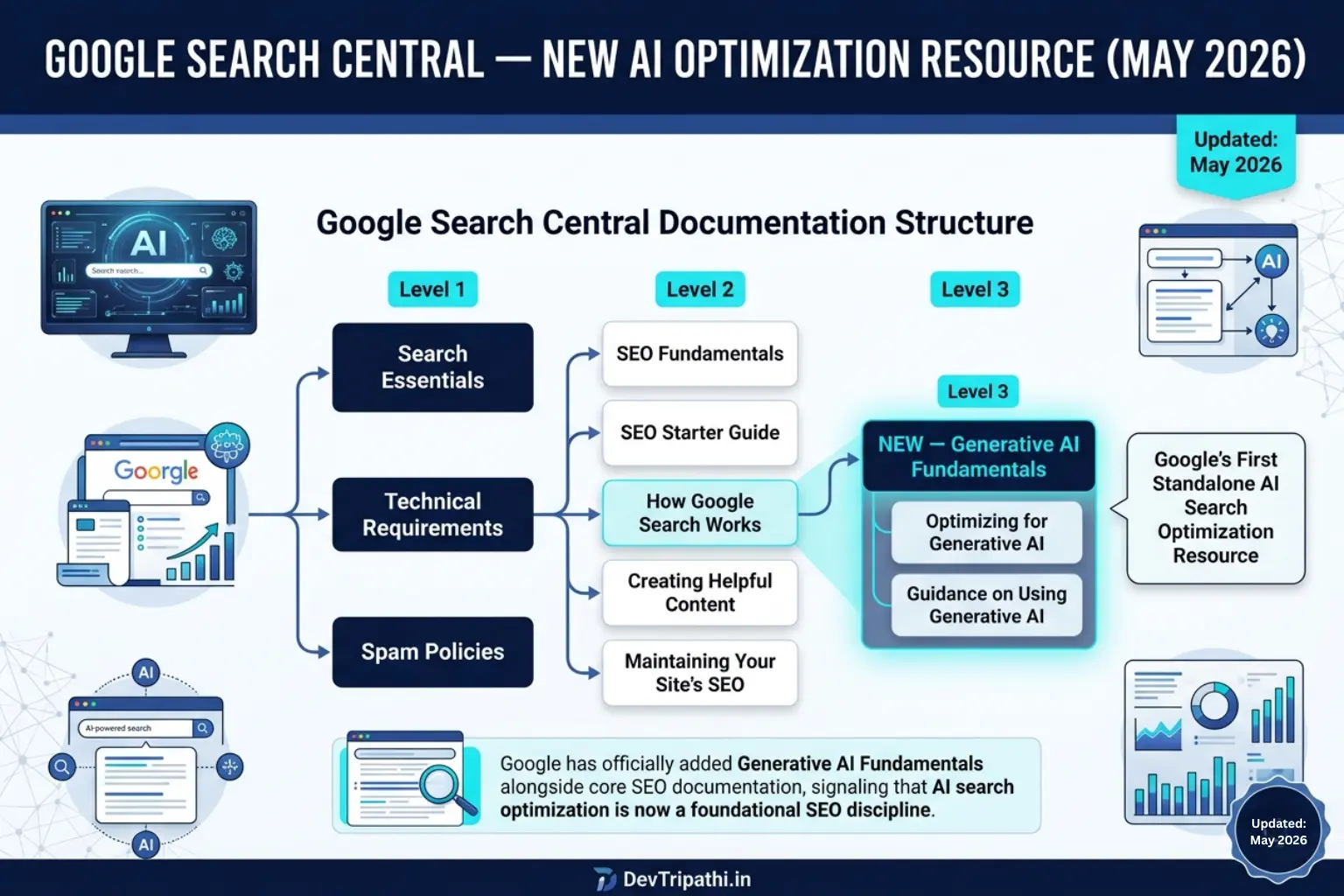
GOOGLE SEARCH CENTRAL — NEW AI OPTIMIZATION RESOURCE (MAY 2026)
05 April 2026
Google's New AI Optimization Resource: What Search Central's May 2026 Announcement Means for SEO
On May 19, 2026, the same day as Google I/O, Google Search Central published a new blog post announcing something significant: a dedicated, official resource specifically focused on optimizing for generative AI in Google Search.
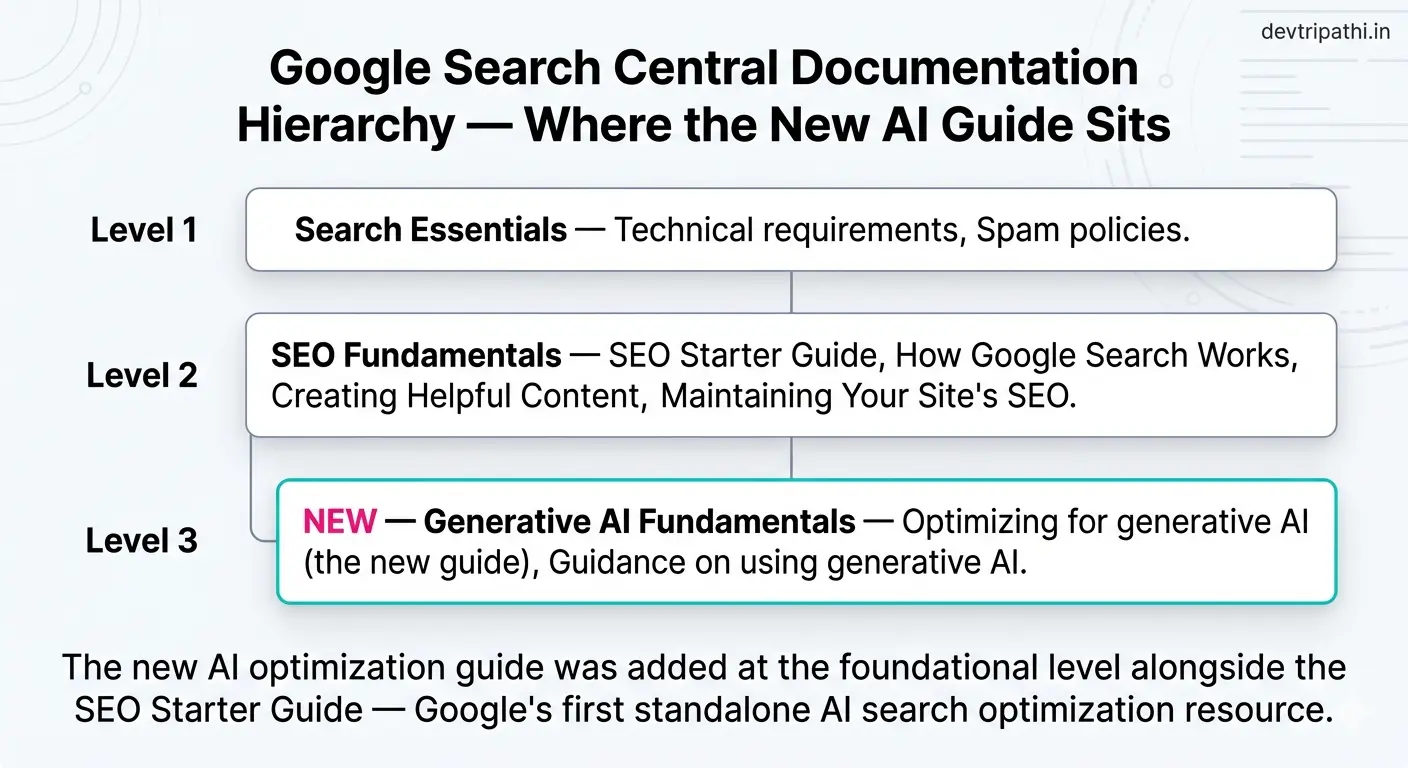
This is not just another help document. It is the first time Google has created a standalone, top-level resource in its official documentation specifically addressing how website owners should approach visibility in AI-powered search experiences including AI Overviews and AI Mode. It was published at https://developers.google.com/search/docs/fundamentals/ai-optimization-guide and it sits alongside the SEO Starter Guide and Search Essentials as a fundamental resource in Google Search Central.
For SEO professionals, the existence and content of this resource carries two layers of significance: what Google is officially saying about optimizing for AI search, and what the decision to publish this document signals about how Google views the relationship between traditional SEO and generative AI optimization.
This article covers the announcement, its full context, and the specific implications for every SEO professional managing search visibility in 2026.
Why This Announcement Is Significant
Google Search Central publishes new blog posts regularly. Most cover specific technical updates, schema additions, or platform features. What makes this announcement different is its scope and placement.
The new resource is positioned as a fundamental guide, not a feature update. It sits in the same section of Google Search Central as the SEO Starter Guide, which has existed for over a decade as Google's primary orientation resource for web publishers. Adding a generative AI optimization guide at that level signals that Google now considers AI search optimization to be a foundational topic that all website owners should understand, not a specialist topic for advanced practitioners.
The timing alongside I/O 2026 is also deliberate. Google announced AI Mode has one billion monthly users, generative UI is coming to all users for free, and Search agents are launching. Publishing an official optimization guide on the same day sends a clear message: the AI search ecosystem is mature enough that Google is now providing formal optimization guidance for it.
This is the equivalent of Google publishing its original SEO Starter Guide in 2008, when search was already dominant but the principles for performing well in it were still being formalized. The brands that understood those principles early built compounding advantages. The same dynamic is available today for the brands that internalize this guidance now.
For the broader context of Google I/O 2026 announcements alongside which this guide was published, see: Google I/O 2026 Search Updates: AI Agents, Gemini 3.5 Flash, Personal Intelligence, and the New Search Box Explained at https://devtripathi.in/blogs/google-io-2026-search-updates-ai-agents-personal-intelligence/
What Google's Blog Post Actually Said
The Search Central blog post published on May 19, 2026 was titled "A new resource for optimizing for generative AI in Google Search." The post itself was brief and directed readers to the new guide, but the positioning is worth noting exactly: Google Search Central named the guide "Optimizing for generative AI features on Google Search" and described it as covering "official best practices from Google Search on how to succeed in generative AI features in Google Search (such as AI Overviews and AI Mode)."
The phrase "official best practices" is important. There is a significant amount of third-party research and practitioner guidance on AEO, GEO, and AI search optimization. This is now Google's own, first-party documentation on the subject. When Google publishes official best practices, those practices represent the clearest available signal of what the system is designed to reward.
The guide is located at https://developers.google.com/search/docs/fundamentals/ai-optimization-guide and should be bookmarked by every SEO professional as a primary reference for AI search optimization strategy.
The Five Core Principles From Google's Official AI Optimization Guide
Having fetched and read the complete official documentation, the following are the five core principles Google articulates for optimizing for generative AI features in Google Search. Each principle carries specific implementation implications.
Principle 1: SEO Remains Essential for Generative AI Search
Google opens the guide with a direct and definitive answer to the question many SEO professionals have been asking: "Is SEO still relevant for generative AI search?"
Google's answer: "In short, yes! The best practices for SEO continue to be relevant because our generative AI features on Google Search are rooted in our core Search ranking and quality systems."
The guide explains two specific technical mechanisms that connect traditional SEO to AI search performance:
Retrieval-Augmented Generation (RAG): Google's AI features use RAG, also described as "grounding," to improve the quality, accuracy, and freshness of AI responses. RAG works by using Google's core Search ranking systems to retrieve relevant, up-to-date web pages from the Search index. This means a page that ranks well in traditional Google Search is more likely to be retrieved for AI Mode response generation. Traditional ranking signals (quality content, technical health, authoritative backlinks) directly feed AI response generation.
Query Fan-Out: The guide explicitly names and explains query fan-out. When a user submits a complex query, Google's AI generates multiple concurrent, related sub-queries to retrieve more comprehensive information. The guide gives the specific example: for the query "how to fix a lawn full of weeds," fan-out queries might include "best herbicides for lawns," "remove weeds without chemicals," and "how to prevent weeds in lawn."
This is the first time Google has officially confirmed and named query fan-out in its public documentation. For SEO professionals building content strategy, this validation of fan-out confirms that optimizing for a single primary keyword is insufficient. Content must address the full semantic landscape of related sub-queries that the AI generates, not only the exact phrase a user types.
Regarding AEO and GEO by name: Google's guide states "AEO stands for 'answer engine optimization' and GEO for 'generative engine optimization'. These are both terms you may see used to describe work specifically focused on improving visibility in AI search experiences. From Google Search's perspective, optimizing for generative AI search is optimizing for the search experience, and thus still SEO."
This is Google's official position: AEO and GEO are SEO, extended to a new search surface. Not a replacement. Not a different discipline. SEO applied to the generative AI search experience.
Action for SEO professionals: Maintain all traditional SEO fundamentals as the foundational layer. Traditional ranking is the prerequisite for AI response retrieval. Then apply the specific content structure, schema, and freshness signals that determine whether retrieved content is cited in the generated response.
Principle 2: Create Valuable, Non-Commodity Content
Google's guide places content quality as the most important factor for generative AI search performance, and it is specific about what quality means in this context.
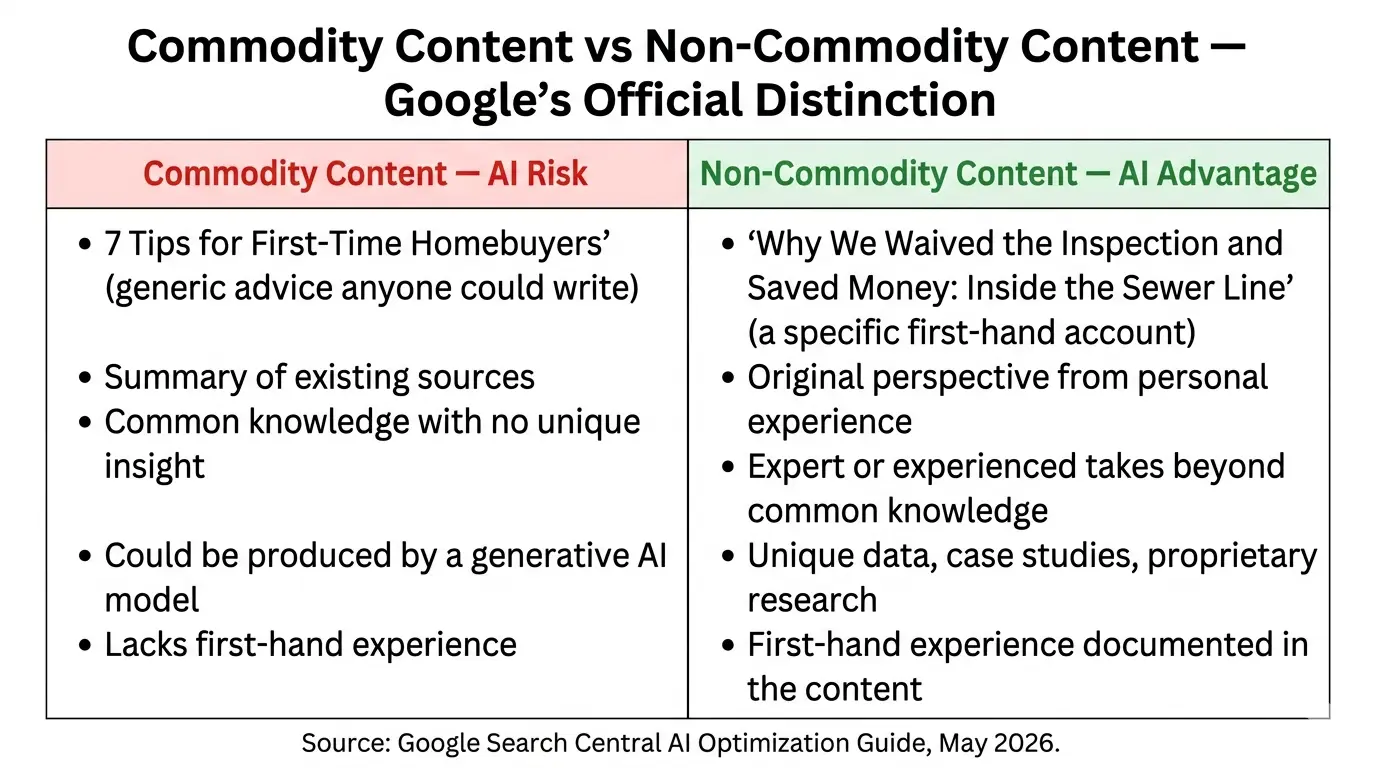
The guide distinguishes between commodity content and non-commodity content:
Commodity content is described as content "based on common knowledge, which could originate from anyone, and typically adds little unique insight." The example given: "7 Tips for First-Time Homebuyers."
Non-commodity content "provides unique expert or experienced takes that go beyond common knowledge and the ordinary." The example given: "Why We Waived the Inspection and Saved Money: A Look Inside the Sewer Line."
Google explicitly states: "Don't just recycle what others on the internet have already said, or could easily be produced by a generative AI model."
The guide identifies three specific attributes of valuable, non-commodity content:
A unique point of view: First-hand experience, original perspective, and personal expertise that cannot be replicated by summarizing existing sources. AI systems evaluate a variety of sources, and unique viewpoints stand out.
Helpful, reliable, people-first content: Not content that could come from anyone, but content written from a position of genuine knowledge and genuine concern for the reader's needs.
Content organized for readers: Well-structured pages with clear paragraphs, sections, and headings that make content easy for human readers to follow. Google notes this organization also helps AI systems understand content structure and context.
Action for SEO professionals: Audit your content library for commodity versus non-commodity content. Any article that is primarily a summary of widely available information is a commodity content risk in the AI search environment. Prioritize transforming your most commercially important pages into non-commodity resources: add original data, first-hand experience, proprietary case studies, unique expert analysis, or original research that no AI system could generate from publicly available sources.
Principle 3: Technical SEO Accessibility for AI Systems
Google's guide addresses the technical requirements that allow AI systems to access and process your content for retrieval. Several of these are critical and frequently overlooked.
The guide confirms that AI systems must be able to reach your pages. This means:
Robots.txt must allow AI crawlers: Google's guide notes that AI features rely on its core Search ranking systems, which use Googlebot for crawling. Blocking Googlebot blocks AI Overview and AI Mode access. For other AI platforms that have separate crawlers (PerplexityBot, ClaudeBot, GPTBot), access must be managed through robots.txt separately.
JavaScript rendering must deliver content in the initial HTML payload: AI retrieval systems may not execute JavaScript before evaluating page content. Critical answer content should be available in the initial server response, not injected after JavaScript hydration.
Page speed affects retrieval priority: Google's core ranking systems, which feed AI retrieval through RAG, consider page experience signals including Core Web Vitals. Pages with LCP above acceptable thresholds may receive lower retrieval priority.
Structured data helps AI systems understand content: Google's guide notes that well-organized content with clear structure helps AI systems understand what the content is about and how it should be used in response generation. Schema markup is the machine-readable layer that makes this explicit.
Action for SEO professionals: Run a technical AI access audit covering robots.txt configuration for all AI crawlers, JavaScript rendering for critical answer content, Core Web Vitals compliance, and schema markup validation across priority pages.
For the complete technical AI access checklist, see: AI Search Optimization (AISEO): The Complete Guide at https://devtripathi.in/blogs/ai-search-optimization-aiseo-complete-guide/
Principle 4: E-E-A-T Signals Are Specifically Important for AI Search
Google's guide reinforces E-E-A-T (Experience, Expertise, Authoritativeness, Trustworthiness) as central to AI search performance, with specific emphasis on the Experience dimension.
The guide directs content creators to demonstrate genuine first-hand experience in their content: "Create the content yourself based on what you know about the topic, and consider what in-depth experience you can bring to your content."
For AI systems evaluating which sources to cite, E-E-A-T signals provide the authority verification that moves a page from retrieved to cited. A page that RAG retrieves because it ranks well but lacks credible authorship, cited evidence, and demonstrable expertise may be retrieved but not cited. A page that demonstrates verifiable expertise, cites authoritative sources, and includes original first-hand perspective is far more likely to be selected as a citation source.
Key E-E-A-T signals for AI search optimization:
Author credentials: Clear bylines on all content with links to author bio pages that document the author's qualifications and experience. AI systems evaluate author credentials as part of content trustworthiness assessment.
First-hand experience language: Writing that reflects personal, documented experience rather than generic synthesis. "In my experience working with 20 clients on GEO implementation, the single most impactful first change was..." signals a different quality of knowledge than "According to best practices, content should be..."
Source citations: Links to authoritative external sources within the content. Google's AI systems evaluate content that cites credible sources as more reliable and more worthy of citation.
Consistent entity signals: The same author, brand, and entity information appearing consistently across the website, author pages, and external references, confirming that the expertise claimed is verifiable across multiple sources.
Action for SEO professionals: Ensure every commercially important article has a credentialed author page. Add first-hand experience language and specific case details to your top content. Include citations to authoritative external sources. Verify entity consistency between on-site author information and off-site references.
For the complete E-E-A-T implementation guide, see: Brand Authority SEO: How to Build Brand Authority That Ranks and Gets Cited by AI at https://devtripathi.in/blogs/brand-authority-seo-complete-guide/
Principle 5: Content Structure and Freshness for AI Extraction
Google's guide addresses content organization specifically in the context of AI extraction: content should be structured so that AI systems can identify and extract relevant sections to include in generated responses.
The guide states content should be "well written and easy to follow" with organization by "paragraphs and sections, along with headings that provide structure." This connects directly to the AEO principle of answer-first content: AI systems extract the most clearly-structured, most directly-answering sections from pages.
On freshness, the guide's use of RAG is particularly important. Google describes RAG as using Search ranking systems to retrieve "relevant, up-to-date web pages." The phrase "up-to-date" is specific: AI systems explicitly prefer current content in their retrieval and citation decisions. Stale content is retrieved less frequently and cited less reliably than current content on the same topic.
Action for SEO professionals: Structure every major article with clear H2 and H3 section headings, answer-first content in the first 150 words of each section, and a systematic content freshness update cycle. Add visible "last updated" timestamps to all high-value commercial pages.
For the complete content freshness system, see: AEO Strategy 2026: The Advanced Playbook to Get Cited in AI-Generated Answers at https://devtripathi.in/blogs/aeo-strategy-2026-advanced-playbook/
What the Publication of This Guide Signals for the SEO Industry
Beyond its specific content, the publication of Google Search Central's AI Optimization Guide signals something important about the maturity of the AI search optimization landscape.
When Google publishes official documentation for an optimization area, it confirms that area has reached a threshold of importance and stability sufficient to warrant formal guidance. The first time Google published guidelines about structured data, it signaled that structured data was becoming a stable, important ranking and appearance factor. The first time it published detailed E-E-A-T guidance, it signaled that expertise and authority signals were becoming formally evaluated.
The publication of this AI optimization guide signals the same thing for AI search. It is no longer experimental. It is no longer a niche discipline for early adopters. It is a formal, stable, and officially documented area of optimization practice. Every SEO professional without a documented AI search optimization strategy now has official Google documentation confirming that they are missing a material part of the modern search performance framework.
The competitive opportunity this creates: the brands that internalize and implement this guidance now, while the majority of their competitors are still primarily focused on traditional ranking factors, will establish the kind of compounding AI citation authority that compounds in the same way domain authority did in the early years of SEO.
Frequently Asked Questions About Google's AI Optimization Resource
What is Google's new AI Optimization Guide? Google's AI Optimization Guide, published on May 19, 2026 at https://developers.google.com/search/docs/fundamentals/ai-optimization-guide, is the first standalone, foundational resource from Google Search Central dedicated to helping website owners optimize for generative AI features on Google Search, specifically AI Overviews and AI Mode. It is positioned alongside the SEO Starter Guide as a fundamental reference and provides official best practices directly from Google.
Is AEO and GEO officially recognized by Google? Yes. Google's AI Optimization Guide explicitly references both AEO (Answer Engine Optimization) and GEO (Generative Engine Optimization) by name, describing them as "terms you may see used to describe work specifically focused on improving visibility in AI search experiences." Google's official position is that both represent extensions of SEO rather than replacement disciplines: "optimizing for generative AI search is optimizing for the search experience, and thus still SEO."
What does Google say about Retrieval-Augmented Generation (RAG) and how it affects SEO? Google's guide officially confirms that AI features including AI Overviews and AI Mode use RAG (Retrieval-Augmented Generation) to retrieve relevant web pages from the Search index before generating responses. This confirmation validates that traditional SEO performance (ranking in Google's index) is the prerequisite for AI feature retrieval. Pages that rank well in traditional Search are more likely to be retrieved and cited in AI responses.
What does Google say about query fan-out? Google's AI Optimization Guide officially names and explains query fan-out for the first time in public documentation. Query fan-out refers to the set of concurrent, related queries that Google's AI generates to gather more comprehensive information when processing a complex user query. The guide's example: "how to fix a lawn full of weeds" generates fan-out queries like "best herbicides for lawns" and "remove weeds without chemicals." This confirms that content must address the full semantic landscape of related sub-queries, not only the exact user query.
What is commodity content according to Google, and why does it matter for AI search? Google's guide defines commodity content as "content based on common knowledge, which could originate from anyone, and typically adds little unique insight." The example given is "7 Tips for First-Time Homebuyers." Google explicitly states that AI systems take a variety of sources into consideration, making unique viewpoints more valuable. Non-commodity content that provides specific first-hand experience, original data, or expert perspective is more likely to be selected as a citation source in AI-generated responses.
How does traditional SEO connect to AI Overview performance? Through RAG (Retrieval-Augmented Generation): Google's AI features use the core Search ranking system to retrieve relevant pages from the index before generating AI responses. Pages that rank well in traditional Search enter the retrieval pool for AI response generation. Strong traditional SEO is therefore the prerequisite for AI feature visibility, not an alternative to it. The additional content structure, freshness, and E-E-A-T signals then determine whether retrieved pages are cited in generated responses.
Where is the new AI Optimization Guide located? The guide is available at: https://developers.google.com/search/docs/fundamentals/ai-optimization-guide. It is accessible through the main Google Search Central documentation navigation under "SEO fundamentals" and "Generative AI fundamentals."
How is this guide different from existing Google documentation? Previous Google documentation covered AI features such as AI Overviews in feature-specific pages but did not provide a unified, foundational resource for optimizing content to perform well across generative AI search experiences. This guide is the first to provide official, consolidated best practices for AI search optimization at the foundational level, positioned alongside the SEO Starter Guide as an orientation resource for all website owners, not a specialist feature guide.
Should SEO professionals change their strategy based on this guide? The guide reinforces and extends existing SEO best practices rather than replacing them. The core recommendation is clear: continue strong traditional SEO as the foundation, then add content quality signals that make retrieved pages more likely to be cited. The specific additions are: non-commodity content with unique viewpoints and first-hand experience, proper content structure with clear headings and answer-first organization, content freshness maintenance, technical accessibility for AI crawlers, and strong E-E-A-T signals throughout. None of these require abandoning traditional SEO. They require extending it.
What is the most important thing to do after reading Google's AI Optimization Guide? Conduct a content quality audit across your top 20 commercial pages. For each page, assess: (1) Is this commodity content (summarizing what anyone could find) or non-commodity content (providing unique first-hand expertise or original data)? (2) Is the content clearly organized with headings and answer-first sections? (3) Is there a credentialed author with a linked bio? (4) When was it last updated and does it have a visible timestamp? (5) Is structured data deployed? This five-question audit identifies the highest-priority improvements for AI search performance aligned with Google's official guidance.
Conclusion
Google Search Central's publication of the official AI Optimization Guide on May 19, 2026 is a landmark moment in the history of the SEO discipline. For the first time, Google has formally documented, at the foundational level, how website owners should approach optimization for generative AI search experiences.
The core message is both reassuring and demanding. Reassuring because the fundamentals have not changed: strong traditional SEO remains the prerequisite for AI search visibility. Demanding because the specific quality bar has been raised: commodity content, generic summaries, and keyword-stuffed pages without genuine expertise are not just lower-performing options in the AI search era. They are explicitly identified by Google as the content that AI systems will not prefer.
The opportunity is clear. The brands that read this guide, internalize its principles, and implement them systematically will build the kind of AI citation authority that compounds over time. The brands that continue operating on keyword-first, commodity content strategies will find the gap between their traditional rankings and their AI search visibility widening.
Read the official guide at https://developers.google.com/search/docs/fundamentals/ai-optimization-guide. Audit your content against its principles. Begin building the content quality, technical accessibility, and E-E-A-T signals that Google's AI systems are designed to recognize and reward.
External Resources:
Google's Official AI Optimization Guide: https://developers.google.com/search/docs/fundamentals/ai-optimization-guide
Google Search Central Blog — May 2026 Announcement: https://developers.google.com/search/blog/2026/05/a-new-resource-for-optimizing
Google I/O 2026 Search Announcements: https://blog.google/products-and-platforms/products/search/search-io-2026/
Google Search Essentials: https://developers.google.com/search/docs/essentials
Google Search Central — Helpful Content Guidelines: https://developers.google.com/search/docs/fundamentals/creating-helpful-content
