
GOOGLE’S OFFICIAL AI OPTIMIZATION GUIDE – COMPLETE BREAKDOWN
06 April 2026
Google's Official AI Optimization Guide: Complete Breakdown and Implementation Checklist for SEO Professionals
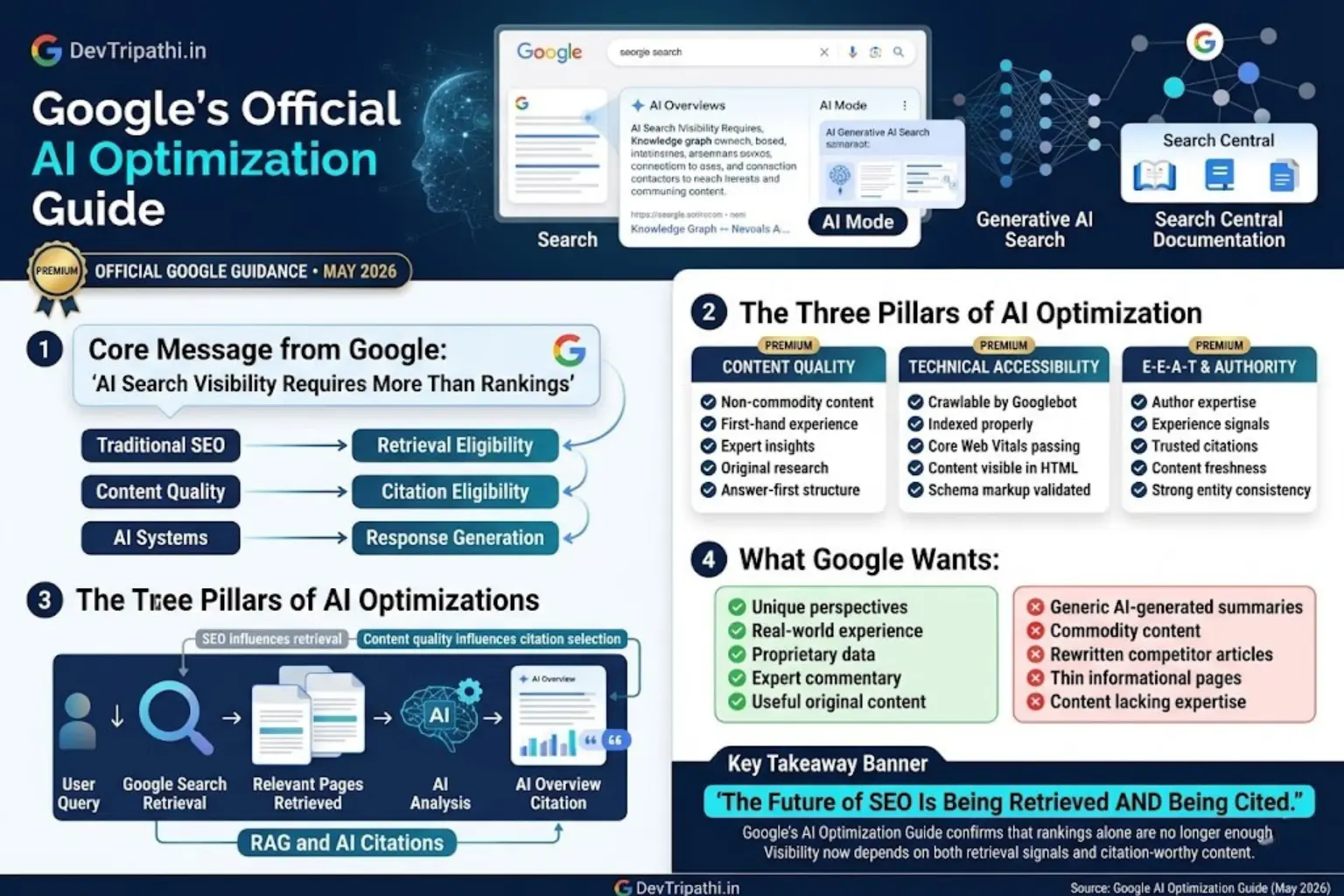
Google has published its first-ever official, dedicated guide for optimizing websites for generative AI features on Google Search. Titled "Optimizing your website for generative AI features on Google Search," it is available at https://developers.google.com/search/docs/fundamentals/ai-optimization-guide and was published on May 19, 2026, the same day as Google I/O 2026.
This is not a product announcement or a feature description. It is a strategic and technical optimization guide written for website owners and SEO professionals. It addresses the most important questions the industry has been asking since AI Overviews launched: what actually matters for AI search performance, how does traditional SEO connect to AI feature visibility, and what specific changes should content teams make to improve citation rates?
This article provides the complete breakdown of every section and recommendation in Google's official guide, with specific implementation steps for each. If you implement everything covered here, your content will meet Google's own stated criteria for performing well in generative AI search features.
For the announcement context and what this guide's publication signals for the SEO industry, see: Google's New AI Optimization Resource: What Search Central's May 2026 Announcement Means for SEO at https://devtripathi.in/blogs/google-search-central-ai-optimization-resource-may-2026/
Section 1: Google's Official Stance - Is SEO Still Relevant for AI Search?
The guide opens by answering the most fundamental question circulating in the SEO industry: does traditional SEO still matter in the age of generative AI search?
Google's answer is unequivocal: "In short, yes! The best practices for SEO continue to be relevant because our generative AI features on Google Search are rooted in our core Search ranking and quality systems."
The guide then explains exactly why through two named mechanisms.
Retrieval-Augmented Generation (RAG)
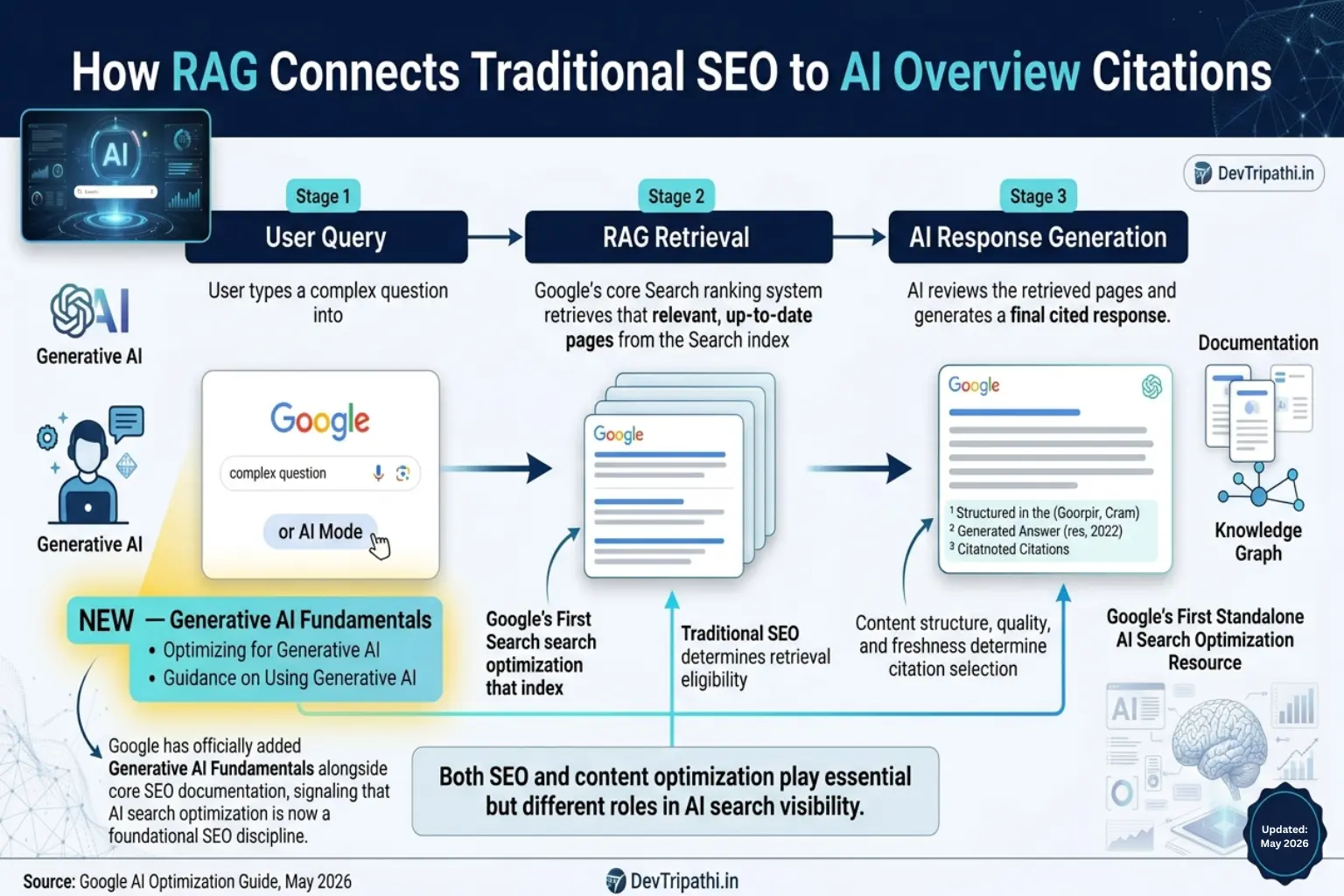
RAG, which Google also calls "grounding," is the technical process by which AI features generate responses. The system works as follows: when a user submits a query, Google's core Search ranking system retrieves relevant, up-to-date web pages from its Search index. The AI then reviews the specific information from those retrieved pages to generate a reliable response, showing prominent, clickable links to the supporting web pages.
The implications of this confirmation are significant:
First, pages must be indexed by Google's core Search system to enter the AI retrieval pool. Technical SEO fundamentals including crawlability, indexability, and canonical management remain prerequisites for AI search visibility.
Second, pages that rank higher in Google's traditional index are retrieved more reliably for AI response generation. Traditional ranking factors (content quality, E-E-A-T, backlink authority, Core Web Vitals) continue to drive AI feature performance through the RAG pipeline.
Third, the specific content and structure of retrieved pages determines whether they are cited in the generated response. Being retrieved is the prerequisite. Being cited is the additional optimization target.
Query Fan-Out
Google officially confirms and names query fan-out for the first time in public documentation. Query fan-out is "a set of concurrent, related queries generated by the model to request more information and fetch additional relevant search results to address the user's query."
Google's specific example: for the query "how to fix a lawn that's full of weeds," fan-out queries might include "best herbicides for lawns," "remove weeds without chemicals," and "how to prevent weeds in lawn."
For content strategy, this means a single piece of content targeting only one keyword phrase will match only one of potentially three to seven fan-out sub-queries generated for a related user query. Content that addresses the full semantic landscape of a topic, covering the primary query and all related sub-queries comprehensively, matches more fan-out sub-queries and therefore has higher citation probability across a broader range of user queries.
Google's official position on AEO and GEO: "AEO stands for 'answer engine optimization' and GEO for 'generative engine optimization'. These are both terms you may see used to describe work specifically focused on improving visibility in AI search experiences. From Google Search's perspective, optimizing for generative AI search is optimizing for the search experience, and thus still SEO."
Implementation Action: Verify all priority pages are indexed in Google Search Console. Maintain traditional SEO fundamentals as the foundation. Build content clusters that address the full semantic scope of target topics, not only the primary keyword, to maximize fan-out query coverage.
Section 2: Creating Valuable, Non-Commodity Content
The second and most detailed section of Google's guide addresses content quality. Google states this clearly: "Creating content that people find unique, compelling, and useful will likely influence your website's presence in generative AI search in the long run more than any of the other suggestions in this guide."
This is not a generic quality platitude. Google defines specifically what non-commodity content looks like.
Unique Point of View
Google instructs: "A first-hand review provides a unique perspective based on personal experience, whereas a summary of existing content simply restates information already available elsewhere. Create the content yourself based on what you know about the topic, and consider what in-depth experience you can bring to your content. Don't just recycle what others on the internet have already said, or could easily be produced by a generative AI model."
This is the clearest articulation Google has published of why AI-generated content without genuine human expertise is at risk in AI search. If content "could easily be produced by a generative AI model," AI systems have no reason to cite it rather than generating the same information themselves. The content that earns AI citations is content the AI cannot produce independently: first-hand experience, proprietary case studies, original research, and genuine expert interpretation.
Non-Commodity Content
Google provides explicit examples of the contrast. The example of commodity content: "7 Tips for First-Time Homebuyers." The example of non-commodity content: "Why We Waived the Inspection and Saved Money: A Look Inside the Sewer Line."
The difference is not length, detail, or technical quality. The difference is originality. The first is advice anyone could give based on widely available knowledge. The second is a specific, documented personal experience with a unique outcome that provides a perspective unavailable anywhere else.
For SEO professionals, this distinction maps directly onto content strategy decisions:
An article titled "10 Best GEO Strategies for 2026" is commodity content. It covers what anyone with access to public research could write.
An article titled "How We Increased a Client's AI Citation Rate from 12% to 67% in 90 Days Using These Three Changes" is non-commodity content. It documents a specific, real outcome with verifiable results.
Section 2: Creating Valuable, Non-Commodity Content
The second and most detailed section of Google's guide addresses content quality. Google states this clearly: "Creating content that people find unique, compelling, and useful will likely influence your website's presence in generative AI search in the long run more than any of the other suggestions in this guide."
This is not a generic quality platitude. Google defines specifically what non-commodity content looks like.
Unique Point of View
Google instructs: "A first-hand review provides a unique perspective based on personal experience, whereas a summary of existing content simply restates information already available elsewhere. Create the content yourself based on what you know about the topic, and consider what in-depth experience you can bring to your content. Don't just recycle what others on the internet have already said, or could easily be produced by a generative AI model."
This is the clearest articulation Google has published of why AI-generated content without genuine human expertise is at risk in AI search. If content "could easily be produced by a generative AI model," AI systems have no reason to cite it rather than generating the same information themselves. The content that earns AI citations is content the AI cannot produce independently: first-hand experience, proprietary case studies, original research, and genuine expert interpretation.
Non-Commodity Content
Google provides explicit examples of the contrast. The example of commodity content: "7 Tips for First-Time Homebuyers." The example of non-commodity content: "Why We Waived the Inspection and Saved Money: A Look Inside the Sewer Line."
The difference is not length, detail, or technical quality. The difference is originality. The first is advice anyone could give based on widely available knowledge. The second is a specific, documented personal experience with a unique outcome that provides a perspective unavailable anywhere else.
For SEO professionals, this distinction maps directly onto content strategy decisions:
An article titled "10 Best GEO Strategies for 2026" is commodity content. It covers what anyone with access to public research could write.
An article titled "How We Increased a Client's AI Citation Rate from 12% to 67% in 90 Days Using These Three Changes" is non-commodity content. It documents a specific, real outcome with verifiable results.
Organization for Readers
Google notes that content should be "organized in a way that helps your readers" with "paragraphs and sections, along with headings that provide structure." This structural guidance connects to AI extraction: well-structured content with clear sections and headings allows AI systems to identify which part of a page answers which sub-query in the fan-out process.
Implementation Actions:
Conduct a content audit across all priority pages. For each page, ask: does this contain information that only we could provide based on our specific experience, data, or expertise? If the answer is no, the page is commodity content and is at risk.
Transform commodity pages by adding: original case study data with specific numbers, first-hand experience sections written from personal professional experience, original research or survey data, or expert quotes from identified professionals with direct expertise in the specific topic.
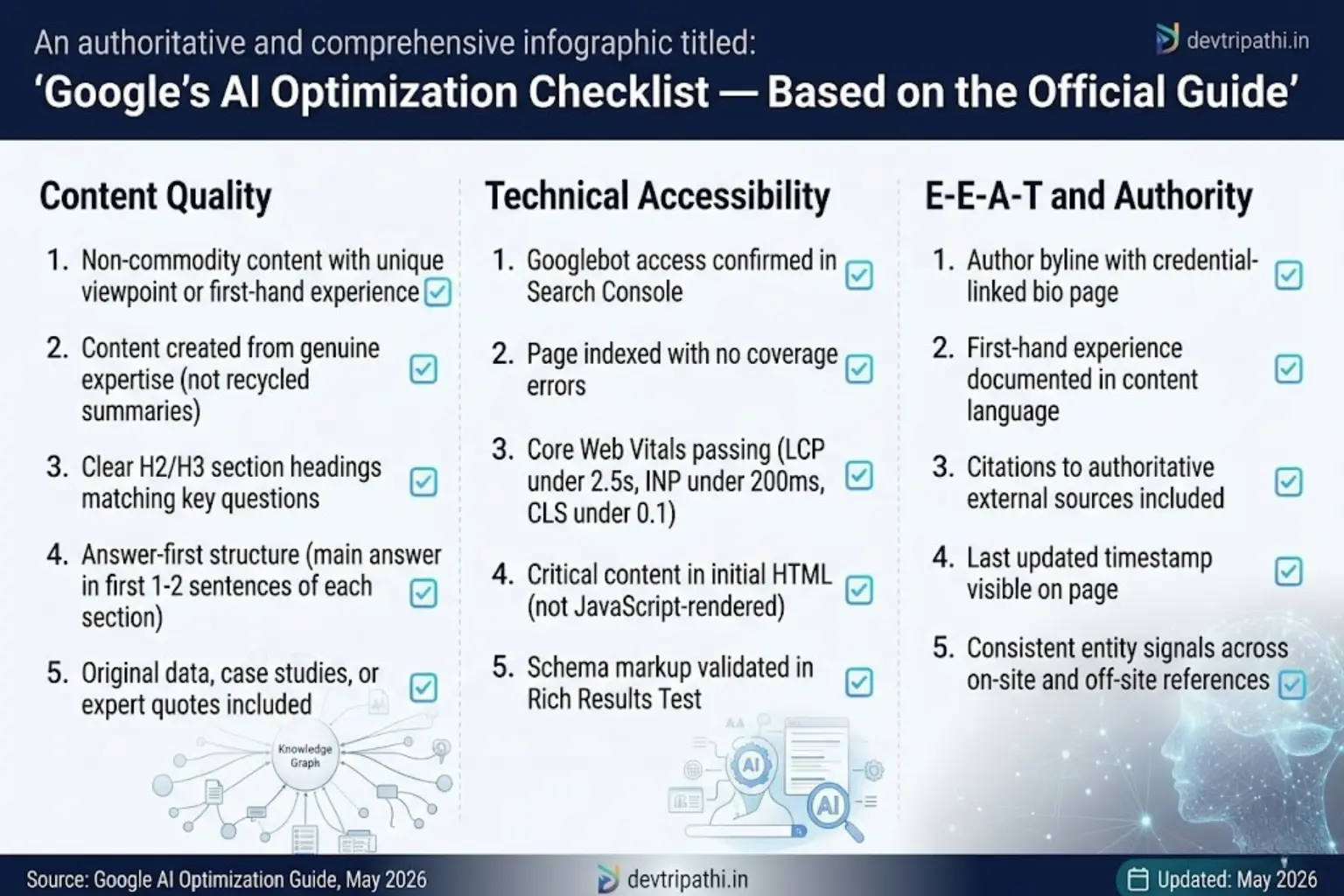
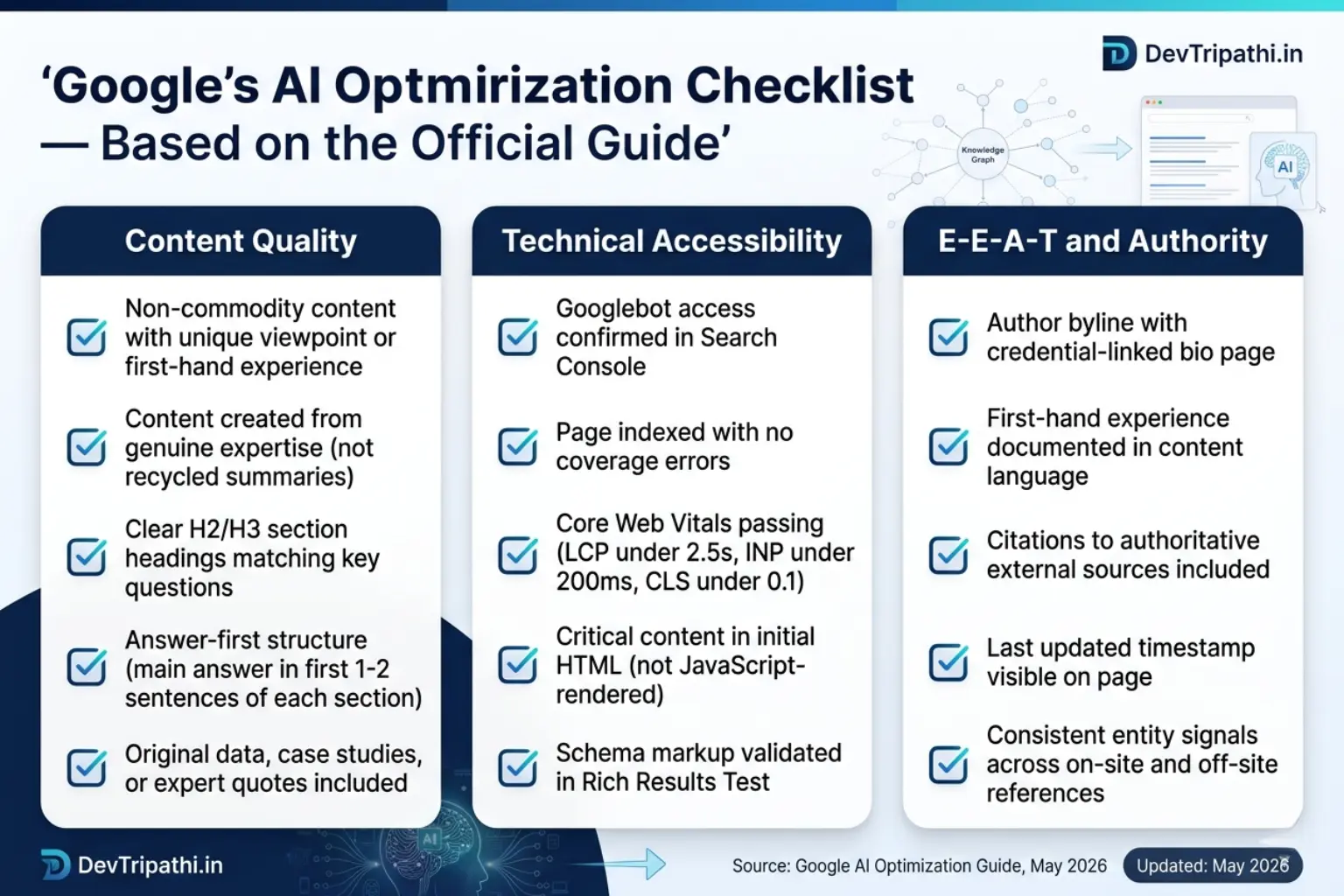
Ensure every page has clear H2 and H3 sections with headings that directly reflect the key questions being answered. Use answer-first structure: the most important answer to each section heading should appear in the first 1 to 2 sentences after that heading.
Section 3: Technical Optimization for AI Search
Google's guide addresses the technical requirements that allow AI systems to access your content within the RAG framework.
The guide notes that AI features "rely on AI techniques to highlight content from our Search index," confirming that the technical requirements for AI search visibility begin with standard crawlability and indexability.
Key technical requirements confirmed in the guide:
Crawlability: Google's AI features use core Search ranking systems for retrieval. This requires Googlebot to be able to crawl your pages without being blocked by robots.txt rules or server errors. Pages that Googlebot cannot access cannot enter the AI retrieval pool.
Indexability: Only pages in Google's Search index are eligible for RAG retrieval. Monitor Google Search Console for coverage issues, indexing errors, and any pages that should be indexed but are not.
Page quality signals: Google's core ranking systems, which determine retrieval eligibility through RAG, evaluate page experience signals including Core Web Vitals. Pages with poor performance scores receive lower retrieval priority.
Content accessibility in initial HTML: AI retrieval systems may not execute JavaScript during content evaluation. Critical content should be rendered in the initial HTML response rather than relying on JavaScript hydration after page load.
Structured data: While not mentioned explicitly in every section, the guide's broader context of helping AI systems "understand content" aligns directly with structured data's function as explicit machine-readable content description.
Implementation Actions: Verify Googlebot access across all priority pages using Google Search Console's Coverage report and URL Inspection tool. Run Core Web Vitals audit and fix any pages failing LCP, INP, or CLS thresholds. Test priority pages with JavaScript disabled to verify critical answer content is available in the initial HTML payload. Validate all structured data using Google's Rich Results Test.
Section 4: E-E-A-T in the Context of Generative AI Search
Google's guide reaffirms E-E-A-T as central to AI search performance with specific emphasis on the first E: Experience.
The guide instructs content creators to bring genuine first-hand experience to their content, contrasting this with generic summaries that could come from anyone. The language is specific: "Consider what in-depth experience you can bring to your content."
For AI search, E-E-A-T signals serve a specific function within the RAG process. When multiple pages have been retrieved for a fan-out query, the AI evaluates which sources are most credible and citable. E-E-A-T signals are the credibility layer that separates citable sources from non-citable retrieved pages.
The four E-E-A-T dimensions in the AI search context:
Experience: First-hand, documented experience embedded in the content itself. Not "here is what the research says" but "here is what I observed when I tested this with clients." The language of experience is specific, detailed, and personal rather than general and passive.
Expertise: Verifiable professional credentials connected to the author, not claimed anonymously. Author bio pages that document relevant qualifications, published work, and professional background that can be cross-referenced with external sources.
Authoritativeness: Recognition by other authoritative sources. Third-party mentions in industry publications, expert interviews, and citations from recognized sources. The guide's reference to evaluating "a variety of sources" for unique viewpoints implies that cross-source recognition is a factor in citation selection.
Trustworthiness: Accurate, cited, non-misleading content. This includes citing sources for specific claims, disclosing the basis of recommendations, and maintaining accuracy over time through regular content updates.
Implementation Actions:
Add an experience-based introduction to every major article: a 2 to 3 sentence opening that documents the specific professional experience the author brings to the topic before any generic content begins.
Ensure all author bylines link to a comprehensive author bio page documenting credentials, years of experience, specific areas of expertise, and links to external publications or profiles that confirm the stated credentials.
Add citations to authoritative external sources for all specific claims and statistics. Each claim should be attributable to a named, verifiable source.
Establish a quarterly review cycle for all high-value content to maintain accuracy and freshness, updating the visible "last updated" timestamp with each substantive revision.
For the complete E-E-A-T implementation framework aligned with AI search requirements, see: Brand Authority SEO: How to Build Brand Authority at Brand Authority SEO Completed Guide
Section 5: Connecting to the Broader AI Search Ecosystem
While Google's official guide focuses specifically on Google's own AI features, the principles it articulates apply across the broader AI search ecosystem. RAG is the standard architecture across ChatGPT, Perplexity, and Google AI systems. Query fan-out is a standard LLM reasoning technique used across platforms. Non-commodity content, E-E-A-T signals, and technical accessibility are universal citation eligibility signals.
The consistency between Google's official guidance and the independent research on GEO and AEO that has been developing since 2023 is itself significant. Princeton University's GEO research (KDD 2024), AirOps research on content freshness and citation rates, and Brandlight's research on citation overlap all align with the principles Google's guide articulates.1
This convergence means the content quality, technical, and authority investments required to perform well in Google AI features are the same investments required to perform well in ChatGPT, Perplexity, and Gemini. A single, consistent optimization strategy addressing these principles benefits visibility across every major AI platform simultaneously.
For the platform-specific strategies that extend Google's principles to other AI systems, see:
AI Citation Optimization Complete Guide
Generative Engine Optimization (GEO) Complete Strategy Guide
AI Visibility Tracking: The Complete Guide
The Complete AI Optimization Implementation Plan Based on Google's Official Guide
Week 1: Content Quality Audit
Identify your top 20 commercially important pages. For each page, complete this five-question audit:
Question 1: Is this commodity or non-commodity content? Could this be written by anyone with access to public information, or does it require specific expertise and experience that only your brand possesses?
Question 2: Is there genuine first-hand experience documented in the content? Can you identify specific sentences that reflect personal, professional, documented experience?
Question 3: Is the content organized with clear H2/H3 sections that directly correspond to the questions being answered? Does each section begin with a direct answer in the first 1 to 2 sentences?
Question 4: Are all specific claims supported by citations to verifiable, authoritative sources? Are those citations linked inline?
Question 5: When was this page last substantively updated? Is a visible "last updated" timestamp present? Pages failing more than two of these five criteria are high-priority improvement targets.
Week 2: Technical Accessibility Audit
Run the following checks across all priority pages:
Google Search Console Coverage report: Are all priority pages indexed with no errors?
robots.txt audit: Are Googlebot and all relevant AI crawlers (GPTBot, PerplexityBot, ClaudeBot, Google-Extended) allowed access?
Core Web Vitals report: Do all priority pages pass LCP (under 2.5s), INP (under 200ms), and CLS (under 0.1) thresholds?
JavaScript rendering check: Load each priority page with JavaScript disabled. Is the primary answer content visible without JavaScript?
Rich Results Test: Does each priority page have valid, error-free structured data?
Weeks 3 to 4: Content Improvement
For each high-priority page identified in the audit:
Transform commodity sections into non-commodity content by adding specific case data, documented personal experience, original research, or unique expert analysis.
Add an experience-based opening paragraph with the author's specific professional context for the topic.
Rewrite H2 and H3 headings as direct questions where they are not already, and add direct 40 to 60 word answer blocks at the start of each section.
Add 2 to 3 citations to authoritative external sources where relevant.
Update the "last updated" timestamp.
Month 2: Authority Building
Build the off-site authority signals that support the on-site content improvements:
Digital PR: Pitch expert commentary on key topics to 3 to 5 industry publications per month.
Author entity consistency: Ensure author credentials are consistently documented across your website, LinkedIn, and any external publication pages.
Review and community presence: Build or maintain presence on review platforms (G2, Trustpilot, Clutch) and community platforms (Reddit, Quora) relevant to your topic area.
Review and community presence: Build or maintain presence on review platforms (G2, Trustpilot, Clutch) and community platforms (Reddit, Quora) relevant to your topic area.
Month 3: Measurement and Iteration
Run AI citation tests across your target queries in Google AI Mode, ChatGPT, Perplexity, and Gemini. Compare before and after citation rates for pages you have improved. Identify which changes produced the strongest citation improvements and replicate those patterns across remaining pages.
For the complete measurement framework, see:
AI Visibility Tracking The Complete Guide
Frequently Asked Questions About Google's AI Optimization Guide
Conclusion
Google's official AI Optimization Guide is the most important SEO document published since Google introduced E-E-A-T guidance into its Quality Rater Guidelines. It is the first time Google has formally documented, in a standalone foundational resource, exactly how website owners should approach optimization for generative AI search features.
The implementation framework it provides is clear: maintain strong traditional SEO as the RAG retrieval foundation, create non-commodity content that provides unique first-hand expertise, organize content clearly for both human readers and AI extraction, maintain technical accessibility for all crawlers, and build strong E-E-A-T signals through verifiable author credentials and cited sources.
These are not hypothetical future requirements. AI Mode has one billion monthly users. Google AI Overviews appear in over 55% of all Google searches. The optimization surface is live, active, and growing at record rates. The guide Google published tells you exactly what the system is designed to reward.
Read the guide at https://developers.google.com/search/docs/fundamentals/ai-optimization-guide. Run the content quality audit against your top 20 pages this week. Begin the transformation from commodity to non-commodity content for your highest-priority pages.
The competitive advantage is real, available, and time-sensitive. The brands that implement this guidance now will compound citation authority while the majority of their competitors are still catching up.
External Resources: Google's Official AI Optimization Guide: https://developers.google.com/search/docs/fundamentals/ai-optimization-guide
Google Search Central — Creating Helpful Content: https://developers.google.com/search/docs/fundamentals/creating-helpful-content
Google Search Essentials: https://developers.google.com/search/docs/essentials
Princeton University GEO Research — KDD 2024: https://arxiv.org/abs/2311.09735
Google Rich Results Test: https://search.google.com/test/rich-results
