
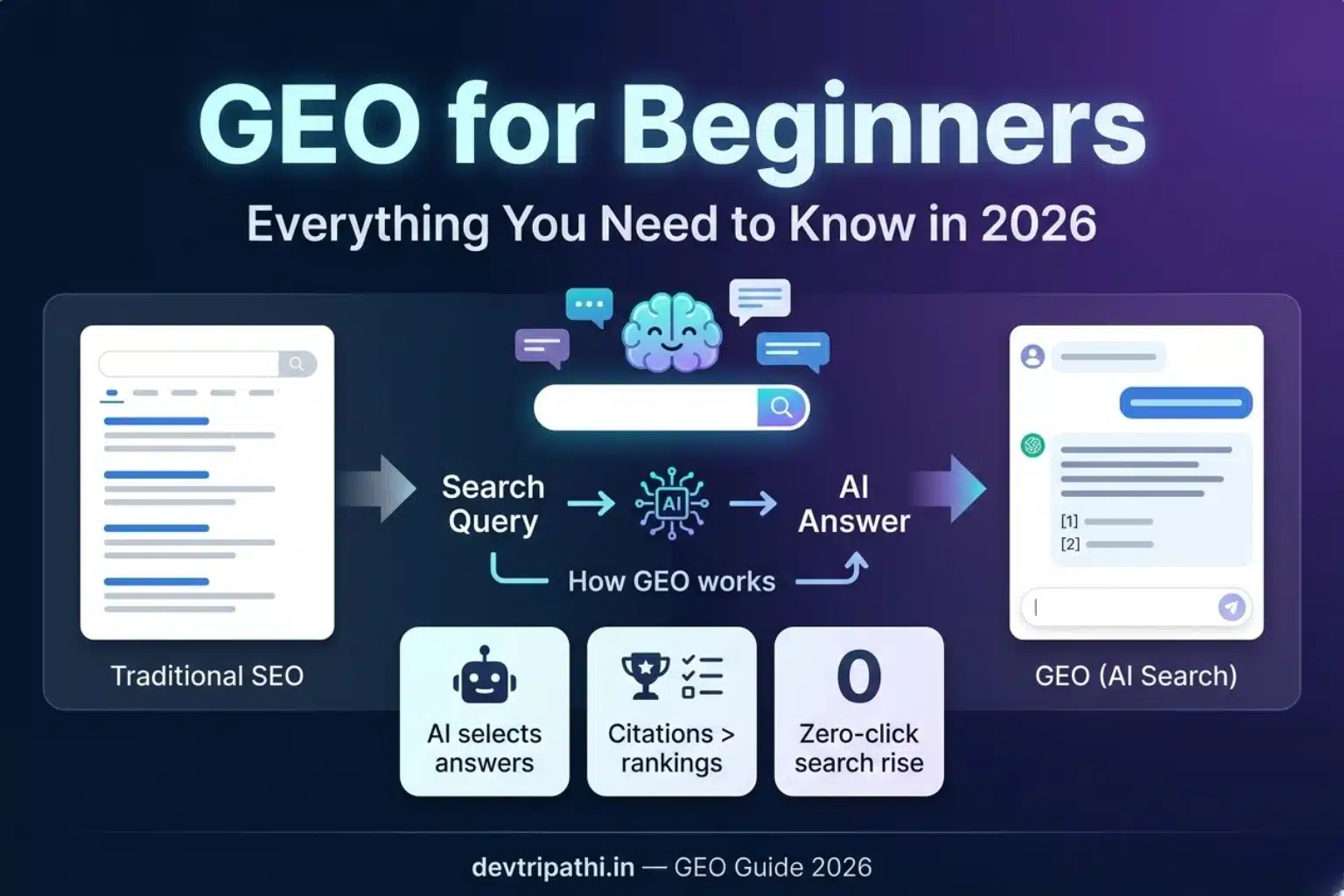
GEO for Absolute Beginners: Everything You Need to Know (2026)
23 March 2026
If You Have Ever Heard ‘You Need GEO’ and Had No Idea What That Means – This Guide Is for You
Let me start with something honest. When GEO first started appearing in marketing conversations, most experienced SEOs quietly googled it before the meeting. It sounds technical. It sounds like something you need a computer science degree to understand.
You do not.
Generative Engine Optimization – GEO – is the practice of making your content visible in AI-generated search answers. When someone asks ChatGPT a question and it gives a detailed answer citing three sources, those three sources are doing GEO well. When someone uses Google and sees an AI summary at the top before the blue links, the brands inside that summary have GEO figured out.
That is it. That is the whole concept. Get your content cited by AI systems when they answer questions in your topic area.
In 2026, this matters because 27% of US consumers are already using AI chatbots instead of traditional search engines (TechRadar). Gartner predicts 25% of all searches will move to AI tools by 2026. AI-referred web sessions grew 527% year-over-year in the first half of 2025 alone. The audience is shifting. GEO is how you follow it.
This guide covers every concept from scratch. No jargon without explanation. No assumed knowledge. By the end, you will have a clear picture of what GEO is, why your blog or business needs it right now, and the exact seven steps to start implementing it today.
✦ Quick Answer – What Is GEO in One Sentence: Generative Engine Optimization (GEO) is the practice of structuring your content so that AI systems like ChatGPT, Perplexity, and Google AI Overviews cite it when answering questions in your topic area. |
1. What Is GEO? The Plain English Explanation
Generative Engine Optimization is the process of adapting your digital content so that AI platforms can understand, extract, and cite it when answering user queries. The easier it is for these platforms to understand what you do and what you know, the easier it is for them to recommend you to users.
Let us use a concrete example to make this real.
Old world (traditional SEO): Someone types ‘best project management tools for freelancers’ into Google. They see 10 blue links. Your blog ranks at #3. They click your link. You get a visit.
New world (GEO): Someone asks ChatGPT ‘what project management software works best for a freelancer who handles 5 clients at once?’ The AI reads multiple sources, synthesizes an answer, and recommends two or three specific tools with explanations – citing the sources it used. If your content is well-structured and authoritative, you are one of those cited sources. The user may or may not click through, but your brand has just received an implicit AI endorsement to a highly qualified potential visitor.
GEO is how you earn that citation. And in 2026, earning those citations is becoming as important for content visibility as ranking on Page 1 was ten years ago.
What Does GEO Stand For – And Other Names You Might See
GEO stands for Generative Engine Optimization. You may also encounter it called AEO (Answer Engine Optimization), LLMO (Large Language Model Optimization), GSO (Generative Search Optimization), or AI SEO. The industry has not settled on a single term yet. All of them describe the same core goal: get your content cited by AI when it answers questions.
→ For a deeper technical understanding, our guide on how generative engine optimization works breaks down the mechanics of RAG, query fan-out, and citation scoring in detail.
2. Why GEO Matters Right Now – The Numbers That Should Concern Every Blogger
If you have been doing SEO for a while and traffic has been dropping without an obvious reason, GEO is likely part of the explanation. Here is what the data shows.
The Shift in How People Search
27% of US Consumers Source: Already use AI chatbots instead of traditional search engines – TechRadar, 2026 |
- AI-referred web sessions grew 527% year-over-year in the first five months of 2025 (Previsible AI Traffic Report, 2025)
- 65% of informational queries are now resolved entirely within AI interfaces without clicking to a website (EEATMinds, 2026)
- Google AI Overviews now appear in 25.11% of all searches – up 57% from Q4 2025 (Conductor, 2026)
- Gartner predicts 25% of all traditional search volume will shift to AI tools by 2026
- AI search adoption grew from 8% to 40% of users in just one year (DOJO AI analysis of McKinsey data)
What This Means for Your Blog Specifically
The people who used to find your blog by clicking a Google link are still out there – but a growing percentage of them are getting their answer from an AI summary instead. They never see your link. They never visit your site. But if your content is what the AI is reading and citing when it builds that summary, your brand still gets exposure – and sometimes a direct click from a highly qualified reader.
AI-referred visitors convert at 4.4 times the rate of traditional organic visitors (Semrush, 2025). They arrive pre-informed, pre-qualified, and closer to a decision. Fewer visits, but dramatically better quality.
The practical implication: losing visibility in AI search is not just a traffic problem. It is a brand authority problem. Brands that are not cited by AI systems are invisible to an increasingly large share of their potential audience.
“GEO is becoming as important in the 2020s as SEO was in the 2000s. It is the next evolution of search marketing. Companies that invest early are positioning themselves to maintain visibility and authority as this new search paradigm scales up.” – Aspectus Group – A Beginner’s Guide to GEO, 2025 |
For the complete picture of where GEO stands in 2026, including platform benchmarks and citation data, see our state of GEO in 2026 analysis.
3. GEO vs SEO vs AEO – What Actually Changed
Let us clear up the terminology first, because these three terms are often used interchangeably – and that creates confusion for beginners.
SEO – Search Engine Optimization
SEO is the practice of optimizing your website and content to rank higher in organic Google results. It focuses on keywords, backlinks, page speed, and technical site health. When someone types a query into Google and sees a list of blue links, the position of each link is determined by SEO. This is still essential in 2026 – Google processes 5 trillion searches annually, and strong SEO is actually a prerequisite for most GEO success.
AEO – Answer Engine Optimization
AEO was originally developed for voice search – optimizing content to appear in featured snippets, People Also Ask boxes, and voice assistant answers. In 2026, AEO is largely absorbed into GEO because most voice queries now route through AI systems using the same generative response mechanisms. Practically speaking, AEO tactics (FAQ sections, structured data, direct answer formatting) are a subset of GEO.
GEO – Generative Engine Optimization
GEO specifically targets AI-powered search platforms – ChatGPT, Perplexity, Google AI Overviews, Gemini, and Microsoft Copilot. These platforms do not return a ranked list of links. They synthesize answers from multiple sources and present a single unified response. GEO ensures your content is structured, authoritative, and trustworthy enough to be one of the sources used in that synthesis.
✪ The Simple Mental Model – SEO, AEO, and GEO as Layers: Start with SEO – it is your foundation. If you do not rank well in traditional search, AI platforms are less likely to find you either. Add AEO – structure your content to answer specific questions clearly. Extend with GEO – build authority beyond your own site, earn third-party validation, create citation-worthy content. (DOJO AI, 2026) |
→ For the complete breakdown, our GEO vs SEO comparison guide covers every difference with real 2026 data and a practical strategy for doing both simultaneously.
4. How Does GEO Work? The Simple Version
You do not need to understand machine learning to implement GEO. But a basic picture of what happens when someone asks an AI a question will make every tactic in Section 6 make instant sense.
What Happens When Someone Asks ChatGPT a Question
Step 1 – The AI breaks the question apart. When someone asks a complex question, the AI does not search for the full phrase. It breaks it into three to five smaller sub-queries and searches for each separately. This is called query fan-out. If someone asks ‘what is the best email marketing tool for a small blog?’, the AI might search ‘best email marketing tools 2026′, ’email marketing for bloggers’, and ‘affordable email marketing small business’ as three separate searches.
Step 2 – The AI retrieves content from the web. Using a process called Retrieval-Augmented Generation (RAG), the AI actively searches the web, pulls relevant passages from multiple pages, and feeds those passages to the language model as context for its answer. It does not read your full article – it pulls individual paragraphs or sections that directly answer the sub-query.
Step 3 – The AI scores and compares sources. This is the GEO moment. The AI evaluates each retrieved piece of content for authority, recency, factual density, and structural clarity. It compares your content against every other source it retrieved – simultaneously. The sources that score highest become citations.
Step 4 – The AI synthesizes its answer and cites sources. The top-scoring content is used to build the final answer. Sources are cited as inline links or reference numbers depending on the platform.
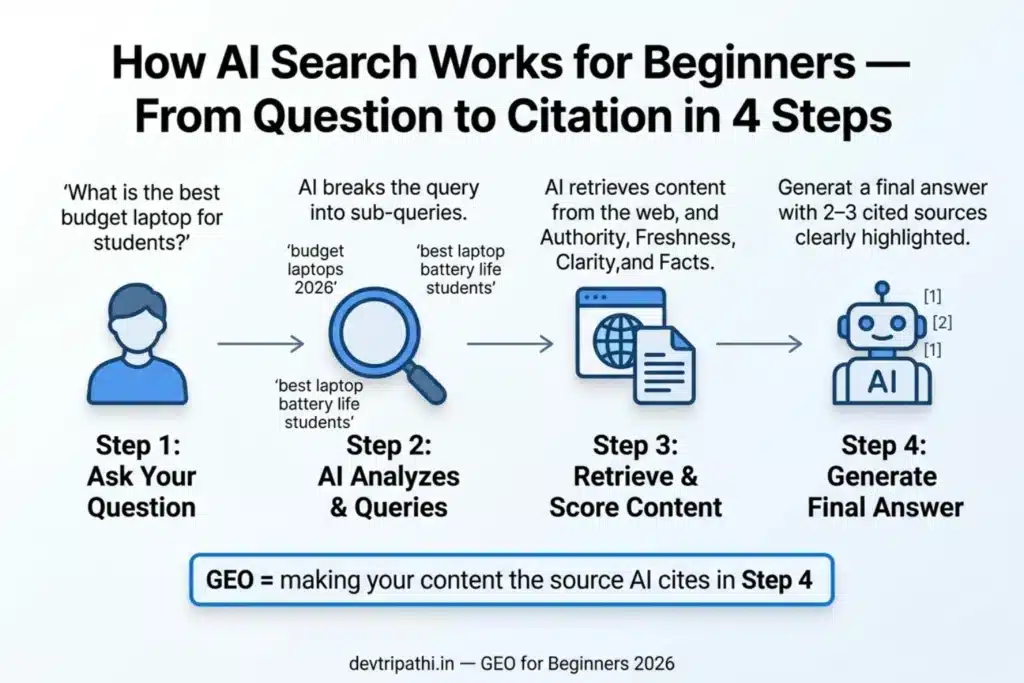
Your entire GEO job as a blogger or content creator is to make your content score highest in Step 3. Every tactic in this guide directly targets one of the four scoring signals: authority, recency, factual density, and structural clarity.
5. The Three Layers of GEO Every Beginner Must Understand
GEO is not a single tactic. It operates across three distinct layers, and as a beginner, understanding which layer you are working on at any moment makes implementation far less overwhelming.
Layer 1: Content Structure – Making Your Content Extractable
This is the layer most beginners can address immediately, with no technical skills required. It is about how you write and format your content so that AI systems can pull clean, useful passages from it.
AI systems do not read your article like a human does. They break it into chunks – typically by paragraph or heading section – and evaluate each chunk independently. A paragraph that only makes sense in context of the previous three paragraphs is useless
to an AI retrieval system. A paragraph that stands alone as a complete answer to a specific question is highly citable.
Content structure tactics: write your introduction as a direct, complete answer to your main topic; format headings as questions (‘How Does GEO Work?’ rather than ‘GEO Overview’); keep paragraphs to 40-70 words each; use tables for comparisons; use numbered lists for step-by-step processes; add comprehensive FAQ sections.
Layer 2: Entity Authority – Making Your Brand Recognizable to AI
AI systems care about who wrote the content, not just what it says. This layer is about building your brand’s recognizability across the internet so that AI systems treat your content as authoritative.
Entity authority comes from: having a named, credentialled author on every piece of content; being mentioned by other websites, publications, and communities (Reddit, Quora, LinkedIn); having a consistent brand presence across the web; and building a content cluster that demonstrates deep expertise on a specific topic. As we covered in our guide on why a structured SEO plan is essential, topical authority compounds over time – the same principle applies even more strongly to GEO entity authority.
Layer 3: Technical Access – Making Sure AI Can Actually Find You
This is the layer that kills GEO strategies before they start – and most beginners do not know it exists. AI platforms use their own web crawlers to read your content before they can cite it. If those crawlers are blocked on your site, your content is completely invisible to AI systems regardless of how well you have optimized it.
▲ Critical Check – Do This Before Any Other GEO Work: Many WordPress sites running Cloudflare block AI crawlers automatically. Cloudflare changed its default configuration in 2024 to block AI bots. Check your robots.txt file and Cloudflare Bot Management settings to ensure GPTBot (ChatGPT), PerplexityBot, Google-Extended, and ClaudeBot are NOT blocked. This is free to check and fix – and it is the single most important GEO step for many beginners. |
→ For technical detail on AI crawlers and what they need, see our complete guide on how GEO works.
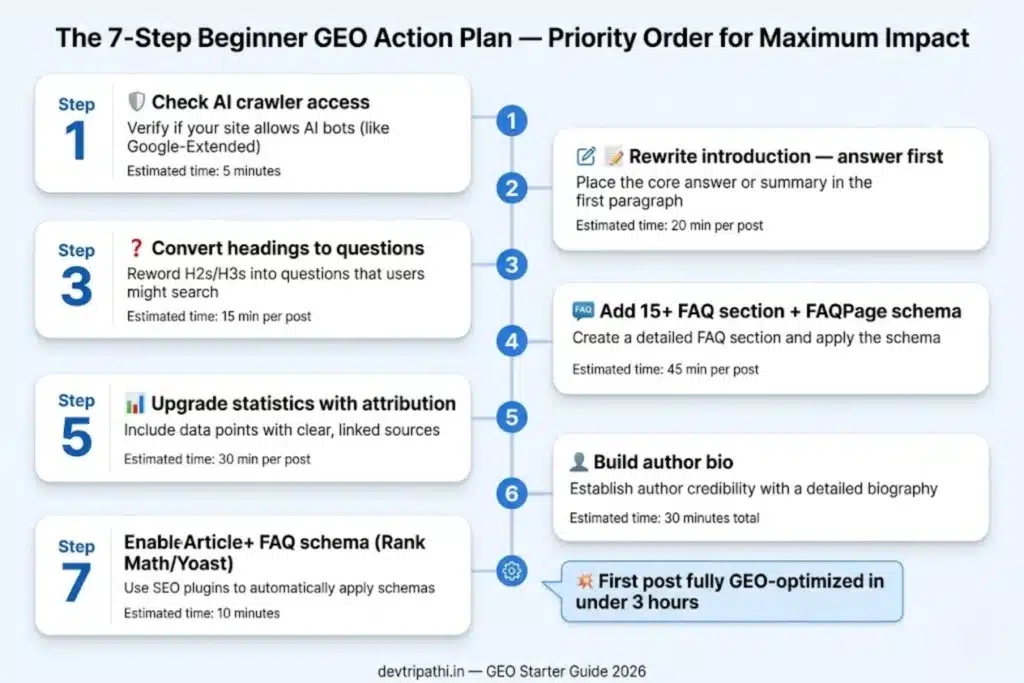
6. The 7-Step Beginner GEO Action Plan
These seven steps are sequenced specifically for beginners – starting with the highest-impact, lowest-effort changes and building toward more comprehensive strategy. You do not need to do all seven at once. Start with Step 1 and work forward.
1
Check That AI Crawlers Can Access Your Site
Go to your robots.txt file (yoursite.com/robots.txt) and check that GPTBot, PerplexityBot, Google-Extended, and ClaudeBot are not disallowed. If you use Cloudflare, check your Bot Management settings. This takes five minutes and unlocks all subsequent GEO work.
2
Rewrite Your Introduction to Answer First
Pick your five most important blog posts. Rewrite the first paragraph of each so it directly and completely answers the main question of that post — in 40-60 words. AI systems extract 44% of their citations from the opening section. This is the single highest-ROI GEO change for existing content.
3
Convert Your Headings to Question Format
Go through your key posts and rewrite generic H2 and H3 headings as questions that mirror what a real user would ask. ‘SEO Overview’ becomes ‘What Is SEO and How Does It Work?’ This directly aligns your content structure with the sub-queries AI systems generate during fan-out.
4
Add a Comprehensive FAQ Section
For each key post, add a FAQ section with at least 15 questions. Get questions from Google’s People Also Ask, Reddit threads, and Quora. Structure each FAQ with an H3 heading for the question and a 2-4 sentence direct answer. Add FAQPage schema markup via Rank Math or Yoast. Pages with FAQ blocks see 44% more AI citations (BrightEdge, 2026).
5
Add Specific Statistics With Source Attribution
Go through your content and upgrade every vague claim to a specific, attributed one. ‘AI search is growing’ becomes ‘27% of US consumers now use AI chatbots instead of traditional search (TechRadar, 2026)’. Specific, attributed claims receive 40% higher AI citation rates than qualitative statements (Wellows, 2025).
6
Build a Detailed Author Bio on Every Post
Add a named author bio to every key post. Include your specific credentials, experience, and a link to your about page. Make sure your LinkedIn profile is complete and consistent with your bio. AI systems weight author authority at 16% of citation decisions (BrightEdge, 2025). Anonymous content is a citation penalty.
7
Add Schema Markup via Rank Math or Yoast
Enable Article schema for every blog post. Add FAQPage schema to all FAQ sections. Both are available through free WordPress SEO plugins with no coding required. Schema markup enables AI engines to extract information with 300% higher accuracy compared to unstructured content (StubGroup, 2026).
7. Common Beginner GEO Mistakes to Avoid
Mistake 1: Optimizing Isolated Pages Instead of Building Topic Coverage
The most common beginner GEO mistake, according to Evertune’s analysis, is optimizing individual pages in isolation rather than building comprehensive topical coverage. AI systems evaluate your overall authority on a subject – not just individual pages. One perfectly optimized article will not generate consistent citations if you lack supporting content that demonstrates expertise across related topics.
Think in terms of topic clusters from day one. Every GEO-priority post needs supporting articles that address the sub-queries it generates. This is why our GEO cluster for devtripathi.in covers 50 interconnected posts rather than five isolated ones.
Mistake 2: Writing Content That Only Makes Sense in Context
AI systems pull individual paragraphs – not full articles. If every paragraph in your post requires the reader to have read the previous three paragraphs to understand it, the AI retrieval system will produce confusing, unusable chunks. Every paragraph must work as a standalone answer.
Mistake 3: Treating GEO as a One-Time Project
GEO requires the same ongoing attention as paid search. With 40-60% of cited sources rotating monthly (Semrush AI Visibility Index), static content loses AI citations within weeks. Build a quarterly content refresh schedule for all GEO-priority pages from the start – adding new statistics, updating examples, and refreshing the ‘Last updated’ timestamp.
Mistake 4: Forgetting to Research Real User Questions
Many beginners invent FAQ questions based on what they think users want to know. The most effective FAQs come from real user research: Google’s People Also Ask, Reddit threads on your topic, Quora questions, and ChatGPT’s own clarifying sub-questions when you ask it your target query. Real questions produce citable answers. Invented questions produce fluff.
Mistake 5: Ignoring the Technical Layer
Beautifully written, perfectly structured content is completely invisible if AI crawlers cannot access your site. Always check your robots.txt and hosting/CDN settings first – before any content optimization work. This is especially important for sites using Cloudflare, which changed its default AI bot settings in 2024.
→ Avoid the full range of optimization errors with our guide on critical SEO mistakes that hurt rankings – many of which also directly damage your GEO performance.
8. Free Tools to Get Started With GEO Today
You do not need a paid GEO platform to start. Here are the most useful free tools for absolute beginners.
For Content Research – Finding Real User Questions
- Google People Also Ask – search your topic keyword and expand all PAA questions; these are your FAQ section fodder
- AnswerThePublic.com – free visual map of all questions around a keyword; shows ‘how’, ‘what’, ‘why’, ‘when’ questions instantly
- Reddit – search your topic and read thread titles and top comments for real user language
- Quora – find the most upvoted questions in your niche – high upvotes = high real-world demand
- ChatGPT/Perplexity – ask your target question and note what clarifying sub-questions the AI asks; those are your fan-out sub-queries
For Technical GEO – Checking AI Crawler Access
- Your robots.txt – yoursite.com/robots.txt – look for Disallow rules blocking GPTBot, PerplexityBot, Google-Extended, ClaudeBot
- Cloudflare Dashboard – navigate to Security > Bots > AI Crawl Metrics to see which AI bots are being blocked
- Google Rich Results Test – validates your schema markup implementation for free
- Google Search Console – completely free, essential for monitoring GEO performance through impression data
For Schema Markup – WordPress Users
- Rank Math (free version) – enables Article schema and FAQ schema with no coding required
- Yoast SEO (free version) – Article schema and basic structured data for all posts
For GEO Monitoring – Manual Methods
- Monthly manual citation audit – search your top 10 target queries in ChatGPT, Perplexity, and Google AI Overviews; note which posts appear as citations
- GA4 AI referral segments – create a custom segment in Google Analytics 4 tracking sessions from chatgpt.com, perplexity.ai, and copilot.microsoft.com
- GSC impression tracking – watch for rising impressions on question-based queries without proportional CTR growth
→ As we covered in our guide on optimizing your content for AI Mode, the free monitoring stack gets you 80% of the data you need to run an effective beginner GEO strategy.
9. How to Measure Your GEO Progress as a Beginner
One of the most confusing things about GEO for beginners is that standard website analytics often do not capture AI citations directly. When ChatGPT cites your article, the user may never click through – your analytics show nothing. Here is how to measure what matters.
The 4-Step Beginner GEO Measurement Process
- Identify your target queries. Write down the 10 questions your audience most commonly asks about your topic area. These are the queries where you want AI systems to cite you.
- Run monthly citation tests. Once a month, type each of your 10 target queries into ChatGPT, Perplexity, and Google AI Overviews. Note whether your content appears as a cited source. Record the results in a simple spreadsheet with the date.
- Track GSC impressions weekly. In Google Search Console, look at your impressions data for question-based queries. Rising impressions without corresponding CTR growth is your most reliable indicator of AI Overview appearances – users are seeing your content in AI summaries without clicking.
- Monitor AI referral traffic in GA4. Create a custom segment in Google Analytics 4 that filters sessions by referral source, including chatgpt.com, perplexity.ai, and copilot.microsoft.com. Even small numbers of AI-referred visitors are worth tracking – they convert at 4.4x the organic average.
What ‘Success’ Looks Like in 90 Days
For a blogger who has never done GEO before, realistic 90-day targets after implementing the 7-step action plan on their top five posts are: one to three manual citation appearances in ChatGPT or Perplexity for target queries; rising impressions in GSC for question-based queries; first AI referral sessions appearing in GA4 data. These are early signals, not transformative numbers. GEO compounds over three to six months of consistent implementation.
✓ The Most Important Beginner Mindset for GEO Measurement: Do not expect overnight results and do not panic if nothing happens in the first two to three weeks. GEO authority builds the same way domain authority builds – gradually, through consistent quality and regular updates. The brands that win at GEO are the ones that treat it as a long-term channel from day one, not a quick fix. |
→ For a complete guide to tracking GEO performance, our in-depth resource on measuring your GEO performance covers every metric, tool, and KPI you need as your strategy matures.
- What Is GEO? Complete 2026 Pillar Guide →
- GEO vs SEO: What’s the Difference and Why You Need Both →
- How Generative Engine Optimization Works: A Deep Dive →
- GEO in 2026: The State of Generative Engine Optimization Right Now →
- Google AI Mode: Transforming Search and SEO Strategies in 2025 →
- Understanding AI Mode Analytics: Measuring GEO Success →
- Optimizing for AI Mode: New SEO Strategies in the Age of Generative Search →
- The Ultimate On-Page SEO Checklist for 2025 →
- Why a Structured SEO Plan Is Essential for Long-Term Success →
- 20 Common SEO Mistakes You Must Avoid →
10. Frequently Asked Questions – GEO for Beginners
What is GEO in simple terms? ▼
GEO (Generative Engine Optimization) is the practice of writing and structuring your content so that AI systems like ChatGPT, Perplexity, and Google AI Overviews cite it when answering questions. In simpler terms: just as SEO helps your content appear in Google's list of links, GEO helps your content appear inside the AI-generated answers that are increasingly replacing those lists.
Do I need technical skills to do GEO? ▼
No - the most impactful GEO changes require zero technical skills. Writing direct answer introductions, using question-format headings, keeping paragraphs concise, and adding FAQ sections are all pure content changes. Schema markup (the main technical element) can be added through free WordPress plugins like Rank Math or Yoast without any coding. The only technical check that matters early on is verifying AI crawlers are not blocked on your site - which takes five minutes to check.
How is GEO different from SEO for beginners? ▼
SEO helps you rank in Google's list of blue links - success is measured by clicks. GEO helps you get cited in AI-generated answers - success is measured by citation frequency. The biggest practical difference for beginners: GEO rewards content that answers questions directly and completely, written in natural conversational language, with specific statistics and clear paragraph structure. These habits also improve SEO performance, so GEO and SEO are complementary, not competing.
Where do I start with GEO if I have a small blog? ▼
Start with your five best-performing existing posts - the ones that already get traffic and have some authority. Apply the 7-step action plan to those posts first: check AI crawler access, rewrite introductions to answer first, convert headings to questions, add 15+ FAQs with schema, add statistics with attribution, strengthen your author bio. Working on existing content with ranking authority produces faster GEO results than publishing new content from scratch.
How long does GEO take to show results? ▼
Expect early signals - first manual citation appearances, rising impressions in Search Console - within four to eight weeks of applying GEO best practices to existing content. Meaningful, consistent AI citation frequency typically develops over three to six months with regular content publishing and quarterly refreshes. This is similar to traditional SEO timelines. GEO is a compounding channel, not a quick fix.
Does GEO work for small or new websites? ▼
Yes - and small niche blogs often have a genuine advantage. AI systems value depth and specificity over domain size. A focused niche blog with genuine expertise, well-structured content, and comprehensive topic coverage can outperform much larger generic sites for specific topic citations. GEO expert DOJO AI notes that GEO actually favors expertise and authority over domain age and backlink quantity - it is one of the few level playing fields in marketing right now.
What is the most important GEO change a beginner can make today? ▼
Add a comprehensive FAQ section to your most important existing post. Aim for 15 questions from real user research (Google People Also Ask, Reddit, Quora). Structure each as an H3 question with a direct 2-4 sentence answer. Add FAQPage schema via Rank Math or Yoast. Pages with structured FAQ blocks see 44% more AI citations (BrightEdge, 2026). This single change, applied to content that already ranks, consistently produces the fastest early GEO results.
What is People Also Ask and how do I use it for GEO? ▼
People Also Ask (PAA) is a Google SERP feature that shows related questions users commonly ask around your target keyword. You access it by searching your keyword in Google and clicking the expansion arrows under the PAA box. These questions are gold for GEO because they represent real user intent in natural language format. Use them directly as H3 headings in your FAQ section, and write direct 2-4 sentence answers for each. PAA questions are pre-validated by Google as genuine user queries - exactly what AI systems are built to answer.
What does 'answer first' mean in GEO? ▼
Answer first - also called BLUF (Bottom Line Up Front) - means writing your introduction so that the direct answer to your main topic appears in the first 40-60 words, before any context, background, or storytelling. AI systems extract 44% of their citations from the opening section of articles. If your answer is buried in paragraph four after three paragraphs of setup, the AI retrieval system will often miss it or extract an incomplete chunk. Front-loading your answer is the highest-ROI single writing change for GEO.
Do I need to optimize for every AI platform? ▼
As a beginner, focus on Google AI Overviews and ChatGPT first - they represent the largest volume and most measurable impact. The core GEO content practices (FAQ sections, answer-first structure, specific statistics, author authority) work across all platforms simultaneously, so you are not building separate strategies. Once you have the basics in place, Perplexity is the next priority - its users are highly research-oriented and convert at impressive rates. Most beginners find that solid fundamentals produce cross-platform citation improvements without platform-specific tweaking.
Can I do GEO if I am not an expert in my topic? ▼
GEO specifically rewards genuine expertise - and penalizes the absence of it. Anonymous content and generic bylines are treated as citation penalties by AI systems. This does not mean you need a PhD, but it does mean you need real knowledge, real experience, or real research to share. The most citable content shows first-hand experience, specific data with attribution, and the kind of specific practical detail that only comes from genuine engagement with a topic. If you are a beginner in your topic, GEO is a good reason to deepen your expertise before publishing.
What is schema markup and do I need it for GEO? ▼
Schema markup is code that gives AI systems and search engines machine-readable information about your content - what type of content it is, who wrote it, what questions it answers. For GEO, the three most important schema types are: Article schema (identifies your post as an article with a named author), FAQPage schema (signals that your FAQ section contains structured question-answer pairs), and Person schema (links your author bio to verifiable external profiles). Schema markup enables AI engines to extract information with 300% higher accuracy versus unstructured content. In WordPress, you add all three through Rank Math or Yoast without coding.
How do I know if AI is already citing my content? ▼
The simplest free method: manually search your target queries in ChatGPT, Perplexity, and Google AI Overviews in an incognito browser window. Note whether your content appears as a cited source. Do this monthly for your top 10 target queries and track results in a spreadsheet. For indirect signals: watch Google Search Console impressions for question-based queries - rising impressions with flat CTR often indicates AI Overview appearances where users see your content but do not click through.
Is GEO just for bloggers and content creators? ▼
No - GEO applies to any business or individual that wants to be cited by AI systems when users ask questions in their category. E-commerce sites, service businesses, B2B companies, and local businesses all benefit from GEO. Blog content is the most cited content type (Conductor, 2026), making blogging the highest-leverage GEO tactic - but GEO principles apply equally to FAQ pages, resource guides, product comparison pages, and any content designed to answer user questions comprehensively.
What is the relationship between GEO and content freshness? ▼
Content freshness is a direct AI citation signal. Pages updated within 60 days are 1.9x more likely to appear in AI answers (BrightEdge, 2026). Perplexity cites pages updated within 30 days at particularly high rates. For beginners, this means building a quarterly refresh habit from the start: update statistics with current-year sources, add new FAQ questions based on recent user queries, and update the visible Last updated timestamp. One-time optimization is not sufficient - GEO requires ongoing content maintenance to sustain citation positions.
Conclusion: GEO Is Simpler Than It Sounds – Start Today
GEO can sound intimidating from the outside. Terms like RAG architecture, query fan-out, and vector embeddings make it feel like advanced computer science. It is not. The core of GEO is deceptively straightforward: write content that directly answers real questions, structure it so AI systems can extract clean passages from it, back your claims with specific data, and make sure AI crawlers can actually read your site.
Every blogger and content creator can do this. It does not require a technical background. It does not require an enterprise budget. The seven steps in this guide can be applied to your top five existing posts this week – and you will likely see your first AI citation signals within 30 to 60 days.
The competitive window for GEO is still wide open in 2026. 47% of brands still have no GEO strategy (Digital Applied, 2026). Most of your direct competitors have not started. The citation authority you build now compounds over months and years – exactly as SEO domain authority compounded for early SEO adopters.
Start with your five best posts. Add the FAQs. Check the crawler access. Rewrite the introductions. The rest will follow.

Devyansh Tripathi
I’m Devyansh Tripathi, an SEO strategist and digital growth expert, helps businesses and individuals rank higher and drive organic traffic. Through DevTripathi., he shares cutting-edge SEO insights, content strategies, and marketing hacks. Passionate about digital success, he’s on a mission to make SEO simple, effective, and result-driven!
Posts
- What Google’s New AI Search Documentation Means for SEO Teams
- Google I/O 2026 Search: AI Agents, Gemini 3.5 and the Unified Box
- Google’s AI Optimization Guide: The Technical and Content Checklist
- July 2026 SEO Update: AI Overviews, llms.txt and Search Console
- Prompt Optimization Beyond Page One: The Position-21 Citation Opportunity
Categories
- AI Citation Optimization
- AI Search Optimization (AISEO)
- AI Visibility Tracking
- Answer Engine Optimization (AEO)
- Brand Authority SEO
- Brand SERP Optimization
- Community Signal SEO
- Conversational Search Optimization
- Generative Engine Optimization (GEO)
- Knowledge Graph Optimization
- Modern SEO Strategies
- Multimodal Search Optimization
- Prompt Optimization
- SEO Trends
- Social Search Optimization
- Topical Authority SEO
- Uncategorized
- Video Search SEO
- Visual Search Optimization
- Voice Engine Optimization (VEO)
- Zero Click Search Optimization
Latest News
Text Widget
Empowering brands with insights, strategies, and stories that drive digital growth.