
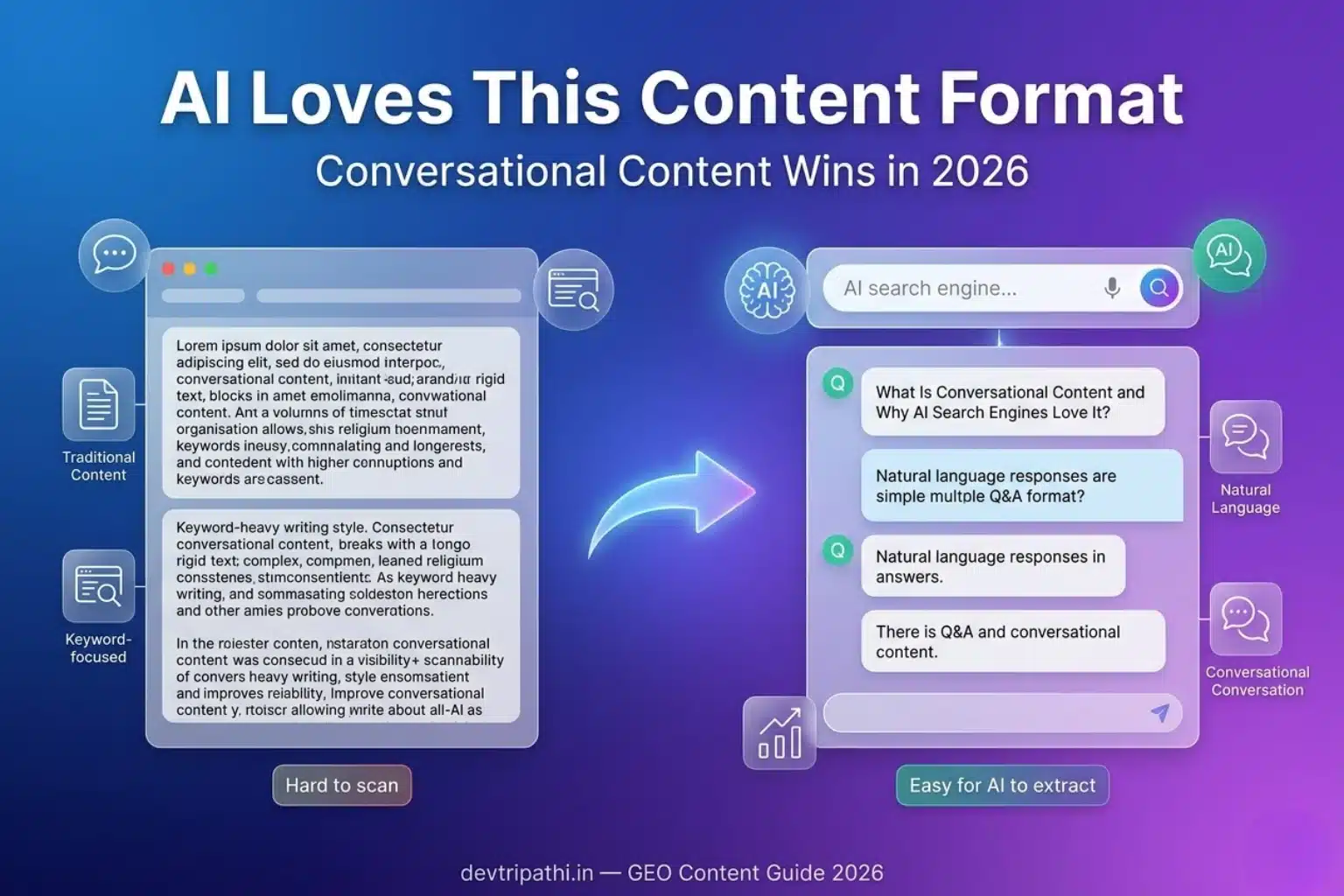
What Is Conversational Content and Why AI Search Engines Love It
26 March 2026
Think about the last time you searched for something online. Did you type “cheap hotels Paris” – or did you ask “What are the best affordable hotels in Paris near the Eiffel Tower?” If it was the second, you used conversational search. So did roughly 40% of everyone else online this month.
Here is what most bloggers still have not figured out: AI search engines – Google AI Overviews, Perplexity, ChatGPT Search, Gemini – are not old-school keyword crawlers. They are large language models trained on billions of words of human conversation. And they have a very clear preference: content that sounds like a knowledgeable person actually talking to another person.
That preference is what conversational content SEO is about. In this beginner guide you will learn exactly what conversational content is, why AI systems reward it, and the practical steps to start writing it for every post you publish from here on.
Quick Answer (TL;DR)
Conversational content is writing that mirrors how people naturally speak and ask questions – using plain language, a direct second-person voice, question-based headings, and immediate answers instead of slow build-up.
AI search engines prefer it because they are trained on human speech patterns. Content that mirrors those patterns is far easier to parse, extract, and cite than dense, formal prose.
Adopting a conversational writing style is one of the highest-impact, zero-cost changes you can make to your GEO (Generative Engine Optimization) performance – starting today.
What Is Conversational Content? (The Plain-English Definition)
Conversational content is writing that uses the same language, rhythm, and structure you would use if a knowledgeable friend were answering your question over coffee. It is not casual to the point of being sloppy. It is not dumbed-down expertise. It is a deliberate style built around three core principles:
- Natural language – short sentences, active voice, no unnecessary jargon
- Second-person address – talking directly to “you” instead of writing about abstract “users” or “one”
- Question-led structure – headings phrased as the actual questions your reader is asking
Here is the clearest way to see the difference between the two approaches:
Element | Traditional SEO Writing | Conversational Content |
|---|---|---|
Heading style | “Digital Marketing Overview” | “What does digital marketing actually involve?” |
Opening line | “In this comprehensive guide we explore…” | “You’ve probably looked up your competitor’s rankings. Here’s what that data really tells you.” |
Keyword use | Exact-match phrase repeated 6–8 times | Natural synonyms and semantically related phrases |
Sentence length | Long, multi-clause constructions | Short. One idea per sentence. |
Voice and person | Formal, third person or passive | Direct, second person (you/your) |
Where the answer lands | Paragraph 3, after extensive preamble | First sentence after the heading |
Who benefits | Search engine crawlers (circa 2012) | Humans and AI models equally |
Why AI Search Engines Have a Built-In Preference for Conversational Content
This preference is not arbitrary and it is not a design choice made in a product meeting. It is a direct consequence of how large language models are trained.
Models like Google Gemini, OpenAI’s GPT-4o, and the engines powering Perplexity are trained on enormous corpora of human-generated text: books, Wikipedia, Reddit threads, support forums, news articles, Q&A sites, and conversational exchanges. The model’s internal understanding of language is fundamentally calibrated to natural human speech patterns.
When your blog content mirrors those patterns – question heading, direct answer, plain explanation – the AI can:
- Identify the core answer in a passage without ambiguity
- Extract a clean, self-contained response to a specific user query
- Understand the semantic relationship between your question heading and the answer below it
- Trust the content as reflecting genuine human expertise, not keyword manipulation
Content that is dense, jargon-heavy, and written in passive-voice constructions forces the model to do more interpretive work – and it will often skip your page in favour of a cleaner source. As White Bunnie’s research on AI-friendly content structure put it: “Write for your reader, not a robot. Use plain language. Put the main answer first.” That used to be good UX advice. In 2026 it is your primary GEO strategy.
The Data: How Conversational Search Is Reshaping the Entire SEO Landscape
The scale of the shift driving this change is not subtle. Here are the numbers from the major SEO research platforms:
~80%
of voice search queries are phrased in natural conversational language
MonsterInsights / Synup Voice Search Studies, 2025
29 words
– average length of a voice search query, vs. 3–4 words for a typed keyword search
DemandSage Voice Search Statistics, 2025
40%
of all online searches now happen through voice interfaces
Building Brands Marketing study, 2025
44%
increase in AI search citations for sites implementing structured FAQ blocks
BrightEdge Research, 2025
2.8×
more likely to earn AI citations — pages with well-organised, question-based headings
AirOps AI Citation Analysis, 2025
+35% organic / +91% paid clicks
for pages cited inside AI Overviews vs. competitors not cited on the same SERP
Seer Interactive / Dataslayer, 2025
The message across all these data points is consistent: search has shifted from keyword matching to conversational reasoning. As Clearscope described it in their 2026 SEO Playbook, we are in the era of “conversational discoverability” – where visibility depends on whether AI systems can understand, trust, and cite your expertise in a direct response to a user’s question.
For a detailed breakdown of what this means for your traffic numbers specifically, our guide to [→ what is an AI Overview and how it affects your blog traffic] covers the CTR and click data in full.
The 8 Defining Characteristics of Conversational Content
Conversational content is not a vague style – it has specific, identifiable characteristics. Here are the eight that matter most for both human readability and AI citation performance.
1. Headings Phrased as Real Questions
The single highest-impact structural change you can make. Rename your H2 and H3 headings from topic labels into genuine questions. “Email Marketing Tips” becomes “How do I write email subject lines that actually get opened?” The second version exactly matches how a real person searches. Ahrefs’ analysis of AI Overview triggers found that 35% of all AI Overview queries are questions starting with who, what, why, when, or how. Your headings should be full of them.
2. The Direct Answer First
Place your answer in the very first sentence after each heading. Do not build context for three paragraphs first. Just answer. This creates what SEO researchers call an “answer island” – a self-contained passage AI can extract cleanly without needing surrounding context. It also directly serves users who skim.
3. Short Paragraphs – 2 to 4 Sentences Maximum
Long paragraph blocks are a signal to both human readers and AI systems that content may be hard to extract quickly. Keep each paragraph to one focused idea. 2–4 sentences. Start a new paragraph. Short blocks are scannable – and AI citation models are essentially the world’s fastest scanners.
4. Active Voice Throughout
Passive voice creates distance and obscures meaning. “Google reads your content” is conversational and clear. “Your content is read by Google” is formal and harder to parse. Active voice tells both your reader and the AI exactly what is happening and who is doing it. It also naturally produces shorter sentences.
5. Second-Person Address (‘You’ and ‘Your’)
Write directly to your reader. Not “bloggers should consider” but “you should consider.” This single shift transforms the tone from lecture to conversation. AI systems are increasingly able to detect and reward content that reads as genuine helpful communication directed at a specific person, rather than SEO-optimised copy written for no one in particular.
6. Plain Language With Terms Defined Immediately
Use simple words by default. When you must use a technical term, define it in the same sentence. “Schema markup (code you add to your page that tells Google what type of content it is)” is more conversational and more AI-friendly than assuming the reader knows. Undefined jargon creates friction for humans and models alike.
7. Natural Language Connectors and Contractions
Use contractions: you’re, it’s, don’t, here’s. Start sentences with And, But, or So when it feels natural. Ask rhetorical questions. These are the connective tissue of spoken language and they make your writing feel like a genuine exchange rather than a corporate white paper.
8. A Well-Built FAQ Section With Schema Markup
A FAQ section is the purest expression of conversational content principles – and one of the most powerful GEO tools available. BrightEdge data confirmed a 44% increase in AI citations for sites implementing structured FAQ blocks. Phrase every question exactly as a real person would speak it. Answer each in 2–4 sentences. Implement FAQPage schema markup to formally signal the Q&A structure to AI systems. Full details in our guide to [→ how to write FAQ sections that get featured in AI Overviews].
How Conversational Content and User Intent Work Together
You cannot write great conversational content without understanding user intent – and the two practices are almost inseparable. When someone searches “How do I start a podcast with no equipment?”, the full sentence tells you everything: they are a beginner, they want practical steps, and budget is a real constraint. That is intent embedded in conversational language.
As we covered in our cluster post on [→ user intent vs keywords and why GEO changed the SEO game forever], understanding why someone is asking is more powerful than identifying which keywords they used. Conversational writing forces you to think in terms of intent naturally – because you are writing for a specific person with a specific question, not for a keyword density target.
One Click Marketing’s 2025 search predictions captured this well: “Search engines will rank content that sounds like the user’s actual query and not over-engineered marketing phrases.” That is the complete case for conversational content in a single sentence.
How to Write Conversationally: A 6-Step Process for Bloggers
Here is the practical process. Apply these six steps to every new post you write – and to every older post you update.
Step 1: Start With Real Questions, Not a Topic
Before you write a word, generate 8–12 genuine questions your reader has about this topic. Use Google’s People Also Ask box, AlsoAsked.com, Reddit threads in your niche, AnswerThePublic, and your own reader emails or comments. Write them down. These questions become your H2 and H3 headings. The last 5–7 also become your FAQ section.
Step 2: Rewrite Every Heading as a Full Question
Go through your outline and convert every heading to a complete sentence in question form. Not “Benefits” but “What are the actual benefits of conversational writing for AI search?” This single habit will improve both your AI citation rate and your human engagement – and it takes less than five minutes per post.
Step 3: Answer Each Heading in 50–75 Words First
Write a direct, self-contained answer to each question in 50–75 words – immediately below the heading. Then expand with evidence, examples, and context below that. This structure serves both skim-readers (who get the headline + first sentence) and AI models (which extract the densest, most informative passage).
Step 4: Read Every Paragraph Out Loud
This is the simplest quality check for conversational writing. If you pause, restart, or have to mentally untangle a clause, rewrite the sentence. If it sounds like something you would genuinely say to a colleague, it is conversational. If it sounds like you are reading a legal brief, it is not. Every sentence should flow the way you would actually speak.
Step 5: Audit for Passive Voice and Undefined Jargon
Do a dedicated pass looking for: (a) passive-voice constructions to flip to active voice, (b) technical terms appearing without plain-language definitions, and (c) sentences over 25 words that could be split. Each fix is small. Cumulatively, these changes transform the readability and AI-parsability of your content significantly.
Step 6: Close With a Conversational FAQ Section
Add 5–7 questions at the end of every post, phrased exactly how a real person would speak or type them. Answer each in 60–100 words. Add FAQPage schema markup via a plugin like Rank Math or manually in JSON-LD. This section alone – properly structured – can deliver a measurable improvement in AI citation rates within 30–60 days of publishing.
Three Misconceptions About Conversational Content (Cleared Up)
Before we get to the checklist, let’s address the three most common things people get wrong about this writing style.
Misconception 1: Conversational Means Unprofessional
Writing conversationally is harder than writing formally – not easier. It requires genuine understanding of your subject, because you have to be able to explain it simply. A surgeon who can explain a procedure clearly to a patient demonstrates more mastery than one who hides behind medical Latin. The same applies to every niche. Your expertise gets more visible when it is stripped of unnecessary formality, not less.
Misconception 2: Conversational Writing = AI-Generated Content
AI writing tools consistently produce the opposite of conversational content – defaulting to hedge-heavy, passive-voice, jargon-dense prose. Phrases like “In today’s rapidly evolving digital landscape” or “It is imperative to leverage synergistic methodologies” are hallmarks of unedited AI output. Real conversational content has a specific human voice, original examples, and a genuine point of view – qualities only you can supply.
Misconception 3: It Only Works for Beginner Audiences
Conversational writing has its biggest impact in technical niches – precisely because the competition there sets such a low bar. A clear, plain-language explanation of a complex SaaS architecture or a technical medical concept immediately stands out against walls of impenetrable jargon. B2B companies using voice-optimised conversational content have reported up to a 21% conversion boost.
Before and After: Seeing the Transformation in Real Examples
The fastest way to internalise these principles is to see the difference directly. Here are three rewrites across different content contexts.
Example 1: The Section Introduction
✗ Before — Traditional SEO Writing
Content marketing has emerged as one of the most significant disciplines in contemporary digital marketing practice. Organisations that implement strategic content marketing initiatives are well-positioned to derive substantial benefits in terms of organic search visibility, brand awareness, and long-term customer acquisition cost reduction.
✓ After — Conversational Content
Content marketing is one of the few strategies where effort compounds over time. A post you publish today can bring in qualified traffic for years. And unlike paid advertising, it does not stop working the moment you stop paying for it.
Example 2: The FAQ Entry
✗ Before
Q: Schema markup overview.
A: Schema markup represents a standardised form of structured data vocabulary that enables webmasters to provide search engines with additional contextual information regarding page content through JSON-LD or Microdata formats.
✓ After
Q: What is schema markup and do I actually need it for my blog?
A: Schema markup is a small piece of code you add to your page that tells Google (and AI systems) exactly what type of content you have — a FAQ, a recipe, an article. Without it, Google guesses. With it, you improve your chances of appearing in rich results and AI Overviews. Yes, you need it.
Example 3: The Technical Explanation
✗ Before
E-E-A-T is Google’s quality framework encompassing Experience, Expertise, Authoritativeness, and Trustworthiness. Content demonstrating these attributes is more likely to be favoured by Google’s quality assessment processes and algorithmic quality signals.
✓ After
E-E-A-T is Google’s shorthand for the question it asks about every piece of content: does this person actually know what they’re talking about, and can I trust them? It stands for Experience, Expertise, Authoritativeness, and Trustworthiness. You improve it by writing from real experience, citing credible primary sources, and making your credentials visible on the page.
Conversational Content as Part of Your Full GEO Strategy
Conversational content does not exist in isolation – it is the writing layer of a broader strategy called Generative Engine Optimization (GEO). Our full introduction to what is GEO (Generative Engine Optimization) covers the complete framework. Here is how conversational writing fits within it:
GEO Layer | Role in Getting AI Citations |
|---|---|
Conversational content (this guide) | Makes your writing parseable and extractable by AI models |
Schema markup | Formally signals content type and structure to AI systems |
Topical authority / content clusters | Shows AI systems your site is a trustworthy expert source |
E-E-A-T signals | Validates the human expertise behind the content |
Content freshness | Keeps your content within the AI citation window |
Conversational writing is the right starting point because it affects every piece of content you produce, requires no tools or budget, and advances both traditional SEO and GEO simultaneously. Once you have this foundation, you can layer in schema markup for GEO and build your → content clusters for topical authority.
For the broader question of how GEO and traditional SEO relate – and why both still matter in 2026 – see our comparison guide: → GEO vs SEO: what’s the difference and why both matter in 2026.
Conversational Content Checklist: 14 Things to Check Before You Hit Publish
Run every post through this list before publishing. It takes under five minutes and directly improves both human readability and AI citation probability.
Conversational Content Pre-Publish Checklist | |
|---|---|
☐ | Every H2 and H3 heading is phrased as a full, natural question |
☐ | A direct 50–75 word answer appears in the first sentence(s) below each heading |
☐ | All paragraphs are 2–4 sentences maximum |
☐ | Active voice used throughout – passive constructions identified and rewritten |
☐ | “You” / “your” used consistently to address the reader directly |
☐ | Every technical term defined in the same sentence it first appears |
☐ | No sentence longer than 25 words without a clear reason |
☐ | Full post reads naturally when spoken aloud without pausing to untangle sentences |
☐ | FAQ section with 5–7 real questions added at the end of the post |
☐ | FAQ questions phrased exactly as a real person would speak or type them |
☐ | FAQPage schema markup implemented on the page (via Rank Math or manually) |
☐ | Introduction reaches the main point within the first 2 sentences |
☐ | Internal links to related cluster posts using descriptive natural anchor text |
☐ | No filler phrases like “In today’s digital landscape” or “leverage synergistic” |
Frequently Asked Questions About Conversational Content SEO
What is conversational content in SEO? ▼
Conversational content is writing that mirrors how people naturally speak and ask questions – using plain language, question-based headings, direct answers at the start of each section, active voice, and a second-person address. In SEO terms it matters because AI search engines are trained on natural human language, which means they can parse and cite conversational writing far more reliably than formal, keyword-stuffed text.
Why do AI search engines prefer conversational writing? ▼
Large language models like Gemini, GPT-4, and Perplexity’s engine are trained primarily on human conversation and natural writing. When your content mirrors those patterns – question heading, direct answer, plain explanation – the AI can extract a clean, trustworthy response without ambiguity. Formal, jargon-heavy writing forces more interpretive work and is more likely to be passed over in favour of a cleaner source.
How is conversational content different from regular blog writing? ▼
Traditional SEO blog writing was optimised for keyword-matching: exact phrases placed in headings and opening paragraphs. Conversational content is optimised for intent and natural language understanding. The key differences are question headings vs. topic-label headings, direct answers first vs. preamble first, second-person vs. passive voice, and semantic keyword variety vs. exact-match repetition.
Does conversational writing hurt authority in professional or technical niches? ▼
Research suggests the opposite – conversational writing has a larger competitive advantage in technical niches, where most content is jargon-dense. A clear explanation of a complex topic immediately signals genuine mastery. B2B companies using voice-optimised, conversational content have reported up to a 21% conversion improvement. Simplifying your language does not reduce your expertise; it makes your expertise accessible.
How long should a conversational blog post be? ▼
Voice search pages that rank well average 2,312 words (DemandSage). For AI citation purposes, depth matters more than length – a 1,600-word post that comprehensively answers its question will outperform a 3,200-word post that pads with repetition. Write until the question is genuinely answered, then stop. The FAQ section alone can add 300-500 high-value words in a natural, citation-friendly format.
How do I know if my writing is conversational enough? ▼
The fastest test: read it aloud. If you pause, restart, or mentally untangle a sentence, rewrite it. If it sounds like something you would genuinely say to a colleague, it is conversational. Formally, aim for a Flesch Reading Ease score above 60 (approximately Grade 9 reading level). You can check this in Hemingway Editor or in the readability section of tools like Yoast or Rank Math.
Is conversational content the same as Answer Engine Optimization (AEO)? ▼
Conversational content is the writing foundation of AEO (Answer Engine Optimization) – but AEO also includes technical elements like schema markup, page speed, structured data, and topical authority signals. Think of conversational writing as the visible layer of your AEO strategy. For the full technical picture, our guide on how generative engine optimization works for bloggers covers every layer in depth.
Can small blogs compete with large domains by using conversational content? ▼
Yes – and research specifically confirms this. SE Ranking’s analysis found that for smaller domains, content depth and quality have roughly 65% more relative impact on AI citations than they do for large authority domains. A focused, well-written 2,500-word post from a niche specialist can consistently outperform a thin page from a high-authority generalist site. Conversational content is one of the clearest paths for independent bloggers to compete on quality rather than domain authority.
What is the difference between conversational content and casual writing? ▼
Conversational content is not casual or sloppy writing – it is a deliberate, structured style. The goal is to sound like a knowledgeable expert talking directly to a reader, not to write informally. You still back every claim with data, define every technical term, and maintain accuracy. The difference is in tone and structure: short sentences, active voice, and direct answers – not slang or shortcuts.
Do I need to rewrite my entire blog to use conversational content? ▼
No – start with your top five most-visited posts and apply the core changes: rewrite H2 headings as questions, add a direct answer in the first sentence of each section, and add a conversational FAQ at the end. These three changes alone will improve both human readability and AI citation potential without requiring a full rewrite of every post.
How do question-based headings improve AI search rankings? ▼
Question-based headings create a direct structural match between what a user searches and what your page contains. AI systems like Google’s AI Overviews scan for heading-and-answer pairs to extract citation-ready responses. Ahrefs data shows that 35% of all AI Overview triggers start with who, what, why, when, or how – making question headings one of the most direct ways to align your content with how AI reads and cites pages.
What tools can help me write more conversationally? ▼
Hemingway Editor highlights long sentences and passive voice in real time – it is the most direct tool for conversational writing audits. Yoast and Rank Math both include readability scoring inside WordPress. AnswerThePublic and AlsoAsked.com generate real user questions for heading inspiration. For checking your Flesch Reading Ease score, both Hemingway and the Yoast SEO plugin show it automatically as you write.
Does conversational content work for e-commerce product pages? ▼
Yes – and it is especially effective for product description pages and category pages that target informational queries. Rewriting product headings as questions, adding direct benefit statements in the first sentence, and including a short FAQ at the bottom of product pages can significantly improve both organic visibility and conversion rates.
How quickly will I see results after switching to conversational content? ▼
For AI citation improvements, most sites begin seeing changes in Google Search Console impressions within 30 to 60 days of updating key pages. Voice search visibility can shift faster – sometimes within two to three weeks for pages that gain featured snippet placement. Traditional organic ranking changes take longer, typically 60 to 90 days, because they depend on recrawling and reindexing timelines.
Should every paragraph in my blog be written conversationally? ▼
Yes – consistency matters more than individual paragraphs. A blog post that switches between formal academic prose and conversational writing feels jarring to readers and harder for AI to parse consistently. Apply the same rules throughout: short paragraphs, active voice, second-person address, and plain language. The core conversational structure should hold throughout the entire post.
Is conversational content better for mobile users? ▼
Significantly so. Mobile readers skim faster and have less patience for dense paragraph blocks than desktop readers. Short paragraphs, question headings, and direct answers are all optimised for the way mobile users actually scroll and read. Given that over 60% of searches now happen on mobile devices, writing conversationally directly serves your largest audience segment – while also aligning with voice search behaviour on those same devices.
Can I use conversational content for pillar pages and long-form guides? ▼
Absolutely – and long-form content benefits most from a conversational structure because it reduces the risk of reader drop-off. Break every major section with a question heading. Open each section with a 50-75 word direct answer. Use short paragraphs throughout. A 4,000-word pillar page written conversationally is far more readable and citation-friendly than a 4,000-word formal guide.
What is an “answer island” and why does it matter for GEO? ▼
An answer island is a self-contained passage that directly answers a specific question without requiring surrounding context to make sense. It is the structural unit AI systems extract when generating citations. Every section of your blog should contain at least one answer island – typically the first 50-75 words below each heading. When your content is built from answer islands, AI systems can reliably pull clean, accurate citations from your page.
Does writing conversationally affect my bounce rate? ▼
Yes – in a positive direction. Conversational writing reduces cognitive load, which keeps readers on the page longer. Short paragraphs, clear headings, and direct answers all reduce the friction that causes readers to leave. Sites that shift to conversational content typically report improvements in average session duration and pages-per-session alongside their search visibility gains.
How do I find the right questions to use as headings in my blog? ▼
Use four sources in combination: Google’s People Also Ask box, AlsoAsked.com (maps the full question tree around any topic), AnswerThePublic (shows question volume and phrasing patterns), and Reddit threads in your niche. Your own reader emails and blog comments are also a goldmine – real questions from real readers are always the most valuable heading source you have.
Final Thoughts: Write Like You Talk – Rank Like You Mean It
The move toward conversational search is not a passing trend. It is the direct outcome of two permanent changes: voice interfaces becoming mainstream, and large language models becoming the layer between your content and your reader.
The bloggers winning in this environment are not necessarily the ones with the biggest sites or the most backlinks. They are the ones whose content sounds the most like a knowledgeable, trustworthy person giving a genuine answer to a real question.
That skill is learnable. You already know how to speak clearly to another human being. The work is translating that natural voice onto the page – question headings, direct answers, short paragraphs, plain language. It does not require a new tool. It does not require a new keyword strategy. It requires a new writing habit.
Start now: open your most-visited blog post. Look at the first H2 heading. Ask yourself: “Could someone actually type or speak this as a question?” If not, rewrite it. Move to the next heading. Add a direct answer in the first sentence below it. Close the post with a conversational FAQ section.
Do that for your top five posts this week. Track impressions and citation changes in Google Search Console over the next 30 days. The data will confirm what the research already shows: AI search engines love content that sounds human. And so do humans.

Devyansh Tripathi
I’m Devyansh Tripathi, an SEO strategist and digital growth expert, helps businesses and individuals rank higher and drive organic traffic. Through DevTripathi., he shares cutting-edge SEO insights, content strategies, and marketing hacks. Passionate about digital success, he’s on a mission to make SEO simple, effective, and result-driven!
Posts
- What Google’s New AI Search Documentation Means for SEO Teams
- Google I/O 2026 Search: AI Agents, Gemini 3.5 and the Unified Box
- Google’s AI Optimization Guide: The Technical and Content Checklist
- July 2026 SEO Update: AI Overviews, llms.txt and Search Console
- Prompt Optimization Beyond Page One: The Position-21 Citation Opportunity
Categories
- AI Citation Optimization
- AI Search Optimization (AISEO)
- AI Visibility Tracking
- Answer Engine Optimization (AEO)
- Brand Authority SEO
- Brand SERP Optimization
- Community Signal SEO
- Conversational Search Optimization
- Generative Engine Optimization (GEO)
- Knowledge Graph Optimization
- Modern SEO Strategies
- Multimodal Search Optimization
- Prompt Optimization
- SEO Trends
- Social Search Optimization
- Topical Authority SEO
- Uncategorized
- Video Search SEO
- Visual Search Optimization
- Voice Engine Optimization (VEO)
- Zero Click Search Optimization
Latest News
Text Widget
Empowering brands with insights, strategies, and stories that drive digital growth.