
What Is an AI Overview and How Does It Affect Your Blog Traffic?
28 March 2026
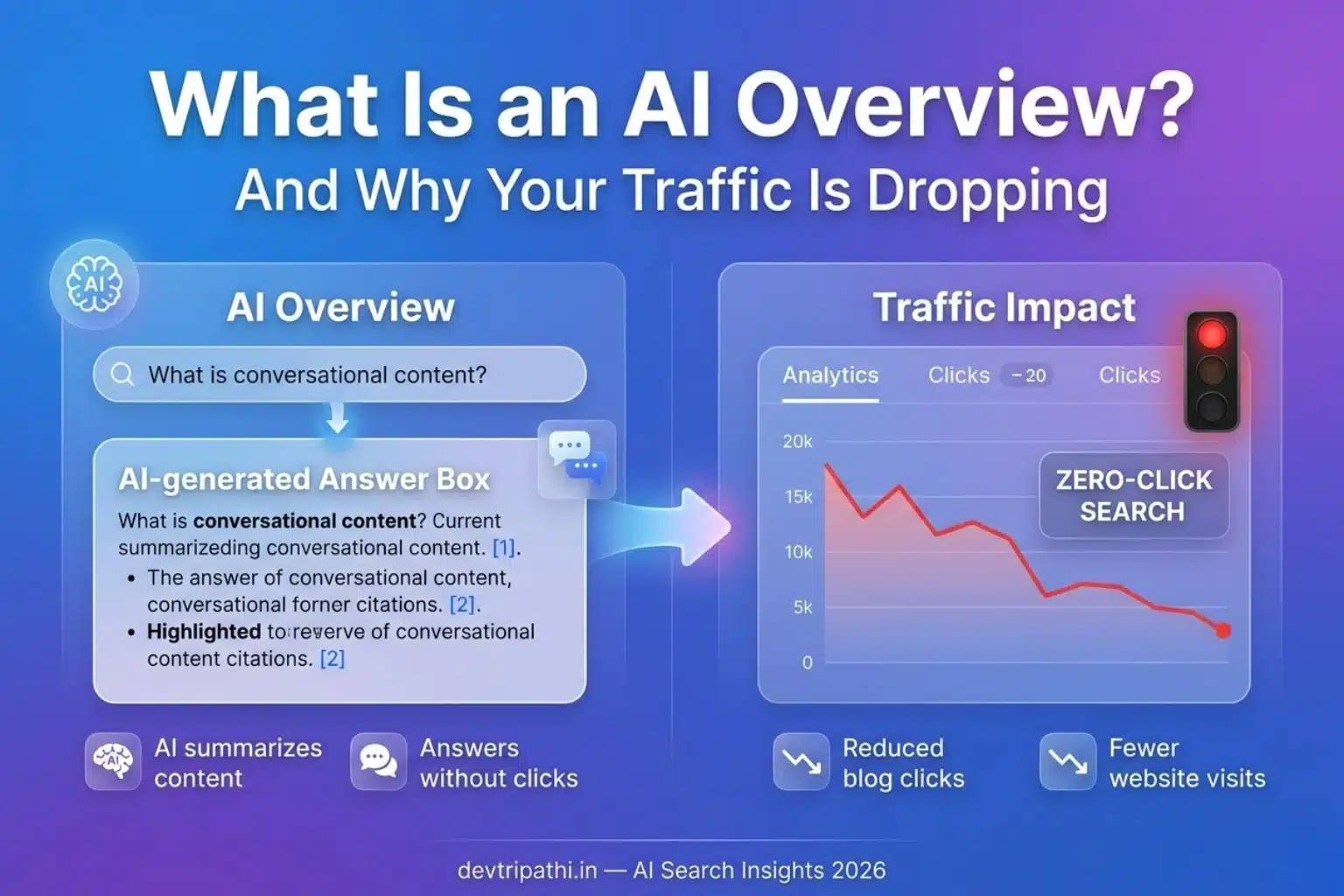
If you have searched Google recently, you have almost certainly seen it – a large AI-generated answer box sitting at the very top of the results page, above all the ranked links, above the ads, above everything.
That box is called an AI Overview. And for bloggers, content creators, and publishers, it is the single most consequential change Google has made to search in the past two decades.
The short answer: an AI Overview is Google’s AI-generated summary that answers a user’s query directly on the search results page – often before they ever see your blog link. And AI Overview SEO is now the discipline you need to understand if you want to stay visible.
This guide explains exactly what AI Overviews are, how they work, what they have done to traffic across every industry, and – most importantly – what you can do to appear inside them rather than be buried beneath them. What GEO means and why it matters for every blogger in 2026?
What Is a Google AI Overview, Exactly?
Google AI Overview – previously known as Search Generative Experience (SGE) when it launched at Google I/O in May 2023 – is an AI-powered feature that generates a synthesised answer at the top of search results pages. It uses Google’s Gemini AI model to read, process, and summarise information from across the web, then presents that summary directly to the user.
In plain language: instead of showing you ten links to click, Google now tries to answer your question itself. It pulls the most relevant passages from across multiple sources, combines them into a readable answer, and presents it with small citation links you can expand.
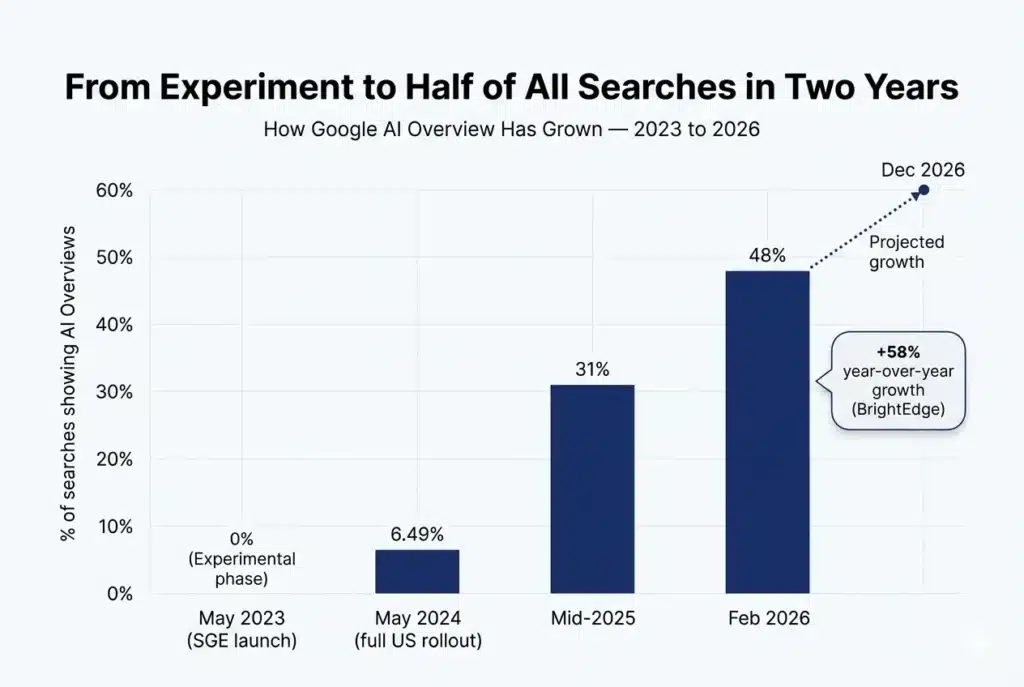
Since its full U.S. rollout in May 2024, AI Overviews have expanded to over 200 countries and 40 languages. By February 2026, they were appearing on approximately 48% of all tracked queries – up from just 6.49% of searches in 2024. That is a 58% year-over-year increase in AI Overview presence, according to BrightEdge’s twelve-month analysis.
How Does an AI Overview Actually Work?
Understanding the mechanics of how AI Overviews are built helps you understand why some content gets cited and other content – even well-ranked content – gets ignored.
When a user submits a query, Google’s system does not simply retrieve a single document. It uses a process of query fan-out, breaking the question into three to five targeted sub-queries and searching for each one separately. This is the first reason why keyword targeting alone is no longer sufficient – the AI is searching for multiple angles of your topic simultaneously.
Next, using Retrieval-Augmented Generation (RAG), the system pulls specific passage chunks from multiple sources – not full articles, but the precise sentences most semantically relevant to each sub-query. It feeds those passages to the Gemini language model, which synthesises them into the final answer you see.
Finally, real-time source scoring compares every retrieved passage against competing sources. As research from The HOTH confirms, the AI is actively evaluating which source explains the concept most clearly, provides better evidence, and carries more authoritative weight. Your content is being scored against every competitor’s content simultaneously – and only the strongest passages make it into the final answer.
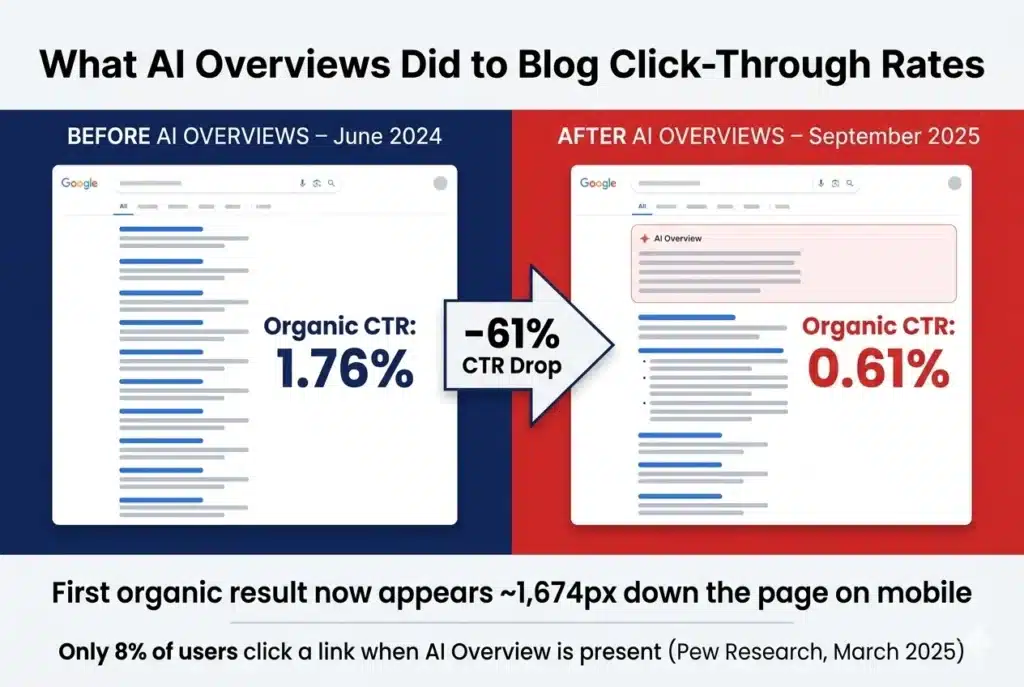
Critically, AI Overviews do not simply mirror Google’s ranked results. Advanced Web Ranking found that AI Overviews average around 169 words when shown and include approximately seven citation links when expanded. The first organic result often appears around 1,674 pixels down the page – well below the visible screen area on most devices. The AI Overview consumes 42% of desktop screen space and 48% on mobile.
| Query Type | AI Overview Trigger Rate | Traffic Risk Level |
|---|---|---|
| Informational (what, how, why) | 88–91% of triggers | Very High |
| B2B Technology queries | 82% of SERPs (up from 36%) | Very High |
| Education queries | 83% of SERPs (up from 18%) | Very High |
| Health / Medical queries | 51.6% of SERPs | High |
| Restaurant / Local queries | 78% of SERPs (up from 10%) | High |
| Commercial / Transactional | 6–8% of triggers | Lower |
| E-Commerce product searches | 4% of SERPs in 2026 | Lower |
What AI Overviews Have Done to Blog Traffic – The Real Numbers
Let us be specific, because the data is stark and every blogger publishing informational content needs to understand it.
The CTR Collapse
Seer Interactive’s September 2025 study – analysing 3,119 informational queries across 42 organisations, tracking 25.1 million organic impressions – found that organic CTR on queries triggering AI Overviews dropped 61%, falling from 1.76% in June 2024 to just 0.61% by September 2025. Paid CTR on the same queries dropped 68%, from 19.7% to 6.34%.
Ahrefs’ December 2025 analysis confirmed: AI Overviews reduce the organic click-through rate for position-one content by 58%. Pew Research’s tracking of 68,879 real searches found that users clicked on a result only 8% of the time when an AI Overview appeared, compared to 15% when no AI summary was shown – a 46.7% relative reduction.
BrightEdge recorded a 30% year-over-year drop in overall clicks across billions of tracked searches. Gartner projects a 25% decline in organic search traffic by end of 2026. Why your blog traffic is dropping in 2026 and how GEO can fix it
Real Publishers, Real Losses
These are not projections. They are documented traffic losses from named organizations.
Publisher / Organization | Traffic Impact |
DMG Media (MailOnline, Metro) | Up to 89% CTR drop on affected queries |
Chegg (learning platform) | 49% decline in non-subscriber traffic, Jan 2024–Jan 2025 |
Business Insider | 55% organic search traffic drop, Apr 2022–Apr 2025 |
Wikipedia | 8% decline in human pageviews in 2025 despite being the most cited domain |
The Planet D (travel blog) | Over 90% traffic collapse following AI Overview expansion |
Average content-focused site | 14% year-over-year traffic decline, H1 2025 (The Digital Bloom) |
The pattern is consistent: informational content built to answer questions is the category most directly replaced by AI Overviews. Educational sites, how-to blogs, definition pages, comparison guides – all are now competing for a fraction of the clicks they previously received.
Who Is Winning in the Age of AI Overviews?
The data is not entirely negative – but the positive outcomes belong almost exclusively to one group: content that gets cited inside the AI Overview itself.
According to Seer Interactive, sites cited within AI Overviews earn 35% more organic clicks and 91% more paid clicks than sites that are not cited. Early adopters of AI visibility optimisation are reporting up to 527% year-over-year growth in AI-driven search traffic. The conversion rate for visitors arriving via AI citations sits at 14.2% – compared to 2.8% from standard organic traffic.
The implication is clear. You do not want to avoid AI Overviews. You want to be inside them.
Research from Ahrefs shows that 76.1% of URLs cited in AI Overviews also rank in the traditional top 10 of Google results. Strong traditional SEO is still the foundation – but it no longer guarantees citation. Only 92.36% of AI Overview citations come from domains already ranking in the top 10. That overlap is high, but the gap matters: pages outside the top 10 now have better chances of AI citations than they ever did for traditional featured snippets, if their content is structured correctly. How traditional SEO and GEO work together in 2026
6 Strategies to Get Your Blog Cited in Google AI Overviews
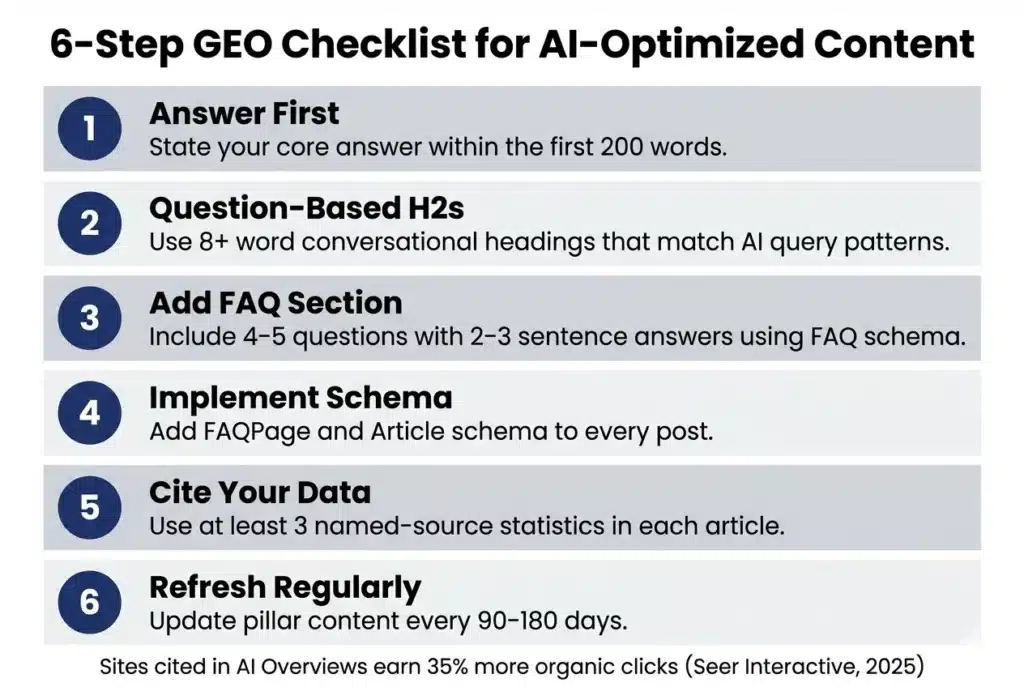
1. Answer the Query Directly in Your First 200 Words
AI Overviews use RAG retrieval to identify the most relevant passage for each sub-query. That process heavily weights the opening content of an article. If your introduction circles the topic for three paragraphs before answering, the AI may pull a competitor’s more direct opening instead. State your core answer within the first 150–200 words. Then expand.
2. Structure Every Article Around Question-Based H2 Headings
BrightEdge data confirms that queries of eight or more words – typically question-style – trigger AI Overviews far more frequently than shorter keyword queries. Headings like ‘What Is Google AI Overview?’ or ‘How Do AI Overviews Affect Blog Traffic?’ match the conversational pattern of queries that trigger AI responses. Review and rewrite your H2 headings accordingly.
3. Add a 4–5 Question FAQ Section to Every Post
FAQ content is among the most frequently cited formats across Google AI Overviews, ChatGPT, and Perplexity. Each question should be 5–10 words. Each answer should be 2–3 sentences – direct, complete, and self-contained. Use Rank Math’s FAQ block to generate FAQPage schema automatically. This single addition consistently improves AI citation rates faster than almost any other change.
4. Implement FAQPage and Article Schema
AI systems use structured data as a signal of content reliability and format. FAQPage schema explicitly marks your FAQ answers as structured responses to questions – exactly what generative AI systems are looking for. Combined with Article schema and a clear author bio with relevant credentials, structured data is one of the fastest signals you can add to existing content.
5. Include Specific Statistics With Named Sources
Verifiability is a core signal for AI citation. A specific, attributed statistic – ‘Organic CTR dropped 61% on AI Overview queries, according to Seer Interactive’s September 2025 analysis of 25 million impressions’ – is far more likely to be cited than a vague claim. Audit your key posts and replace all general statements with specific, sourced data points. Aim for at least three per article.
6. Refresh Your Content Every 90–180 Days
AI systems that use real-time retrieval – including Google AI Overviews and Perplexity – strongly favour recently updated content. A 2023 post with no updates loses ground to a 2026 version of the same article even if it has more backlinks. Build a content refresh schedule for your top-performing posts. Update the statistics, add new examples, and display the ‘Last updated’ date visibly at the top.
Should You Be Worried About AI Overviews?
Yes – but not in the way most bloggers are worried.
The threat is not that your content will disappear from the internet. The threat is that your content will be used by AI to answer questions, your expertise will inform millions of search responses, and you will receive none of the traffic credit for it.
Wikipedia is currently the most cited domain in Google AI Overviews – appearing in over 1.1 million AI-generated answers. And yet Wikipedia saw an 8% decline in human pageviews in 2025. The Wikimedia Foundation confirmed that the drop was directly tied to AI systems reading and summarising Wikipedia content rather than directing users to the actual pages. If it can happen to Wikipedia, it can happen to any content site.
The response is not to create less content. It is to create content that is structured in a way that makes citation more likely, and to build brand authority strong enough that readers choose to click through even when the AI has already given them a summary.
Around 3 in 4 American respondents now say they search with AI tools weekly, according to Mango Thrive’s March 2026 research. That number is growing every month. The blogs and brands that adapt now – building GEO into every post – will be the ones with durable visibility in 2026 and beyond. Explore the complete GEO content cluster for bloggers
FAQ
What is a Google AI Overview? ▼
A Google AI Overview is an AI-generated summary that appears at the top of Google’s search results page, above all ranked links. It uses Google’s Gemini AI model to synthesise information from multiple sources into a direct answer to the user’s query, with expandable citation links. It was previously known as Search Generative Experience (SGE) before its full rollout in May 2024.
How does Google AI Overview affect my blog traffic? ▼
AI Overviews reduce the number of users who click through to your website because they answer the query directly on the search results page. Organic CTR on queries with AI Overviews has dropped 61% between June 2024 and September 2025. The most affected content is informational – how-to articles, definitions, comparisons, and educational guides – which trigger AI Overviews in up to 91% of cases.
How do I get my blog cited in Google AI Overviews? ▼
To be cited in AI Overviews, your content needs to answer the core question within the first 200 words, use question-based H2 headings, include specific statistics with named sources, implement FAQPage and Article schema, and have a clear FAQ section at the end. Sites with strong traditional SEO authority are more likely to be cited – 76.1% of AI-cited URLs also rank in Google’s top 10.
Are AI Overviews shown for every search query? ▼
No. As of February 2026, AI Overviews appear in approximately 48% of tracked queries. They trigger most frequently for informational queries – how, what, why, and when searches. Transactional and product-specific queries trigger AI Overviews far less often. Only 4% of e-commerce product searches trigger an AI Overview, making commercial content less affected than informational content.
Does appearing in an AI Overview help or hurt my traffic? ▼
It helps significantly. Sites cited inside AI Overviews earn 35% more organic clicks and 91% more paid clicks compared to sites that are not cited. Early adopters of AI visibility optimisation have reported up to 527% year-over-year growth in AI-driven search traffic. The goal is not to avoid AI Overviews – it is to be the source cited inside them.
What percentage of Google searches now show an AI Overview? ▼
As of February 2026, Google AI Overviews appear in approximately 48% of all tracked queries – up from 25.11% in mid-2025 and growing. The trigger rate varies significantly by query type: informational queries trigger AI Overviews in 88-91% of cases, B2B technology queries in 82% of SERPs, and education queries in 83% of SERPs. Commercial and e-commerce queries remain largely unaffected at 4-8%.
What was Google SGE and how is it related to AI Overviews? ▼
SGE stands for Search Generative Experience – Google’s original name for its AI-powered answer feature, tested in Google Search Labs from May 2023. In May 2024, Google officially launched the feature as AI Overviews and began rolling it out to all US users. Any GEO or SEO advice written before May 2024 that references SGE is discussing what is now called AI Overviews.
How do AI Overviews decide which sources to cite? ▼
Google AI Overviews prioritise sources that rank in the top 10 organic results for the query (76.1% overlap per Ahrefs 2025), directly answer the question in the opening section, use structured FAQ sections with FAQPage schema, demonstrate strong E-E-A-T signals including named author credentials, and contain specific statistics with attributed sources. Content that is well-structured, authoritative, and answers questions directly is significantly more likely to be selected as a citation source.
Can I opt out of having my content used in Google AI Overviews? ▼
Yes – but with significant trade-offs. You can add the Google-Extended user agent to your robots.txt Disallow list to block Google’s AI training crawler. However, blocking Google-Extended may reduce your eligibility for AI Overview citations without guaranteeing protection from all AI use of your content. For most publishers, opting out means sacrificing citation traffic and brand visibility. The majority of GEO practitioners recommend optimising for citation rather than blocking.
Does being cited in an AI Overview guarantee more traffic? ▼
Not always – but it significantly improves traffic outcomes compared to not being cited. Pages cited inside AI Overviews earn 35% more organic clicks and 91% more paid clicks than non-cited competitors on the same SERP. Even in zero-click scenarios, your citation still builds brand authority and trust – positioning your brand as the authoritative source in users’ minds even when they do not click through.
What types of content are most at risk from AI Overviews? ▼
Informational content is most at risk: how-to guides trigger AI Overviews in 88-91% of cases, B2B technology content in 82% of SERPs, and education content in 83% of SERPs. Generic definitions, basic explainers, and content that simply restates publicly available information are the most vulnerable. Content with original data, personal experience, case studies, and unique insights is significantly harder for AI to replace and more likely to be cited as a source.
How quickly did Google AI Overviews grow in 2025? ▼
Growth has been rapid. Google AI Overviews grew 58% from February 2025 to February 2026. AI Mode grew from 0.25% of searches in May 2025 to over 1% in July 2025 – a 4x increase in just two months. AI-referred web sessions grew 527% year-over-year from January-May 2024 to January-May 2025. Every platform metric points to accelerating adoption rather than a plateau.
Do AI Overviews appear on mobile searches too? ▼
Yes – Google AI Overviews appear across desktop and mobile search results. Given that over 60% of searches now happen on mobile devices, the impact on mobile traffic is significant. Mobile AI Overview appearances tend to take up more screen real estate proportionally than on desktop, making them even more dominant in pushing organic results below the fold. The citation and structure requirements are identical across both platforms.
What is the difference between a Google AI Overview and a featured snippet? ▼
A featured snippet is a single extracted passage from one webpage displayed in a box above organic results – it pulls from one source and links directly to that page. A Google AI Overview synthesises information from multiple sources, generates a new summarised answer, and provides multiple expandable citation links. Featured snippets typically drive more direct traffic per appearance. AI Overviews expose your brand to more users as one of several trusted sources.
Should I change my content strategy if AI Overviews are hurting my traffic? ▼
Yes – and the change is specific. Shift from writing content that explains what everyone else explains to writing content that adds something AI cannot replicate: original data, first-hand experience, unique frameworks, expert interviews, and specific case studies. Simultaneously, optimise existing posts for AI citation using BLUF introductions, question-based headings, FAQ sections with schema, and named author credentials. The goal is to move from being displaced by AI Overviews to being cited inside them.
How do I check if my content is currently appearing in Google AI Overviews? ▼
Use three methods in combination. First, manual testing: search your top 20 target keywords in an incognito Chrome window and note whether an AI Overview appears and whether your site is cited. Second, Google Search Console: look for queries where impressions are rising but CTR is falling – this is the clearest signal of AI Overview displacement. Third, paid tools: Semrush AI Visibility Toolkit, Ahrefs Brand Radar, and AthenaHQ all provide automated monitoring of your citation appearances.
Do local businesses need to worry about Google AI Overviews? ▼
Less so than informational publishers – for now. AI Overviews appear on only about 7% of local queries (Ahrefs), making local search relatively insulated. However, restaurant and local queries are already triggering AI Overviews in 78% of SERPs – up from just 10% previously. Local businesses should monitor this trend and begin building GEO-ready content (local FAQs, structured business information, review-backed authority signals) before the trigger rate increases further.
What is AI Mode and how is it different from AI Overviews? ▼
AI Mode is Google’s more immersive AI search experience, launched in May 2025, that presents an entirely AI-generated interface rather than the traditional results page with an AI Overview panel added on top. In AI Mode, 93% of search sessions end without a click to any external website. AI Overviews are embedded within the standard Google search interface and still show organic results below them. AI Mode grew from 0.25% to 1%+ of searches in just two months.
Does page speed affect AI Overview citation eligibility? ▼
Page speed affects AI Overview eligibility indirectly through its impact on traditional organic rankings. Since 99.5% of AI Overview sources come from pages already ranking in Google’s top 10, and Core Web Vitals are a ranking factor, a slow page that fails to rank in the top 10 is also unlikely to be cited in AI Overviews. Fast, crawlable pages with clean HTML structure are easier for AI systems to parse and extract content from – making technical performance a supporting factor in GEO.
What is the best way to structure a blog post to get cited in AI Overviews? ▼
Follow this seven-part structure: open with a BLUF paragraph answering the main question directly, use question-format H2 and H3 headings throughout, add a 50-75 word direct answer in the first sentence below each heading, include at least two specific statistics with named sources, add a named and credentialled author with author schema, implement triple schema stacking (Article + FAQPage + ItemList), and close with a 15+ question FAQ section. This structure increases AI citation rates by up to 2.8x compared to traditionally formatted blog posts.
Is it possible to rank number one on Google but not appear in AI Overviews? ▼
Yes – and it is more common than most publishers realise. Ranking position is a necessary but not sufficient condition for AI Overview citation. A page ranking number one with poor structure – no direct answer block, topic-label headings, no FAQ section, no schema markup – can be passed over in favour of a page ranking fourth or fifth that is better structured for AI extraction. Ranking gets you in the eligible pool, but structure determines whether you are actually cited.
How do AI Overviews handle conflicting information from different sources? ▼
Google AI Overviews are designed to synthesise consensus information from multiple trusted sources. When sources conflict, the AI typically presents the most commonly held position or selects the source with the strongest E-E-A-T signals and most specific cited evidence. Concrete data points with named sources are significantly more citation-worthy than general opinion statements – vague, hedged, or unsourced claims are less likely to be selected.
What happens to my existing blog traffic if I ignore AI Overviews? ▼
The data suggests a gradual but accelerating decline for informational content publishers who do not adapt. Organic CTR on AI Overview queries has already dropped 61% since June 2024. As AI Overviews expand to more query types and AI Mode grows, informational content not optimised for citation will see continued traffic erosion. Competitors who do optimise will begin capturing the remaining citation-driven traffic, making recovery increasingly difficult over time.
Does Google AI Overview use content from paywalled or subscription sites? ▼
Generally no – Google AI Overviews prioritise publicly accessible content that its crawlers can fully index. Paywalled content requiring a login is typically not crawlable and therefore not eligible for AI Overview citation. If your site uses a soft paywall or metered access, the freely accessible portions may still be indexed and cited. Gating content trades citation eligibility for subscription revenue – a strategic trade-off that requires careful evaluation given the growing importance of AI citation authority.
What is the single most important thing I can do today to improve my AI Overview visibility? ▼
Open your highest-traffic informational blog post and add a direct answer block in the first 200 words – a 50-100 word paragraph that answers the post’s main question immediately, without any preamble. AI systems extract 44% of citations from the opening section of a page, making this the highest-return single change you can make. Do this for your top five posts today. Then check Google Search Console impressions for those posts in 30 days to measure the impact before investing time in further structural changes.

Devyansh Tripathi
I’m Devyansh Tripathi, an SEO strategist and digital growth expert, helps businesses and individuals rank higher and drive organic traffic. Through DevTripathi., he shares cutting-edge SEO insights, content strategies, and marketing hacks. Passionate about digital success, he’s on a mission to make SEO simple, effective, and result-driven!
Posts
- What Google’s New AI Search Documentation Means for SEO Teams
- Google I/O 2026 Search: AI Agents, Gemini 3.5 and the Unified Box
- Google’s AI Optimization Guide: The Technical and Content Checklist
- July 2026 SEO Update: AI Overviews, llms.txt and Search Console
- Prompt Optimization Beyond Page One: The Position-21 Citation Opportunity
Categories
- AI Citation Optimization
- AI Search Optimization (AISEO)
- AI Visibility Tracking
- Answer Engine Optimization (AEO)
- Brand Authority SEO
- Brand SERP Optimization
- Community Signal SEO
- Conversational Search Optimization
- Generative Engine Optimization (GEO)
- Knowledge Graph Optimization
- Modern SEO Strategies
- Multimodal Search Optimization
- Prompt Optimization
- SEO Trends
- Social Search Optimization
- Topical Authority SEO
- Uncategorized
- Video Search SEO
- Visual Search Optimization
- Voice Engine Optimization (VEO)
- Zero Click Search Optimization
Latest News
Text Widget
Empowering brands with insights, strategies, and stories that drive digital growth.