
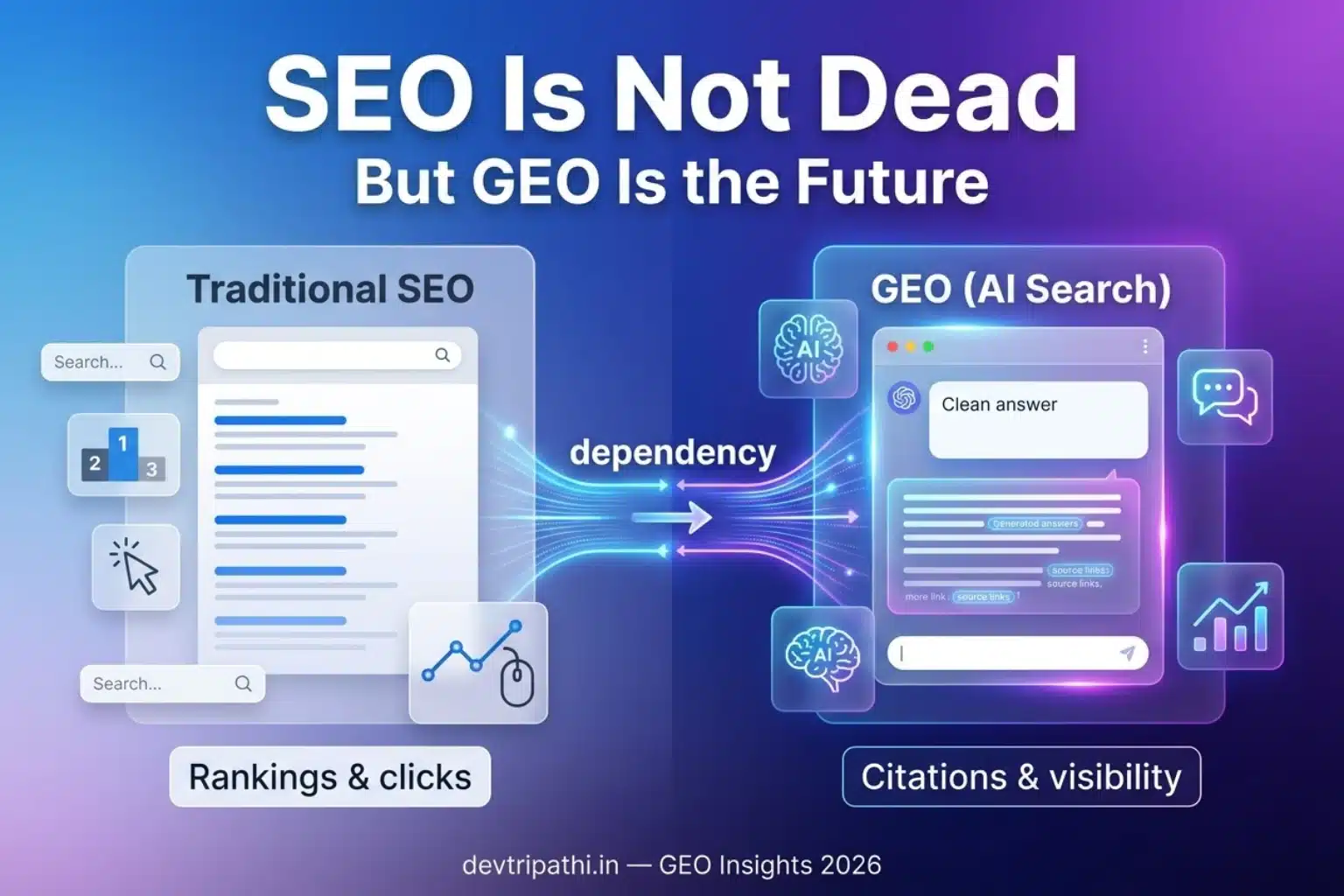
Traditional SEO Is Not Dead – But It Needs GEO to Survive
29 March 2026
Every few months, someone declares SEO dead. In 2026, with AI Overviews eating clicks and ChatGPT handling millions of queries that used to land on your blog, the declaration is louder than ever.
But here is what the data actually shows: traditional SEO is not dead. It has simply become insufficient on its own. The bloggers and brands struggling right now are not those who did SEO wrong. They are those who did only SEO – and never added the next layer. Why your blog traffic is dropping in 2026 and how GEO can fix it
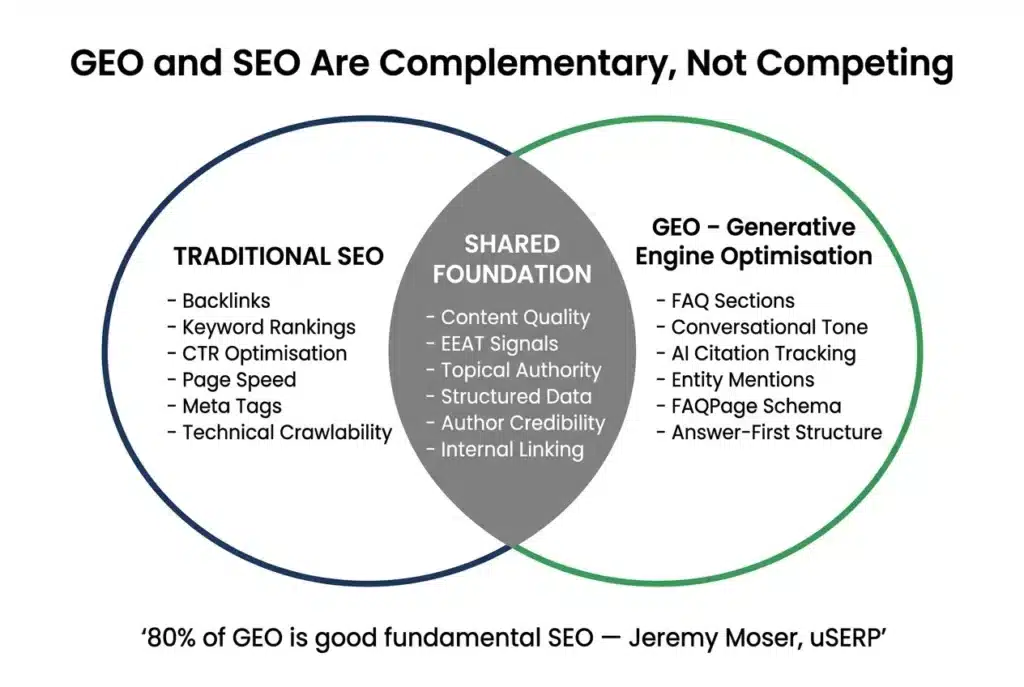
That next layer is GEO – Generative Engine Optimisation. And the good news is that 80% of what makes good SEO also makes good GEO. You are not starting over. You are building on what you already have.
What the ‘SEO Is Dead’ Debate Gets Wrong
The death-of-SEO narrative is not entirely wrong – it is just imprecise. What is dying is a specific version of SEO: the keyword-stuffed, backlink-chasing, rank-and-pray approach that worked in 2015.
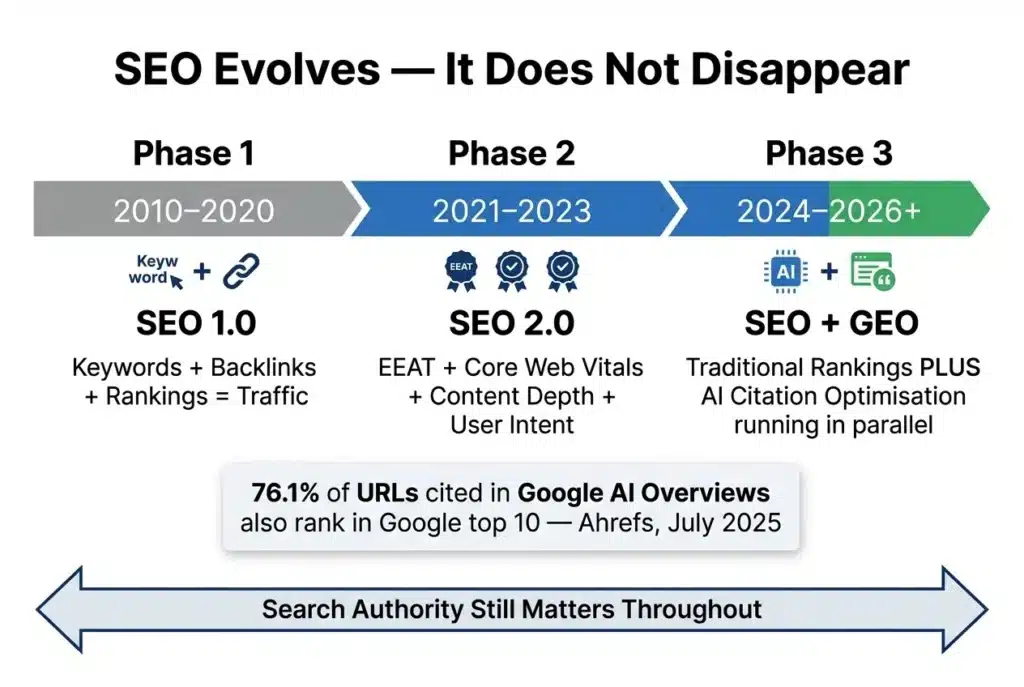
The fundamentals that made SEO work – authority, clarity, relevance, trust – are not dying. They are becoming more important. And they now apply to two parallel systems: Google’s traditional index and AI engines like ChatGPT, Perplexity, and Google AI Overviews.
WordStream’s 2026 Small Business Website Trends Report found that 60% of businesses had not yet seen any measurable impact on their traffic from AI-assisted search. Traditional organic search still drives the majority of high-intent traffic for most niches. The disruption is real – but it is uneven, and it is not total.
How Big Is AI Search Really? (The Honest Numbers)
Before declaring that GEO has replaced SEO, it helps to look at the actual scale of each channel right now.
Google still processes between 9.1 and 13.6 billion searches every single day. ChatGPT, by comparison, handles roughly 29,000 messages per second – impressive, but still a fraction of Google’s volume. AI chatbots and generative engines currently account for approximately 15–20% of total search referrals, according to recent industry research – a figure that was effectively zero just two years ago.
The growth trajectory is steep and undeniable. But traditional SEO is not yet in crisis for most content categories. WordStream notes that GEO hype cycles are already generating unrealistic expectations, and warns that many organizations investing in GEO tools without strategic clarity will become disillusioned when results do not match vendor promises.
The honest 2026 picture: SEO still drives the majority of your traffic. GEO determines whether you stay relevant as AI search grows. Both need your attention – in that order.
Where SEO and GEO Overlap – And Where They Differ
The reason GEO does not require you to start from scratch is that both systems reward the same underlying content quality. They just measure and apply it differently.
Element | Traditional SEO | GEO (2026) |
Primary Goal | Rank in top 10 blue links | Get cited inside AI-generated answers |
Traffic Type | High volume, lower conversion | Lower volume, higher conversion (~14–23x) |
Key Content Signal | Keywords, backlinks, dwell time | Structure, authority, data richness, clarity |
Heading Format | Descriptive and keyword-rich | Conversational and question-based |
Schema Priority | Title, description, breadcrumbs | FAQPage, Article, HowTo schemas |
Recency Weighting | Moderate | High – AI engines strongly favour fresh content |
Overlap | – | EEAT, topical authority, internal linking, technical accessibility |
The overlap column is the key insight. When Ahrefs studied which pages get cited in Google AI Overviews, they found that 76.1% of cited URLs also rank in the traditional top 10. Doing SEO well is still the best foundation for GEO visibility. The two are not competing – they are compounding. What GEO actually means and how it works from the ground up
What GEO Adds That SEO Alone Cannot Do
If SEO gets you ranked, GEO gets you cited. These are two distinct forms of visibility that serve different moments in your reader’s journey.
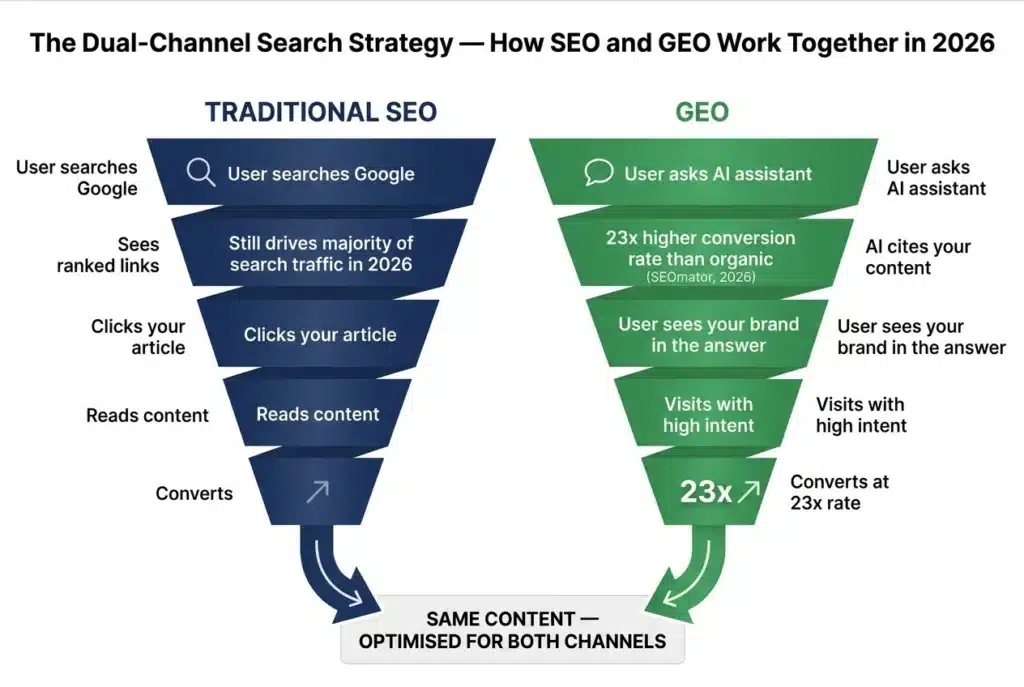
When someone searches Google the traditional way, they scan a list of links and choose one. Your SEO ranking determines whether you appear in that list. When someone asks ChatGPT or Perplexity a question and receives a synthesised answer, no list of links appears. Either your content was used to generate that answer – or it was not. GEO determines whether you are in the answer at all.
The conversion numbers make this distinction urgent. According to Adobe Digital Insights, visitors arriving from AI platforms spend 38% longer on retail sites than traditional search visitors. SEOmator’s 2026 data puts AI-referred traffic conversion rates at 23 times higher than standard organic traffic. You may get fewer visitors from AI search – but each one is significantly more valuable.
Being cited as a source in an AI Overview also generates an additional 1.08% CTR boost and strengthens brand awareness even for users who do not click – according to Incremys 2026 research. GEO creates brand presence beyond the click.
5 Things to Add to Your SEO Strategy to Make It GEO-Ready
1. Restructure Your Openings – Answer First, Then Expand
Every blog post should answer its core question in the first 150–200 words. AI systems using real-time retrieval – Perplexity, Google AI Overviews – heavily weight opening content when selecting sources. Traditional SEO allowed you to warm up to your answer over several paragraphs. GEO does not. State the answer. Then earn the reader’s time.
2. Convert H2 Headings Into Questions
BrightEdge data shows that question-style queries of 8 or more words trigger AI Overviews far more frequently than shorter keyword-based queries. A heading like ‘Is SEO Dead in 2026?’ outperforms ‘SEO in 2026’ for both AI visibility and voice search. Review your existing blog headings and convert them to natural questions where possible.
3. Add a 4–5 Question FAQ to Every Post
FAQ-structured content is among the most cited content formats across ChatGPT, Perplexity, and Google AI Overviews. Each question should be 5–10 words, and each answer should be 2–3 sentences – direct, complete, and citable. Use Rank Math’s FAQ block so the FAQPage schema is generated automatically. This single addition can significantly increase the rate at which AI systems reference your content.
4. Attach Real Data and Named Sources to Every Claim
GEO rewards verifiability. ‘Many experts believe’ carries no weight with an AI engine. ‘According to Ahrefs’ July 2025 study, 76.1% of URLs cited in AI Overviews also rank in Google’s top 10′ gives a citable, verifiable fact. Audit your existing content and replace vague claims with specific, sourced statistics wherever possible.
5. Refresh Your Pillar Content Every 90–180 Days
AI engines strongly favour recent content. A 2023 guide that has not been updated loses ground to a 2026 version of the same article – even if the older piece has more backlinks. Build a refresh calendar for your cornerstone content. Update the data, add new examples, and change the ‘Last updated’ timestamp visibly at the top of the post. How to write FAQ sections that get featured in AI Overviews
The Real Risk in 2026: Choosing One Over the Other
The most dangerous position a blogger can take right now is betting entirely on one channel.
Bloggers who invest only in traditional SEO are already seeing traffic erosion as AI Overviews answer their readers’ questions before they arrive. Marketers who pivot entirely to GEO – abandoning technical SEO, internal linking, and domain authority – are building on a foundation that AI engines themselves still depend on.
Search Engine Land’s January 2026 survey of six senior SEO leaders found consistent agreement: the blogs and brands that will dominate visibility in 2026 are those who optimise for both human searchers and machine readers simultaneously. As Britney Muller, AI educator and consultant, put it: the biggest risk is not AI itself – it is applying old-channel thinking to a new-channel problem.
The goal is not to choose. The goal is to build content that ranks on Google and gets cited by AI. Those two outcomes now live in the same well-structured, authoritative, data-rich article.
The Bottom Line
Traditional SEO is not dead. It is the foundation that GEO runs on top of. The 76.1% overlap between Google top-10 results and AI Overview citations is not a coincidence – it is evidence that quality content earns visibility in both systems.
What is dead is the idea that one channel is enough. In 2026, every blog post you publish needs to earn a ranking and earn a citation. The strategies for doing both overlap more than they differ – and the bloggers who understand that are the ones quietly building the most durable content businesses on the internet.
Start where you are. Add the GEO layer to what you have already built. The foundation is not wasted – it just needs a new roof. The complete GEO content cluster built for bloggers in 2026
FAQ
Is traditional SEO still worth investing in for 2026? ▼
Yes – absolutely. Google still processes billions of searches daily, and 76.1% of URLs cited in Google AI Overviews also rank in the traditional top 10. Strong SEO is not just useful on its own – it directly feeds your GEO visibility. The two strategies compound each other.
What is the difference between SEO and GEO? ▼
Traditional SEO optimises your content to rank in Google’s list of blue links. GEO – Generative Engine Optimisation – optimises your content to be cited inside AI-generated answers from tools like ChatGPT, Perplexity, and Google AI Overviews. Both are now necessary, and they share the same content quality foundations.
Do I need to rewrite all my old blog content for GEO? ▼
Not entirely. Start by adding an FAQ section to your existing posts, answer the core question in the first 200 words, and update your data with current statistics. These three changes alone – applied to your top-performing posts – can significantly improve AI citation rates without a full rewrite.
Which AI engines should I optimise for first? ▼
Prioritise Google AI Overviews first – they appear in 60% of U.S. search results and directly impact your existing organic traffic. Then optimise for Perplexity, which strongly favours recent, structured content with clear attribution. ChatGPT Search draws from a wider range of sources including lower-ranking pages, making brand mentions and third-party citations particularly important there.
How do I know if my GEO strategy is working? ▼
Track AI referral traffic in Google Analytics – filter for referrals from chatgpt.com, perplexity.ai, and gemini.google.com. In Google Search Console, monitor impressions on queries where AI Overviews appear. Tools like Profound and BrandMentions also track how often your brand is cited in AI-generated answers, giving you a direct measure of GEO visibility.
Will GEO replace SEO completely? ▼
No – and the data is clear on this. Traditional search still drives 48.5% of all website traffic globally (SparkToro, 2024), and Google processes 5 trillion queries annually. The most accurate frame for 2026 is that SEO and GEO are complementary disciplines that require simultaneous investment – not competing alternatives where you must choose one.
What does GEO actually mean for a small blogger with low domain authority? ▼
It is genuinely good news. AI systems value depth, specificity, and original expertise over domain authority. SE Ranking’s analysis found that for smaller domains, content depth and quality have roughly 65% more relative impact on AI citations than they do for large authority domains. A focused, well-written 2,500-word post from a niche specialist consistently outperforms a thin page from a high-authority generalist site.
How is GEO different from AEO? ▼
AEO (Answer Engine Optimization) was originally developed for voice search and featured snippets – optimising short, direct answers for single-source retrieval. GEO covers all generative AI platforms including ChatGPT, Perplexity, Gemini, and Google AI Overviews, and emphasises comprehensive depth, entity authority, and multi-platform optimisation. In 2026, AEO is largely considered a subset of GEO. If you have been doing AEO, you are already ahead on GEO.
What is the most common GEO mistake bloggers make? ▼
Writing content that buries the answer. The single most common GEO mistake is spending the first three paragraphs on context and build-up before getting to the actual answer. AI systems extract 44% of citations from the opening 200 words of a page. A post that spends its first 200 words on preamble has near-zero chance of being cited regardless of how good the rest of the content is. Fix: put the direct answer first, every time, for every section.
Does link building still matter for GEO in 2026? ▼
Less than it did for traditional SEO – but it is not irrelevant. Branded web mentions now correlate 3x more strongly with AI visibility than backlinks (Position Digital, 2026). The shift in 2026 is from link-building to mention-building: getting your brand name referenced in Reddit threads, Quora answers, industry publications, and community discussions signals to AI systems that you are a recognised authority.
How long does it take for GEO improvements to show results? ▼
Faster than traditional SEO in most cases. Some sites report appearing in AI citations within 2-4 weeks of publishing well-structured, authoritative content. Building consistent, reliable GEO visibility typically takes 3-6 months of focused effort. For existing posts updated with GEO structure, improvements in Google Search Console impressions are often visible within 30-60 days of the update being recrawled.
What is the best free tool for tracking GEO performance? ▼
Google Search Console combined with manual citation testing is the most accessible free GEO measurement stack. In Search Console, monitor impressions for question-based queries – rising impressions with flat or declining CTR is a strong signal of AI Overview appearances. For manual testing, search your top 10-15 target queries in incognito mode across ChatGPT, Perplexity, and Google AI Overviews monthly and track citation appearances in a simple spreadsheet.
Should I focus more on ChatGPT or Google AI Overviews for GEO? ▼
Both – but for different reasons. Google AI Overviews should be your primary focus because they appear in 60% of U.S. search results and directly affect your existing organic traffic. ChatGPT drives 87.4% of all AI referral traffic and has 2.8 billion monthly active users. The content structure required for both platforms overlaps almost entirely – BLUF openings, question headings, FAQ sections, schema markup, and named author credentials work equally well for both.
What is topical authority and how do I build it for GEO? ▼
Topical authority is the degree to which AI systems recognise your site as a comprehensive, reliable expert on a specific subject. You build it by publishing a content cluster: one pillar post covering the main topic in depth, supported by 8-12 cluster posts covering specific sub-questions, all internally linked to each other. Sites with 20+ interconnected articles on a topic see 3.2x higher AI citation rates than sites with isolated posts (Moz, 2025).
How important is page speed for GEO performance? ▼
Page speed matters indirectly but significantly. Since 99.5% of AI Overview sources already rank in Google’s top 10 organic results, and Core Web Vitals are a Google ranking factor, a slow page that fails to rank in the top 10 is also unlikely to be cited in AI Overviews. Fast, technically clean pages with well-structured HTML are also easier for AI crawlers to parse and extract clean content chunks from.
Does social media presence help with GEO? ▼
Indirectly – through brand mention signals. Active social media presence that generates discussion and brand mentions across Reddit, LinkedIn, Quora, and X contributes to the entity authority signals that AI systems use to evaluate your credibility. Branded web mentions have a 0.664 correlation with AI Overview appearances (Position Digital, 2026). Social media does not directly influence AI citation algorithms the way schema markup does, but a visible, consistent brand presence strengthens the entity signals that make your content more citation-worthy.
What is schema markup and which types matter most for GEO? ▼
Schema markup is structured data code added to your page that tells AI systems and search engines exactly what type of content you have. For GEO, the most impactful combination is triple schema stacking: Article schema, FAQPage schema for FAQ sections, and ItemList schema for list-format content. Pages using all three receive 1.8x more AI citations than pages with Article schema alone (GenOptima). In WordPress, Rank Math Pro supports all three simultaneously.
How do I write content that works for both humans and AI search? ▼
The requirements are almost identical. Human readers and AI systems both prefer: direct answers before context, short paragraphs that cover one idea each, question-based headings that match natural search language, specific data points with named sources, and plain language over jargon. Write the way a knowledgeable colleague would explain something in a meeting. Read every paragraph aloud: if you pause or stumble, rewrite it.
What is E-E-A-T and how does it connect to GEO? ▼
E-E-A-T stands for Experience, Expertise, Authoritativeness, and Trustworthiness – Google’s framework for evaluating content quality. Websites with author schema are 3x more likely to appear in AI answers (BrightEdge). Author credentials carry 16% weight in AI citation decisions – up from 8% in 2024. Every GEO-priority page needs a named author with a verifiable external presence: LinkedIn profile, published work, or industry mentions. Anonymous content is effectively a citation penalty.
Can e-commerce sites benefit from GEO or is it only for bloggers? ▼
E-commerce sites benefit from GEO primarily through their informational and educational content – buying guides, comparison posts, how-to content, and category-level FAQ pages. Product pages themselves trigger AI Overviews in only 4% of cases. However, the informational content around product categories is heavily AI-affected and represents a significant citation opportunity. E-commerce brands that invest in authoritative informational content build brand authority that also influences AI recommendations for commercial queries.
What is the difference between being cited in an AI Overview and being mentioned? ▼
A citation is when an AI response includes an inline hyperlink to your specific URL – it generates trackable referral traffic and signals that the AI trusts your content enough to send users directly to it. A mention is when an AI response references your brand name without providing a clickable link – it builds brand recognition but does not generate measurable traffic. Citations are significantly more valuable. Most dedicated GEO monitoring tools now track both metrics separately.
How do I future-proof my blog against further AI search changes? ▼
Build on signals that are structurally durable rather than platform-specific. The most future-proof investments are: genuine topical authority through deep content clusters, original data and first-hand experience content that AI cannot replicate, named author credentials with verifiable external presence, and an email audience you own directly – which is unaffected by search algorithm changes entirely. Content that demonstrates irreplaceable human expertise will remain valuable across all platform changes.
How much does it cost to implement a full GEO strategy? ▼
The core GEO improvements – BLUF introductions, question-based headings, FAQ sections, and schema markup via a free plugin – cost nothing beyond your time. Rank Math free tier handles FAQPage and Article schema. Google Search Console and GA4 provide free measurement. Dedicated GEO monitoring tools average $337 per month at the industry level (Conductor, 2026), but for bloggers and small publishers, the free stack is fully sufficient to implement and measure a GEO strategy.
Is there a risk that AI search makes blogging completely obsolete? ▼
Not for bloggers who produce genuinely valuable, original content. AI cannot replicate first-hand experience, proprietary data, original research, specific case studies, or genuine expert opinion – these are precisely the content types that AI systems need to cite because they cannot generate them from training data alone. The blogs most at risk are those producing generic, derivative content. Original, experience-based, deeply authoritative blogs are actually more valuable in the AI search era.
What should my GEO action plan look like for the next 90 days? ▼
Days 1-30: audit your top 10 posts and add BLUF answer blocks in the first 200 words of each, convert H2 headings to question format, and add FAQ sections with FAQPage schema. Days 31-60: set up GA4 AI referral tracking, run manual citation tests for your top 15 target queries across ChatGPT, Perplexity, and Google AI Overviews, and establish your baseline Citation Share. Days 61-90: publish 2-3 new cluster posts targeting specific sub-queries, update author pages with verifiable credentials and author schema, and run a second citation audit to measure improvement against your baseline.

Devyansh Tripathi
I’m Devyansh Tripathi, an SEO strategist and digital growth expert, helps businesses and individuals rank higher and drive organic traffic. Through DevTripathi., he shares cutting-edge SEO insights, content strategies, and marketing hacks. Passionate about digital success, he’s on a mission to make SEO simple, effective, and result-driven!
Posts
- What Google’s New AI Search Documentation Means for SEO Teams
- Google I/O 2026 Search: AI Agents, Gemini 3.5 and the Unified Box
- Google’s AI Optimization Guide: The Technical and Content Checklist
- July 2026 SEO Update: AI Overviews, llms.txt and Search Console
- Prompt Optimization Beyond Page One: The Position-21 Citation Opportunity
Categories
- AI Citation Optimization
- AI Search Optimization (AISEO)
- AI Visibility Tracking
- Answer Engine Optimization (AEO)
- Brand Authority SEO
- Brand SERP Optimization
- Community Signal SEO
- Conversational Search Optimization
- Generative Engine Optimization (GEO)
- Knowledge Graph Optimization
- Modern SEO Strategies
- Multimodal Search Optimization
- Prompt Optimization
- SEO Trends
- Social Search Optimization
- Topical Authority SEO
- Uncategorized
- Video Search SEO
- Visual Search Optimization
- Voice Engine Optimization (VEO)
- Zero Click Search Optimization
Latest News
Text Widget
Empowering brands with insights, strategies, and stories that drive digital growth.