
GEO vs SEO: What’s the Difference and Why You Need Both in 2026
19 March 2026
Your Rankings Are Holding - But Are You Visible?
Picture this. Your blog is ranking on Page 1 of Google. Traffic is steady. Your SEO is working exactly as planned.
Then a 22-year-old intern walks in and asks a question that stops you cold: ‘Why don’t we show up when people ask ChatGPT about our topic?’
You pull up ChatGPT. You type your best keyword. The AI gives five confident, detailed answers. Your site is not mentioned once. You try Perplexity. Same result.
This is the GEO vs SEO gap – and in 2026, it is playing out in marketing teams everywhere. The uncomfortable truth is that your SEO investment does not automatically translate into AI visibility. They are different games, with different rules, different success metrics, and different optimization habits.
But here is the good news upfront: you do not have to choose between them. GEO and SEO are not rivals. They are complementary disciplines that share the same content quality foundation – and the brands winning in 2026 are the ones who have learned to do both simultaneously.
This guide breaks down every key difference, backs it with real 2025-2026 data, and gives you a practical roadmap for building a strategy that dominates both channels.
Quick Answer – GEO vs SEO in One Sentence: SEO gets your content ranked in Google’s list of links (click-focused). GEO gets your content cited inside AI-generated answers (citation-focused). In 2026, both matter – and they share more fundamentals than most people realize. |
1. What Is SEO? The Foundation That Still Drives Most Traffic
Search Engine Optimization (SEO) is the practice of optimizing your website and content to rank higher in organic search results – primarily Google, which still handles over 5 trillion searches annually and commands 91% of global search traffic (StatCounter, 2026).
Traditional SEO is built around three interlocking pillars:
- On-page SEO – keyword research, title tags, meta descriptions, header structure, content quality, and internal linking
- Off-page SEO – backlink acquisition, brand mentions, and domain authority building
- Technical SEO – site speed, mobile-friendliness, crawlability, Core Web Vitals, structured data, and indexation
The goal of traditional SEO is clear and measurable: secure a top position in Google’s results page for a target keyword, earn the click, and drive the visit. For over two decades, this has been the dominant digital marketing model – and it still works.
Traditional organic search drives 48.5% of all global website traffic (SparkToro/Datos, 2024). Google still processes more queries in a day than ChatGPT handles in a month. SEO is not dead. It is not dying. But it is no longer sufficient on its own.
48.5% of All Website Traffic Source: Still from traditional organic search – SparkToro/Datos, 2024 |
Related reading on devtripathi.in: The Ultimate On-Page SEO Checklist for 2025
2. What Is GEO? The New Visibility Layer for AI Search
Generative Engine Optimization (GEO) is the practice of optimizing your content so that AI-powered search systems – Google AI Overviews, ChatGPT, Perplexity AI, Gemini, and Microsoft Copilot – can retrieve, understand, trust, and cite it when generating answers to user queries.
Unlike traditional search engines, which return a ranked list of ten blue links, generative AI systems synthesize answers from multiple sources and present a single, unified response. The user gets their answer directly. They may never click through to any website. Your goal with GEO is not to appear on a list – it is to be one of the sources the AI reads and cites in that synthesized answer.
Why Did GEO Become Necessary?
Because 37% of consumers now begin their searches with AI tools rather than traditional search engines (Eight Oh Two, January 2026). Because 44% of consumers identify AI as their primary information source – ahead of traditional search at 31% (StatusLabs, 2025). Because AI Overviews now appear in roughly 60% of U.S. search results (StatusLabs, 2026), and when they appear, only 8% of users click traditional results versus 15% without summaries.
If your content is not being cited in these AI-generated answers, you are effectively invisible to an expanding portion of your target audience – regardless of how well you rank on Google.
37% of Consumers Source: Now start searches with AI tools rather than Google – Eight Oh Two Study, January 2026 |
Deep dive: What Is Generative Engine Optimization (GEO)? Complete 2026 Guide
3. GEO vs SEO: A Clear Side-by-Side Comparison
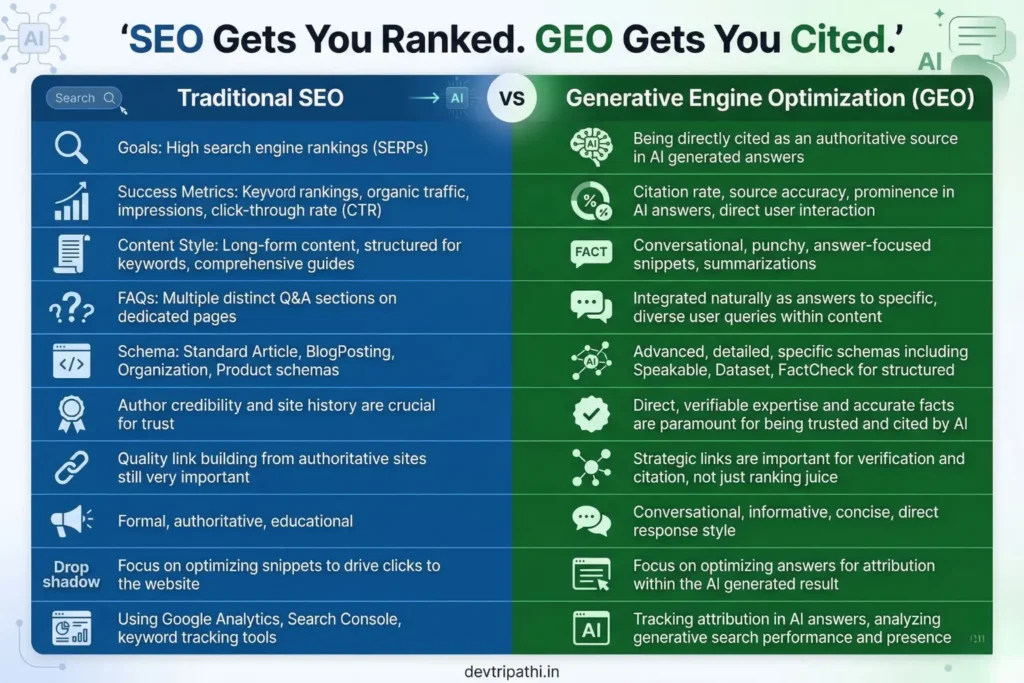
Factor | Traditional SEO | GEO |
Primary Goal | Rank in Google’s top 10 results | Be cited inside AI-generated answers |
Success Metric | Organic clicks and CTR | AI citation frequency and brand mentions |
Content Style | Keyword-structured, informational | Conversational, answer-first, intent-driven |
Role of Keywords | Central – keyword density matters | Supporting – user intent matters more |
FAQs | Optional – helpful for snippets | Essential – 15 to 20+ per post minimum |
Schema Markup | Recommended | Mandatory for AI readability |
EEAT Weight | Important | Critical – 16% of AI citation decisions |
Backlinks | Critical ranking factor | Helpful; entity mentions matter more |
Writing Style | Structured for algorithm crawlers | Natural, extractable, self-contained sections |
Zero-Click Searches | Loses traffic to zero-click SERPs | Designed for zero-click environments |
Measurement Tools | GSC, Ahrefs, Semrush, GA4 | Manual AI testing + GSC impressions tracking |
Results Timeline | 3–6 months typically | 4–8 weeks for early citation signals |
4. The 7 Core Differences Between GEO and SEO - Explained
Difference 1: What 'Winning' Looks Like
In traditional SEO, winning is a click. Your page appears in the search results, a user clicks through, and they land on your site. Every SEO tool – Google Analytics, Search Console, Ahrefs – is built to measure that click and the conversion that follows.
In GEO, winning is a citation. An AI system reads your content, extracts the most relevant information, and uses it when generating an answer. The user may never visit your site – but they associate that knowledge and expertise with your brand. As LLMrefs puts it: ‘GEO isn’t obsessed with clicks; it’s about getting your brand’s facts, data, and unique insights embedded directly into the answers AI models generate.’
✦ The GEO Mindset Shift: Think of SEO as getting your book onto the most visible shelf in the library. GEO is having the librarian pull your book off the shelf and quote it directly when someone asks a question. Both outcomes have value. They are just different kinds of value. (LLMrefs, 2026) |
Difference 2: How AI Systems Read Content vs How Google Does
Google ranks pages using hundreds of signals – keyword placement, backlinks, page speed, mobile-friendliness, Core Web Vitals, and more. It is a complex algorithm that rewards technical excellence as much as content quality.
AI search systems evaluate content on five dimensions identified by StatusLabs through analysis of 150,000 AI citations: authority, recency, relevance, content structure, and factual density. A specific, attributed statement (‘AI-referred visitors convert at 4.4x the rate – Semrush, 2025’) is dramatically more citable than a vague claim (‘AI visitors convert better’). Headings that directly mirror user queries trigger extraction. Outdated content loses ground to fresher alternatives.
Difference 3: Keywords vs User Intent
Traditional SEO starts with a keyword – a specific phrase with measurable search volume. You find it, target it, and optimize your content around it.
GEO starts with user intent – the complete informational need behind someone’s question. Not just what words are they typing, but what problem are they trying to solve? AI systems are fundamentally question-answering machines, not keyword-matching systems. Content that comprehensively addresses a real user intent gets extracted and cited far more than content built around keyword density alone.
Difference 4: The Role of Structure and FAQs
In SEO, heading structure matters for keyword placement and readability. FAQs are useful for featured snippets.
In GEO, structure is everything – and FAQs are not optional. AI systems pull individual sections, not full articles. Every section of your content needs to work as a standalone complete answer. And according to analysis of real AI citation patterns, content in Q&A format gets extracted 2.3x more than prose-only content. Only 34% of websites use FAQPage schema – making this one of the biggest competitive gaps in GEO today.
Only 34% of Websites Source: Use FAQPage schema – a massive competitive opportunity in GEO, 2026 |
Difference 5: EEAT and Author Authority
EEAT (Experience, Expertise, Authoritativeness, Trustworthiness) matters for both SEO and GEO – but its weight in GEO is significantly higher. Author credentials carry 16% weight in AI citation decisions (BrightEdge, 2025), up from 8% in 2024. Named experts with verifiable credentials consistently get cited more than anonymous content.
As the Washington Post’s chief revenue officer Karl Wells noted, people arriving from AI platforms convert at 4-5x higher subscription rates than those from traditional search – because the AI has already done the credibility-vetting for them.
Difference 6: Backlinks vs Entity Mentions
Backlinks are a critical ranking signal in traditional SEO. The more authoritative sites that link to you, the more Google trusts your content.
For GEO, branded web mentions correlate 3x stronger with AI visibility than backlinks alone (Position Digital, 2026). Building your presence on Reddit, Quora, LinkedIn, YouTube, and industry publications – platforms that AI systems heavily index – matters more for AI citation authority than raw link acquisition.
Difference 7: Measuring Success
SEO measurement is mature and well-tooled. Google Analytics and Search Console give you clear attribution from search query to click to conversion. The funnel is linear and trackable.
GEO measurement is still developing. When ChatGPT cites your article, standard analytics often do not capture it. As Semrush explains: ‘Traditional SEO metrics like rankings, clicks, and bounce rate tell part of the story. You need both traditional SEO metrics and AI visibility metrics to understand your full organic search presence in 2026.’ Manual testing – searching your target queries in ChatGPT, Perplexity, and Google AI Overviews monthly – is currently the most reliable method.
→ Related: Understanding AI Mode Analytics: Measuring Success in a Generative Search Landscape
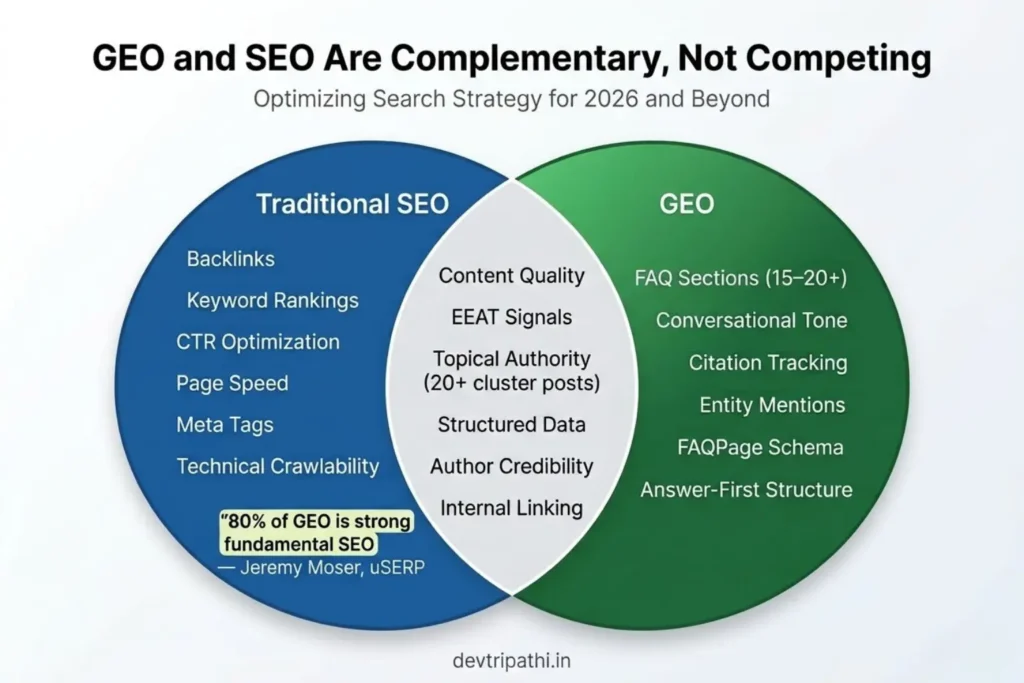
5. Where GEO and SEO Overlap - The 80% You Already Know
Here is something many GEO guides skip: GEO and SEO share far more DNA than they differ on. Jeremy Moser, CEO of SEO agency uSERP, put it bluntly in Digiday: ’80 percent of GEO is good, fundamental SEO. If a GEO service does not openly tell you that, they are selling you snake oil.’
Google’s own Danny Sullivan reinforced this: ‘Good SEO is good GEO. What you’ve been doing for search engines generally is still perfectly fine and the things you should be doing.’
Overlap 1: Google Rankings Drive AI Citations
This is the most important overlap – and one that completely reframes the GEO vs SEO debate. According to Ahrefs (2025), 76.1% of URLs cited in Google AI Overviews also rank in Google’s top 10 organic results. Nest Content tracked every AI citation across their platform between June 2025 and February 2026 and found: not a single article got AI citations without first earning organic rankings.
Translation: GEO is not a separate channel. It is an additional benefit you earn by doing SEO well – with better structure, clearer answers, and stronger data. The content that ranks well is the content that gets cited.
76.1% of AI Overview Citations Source: Come from pages that also rank in Google’s top 10 – Ahrefs, 2025 |
Overlap 2: Content Quality Is the Foundation of Both
Both Google and AI citation systems reward genuinely helpful, accurate, well-researched content. Keyword stuffing hurts both. Thin, generic content gets filtered out by both. Depth, accuracy, and real user value are universally rewarded.
Overlap 3: Topical Authority Wins in Both
Sites with 20+ interconnected articles on a specific topic see 3.2x higher AI citation rates than sites with isolated posts (Moz, 2025). This is the exact same topical authority principle that has driven SEO for years – content clusters, pillar pages, and strong internal linking. What builds SEO authority also builds GEO authority.
Overlap 4: Technical Accessibility Matters for Both
A slow, poorly structured website hurts both Google rankings and AI citation potential. Pages with First Contentful Paint under 0.4 seconds average 6.7 AI citations versus 2.1 for slower pages (SE Ranking, 2025). Core Web Vitals matter for both channels simultaneously.
Overlap 5: EEAT Is Foundational for Both
Strong author bios, first-hand experience, accurate external citations, and regularly updated content build trust signals that improve performance in both Google rankings and AI citation decisions. You do not need to build EEAT twice – investing in it once pays dividends across both channels.
→ Related: Why a Structured SEO Plan Is Essential for Long-Term Success
6. Real 2026 Data: What the Numbers Actually Show
The Scale of AI Search Right Now
- AI Overviews appear in roughly 60% of U.S. search results (StatusLabs, 2026) – when they appear, traditional result CTR drops from 15% to 8%
- 37% of consumers now start searches with AI tools, not Google (Eight Oh Two, January 2026)
- 44% of consumers identify AI as their primary information source, ahead of traditional search at 31% (StatusLabs, 2025)
- 49% of all ChatGPT messages are information-seeking queries – ‘Asking’ behavior (OpenAI Signals, February 2026)
- GEO market valued at $848 million in 2025, projected to reach $33.7 billion by 2034 at 50.5% CAGR (Superlines/Dimension Market Research)
- 54% of US marketers plan to implement GEO within 3-6 months (eMarketer, January 2026)
SEO Still Drives the Majority of Traffic
- Traditional organic search still drives 48.5% of all website traffic globally (SparkToro/Datos, 2024)
- Google still processes 5 trillion searches annually – 373x more than ChatGPT search volume (WordStream, 2026)
- Traditional SEO drives 75% of organic clicks from Page 1 results (LLMrefs, 2026)
- 87% of ChatGPT citations are expected to come from Bing’s top-ranked results by end of 2026 (LLMrefs)
Where GEO Beats SEO on Quality
- AI-referred visitors convert at 4.4x the rate of traditional organic visitors (Semrush, 2025)
- Washington Post: AI platform visitors subscribe at 4-5x higher rates than traditional search visitors
- AI visitors spend significantly more time on-site than traditional search visitors (SE Ranking, 2025)
- 93% of AI search sessions end without a website click – but the 7% who do click are pre-qualified buyers
What Gets Content Cited by AI
- 76.1% of AI Overview citations come from Google’s top 10 organic results (Ahrefs, 2025)
- Pages with structured lists, quotes, and statistics have 30-40% higher AI visibility (LLMrefs analysis of 10,000 queries)
- Content in Q&A format gets extracted 2.3x more than prose-only content
- Sites with 20+ interconnected articles see 3.2x higher AI citation rates (Moz, 2025)
- 40-60% of cited sources change month-to-month – freshness is a major citation factor (Semrush AI Visibility Index)
- Branded web mentions correlate 3x stronger with AI visibility than backlinks (Position Digital, 2026)
“The brands dominating their categories in late 2026 will be those with a dual presence: top Google rankings and consistent AI citations. This is the same dynamic that played out with SEO and Google Ads. The brands that did both outperformed the ones that chose sides.” – upGrowth Digital – GEO vs SEO Complete Guide, 2026 |
“Good SEO is good GEO. What you’ve been doing for search engines generally is still perfectly fine and the things you should be doing.” – Danny Sullivan, Google Search Liaison – Search Engine Roundtable, January 2026 |
“Not a single article got AI citations without first earning organic rankings. The content that ranks well is the content that gets cited. GEO isn’t a separate discipline – it’s a set of writing habits you should adopt anyway because they make your content better for human readers too.” – Nest Content Platform – GEO vs SEO Data Report, February 2026 |
External reference: Superlines – 60+ AI Search Statistics 2026 | StatusLabs – How GEO Will Replace Traditional SEO in 2026
Visual Summary: The GEO + SEO Relationship
7. When to Prioritize SEO vs GEO - A Practical Decision Framework
Prioritize Traditional SEO First When:
- Your site is new or has low domain authority – build your ranking foundation first, since AI citations require SEO authority as a prerequisite
- Your target queries are primarily transactional (buy, pricing, booking, comparison) – users still click through for high-intent commercial searches
- You need clear, measurable, trackable attribution from search to conversion within a defined budget
- Your audience is primarily on Google and accesses information by clicking through to websites
Prioritize GEO When:
- AI Overviews are already appearing for your target queries – check manually in incognito mode
- Your audience is research-oriented and uses ChatGPT or Perplexity as their primary research tool
- You are targeting informational queries in a competitive niche where ranking in the top 3 is difficult
- You want to build long-term brand authority that compounds beyond traffic volume metrics
- Your conversion funnel benefits from pre-qualified, high-intent visitors who arrive already informed
The Practical Answer: Build Both Simultaneously
For any serious content strategy in 2026, the answer is not either/or. As Pimberly’s GEO vs SEO guide concludes: ‘Brands that win in 2026 will design content ecosystems that serve both human searchers and machine readers.’ The writing habits that earn AI citations – direct answers, conversational tone, specific data, comprehensive FAQs – are the same habits that make content better for human readers and more likely to rank well on Google.
Build the SEO foundation. Layer GEO writing habits on top. Publish consistently within a topical cluster. The AI citations follow the rankings. The rankings reward the content quality. The quality serves both channels at once.
8. How to Build a Dual GEO + SEO Strategy – Step by Step
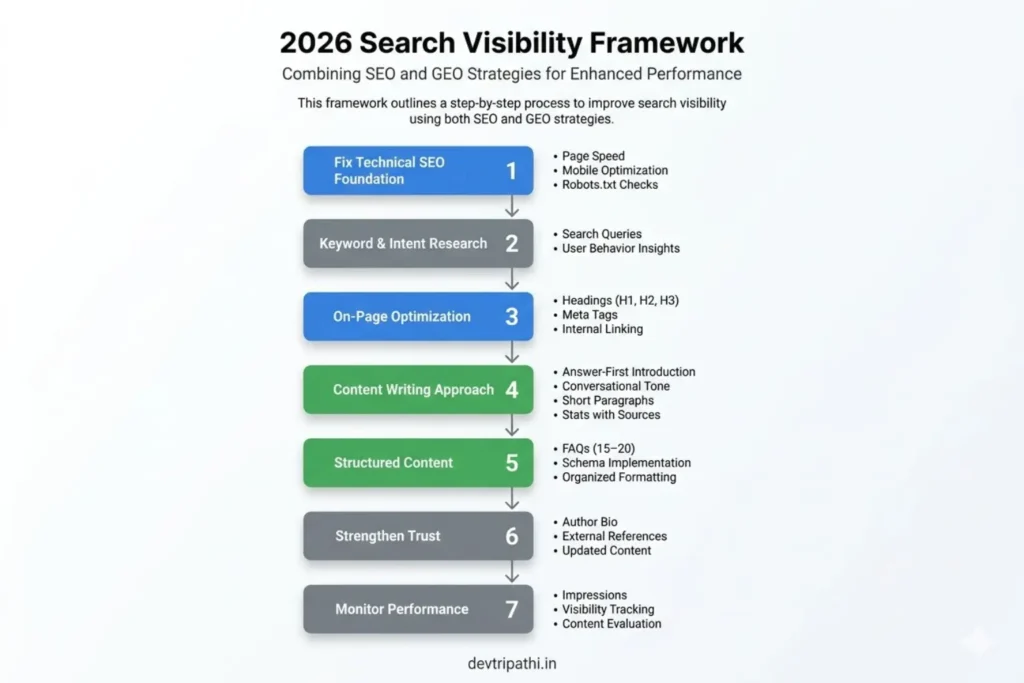
Step 1: Fix Your SEO Foundation First
Before any GEO work, ensure your SEO foundation is solid. Use Google Search Console to identify your highest-impression pages and their existing query data. Fix any technical issues – page speed, mobile usability, crawl errors. And critically: ensure GPTBot, Google-Extended, PerplexityBot, and Claude-Web are not blocked in your robots.txt or Cloudflare settings. Many sites block AI crawlers without realizing it, making all GEO work pointless.
Step 2: Research Actual User Questions Before Writing
GEO requires a different research starting point than traditional SEO. Instead of asking ‘what does Google want to rank for this query?’, ask ‘what do AI systems currently cite for this query – and where are they inadequate?’ Query ChatGPT, Perplexity, and Google AI Overviews for your target topic before writing. Note what sources they cite and what questions they leave partially answered. Those gaps are your GEO opportunity.
Then layer traditional keyword research on top: search volume, competition, People Also Ask data from Google, Reddit threads, and Quora questions. Combine both to build a complete picture of what your content needs to cover.
Step 3: Apply GEO Writing Habits to Every Post
- Open with a direct, complete answer to the primary query in your first paragraph – AI systems extract 44% of citations from opening sections
- Use second-person conversational language – write like you are explaining to a knowledgeable friend
- Keep paragraphs to 2-3 sentences maximum – long blocks of text are harder for AI to parse and extract
- Make every section self-contained – test by reading each H2/H3 section in isolation. If it does not make sense without surrounding context, rewrite it
- Include specific statistics with clear source attribution for every major factual claim
Step 4: Build Comprehensive FAQ Sections
For every significant blog post: research 20+ real questions from Reddit threads, Quora answers, Google People Also Ask, and ChatGPT prompts. Select the 15 most relevant. Structure as H3 questions with direct 2-4 sentence answers. Add FAQPage schema via Rank Math or Yoast. This single step has the most immediate measurable impact on AI Overview visibility.
Step 5: Implement All Relevant Schema Markup
Every blog post needs: Article schema (author, publication date, topic), FAQPage schema (for your FAQ section), and Person/Author schema in your bio. Attribute-rich schema achieves a 61.7% AI citation rate versus 41.6% for generic schema (Growth Marshal, 2026). Use Google’s Rich Results Test to validate all schema implementation.
Step 6: Build Your Topical Content Cluster
Publish 20+ interconnected posts on your core topic area with consistent internal linking between them. This builds the topical authority that compounds for both Google rankings and AI citation rates. Sites with 20+ interconnected articles see 3.2x higher citation rates. Your GEO pillar post is the hub – every supporting post links back to it and to each other.
Step 7: Monitor Both Channels Weekly
For SEO: track GSC impressions, clicks, and average position weekly. For GEO: manually search your 10 most important target queries in ChatGPT, Perplexity, and Google AI Overviews once a month. Track GA4 referrals from chatgpt.com and perplexity.ai. Watch for rising branded search queries in GSC – this is the clearest indirect signal that AI citations are building brand awareness.
→ Further reading: How to Update Old Content for SEO: A Complete Guide
9. Common GEO vs SEO Mistakes to Avoid
Mistake 1: Treating GEO as a Replacement for SEO
The data is clear: 76.1% of AI citations come from pages that already rank in Google’s top 10. Abandoning traditional SEO to focus purely on GEO is like pulling your foundation out from under a building. GEO is an additional layer, not a replacement.
Mistake 2: Implementing Generic Schema Markup
Sparse schema with only required fields and template defaults actually performs worse than no schema at all – 41.6% citation rate versus 59.8% for no schema (Growth Marshal, 2026). Only implement schema types you can populate with rich, specific, accurate data. Generic implementation does more harm than good.
Mistake 3: Blocking AI Crawlers
Many sites running Cloudflare or similar WAFs block AI crawlers by default. If GPTBot, Google-Extended, Claude-Web, and PerplexityBot are getting blocked on your site, your content is completely invisible to AI search – regardless of how well optimized it is. Check your robots.txt immediately.
Mistake 4: Writing Vague, Data-Free Content
‘AI search is growing’ is not citable. ‘37% of consumers now start searches with AI tools rather than Google (Eight Oh Two, January 2026)’ is. Every major claim in your content should be specific, attributed, and verifiable. Generality gets filtered out; specificity gets extracted and cited.
Mistake 5: Publishing Isolated Posts Without Cluster Strategy
Single blog posts, no matter how well optimized, have significantly lower AI citation rates than content within topical clusters. Building 20+ interconnected posts with strong internal linking is not optional for serious GEO – it is the baseline requirement for topical authority that AI systems recognize.
→ Related:
- What Is GEO? Complete 2026 Pillar Guide →
- Google AI Mode: Transforming Search and SEO Strategies in 2025 →
- Understanding AI Mode Analytics: Measuring Success in a Generative Search Landscape →
- AI Mode vs Traditional Search: Comparing User Experiences →
- Optimizing for AI Mode: New SEO Strategies →
- Google December 2025 Core Update: Complete Analysis →
- The Ultimate On-Page SEO Checklist for 2025 →
- How to Update Old Content for SEO →
- Why a Structured SEO Plan Is Essential for Long-Term Success →
- 20 Common SEO Mistakes You Must Avoid →
Frequently Asked Questions: GEO vs SEO
Why is my blog traffic dropping in 2026? ▼
The most common cause is Google’s AI Overviews combined with zero-click search behaviour. Searches that trigger AI Overviews now show an 83% zero-click rate, meaning most users get their answer directly on the search page and never visit your blog – even if your content ranks well.
What is GEO and how is it different from SEO? ▼
GEO stands for Generative Engine Optimisation. Traditional SEO focuses on ranking your content among ten blue links in Google results. GEO focuses on getting your content cited inside AI-generated answers from ChatGPT, Perplexity, and Google AI Overviews. Both strategies work together – GEO is the additional layer that SEO alone cannot cover.
How long does GEO take to show results? ▼
Some brands report appearing in AI citations within 2-4 weeks of publishing well-structured, authoritative content. Building consistent, reliable GEO visibility typically takes 3-6 months of focused effort – faster than traditional SEO, but still requiring sustained work.
Does traditional SEO still matter in 2026? ▼
Yes. Google still handles billions of searches daily, and 76.1% of URLs cited in AI Overviews also rank in Google’s top 10. Strong traditional SEO still feeds GEO visibility. The two strategies share the same foundation – GEO simply adds specific optimisation requirements on top.
What type of blog content is safest from AI traffic loss? ▼
Content with personal experience, original data, unique frameworks, honest opinions, and specific case studies is hardest for AI to replicate and most likely to be cited as a source. Generic informational content – definitions, how-to basics, broad overviews – is the most vulnerable category.
Is my entire blog traffic going to disappear because of AI search? ▼
Not entirely – but the type of traffic is changing. Traditional search still drives 48.5% of all website traffic, and Google processes 5 trillion queries annually. What is disappearing is low-value informational traffic from generic queries. What is growing is high-intent traffic from AI-referred visitors, who convert at 4.4x the organic average (Semrush). The goal is not to chase lost volume but to build content that earns the higher-quality traffic that remains.
Why did my Google Search Console impressions go up but clicks go down? ▼
This is the clearest signal that AI Overviews are appearing for your keywords. Rising impressions mean Google is showing your content to more users – but inside the AI Overview panel, not as a clickable blue link. The user sees your information without visiting your page. This is called zero-click displacement, and it is now affecting 83% of searches that trigger an AI Overview. The fix is to optimise your content to be cited inside the AI Overview itself, which generates 35% more organic clicks for cited pages vs. non-cited competitors.
Which types of blog posts are losing the most traffic to AI in 2026? ▼
The highest-risk content categories are: generic definitions, basic how-to guides, broad topic overviews, listicles with no original insight, and content that simply aggregates publicly available information. AI can answer all of these directly without sending the user to your site. The safest content includes original research, first-hand experience, unique data, specific case studies, and expert opinions that AI cannot replicate from its training data alone.
How do I get my blog cited in Google AI Overviews? ▼
Five things increase your citation probability significantly: rank in Google’s top 10 for the target query (99.5% of AI Overview sources already rank there), structure your content with question-based H2 headings and direct 50-75 word answers below each one, implement FAQPage schema markup, add original statistics or data that AI systems want to reference, and keep your content updated – AI systems heavily favour fresh content over static pages. Pages with all five elements see citation rates up to 2.8x higher than pages without them.
What is zero-click search and how badly is it affecting bloggers? ▼
Zero-click search happens when a user’s query is answered directly on the search results page – in an AI Overview, featured snippet, or knowledge panel – without them clicking through to any website. In 2026, 65% of all informational queries are now resolved entirely within AI interfaces. For bloggers whose revenue depends on pageviews and ad impressions, this is a structural threat. The response is not to fight zero-click search but to get your content inside the AI answer – so your brand is the source users see, even when they do not click.
Can I recover lost blog traffic or is it gone permanently? ▼
Some of it is permanently redistributed – informational traffic that AI now resolves directly is unlikely to return at previous volumes. But lost traffic is recoverable through GEO optimisation (getting cited in AI answers), content repositioning (shifting generic posts toward original, experience-based content), and audience diversification (email lists, YouTube, social) that reduces dependence on search traffic alone. Brands that have implemented GEO strategies report recovering and exceeding previous visibility within 3-6 months.
Does ChatGPT and Perplexity actually send traffic to blogs? ▼
Yes – and the traffic quality is exceptionally high. AI-referred visitors from ChatGPT and Perplexity convert at 4.4x the rate of organic search visitors (Semrush). ChatGPT alone drives 87.4% of all AI referral traffic across platforms. The volume is smaller than traditional search traffic, but the intent quality is significantly higher – users who click through from an AI answer are specifically seeking your content. Set up a GA4 segment filtering chatgpt.com and perplexity.ai referrals to measure this directly.
What is the fastest way to fix dropping blog traffic in 2026? ▼
The fastest interventions, in order of impact: first, add a direct answer block in the first 200 words of your top 10 posts. Second, convert H2 and H3 headings to question format. Third, add a structured FAQ section with FAQPage schema markup to each post. Fourth, add original data, statistics, or a first-person case study to thin posts. These four changes can begin showing AI citation improvements within 30-60 days and require no new content – just structural edits to what you already have.
How do I know if AI Overviews are specifically causing my traffic drop? ▼
Check three signals in Google Search Console: rising impressions with declining CTR on the same queries, a drop in clicks concentrated on informational query types (how, what, why questions), and position stability while traffic falls. You can also manually search your top keywords in incognito mode – if an AI Overview appears above the blue links for queries you previously ranked for, that is the direct cause of your traffic loss.
Should I stop writing informational blog content altogether? ▼
No – but you need to upgrade it. Generic informational content is vulnerable; authoritative informational content with original data, expert perspective, and structured citations is more valuable than ever because AI systems need credible sources to cite. The shift is from ‘explaining what everyone else explains’ to ‘being the primary source that AI and readers cite.’ Informational content with original research, specific statistics, and genuine expertise is among the most frequently cited content type in AI Overviews.
What is E-E-A-T and does it actually affect AI citations? ▼
E-E-A-T stands for Experience, Expertise, Authoritativeness, and Trustworthiness – Google’s framework for evaluating content quality. In 2026 it directly affects AI citation probability: websites with author schema are 3x more likely to appear in AI answers (BrightEdge), and author credentials now carry 16% weight in AI citation decisions, up from 8% in 2024. Anonymous content and generic ‘Staff Writer’ bylines are effectively citation penalties. Every GEO-priority page needs a named, credentialled author with a verifiable external presence.
How important is schema markup for recovering blog traffic in 2026? ▼
Highly important – and specifically the combination of schema types matters. Pages using triple schema stacking (Article + FAQPage + ItemList schema together) receive 1.8x more AI citations than pages with Article schema alone (GenOptima). BrightEdge confirms schema markup enables AI engines to extract information with 300% higher accuracy versus unstructured content. In WordPress, Rank Math Pro supports all three schema types simultaneously and is the most accessible implementation path for bloggers.
Is it too late to start GEO in 2026? ▼
No – 47% of brands still have no dedicated GEO strategy at all (Digital Applied, 2026), meaning the majority of your competitors have not started. But the window is narrowing. Citation positions are beginning to concentrate around early movers in many niches, and topical authority compounds over time in ways that become harder to displace. Starting in 2026 still puts you ahead of most competitors, but starting in 2027 will be meaningfully harder in competitive niches.
What is topical authority and why does it matter for GEO? ▼
Topical authority is the degree to which AI systems and search engines recognise your site as a trustworthy expert on a specific subject. It is built by publishing comprehensive, interlinked content clusters around a core topic – not isolated posts. AI systems evaluate topical authority when deciding which sources to cite, and sites with deep, well-structured topic coverage consistently earn more citations than generalist sites with broader but shallower content.
Will GEO replace SEO completely in the next few years? ▼
No – the data does not support this scenario. Traditional search still drives 48.5% of all website traffic, and Google processes 5 trillion queries annually. What is happening is a gradual shift: AI search is growing rapidly as a second visibility channel that operates alongside traditional search. The most accurate frame is that both channels now require optimisation simultaneously, not that one replaces the other.
What does a GEO-optimised blog post look like in practice? ▼
A GEO-optimised post has these structural elements: a direct answer block in the first 200 words, H2 and H3 headings written as full questions, a 50-75 word direct answer in the first sentence of each section, original data or statistics, a named and credentialled author with author schema, triple schema stacking (Article + FAQPage + ItemList), and a 15+ question FAQ section at the end. Blog posts remain the number one cited content type in AI Overviews (Conductor, 2026), making this structure the highest-return investment for bloggers.
How do I track whether my GEO efforts are actually working? ▼
Use a four-part measurement system: Google Search Console for impressions vs. CTR trends on target queries, a GA4 custom segment filtering sessions from chatgpt.com and perplexity.ai to track AI referral volume directly, monthly manual citation testing by searching your target keywords in incognito, and paid tools like Semrush AI Visibility or Ahrefs Brand Radar for automated cross-platform citation monitoring at scale.
Why is my content ranking on Google but not getting cited in AI Overviews? ▼
Ranking is necessary but not sufficient for AI citations. Common reasons cited content is skipped despite ranking: no direct answer block in the opening section, headings written as topics rather than questions, no FAQ section or schema markup, content is too long and dense without scannable structure, and no original data or statistics for AI to reference. Pages that rank in positions 4-10 with strong GEO structure are frequently cited over position 1-3 pages with poor structure.
What should my content refresh strategy look like to maintain AI citations? ▼
Semrush’s AI Visibility Index shows 40-60% of cited sources rotate monthly, and AirOps found that AI Overview content changes roughly 70% of the time for the same query. This means static content loses citation positions to fresher competitors over time. Build a quarterly content refresh cycle: update statistics, add new data points, expand FAQ sections, and add recent case studies. Pages refreshed in the last 90 days consistently outperform static pages in AI citation rates, even when the static page ranks higher in organic search.
What is the single most important thing I can do today to stop my blog traffic from dropping? ▼
Open your highest-traffic blog post and add a direct answer block in the first 200 words – a 50-100 word paragraph that answers the post’s main question immediately, without preamble. This single change creates the answer island that AI systems extract for citations, improves featured snippet eligibility, and signals to readers that your content is worth reading. Do this for your top five posts this week. Then check Google Search Console impressions for those posts in 30 days – the data will show whether citation visibility is improving before you invest in any further changes.
Conclusion: Stop Asking Which One – Start Building Both
The GEO vs SEO question assumes a binary choice that does not exist. In 2026, effective search visibility is not about SEO or GEO – it is about SEO and GEO, executed as a unified content strategy.
Traditional SEO builds the foundation: the ranking authority, the technical infrastructure, and the domain credibility that AI citation systems rely on. As every major data source confirms, you cannot reliably earn AI citations without first earning Google rankings. GEO is the additional layer that maximizes your visibility when users bypass the blue links entirely and turn to AI for their answers.
The practical path forward is clear. Audit your existing top-performing posts. Apply GEO writing habits: answer-first introductions, conversational tone, specific attribution, 15+ FAQs with schema. Check that AI crawlers are not blocked. Build your topical cluster. Monitor both your GSC impressions and your AI citation appearances monthly.
As Harmukh Technologies put it precisely: ‘SEO still builds the foundation. GEO expands the ceiling. Brands that adapt early won’t just rank – they’ll teach the machines what the correct answer is.’ Every well-optimized post you publish today compounds your citation authority for months and years ahead.
The window to get ahead in GEO is still wide open. Most of your competitors have not started. The brands that build both disciplines now will be the ones the AI quotes tomorrow.

Devyansh Tripathi
I’m Devyansh Tripathi, an SEO strategist and digital growth expert, helps businesses and individuals rank higher and drive organic traffic. Through DevTripathi., he shares cutting-edge SEO insights, content strategies, and marketing hacks. Passionate about digital success, he’s on a mission to make SEO simple, effective, and result-driven!
Posts
- What Is EEAT and How It Connects to GEO in 2026 (Blogger’s Guide)
- How to Make Your Blog Appear in Google AI Overviews
- Traditional SEO Is Not Dead – But It Needs GEO to Survive
- What Is an AI Overview and How Does It Affect Your Blog Traffic?
- 10 GEO Terms Every Blogger Must Know in 2026 – Plain English Glossary
Latest News
Text Widget
Empowering brands with insights, strategies, and stories that drive digital growth.