
GOOGLE I/O 2026 SEARCH ANNOUNCEMENTS
04 April 2026
Google I/O 2026 Search Updates: AI Agents, Gemini 3.5 Flash, Personal Intelligence, and the New Search Box Explained
On May 19, 2026, Google's VP of Search Elizabeth Reid took the I/O stage and announced what she called "the next step in our journey to bring together the best of a search engine with the best of AI." The announcements were significant and wide-ranging: a new default AI model in AI Mode, the biggest redesign of the Google Search box in over 25 years, a new category of AI agents operating directly in Search, agentic coding capabilities, and the global expansion of Personal Intelligence.
For SEO professionals, each of these changes carries direct implications for how content performs, how users discover brands, and how the concept of "search visibility" must be redefined.
This article covers every major announcement from Google I/O 2026 in detail, with a clear explanation of what each change means in practice, and the specific actions SEO professionals should take in response.
The Scale of Google AI Mode: One Billion Monthly Users
Before the product announcements, Google revealed a landmark metric that reframes the urgency of the entire session.
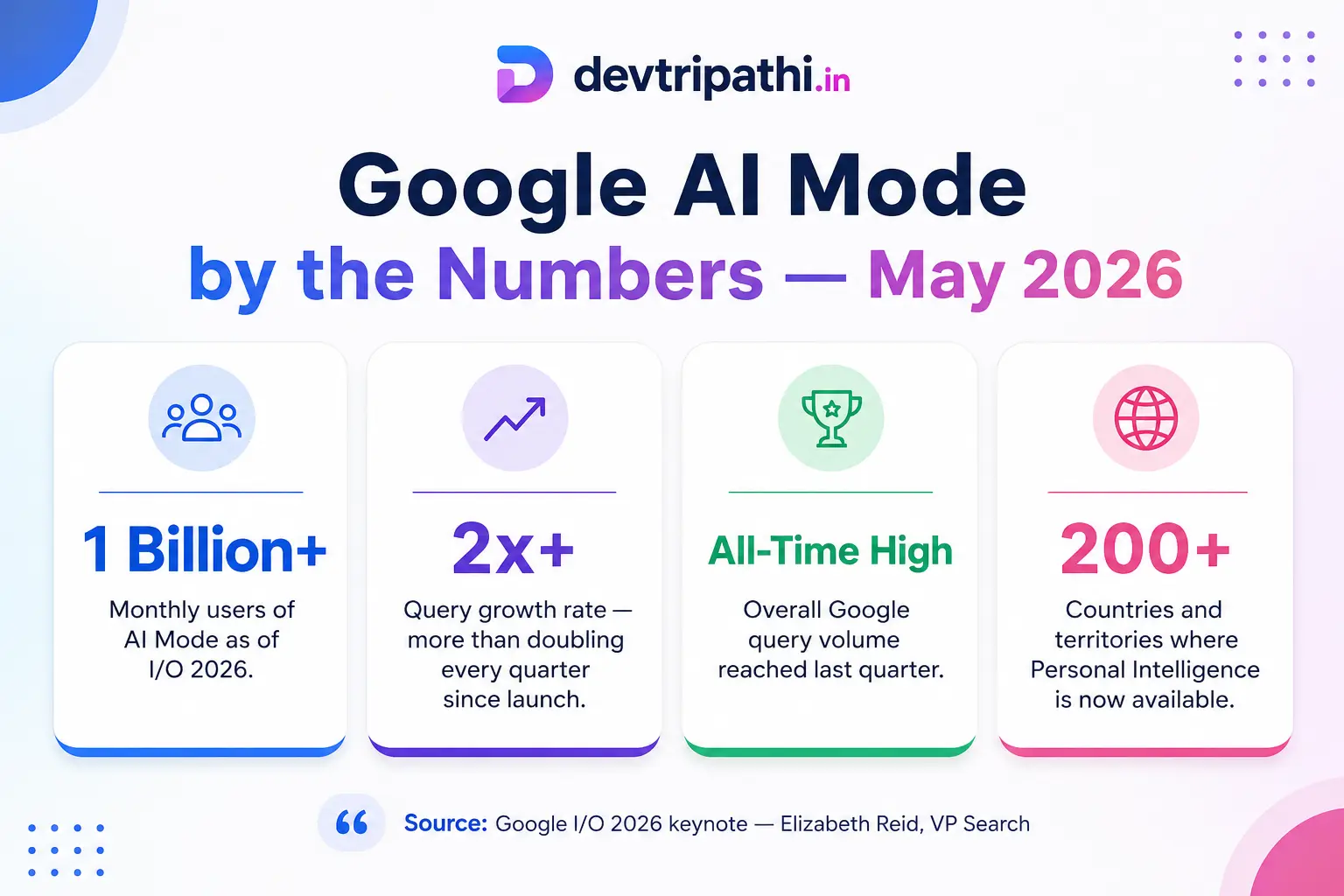
AI Mode, which debuted just one year before I/O 2026, has surpassed one billion monthly users. Queries in AI Mode have more than doubled every quarter since launch. As a direct result, Google's overall query volume reached an all-time high last quarter, demonstrating that AI-powered search is expanding the total volume of search rather than simply cannibalizing traditional results.
This data point is critical context for every announcement that followed. AI Mode is not an experimental feature or a niche product. It is now the primary search experience for over a billion people globally. The optimization strategies that govern AI Mode performance are not future considerations. They are present-day requirements.
For the complete framework on optimizing for AI Mode and AI Overviews, see: Answer Engine Optimization (AEO): The Complete Guide for SEO Professionals at
Announcement 1: Gemini 3.5 Flash Becomes the Default AI Mode Model
The first product announcement was the upgrade of the default AI model powering AI Mode globally. Starting from I/O day (May 19, 2026), Gemini 3.5 Flash replaced the previous default model across all AI Mode experiences for all users globally.
Google described Gemini 3.5 Flash as delivering "sustained frontier performance for agents and coding." This is not simply a speed improvement. It is a capability upgrade that enables two of the other major announcements (agentic coding and AI agents) to function at scale within the Search interface.
What this means for SEO professionals:
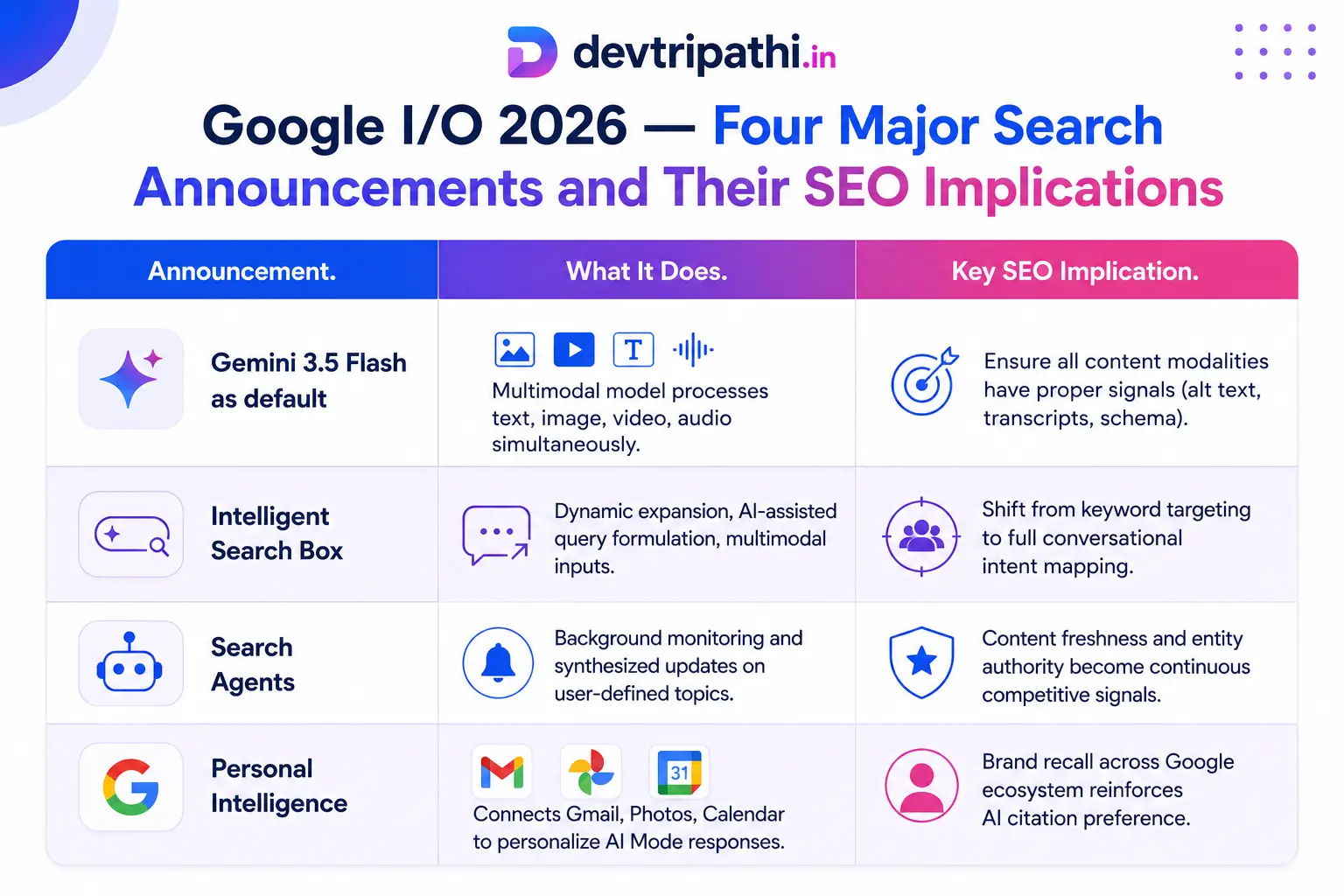
Gemini 3.5 Flash is a natively multimodal model, meaning it processes and evaluates text, images, video, and audio simultaneously when determining which sources to surface in AI Mode responses. Content that only exists in text format without accompanying image alt text, video transcripts, or structured data signals is evaluated against a richer contextual picture than before.
The model's enhanced coding and agent capabilities also mean that AI Mode responses for technical, process-oriented, and complex queries will become more sophisticated. Content that provides deep, structured, expert-level answers to complex queries will become increasingly differentiated from content that provides surface-level overviews.
Action for SEO professionals: Audit your highest-traffic pages for multimodal completeness. Ensure descriptive alt text is on all images, that video content has accurate transcripts, and that structured data covers the full range of content types on each page. This is the multimodal foundation that Gemini 3.5 Flash evaluates.
For the complete multimodal optimization guide, see: Multimodal Search Optimization: The Complete Guide at https://devtripathi.in/blogs/multimodal-search-optimization-complete-guide/
Announcement 2: The Biggest Upgrade to the Google Search Box in 25 Years
This announcement carries the largest long-term structural implication for SEO of everything announced at I/O 2026.
Google announced a complete redesign of the Search box itself, marking what it called "the biggest upgrade to our Search box in over 25 years." The new intelligent Search box has the following specific capabilities:
Dynamically expands to give users space to describe complex needs in full natural language, rather than compressing intent into short keyword strings.
Provides AI-powered suggestions that go beyond traditional autocomplete, helping users formulate their questions more precisely before submitting.
Accepts multimodal inputs directly: text, images, files, videos, and Chrome browser tabs can all be used as search inputs simultaneously.
Users continue to receive a range of results from Search, just as they do today. The interface change does not eliminate traditional results. It changes what queries look like before they reach those results.
The new intelligent Search box is rolling out globally from May 19, 2026, in all countries and languages where AI Mode is available.
What this means for SEO professionals:
This is the most structural change to keyword research methodology since the introduction of Google Instant in 2010. The new Search box actively helps users expand and refine their queries into more detailed, conversational, natural-language phrases. This accelerates a shift that was already underway: the migration from short keyword fragments to long, intent-rich, conversational search queries.
For content teams, this means the research methodology for understanding what users actually want must shift. Keyword volume tools that report data on short-tail terms will become increasingly incomplete as the dominant query form shifts toward longer, AI-assisted natural language inputs. Content that only targets fragmented keywords without addressing the full conversational intent behind those keywords will see declining relevance.
For brands, the multimodal input capability means users can now search by showing Google a photo, uploading a file, or sharing a browser tab rather than typing. This substantially increases the commercial importance of visual search optimization and the indexability of image and file content.
Action for SEO professionals: Update your content research process to include natural language intent mapping alongside keyword volume research. Use People Also Ask data, Search Console long-tail query data, and AI platform prompt testing to understand the full conversational intent behind your target topics. Redesign content around that full intent, not just the fragment keyword.
For the natural language and conversational content strategy, see: Conversational Search Optimization: The Complete Guide at https://devtripathi.in/blogs/conversational-search-optimization-complete-guide/
Announcement 3: Search Agents — AI That Works for You in the Background
The most forward-looking announcement of I/O 2026 was the introduction of Search agents: AI systems that operate in the background, continuously, without requiring a user to submit a new search query.
Google described this as "the era of Search agents" with a specific starting category: information agents.
Information agents work as follows: a user describes what they want to monitor in natural language, as broadly or as specifically as they choose. The agent then continuously scans the web, including blogs, news sites, and social posts, as well as Google's freshest real-time data covering finance, shopping, and sports, monitoring for changes related to that specific question.
When the agent finds relevant changes, it delivers an intelligent, synthesized update with the ability to trigger an action. Google provided two illustrative examples: an apartment hunter who describes their exact requirements and receives continuous notifications when listings match, and a consumer who wants to know the instant a favorite athlete announces a sneaker collaboration.
Information agents will launch first for Google AI Pro and Ultra subscribers this summer.
Additionally, Google announced expanded agentic booking capabilities: users can describe specific criteria for local experiences and services, and Search will surface current pricing and availability with direct booking links. For select categories including home repair, beauty, and pet care, Google is enabling AI to call businesses on behalf of the user.
What this means for SEO professionals:
Search agents represent a fundamental change to the discovery funnel. Traditionally, brands compete for visibility at the moment of search: when a user actively submits a query. Search agents shift some of that visibility to a continuous background monitoring model where brands are either consistently included in an agent's monitoring scope or they are not.
For brands operating in categories where information agents will be active (finance, shopping, local services, news, sports), content freshness becomes more critical than ever. An information agent is specifically designed to detect changes. Content that is regularly updated, timestamp-refreshed, and structured with clear freshness signals will receive systematic attention from information agents that static, rarely-updated content will not.
Booking integration is particularly significant for local service businesses. If Google can complete a booking within AI Mode without requiring the user to visit a business website, traffic patterns for local categories will change substantially. The brand that appears as the agent-recommended booking option for a given category in a given location has an outsized advantage. This makes local AEO, entity completeness, review volume, and Google Business Profile quality more commercially important than ever.
Action for SEO professionals: Establish systematic content freshness updates across all high-value commercial pages. Ensure Google Business Profile is complete and regularly updated for all service categories. Build the entity authority signals that make your brand the agent's preferred recommendation for target local categories.
For the local AEO strategy, see: AEO Strategy 2026: The Advanced Playbook at AEO Strategy 2026 advanced Playbook
Announcement 4: Agentic Coding in Search — Custom Experiences Generated On-the-Fly
Google announced the integration of agentic coding capabilities directly into Search, powered by Gemini 3.5 Flash and Google's Antigravity agentic development platform.
The specific capability: Search can now build custom UI responses entirely on the fly, tailored to the specific nature of each query. This includes interactive visuals, tables, graphs, and simulations assembled in real-time. The example Google provided was a user exploring astrophysics concepts who receives a custom-built interactive simulation rather than a list of links.
For ongoing tasks, Search can go further: building custom dashboards and trackers that users can return to repeatedly. Google gave the example of a user asking Search to build a custom fitness tracker, assembled from real-time sources including reviews, live maps, and local weather data. Google described these as "mini apps for your own specific tasks."
Generative UI capabilities will be available for everyone in Search this summer, free of charge. The mini app building capability will roll out first for Google AI Pro and Ultra subscribers in the US.
What this means for SEO professionals:
This announcement is the clearest signal yet that for certain query types, Google intends to satisfy the user's need entirely within the Search interface without a click to any external website. A user who asks Search to build a fitness tracker, a wedding planning dashboard, or a home renovation tracker may never visit a single content website during that research and planning session.
However, the generative UI draws from "fresh, real-time sources including reviews, live maps, and local data." The sources feeding these generated experiences are the brands, products, and content providers that are indexed, authoritative, and well-represented in Google's data systems. Being the data source that powers a generative experience, even without a visible click, is a new category of search visibility.
Action for SEO professionals: Expand your definition of search visibility to include data-layer presence, not only click-through traffic. Ensure your business data is complete and accurate across Google Business Profile, Google Maps, Google Shopping, and structured data on your website. The brands that feed generative UI experiences are the brands with the most complete, most accurate, most current structured data in Google's systems.
Announcement 5: Personal Intelligence Expands Globally
The final major Search announcement addressed Personal Intelligence: Google's system for connecting AI Mode to a user's personal data from connected Google applications.
Personal Intelligence is now expanding to nearly 200 countries and territories across 98 languages, with no subscription required. Users can securely connect Gmail, Google Photos, and soon Google Calendar to their AI Mode experience.
Google was explicit about the privacy design: users are always in control of whether they connect apps, and the feature was "designed with transparency, choice and control at its core."
The practical capability: AI Mode can now draw on a user's personal context when formulating search responses. A user searching for restaurants can receive recommendations that factor in previous email conversations about upcoming events. A user researching vacation destinations can receive suggestions informed by their personal travel photos. A user asking about scheduling can receive context-aware responses that account for their calendar.
What this means for SEO professionals:
Personal Intelligence creates a layer of search personalization that sits above the standard web content ranking system. For a user whose connected Gmail contains multiple references to a specific brand, that brand may receive elevated consideration in AI Mode responses for relevant queries. This is brand recall becoming algorithmically observable.
This reinforces the strategic importance of generating real-world brand conversations that end up in users' email inboxes and communication records. Newsletters, transactional emails, service communication, and brand emails all become potential Personal Intelligence signals. A brand that users have a positive, recurring email relationship with has a form of recall advantage in a personally-connected AI Mode session.
The Google Calendar integration (announced as coming soon) is particularly significant for event-driven commercial categories: travel, hospitality, experiences, and appointment-based services. When Search can see a user's upcoming calendar events, it can serve highly contextual commercial recommendations for surrounding needs.
Action for SEO professionals: Build email communication strategies that create genuine positive brand touchpoints with your audience. Ensure your transactional emails, newsletters, and service communications are valuable and welcomed rather than generic. In a personally-connected AI Mode environment, genuine brand relationships create observable preference signals.
The I/O 2026 Follow-Up Conversation Feature
Alongside the major announcements, Google confirmed an enhancement to the conversational flow within Search: users can now ask follow-up questions directly from within an AI Overview, flowing seamlessly into a conversational back-and-forth with AI Mode while context is preserved throughout the session.
This seamless, multi-turn conversational experience is live globally across desktop and mobile as of May 19, 2026.
For content optimization, this confirms the importance of multi-turn intent coverage. A page that answers the primary query and anticipates natural follow-up questions is more likely to remain the cited source across multiple turns of a conversational search session than a page that addresses only the initial query.
For the complete conversational search optimization guide, see: Conversational Search Optimization: The Complete Guide at Conversational search Optimization Complete Guide
What Google I/O 2026 Means for SEO Strategy: The Complete Summary
The I/O 2026 Search announcements collectively signal a single, coherent direction: Google is building Search to do more for users than retrieve and rank content. It is building Search to act, generate, personalize, and monitor on behalf of users continuously.
For SEO professionals, this creates five priority actions:
First: Embrace multimodal content completeness. Gemini 3.5 Flash evaluates content across text, image, video, and audio simultaneously. Every content gap in non-text modalities is a potential citation gap in AI Mode responses.
Second: Redesign content research around conversational intent. The new intelligent Search box actively helps users submit richer, more natural-language queries. Keyword volume alone no longer captures what users are actually searching.
Third: Treat content freshness as a continuous competitive signal. Information agents are specifically designed to monitor for changes. Fresh, regularly updated content with clear freshness timestamps is seen by agents. Static content is not.
Fourth: Expand structured data investment for agentic experience sourcing. Generative UI and agentic booking draw from Google's most complete, most accurate structured data sources. Business data completeness across Google Business Profile, Shopping, and website schema is now a prerequisite for being included in generated experiences.
Fifth: Build genuine brand presence across the Google ecosystem. Personal Intelligence makes email relationships, Google Photos appearances, and Calendar context algorithmically relevant to search personalization. Brands that exist in users' personal digital lives have recall advantages in AI Mode.
For the unified AI search optimization framework that connects all five priorities, see: AI Search Optimization (AISEO): The Complete Guide at AI Search Optimization AISEO Complete Guide
Frequently Asked Questions About Google I/O 2026 Search Updates
Conclusion
Google I/O 2026 represents the clearest public statement yet that Google is building Search not as a tool that helps users find content, but as a system that acts on users' behalf. Agents monitor. Coding generates. Personal Intelligence personalizes. The intelligent Search box helps users ask better questions.
For SEO professionals, these are not disruptions to existing strategy. They are extensions of the same underlying principle that has always governed search performance: give Google complete, clear, authoritative, and fresh information about your brand, and the system will surface your brand in the experiences where users are looking.
What has changed is where those experiences are, how they are assembled, and how personal context influences which brands are selected. The technical requirements are multimodal completeness, entity consistency, content freshness, and structured data quality. The strategic requirements are genuine brand authority, real community presence, and an authentic relationship with your audience.
I/O 2026 raised the bar. The brands that meet the new bar will earn more qualified, more intent-rich, more commercially valuable search visibility than at any previous point in the history of the discipline.
Start with the audit. Then build systematically.
External Resources: Google I/O 2026 Search Announcement (Official): https://blog.google/products-and-platforms/products/search/search-io-2026/
Google AI Mode: https://g.ai/
Google AI Optimization Guide (Official): https://developers.google.com/search/docs/fundamentals/ai-optimization-guide
Google Search Central Blog: https://developers.google.com/search/blog
Google Antigravity — Agentic Development Platform: https://developers.googleblog.com/build-with-google-antigravity-our-new-agentic-development-platform/
