
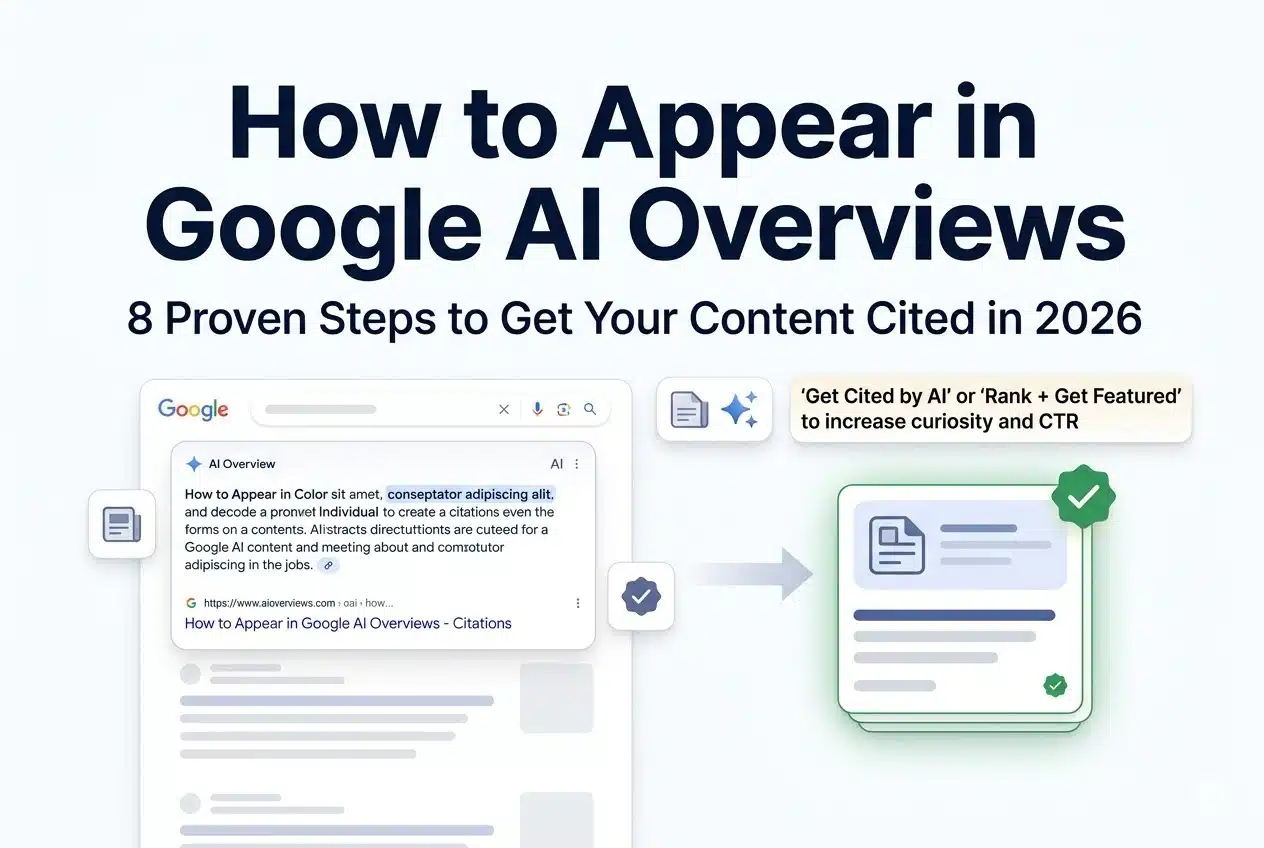
How to Make Your Blog Appear in Google AI Overviews
30 March 2026
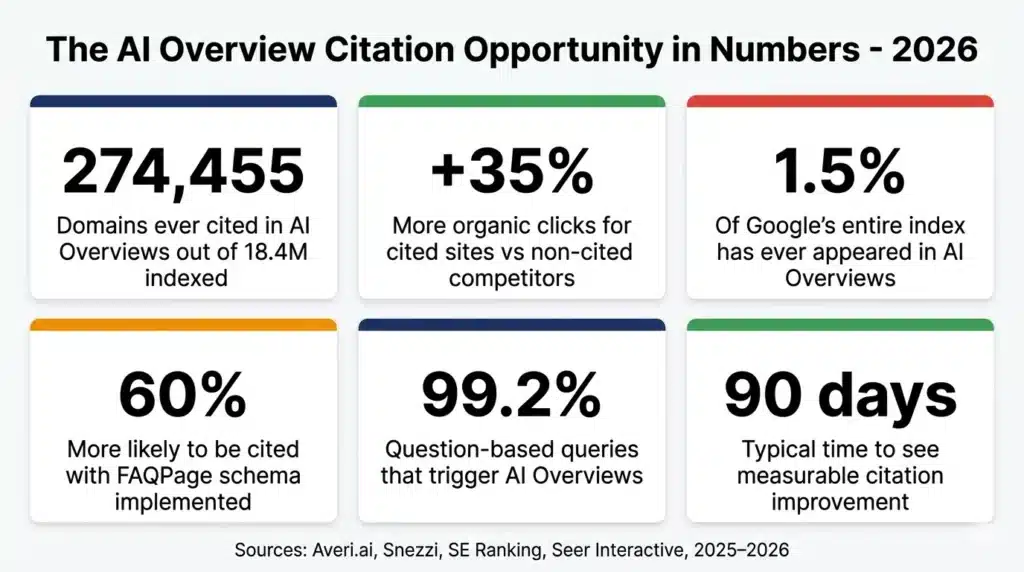
There are 18.4 million domains in Google’s search index. Only 274,455 of them have ever appeared in a Google AI Overview.
That is 1.5% of the entire indexed web. And yet the blogs and brands inside that 1.5% earn 35% more organic clicks and 91% more paid clicks than those outside it.
If you want to appear in Google AI Overviews, you need to understand one thing first: this is not about gaming an algorithm. It is about building content that an AI system – evaluating dozens of competing sources in real time – consistently chooses as the most trustworthy, clear, and useful answer.
This guide gives you the exact framework to do that – based on what the data shows actually works in 2026, confirmed by Google’s own Search Central documentation and independent research across millions of AI Overview citations.
What Google Actually Looks for Before Citing Your Blog
Before diving into specific strategies, it helps to understand how Google’s system selects sources – because most optimisation advice misses this foundational step.
According to Google’s own Search Central documentation, there are no special technical requirements to appear in AI Overviews beyond standard Google indexing eligibility. Your page must be indexed and eligible to appear in standard Google Search results. That is the baseline. Everything above that baseline is about content quality, authority, and structure.
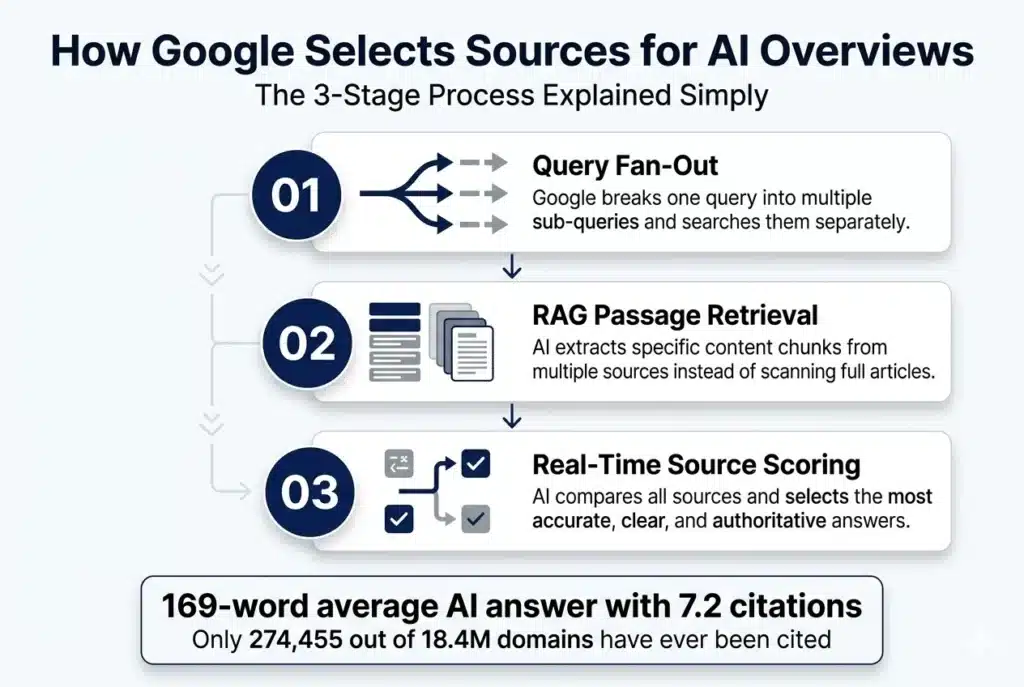
Google’s AI systems use query fan-out – breaking the user’s question into three to five targeted sub-queries – and then use Retrieval-Augmented Generation (RAG) to pull specific passage chunks from multiple sources. The AI does not read your full article. It evaluates whether specific passages within your article can function as self-contained, trustworthy answers to each sub-query.
This changes the optimisation target entirely. You are not trying to rank an article. You are trying to build an article full of passages that each work as standalone answers.
Research confirms that AI Overview summaries average around 169 words with approximately 7.2 citation links per summary. Pages with high semantic alignment with the user’s query receive 7.3 times higher selection rates. Pages with proper schema markup are 3 times more likely to earn AI citations than those without.
The 8 Factors That Determine Whether Your Blog Gets Cited
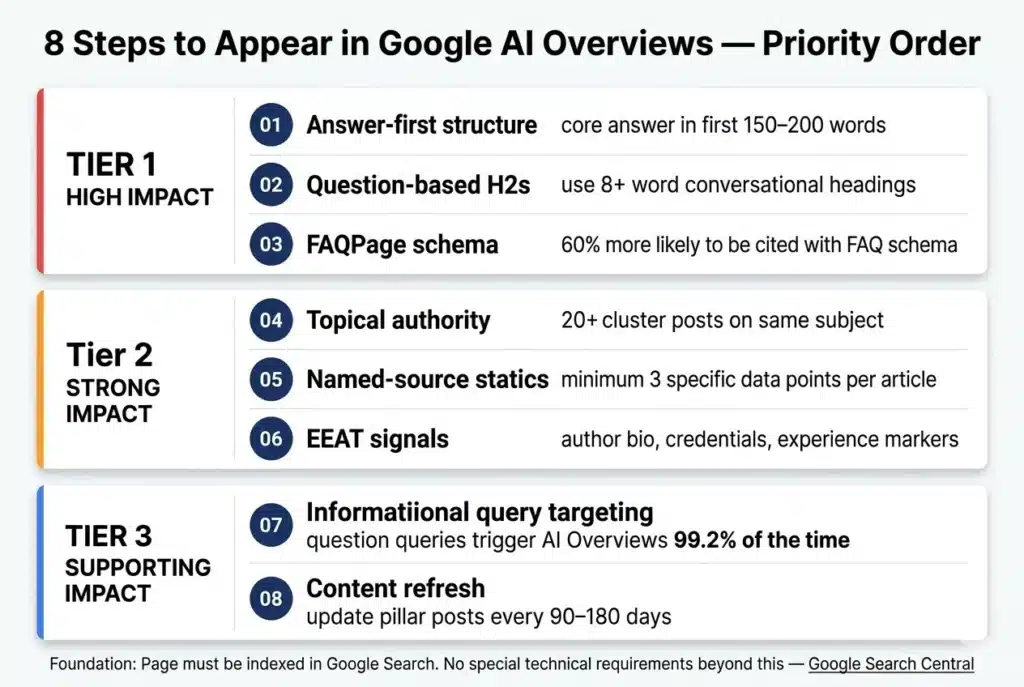
Based on analysis of AI Overview citation patterns across 2025 and 2026, eight factors consistently separate cited pages from non-cited ones. The first three carry the highest individual impact.
| Factor | What It Means | Impact Level |
|---|---|---|
| Answer-first structure | Core answer appears in first 150–200 words | Very High |
| Topical authority | 20+ related posts on the same subject cluster | Very High |
| FAQPage schema | Structured FAQ markup implemented correctly | Very High |
| Question-based H2 headings | Conversational headings matching 8+ word queries | High |
| Named-source statistics | Specific data with verifiable attribution | High |
| EEAT signals | Author bio, credentials, first-hand experience | High |
| Content recency | Updated within last 90–180 days | Medium |
| Page speed / Core Web Vitals | LCP under 2.5s, fully mobile-optimised | Medium |
One number puts the authority factor in perspective: 92.36% of all AI Overview citations come from domains already ranking in Google’s top 10 for that query. Yet 46.5% of cited URLs rank outside the top 50 – meaning strong content structure and authority signals can compensate for lower ranking positions. Building topical authority across a content cluster remains the single most powerful long-term lever available.
8 Step-by-Step Strategies to Appear in Google AI Overviews
Step 1 – Answer the Query Directly in Your First 150–200 Words
AI systems using RAG retrieval evaluate opening content heavily. When Google’s AI decomposes a user’s question and searches for passage chunks, the first 150–200 words of your article are among the first passages assessed for relevance. Write your opening paragraph as if it were a direct answer to the exact search query. State the core answer in the first two sentences. Then use the rest of the article to provide the depth and evidence that makes your answer trustworthy.
The warm-up introduction that traditional SEO allowed – several paragraphs building context before the actual answer – is now actively working against your AI citation chances. Answer first. Expand second.
Step 2 – Use Question-Based H2 Headings (8+ Words)
SE Ranking’s 2024 AI Overviews study found that long-tail queries of four or more words trigger AI Overviews 60.85% of the time. BrightEdge confirms that question-style queries of eight or more words trigger them at an even higher rate. Your H2 headings are the first structural signal the AI reads when decomposing your article into passage chunks.
A heading like ‘How Do I Get My Blog to Appear in Google AI Overviews?’ directly matches the query pattern that triggers AI Overviews. A heading like ‘AI Overview Optimisation Tips’ does not. Review every H2 in your existing content and rewrite them as natural, complete questions wherever possible.
Step 3 – Add FAQPage Schema to Every Post
Pages with FAQ schema are 60% more likely to be featured in AI Overviews compared to those without structured data, according to January 2026 research. Pages with any proper schema markup are 3 times more likely to earn AI citations overall. FAQPage schema explicitly marks your FAQ answers as structured responses to specific questions – exactly the format Google’s AI is designed to retrieve and cite.
Use Rank Math’s FAQ block to generate FAQPage schema automatically. Each question should be 5–10 words. Each answer should be 2–3 sentences: direct, complete, and self-contained enough to be pulled as a standalone passage without needing additional context from the surrounding article.
Step 4 – Build Topical Authority With a Content Cluster
A single well-optimised post is unlikely to earn consistent AI citations. Google’s AI systems evaluate domain-level topical authority – how comprehensively your site covers a subject – when deciding which sources to trust across related queries. Building 20 or more interlinked posts on a single topic cluster signals to Google that your domain has genuine depth of expertise in that area.
This is why the GEO content cluster approach outperforms isolated blog posts for AI citation rates. Each cluster post reinforces the domain’s authority signal for the entire topic. One post about GEO is a data point. Twenty interlinked posts about GEO is a recognised authority signal.
Step 5 – Attach Specific Statistics to Every Key Claim
Verifiability is among the strongest signals for AI citation selection. An AI system comparing two sources on the same concept will consistently favour the source providing specific, attributed data over one making general claims. The standard to aim for is at least three named-source statistics per article.
Not ‘research shows’ or ‘experts agree’ – but ‘According to SE Ranking’s 2024 AI Overviews study, four-plus-word queries trigger AI Overviews 60.85% of the time.’ That level of specificity makes your content citation-worthy. General assertions do not.
Step 6 – Strengthen EEAT Signals on Every Post
Google’s AI systems are designed to surface trustworthy sources. EEAT – Experience, Expertise, Authoritativeness, and Trustworthiness – is the framework Google uses to evaluate source credibility. For AI Overview citation selection, EEAT signals include a clearly identified author with relevant credentials, an author bio page with links to other published work, first-hand experience demonstrated within the content, and outbound links to credible authoritative sources.
The fastest EEAT improvement most bloggers can make is adding a detailed author bio to every post – with specific credentials, relevant experience, and a link to an author page. This single change signals author identity to Google’s AI systems and improves citation eligibility across every post that author has written.
Step 7 – Target Informational and Question-Based Query Types
Not all queries trigger AI Overviews equally. Question-based queries trigger AI Overviews 99.2% of the time. Long-tail queries of four or more words trigger them 60.85% of the time. B2B technology queries trigger AI Overviews on 82% of SERPs. Education queries trigger them on 83%. Commercial and transactional queries trigger them only 6–8% of the time.
If your blog is primarily informational – which is the case for most content creators and niche bloggers – you are operating in the highest-trigger-rate category. The disruption risk is highest, but so is the citation opportunity. Optimise your informational content for AI citation first, before moving to other content types.
Step 8 – Refresh Your Content Every 90–180 Days
AI systems that use real-time retrieval strongly favour recently updated content. A 2023 article with 200 backlinks loses ground to a 2026 version of the same article with updated data and a visible ‘Last updated’ timestamp, even when the newer article has fewer backlinks. Build a content refresh calendar. Prioritise your highest-traffic informational posts first.
Update every statistic, add new examples from the current year, and display the ‘Last updated’ date visibly at the top of the post. Research tracking tactical AI citation changes shows most blogs see citation improvements within 30–45 days of refreshing content with specific statistics and structured FAQ sections.
How to Track Whether Your Blog Is Appearing in AI Overviews
Knowing your strategy is working requires measuring it. There are four practical methods to track AI Overview appearances for your blog.
Google Search Console now includes AI Overview data in its Performance report under the ‘Web’ search type, as of June 2025. While it does not separate AI Overview traffic from standard organic traffic, you can identify AI Overview impact by filtering for queries where impressions are high but CTR has dropped – this pattern typically indicates AI Overview presence is intercepting clicks.
For more granular tracking, Semrush’s AI Toolkit shows which of your target keywords trigger AI Overviews and which competitors are being cited. Dedicated tools like Otterly.AI and Profound track your brand’s citation frequency across multiple AI platforms simultaneously. Manual sampling – searching your target keywords in Google weekly and documenting which pages appear in the AI Overview – remains one of the most direct methods available to smaller blogs.
Most brands see measurable citation improvements within 90 days of systematic optimization. The fastest gains – typically within 30–45 days – come from adding specific statistics and structured FAQ sections to existing content.
Tracking Method | What It Shows |
Google Search Console | Impressions vs CTR patterns – indirect AI Overview signal (from June 2025) |
Semrush AI Toolkit | Which keywords trigger AI Overviews + competitor citation tracking |
Otterly.AI / Profound | Direct citation tracking across Google, Perplexity, and ChatGPT |
Manual keyword sampling | Weekly SERP checks – most direct method for independent bloggers |
Google Analytics referral | Filter for chatgpt.com, perplexity.ai, gemini.google.com referrals |
The Window Is Open – But It Is Closing
Only 1.5% of Google’s indexed web has ever appeared in an AI Overview. That number will grow – but the blogs and brands establishing citation authority now will have compounding advantages that late movers cannot easily overcome.
Once an AI system selects a trusted source for a topic, it reinforces that choice across related queries. The blog that becomes the default citation in its category today will be harder to displace tomorrow. This winner-takes-most dynamic makes early optimisation significantly more valuable than delayed optimisation.
Start with the three highest-impact changes – answer-first structure, question-based H2 headings, and FAQPage schema – and apply them to your five most-visited informational posts. Track your Search Console impression data over the following 90 days. The evidence of what is working will show itself in the data, and you can build from there.
The goal has always been to help your readers find the best answer to their question. In 2026, that answer sometimes comes from an AI. The question is simply whether you are the source it cites.
- What Is GEO? Complete 2026 Pillar Guide →
- Google AI Mode: Transforming Search and SEO Strategies in 2025 →
- Understanding AI Mode Analytics: Measuring Success in a Generative Search Landscape →
- AI Mode vs Traditional Search: Comparing User Experiences →
- Optimizing for AI Mode: New SEO Strategies →
- Google December 2025 Core Update: Complete Analysis →
- The Ultimate On-Page SEO Checklist for 2025 →
- How to Update Old Content for SEO →
- Why a Structured SEO Plan Is Essential for Long-Term Success →
- 20 Common SEO Mistakes You Must Avoid →
FAQ
How do I get my blog to appear in Google AI Overviews? ▼
To appear in Google AI Overviews, answer your core query in the first 150-200 words, use question-based H2 headings, add FAQPage schema using Rank Math, include at least three specific statistics with named sources, and build topical authority by publishing a cluster of 15-20 interlinked posts on the same subject. Pages with FAQ schema are 60% more likely to be cited.
Do I need to rank in Google top 10 to appear in AI Overviews? ▼
Not necessarily, but it significantly helps. Research shows 92.36% of AI Overview citations come from domains ranking in the top 10. However, 46.5% of cited URLs rank outside the top 50, meaning strong content structure and authority signals can compensate for lower ranking positions. Traditional SEO is still the strongest foundation for AI citation eligibility.
How long does it take to appear in Google AI Overviews? ▼
Most blogs see measurable citation improvements within 90 days of systematic optimisation. The fastest gains – typically within 30-45 days – come from adding specific statistics and structured FAQ sections to existing content. Building domain-level topical authority that drives consistent, broad AI citations takes 3-6 months of sustained publishing and internal linking.
Which type of blog content is most likely to appear in AI Overviews? ▼
Informational content – how-to guides, explanatory articles, educational posts, and question-based content – is most likely to trigger AI Overviews. Question queries trigger AI Overviews 99.2% of the time. Long-tail queries of four or more words trigger them 60.85% of the time. Commercial and transactional content triggers AI Overviews only 6-8% of the time.
Does appearing in a Google AI Overview actually increase my traffic? ▼
Yes – significantly. Sites cited inside AI Overviews earn 35% more organic clicks and 91% more paid clicks compared to non-cited competitors. AI-referred traffic converts at 14.2%, compared to 2.8% for standard organic traffic. Even when users do not click through, your brand appearing as a cited source builds awareness and trust with every reader who sees your content referenced in the AI-generated answer.
What is the fastest single change I can make to improve my AI Overview eligibility? ▼
Add a direct answer block in the first 150-200 words of your post – a 50-100 word paragraph that answers the main question immediately without any preamble. AI systems extract 44% of all citations from the opening section of a page. This single structural change, applied to your top five posts, can begin showing citation improvements in Google Search Console impressions within 30-45 days and requires no new content creation.
How many blog posts do I need to publish to build topical authority for AI Overviews? ▼
Research consistently points to 15-20 interlinked posts on the same subject cluster as the threshold where topical authority signals become strong enough to drive consistent AI citations. Sites with 20+ interconnected articles on a topic see 3.2x higher AI citation rates than those with isolated posts (Moz, 2025). Start with one comprehensive pillar post and build 8-12 cluster posts targeting specific sub-questions your audience asks about the same topic.
Does FAQPage schema really make a difference for AI Overview citations? ▼
Yes – measurably. Pages with FAQPage schema are 60% more likely to be cited in AI Overviews than pages without it. BrightEdge confirms schema markup enables AI engines to extract information with 300% higher accuracy versus unstructured content. The combination of Article schema, FAQPage schema, and ItemList schema produces 1.8x more AI citations than Article schema alone (GenOptima). In WordPress, Rank Math Pro supports all three schema types simultaneously.
What word count should my blog post be to get cited in AI Overviews? ▼
Posts under 800 words rarely provide enough structured content for AI systems to extract multiple useful citation chunks. The recommended range for cluster posts is 2,000-3,500 words with strong internal structure. Interestingly, 53.4% of AI-cited pages are under 1,000 words – indicating that a well-structured 900-word post with a strong opening answer block and FAQ section can outperform a poorly structured 3,000-word post. Structure matters more than length.
How do question-based H2 headings help with Google AI Overviews? ▼
Question-based H2 headings create a direct structural match between what a user searches and what your page contains. Ahrefs data shows 35% of all AI Overview triggers are questions starting with who, what, why, when, or how. AI systems scan heading-and-answer pairs to extract citation-ready responses – a question heading followed immediately by a direct 50-75 word answer creates exactly the structured chunk AI needs to cite your page confidently. Pages with question-based headings are 2.8x more likely to earn AI citations.
Can I get cited in Google AI Overviews without a high domain authority score? ▼
Yes – and this is one of the most important opportunities for independent bloggers. While 92.36% of AI Overview citations come from top-10 ranking domains, 46.5% of cited URLs rank outside the top 50. AI systems evaluate content quality, specificity, and structure independently of domain authority. SE Ranking found that for smaller domains, content depth has 65% more relative impact on AI citations than it does for large authority sites.
What statistics or data should I include to improve AI Overview citations? ▼
Include specific, attributed statistics with named sources – not vague claims. For example: ‘76.1% of AI Overview citations come from top-10 ranking pages (Ahrefs, 2025)’ is citation-worthy. ‘Most AI citations come from well-ranked pages’ is not. Aim for at least three attributed statistics per post. Content with original statistics receives 2.5x more LLM citations than derivative content (EEATMinds, 2026). If you have run your own tests, include those results – original data is the single highest-value citation signal available.
How do I check which of my posts are already appearing in Google AI Overviews? ▼
Use three methods in combination. First, manual testing: search your top 20 keywords in incognito Chrome and check whether an AI Overview appears and whether your site is cited. Second, Google Search Console: identify queries where impressions are rising but CTR is declining – this pattern signals AI Overview citation appearances. Third, paid tools: Semrush AI Visibility Toolkit, Ahrefs Brand Radar, and AthenaHQ all provide automated monitoring of your citation appearances at scale.
Does my author bio affect my chances of appearing in AI Overviews? ▼
Yes – significantly. Websites with author schema are 3x more likely to appear in AI answers (BrightEdge). Author credentials now carry 16% weight in AI citation decisions – up from 8% in 2024. Your author bio should include your full name, specific credentials relevant to your topic, links to verifiable external presence (LinkedIn, published work), and be marked up with Person schema. An anonymous post or generic Staff Writer byline is effectively a citation penalty.
Should I create separate landing pages for AI Overview optimisation? ▼
No – optimise your existing blog posts rather than creating separate pages. AI Overview citations come from contextually rich, comprehensive content that also ranks well in traditional search. A separate thin page created only for AI citation purposes will lack the depth, internal linking context, and ranking signals that make content citation-eligible. The most effective approach is to upgrade your existing top-performing informational posts with BLUF introductions, question headings, FAQ sections, and schema markup.
How do internal links affect my AI Overview citation chances? ▼
Internal linking between related posts on the same topic is one of the most important signals for building the topical authority that drives consistent AI citations. When AI systems crawl your site and find 15-20 posts on the same subject all linking to each other, they recognise your site as a comprehensive, reliable source – significantly increasing citation probability across all posts in the cluster. Orphan posts with no internal links are significantly less likely to be cited.
What is the difference between appearing in Google AI Overviews and ranking position 1? ▼
Ranking position 1 means your blue link appears first in Google’s organic results. Appearing in a Google AI Overview means your content is cited inside the AI-generated summary that appears above all organic results. The AI Overview is now the most prominent element on the search results page. Being cited in the AI Overview while also ranking position 1 is the optimal outcome: cited pages earn 35% more organic clicks than non-cited pages even if those non-cited pages outrank you traditionally.
How often should I update my posts to maintain AI Overview citations? ▼
Every 90-180 days for core cluster posts, and every 60 days for posts on fast-moving topics. Semrush’s AI Visibility Index shows 40-60% of cited sources rotate monthly – meaning static content loses citation positions to fresher competitors over time. Each update should add new statistics, refresh outdated data points, expand the FAQ section with new questions, and update the last-updated timestamp. Pages refreshed within the last 90 days consistently outperform static pages in AI citation rates.
Do I need to pay for tools to optimise for Google AI Overviews? ▼
No – the core optimisation changes are free. The free stack: Rank Math free tier for FAQPage and Article schema, Google Search Console for citation monitoring, GA4 for AI referral traffic tracking, Hemingway Editor for readability auditing, and monthly manual citation testing in incognito mode. Paid tools like Semrush AI Visibility Toolkit and Ahrefs Brand Radar add automation and scale but are not required to start getting results.
What content topics get cited most in Google AI Overviews? ▼
In order of AI Overview trigger frequency: informational queries (88-91% trigger rate), B2B technology content (82% of SERPs), education content (83% of SERPs), health and medical queries (51.6% of SERPs). Blog posts are the number one cited content type overall (Conductor, 2026). Within blog content, structured list format articles account for 74.2% of all AI citations (GenOptima, Q1 2026). Commercial and transactional queries trigger AI Overviews only 6-8% of the time.
What is a content cluster and why is it essential for AI Overview visibility? ▼
A content cluster is a group of interlinked blog posts that together cover a single topic comprehensively – one broad pillar post supported by 8-15 cluster posts each targeting a specific sub-question. For AI Overviews, content clusters work because AI systems evaluate topical authority at the domain level. When your site comprehensively covers all aspects of a subject through interlinked posts, AI systems recognise it as a trustworthy expert source and increase citation probability across all posts in the cluster.
How do I write an introduction that gets cited in Google AI Overviews? ▼
Write a BLUF (Bottom Line Up Front) introduction: your first paragraph should directly answer the main question in 50-75 words, with no build-up and no context-setting. State the answer immediately, include one specific attributed statistic, and add one sentence on why this matters. AI systems extract 44% of all citations from the opening 200 words of a page. An introduction that spends its first 150 words on background before getting to the answer has minimal chance of being cited.
What is the role of E-E-A-T in Google AI Overview citations? ▼
E-E-A-T (Experience, Expertise, Authoritativeness, Trustworthiness) directly affects AI Overview citation probability. The Experience component is particularly important in 2026 – first-hand experience content (personal test results, case studies, real examples) outperforms generic expertise content because it provides information AI cannot generate from training data alone. Implement E-E-A-T by naming your author with full credentials, linking to verifiable external presence, citing primary sources for all statistics, and including specific real examples rather than hypothetical scenarios.
Should I mention competing brands or tools in my posts to improve AI citation? ▼
Yes – contextually mentioning established tools, platforms, and brands in your field increases Semantic Density and signals to AI systems that your content covers the topic comprehensively. A post about GEO that mentions Semrush, Ahrefs, Google Search Console, Rank Math, and Perplexity in relevant context demonstrates genuine familiarity with the full ecosystem. Avoid shallow name-dropping – each mention should add genuine context or comparison value for the reader.
What should I do in the next 30 days to start appearing in Google AI Overviews? ▼
Week 1: identify your top five highest-traffic informational posts and add a BLUF answer block in the first 150 words of each. Week 2: convert all H2 and H3 headings in those five posts to question format. Week 3: add a 10-15 question FAQ section with FAQPage schema to each post using Rank Math. Week 4: update any statistics older than 12 months, add a named author bio with credentials, and set up a GA4 custom segment filtering chatgpt.com and perplexity.ai referrals to begin tracking AI traffic.

Devyansh Tripathi
I’m Devyansh Tripathi, an SEO strategist and digital growth expert, helps businesses and individuals rank higher and drive organic traffic. Through DevTripathi., he shares cutting-edge SEO insights, content strategies, and marketing hacks. Passionate about digital success, he’s on a mission to make SEO simple, effective, and result-driven!
Posts
- What Is EEAT and How It Connects to GEO in 2026 (Blogger’s Guide)
- How to Make Your Blog Appear in Google AI Overviews
- Traditional SEO Is Not Dead – But It Needs GEO to Survive
- What Is an AI Overview and How Does It Affect Your Blog Traffic?
- 10 GEO Terms Every Blogger Must Know in 2026 – Plain English Glossary
Latest News
Text Widget
Empowering brands with insights, strategies, and stories that drive digital growth.