
What Is EEAT and How It Connects to GEO in 2026 (Blogger’s Guide)
31 March 2026
Most bloggers know EEAT as a Google ranking signal. They add an author bio, link to a few credible sources, and consider the job done.
In 2026, that understanding is no longer sufficient – and it is leaving real visibility on the table.
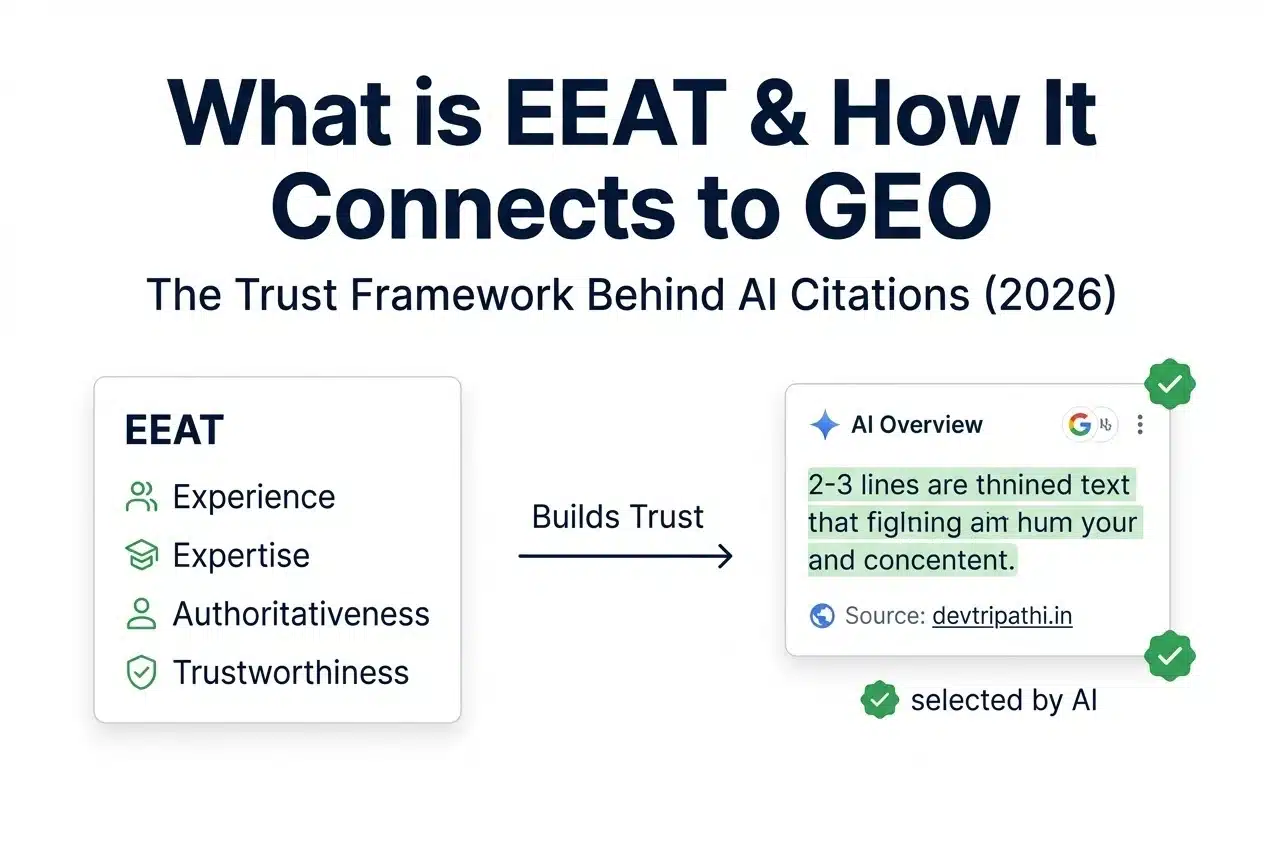
EEAT – Experience, Expertise, Authoritativeness, and Trustworthiness – has evolved from a human quality-check framework into what one researcher called an AI confidence score. It now determines not just where your blog ranks in Google search results, but whether AI systems like Google AI Overviews, Perplexity, and ChatGPT are willing to cite your content at all.
Understanding the EEAT and GEO connection is no longer optional for bloggers who want to stay visible as AI search continues to grow. This guide explains what EEAT actually means in 2026, why it matters specifically for GEO, and the concrete steps you can take to build it – even as a solo blogger without a team or budget.
What EEAT Actually Means – Beyond the Acronym
EEAT stands for Experience, Expertise, Authoritativeness, and Trustworthiness. It comes from Google’s Search Quality Rater Guidelines – a publicly available document that Google uses to train the human evaluators who assess whether its search results are returning high-quality content.
The extra ‘E’ – Experience – was added in December 2022, upgrading the original EAT framework. The addition matters because it shifted Google’s emphasis from theoretical knowledge to demonstrated, first-hand experience. An article about mountain hiking written by someone who has climbed 50 mountains carries a different quality signal than the same article written by someone who has never left the city.
EEAT Component | What Google and AI Look For | Blogger Example |
Experience (E) | First-hand, lived engagement with the topic | Case studies, personal results, ‘I tested this’ content |
Expertise (E) | Deep knowledge, credentials, qualifications | Author bio with credentials, niche-specific depth |
Authoritativeness (A) | Recognition by others in the same field | Backlinks from industry sites, citations, mentions |
Trustworthiness (T) | Accuracy, transparency, security, reliability | Named authors, cited sources, HTTPS, contact page |
Google’s Search Quality Rater Guidelines state explicitly that Trustworthiness is the most important of the four components: ‘Trust is the most important member of the E-E-A-T family because untrustworthy pages have low E-E-A-T no matter how Experienced, Expert, or Authoritative they may seem.’ Without trust, the other three signals carry significantly less weight.
How EEAT Connects to GEO – The Critical 2026 Link
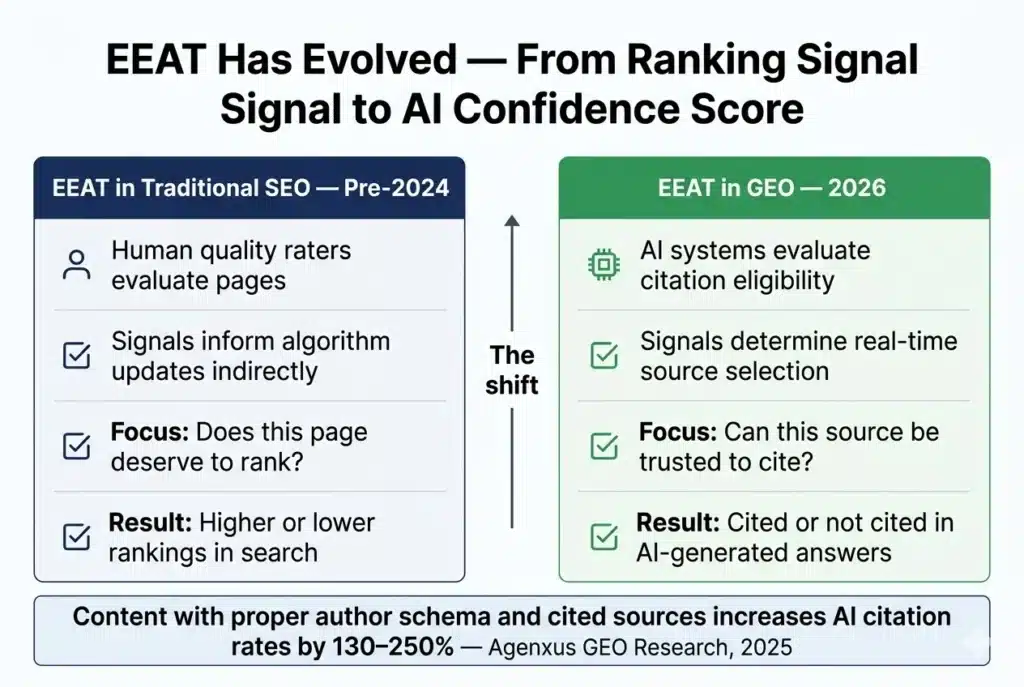
Traditional SEO used EEAT primarily as a quality framework – Google’s quality raters evaluated pages against these signals, and the results informed algorithm updates. The connection was real but indirect.
GEO changes this relationship completely. When an AI system generates a response to a user query, it is not just ranking your page – it is deciding whether to cite your content as a trusted source inside its answer. That decision is fundamentally an EEAT evaluation.
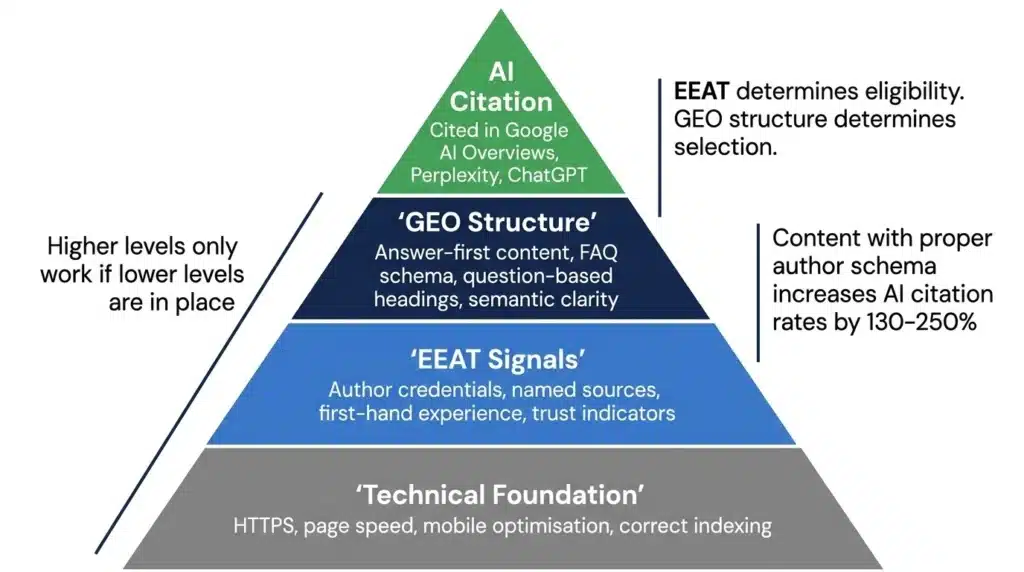
As researchers who study AI citation patterns have observed, the process works like this: EEAT determines eligibility, while GEO structure determines selection within the eligible pool. Without strong EEAT signals, even perfectly structured content may not pass the AI’s trust threshold. With strong EEAT, content has a significantly better chance of being retrieved and cited.
The research supports this. Content with proper author schema, named credentials, and cited sources increases AI citation rates by 130–250%, according to analysis of GEO citation patterns across multiple AI platforms. Well-researched content supported by credible citations improves AI search response integration by up to 40%, according to findings from the Princeton GEO study.
If you want to understand how this works in practice, the connection to the blogs already published in this series is direct – the same authority signals that get your blog to appear in Google AI Overviews are built on EEAT foundations. And why your blog traffic is dropping in 2026 is partly explained by the gap between content that passes the EEAT trust threshold for AI citation and content that does not.
The 4 EEAT Components – What Each Means for Bloggers Specifically
1. Experience – Show You Have Actually Done This
Experience is the EEAT signal most bloggers underestimate – and the one AI systems in 2026 are increasingly designed to detect. It means demonstrating within your content that you have first-hand, personal engagement with the topic you are writing about.
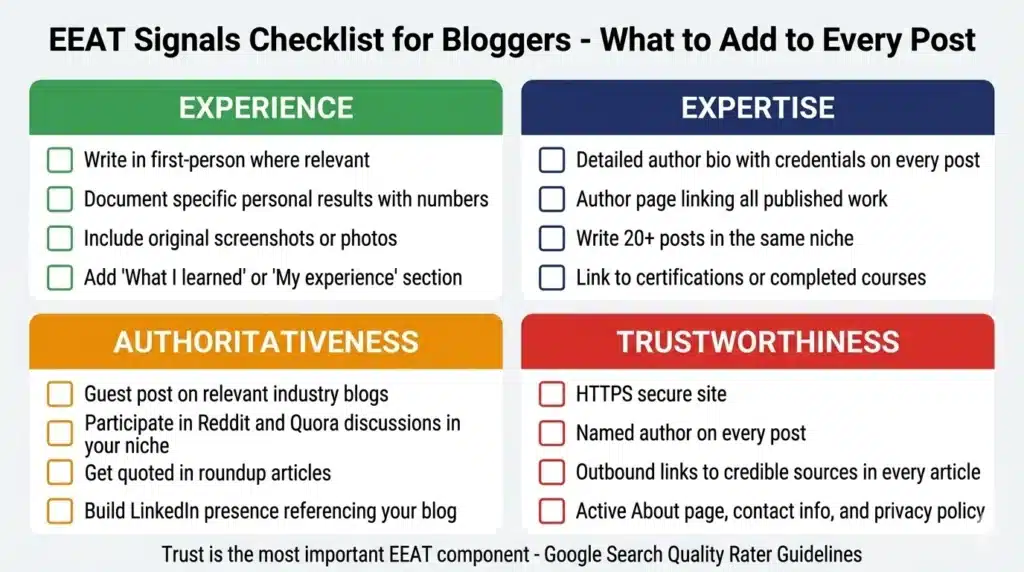
For a solo blogger, experience signals include writing in first-person where relevant (‘I tested this for 30 days’), documenting specific results with numbers (‘my blog impressions went from 4,000 to 271,000’), sharing behind-the-scenes processes, and including original photographs or screenshots from your own work rather than stock images. AI systems that evaluate content quality are specifically looking for the markers of lived engagement that AI-generated content cannot produce on its own.
2. Expertise – Build a Clear Author Identity
Expertise means your author identity is visible, verifiable, and consistent. This starts with a detailed author bio on every post – not a two-sentence placeholder, but a bio that names your specific experience, states your credentials, links to other published work, and connects to an author page on your site.
For blogging about GEO, expertise signals include listing years of SEO experience, naming tools you use, linking to courses or certifications you have completed, and writing consistently within your niche rather than jumping between unrelated topics. Topical consistency across 20 or more posts on the same subject is one of the strongest expertise signals available to individual bloggers – it tells both Google and AI systems that this author has sustained, deep knowledge in a specific area.
3. Authoritativeness – Get Others to Recognise You
Authoritativeness is the most externally dependent of the four EEAT signals – it requires other people and other sites to reference and recognise your expertise. For traditional SEO, this meant backlinks. For GEO in 2026, it means a broader set of co-citation and brand mention signals that AI systems can verify across the web.
Practical authority-building for bloggers includes: getting guest posts published on relevant industry blogs, being quoted in roundup articles, participating in Reddit and Quora discussions within your niche, building a presence on LinkedIn that references your blog content, and earning organic links through original data or research that others want to cite. AI systems like ChatGPT and Perplexity, which monitor community platforms like Reddit and Quora for topical signals and credibility indicators, are more likely to cite sources that appear consistently across multiple external contexts.
4. Trustworthiness – The Non-Negotiable Foundation
Google’s guidelines are explicit: Trust is the most important EEAT component. A page can demonstrate experience, expertise, and authority – but if the AI system cannot verify its trustworthiness, it will not cite it.
Trust signals that directly affect AI citation eligibility include: a secure HTTPS site, a visible and accurate ‘About’ page, clear contact information, no anonymous authorship (every post should have a named author), outbound links to credible and authoritative sources within each article, a privacy policy and terms of service page, and regular content updates that demonstrate active maintenance. For YMYL (Your Money or Your Life) topics – health, finance, legal advice – trust requirements are significantly higher and more rigorously evaluated.
How to Build EEAT Specifically for GEO – 6 Practical Actions
1. Implement Author Schema on Every Post
Author schema is the single fastest EEAT improvement most bloggers can make for GEO. It explicitly tells AI systems who wrote the content, what their credentials are, and where else their work appears. Use Rank Math’s schema settings to add Person schema for every author, including a job title, description, image, and links to social profiles. Pages with proper author schema are significantly more likely to be cited in AI Overviews and Perplexity results.
2. Add Verifiable Citations to Every Key Claim
Every factual claim in your blog should be supported by a specific, named source with a link. ‘Research shows’ is not a citation. ‘According to Princeton University’s 2024 GEO study’ is a citation. AI systems evaluate content trustworthiness partly by checking whether the claims made can be verified against other authoritative sources – a process called cross-referencing. Content that cites credible sources is more likely to pass this verification step and earn a citation.
3. Build a Dedicated, Detailed Author Page
Your author page is your EEAT headquarters. It should list your professional credentials, years of experience in your niche, any relevant publications, courses, or certifications, and links to your social profiles and other published work. Link to this author page from the bio at the bottom of every post. AI systems that evaluate author authority need to be able to find consistent, verifiable information about who you are across multiple pages and platforms.
4. Include Original Data, Research, or Case Studies
First-hand data that exists nowhere else on the internet is one of the most powerful EEAT signals available to bloggers. It demonstrates experience (you ran the experiment), expertise (you understood what to measure), authority (others cite your data), and trustworthiness (the data is verifiable). Even simple original research – tracking your own blog metrics and publishing the results – creates a unique content asset that AI systems are incentivised to cite because it cannot be found anywhere else.
5. Update Content Regularly and Show It
Content updated within 90 days is cited 40–60% more frequently than identical content last modified more than 12 months ago, according to analysis of Perplexity citation patterns. Add a visible ‘Last updated’ timestamp to the top of every post. Create a refresh schedule for your top-performing content. Each refresh should add new statistics, update outdated claims, and include a brief ‘Updated [date]: What changed’ note – this signals to AI systems that the content is actively maintained by a knowledgeable author.
6. Publish Consistently Within One Topical Cluster
Topical authority – publishing 20 or more deeply interlinked posts on the same subject – is the most powerful long-term EEAT signal a blogger can build. It tells AI systems that your domain is the recognised go-to source for that topic, not a generalist site that occasionally covers it. A GEO content cluster like the one you are reading now is the structural embodiment of topical EEAT: each post reinforces the domain’s expertise and authority signal for every related query.
Common EEAT Mistakes Bloggers Make in 2026
The most damaging EEAT mistake is anonymous content – publishing posts without a named, credentialled author. Anonymous content cannot pass the trust threshold required for AI citation, regardless of how well it is structured or optimized for GEO. Every post needs a human author with a visible identity.
The second most common mistake is generic author bios – ‘John is a writer who loves technology’ tells an AI system nothing about whether John’s perspective on technology is trustworthy or expert. A bio that says ‘John has been optimizing content for AI search since 2023, has managed SEO for 12 SaaS brands, and holds a Google Analytics certification’ gives the AI system verifiable, specific signals to evaluate.
The third mistake is treating EEAT as a one-time checklist rather than an ongoing practice. Content updated regularly, authors who continue publishing in their niche, and domains that consistently earn external citations all build compounding EEAT authority over time. The bloggers winning AI citations in 2026 are not those who checked the EEAT boxes once – they are those who built EEAT into their standard content workflow.
The Bottom Line on EEAT and GEO
EEAT is not a box to tick. It is the trust infrastructure that makes everything else in your GEO strategy possible. Without it, FAQ schema is less effective, answer-first structure is less impactful, and topical authority builds more slowly. With it, every GEO technique you apply has a more solid foundation to build on.
The good news for solo bloggers is that EEAT is not about budget or team size. It is about consistency, transparency, and genuine expertise demonstrated through your content. A solo blogger who writes every post with a detailed author bio, cites every claim, documents personal results, and publishes 20 or more posts in one niche can build stronger EEAT signals than a larger site that produces anonymous, uncited, generic content at scale.
Start with the four changes that have the highest immediate impact on AI citation eligibility: add proper author schema, add a detailed author bio to every post, create a dedicated author page, and add specific, named citations to every factual claim. Build from there.
- What Is GEO? Complete 2026 Pillar Guide →
- Google AI Mode: Transforming Search and SEO Strategies in 2025 →
- Understanding AI Mode Analytics: Measuring Success in a Generative Search Landscape →
- AI Mode vs Traditional Search: Comparing User Experiences →
- Optimizing for AI Mode: New SEO Strategies →
- Google December 2025 Core Update: Complete Analysis →
- The Ultimate On-Page SEO Checklist for 2025 →
- How to Update Old Content for SEO →
- Why a Structured SEO Plan Is Essential for Long-Term Success →
- 20 Common SEO Mistakes You Must Avoid →
15 Real Questions People Are Asking About EEAT and GEO
What does EEAT stand for in SEO? ▼
EEAT stands for Experience, Expertise, Authoritativeness, and Trustworthiness. It is the framework Google uses to evaluate the quality and reliability of web content, drawn from its Search Quality Rater Guidelines. The second ‘E’ for Experience was added in December 2022, upgrading the original EAT framework.
Is EEAT a direct Google ranking factor? ▼
EEAT is not a direct algorithmic ranking factor in the traditional sense – there is no EEAT score that Google calculates and feeds into its ranking formula. Instead, EEAT signals inform Google’s quality assessment systems and influence how content is evaluated. In 2026, its more significant role is as an AI citation eligibility signal – determining whether AI systems like Google AI Overviews will cite your content.
How does EEAT affect my chances of appearing in Google AI Overviews? ▼
EEAT is the primary trust filter AI systems use before selecting citation sources. Content that passes the EEAT trust threshold – through named authors, cited claims, demonstrated experience, and authority signals – is significantly more likely to be cited. Content with proper author schema and credible citations increases AI citation rates by 130-250%, according to GEO citation research.
Can a beginner blogger build EEAT without credentials or experience? ▼
Yes – experience is demonstrated through your documented engagement with a topic, not a formal credential. A blogger who writes about their personal testing results, documents their own metrics, and publishes consistently in one niche over 12 months is building genuine EEAT signals. Start with transparency: use your real name, document your actual experience, and cite sources for every claim you make.
What is the fastest way to improve EEAT for an existing blog? ▼
The three fastest improvements are: adding a detailed, credentialled author bio to every post, adding proper author schema using a plugin like Rank Math, and adding specific named-source citations to every factual claim. These three changes directly address the trust and expertise signals that AI citation systems evaluate, and most bloggers see improvements in citation visibility within 30-60 days.
Does EEAT matter for AI search engines like ChatGPT and Perplexity, not just Google? ▼
Yes – all major AI search platforms evaluate content trustworthiness signals equivalent to EEAT when selecting citation sources. Perplexity explicitly favours content with clear editorial structure and named sources. ChatGPT weights content from domains with consistent, established expertise. The EEAT framework applies across all AI citation contexts, not just Google.
How is EEAT different from domain authority? ▼
Domain authority is a third-party metric that measures the strength of a site’s backlink profile. EEAT is Google’s quality evaluation framework covering experience, expertise, authoritativeness, and trustworthiness. They overlap in the authority dimension – strong backlinks contribute to authoritativeness – but EEAT is broader. A page can have low domain authority but high EEAT if it demonstrates strong first-hand experience and transparent authorship.
Do I need to be a certified expert to have strong EEAT? ▼
No. Formal certifications contribute to expertise signals but are not required. Demonstrated first-hand experience – writing consistently about a topic from personal engagement, documenting real results, and showing sustained knowledge through a cluster of related posts – builds strong EEAT signals. A blogger who has documented 50 original experiments on their topic has stronger experience EEAT than a credentialled academic who writes one generic overview.
Why is Trustworthiness considered the most important EEAT component? ▼
Google’s Search Quality Rater Guidelines state that trust is the most important EEAT component because untrustworthy pages have low EEAT regardless of their experience, expertise, or authority. Trust is the precondition for all other quality signals – if an AI system cannot verify that a source is accurate, transparent, and reliable, it cannot safely cite it regardless of the author’s credentials.
What is the connection between EEAT and topical authority? ▼
Topical authority – publishing 20 or more deeply interlinked posts on the same subject – is one of the strongest EEAT signals a blogger can build. It demonstrates sustained expertise (you keep writing about this topic), experience (you have explored it from many angles), and authoritativeness (you are a recognised source for this niche). Topical authority clusters are the structural implementation of EEAT at a domain level.
Should I add EEAT signals to old blog posts or only new ones? ▼
Prioritise both. For new posts, build EEAT in from the start – author schema, detailed bio, cited claims, first-person experience sections. For existing posts, start with your highest-traffic informational pages and add author bios, update statistics with named sources, and add a last-updated timestamp. Refreshed content with stronger EEAT signals typically sees citation improvement within 30-90 days.
How does anonymous or AI-generated content affect EEAT? ▼
Anonymous content – posts without a named author – cannot pass the trust threshold required for AI citation. AI-generated content without human editorial oversight scores poorly on the Experience component and raises trustworthiness concerns. The most effective approach in 2026 is to use AI tools to assist drafting while ensuring every published post has a named human author with verifiable credentials and first-hand experience woven into the content.
Does EEAT affect local blogs and niche sites the same way it affects big publications? ▼
Yes – and niche sites often have an advantage. A highly focused niche blog with strong topical authority, a credentialled author, and consistent experience signals can outperform a large general publication for AI citation in its specific area. AI systems evaluate EEAT at the page and author level, not just the domain level. A niche blogger with genuine expertise in one subject often has stronger EEAT signals for that subject than a large site that covers it only occasionally.
What tools can I use to check my EEAT signals? ▼
Google Search Console shows how your content performs on quality-sensitive queries. Google’s Rich Results Test verifies your schema implementation. Rank Math’s content analysis highlights missing author and schema signals. For AI-specific EEAT tracking, tools like Profound and Otterly.AI monitor how frequently your brand is cited across AI platforms – which is a direct measure of whether your EEAT signals are translating into AI citation eligibility.
How long does it take to build strong EEAT signals as a new blogger? ▼
The fastest individual EEAT improvements – adding author schema, author bios, and named citations – can be implemented within days and typically show citation improvements within 30-60 days. Building domain-level topical authority through a content cluster of 20 or more interlinked posts typically takes 6-12 months of consistent publishing. EEAT is a compounding asset: the stronger your signals become, the more each new post benefits from the authority the entire domain has already built.
What specific information should my author bio include for strong EEAT? ▼
Your author bio should include: your full real name, specific credentials or qualifications directly relevant to your topic, the number of years you have been working in or writing about the subject, links to verifiable external presence (LinkedIn profile, published work elsewhere, industry mentions), and a brief first-person statement of direct experience with the topic. Mark the entire author section up with Person schema using Rank Math. A bio that says ‘John Smith has tested 47 SEO tools over 6 years and has been cited in Search Engine Journal’ is significantly more EEAT-credible than ‘John Smith is a digital marketing enthusiast.’
How do I demonstrate the Experience component of EEAT in my writing? ▼
Include first-person accounts of direct engagement with your topic: ‘When I tested this approach on my own blog, impressions increased by 34% in 60 days.’ Include specific numbers from your own experience, not just cited statistics from others. Document your process – show the reader what you actually did, what worked, and what did not. Photographs, screenshots, and personal data from your own tests are the highest-value Experience signals. Generic content that describes a topic without personal engagement demonstrates no Experience component and is increasingly filtered out by AI citation systems.
Does linking to authoritative external sources improve EEAT? ▼
Yes – citing credible external sources is a direct trust signal for both Google’s quality systems and AI citation algorithms. Every specific claim, statistic, or fact in your post should link to or attribute a named, verifiable source. Princeton University’s GEO research found that adding citations and attributed statistics to content improves AI visibility by 30-40%. Linking to primary sources (original research papers, official reports, government data) carries significantly more trust weight than linking to other blog posts that aggregate the same information.
How does author schema markup improve EEAT signals? ▼
Author schema (Person schema) tells AI crawlers and search engines exactly who wrote the content, what their credentials are, and where they can be verified externally. Without author schema, AI systems have to infer authorship from unstructured page content – which is less reliable and less credible. Websites with author schema are 3x more likely to appear in AI answers (BrightEdge). Implement it through Rank Math by filling in the author profile completely: name, description, social profiles, and professional credentials.
What is the difference between Expertise and Experience in EEAT? ▼
Expertise refers to formal knowledge of a subject – qualifications, credentials, professional background, and demonstrated mastery of the technical content. Experience refers to first-hand, lived engagement with the topic – having personally done the thing you are writing about, tested the tools, visited the places, or used the products. Google added Experience to the framework in 2022 specifically because formal expertise without direct experience produces less useful content. The most citation-worthy content combines both: technical expertise applied to real, personal, documented experience.
Can EEAT help me compete with established websites in my niche? ▼
Yes – and this is one of the most important strategic insights for independent bloggers. Large established sites often have strong domain authority but weak page-level EEAT – they publish content from anonymous staff writers, cite no primary sources, and include no first-hand experience. A focused niche blogger with a credentialled author bio, original data, specific citations, and documented personal experience on every post can consistently outperform these pages in AI citations for specific queries.
What is YMYL content and why does it have stricter EEAT requirements? ▼
YMYL stands for Your Money or Your Life – a category of content that could significantly impact a reader’s financial situation, health, safety, or wellbeing if it contains incorrect information. Google and AI systems apply much stricter EEAT standards to YMYL content. If your blog covers health, medical, legal, or financial topics, formal credentials, professional affiliations, and verifiable external authority signals are not optional – they are baseline requirements for citation eligibility.
How do branded web mentions contribute to EEAT and AI visibility? ▼
Branded web mentions – your name or blog being referenced in Reddit discussions, Quora answers, industry publications, and other trusted platforms – are one of the strongest authoritativeness signals for AI citation. Position Digital’s 2026 research found that branded web mentions have a 0.664 correlation with AI Overview appearances, significantly higher than backlinks at 0.218. Build mentions by actively participating in Reddit and Quora threads in your niche and engaging consistently in your topic community.
What is the single most important EEAT action for a blogger who wants to improve AI citations quickly? ▼
Add a detailed, credentialled author bio with Person schema to every post on your site – starting with your highest-traffic informational pages. This single action addresses three of the four EEAT components simultaneously: it demonstrates Expertise (your credentials), builds Trustworthiness (a named, verifiable human is responsible for this content), and contributes to Authoritativeness (a named expert in this field wrote it). Websites with author schema are 3x more likely to appear in AI answers (BrightEdge).
How do I build EEAT for a brand new blog with no existing authority? ▼
Start with the signals you can control immediately: publish under your real name from day one, write every post from genuine first-hand experience rather than aggregating other sources, cite a named primary source for every factual claim, and set up author schema before publishing your first post. Then build topical authority systematically – choose one narrow topic and publish 15-20 deeply interlinked posts on that single subject before expanding. EEAT compounds over time: a new blog with strong signals from the first post builds authority significantly faster than an established blog trying to retrofit credibility signals years later.

Devyansh Tripathi
I’m Devyansh Tripathi, an SEO strategist and digital growth expert, helps businesses and individuals rank higher and drive organic traffic. Through DevTripathi., he shares cutting-edge SEO insights, content strategies, and marketing hacks. Passionate about digital success, he’s on a mission to make SEO simple, effective, and result-driven!
Posts
- What Is EEAT and How It Connects to GEO in 2026 (Blogger’s Guide)
- How to Make Your Blog Appear in Google AI Overviews
- Traditional SEO Is Not Dead – But It Needs GEO to Survive
- What Is an AI Overview and How Does It Affect Your Blog Traffic?
- 10 GEO Terms Every Blogger Must Know in 2026 – Plain English Glossary
Latest News
Text Widget
Empowering brands with insights, strategies, and stories that drive digital growth.