
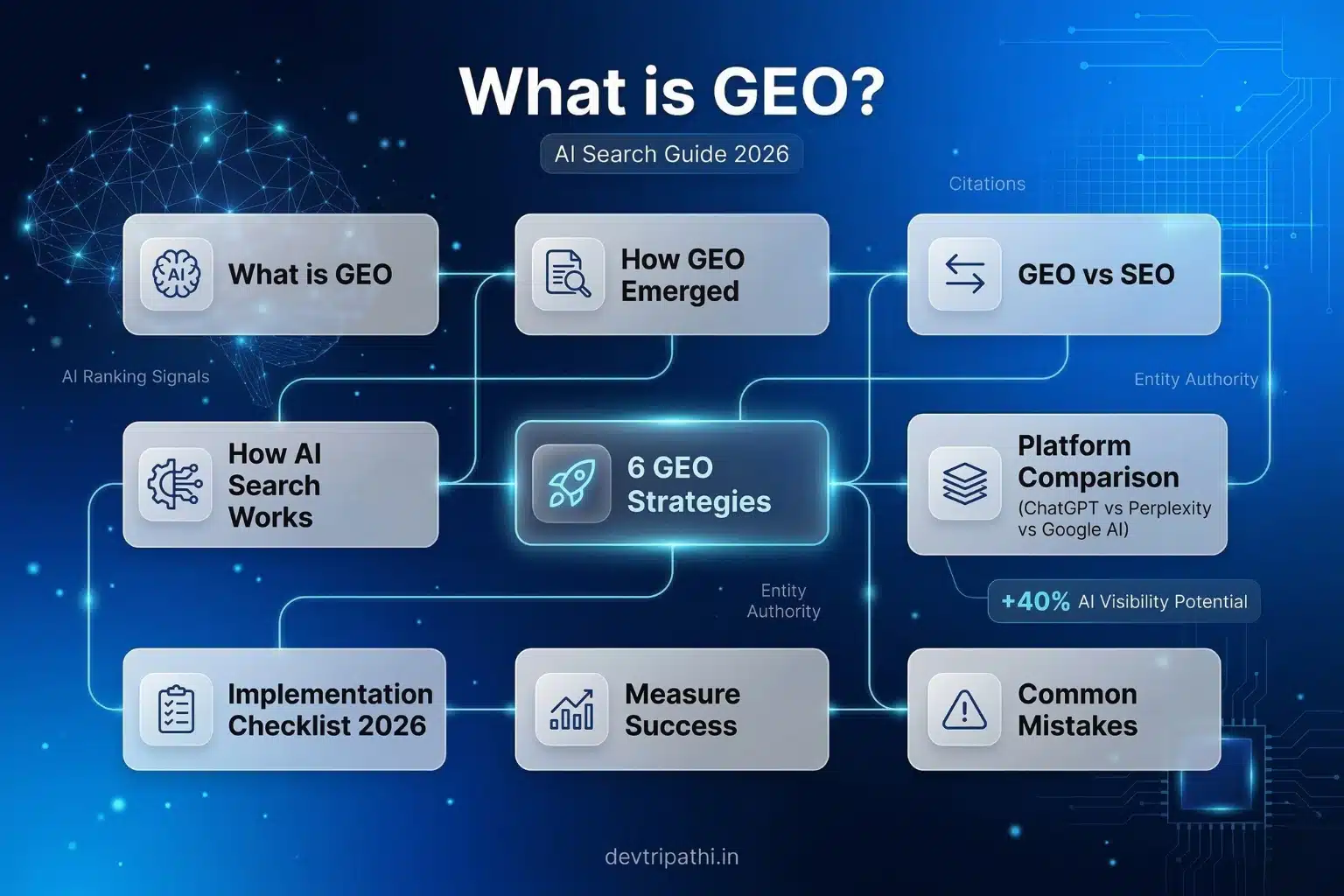
What Is Generative Engine Optimization (GEO)? The Complete 2026 Guide to Ranking in AI Search
18 March 2026
The Search Engine You Grew Up With Just Changed
You spent years building your SEO strategy around one simple goal rank on Page 1 of Google, get clicked, and drive traffic. And it worked. For most of the internet’s history, that was the game.
But here is what is happening in 2026: a growing portion of your potential audience is no longer clicking on Google results. They are typing their questions into ChatGPT, Perplexity, or Google’s own AI Overviews and getting a complete, synthesized answer without visiting a single website.
For the first time in digital marketing history, ranking #1 on Google does not guarantee you get seen.
That is the problem Generative Engine Optimization – GEO – was built to solve.
GEO is not a replacement for SEO. Think of it as SEO’s next evolution. If traditional SEO made your content visible to Google’s algorithm, GEO makes your content trustworthy and citable by the AI systems that are increasingly mediating between your audience and their information needs.
In this guide, you will learn exactly what GEO is, how it differs from traditional SEO, what the research says about what actually works, and the step-by-step tactics you can implement starting today.
TLDR – Quick Definition: Generative Engine Optimization (GEO) is the practice of optimizing your content so that AI-powered search systems – like Google AI Overviews, ChatGPT, Perplexity, and Gemini – can find, understand, trust, and cite it when answering user queries. |
1. What Is Generative Engine Optimization (GEO)? - A Clear Definition
Generative Engine Optimization (GEO) is the process of structuring and optimizing your content so that AI-powered generative search platforms – including ChatGPT, Google AI Overviews, Perplexity AI, Gemini, and Microsoft Copilot – can retrieve, understand, and cite it when answering user questions.
Unlike traditional search engines, which return a ranked list of links, generative AI search systems synthesize answers from multiple sources and present a unified response. Your goal with GEO is not to appear on a list – it is to be one of the sources the AI synthesizes from and cites.
You may also see GEO referred to by other names in the industry: Answer Engine Optimization (AEO), Large Language Model Optimization (LLMO), Generative Search Optimization (GSO), or AI Optimization (AIO). While terminology varies, they all describe the same fundamental discipline: make your content a trusted source for AI-generated answers.
Why GEO Matters Right Now
AI-referred sessions jumped 527% year-over-year in the first five months of 2025 (Previsible AI Traffic Report, 2025). Google AI Overviews now appear in more than 25% of all Google searches – and that number is growing every month. ChatGPT has 900 million weekly active users globally.
If your content is not showing up in these AI-generated answers, you are invisible to a rapidly expanding portion of your target audience.
527% YoY Growth Source: AI-referred web sessions, Jan–May 2025 – Previsible AI Traffic Report |
2. How GEO Emerged - The Research Behind It
GEO is not a marketing buzzword invented by an agency. It has academic roots. The term was formally introduced in a peer-reviewed paper by researchers from Princeton University, Georgia Tech, and IIT Delhi, published at KDD 2024 – one of the most prestigious data science conferences in the world.
Their research studied how different content optimization techniques affected visibility in AI-generated outputs from platforms like Bing AI, GPT-4, and Claude. The findings were clear: certain specific content changes dramatically increase the likelihood of being cited by AI systems.
40% More AI Visibility Source: Adding statistics, expert quotes, and source citations – Princeton GEO Paper, KDD 2024 |
What the Princeton Research Found
- Adding statistics and specific data points increases AI citation likelihood significantly
- Including expert quotes with clear attribution boosts visibility by up to 40%
- Citing authoritative external sources signals credibility to AI systems
- Content structured around direct answers performs better than narrative-style prose
- Fluency, quotation-rich writing, and easy-to-extract information are the top predictors of AI citation
External reference: Princeton GEO Research Paper – KDD 2024
3. How GEO Differs from Traditional SEO
This is the question most people ask first – and it is the right starting point. The difference is not about choosing one over the other. It is about understanding that they optimize for different audiences: SEO optimizes for Google’s algorithm, GEO optimizes for AI systems.
Traditional SEO: What It Targets
Traditional SEO is built around three pillars: on-page optimization (keywords, headings, meta tags), off-page optimization (backlinks and brand mentions), and technical SEO (speed, crawlability, Core Web Vitals). The goal is a ranked position in Google’s results page – and the click that follows.
GEO: What It Targets
GEO targets AI systems’ retrieval and synthesis processes. These systems do not rank pages – they extract information from multiple sources and generate a single coherent answer. Your goal is to be extracted from, not ranked above.
Factor | Traditional SEO | GEO |
Primary Goal | Rank in Google’s top 10 | Be cited inside AI-generated answers |
Success Metric | Organic clicks and CTR | AI citation frequency + impressions |
Content Focus | Keyword density and placement | User intent + comprehensive answers |
Backlinks | Critical ranking factor | Helpful; entity authority matters more |
FAQs | Optional | Essential – 15 to 20+ per post |
Schema Markup | Recommended | Mandatory for AI readability |
Writing Style | Keyword-structured prose | Conversational, answer-first |
EEAT Weight | Important | Critical – AI systems require trust signals |
Measurement | GSC, Ahrefs, Semrush | Manual AI testing + GSC impressions |
Timeline | 3–6 months typical | 4–8 weeks for early signals |
The key insight from real data: between June 2025 and February 2026, one content platform tracked that every article cited by ChatGPT had first ranked on Google. Traditional SEO is still the foundation – GEO is the additional layer that maximizes visibility in AI responses (Nest Content, 2026).
→ Related reading: GEO vs SEO: What’s the Difference and Why Both Matter in 2026
4. How AI Search Engines Work – The Technical Reality
To optimize for AI search systems, you need to understand how they actually process your content. It is different from how Google crawls and indexes pages – and understanding the difference changes how you write.
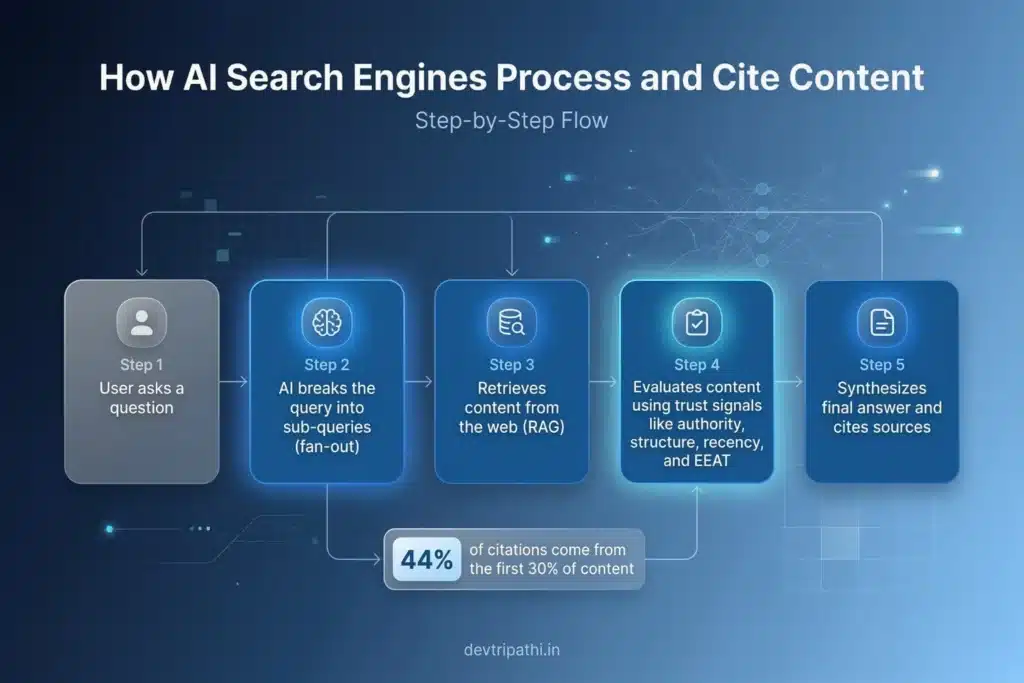
Query Fan-Out – How AI Breaks Down Questions
When a user asks a complex question to an AI like ChatGPT or Perplexity, the AI does not paste the full prompt into a search engine. It breaks the question into smaller sub-queries and searches for each one separately. If someone asks ‘What is the best GEO strategy for a new blog in 2026?’, the AI might search for ‘GEO strategies 2026’, ‘GEO for new websites’, and ‘how to get cited by AI search’ as three separate queries.
This means your content needs to rank for these shorter, specific sub-queries – not just the main head term. Think about what fragments of a complex question a user might search for, and make sure your content addresses each one clearly.
Retrieval-Augmented Generation (RAG)
Most AI search systems use Retrieval-Augmented Generation (RAG). In plain language: when a user asks a question, the AI does not rely only on its training data. It actively searches the web, retrieves content from relevant pages, and uses that retrieved content to generate a fresh, synthesized answer.
Your content needs to survive two filters: being retrieved (which requires AI crawlers to access your page), and being trusted enough to synthesize from (which requires clear structure, credibility signals, and direct answers).
Critical Technical Point – Are AI Bots Blocked on Your Site?
▲Action Required – Check This Now: Many WordPress sites using Cloudflare block AI crawlers without realizing it. Cloudflare changed its default configuration in 2024 to block AI bots. Check your robots.txt to ensure GPTBot (OpenAI), Google-Extended, PerplexityBot, and Claude-Web are NOT blocked. If they are blocked, your content is completely invisible to AI search systems regardless of quality. |
How AI Systems Select Content to Cite
5. The 6 Proven GEO Strategies That Boost AI Visibility
These are not guesses. These are the strategies backed by the Princeton GEO paper, real traffic data from content platforms, and analysis of thousands of AI citations across ChatGPT, Perplexity, and Google AI Overviews.
Strategy 1: Lead with a Direct Answer (Definition-First Structure)
AI engines extract the first 30% of your content most heavily – 44.2% of all AI citations come from the opening section of an article (SE Ranking, 2025). Your introduction must directly and completely answer the primary query in the first two to three sentences, before any context or background.
This mirrors what top-performing GEO content consistently does: TL;DR first, details second. If someone searches ‘what is GEO?’, your first sentence should be a clear, complete definition – not a story about how search is changing.
Strategy 2: Write Question-Led Headings
AI systems pattern-match your H2 and H3 headings to user queries. A heading that reads ‘What Is GEO and How Does It Work?’ is dramatically more likely to be cited for the query ‘what is generative engine optimization’ than a heading that reads ‘GEO Overview’.
Audit your top 10 articles in Google Search Console. Look at the actual queries people are using to find each article. Then rewrite your H2/H3 headings as questions that mirror those real queries. This is one of the highest-ROI GEO changes you can make to existing content (Enrich Labs, 2026).
Strategy 3: Add Statistics and Specific Data Points
The Princeton research found that adding statistics significantly boosts AI visibility. A statement like ‘AI search is growing’ is vague and not worth citing. A statement like ‘AI-referred sessions grew 527% year-over-year in the first five months of 2025 (Previsible, 2025)’ is specific, citable, and gives AI systems a concrete data point to extract and attribute.
For every factual claim in your content, ask: can I make this more specific with a number? If yes, do it – and attribute the source clearly.
Strategy 4: Include Expert Quotes with Attribution
The Princeton GEO paper consistently found that content with named expert quotes performed better in AI citations. This connects directly to EEAT – AI systems want to cite credible, authoritative sources, and expert quotes signal that your content has been validated by recognized expertise.
When quoting an expert or study, always include: the person’s name, their role/credential, the source or publication, and the year. This gives AI systems everything they need to attribute the citation accurately.
Strategy 5: Build Comprehensive FAQ Sections (15+ Questions)
FAQ sections are one of the most powerful and underused GEO tools. Only 34% of websites use FAQPage schema – which means there is a massive competitive opportunity for any site that does this well (internal analysis, 2026).
For every major blog post, add a FAQ section with at least 15 questions drawn from real user queries – from Reddit, Quora, Google’s People Also Ask, and ChatGPT prompts. Structure each FAQ with an H3 heading for the question and a direct two-to-four sentence answer. Add FAQPage schema markup. Content in Q&A format gets extracted by AI systems 2.3 times more than prose-only content.
2.3x More AI Extractions Source: Content in Q&A format vs prose-only – Content platform analysis, 2025 |
Strategy 6: Strengthen Your EEAT Signals
According to BrightEdge (2025), author credentials carry 16% weight in AI citation decisions – up from 8% in 2024. AI systems prefer to cite content from named, verifiable experts over anonymous sources.
Practical EEAT improvements: add a detailed author bio with specific credentials on every post, link to credible external sources for factual claims, keep content current with clearly marked revision dates, and build your presence on Reddit, Quora, and LinkedIn – domains with strong social proof profiles have 3x to 4x higher AI citation rates (SE Ranking, 2025).
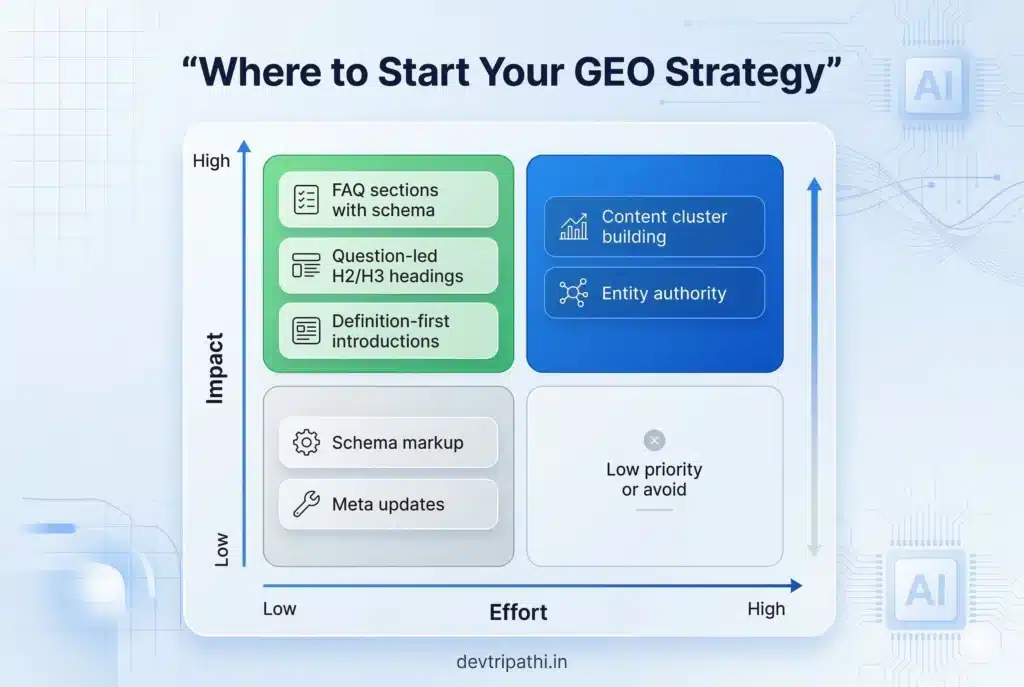
The GEO Strategy Priority Matrix
6. GEO Platform Guide - ChatGPT vs Perplexity vs Google AI Overviews
Google AI Overviews - Highest Volume, Most SEO-Connected
Google AI Overviews now appear in 25.11% of searches (Conductor, 2026) – up from 13.14% in March 2025. Critically, 76.1% of URLs cited in AI Overviews also rank in Google’s top 10 organic results (Ahrefs, 2025). Your traditional SEO performance directly influences your AI Overview citation likelihood.
Google AI Overviews heavily favour content with FAQPage schema, structured headings, and content that ranks on Page 1 already. Prioritize this platform first.
ChatGPT - Highest Referral Traffic Share
ChatGPT has 900 million weekly active users and accounts for 78% of all AI referral traffic (Nest Content, 2026). ChatGPT Search, launched late 2024, synthesizes answers from web sources and cites them inline. Wikipedia accounts for 47.9% of ChatGPT’s top citations – meaning authoritative, well-structured content performs best.
Key for ChatGPT: ensure GPTBot is not blocked in your robots.txt. Write in an encyclopedic, clear style with well-defined entities. Build presence on platforms ChatGPT frequently cites: Reddit, Quora, and educational domains.
Perplexity AI - Fastest Growing, Most Research-Oriented
Perplexity handles 1.2 to 1.5 billion queries per month with 370% year-over-year growth. Its users are predominantly research-oriented – they want detailed, sourced answers on complex topics. Perplexity heavily rewards content with explicit citations, original data, and deep topic coverage. Semrush – AI Traffic & GEO Statistics 2026
7. Step-by-Step GEO Implementation Checklist for 2026
Phase 1: Technical Foundation (Week 1)
- Check robots.txt – ensure GPTBot, Google-Extended, PerplexityBot, Claude-Web are NOT blocked
- Check Cloudflare settings – confirm AI bots are not blocked at CDN level
- Verify content is server-side rendered, not hidden behind JavaScript
- Consider adding an llms.txt file to help AI systems understand your site structure
- Confirm your site passes Core Web Vitals – pages loading under 0.4 seconds average 6.7 AI citations vs 2.1 for slow pages (SE Ranking)
Phase 2: Content Optimization (Weeks 2–4)
- Audit your top 10 posts – identify which lack direct answer introductions
- Rewrite H2/H3 headings as questions that mirror real user queries from GSC
- Add statistics with clear attribution to every major claim
- Include at least one expert quote per post with full attribution
- Add comprehensive FAQ section (15+ questions) to each key post
- Implement FAQPage schema, Article schema, and Author/Person schema
Phase 3: Authority Building (Months 2–3)
- Create a detailed author bio page with specific credentials and experience
- Build a content cluster – 20+ interconnected articles produce 3.2x higher AI citation rates (Moz, 2025)
- Build presence on Reddit and Quora – answer questions in your niche with genuine expertise
- Earn third-party mentions – branded web mentions correlate 3x stronger with AI visibility than backlinks (Position Digital, 2026)
Phase 4: Monitor and Iterate (Ongoing)
- Track GSC impressions weekly – rising impressions with stable CTR signals AI Overview appearances
- Manually search your 10 target queries in ChatGPT, Perplexity, and Google AI Overviews monthly
- Set up GA4 referral tracking for chatgpt.com, perplexity.ai, and copilot.microsoft.com
- Refresh top posts every 3 months – AI systems penalise outdated content with no recency signals
8. How to Measure GEO Success
Google Search Console – Your Primary GEO Dashboard
GSC is still your most reliable free tool for GEO measurement. Look for: rising total impressions (especially for question-based queries) without corresponding CTR growth – this pattern typically indicates AI Overview appearances. Monitor average position improvements, especially for longtail question queries.
Manual AI Citation Testing
Once a month, manually search your 10 most important target queries in ChatGPT, Perplexity, and Google AI Overviews. Note whether your content appears as a cited source. Track this in a simple spreadsheet over time.
Branded Search Volume
An increase in branded search queries in GSC over time is a strong indirect indicator that AI citations are building awareness of your brand. Users who see your brand cited by AI often search for you directly later.
GA4 AI Referral Tracking
In Google Analytics 4, create a custom segment tracking sessions from chatgpt.com, perplexity.ai, and copilot.microsoft.com as referral sources. While AI traffic is currently small in absolute volume (0.15% of global traffic), its conversion rate is 4.4x higher than traditional organic (Semrush, 2025).
9. Common GEO Mistakes to Avoid
Mistake 1: Blocking AI Crawlers Without Knowing It
This is the most common and most damaging GEO mistake. If GPTBot, Google-Extended, or PerplexityBot cannot access your pages, no amount of content optimization will help. Check your robots.txt and Cloudflare settings before any other GEO work.
Mistake 2: Generic, Data-Free Content
‘AI search is growing’ is not citable. ‘527% year-over-year growth in AI-referred sessions’ is. Every factual claim in your content should be specific, attributed, and verifiable. Generic statements get ignored; specific data gets cited.
Mistake 3: Skipping FAQs
Only 34% of websites use FAQPage schema. If you add 15+ well-structured FAQs with schema markup to your key posts, you are already ahead of 66% of your competitors in AI Overview optimization.
Mistake 4: Treating GEO as a Separate Strategy from SEO
76.1% of AI Overview citations come from pages that rank in Google’s top 10 (Ahrefs, 2025). GEO is not a separate channel – it is an additional layer you build on top of solid traditional SEO. Do not abandon keyword research, backlinks, and technical SEO in favour of pure GEO.
Mistake 5: Expecting Instant Results
GEO is a compounding strategy. Like domain authority, citation authority builds over time. Expect four to eight weeks for early signals, and three to six months for meaningful, consistent AI citation frequency with regular content publishing.
10. Frequently Asked Questions About GEO
What does GEO stand for in digital marketing? ▼
GEO stands for Generative Engine Optimization. It refers to the practice of optimizing content so that AI-powered search systems – including ChatGPT, Google AI Overviews, Perplexity, and Gemini – can retrieve, understand, and cite it when generating answers to user queries.
Is GEO the same as SEO? ▼
No – GEO and SEO are related but distinct disciplines. Traditional SEO focuses on ranking in Google’s organic search results through keywords, backlinks, and technical optimization. GEO focuses specifically on being cited by AI-generated responses. In 2026, you need both: a strong SEO foundation enables GEO performance.
How does Google AI Overview decide which content to cite? ▼
Google AI Overviews heavily weight content that ranks in the top 10 organic results (76.1% overlap per Ahrefs 2025), contains structured FAQ sections with FAQPage schema, directly answers the query in the opening section, and demonstrates strong E-E-A-T signals with clear author attribution.
How is GEO different from AEO (Answer Engine Optimization)? ▼
AEO was originally developed for voice search and featured snippets. GEO is a broader, more current term that encompasses optimization for all generative AI systems – including ChatGPT, Perplexity, Gemini, and Google AI Overviews. AEO is now largely considered a subset of GEO.
What content format works best for GEO? ▼
Q&A format content gets extracted by AI systems 2.3x more than prose-only content. Definition-first structures, numbered lists, tables, and clearly labelled FAQ sections all perform strongly. The first 200 words should directly answer the primary query – AI systems extract 44% of citations from opening sections.
Does GEO work for small websites and new blogs? ▼
Yes – and niche blogs often have an advantage. AI systems value depth and specificity over domain size. A well-structured niche blog with genuine expertise can outperform large generic sites in AI citations. According to StatusLabs, AI cites content from positions 21+ nearly 90% of the time – lower-ranked pages still get cited if they are the most specific, authoritative answer available.
How do I check if my content is being cited by AI? ▼
The most reliable method is manual testing: regularly search your target queries in ChatGPT, Perplexity, and Google AI Overviews and note whether your content appears. In Google Search Console, monitor impressions for question-based queries – rising impressions without corresponding CTR growth often indicates AI Overview appearances.
What is an llms.txt file and do I need one? ▼
An llms.txt file is a proposed standard similar to robots.txt that helps AI systems understand your site structure, key pages, and content summaries. While not yet universally adopted, adding one is a forward-looking technical step that can improve how AI crawlers interpret your site. It is not required but is recommended as best practice in 2026.
How important are backlinks for GEO? ▼
Less critical than for traditional SEO. Branded web mentions correlate 3x stronger with AI visibility than backlinks (Position Digital, 2026). Building genuine brand presence through community participation on Reddit and Quora, industry citations, and consistent content publishing matters more for GEO than raw link volume.
What is the minimum content length for GEO to work? ▼
There is no strict minimum, but comprehensive coverage consistently outperforms thin content in AI citations. Posts under 800 words rarely provide enough depth for AI systems to extract multiple useful chunks. For key cluster posts, 2,000 to 3,500 words with strong structure – including FAQs, statistics, and clear section headings – is the recommended range.
How often should I update content for GEO? ▼
AI systems weight recency as a citation factor. Cornerstone content should be refreshed every three to six months with updated data, new statistics, and a clearly updated last-updated timestamp. For fast-moving topics like GEO itself, monthly light updates are recommended to maintain citation authority.
Can I use AI tools to write GEO-optimized content? ▼
AI writing tools are excellent for research, structure, and FAQ generation. However, the most powerful GEO signals – first-hand experience, original data, verifiable credentials, and unique insights – require genuine human expertise. Use AI tools to assist and accelerate your process, but ensure your content contains authentic expertise that AI alone cannot replicate.
What is the current state of GEO in 2026? ▼
GEO has moved from experimental to operational in 2026. Google AI Overviews now appear in 25.11% of all searches, ChatGPT has 2.8 billion monthly active users, and 98% of CMOs are investing in AEO/GEO strategies. The GEO tools market is valued at $848 million and projected to reach $33.7 billion by 2034. The competitive window is still open, but narrowing as citation positions begin to concentrate around early adopters.
Which AI search platform should I prioritize for GEO? ▼
Priority depends on your goals. For the most traffic volume, optimize for ChatGPT first – it drives 87.4% of all AI referral traffic. For the highest-quality research-oriented audience, optimize for Perplexity. For the most direct connection between GEO and SEO investments, prioritize Google AI Overviews. For most brands, the practical answer is to build content that meets the quality and structure standards for all three platforms simultaneously.
Why are my AI citations disappearing after a few weeks? ▼
AI citation positions rotate constantly. Semrush’s AI Visibility Index shows 40-60% of cited sources rotate monthly, and AirOps found that AI Overview content changes roughly 70% of the time for the same query. The primary drivers are content freshness, competitive improvements from other publishers, and algorithm changes within the AI platforms. The mitigation is regular content refreshes every 60-90 days and continuous citation monitoring.
What is the difference between a GEO mention and a GEO citation? ▼
A mention is when an AI response includes your brand name or references your content without providing a clickable link. A citation is when the AI provides an inline hyperlink to your specific URL as a supporting source. Citations are more valuable because they generate trackable referral traffic and prove the AI trusts your content enough to send users directly to it. Most GEO monitoring tools now distinguish between the two.
How does GEO affect zero-click searches? ▼
GEO is specifically designed for zero-click environments. With 93% of AI Mode searches ending without a click and 65% of informational queries resolved entirely within AI interfaces, the traditional click-based traffic model is under structural pressure. GEO reframes the success metric: instead of measuring clicks alone, measure brand visibility, citation frequency, and the conversion quality of visitors who do click through. AI-referred visitors convert at 4.4x the organic average.
What is triple schema stacking and why does it matter for GEO? ▼
Triple schema stacking means deploying three JSON-LD schema types on a single page: Article schema, ItemList schema for list-format content, and FAQPage schema for FAQ sections. Pages with the full triple stack receive 1.8x more AI citations than pages with Article schema alone (GenOptima). BrightEdge confirms schema markup enables AI engines to extract information with 300% higher accuracy versus unstructured content.
How important is author authority for GEO in 2026? ▼
Increasingly critical. Websites with author schema are 3x more likely to appear in AI answers (BrightEdge). Author credentials carry 16% weight in AI citation decisions – up from 8% in 2024. Anonymous content and generic Staff Writer bylines are effectively citation penalties. Every GEO-priority page needs a named, credentialled author with a verifiable external presence to maximize AI citation likelihood.
Does GEO cost money to implement? ▼
The core changes – writing direct answer blocks, adding FAQ sections, implementing schema markup via plugins – have no additional cost beyond your time. Dedicated GEO monitoring tools average $337/month at the industry level (Conductor, 2026). For bloggers and small businesses, the free stack – Google Search Console, GA4 custom segments, and monthly manual citation testing – provides sufficient measurement to build and iterate a GEO strategy effectively.
What industries see the most benefit from GEO in 2026? ▼
The IT and technology industry leads AI referral traffic at 2.8% of all visits (Conductor, 2026). Healthcare, legal, finance, and insurance see higher AI visitor rates compared to SaaS and eCommerce. Informational content verticals – education, how-to content, research-heavy topics – are most heavily affected by AI Overview changes. Local search remains relatively insulated, with AI Overviews appearing on only about 7% of local queries (Ahrefs).
How do branded web mentions help GEO? ▼
Branded mentions – your business or blog name appearing in forums, review sites, Reddit threads, Quora answers, and industry publications – signal to AI systems that your brand is a recognised authority. Position Digital’s 2026 research shows branded web mentions correlate 3x stronger with AI visibility than backlinks. Actively participating in Reddit and Quora discussions, getting quoted in industry roundups, and building community presence all contribute directly to GEO citation authority.
What is a BLUF structure and how does it help GEO? ▼
BLUF stands for Bottom Line Up Front – a writing structure where you state the direct answer to your main question in the very first sentence or paragraph, before any context or background. AI systems extract 44% of citations from the opening 200 words of a page. A BLUF introduction creates an answer island that AI can cleanly extract without needing surrounding context. It is the single highest-impact structural change you can make to an existing blog post.
How do I build a GEO content strategy from scratch? ▼
Start with your core topic and build a content cluster: one comprehensive pillar post covering the main topic, supported by 8-12 cluster posts targeting specific sub-questions your audience is asking. Each post needs a BLUF introduction, question-based headings, direct answer blocks, original data or experience, and FAQPage schema. Set up GA4 AI referral tracking and monthly manual citation testing from day one. Focus on depth within a tight topic area – topical authority is the compounding asset in GEO.
What is the competitive window for GEO and is it still worth starting now? ▼
The window is real but narrowing. 47% of brands still lack any dedicated GEO strategy (Digital Applied, 2026), meaning the majority of competitors have not started. But the brands that have started are building citation authority and topical cluster depth that becomes harder to displace over time. Starting in 2026 still puts you ahead of most competitors. The advantage of starting now is establishing topical authority before your competitors do – before citation positions calcify around the first movers in your space.
Conclusion: GEO Is Not Optional in 2026
Search has changed. Not completely, not overnight – but fundamentally. A growing portion of your audience is getting their information from AI-generated answers, and if your content is not part of those answers, you are missing a rapidly expanding visibility channel.
The good news is that GEO is achievable. The tactics are clear: check your technical access, write direct answers, structure with question-led headings, add comprehensive FAQs, include specific data with attribution, and build genuine author authority. These are not complicated changes – but they require discipline and consistency.
Start with your five best-performing blog posts. Add fifteen FAQs each. Check your robots.txt. Strengthen your author bio. Then watch your GSC impressions over the next 90 days.
GEO authority, like domain authority, compounds over time. Every well-optimized post you publish today is building your citation credibility for months and years to come.

Devyansh Tripathi
I’m Devyansh Tripathi, an SEO strategist and digital growth expert, helps businesses and individuals rank higher and drive organic traffic. Through DevTripathi., he shares cutting-edge SEO insights, content strategies, and marketing hacks. Passionate about digital success, he’s on a mission to make SEO simple, effective, and result-driven!
Posts
- What Is EEAT and How It Connects to GEO in 2026 (Blogger’s Guide)
- How to Make Your Blog Appear in Google AI Overviews
- Traditional SEO Is Not Dead – But It Needs GEO to Survive
- What Is an AI Overview and How Does It Affect Your Blog Traffic?
- 10 GEO Terms Every Blogger Must Know in 2026 – Plain English Glossary
Latest News
Text Widget
Empowering brands with insights, strategies, and stories that drive digital growth.