
Why Your Blog Is Losing Traffic in 2026 (And How GEO Can Fix It)
21 March 2026
If your blog analytics have been quietly bleeding over the past several months, you are not alone – and you are not doing anything wrong. The search landscape shifted beneath everyone’s feet, and most bloggers were never told.
Here is the short answer: Google’s AI Overviews, ChatGPT, Perplexity, and other AI engines are now answering your readers’ questions before they ever reach your website. Your content may rank on page one. Your article may be well-written and genuinely useful. And still – the blog traffic loss in 2026 continues.
This is not a content problem. It is a search architecture problem. And there is a very specific strategy built to solve it – called GEO, or Generative Engine Optimisation – and by the end of this article, you will know exactly how to use it.
What Is Actually Happening to Your Blog Traffic?
Let us start with the numbers, because they tell the story better than anything else.
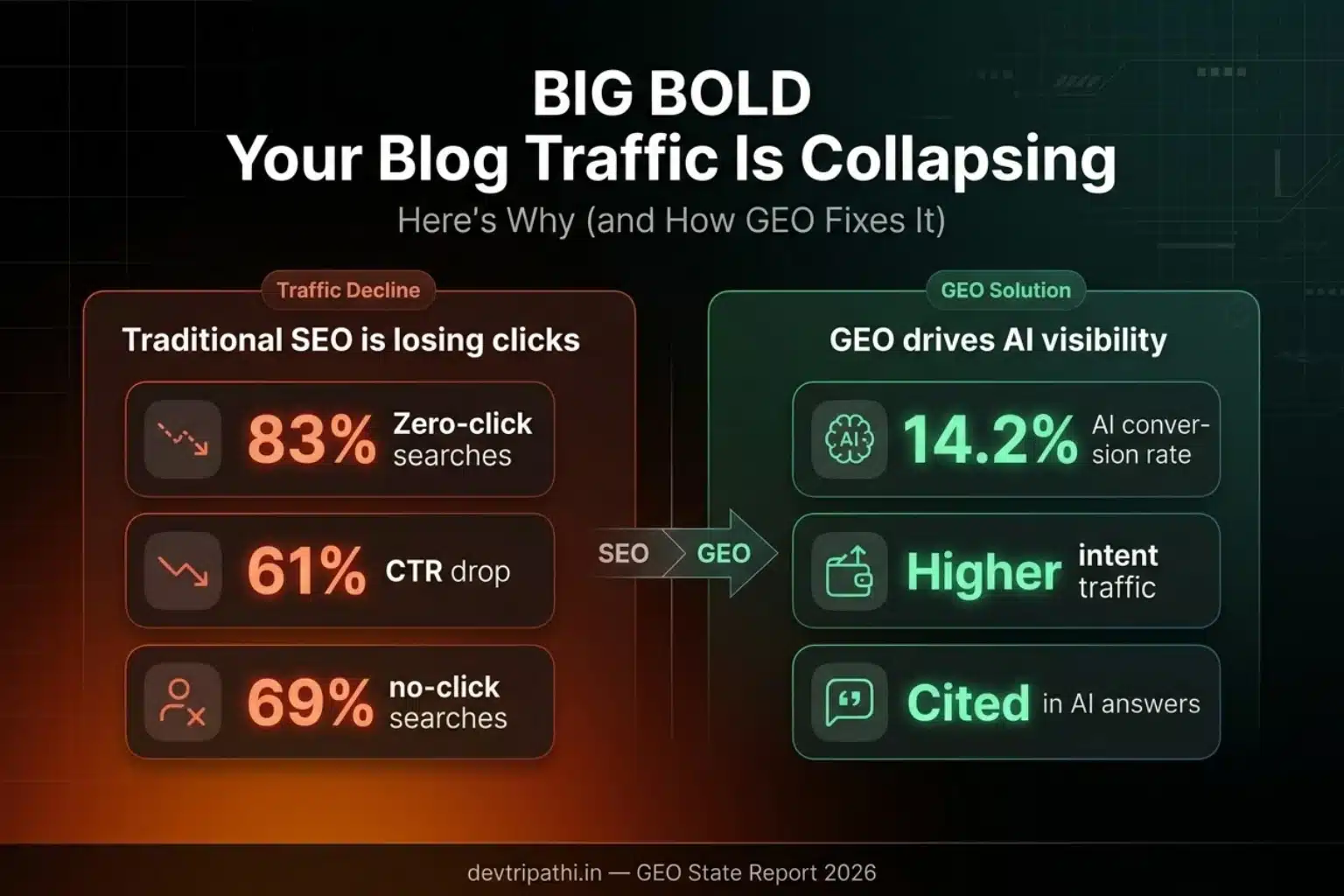
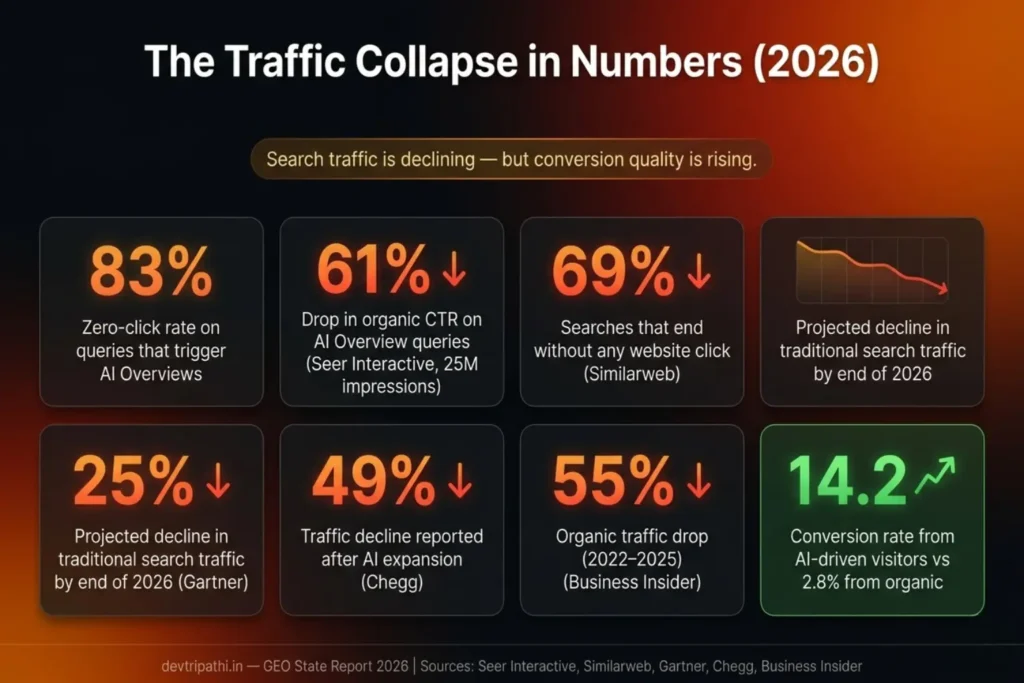
According to Seer Interactive’s September 2025 study analysing over 25 million organic impressions across 42 organisations, organic click-through rates on queries that trigger AI Overviews dropped 61% – from 1.76% in June 2024 to just 0.61% by September 2025. In plain language: for every 100 people who used to click your blog link, only 39 are clicking now.
Zero-click searches – where a user gets their answer directly on the search page without visiting any website – have now reached 69% of all Google searches, according to Similarweb data tracking from May 2024 to May 2025. That number is projected to climb toward 70% by mid-2026.
What this means practically: if someone searches ‘what is content marketing,’ Google’s AI answers it right there. Your 2,000-word article on that topic – no matter how well it ranks – may never be seen.
Real Publishers, Real Losses
This is not abstract. The names and numbers are documented.
Chegg, the learning platform, reported a 49% decline in non-subscriber traffic between January 2024 and January 2025 – directly tied to AI Overviews answering study questions that previously drove their traffic. Business Insider saw organic search traffic fall 55% between April 2022 and April 2025. HuffPost’s search referrals dropped by nearly half over the same period.
Smaller publishers were hit even harder. The travel blog The Planet D, which had been publishing since 2008, saw traffic collapse by over 90% following AI Overview expansion. The median publisher experienced a 10% year-over-year traffic decline in the first half of 2025 alone – with content-focused sites down 14%, according to The Digital Bloom’s analysis.
The message is the same everywhere: informational content that used to drive steady traffic is now the most vulnerable category in all of search.
So What Is GEO – and Why Does It Change Everything?
GEO stands for Generative Engine Optimisation.
Traditional SEO got your article to rank among ten blue links on a results page. GEO gets your content inside the AI-generated answer itself – cited as the source when ChatGPT, Perplexity, or Google AI Overviews generate a response to a user’s question.
The distinction matters enormously. Research from GEO firm Brandlight found that the overlap between top Google-ranking pages and AI-cited sources has dropped from 70% to below 20%. Ranking on Google no longer guarantees you will appear in AI answers. And appearing in AI answers no longer requires you to rank on Google. These are now two parallel games being played on different boards.
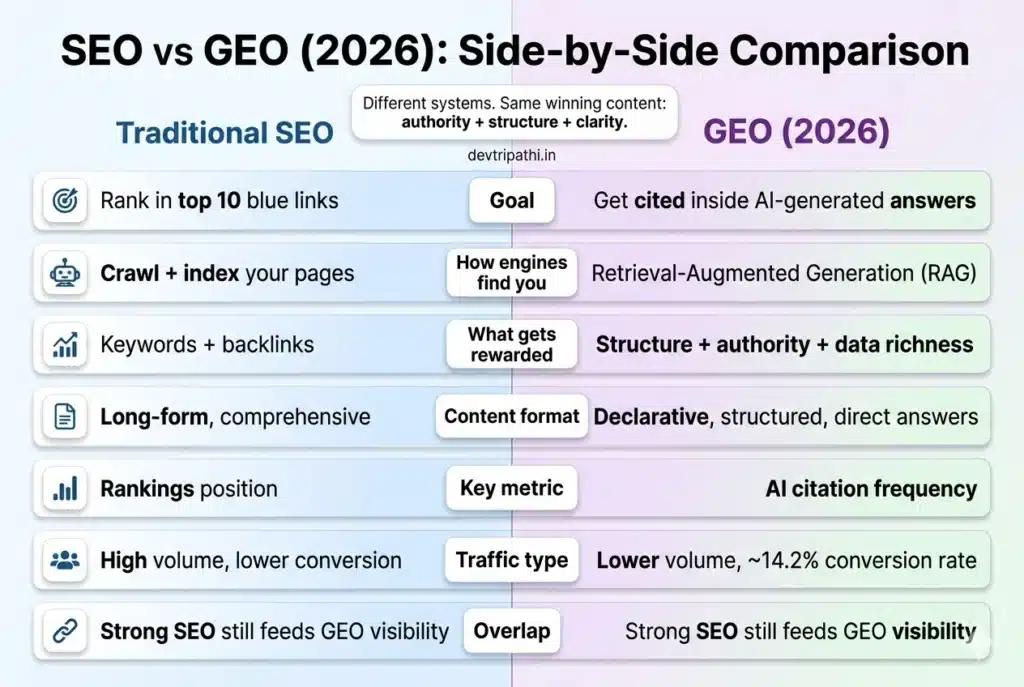
SEO vs GEO – SIDE BY SIDE COMPARISON | ||
ELEMENT | TRADITIONAL SEO | GEO (2026) |
Goal | Rank in top 10 blue links | Get cited inside AI-generated answers |
How engines find you | Crawl + index your pages | Retrieval-Augmented Generation (RAG) |
What gets rewarded | Keywords + backlinks | Structure + authority + data richness |
Content format | Long-form, comprehensive | Declarative, structured, direct answers |
Key metric | Rankings position | AI citation frequency |
Traffic type | High volume, lower conversion | Lower volume, ~14.2% conversion rate |
Overlap | – | Strong SEO still feeds GEO visibility |
Here is the silver lining buried in all of this: traffic from AI citations converts at 14.2% – nearly five times the traditional organic rate of 2.8%. Visitors arriving via AI citations show longer sessions, more pages per visit, and lower bounce rates. The volume drops, but the value of each visit increases dramatically.
The goal is no longer just traffic. It is the right traffic.
7 GEO Strategies to Recover Your Blog Traffic in 2026
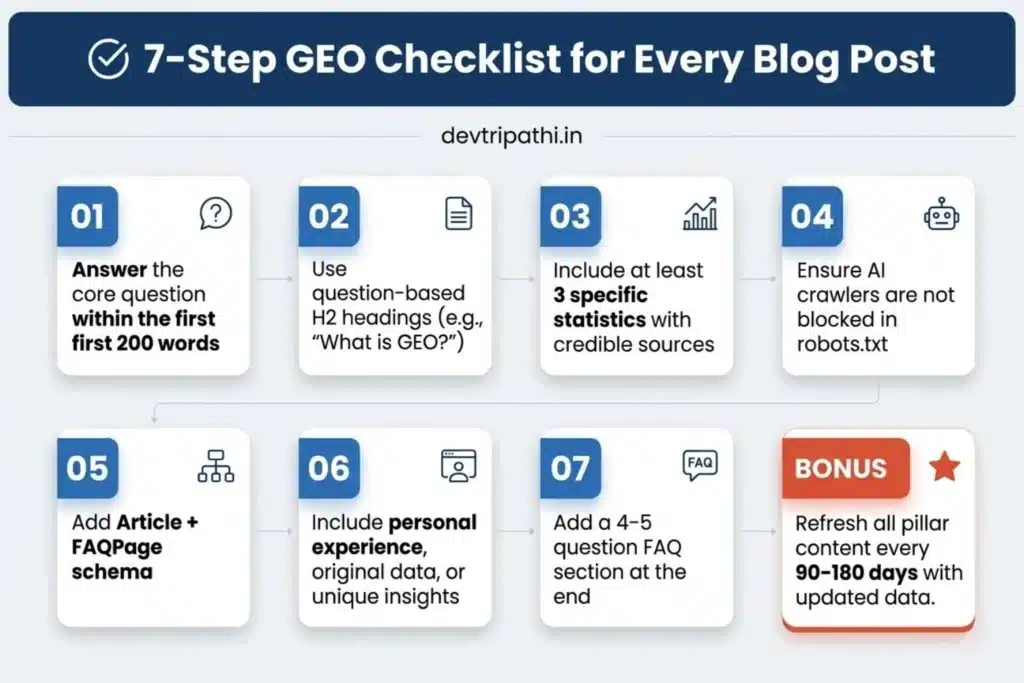
1. Answer the Question in Your First 200 Words
AI systems that use real-time retrieval – Perplexity, Google AI Overviews – evaluate a page’s relevance primarily on its opening content. The first 200 words of any article should directly and completely answer the primary query. Not build up to it. State the answer immediately, then earn your reader’s time with the depth that follows.
2. Use Question-Based H2 Headings
Headings like ‘What Is GEO?’ outperform headings like ‘Introduction to Generative Engine Optimisation’ in AI retrieval. AI systems read your H2 headings as direct questions to match against user queries. Make them conversational, specific, and searchable.
BrightEdge data confirms that longer, question-style queries of 8 or more words trigger Google AI Overviews far more often than shorter queries – meaning question-based headings align perfectly with how AI search is being used.
3. Include Real Data and Specific Statistics
Vague claims carry no weight with AI engines. Specific, attributed numbers do. ‘Many bloggers are seeing traffic drops’ tells an AI nothing citable. A precise statistic with a named source gives the AI a verifiable, quotable reference it can surface in answers.
Every factual claim you make should have a number, a source, or a specific example attached to it.
4. Make Your Content Technically Readable by AI
Verify that AI crawlers are not blocked in your robots.txt file. Ensure your important content is server-side rendered and not hidden behind JavaScript. Implement Article and FAQPage schema markup. Use clear heading hierarchies – one main topic per section, no nested tangents. If an AI system cannot cleanly extract your content, it will not cite you.
5. Write What AI Cannot Replicate
AI can synthesise general information from dozens of sources. What it cannot do is replicate your personal experience, your specific experiments, your proprietary data, or your original framework built from years of work. Case studies from your own blog, specific results you have tracked, honest opinions you hold – these are the things AI engines are most likely to cite, because they exist nowhere else on the internet.
Your voice and your lived experience are now your single biggest competitive advantage.
6. Add an FAQ Section to Every Blog Post
FAQ-structured content is heavily favoured by Google AI Overviews, ChatGPT, and Perplexity when generating answers. Four to five direct questions with crisp 2–3 sentence answers at the bottom of every post can significantly improve your AI citation rate. Use Rank Math’s FAQ block so the FAQPage schema is generated automatically.
7. Refresh Old Content With Updated Data and Timestamps
AI engines weigh recency when selecting sources. A pillar article published in 2023 with no updates loses ground to a freshly updated 2026 version on the same topic. Update your cornerstone content every 90–180 days. Add fresh data, new examples, and a clearly visible ‘Last updated’ timestamp.
GEO Is Not a Replacement for SEO – It Is the Next Layer
The fundamentals of traditional SEO still matter. Google still handles between 9.1 and 13.6 billion searches daily. Strong domain authority, quality backlinks, fast page speed, and well-structured content all continue to feed GEO visibility – the two strategies share deep foundations.
According to Ahrefs’ July 2025 analysis, 76.1% of URLs cited in Google AI Overviews also rank in the top 10 of traditional Google results. The two systems reward the same underlying quality – GEO just demands that you present it in a way AI can use.
The Honest Truth About Where Search Is Going
Gartner projects traditional search volume will drop 25% by end of 2026. Google AI Overviews now reach over 1.5 billion users monthly across more than 200 countries. ChatGPT serves approximately 800 million weekly active users. Perplexity processed 780 million queries in May 2025 alone.
This is not a temporary disruption. This is the new operating reality of the internet.
But here is what the data also shows: brands that get cited inside AI answers earn 35% more organic clicks and 91% more paid clicks than brands that are not cited – even accounting for the overall CTR decline. Visibility in AI search is measurably, trackably better for business.
Your blog is not broken. The game changed. GEO is how you play the new one.
If you want to understand the full picture of how GEO, AIO, VEO, and traditional SEO fit together, explore the complete GEO content cluster on this blog – built from real data, real experiments, and real results.
FAQ – Add Using Rank Math FAQ Block
Why is my blog traffic dropping in 2026? ▼
The most common cause is Google’s AI Overviews combined with zero-click search behaviour. Searches that trigger AI Overviews now show an 83% zero-click rate, meaning most users get their answer directly on the search page and never visit your blog – even if your content ranks well.
What is GEO and how is it different from SEO? ▼
GEO stands for Generative Engine Optimisation. Traditional SEO focuses on ranking your content among ten blue links in Google results. GEO focuses on getting your content cited inside AI-generated answers from ChatGPT, Perplexity, and Google AI Overviews. Both strategies work together – GEO is the additional layer that SEO alone cannot cover.
How long does GEO take to show results? ▼
Some brands report appearing in AI citations within 2-4 weeks of publishing well-structured, authoritative content. Building consistent, reliable GEO visibility typically takes 3-6 months of focused effort – faster than traditional SEO, but still requiring sustained work.
Does traditional SEO still matter in 2026? ▼
Yes. Google still handles billions of searches daily, and 76.1% of URLs cited in AI Overviews also rank in Google’s top 10. Strong traditional SEO still feeds GEO visibility. The two strategies share the same foundation – GEO simply adds specific optimisation requirements on top.
What type of blog content is safest from AI traffic loss? ▼
Content with personal experience, original data, unique frameworks, honest opinions, and specific case studies is hardest for AI to replicate and most likely to be cited as a source. Generic informational content – definitions, how-to basics, broad overviews – is the most vulnerable category.
Is my entire blog traffic going to disappear because of AI search? ▼
Not entirely – but the type of traffic is changing. Traditional search still drives 48.5% of all website traffic, and Google processes 5 trillion queries annually. What is disappearing is low-value informational traffic from generic queries. What is growing is high-intent traffic from AI-referred visitors, who convert at 4.4x the organic average (Semrush). The goal is not to chase lost volume but to build content that earns the higher-quality traffic that remains.
Why did my Google Search Console impressions go up but clicks go down? ▼
This is the clearest signal that AI Overviews are appearing for your keywords. Rising impressions mean Google is showing your content to more users – but inside the AI Overview panel, not as a clickable blue link. The user sees your information without visiting your page. This is called zero-click displacement, and it is now affecting 83% of searches that trigger an AI Overview. The fix is to optimise your content to be cited inside the AI Overview itself, which generates 35% more organic clicks for cited pages vs. non-cited competitors.
Which types of blog posts are losing the most traffic to AI in 2026? ▼
The highest-risk content categories are: generic definitions, basic how-to guides, broad topic overviews, listicles with no original insight, and content that simply aggregates publicly available information. AI can answer all of these directly without sending the user to your site. The safest content includes original research, first-hand experience, unique data, specific case studies, and expert opinions that AI cannot replicate from its training data alone.
How do I get my blog cited in Google AI Overviews? ▼
Five things increase your citation probability significantly: rank in Google’s top 10 for the target query (99.5% of AI Overview sources already rank there), structure your content with question-based H2 headings and direct 50-75 word answers below each one, implement FAQPage schema markup, add original statistics or data that AI systems want to reference, and keep your content updated – AI systems heavily favour fresh content over static pages. Pages with all five elements see citation rates up to 2.8x higher than pages without them.
What is zero-click search and how badly is it affecting bloggers? ▼
Zero-click search happens when a user’s query is answered directly on the search results page – in an AI Overview, featured snippet, or knowledge panel – without them clicking through to any website. In 2026, 65% of all informational queries are now resolved entirely within AI interfaces. For bloggers whose revenue depends on pageviews and ad impressions, this is a structural threat. The response is not to fight zero-click search but to get your content inside the AI answer – so your brand is the source users see, even when they do not click.
Can I recover lost blog traffic or is it gone permanently? ▼
Some of it is permanently redistributed – informational traffic that AI now resolves directly is unlikely to return at previous volumes. But lost traffic is recoverable through GEO optimisation (getting cited in AI answers), content repositioning (shifting generic posts toward original, experience-based content), and audience diversification (email lists, YouTube, social) that reduces dependence on search traffic alone. Brands that have implemented GEO strategies report recovering and exceeding previous visibility within 3-6 months.
Does ChatGPT and Perplexity actually send traffic to blogs? ▼
Yes – and the traffic quality is exceptionally high. AI-referred visitors from ChatGPT and Perplexity convert at 4.4x the rate of organic search visitors (Semrush). ChatGPT alone drives 87.4% of all AI referral traffic across platforms. The volume is smaller than traditional search traffic, but the intent quality is significantly higher – users who click through from an AI answer are specifically seeking your content. Set up a GA4 segment filtering chatgpt.com and perplexity.ai referrals to measure this directly.
What is the fastest way to fix dropping blog traffic in 2026? ▼
The fastest interventions, in order of impact: first, add a direct answer block in the first 200 words of your top 10 posts. Second, convert H2 and H3 headings to question format. Third, add a structured FAQ section with FAQPage schema markup to each post. Fourth, add original data, statistics, or a first-person case study to thin posts. These four changes can begin showing AI citation improvements within 30-60 days and require no new content – just structural edits to what you already have.
How do I know if AI Overviews are specifically causing my traffic drop? ▼
Check three signals in Google Search Console: rising impressions with declining CTR on the same queries, a drop in clicks concentrated on informational query types (how, what, why questions), and position stability while traffic falls. You can also manually search your top keywords in incognito mode – if an AI Overview appears above the blue links for queries you previously ranked for, that is the direct cause of your traffic loss.
Should I stop writing informational blog content altogether? ▼
No – but you need to upgrade it. Generic informational content is vulnerable; authoritative informational content with original data, expert perspective, and structured citations is more valuable than ever because AI systems need credible sources to cite. The shift is from ‘explaining what everyone else explains’ to ‘being the primary source that AI and readers cite.’ Informational content with original research, specific statistics, and genuine expertise is among the most frequently cited content type in AI Overviews.
What is E-E-A-T and does it actually affect AI citations? ▼
E-E-A-T stands for Experience, Expertise, Authoritativeness, and Trustworthiness – Google’s framework for evaluating content quality. In 2026 it directly affects AI citation probability: websites with author schema are 3x more likely to appear in AI answers (BrightEdge), and author credentials now carry 16% weight in AI citation decisions, up from 8% in 2024. Anonymous content and generic ‘Staff Writer’ bylines are effectively citation penalties. Every GEO-priority page needs a named, credentialled author with a verifiable external presence.
How important is schema markup for recovering blog traffic in 2026? ▼
Highly important – and specifically the combination of schema types matters. Pages using triple schema stacking (Article + FAQPage + ItemList schema together) receive 1.8x more AI citations than pages with Article schema alone (GenOptima). BrightEdge confirms schema markup enables AI engines to extract information with 300% higher accuracy versus unstructured content. In WordPress, Rank Math Pro supports all three schema types simultaneously and is the most accessible implementation path for bloggers.
Is it too late to start GEO in 2026? ▼
No – 47% of brands still have no dedicated GEO strategy at all (Digital Applied, 2026), meaning the majority of your competitors have not started. But the window is narrowing. Citation positions are beginning to concentrate around early movers in many niches, and topical authority compounds over time in ways that become harder to displace. Starting in 2026 still puts you ahead of most competitors, but starting in 2027 will be meaningfully harder in competitive niches.
What is topical authority and why does it matter for GEO? ▼
Topical authority is the degree to which AI systems and search engines recognise your site as a trustworthy expert on a specific subject. It is built by publishing comprehensive, interlinked content clusters around a core topic – not isolated posts. AI systems evaluate topical authority when deciding which sources to cite, and sites with deep, well-structured topic coverage consistently earn more citations than generalist sites with broader but shallower content.
Will GEO replace SEO completely in the next few years? ▼
No – the data does not support this scenario. Traditional search still drives 48.5% of all website traffic, and Google processes 5 trillion queries annually. What is happening is a gradual shift: AI search is growing rapidly as a second visibility channel that operates alongside traditional search. The most accurate frame is that both channels now require optimisation simultaneously, not that one replaces the other.
What does a GEO-optimised blog post look like in practice? ▼
A GEO-optimised post has these structural elements: a direct answer block in the first 200 words, H2 and H3 headings written as full questions, a 50-75 word direct answer in the first sentence of each section, original data or statistics, a named and credentialled author with author schema, triple schema stacking (Article + FAQPage + ItemList), and a 15+ question FAQ section at the end. Blog posts remain the number one cited content type in AI Overviews (Conductor, 2026), making this structure the highest-return investment for bloggers.
How do I track whether my GEO efforts are actually working? ▼
Use a four-part measurement system: Google Search Console for impressions vs. CTR trends on target queries, a GA4 custom segment filtering sessions from chatgpt.com and perplexity.ai to track AI referral volume directly, monthly manual citation testing by searching your target keywords in incognito, and paid tools like Semrush AI Visibility or Ahrefs Brand Radar for automated cross-platform citation monitoring at scale.
Why is my content ranking on Google but not getting cited in AI Overviews? ▼
Ranking is necessary but not sufficient for AI citations. Common reasons cited content is skipped despite ranking: no direct answer block in the opening section, headings written as topics rather than questions, no FAQ section or schema markup, content is too long and dense without scannable structure, and no original data or statistics for AI to reference. Pages that rank in positions 4-10 with strong GEO structure are frequently cited over position 1-3 pages with poor structure.
What should my content refresh strategy look like to maintain AI citations? ▼
Semrush’s AI Visibility Index shows 40-60% of cited sources rotate monthly, and AirOps found that AI Overview content changes roughly 70% of the time for the same query. This means static content loses citation positions to fresher competitors over time. Build a quarterly content refresh cycle: update statistics, add new data points, expand FAQ sections, and add recent case studies. Pages refreshed in the last 90 days consistently outperform static pages in AI citation rates, even when the static page ranks higher in organic search.
What is the single most important thing I can do today to stop my blog traffic from dropping? ▼
Open your highest-traffic blog post and add a direct answer block in the first 200 words – a 50-100 word paragraph that answers the post’s main question immediately, without preamble. This single change creates the answer island that AI systems extract for citations, improves featured snippet eligibility, and signals to readers that your content is worth reading. Do this for your top five posts this week. Then check Google Search Console impressions for those posts in 30 days – the data will show whether citation visibility is improving before you invest in any further changes.
- What Is GEO? Complete 2026 Pillar Guide →
- Google AI Mode: Transforming Search and SEO Strategies in 2025 →
- Understanding AI Mode Analytics: Measuring Success in a Generative Search Landscape →
- AI Mode vs Traditional Search: Comparing User Experiences →
- Optimizing for AI Mode: New SEO Strategies →
- Google December 2025 Core Update: Complete Analysis →
- The Ultimate On-Page SEO Checklist for 2025 →
- How to Update Old Content for SEO →
- Why a Structured SEO Plan Is Essential for Long-Term Success →
- 20 Common SEO Mistakes You Must Avoid →

Devyansh Tripathi
I’m Devyansh Tripathi, an SEO strategist and digital growth expert, helps businesses and individuals rank higher and drive organic traffic. Through DevTripathi., he shares cutting-edge SEO insights, content strategies, and marketing hacks. Passionate about digital success, he’s on a mission to make SEO simple, effective, and result-driven!
Posts
- What Is EEAT and How It Connects to GEO in 2026 (Blogger’s Guide)
- How to Make Your Blog Appear in Google AI Overviews
- Traditional SEO Is Not Dead – But It Needs GEO to Survive
- What Is an AI Overview and How Does It Affect Your Blog Traffic?
- 10 GEO Terms Every Blogger Must Know in 2026 – Plain English Glossary
Latest News
Text Widget
Empowering brands with insights, strategies, and stories that drive digital growth.