
What Is an AI Overview and How Does It Affect Your Blog Traffic?
24 March 2026
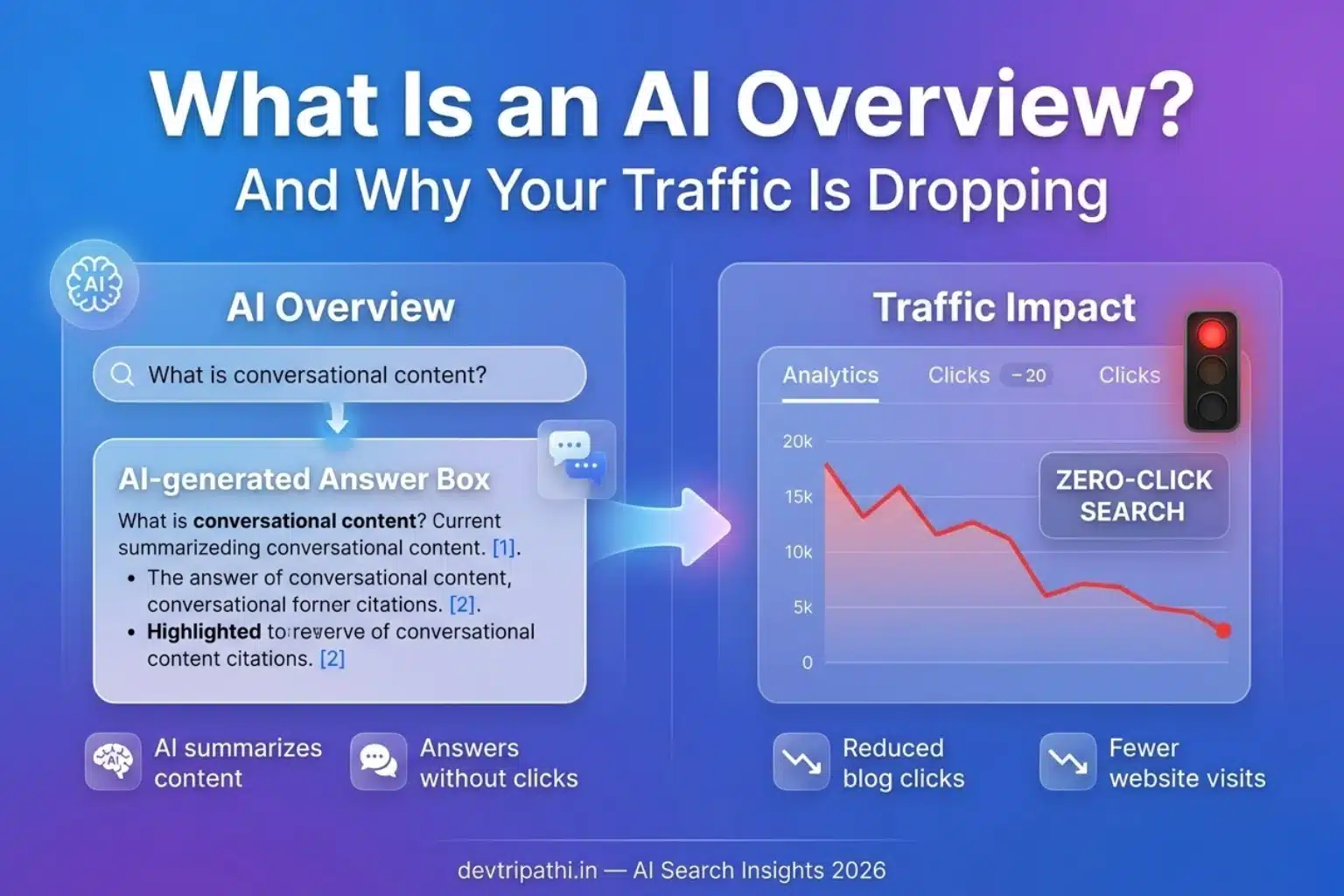
You spent months perfecting a blog post. It ranks on page one. Then one morning you open Google Search Console and notice something alarming: impressions are up, but clicks are collapsing. Nobody is blaming your writing. Nobody is penalizing your site. Google’s new AI Overview SEO landscape is simply answering your audience’s question before they ever reach your link.
In this guide you will learn exactly what an AI overview is, what the data says about its impact on blog traffic, which niches get hit hardest, and – most importantly – what you can do right now to stay visible in an AI-first search world.
Quick Answer (TL;DR) An AI Overview is a generative AI-powered summary box that appears at the top of Google search results for certain queries. It synthesises information from multiple web pages and answers the user’s question directly on the SERP. For bloggers, this means fewer click-throughs to your site – but being cited inside an AI Overview can actually increase qualified traffic and brand authority. The solution is to optimise for citation, not just for ranking. |
What Is an AI Overview? (And Why Google Built It)
Google’s AI Overview – formerly known as Search Generative Experience (SGE) – is a generative AI summary that appears at the top of search results for qualifying queries. Instead of listing ten blue links and letting you choose, Google now synthesizes content from multiple trusted pages and presents one cohesive answer, with a handful of expandable citations beneath.
The feature launched in May 2024 and is powered by Google’s Gemini large language model. By mid-2025, over one billion people worldwide had encountered AI Overviews, and Google had removed the sign-in requirement, opening the feature to virtually all users, including teenagers.
How an AI Overview Is Generated
The AI doesn’t handcraft summaries. According to Google’s own guidance, AI Overviews are generated from the same ranking signals used for traditional search – content quality, trustworthiness, relevance, and usability – processed differently through the Gemini model. The system identifies the most relevant, scannable, and authoritative content it can find, then synthesizes a direct answer.
Crucially, there is no special submission process. If your content is crawlable, indexed, and meets Google’s quality bar, it is automatically eligible.
Which Queries Trigger an AI Overview?
AI overviews are most likely to appear for:
- Informational queries – ‘how’, ‘what’, ‘why’, ‘best’ style searches
- Educational and research topics (science, health, finance)
- Multi-part complex questions that benefit from synthesis
- How-to and step-by-step instructional content
They are far less common for navigational queries (‘Facebook login’), transactional queries (‘buy sneakers online’), and local intent searches (‘pizza near me’).
The Data: How Prevalent Will AI Overviews Be in 2025?
The rollout has been fast but uneven. Here is what the major SEO research platforms found after analyzing tens of millions of queries:
Metric | Finding | Source |
|---|---|---|
% of all queries triggering AIO (Jan 2025) | 6.49% | Semrush |
% of all queries triggering AIO (Jul 2025 peak) | 24.61% | Semrush |
% of all queries triggering AIO (Nov 2025) | 15.69% | Semrush |
AIO prevalence for US desktop keywords (Sep 2025) | 30% | seoClarity |
Year-over-year AIO growth, US mobile (Sep 2025) | +475% | seoClarity |
Growth of AIO presence across keyword portfolios (Q1–Q4 2025) | +155% | Semrush |
Share of informational queries with AIO | 88% | Semrush |
The clearest takeaway: AI Overviews are not a fringe feature. They now appear for nearly one-third of all desktop searches. If your blog targets informational keywords – which most blogs do – your content is almost certainly operating in AIO territory.
How AI Overviews Affect Your Blog Traffic (The Real Numbers)
This is the question every blogger is asking. Let’s go through the evidence methodically, because the picture is more nuanced than the headlines suggest.
Click-Through Rates Are Falling – But Not Equally for Everyone
CTR drops from 15% → 8% when an AI Overview is present – Pew Research Center, July 2025 |
Organic CTR fell 61% from 1.76% to 0.61% for queries with AI Overviews – Seer Interactive, Sep 2025 |
Only 1% of searches lead to users clicking a link within an AI Overview – Pew Research Center, July 2025 |
In concrete terms: if your site was earning 10,000 clicks per month from an informational keyword, an AI overview appearing for that query could reduce that to 7,600–5,500 clicks without your page dropping a single position in the rankings.
Zero-Click Searches Are Rising
According to a Bain study from February 2025, 60% of searches in traditional search engines now end without a click due to AI-generated summaries. Users find their answer on the SERP and never proceed to a website. SparkToro found a related figure: over 58% of Google searches result in zero clicks overall.
For bloggers who built their entire model around organic traffic volume, this is a genuine structural shift, not a temporary fluctuation.
But Being Cited Changes Everything
Here is the number most people miss:
Cited pages earn 35% more organic clicks + 91% more paid clicks vs. competitors not cited – Search Engine Land / Seer Interactive, 2025 |
When your content is cited inside an AI Overview, your brand earns trust before the user even clicks. The users who do click through are more intentional, more qualified, and more likely to convert. The #1 organic result on Google now enjoys a 39.8% CTR – up slightly year-over-year – and links cited in AI Overviews can pull CTRs rivalling the top 3–5 organic positions.
Which Blog Niches Are Hit Hardest by AI Overview SEO?
Semrush analysed 11,000+ domains to map the impact by industry. The findings are striking:
Niche / Industry | AIO Exposure Level | Key Insight |
|---|---|---|
Science & Education | Very High | Factual, consensus-based content easiest to synthesise |
Health & Medical | High | YMYL queries get AIOs; Google is cautious but thorough |
Food & Recipe Blogs | High (fast-growing) | Biggest vertical growth in 2025; significant monetisation risk |
Finance & Legal | Medium–High | Complex queries trigger AIO; trust signals critical |
Tech & SaaS | Medium | Comparison and ‘best of’ queries heavily targeted by AIO |
Real Estate & Shopping | Low | Local packs and ads already satisfy intent; AIO growth minimal |
Entertainment & Pop Culture | Low | Visual-heavy, experience-led content harder to synthesise |
Food bloggers and recipe sites deserve a specific mention. This vertical saw the fastest AIO growth of any category in 2025. Sites that previously relied on organic search for ad revenue and affiliate income now need to rethink their traffic and monetisation models.
How Does Google Decide Which Blogs to Cite in AI Overviews?
Understanding the selection mechanism is the foundation of AI Overview SEO strategy. Several major research organisations have identified the key factors:
1. Organic Ranking Still Matters – But Isn’t the Whole Story
Ahrefs found that 76.1% of URLs cited in AI Overviews also rank in the top 10 of Google search results. Single Grain’s research across 18,767 AIO-triggering keywords found that 92.36% resulted in responses linking to at least one domain in the top 10. However, the overlap is imperfect – pages outside the top 10 now have better odds of citation than they ever did for traditional featured snippets.
2. E-E-A-T Is the Primary Filter
Google’s E-E-A-T framework – Experience, Expertise, Authoritativeness, Trustworthiness – has become the central filter for AI Overview selection. One analysis found that 96% of AI Overview content came from sources with verified E-E-A-T signals, and that the E-E-A-T bar grew 27% stricter in 2025 versus 2024. Content lacking clear E-E-A-T signals gets filtered out before any other consideration.
3. Content Freshness
A Seer Interactive study found that 85% of AI Overview citations were published within the last two years, with 44% from 2025 alone. Content updated in the past three months averages 6 citations versus 3.6 for outdated pages (SE Ranking, November 2025). Recency is often the tiebreaker between two otherwise equal pages.
4. Semantic Completeness
Analysis of 15,847 AI Overview results found that semantic completeness – where content answers the query fully within a single, self-contained passage – has an r = 0.87 correlation with citation selection. Content scoring 8.5/10 or above on this metric is 4.2 times more likely to be cited. AI systems prefer ‘answer islands’: focused sections that can be extracted and understood without surrounding context.
5. Content Depth and Word Count
SE Ranking’s November 2025 study found that articles over 2,900 words average 5.1 AI citations, while those under 800 words average only 3.2. For smaller domains, content length has roughly 65% more impact on citations than it does for top domains. Longer, more thorough content earns more citations.
How to Optimise Your Blog for AI Overview Citations (8 Actionable Strategies)
The good news: AI Overview SEO is not a separate discipline. It is the evolution of what good SEO has always demanded – clear, authoritative, well-structured content. Here is how to implement it precisely.
Strategy 1: Write a Direct Answer Block Under Every Key H2
Place a 50–75 word answer capsule immediately below every question-format H2 or H3 heading. This gives Gemini a self-contained ‘answer island’ it can extract without confusion. Single Grain’s research confirms this is one of the highest-impact structural changes you can make.
Example Format H2: What Is an AI Overview?[Direct answer in 50–75 words – clear, factual, no filler][Expanded explanation, examples, and data below] |
Strategy 2: Restructure Headings as Real Questions
Rename your subheadings from generic labels (‘Overview’, ‘Key Points’) to the exact phrasing users type into Google (‘What is…?’, ‘How does…?’, ‘Why does…?’). Pages using question-based headings and FAQ sections have measurably higher citation rates across ChatGPT and Google AI Overviews.
Strategy 3: Add an FAQ Section with Schema Markup
Pages with FAQPage schema markup are 3.2 times more likely to appear in Google AI Overviews (Frase.io). Only 12.4% of websites currently implement structured data – meaning early adopters gain a significant competitive advantage. Keep FAQ answers to 2–4 sentences: direct, specific, and in natural conversational language.
Important caveat: after Google’s August 2023 changes, FAQ rich results are restricted to authoritative government and health sites. However, FAQPage schema retains full value for AI citation selection even without the visible rich result in the SERP.
Strategy 4: Update Your Content Regularly
Freshness is a tiebreaker. Audit your top-performing posts quarterly. Update statistics, swap in newer examples, and refresh your conclusion. Even moderate updates can shift a post from the ‘outdated’ bracket into the preferred citation window. Use Google Analytics 4 to identify posts with declining traffic – those are your first update targets.
Strategy 5: Publish E-E-A-T Signals Throughout Your Post
Practical E-E-A-T actions that AI systems can parse:
- Add an author bio with verifiable credentials and first-hand experience notes
- Use Person schema with ‘sameAs’ links to LinkedIn or other authoritative profiles
- Cite primary sources – government, academic, and original research – not aggregators
- Include original data, case studies, or first-hand observations specific to your niche
- Add an ‘Expert Reviewed’ or ‘Last Updated’ label visible on the page
Strategy 6: Format for AI Parsability
AI systems scan, extract, and summarise. Design your content to be easy to chunk:
- Use one main topic per section – avoid blending two ideas under one heading
- Keep paragraphs to 3–4 sentences maximum
- Include comparison tables where relevant (‘X vs Y’ formats are frequently cited)
- Use numbered steps for how-to content
- Aim for 120–180 words between headings (SE Ranking found this boosts ChatGPT citations by 70%)
Strategy 7: Build Topical Authority Across Your Cluster
A single great post is no longer enough. AI systems evaluate topical authority – how thoroughly your site covers a subject area. Build content clusters: a pillar page surrounded by supporting posts that cover adjacent subtopics. Strong internal linking between cluster posts signals depth of expertise and improves both traditional ranking and AIO citation probability.
Strategy 8: Track AI Visibility, Not Just Rankings
Traditional rank tracking no longer tells the full story. Add these metrics to your reporting:
- Manual SERP checks: search your target keywords in Incognito mode and note whether an AI Overview appears and whether your domain is cited
- CTR vs. impressions trends in Google Search Console – widening gaps often signal AIO cannibalisation
- Branded search volume lift – a proxy for influence even without a click
- AI platform citations in ChatGPT, Perplexity, and Gemini – test your most important queries monthly
- Assisted conversions – traffic that doesn’t click first visit but returns later
Zero-Click Doesn’t Mean Zero Value: Rethinking Your Traffic Model
The most important mindset shift in AI Overview SEO: a user who reads an AI-generated summary powered by your content has still encountered your thinking, your data, and your brand. That influence has value – even without a click.
HubSpot’s experience illustrates the new reality starkly. The company reported a 70–80% decline in organic traffic between 2024 and 2025. Their response was instructive: they pivoted to optimise for AI search citations, claiming to be cited in LLMs more than any other CRM – and began generating conversions from that channel. Blog traffic as a percentage of leads fell to 10%, but AI citation-driven authority became a strategic asset.
The publishers winning in 2025 are those treating AI citations as their own KPI – separate from traffic. Being the voice behind an AI answer builds brand recall, reduces paid search costs, and generates more qualified visits when users do click through. (For more on tracking these newer signals, see our guide to GEO / generative engine optimisation.
What Type of Blog Content Is Safest From AI Overview Disruption?
Not all content is equally at risk. These formats tend to preserve click-through value even in an AIO-saturated SERP:
- Original research and proprietary data – AI cannot replicate first-party statistics
- Case studies and real-world success stories – specific experiences AI systems lack
- Opinionated commentary and analysis – unique human perspective; AI gives consensus views
- Tools, calculators, and interactive resources – utility that requires a visit
- Community and forum-style content – Reddit appeared prominently in AI Mode citations in Ahrefs’ September 2025 data
- Visual-heavy content – infographics, photo essays, and video tutorials are harder to summarise away
Substack demonstrated a 40% year-over-year traffic growth in July 2025 – reaching 67.7 million visits – precisely because its authentic, personality-driven writing is the content type Google’s Liz Reid specifically identified as gaining traffic in the AI era.
AI Overview SEO Checklist: Is Your Blog Ready?
Run through this before publishing every new post:
AI Overview SEO Checklist Item | |
|---|---|
☐ | H2/H3 headings phrased as real questions users search |
☐ | 50–75 word direct answer block below each key heading |
☐ | FAQ section with 3–5 genuine questions + schema markup |
☐ | Author bio with credentials and first-hand experience statement |
☐ | All claims cited to primary sources (gov, academic, original data) |
☐ | Last Updated date visible on page + freshness of stats confirmed |
☐ | Comparison table if post covers ‘X vs Y’ or ‘best of’ topic |
☐ | Internal links to related cluster posts with natural anchor text |
☐ | Core Web Vitals passing (LCP ≤ 2.5s, CLS ≤ 0.1, INP ≤ 200ms) |
☐ | Googlebot not blocked; page returns 200 status; nosnippet not set |
Frequently Asked Questions About AI Overview SEO
Does ranking #1 on Google guarantee I will be cited in AI Overviews? ▼
No, but it helps. Research shows that 76–92% of AI Overview citations come from top-10 organic results, but high ranking does not guarantee citation. Google also selects based on content structure, E-E-A-T signals, freshness, and semantic completeness. Pages outside the top 10 can be cited too.
Should I try to block Google's AI Overviews from using my content? ▼
You can use meta tags or robots.txt directives to block AI Overview inclusion, but most SEO experts advise against it. Being cited builds brand authority and qualified traffic even if total click volume dips. Blocking limits your long-term visibility. Focus on being cited, not excluded.
How much traffic are blogs losing to AI Overviews? ▼
Estimates vary by niche and query type, but most informational blogs see a 5–45% decline in organic clicks on queries where AI Overviews appear. The Ahrefs study found an average of 24% organic traffic reduction. The impact is lower for transactional and local queries.
Can small blogs compete with big domains for AI Overview citations? ▼
Yes – especially for niche topics. SE Ranking's November 2025 data found that for smaller domains, content depth has roughly 65% more relative impact on ChatGPT citations than it does for large domains. A focused, authoritative 3,000-word post from a specialist blog can outperform a thin page from a high-authority generalist site.
What queries should I focus on to avoid AIO disruption? ▼
Transactional and local queries are less likely to trigger AI Overviews. Informational and educational queries are most at risk. If your revenue depends on informational content, focus on adding original data, case studies, and unique perspectives that AI cannot generate – and optimize for citation rather than just ranking.
How do I know if an AI Overview is stealing my traffic? ▼
The signature signal is impressions growing or holding steady in Google Search Console while clicks and CTR decline. Search your target keywords in Incognito mode and check whether an AI Overview appears. If it does and your domain isn't cited, that is your priority optimization target.
Final Thoughts: AI Overview SEO Is a Strategy, Not a Crisis
AI Overviews are not going away. As of mid-2025, Google has been explicit: over one billion users have adopted this feature. The SERP has changed permanently, and AI Overview SEO is no longer optional for anyone who publishes informational content.
But the bloggers who reframe the question – from ‘how do I protect my traffic?’ to ‘how do I become the source AI trusts?’ – are the ones building sustainable visibility. The strategies are the same ones that have always defined great content: deep expertise, real-world experience, clear structure, and relentless freshness.
Start with the checklist above. Audit your five highest-traffic posts. Add direct answer blocks, restructure your headings as questions, implement FAQ schema, and update your statistics. Then measure citations alongside clicks. That dual measurement is your new north star.
The goal is not to rank. The goal is to be the voice that AI trusts when your audience asks their most important questions. Win that, and the traffic – qualified, intentional traffic – will follow.

Devyansh Tripathi
I’m Devyansh Tripathi, an SEO strategist and digital growth expert, helps businesses and individuals rank higher and drive organic traffic. Through DevTripathi., he shares cutting-edge SEO insights, content strategies, and marketing hacks. Passionate about digital success, he’s on a mission to make SEO simple, effective, and result-driven!
Posts
- What Google’s New AI Search Documentation Means for SEO Teams
- Google I/O 2026 Search: AI Agents, Gemini 3.5 and the Unified Box
- Google’s AI Optimization Guide: The Technical and Content Checklist
- July 2026 SEO Update: AI Overviews, llms.txt and Search Console
- Prompt Optimization Beyond Page One: The Position-21 Citation Opportunity
Categories
- AI Citation Optimization
- AI Search Optimization (AISEO)
- AI Visibility Tracking
- Answer Engine Optimization (AEO)
- Brand Authority SEO
- Brand SERP Optimization
- Community Signal SEO
- Conversational Search Optimization
- Generative Engine Optimization (GEO)
- Knowledge Graph Optimization
- Modern SEO Strategies
- Multimodal Search Optimization
- Prompt Optimization
- SEO Trends
- Social Search Optimization
- Topical Authority SEO
- Uncategorized
- Video Search SEO
- Visual Search Optimization
- Voice Engine Optimization (VEO)
- Zero Click Search Optimization
Latest News
Text Widget
Empowering brands with insights, strategies, and stories that drive digital growth.