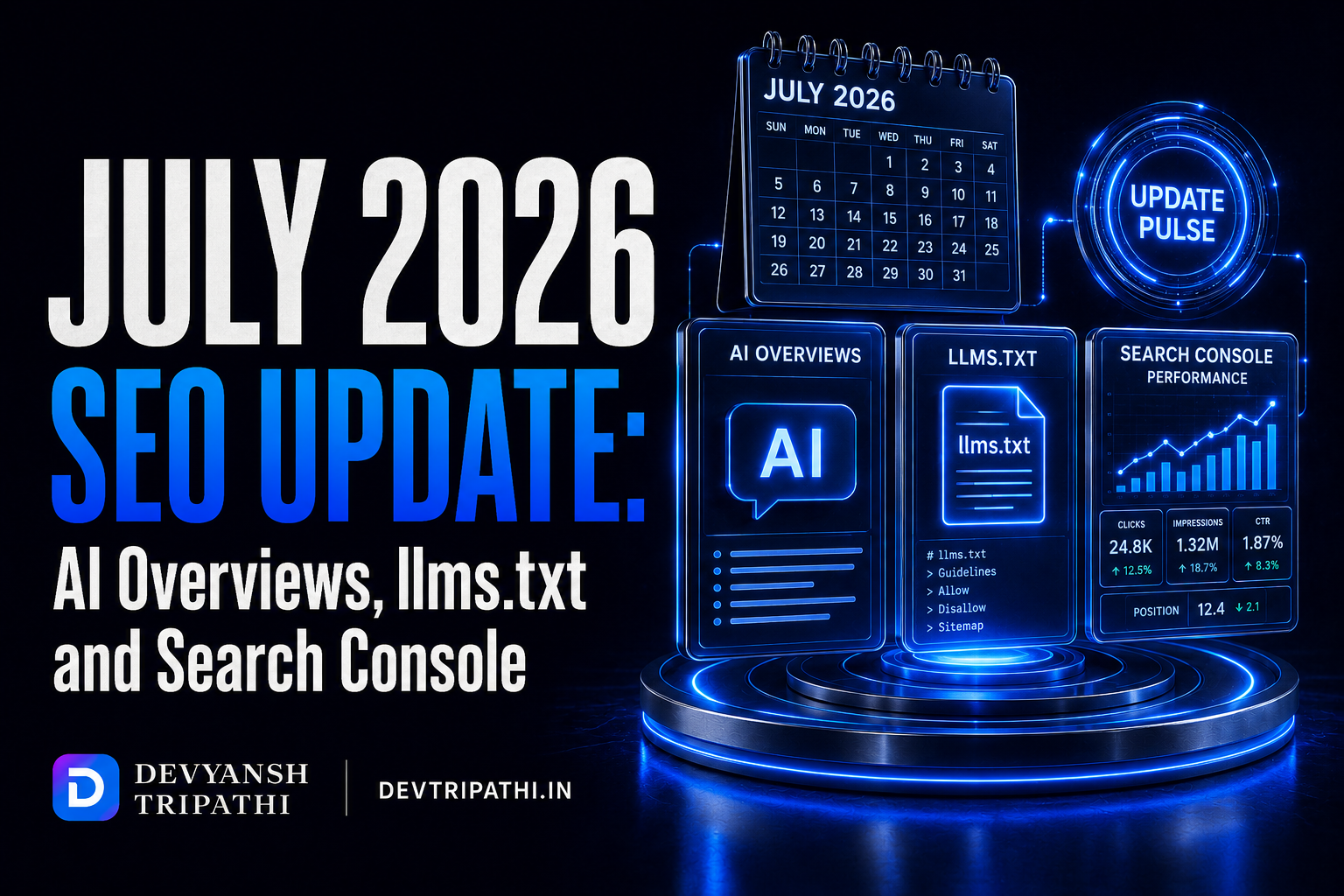
July 2026 SEO Update: AI Overviews, llms.txt and Search Console
29 July 2026
SEO trends for the second half of 2026 are defined less by dramatic algorithm upheaval than by Google systematically reshaping the search results page itself: July 2026 saw no broad core update and settled quickly after a fast-moving spam update, while the bigger story was AI Overviews gaining a live news carousel, AI-generated images, and new citation displays, Search Console quietly adding the tools site owners have been requesting to control how content appears inside AI features, and the UK Competition and Markets Authority formally ordering Google to disclose how its rankings actually work, arriving in the same month Pew Research found only 1% of users click any link inside a Google AI Overview at all.
This Cycle 4 trends report covers the complete state of SEO as of late July 2026: the confirmed algorithm timeline showing why this has been a month of refinement rather than disruption, the specific new AI Overview and Search Console features reshaping the branded and organic search experience, the official Google clarification on LLMs.txt files that resolves months of practitioner uncertainty, the CMA’s regulatory intervention forcing unprecedented ranking transparency, and the Pew Research finding on AI Overview click behavior that provides the starkest zero-click data point published so far in 2026.
Only 1% of Users Click a Link Inside an AI Overview. Is Your Visibility Strategy Built for That Reality?
Get a complete SEO trends assessment covering your readiness for Google's newest AI Overview features, LLMs.txt and technical format clarity, Search Console AI performance report utilization, and a visibility-first strategy built for the 1% click reality Pew Research has now confirmed.
Get My SEO Trends AssessmentA Month of Refinement, Not Upheaval
Numinix’s characterization of July 2026 as a month of refinement rather than upheaval provides an important corrective to the perpetual sense of algorithmic crisis that often dominates SEO discourse. There was no broad core update in July. The May 2026 core update had already fully settled by early June. The loudest algorithm news of the month was a fast-moving spam update that, according to Search Engine Roundtable, took only two days to roll out despite feeling substantial to affected sites.
The genuinely significant story of the month was not algorithmic volatility but Google’s continued, deliberate reshaping of the search results page itself. This distinction matters strategically: brands chasing every reported ranking fluctuation as evidence of a hidden algorithm shift are often missing the more consequential, slower-moving structural changes happening in parallel, changes to what the search results page contains, how AI features are controlled, and what data site owners have access to, that collectively matter more for long-term visibility strategy than short-term ranking volatility that frequently resolves itself without any lasting SEO action required.
1%of users click any link inside a Google AI Overview (Pew Research, July 2026)
43%zero-click rate in AI Overviews vs 93% in AI Mode specifically (Position Digital)
2 daysrollout time for the fast-moving June 2026 spam update
45%less low-quality, unoriginal content in Google's index reported since 2024 changes
The New AI Overview Features Reshaping the Search Results Page
July 2026 saw AI Overviews gain three distinct new capabilities that collectively expand their scope and prominence within the search results page: a live news carousel providing real-time news integration directly within AI-generated summaries, AI-generated images produced directly by the system rather than only pulling existing indexed images, and new citation displays presenting source attribution in an updated format. Together these additions confirm Google’s continued investment in making AI Overviews a more complete, self-contained answer surface rather than a supplementary summary sitting above traditional organic results.
New Feature 1
Live News Carousel Within AI Overviews
Real-time news integration directly within AI-generated summaries means AI Overviews now handle time-sensitive, current-events-adjacent queries with fresher, more dynamically updated content than the static summary format could previously provide, expanding the query categories where AI Overviews compete directly with dedicated news search results.
New Feature 2
AI-Generated Images Within Search Results
Google's July 2026 shift toward generating images directly within AI Overviews rather than exclusively pulling existing indexed images represents continued investment in visual discovery as a standalone search behavior, reinforcing the multimodal search optimization requirements covered in our Knowledge Graph Optimization Cycle 4 guide and broader 2026 multimodal research.
New Feature 3
New Citation Display Format
Updated citation presentation within AI Overviews changes how source attribution appears to users, a development site owners should monitor directly given its potential effect on the already-minimal 1% click-through rate Pew Research has documented for AI Overview links specifically.
The LLMs.txt Clarification: Resolving Months of Practitioner Uncertainty
One of the most practically useful clarifications to emerge from July 2026 reporting addresses a question that had generated considerable practitioner debate throughout the first half of the year: Google confirmed that LLMs.txt files, a proposed standard some sites have adopted specifically to guide AI crawlers, currently neither help nor hurt rankings in Google Search. This official clarification resolves the uncertainty that had led some sites to invest implementation effort in LLMs.txt files under the assumption they might provide a direct ranking or citation advantage within Google’s ecosystem specifically.
Google separately reaffirmed that HTML remains the standard format for SEO purposes rather than Markdown files, a clarification addressing another area of practitioner speculation about whether AI-native content formats might be gaining direct technical preference within Google’s crawling and ranking systems. Together these two clarifications confirm that, at least within Google’s specific ecosystem as of July 2026, the technical format and crawler-guidance innovations some sites have adopted in anticipation of AI-specific requirements have not yet translated into confirmed ranking or citation benefits, reinforcing that proven content quality and structural fundamentals remain the priority over speculative technical format changes.
The CMA’s Ranking Transparency Order: A Regulatory Turning Point
Perhaps the most structurally significant development reported in July 2026 is regulatory rather than algorithmic: the UK Competition and Markets Authority ordered Google to share how its rankings work, a formal transparency requirement arriving alongside an updated zero-click report. This regulatory intervention represents a meaningful escalation in the ongoing tension between search engine opacity and the accountability demands of regulators increasingly focused on the market power that ranking algorithm control confers.
For SEO practitioners, this development is worth monitoring closely, since any resulting disclosure could provide the industry with meaningfully more concrete ranking factor information than has historically been available, information that has traditionally been inferred through extensive practitioner testing, correlation studies, and Google’s own selectively shared guidance rather than direct, mandated disclosure. Whether this regulatory pressure produces genuinely actionable new transparency or only incremental additional disclosure remains to be seen as the CMA’s order proceeds, but its very existence confirms that ranking algorithm opacity has become a live regulatory concern rather than an accepted industry constant. For the complete measurement framework that helps brands navigate continued algorithmic and regulatory uncertainty through independent citation testing, see our AI Visibility Tracking Cycle 4 guide.
Google's Own Regulator Is Now Demanding Ranking Transparency. Do Not Wait for Disclosure to Build Your Strategy.
Dev Tripathi helps brands build SEO strategy on the evidence currently available rather than waiting for regulatory disclosure, combining the newest confirmed Google clarifications with independent citation testing and Search Console's expanding AI performance reporting tools.
Build My Evidence-Based SEO StrategyPew Research’s 1% Finding: The Starkest Zero-Click Data Point Yet
Pew Research’s finding that only 1% of users click any link inside a Google AI Overview represents the starkest, most specific zero-click statistic published in 2026 research to date. While earlier 2026 research established zero-click rates in the 68% to 93% range depending on the specific search context, Pew’s 1% figure isolates the click behavior specifically within AI Overview link elements themselves, providing an even more granular and sobering measurement of exactly how rarely users engage with the source links Google’s AI Overviews present.
The complementary Position Digital data showing 43% zero-click specifically in AI Overviews versus 93% zero-click in AI Mode clarifies an important distinction this guide’s broader trends coverage should not obscure: AI Mode swaps the traditional results page entirely for a chat-based interface, while AI Overviews keep organic links visible on the page alongside the AI-generated summary. This structural difference explains why AI Mode’s zero-click rate runs so much higher than AI Overviews’ rate, even though Pew’s 1% finding confirms that the organic links AI Overviews do keep visible are clicked at an extremely low rate regardless. For the complete citation-first strategic framework that responds directly to this stark click reality, see our Zero-Click Search Optimization Cycle 4 guide.
| July 2026 Development | Category | Practical Implication |
|---|---|---|
| AI Overview live news carousel, AI images, citation displays | SERP feature expansion | AI Overviews handle a broader query range with more self-contained answers |
| LLMs.txt clarification (neither helps nor hurts) | Technical guidance | Prioritize proven fundamentals over speculative AI-specific technical formats |
| CMA ranking transparency order | Regulatory | Monitor for potential future disclosure of concrete ranking factor data |
| Pew Research 1% AI Overview click rate | Behavioral data | Citation-first, visibility-focused strategy now essential over click-focused strategy |
Search Console’s Expanding AI Toolset
Search Console quietly gained the tools site owners have been asking for to control how their content shows up inside AI features throughout July 2026, including expanded access to AI performance reports and a deep dive help document on AI controls specifically. This expansion, alongside a fixed long-standing bug in the Links report that now provides more reliable internal and external link data, confirms Google continuing to build out the measurement and control infrastructure that SEO practitioners require to manage their presence across an increasingly AI-mediated search landscape, even as some reporting features including the Page Indexing report continue experiencing delays and a new bug affecting the generative AI Discover report surfaced during the same period.
This pattern of incremental tooling improvement alongside persistent reporting friction reflects the genuinely early-stage nature of AI-specific search measurement infrastructure: Google is actively building the tools practitioners need, but that infrastructure remains a work in progress rather than a fully mature, reliable reporting system as of mid-2026. Practitioners should treat Search Console’s AI-specific reporting as a valuable but still-developing supplementary data source, combined with the independent citation testing covered throughout Cycle 4 research, rather than as a complete, standalone source of truth for AI search performance measurement. For the complete modern SEO strategy framework this evolving measurement landscape operates within, see our Modern SEO Strategies Cycle 4 guide.
Frequently Asked Questions About SEO Trends in July 2026
Why is July 2026 described as a month of refinement rather than upheaval?
July 2026 saw no broad core update, with the May 2026 core update having already fully settled by early June, and the loudest algorithm news being a fast-moving spam update that took only two days to roll out. The more significant developments this month were structural changes to the search results page itself, including new AI Overview features and Search Console tooling, rather than the kind of dramatic ranking algorithm shifts that have characterized other periods in 2026, making refinement a more accurate description of the month's overall pattern than upheaval.
What new features did AI Overviews gain in July 2026?
AI Overviews gained three distinct new capabilities in July 2026: a live news carousel providing real-time news integration, AI-generated images produced directly by the system rather than only pulling existing indexed images, and new citation displays presenting source attribution in an updated format. Together these additions expand AI Overviews' scope and self-sufficiency as an answer surface, handling a broader range of query types with more complete, dynamically updated content than the previous static summary format provided.
What did Google clarify about LLMs.txt files in July 2026?
Google clarified that LLMs.txt files, a proposed standard some sites have adopted specifically to guide AI crawlers, currently neither help nor hurt rankings in Google Search. This resolves months of practitioner uncertainty about whether implementing this emerging standard might provide a direct ranking or citation advantage, confirming that within Google's ecosystem specifically, this particular AI-crawler-guidance format has not yet translated into any confirmed ranking benefit as of mid-2026.
What is the CMA's ranking transparency order and why does it matter?
The UK Competition and Markets Authority ordered Google to share how its rankings actually work, a formal regulatory transparency requirement arriving alongside an updated zero-click report. This matters because it represents a meaningful escalation in regulatory scrutiny of search algorithm opacity, potentially producing more concrete ranking factor information than the industry has historically had access to, information traditionally inferred through practitioner testing and correlation studies rather than direct, mandated disclosure from Google itself.
Why does Pew Research's 1% AI Overview click finding matter so much?
Pew Research's finding that only 1% of users click any link inside a Google AI Overview represents the starkest, most granular zero-click statistic published in 2026 research, isolating click behavior specifically within AI Overview link elements rather than measuring broader zero-click rates across all search contexts. This confirms that even when organic links remain visible alongside an AI Overview summary, as they do in AI Overviews specifically (unlike AI Mode's fully chat-based interface), user engagement with those links is extremely rare, reinforcing the citation-first strategic priority covered throughout 2026 zero-click research.
How does the 43% versus 93% zero-click gap between AI Overviews and AI Mode explain their different structures?
The 43% zero-click rate in AI Overviews versus 93% in AI Mode reflects a fundamental structural difference: AI Mode swaps the traditional results page entirely for a chat-based conversational interface, while AI Overviews keep organic links visible on the page alongside the AI-generated summary. This structural difference explains why AI Mode suppresses clicks so much more severely, even though Pew Research's 1% finding confirms that the links AI Overviews do keep visible are engaged with at an extremely low rate regardless of their continued presence on the page.
What is the Google June 2026 spam update and how significant was it?
The June 2026 spam update was a fast-moving update that took only two days to roll out despite feeling substantial to affected sites, according to Search Engine Roundtable's reporting. Google's Head of Search Liz Reid discussed content quality, chunking, site signals, and AI clicks with the search community during the same period, suggesting the update reflected Google's continued refinement of content quality evaluation rather than a fundamentally new spam detection approach, consistent with July 2026's broader characterization as a period of refinement rather than major disruption.
What new Search Console tools became available in July 2026?
Search Console gained expanded access to AI performance reports and posted a deep dive help document on AI controls specifically, alongside a fixed long-standing bug in the Links report that now provides more reliable internal and external link data. However, the Page Indexing report was delayed again by roughly two weeks, and a new bug affecting the generative AI Discover report surfaced on June 24, confirming this AI-specific measurement infrastructure remains a work in progress rather than a fully mature reporting system.
What are Google Search Profiles and Publisher Profile Pages?
Google Search Profiles, offering Publisher Profile Pages, officially went live in July 2026, representing a new feature for how publishers and site owners manage their presence within Google's search ecosystem. Combined with the new Platform Property Tooltips tool in Search Console, these incremental additions reflect Google's continued investment in giving site owners more direct tools and visibility into how their content and brand presence function across Google's evolving search surfaces.
How should SEO strategy respond to the combination of algorithmic refinement and AI feature expansion documented in July 2026?
SEO strategy should treat the relative algorithmic calm of July 2026 as an opportunity to invest in the structural fundamentals, entity clarity, content quality, and citation-first optimization, that remain valuable regardless of specific short-term ranking fluctuations, rather than reacting to every reported update as an urgent crisis requiring immediate tactical response. The genuinely significant developments this month, expanding AI Overview features, new Search Console tooling, and the CMA transparency order, all point toward continued investment in AI-mediated search readiness as the durable strategic priority. For the complete synthetic share of voice framework this readiness should be measured against, see our Modern SEO Strategies Cycle 4 guide.
Build SEO Strategy for the AI-Mediated Search Reality July 2026 Has Confirmed
Get a complete SEO trends assessment covering your readiness for the newest AI Overview features, an audit of your technical foundation against Google's LLMs.txt and HTML format clarifications, Search Console AI performance report configuration, and a citation-first strategy built for the 1% AI Overview click reality Pew Research has now documented.
Get My Free SEO Trends AssessmentConclusion
SEO trends as of late July 2026 confirm a landscape defined less by algorithmic disruption than by the steady, deliberate expansion of AI-mediated search features and the measurement infrastructure required to navigate them: no broad core update, a fast-resolving spam update, but AI Overviews gaining a live news carousel, AI-generated images, and new citation displays, alongside Search Console’s expanding AI performance reporting tools. The Google clarifications on LLMs.txt and HTML format requirements resolve genuine practitioner uncertainty, while the UK CMA’s ranking transparency order signals that search algorithm opacity has become an active regulatory concern rather than an accepted industry constant.
Pew Research’s finding that only 1% of users click any link inside a Google AI Overview, alongside the 43% versus 93% zero-click gap between AI Overviews and AI Mode specifically, together provide the starkest and most structurally informative click behavior data published in 2026, confirming that citation-first, visibility-focused strategy is no longer a forward-looking consideration but the immediate, documented reality of how the majority of AI-mediated search interactions now conclude. For the complete citation-first strategic framework built directly for this documented reality, see our Zero-Click Search Optimization Cycle 4 guide.

Devyansh Tripathi
I’m Devyansh Tripathi, an SEO strategist and digital growth expert, helps businesses and individuals rank higher and drive organic traffic. Through DevTripathi., he shares cutting-edge SEO insights, content strategies, and marketing hacks. Passionate about digital success, he’s on a mission to make SEO simple, effective, and result-driven!
Posts
- What Google’s New AI Search Documentation Means for SEO Teams
- Google I/O 2026 Search: AI Agents, Gemini 3.5 and the Unified Box
- Google’s AI Optimization Guide: The Technical and Content Checklist
- July 2026 SEO Update: AI Overviews, llms.txt and Search Console
- Prompt Optimization Beyond Page One: The Position-21 Citation Opportunity
Categories
- AI Citation Optimization
- AI Search Optimization (AISEO)
- AI Visibility Tracking
- Answer Engine Optimization (AEO)
- Brand Authority SEO
- Brand SERP Optimization
- Community Signal SEO
- Conversational Search Optimization
- Generative Engine Optimization (GEO)
- Knowledge Graph Optimization
- Modern SEO Strategies
- Multimodal Search Optimization
- Prompt Optimization
- SEO Trends
- Social Search Optimization
- Topical Authority SEO
- Uncategorized
- Video Search SEO
- Visual Search Optimization
- Voice Engine Optimization (VEO)
- Zero Click Search Optimization
Latest News
Text Widget
Empowering brands with insights, strategies, and stories that drive digital growth.