Prompt Optimization Beyond Page One: The Position-21 Citation Opportunity
28 July 2026
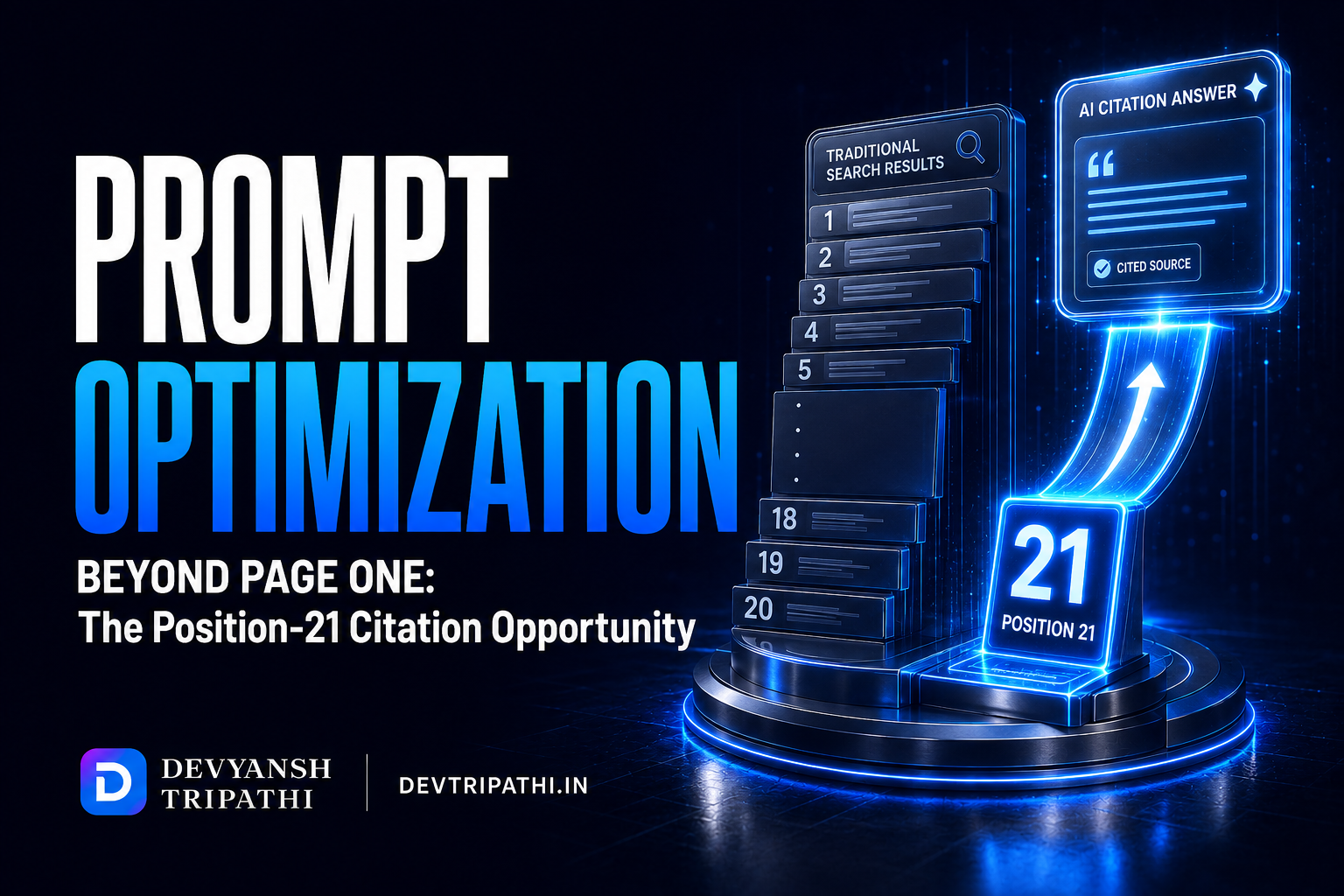
Prompt optimization in the second half of 2026 must reckon with two counterintuitive findings that overturn common assumptions about how AI citation eligibility actually works: Semrush’s research found ChatGPT cited pages ranking in traditional organic position 21 or worse almost 90% of the time, confirming that content ranking well outside the traditional top-10 focus zone still carries substantial citation opportunity, while a separate finding reveals ChatGPT sends 28.8% of its referrals not to the specific page that answers a query but to a site’s internal search results page instead, because the model trusts a domain enough to send a visitor but cannot always identify the exact right page, meaning internal site search has quietly become an unoptimized AI acquisition surface that most brands have never evaluated.
This Cycle 4 guide covers prompt optimization built on these newest structural findings: the complete position-21 citation data and why it confirms AI platforms are genuinely citation-hungry in a way traditional search rankings never were, the internal search results page discovery and the specific technical work required to turn that surface into a functioning acquisition channel rather than a dead end, the refined citation-position data showing exactly how citations distribute across the beginning, middle, and end of a page, the direct-answer headline finding showing a 12-percentage-point citation rate gap between headlines that directly answer a question and headlines that only loosely relate to it, and the RAG pipeline mechanics that explain precisely why all of these findings occur the way they do.
ChatGPT Sends 28.8% of Referrals to Your Internal Search Page. Have You Ever Optimized It?
Get a complete prompt optimization audit covering your internal site search functionality as an AI acquisition surface, your position-21-and-beyond content citation opportunity, heading structure against the direct-answer citation rate benchmark, and content distribution alignment with the documented first-30%/middle/last-third citation pattern.
Get My Prompt Optimization AuditThe Position-21 Opportunity: AI Platforms Are Genuinely Citation-Hungry
Semrush’s July 2025 research produced a finding that directly contradicts the assumption most SEO practitioners carry over from traditional search optimization: ChatGPT cited pages ranking in traditional organic position 21 or worse almost 90% of the time. This is not a minor exception to an otherwise top-10-dominated citation pattern. It confirms that AI platforms, unlike traditional Google search results where the overwhelming majority of click volume concentrates in the top three to five positions, are genuinely citation-hungry in a way that creates real, substantial opportunity for content that would never earn meaningful traditional organic traffic from its actual ranking position.
The practical implication is significant for resource allocation: while 92.36% of AI citations still come from top-10 organic results according to SEOScaleUp’s broader 2026 research, meaning traditional ranking remains the dominant predictor overall, the position-21 finding confirms that content teams should not abandon or deprioritize pages that rank respectably but not exceptionally, somewhere in positions 11 through 30, purely because that ranking position would produce minimal traditional organic traffic. For newer or smaller sites specifically, where the search engine results pages are saturated with established competition, AI platforms represent an unprecedented, comparatively uncrowded opportunity to gain meaningful visibility that traditional top-10 competition would never realistically allow.
~90%of the time ChatGPT cited pages ranking position 21 or worse (Semrush, July 2025)
28.8%of ChatGPT referrals land on internal search results pages, not the answer page itself
41%citation rate for direct-answer headlines vs 29% for loosely related headlines (Growth Memo)
44.2%of all LLM citations come from the first 30% of a text (Growth Memo, Feb 2026)
The Internal Search Discovery: An Unoptimized Acquisition Surface
The most operationally significant new finding for prompt optimization in 2026 is the discovery that ChatGPT sends 28.8% of its referrals to a site’s internal search results page rather than to the specific page that actually answers the query. The mechanism behind this pattern is straightforward but had previously gone largely unexamined: the model trusts a domain enough, based on its overall entity authority and topical relevance, to confidently send a visitor there, but it cannot always identify precisely which specific page on that domain contains the exact answer, so it defaults to directing the user to the site’s own internal search function instead.
In practice, this finding means internal site search is no longer a housekeeping feature relegated to secondary technical priority. It has become a genuine acquisition surface that most sites have never optimized at all. When nearly three in ten AI-referred visitors from a major platform arrive at a site’s internal search results page rather than a specific, purpose-built answer page, the quality, relevance, and speed of that internal search experience directly determines whether the visit converts into a satisfied user finding what they need or a frustrated bounce that undermines the entity trust the AI platform had extended to the domain in the first place.
Priority Action 1
Audit Internal Search Result Relevance
Test your site's internal search function using the exact conversational query phrasing an AI-referred visitor might use, since these queries typically differ meaningfully from the abbreviated keyword phrasing internal search functions are traditionally optimized to handle. Confirm the search returns genuinely relevant results within the first few positions rather than requiring extensive scrolling or refinement.
Priority Action 2
Strengthen Page-Level Entity and Topic Clarity
The root cause of the 28.8% internal-search-redirect pattern is that the model cannot always confidently identify which specific page contains the answer, even when it trusts the domain overall. Strengthening individual page titles, headings, and structured data to more precisely signal exactly what question each page answers reduces this ambiguity and increases the probability of direct-page citation rather than domain-level redirection to internal search.
Priority Action 3
Treat Internal Search Analytics as a New Measurement Category
Most analytics setups do not currently isolate and report on internal search usage originating specifically from AI platform referral traffic. Configuring this segmentation reveals the actual scale of this acquisition surface for a specific brand and provides the baseline data needed to measure whether internal search improvements are producing the conversion lift this newly identified traffic pattern makes possible.
Nearly 1 in 3 AI-Referred Visitors Land on Your Internal Search Page. Make That Landing Count.
Dev Tripathi builds complete prompt optimization programmes covering internal search relevance auditing, page-level entity clarity strengthening, position-21-and-beyond content strategy, and heading structure optimization aligned with the documented direct-answer citation rate advantage.
Build My Prompt Optimization StrategyThe Refined Citation Distribution: First 30%, Middle, and Final Third
Growth Memo’s February 2026 research provides the most granular citation distribution data currently available, confirming that 44.2% of all LLM citations come from the first 30% of a text, 31.1% come from the middle 30 to 70% span, and 24.7% come from the final third of an article. This complete three-part breakdown extends the previously established front-loading principle with specific guidance for the full page structure rather than only confirming that early content matters most.
The practical implication of the full distribution is that while front-loading the most citable, data-dense content remains the highest-priority structural decision, the middle and final sections of a page still account for a combined 55.8% of total citation volume, confirming that comprehensive, well-structured content throughout the complete page continues to matter substantially rather than only the opening section. Content teams should apply the same citability principles, direct answers, specific data points, and clear structure, consistently across the entire page rather than concentrating optimization effort exclusively on the introduction while allowing quality to decline through the middle and closing sections.
The Direct-Answer Headline Advantage: A 12-Point Citation Rate Gap
Growth Memo’s April 2026 research quantifies a specific, actionable heading structure finding: pages with headlines that directly answer the question get cited by ChatGPT 41% of the time, while pages with headlines that are only loosely related to the underlying question drop to a 29% citation rate, a 12-percentage-point gap attributable specifically to headline phrasing precision. This provides concrete, quantified evidence for the Q&A heading conversion principle covered throughout prior prompt optimization research, moving it from a generally recommended best practice into a specifically measured, statistically significant citation rate factor.
| Content Section | Share of Total Citations | Primary Optimization Focus |
|---|---|---|
| First 30% of Page | 44.2% | Direct answers, key statistics, highest data density |
| Middle 30-70% of Page | 31.1% | Supporting detail, process explanation, comparisons |
| Final Third of Page | 24.7% | Conclusions, FAQ sections, summary reinforcement |
Auditing existing content against this specific finding requires reviewing every H2 and H3 heading against a simple test: does the heading itself directly pose and imply an answer to the exact question a user would ask, or does it only broadly relate to the surrounding topic area without directly framing a specific question? Converting headings from the latter category to the former, based on this quantified 12-point citation rate differential, represents one of the highest-confidence, lowest-effort prompt optimization actions available for any existing content library. For the complete data density and structural framework this heading precision principle operates within, see our AEO Cycle 4 guide.
The RAG Pipeline: Why These Findings Occur the Way They Do
Elementor’s 2026 guide to optimizing content for AI search engines provides the underlying mechanical explanation for why all of the findings covered in this guide occur as they do, describing the Retrieval-Augmented Generation pipeline that governs how AI systems select and cite content. Content, along with data from APIs, databases, and other documents, is first crawled, processed, broken into logical chunks, converted into numerical embeddings, and stored in a vector database functioning as a curated knowledge library. When a user submits a query, the system retrieves the most conceptually relevant chunks from this library and uses them to ground a generated, cited response.
This architecture explains the position-21 finding directly: because retrieval operates on conceptual relevance within the vector database rather than on the traditional ranking algorithm’s link-based authority signals, a page’s traditional organic position and its retrieval eligibility within the RAG pipeline are related but genuinely distinct evaluations. It also explains why relevance in this system is fundamentally about matching conceptual intent rather than matching keywords, the specific technical reason building broad topical authority across a well-structured content cluster has become more important than narrow, isolated keyword targeting throughout 2026 GEO and prompt optimization research. For the complete topical authority cluster methodology that directly serves this RAG-based conceptual retrieval requirement, see our Topical Authority SEO guide.
Frequently Asked Questions About Prompt Optimization in 2026
Why does ChatGPT cite pages ranking position 21 or worse almost 90% of the time?
Semrush's July 2025 research found ChatGPT cites pages ranking position 21 or worse almost 90% of the time because AI citation selection operates through conceptual relevance retrieval within a vector database rather than through the traditional link-based ranking algorithm, meaning a page's traditional organic ranking position and its AI citation eligibility are related but genuinely distinct evaluations. This confirms AI platforms are citation-hungry in ways traditional search rankings never were, creating substantial opportunity for content that would never earn meaningful traffic from its actual traditional ranking position alone.
What does the 28.8% internal search referral finding mean for site optimization?
The finding that ChatGPT sends 28.8% of its referrals to a site's internal search results page rather than the specific answer page means internal site search has become a genuine, previously unrecognized AI acquisition surface. This occurs because the model trusts a domain enough to send a visitor but cannot always identify precisely which page contains the answer, defaulting to internal search instead. Brands should audit internal search relevance for conversational query phrasing and treat this traffic segment as a distinct measurement and optimization category.
Why do direct-answer headlines earn a 41% citation rate compared to 29% for loosely related headlines?
Growth Memo's April 2026 research found pages with headlines that directly answer the question get cited by ChatGPT 41% of the time, compared to 29% for loosely related headlines, because a heading that directly poses and implies an answer to a specific question provides a clearer, more directly extractable match for the conceptual retrieval process AI systems use to select citation sources. This 12-percentage-point gap provides concrete, quantified evidence justifying the Q&A heading conversion principle as a specifically measured citation rate factor rather than only a generally recommended best practice.
How is citation volume distributed across the beginning, middle, and end of a page?
Growth Memo's February 2026 research found 44.2% of all LLM citations come from the first 30% of a text, 31.1% come from the middle 30 to 70% span, and 24.7% come from the final third of an article. While front-loading the most citable content remains the highest-priority structural decision given the largest single share, the middle and final sections combined still account for 55.8% of total citation volume, confirming comprehensive quality throughout the full page continues to matter substantially.
What is the Retrieval-Augmented Generation pipeline and why does it matter for prompt optimization?
The Retrieval-Augmented Generation pipeline describes how AI systems process content: crawling and chunking content into logical segments, converting those chunks into numerical embeddings stored in a vector database, then retrieving the most conceptually relevant chunks to ground a generated, cited response to a user query. This architecture explains why AI citation relevance is fundamentally about matching conceptual intent rather than matching exact keywords, the specific mechanical reason broad topical authority has become more important than narrow keyword targeting for AI citation eligibility.
Why has AI Overview appearance frequency declined from a July 2025 peak?
AI Overviews appeared on approximately 16% of searches as of November 2025, down from a peak near 25% in July 2025 according to Semrush's research. This decline likely reflects Google refining its AI Overview trigger criteria based on accumulated performance and user satisfaction data since the feature's broader rollout, rather than indicating declining overall AI search adoption, given that AI Mode and other AI-mediated search surfaces have continued growing substantially over the same period according to separate 2026 research.
Should content teams stop optimizing for traditional top-10 rankings given the position-21 finding?
No. 92.36% of AI citations still come from top-10 organic results according to SEOScaleUp's broader 2026 research, confirming traditional ranking remains the dominant predictor of citation eligibility overall. The position-21 finding identifies genuine additional opportunity beyond the traditional top-10 focus zone, not a replacement for it. Content teams should continue prioritizing traditional ranking as the foundation while recognizing that content ranking outside the top 10 still carries meaningful, previously underappreciated AI citation potential worth pursuing as a secondary priority.
How should content teams audit their internal search function for AI referral readiness?
Test the internal search function using the exact conversational query phrasing an AI-referred visitor might realistically use, since these queries typically differ meaningfully from the abbreviated keyword phrasing internal search functions are traditionally built to handle. Confirm the search returns genuinely relevant results within the first few positions without requiring extensive scrolling or query refinement, and configure analytics to specifically segment and track internal search usage originating from AI platform referral traffic to measure this newly identified acquisition surface's actual performance.
What is query fan-out and how does it relate to prompt optimization strategy?
Query fan-out is the process by which AI systems split a user's prompt into related sub-queries, using information relevant to each sub-query to synthesize a complete answer to the original question. Optimizing for query fan-out means ensuring content addresses the full range of sub-topics a complex query might decompose into, rather than only the primary, most obvious interpretation of the query, connecting directly to the topical cluster architecture that provides comprehensive coverage across every predictable sub-query dimension a fan-out expansion generates.
How does prompt optimization connect to the broader GEO measurement framework?
Prompt optimization provides the specific, tactical content structure techniques, heading precision, citation distribution alignment, and internal search readiness, that directly implement the broader GEO strategic framework. The quantified findings covered in this guide, including the 12-point direct-answer headline gap and the position-21 citation opportunity, provide the specific evidence base that GEO measurement programmes should track to confirm these tactical improvements are producing measurable citation rate gains over time. For the complete measurement infrastructure that tracks these prompt optimization outcomes, see our AI Visibility Tracking Cycle 4 guide.
Capture the Citation Opportunity Traditional Ranking Metrics Have Been Hiding From You
Get a complete prompt optimization programme covering internal search acquisition surface optimization, position-21-and-beyond content strategy, direct-answer heading conversion for the documented 12-point citation rate gap, and full-page content structure aligned with the complete first-30%/middle/final-third citation distribution data.
Start My Prompt Optimization ProgrammeConclusion
Prompt optimization in the second half of 2026 must incorporate two structural findings that challenge assumptions carried over from traditional SEO practice: ChatGPT’s near-90% citation rate for pages ranking position 21 or worse confirms genuine, underexploited opportunity beyond the traditional top-10 focus zone, while the discovery that 28.8% of ChatGPT referrals land on internal search results pages rather than specific answer pages reveals an entirely new, previously unoptimized acquisition surface most brands have never evaluated. Combined with the granular citation distribution data, 44.2% first-30%, 31.1% middle, 24.7% final third, and the quantified 12-percentage-point citation rate advantage for direct-answer headlines, content teams now have specific, evidence-based guidance for exactly where and how to concentrate structural optimization effort.
The RAG pipeline mechanics underlying all of these findings, crawling, chunking, embedding, retrieval, and grounded generation, confirm that conceptual intent matching rather than keyword matching now governs AI citation eligibility, reinforcing why broad topical authority and precise, question-answering content structure together determine citation performance in ways that traditional keyword-density optimization alone cannot achieve. For the complete AI citation optimization strategy this prompt-level structural work directly feeds into, see our AI Citation Optimization Cycle 4 guide.

Devyansh Tripathi
I’m Devyansh Tripathi, an SEO strategist and digital growth expert, helps businesses and individuals rank higher and drive organic traffic. Through DevTripathi., he shares cutting-edge SEO insights, content strategies, and marketing hacks. Passionate about digital success, he’s on a mission to make SEO simple, effective, and result-driven!
Posts
- What Google’s New AI Search Documentation Means for SEO Teams
- Google I/O 2026 Search: AI Agents, Gemini 3.5 and the Unified Box
- Google’s AI Optimization Guide: The Technical and Content Checklist
- July 2026 SEO Update: AI Overviews, llms.txt and Search Console
- Prompt Optimization Beyond Page One: The Position-21 Citation Opportunity
Categories
- AI Citation Optimization
- AI Search Optimization (AISEO)
- AI Visibility Tracking
- Answer Engine Optimization (AEO)
- Brand Authority SEO
- Brand SERP Optimization
- Community Signal SEO
- Conversational Search Optimization
- Generative Engine Optimization (GEO)
- Knowledge Graph Optimization
- Modern SEO Strategies
- Multimodal Search Optimization
- Prompt Optimization
- SEO Trends
- Social Search Optimization
- Topical Authority SEO
- Uncategorized
- Video Search SEO
- Visual Search Optimization
- Voice Engine Optimization (VEO)
- Zero Click Search Optimization
Latest News
Text Widget
Empowering brands with insights, strategies, and stories that drive digital growth.