
User Intent vs Keywords: Why GEO Changed the SEO Game Forever (2026)
25 March 2026
The Day Keywords Stopped Being Enough
For most of search engine history, the game was simple. Find a keyword with decent search volume. Place it in your title, your headings, your content, your meta description. Repeat it enough times. Rank.
It worked – for a while. Not because it was good strategy, but because search engines at the time were essentially sophisticated keyword-matching systems. They compared what users typed to what appeared in your content. More matches, better rankings.
That era is definitively over.
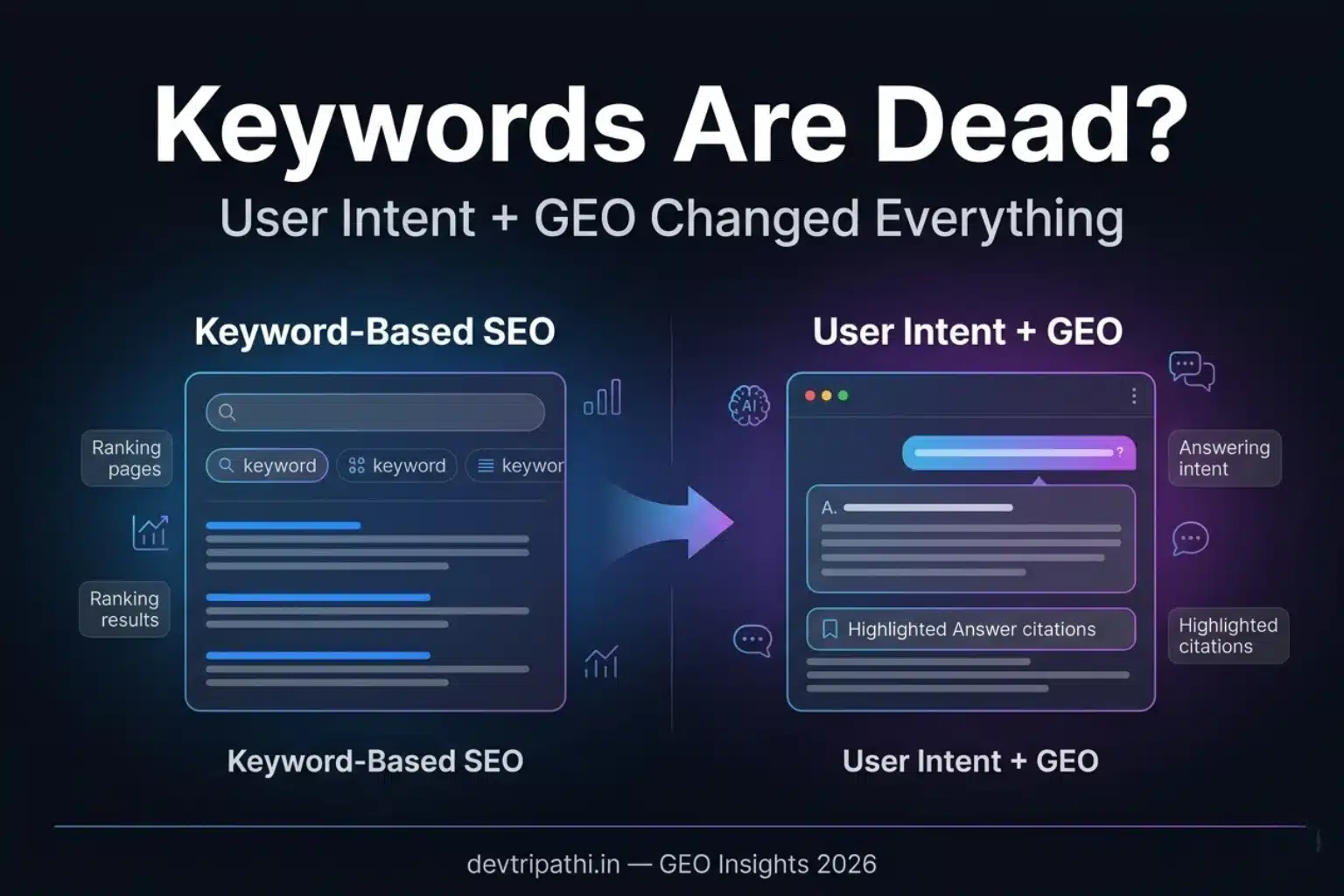
In 2026, Google’s ranking systems understand nuance, context, and intent with unprecedented accuracy. AI search platforms like ChatGPT and Perplexity do not match keywords at all – they interpret goals and synthesize answers. A page can rank #1 for a keyword it barely mentions if it better satisfies the intent behind the search. And a keyword-dense page that misses the user’s actual need gets ignored by both Google and every major AI system.
This is the User Intent vs Keywords shift – and understanding it is arguably the most important conceptual update any content creator or SEO professional can make in 2026. It changes what you research, what you write, how you structure content, and how you measure success.
More importantly for GEO specifically: AI systems do not just prefer intent-aligned content. They require it. As Wellows’ analysis of AI citation patterns found, generative engines ‘interpret user goals and select content accordingly – they don’t just scan for keywords.’ If your content does not align with the intent behind a query, it does not get cited. Full stop.
✦ Quick Answer – Keywords vs User Intent: Keywords tell search engines what your content is about. User intent tells them whether your content actually helps the person searching. In the GEO era, keywords are the starting point – but intent determines whether you rank, get cited by AI, and actually serve your audience. |
1. What Is User Intent – And Why It Is Not the Same as a Keyword
A keyword is what someone types into a search bar. User intent is why they typed it.
These two things often look identical on the surface. The keyword ‘project management software’ is just four words. But the intent behind those four words could be any of the following: someone comparing options before making a purchase decision, someone who already bought software and is looking for help using it, someone evaluating whether to switch from their current tool, a student researching for an essay, or a developer looking for an API.
Same keyword. Completely different needs. Completely different content required.
This is why Semrush defines search intent as ‘the why behind every search query – the customer’s purpose for typing those specific words into a search engine.’ Understanding this why is not a bonus SEO technique. In 2026, it is the foundation of every content decision that matters.
Why Keywords Alone Have Become Insufficient
Storycat Creative’s 2026 SEO analysis states it clearly: ‘Search engines are no longer keyword-matching systems. They are intent interpretation engines. Earlier SEO strategies treated keywords as the goal rather than a signal. Pages were optimised to rank, not to help.’
The result of that mismatch was predictable. Users clicked keyword-optimised pages, found content that technically contained their search terms but did not actually answer their question, and bounced back to the results page. Google learned from that behavior. Today, ranking systems use dwell time, bounce rate, click-through rates, and user engagement signals to evaluate whether a page truly satisfied the intent behind a query – not just whether it contained the right words.
In the GEO era, AI systems made this even more explicit. They do not rank pages. They evaluate intent alignment and synthesize the best available answer from the most intent-aligned sources. There is no keyword-matching shortcut. You either answer the question the user was actually asking, or you do not get cited.
71.5% of US Consumers Source: Now use ChatGPT, Gemini, and Perplexity for information searches – Wellows, 2026 |
→ As we explored in our guide on how generative engine optimization works, AI systems break queries into sub-intents and evaluate each piece of content against the specific goal behind each sub-query – not the surface keyword.
2. The 4 Types of Search Intent Every Content Creator Must Know
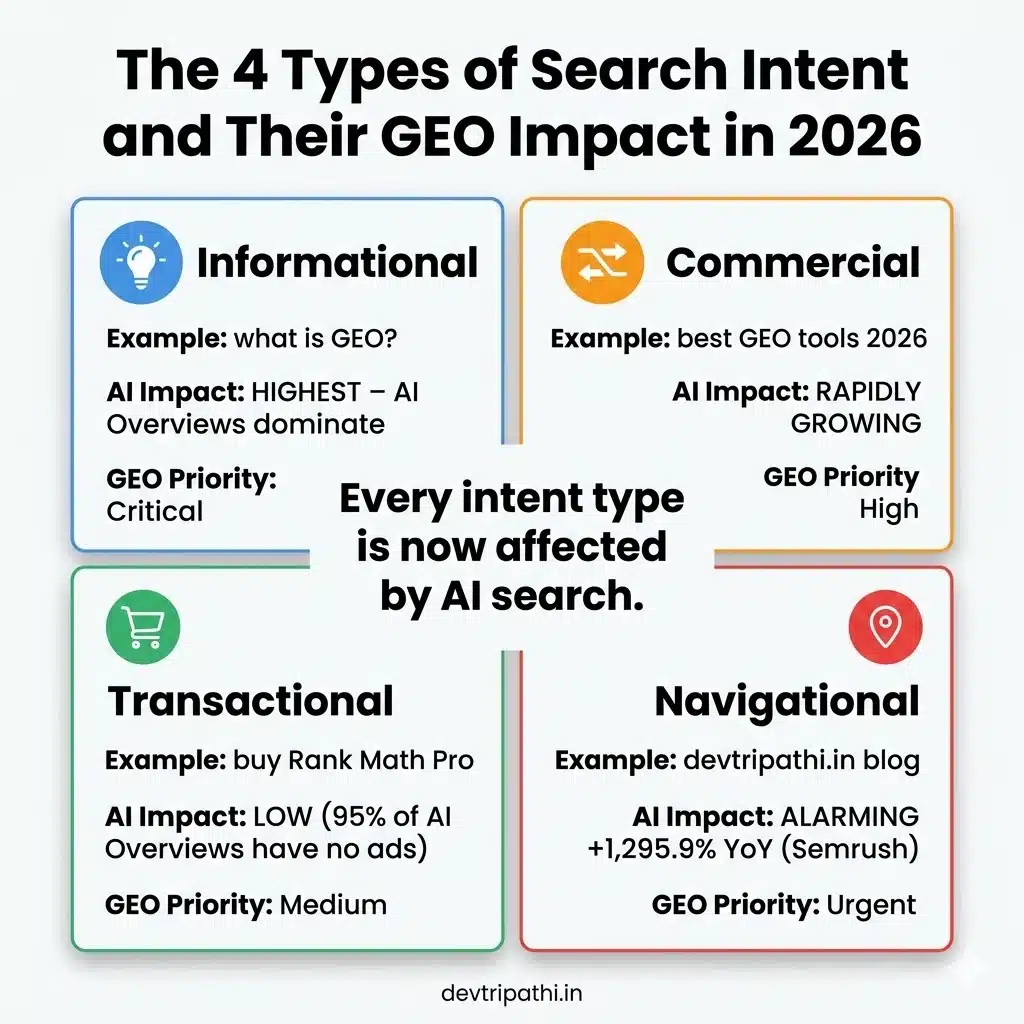
Search intent is typically classified into four categories. These categories have been standard in SEO for years – but their implications for GEO are significantly more nuanced than most guides acknowledge.
Informational Intent – The User Wants to Learn
The user’s goal is to acquire knowledge. Queries like ‘what is GEO?’, ‘how does generative engine optimization work?’, or ‘why is user intent important in SEO?’ all have informational intent. The user is not ready to buy. They are not looking for a specific website. They want a clear, complete, accurate answer.
Informational queries make up the largest share of AI Overview triggers. Semrush’s analysis of 10 million keywords found that informational searches dominate AI Overview appearances – top-of-funnel educational content is where AI-generated answers are most prevalent, and therefore where intent-first content has the highest GEO impact.
Commercial Intent – The User Is Comparing Options
The user is in the research and evaluation phase. They want to compare tools, platforms, or approaches before making a decision. Queries like ‘best GEO tools 2026’, ‘ChatGPT vs Perplexity for research’, or ‘Rank Math vs Yoast for schema markup’ have commercial intent. The user needs specific, comparative, evidence-based content that helps them evaluate options.
Commercial intent queries are increasingly targeted by AI Overviews. Semrush found that commercial query AI Overview appearances grew significantly from 2024 to 2025 – meaning comparison content now needs to satisfy both traditional SEO ranking requirements and AI citation standards simultaneously.
Transactional Intent – The User Is Ready to Act
The user wants to take a specific action – purchase, sign up, download, or contact. Queries like ‘buy Rank Math Pro’, ‘sign up for Semrush trial’, or ‘download GEO checklist’ have transactional intent. This is where purchase happens.
Transactional queries are still largely protected from AI Overview disruption – 95% of keywords triggering AI Overviews have no paid ads, and commercially high-value transactional keywords remain largely untouched by AI summaries (Semrush AI SEO Statistics, 2025). Traditional conversion-focused SEO still governs this intent type.
Navigational Intent – The User Is Looking for a Specific Destination
The user already knows where they want to go. They are searching for a specific website or brand. Queries like ‘devtripathi.in GEO blog’, ‘ChatGPT login’, or ‘Semrush keyword tool’ have navigational intent.
This is the most alarming intent shift in 2026. Semrush’s study recorded a 1,295.9% increase in navigational AI Overviews – meaning even branded searches are now being intercepted by AI-generated summaries. Brands that previously relied on branded keyword traffic as a reliable baseline now need GEO strategies to protect even their own branded visibility.
1,295.9% Increase Source: In navigational AI Overviews – even branded searches now intercepted by AI (Semrush AI Overviews Study, 2025) |
3. How Google’s Understanding of Intent Evolved – From Keywords to Meaning
Understanding the progression of Google’s algorithm helps explain why keyword-first strategies stopped working – and why intent-first strategies became mandatory.
The Keyword Era (Pre-2013): Match the Words
Early Google was essentially a keyword frequency counter. Pages that contained the right words at the right density ranked higher. This created the keyword stuffing era – content that crammed target phrases into every possible location, often at the expense of readability and genuine usefulness. Users suffered. The web suffered.
The Semantic Era (2013-2019): Understand the Topic
Google’s Hummingbird update (2013), followed by RankBrain (2015) and BERT (2019), progressively shifted Google from keyword matching to semantic understanding. Rather than matching individual words, Google began understanding related concepts, synonyms, and topic contexts. A page discussing ‘automobile maintenance’ could rank for ‘car care tips’ without containing those exact words. Keywords Everywhere’s 2026 analysis describes this shift: ‘Rather than assigning a single keyword, Google associates a page with a set of topics and meanings. This allows the page to surface for a wide range of related searches, even when the exact phrasing doesn’t appear on the page.’
The Intent Era (2019-Present): Understand the Goal
Google’s Helpful Content System, combined with behavioral signals, shifted the focus from understanding topics to understanding goals. The system evaluates whether content satisfies the real need behind a query – not just whether it discusses the right topic. Content that users engage with, return to, and find genuinely helpful rises. Content that users abandon signals intent mismatch and drops.
In 2026, as Solidappmaker’s analysis confirms: ‘The days when keyword density and backlink quantity could manipulate rankings are definitively over.’ The ranking question is no longer ‘does this page contain the keyword?’ It is ‘does this page answer the real question behind the keyword better than any other available source?’
“In 2026, there is a considerable shift towards relevance, satisfaction, and authority in ranking – a change that is being pushed by Google’s Helpful Content System along with behavioural signals such as dwell time and bounce rate. Today, the pages that consistently win are not those that repeat keywords most accurately, but those that satisfy search intent most completely.” – Storycat Creative – Why Search Intent, Not Keywords, Will Decide Rankings in 2026 |
→ For the full picture of how Google’s AI Mode is changing search, our comprehensive guide covers every algorithm shift driving the intent-first era.
4. How GEO Took Intent Further Than Google Ever Did
If Google’s journey from keyword matching to intent interpretation took fifteen years, GEO compressed that evolution into a single conceptual leap. AI search platforms were never keyword-matching systems. They were intent interpretation systems from day one.
VERTU’s 2026 GEO strategy guide makes the distinction explicit: ‘GEO is less about individual keywords and more about Brand Authority and Sentiment. If an AI knows your brand is the leader in sustainable fashion, it will recommend you even if you don’t rank #1 for a specific keyword that day.’
This is a fundamental paradigm shift. In traditional SEO, authority was built primarily through backlinks – external sites linking to yours. In GEO, authority is built through entity recognition – AI systems learning, through consistent signals across the web, that your brand is the reliable, trustworthy, expert source on a specific topic.
Intent in GEO Is More Granular Than Intent in SEO
Traditional SEO works with four broad intent categories – informational, commercial, transactional, navigational. GEO operates at a more granular level. Wellows’ research identifies what they call ‘micro-intents’: the specific, granular goals within a broader intent type that AI systems detect and respond to independently.
When someone searches ‘best email marketing tool for a solo blogger who publishes twice a week and needs automation’, the broad intent is commercial. But the micro-intents are: find a tool with automation (not just email sending), find something suitable for low-volume publishing, find something a solo creator can afford and manage alone. An AI system decomposes that query into those micro-intents and searches for content that addresses each one. The content that wins is the content that covers all three micro-intents completely – not just the broad keyword ’email marketing tool’.
Why Intent Alignment Is the Primary GEO Citation Signal
Wellows’ analysis of AI citation patterns found that 73% of commercial intent queries in ChatGPT prioritize task-completion content over keyword-matched content. The AI is not looking for the page that most frequently mentions the keyword. It is looking for the page that most completely addresses what the user is trying to accomplish. This is why a 500-word highly specific answer to a precise micro-intent can out-cite a 3,000-word comprehensive guide that is written around a broad keyword rather than a specific user goal.
73% of Commercial Queries Source: ChatGPT prioritizes task-completion content over keyword-matched content – Wellows AI Citation Analysis, 2026 |
→ Understanding this connects directly to why optimizing your content for AI Mode requires a fundamentally different approach to content planning than traditional keyword-based SEO – one that starts with what the user is trying to accomplish, not what phrase has the highest search volume.
5. User Intent in Generative Engines – How AI Reads Queries Differently
The way generative AI systems process intent is architecturally different from how traditional search engines do. Understanding this difference clarifies why some intent-optimized content earns consistent AI citations while other equally good content is overlooked.
Query Fan-Out and Sub-Intent Detection
When a user submits a query to ChatGPT or Perplexity, the AI does not search for the exact phrase. It decomposes the query into sub-intents – the component goals that together constitute the user’s full informational need. Each sub-intent becomes a separate search. As Wellows describes it: ‘One search splits into many sub-intents. Intent-rich sections get cited more than general pages. Write modular, answer-first blocks for each micro-intent.’
The practical implication is significant: your content needs to address the sub-intents that your target query generates, not just the head term. If your post on ‘GEO strategies for bloggers’ comprehensively addresses the sub-intent ‘how to add FAQ sections for GEO’ but your competitor’s post does not, you earn that specific citation even if your competitor outranks you on Google for the main term.
How AI Search Intent Differs From SEO Intent
Traditional SEO Intent | GEO / AI Search Intent |
Four broad categories: informational, commercial, transactional, navigational | Granular micro-intents within each category, specific to user’s exact goal |
Evaluated at the page level | Evaluated at the passage level – each paragraph assessed independently |
Matched after content is published | Evaluated in real time against competing sources for every query |
Keyword as primary signal of intent alignment | Task completion and specificity as primary signals |
One correct intent per keyword | Multiple simultaneous sub-intents per complex query |
Static – same intent for same keyword | Dynamic – intent shifts based on context, user history, platform |
Backlinks signal topical authority | Entity mentions and citation patterns signal intent authority |
What ‘Intent Authority’ Means in GEO
Envisionit’s 2026 SEO trends analysis introduces a term that captures the GEO intent shift perfectly: ‘intent density’ – the degree to which your content addresses multiple specific user goals per unit of content. In the traditional model, success meant ranking for high-volume keywords. In the GEO model, success means owning the citation for specific user goals: ‘When a user wants to know X with these specific constraints, your content is what the AI retrieves.’
Building intent authority requires a shift from topic-centered content planning to goal-centered content planning. Instead of asking ‘what keyword should I target?’, the GEO practitioner asks ‘what specific goal is my target user trying to accomplish, and what would make my answer to that goal uniquely complete and trustworthy?’
“In traditional SEO, intent mattered. In GEO, it decides everything. Generative engines like ChatGPT, Perplexity, Gemini, and Google’s AI Mode dissect every query into sub-intents, evaluate content at the passage level, and prioritize answers that feel complete, clear, and task-specific.” – Wellows – User Intent in Generative Engines: Guide to AI Search Optimization, 2026 |
6. Intent vs Keywords: A Direct Comparison With Real Examples
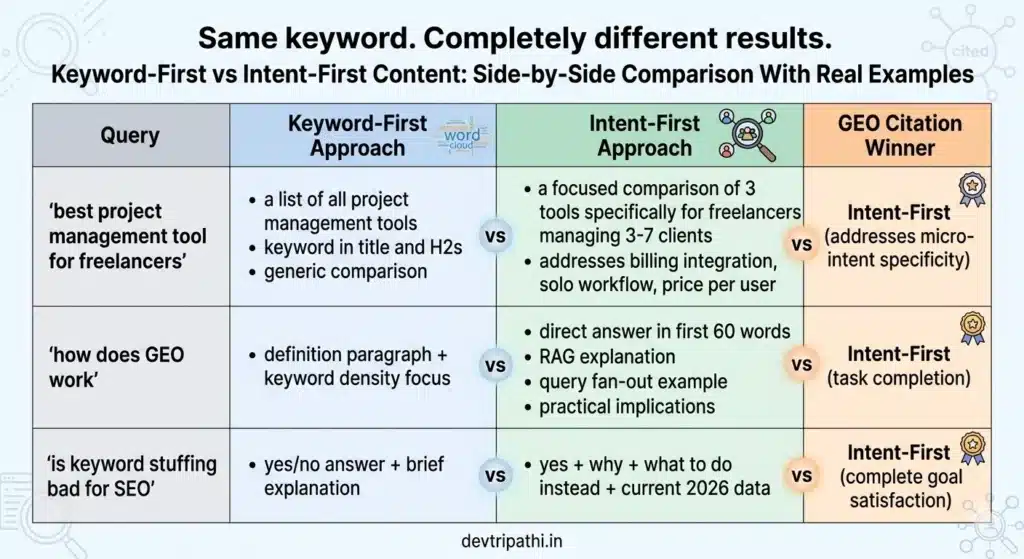
Abstract principles only go so far. Here are real examples showing exactly how the keyword-first vs intent-first difference plays out in practice.
Example 1 – Same Keyword, Different Intent Match
Consider two pages targeting ’email marketing for small businesses’. Page A was written around the keyword – it mentions email marketing for small businesses frequently, covers general email marketing principles, and includes tools without specifics. Page B was written around the intent – it answers ‘what does a small business owner with no marketing team actually need from an email marketing tool?’ It covers budget constraints, ease of use without a designer, automation for time-poor owners, and lists three specific tools that match those constraints.
Google increasingly ranks Page B higher despite lower keyword density. Every AI system cites Page B and not Page A. Not because Page B used the keyword better – but because it answered the goal behind the keyword better. As DMCockpit’s search intent analysis confirms: ‘A page can include the perfect keywords and still fail to rank. Meanwhile, another page with fewer keyword matches can dominate because it satisfies the real need behind the search.’
Example 2 – Intent Mismatch Failure
Keywords Everywhere’s 2026 analysis gives a clear failure example: a service business trying to rank a hard-selling service page for a query with clear informational intent. The page optimizes for the keyword ‘SEO services’ – but users searching that term are typically in an early research phase, comparing what SEO services involve and whether they need them. A sales page with pricing and a contact form mismatches that intent completely. Higher bounce rate. Lower dwell time. Lower rankings. Zero AI citations.
The fix is simple: create an educational guide answering ‘what do SEO services include, who needs them, and how do you choose the right provider?’ for the informational intent, and keep the sales page for transactional queries like ‘hire SEO agency’.
Example 3 – The 500-Word Intent Win
One of the most counterintuitive GEO findings: 53.4% of cited pages are under 1,000 words (Ahrefs/SE Ranking analysis). A highly specific, 500-word piece that perfectly addresses a precise micro-intent can out-cite a 3,000-word comprehensive guide built around a broad keyword. The guide covers more ground. The focused piece answers one specific question with more precision. For that specific sub-query, the AI cites the focused piece.
This does not mean shorter is always better. It means intent-fit is more important than length. Write as long as the intent requires – not as long as you think content should be.
→ For tactical guidance on avoiding the most common intent mismatch errors, our analysis of critical SEO mistakes that hurt rankings covers the specific patterns that damage both Google rankings and AI citation rates simultaneously.
7. How to Research User Intent the Right Way in 2026
Intent research in 2026 goes beyond keyword volume analysis. Here is the complete intent research process that produces GEO-ready content briefs.
Step 1 – Start With the SERP, Not the Keyword Tool
Before writing anything, search your target keyword on Google in an incognito window. Look at: what type of content dominates the top 5 results (articles, tools, comparison pages, videos); what the featured snippet or AI Overview says – this is Google’s best interpretation of the intent; and what the People Also Ask section shows – these are the sub-intents most commonly associated with your main query.
The SERP is Google’s intent interpretation rendered visible. If the top 5 results are all how-to guides, Google has determined the intent is informational. If they are all product pages, the intent is transactional. Your content must match the dominant intent type to compete.
Step 2 – Mine Real User Language From Reddit and Quora
Keyword tools tell you search volume. Reddit and Quora tell you how real people describe their problems in their own words. Search your topic on Reddit and read the most upvoted posts and comments. The language people use – the specific constraints they mention, the frustrations they describe, the follow-up questions they ask – is the language of genuine intent.
This is where micro-intents live. Not in ’email marketing for small businesses’ (keyword tool output) but in ‘I have 500 subscribers and no time to design templates, which tool lets me automate without learning design?’ (Reddit reality). Content that addresses the Reddit-level specificity of intent earns AI citations. Content that addresses the keyword-tool-level generality of a topic does not.
Step 3 – Use AI Platforms to Reveal Sub-Intents
Type your target query into ChatGPT and Perplexity. Note: what clarifying sub-questions does the AI ask before answering? What follow-up questions does it address in its response? What topics does it automatically include that you did not ask for? These are the sub-intents the AI has learned are genuinely associated with your main query – the micro-goals that comprehensive intent-first content must address.
Step 4 – Map Intent Across the Content Piece
Once you have your intent research, map each section of your planned content to a specific user goal or sub-intent. Every H2 section should address a distinct goal the user has. If you cannot articulate what specific user goal each section satisfies, that section probably does not belong in the piece – or it needs to be restructured as a goal-answering section rather than a topic-covering one.
✓ The Intent Research Shortcut That Works Every Time: Ask ChatGPT: ‘What are all the specific questions and sub-topics a user might need answered if they searched [your target keyword]?’ The AI will generate a comprehensive sub-intent map based on its training data of millions of real search sessions. Use that map to build your content outline – you are now writing for intent at a depth that most keyword-based content briefs never reach. |
→ The on-page SEO implications of intent-first content planning are covered in full in our on-page SEO fundamentals guide – including how to structure headings, meta descriptions, and content sections for maximum intent alignment.
8. How to Write Intent-First Content That Ranks and Gets Cited
Intent research tells you what to cover. Intent-first writing tells you how to cover it in a way that both Google and AI systems reward. These are the practical writing principles that produce content with strong intent alignment.
Principle 1 – Answer the Primary Intent in the First 60 Words
Your introduction must satisfy the primary intent immediately. Not after context. Not after a story. Immediately. AI systems extract 44% of their citations from the opening section – and Google’s Helpful Content System evaluates whether content provides value to the user quickly or buries the answer.
If someone searches ‘what is user intent in SEO’, your first sentence should be a direct definition. If they search ‘best project management tool for freelancers’, your first paragraph should name your top recommendation and the key reason why. The rest of the article provides the depth and context that justifies that recommendation.
Principle 2 – Match Format to Intent Type
Each intent type requires a different content format. Informational intent: clear definitions, step-by-step explanations, comprehensive FAQ sections. Commercial intent: comparison tables, feature breakdowns, real-world testing data, decision frameworks. Transactional intent: clear CTAs, social proof, pricing transparency, trust signals. Navigational intent: brand-specific pages, accurate structured data, consistent messaging across all platforms.
Forcing the wrong format onto an intent is one of the most common and most costly content mistakes. A transactional page trying to rank for informational intent, or an informational guide that buries comparative data needed for commercial intent, are both intent mismatches that neither Google nor AI systems will reward.
Principle 3 – Write Modular Sections for Each Sub-Intent
Wellows’ research recommends ‘writing modular, answer-first blocks for each micro-intent’ – structuring your content so that each section independently answers a specific user sub-goal. This serves two purposes simultaneously: it satisfies Google’s requirement for content that comprehensively addresses an intent, and it creates individual passage chunks that AI RAG systems can extract cleanly and cite accurately.
Test each section by asking: if a user only read this section and nothing else, would they have a complete, useful answer to a specific question? If yes, the section is modular. If no, restructure it around a specific answerable goal.
Principle 4 – Use Specificity as Your Differentiator
Generic content describing a topic satisfies no one’s intent deeply. Specific content that addresses the precise constraints of a real user’s situation satisfies intent completely. ‘Email marketing tools are useful for small businesses’ satisfies no one. ‘For a solo blogger publishing twice a week with a list under 1,000 subscribers, MailerLite’s free tier handles automation, has no design requirements, and costs nothing until you scale past 1,000 contacts’ satisfies the exact intent of a specific user looking for exactly that.
Link-Assistant’s 2026 SEO analysis confirms: ‘Winning in 2026 isn’t about stuffing terms or chasing one perfect keyword – it’s about understanding intent, covering topics deeply, and providing real value.’ Specificity is the practical expression of that principle.
→ For a deep dive into the structural changes that make content more intent-aligned and more GEO-ready, our guide on how AI Mode is changing search behaviour covers the full spectrum of how AI-powered search evaluates and rewards intent-first content.
9. The Biggest Intent Mistakes Content Creators Still Make in 2026
Mistake 1 – Optimizing for Search Volume Instead of Intent Fit
High-volume keywords are attractive. But a keyword with 10,000 monthly searches that has ambiguous or mismatched intent is far less valuable than a keyword with 500 searches and crystal-clear intent alignment with your content. Envisionit’s 2026 SEO analysis notes that ‘SEO thinking shifts from traffic volume to intent density.’ Quality of intent alignment outweighs quantity of search volume in the GEO era.
Mistake 2 – Mixing Intents on a Single Page
Serving multiple different intent types on a single page confuses both users and search systems. A blog post that tries to simultaneously provide an informational overview, compare products commercially, and close a sale transactionally serves none of those intents well. Each intent deserves its own piece of content, optimized specifically for its audience’s goal.
Mistake 3 – Writing for the Topic, Not the Task
Topic-centered writing covers everything about a subject. Task-centered writing helps the user accomplish something specific. In the GEO era, task-centered content earns citations. Topic-centered content earns impressions without citations. The key question is not ‘what should I say about this topic?’ but ‘what specific task is my user trying to complete, and how do I help them complete it most efficiently?’
Mistake 4 – Ignoring Mobile and Voice Intent Differences
LNM’s 2026 intent research highlights that search intent often looks different on mobile devices and voice assistants. A desktop user searching ‘best CRM software’ is typically in a research phase. The same person voice-searching ‘what’s the best simple CRM I can set up today?’ on their phone is in an action phase. Mobile and voice queries tend to have more immediate, action-oriented intent – and content optimized for desktop informational intent may completely miss the mobile/voice intent for the same keyword.
Mistake 5 – Treating Intent as a One-Time Classification
Intent is dynamic. The same keyword can shift intent over time as the topic evolves, as user behavior changes, or as the available solutions change. The SERP Google shows for a keyword today may look different from the SERP six months ago – because Google has updated its intent model based on accumulated behavioral data. Regular SERP analysis and content updates are required to maintain intent alignment, not just initial optimization.
▲ The Intent-SEO Mistake That Also Kills GEO Performance: Publishing content that satisfies broad informational intent but ignores commercial micro-intents within informational queries. 73% of ChatGPT queries have commercial intent even when they appear informational – users who ask ‘what is the best GEO tool’ are simultaneously seeking information AND making a comparison decision. Content that provides only a definition without addressing the comparison goal misses the commercial micro-intent and loses the AI citation to more specific content. |
- What Is GEO? The Complete 2026 Guide →
- GEO vs SEO: What’s the Difference and Why You Need Both →
- How Generative Engine Optimization Works: A Deep Dive →
- GEO in 2026: The State of Generative Engine Optimization →
- GEO for Absolute Beginners: Everything You Need to Know →
- Google AI Mode: Transforming Search and SEO Strategies in 2025 →
- Understanding AI Mode Analytics: Measuring GEO Success →
- AI Mode vs Traditional Search: Comparing User Experiences →
- Optimizing for AI Mode: New SEO Strategies in the Age of Generative Search →
- The Ultimate On-Page SEO Checklist for 2025 →
- 20 Common SEO Mistakes You Must Avoid →
11. Frequently Asked Questions: User Intent vs Keywords
What is user intent in SEO and GEO? ▼
User intent, also called search intent, is the goal or purpose behind a search query – the real reason someone typed those specific words into a search engine or asked an AI a question. It is distinct from the keyword itself. Understanding user intent means going beyond the surface words to identify what the user is actually trying to accomplish: learn something, compare options, make a purchase, or reach a specific destination. In GEO, intent alignment is the primary citation signal – AI systems evaluate whether your content completes the user's task, not whether it contains target keywords.
Do keywords still matter in 2026? ▼
Yes – but their role has changed fundamentally. Keywords are no longer the optimization target; they are signals of user intent. They tell you what topics your audience cares about and what vocabulary they use. Keyword research remains the most accessible entry point for understanding what users want. But success no longer comes from keyword placement and density – it comes from using keywords as research inputs to understand intent, then creating content that fully satisfies that intent. As Keywords Everywhere's 2026 analysis states: 'Keywords still open the door, but it's quality, coverage, and context that get you inside.'
What are the 4 types of search intent? ▼
The four main intent types are: Informational (user wants to learn – 'what is GEO?'), Commercial (user is comparing options – 'best GEO tools 2026'), Transactional (user is ready to act – 'buy Rank Math Pro'), and Navigational (user is looking for a specific destination – 'devtripathi.in blog'). In GEO, informational queries have the highest AI Overview density, commercial intent is rapidly being intercepted by AI systems, transactional queries remain mostly protected, and navigational queries saw a 1,295.9% increase in AI Overview appearances in 2025 (Semrush).
How do AI systems evaluate user intent differently from Google? ▼
Google evaluates intent at the page level using a combination of keyword signals, behavioral data (dwell time, bounce rate, CTR), and content quality signals from its Helpful Content System. AI systems evaluate intent at the passage level using semantic embeddings – they decompose queries into micro-intents and search for specific passages that address each one. AI systems also compare content against competing sources in real time, assessing which source most completely satisfies the user's specific goal. A 500-word highly specific answer to a precise micro-intent can out-cite a 3,000-word general guide on the same broad topic.
What is a micro-intent in GEO? ▼
A micro-intent is a specific, granular sub-goal within a broader search intent type. For example, the broad intent behind 'email marketing tools' is commercial – the user wants to compare options. But the micro-intents within that broad intent might include: tools for very small lists, tools without design requirements, tools with specific automation capabilities, tools in a specific price range. GEO requires addressing micro-intents because AI systems decompose complex queries into these specific sub-goals and search for content that addresses each one. Content that addresses only the broad intent misses the micro-intent citations.
How do I identify the user intent behind a keyword? ▼
The most reliable method: search the keyword in Google incognito and analyse the SERP. The dominant content type in the top 5 results reveals Google's intent interpretation. Complement this with: Google's People Also Ask questions (sub-intents), Reddit threads on your topic (micro-intent language from real users), Quora questions (upvoted questions reveal high-demand sub-intents), and prompting ChatGPT with your target query to see what sub-questions the AI automatically addresses. This multi-source research produces a comprehensive intent map that covers both broad intent and the micro-intents that matter for GEO citations.
Why does content with the same keyword rank differently for different intents? ▼
Because keyword-matching and intent-matching are different operations. Google groups search results by intent – it shows different pages for the same keyword depending on what the user's context, history, and behavioral signals suggest their specific intent is. A user searching 'SEO tools' from a technical context might see developer-focused tools. The same search from a marketing context might show content marketing tools. When Google's intent interpretation differs from your content's intent alignment, you lose visibility – regardless of keyword optimization.
What is 'intent density' in the context of GEO? ▼
Intent density refers to the degree to which your content addresses multiple specific user goals per unit of content. High intent density means each section, paragraph, and heading directly addresses a specific user sub-goal with precision and completeness. Low intent density means content covers topics broadly without resolving specific user tasks. AI systems favor high intent density because each section becomes a clean, citable answer to a specific sub-intent. Envisionit's 2026 analysis introduced this concept as a key metric for evaluating GEO content quality beyond traditional word count or keyword density measures.
How does query fan-out connect to user intent? ▼
Query fan-out is how AI systems operationalize intent analysis. When a user submits a complex query, the AI decomposes it into multiple sub-queries – each representing a distinct micro-intent within the broader question. The AI then searches for content that addresses each sub-query independently. Your content earns citations for the sub-queries where it provides the most complete, specific, authoritative answer. This is why topical content clusters outperform single pillar posts in GEO – each cluster article targets the sub-intents that the main topic generates through fan-out.
Does intent differ across AI platforms? ▼
Yes – each platform has a distinct user base with different intent profiles. ChatGPT users show 73% commercial intent in their queries – they are often comparing options, evaluating solutions, or seeking task-completion answers (Wellows, 2026). Perplexity users tend toward deep informational research – they want comprehensive, sourced answers to complex questions. Google AI Overview users largely reflect traditional Google search intent distribution – informational queries dominate. Creating platform-specific content is rarely practical, but understanding these differences helps prioritize which intent types to address most thoroughly for each platform.
How does intent-first content improve both SEO and GEO simultaneously? ▼
Intent-first content improves SEO by reducing bounce rate, increasing dwell time, and generating better user satisfaction signals – all behavioral metrics that Google's ranking systems directly measure. It improves GEO by creating content that AI systems can confidently cite as a complete answer to specific user goals. The underlying mechanism is the same: content that genuinely helps a user accomplish their goal performs better in every system that evaluates content quality – whether that system is Google's ranking algorithm or an AI citation model.
What is the difference between keyword research and intent research? ▼
Keyword research identifies what vocabulary users use and how frequently. It tells you what topics to cover and what words to include. Intent research identifies why users use those words – what goal they are trying to accomplish, what constraints they are working within, and what a genuinely complete answer to their need looks like. Keyword research starts with search engines (Semrush, Ahrefs, Google Keyword Planner). Intent research starts with users (Reddit, Quora, actual user conversations, real product reviews). In 2026, both are necessary – keyword research for discovery and structure, intent research for depth and relevance.
Can informational content have commercial micro-intents? ▼
Yes – and this is one of the most important nuances in GEO intent strategy. Wellows' citation research found that 73% of ChatGPT queries have commercial intent even when they appear informational. A user asking 'what is the best CRM for small businesses' appears to have informational intent but is simultaneously conducting commercial evaluation. Content that provides only a definition or general overview without addressing the comparison micro-intent misses the citation opportunity for the commercial sub-goal. The most effective GEO content identifies and addresses both the surface informational intent and the underlying commercial micro-intents within the same piece.
How often should I review and update content for intent alignment? ▼
Intent evolves as topics evolve, as available solutions change, and as Google's and AI systems' intent models update. For high-priority GEO content, quarterly intent reviews are recommended: re-run your target keyword on Google incognito and compare the current SERP to your content's structure; check the current People Also Ask questions; re-test in ChatGPT and Perplexity to see if the intent you are addressing matches current AI citation patterns. If the SERP has shifted significantly from when you originally published, update your content to realign with current intent signals before refreshing other elements.
Conclusion: Intent Is Not a Feature of Good SEO – It Is the Foundation
The shift from keyword-first to intent-first is not an incremental update to SEO strategy. It is a fundamental reorientation of what content creation is for. Keywords never were the goal – they were always a proxy for understanding what users needed. The technical limitations of early search engines made keyword optimization the most practical approach. Those limitations no longer exist.
In 2026, Google’s systems understand meaning, context, and goal. AI systems like ChatGPT and Perplexity skip the keyword interpretation step entirely and operate directly on intent from the start. Content that is engineered around keywords but not around user goals is now at a systematic disadvantage in every search environment that matters.
The good news is that intent-first content is also better content for humans. When you genuinely understand what someone is trying to accomplish and create content that helps them accomplish it completely, you are producing the kind of material that builds genuine audience relationships, earns trust, and generates the sustained engagement that compounds into long-term SEO and GEO authority.
Stop asking ‘what keyword should I rank for?’ Start asking ‘what is my user actually trying to accomplish, and how do I help them accomplish it better than anyone else online?’ Answer that question well enough, in a structure AI systems can extract from, and both the rankings and the citations will follow.

Devyansh Tripathi
I’m Devyansh Tripathi, an SEO strategist and digital growth expert, helps businesses and individuals rank higher and drive organic traffic. Through DevTripathi., he shares cutting-edge SEO insights, content strategies, and marketing hacks. Passionate about digital success, he’s on a mission to make SEO simple, effective, and result-driven!
Posts
- What Google’s New AI Search Documentation Means for SEO Teams
- Google I/O 2026 Search: AI Agents, Gemini 3.5 and the Unified Box
- Google’s AI Optimization Guide: The Technical and Content Checklist
- July 2026 SEO Update: AI Overviews, llms.txt and Search Console
- Prompt Optimization Beyond Page One: The Position-21 Citation Opportunity
Categories
- AI Citation Optimization
- AI Search Optimization (AISEO)
- AI Visibility Tracking
- Answer Engine Optimization (AEO)
- Brand Authority SEO
- Brand SERP Optimization
- Community Signal SEO
- Conversational Search Optimization
- Generative Engine Optimization (GEO)
- Knowledge Graph Optimization
- Modern SEO Strategies
- Multimodal Search Optimization
- Prompt Optimization
- SEO Trends
- Social Search Optimization
- Topical Authority SEO
- Uncategorized
- Video Search SEO
- Visual Search Optimization
- Voice Engine Optimization (VEO)
- Zero Click Search Optimization
Latest News
Text Widget
Empowering brands with insights, strategies, and stories that drive digital growth.