
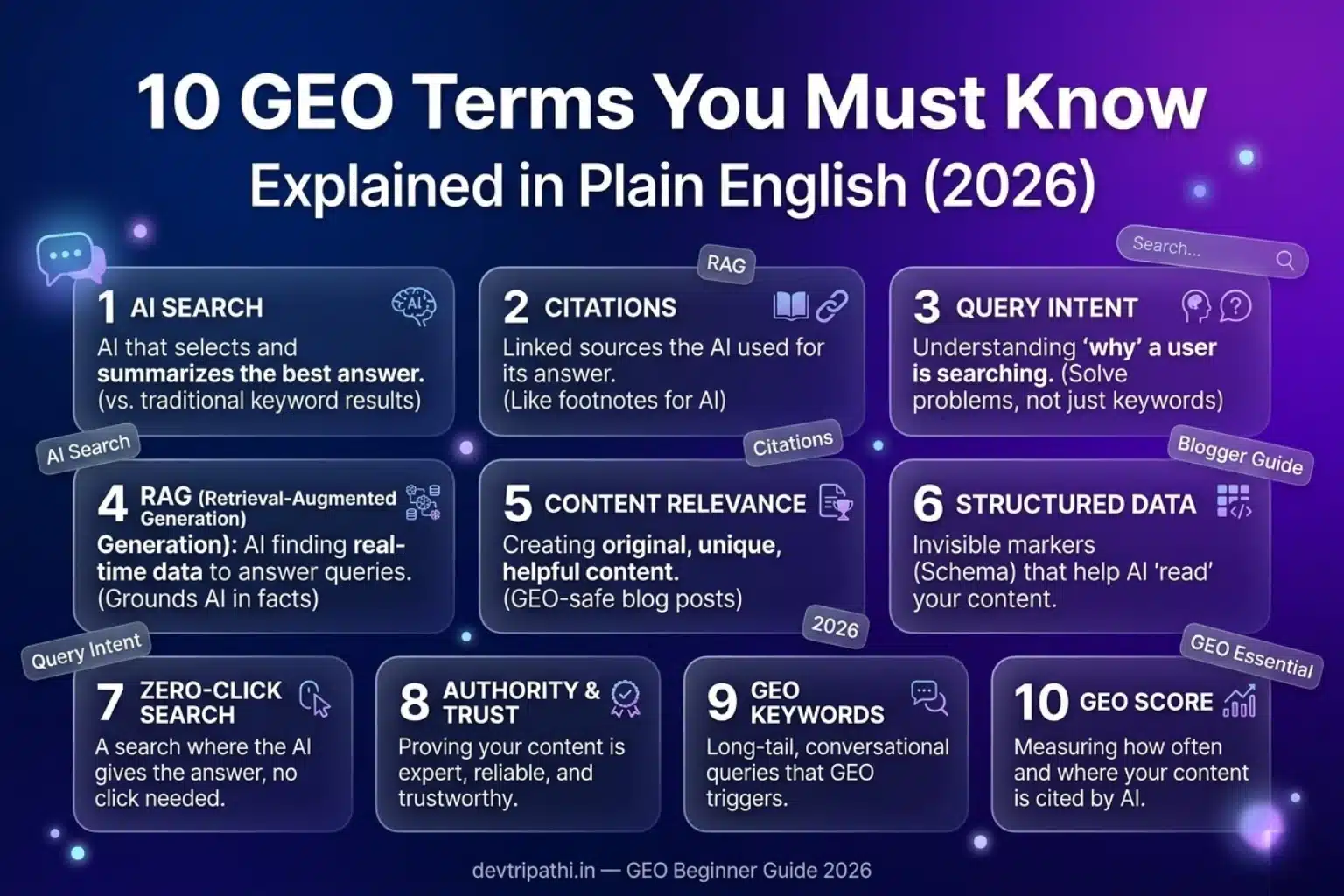
10 GEO Terms Every Blogger Must Know in 2026 – Plain English Glossary
27 March 2026
Why the GEO Vocabulary Feels So Confusing (And How to Fix That)
If you have been reading about GEO lately, you have almost certainly encountered a wall of acronyms that made everything feel harder than it should be. GEO. AIO. RAG. LLMO. AEO. Query fan-out. Semantic density. Chunking. Citation share. It reads like someone spilled alphabet soup on a computer science textbook.
Here is the honest truth about this vocabulary explosion: most of these terms describe the same underlying goal – get your content seen and cited by AI systems. The reason there are so many names is that the terminology came from multiple directions simultaneously: academics coined GEO, practitioners coined LLMO, Google invented its own product names, and agencies invented new acronyms to differentiate their services.
As Onely’s research into GEO terminology found, 37% of SEO professionals admit they do not know how to use AI tools effectively – not because the concepts are hard, but because the vocabulary creates unnecessary confusion. The Backlinko/Semrush team put it directly: ‘Whether you call it SEO, GEO, AIO, or LLMO, the fundamentals of optimization and creating great content don’t change. The goals shift a little, and how you measure success will differ – but the foundations remain.’
This glossary cuts through all of that. Each entry defines the term clearly, explains exactly why a blogger needs to understand it, gives a real example of how it applies to content creation, and notes the key stat or research finding that makes it matter. By the time you finish this guide, you will be able to walk into any GEO conversation and understand exactly what is being said.
✦ Quick Navigation – 10 Terms Covered: 1. GEO (Generative Engine Optimization) | 2. RAG (Retrieval-Augmented Generation) | 3. AIO (AI Overview Optimization) | 4. LLMO (Large Language Model Optimization) | 5. AEO (Answer Engine Optimization) | 6. Query Fan-Out | 7. Information Gain | 8. Entity Authority | 9. Citation Share (Share of Model) | 10. Semantic Density |
1. Why GEO Vocabulary Matters for Bloggers Specifically
Understanding GEO terminology is not just an academic exercise. Each term corresponds to a specific optimization decision you either make or miss. If you do not know what RAG is, you cannot structure your paragraphs to be RAG-friendly. If you do not understand query fan-out, you cannot build the content cluster that covers your topic’s subqueries. If you do not know what citation share means, you cannot measure your GEO strategy’s success.
The second reason to know this vocabulary is it helps you evaluate GEO advice critically. As DOJO AI’s 2026 guide notes, 73% of agency leaders acknowledge AI has transformed search – but the terminology is so inconsistently applied that many vendors use it to obscure what they are actually doing. Bloggers who understand the vocabulary can ask better questions and make better decisions.
90+ Companies Source: Building dedicated GEO tools in 2026 – Deepak Gupta / GrackerAI market research, 2026 |
→ For context on where all of this fits in the broader 2026 search landscape, our state of GEO in 2026 analysis covers the full market picture with verified benchmarks.
2. The 10 GEO Terms Every Blogger Must Know in 2026
01
GEO – Generative Engine Optimization (jee-ee-oh)
Also called: AEO, LLMO, AI SEO, AIO
Definition
GEO is the practice of structuring your content so that AI-powered search systems – ChatGPT, Perplexity, Google AI Overviews, Gemini, and Microsoft Copilot – can retrieve, understand, trust, and cite it when answering user queries. Unlike traditional SEO, which aims for a ranked position in a list of links, GEO aims for a citation inside an AI-generated answer. The term was formally coined by Princeton University researchers in a paper published at KDD 2024.
Why bloggers need to know
GEO is the umbrella concept behind everything else in this glossary. Every other term in this list is either a component of GEO, a specific technique within it, or a related discipline. You cannot understand any GEO tactic without first understanding what GEO is trying to accomplish: making your content the source an AI system trusts and quotes when answering questions in your topic area.
Real example
A food blogger writes a detailed post about the best cast iron skillets for beginners. When a user asks ChatGPT what cast iron skillet should I buy as a beginner cook, ChatGPT cites that blogger’s article as a source. That citation is the result of successful GEO.
Key stat: GEO optimization methods (adding statistics, expert quotes, citations) improve AI visibility by 30-40% compared to unoptimized content – Princeton University, KDD 2024
02
RAG – Retrieval-Augmented Generation (rhymes with ‘bag’)
Also called: Retrieval-based generation, grounded generation
Definition
RAG is the technical architecture that most AI search systems use to generate answers. Instead of relying solely on what the AI learned during training, RAG actively searches the web at query time, retrieves specific passages from relevant pages, and feeds those passages to the language model as additional context. Think of it as the AI doing its own real-time fact-checking before it answers.
Why bloggers need to know
RAG is why your writing structure matters so much for GEO. RAG does not read your full article – it pulls individual passage chunks and evaluates each one independently. This means every paragraph in your blog must work as a standalone, complete answer to a specific question. A paragraph that only makes sense in context of surrounding text will be extracted as a confusing, unusable chunk by the RAG system.
Real example
A travel blogger has a post about budget travel in Japan with a well-structured section titled ‘How Much Does a Week in Japan Cost on a Budget?’ with a direct answer in the first two sentences. When a user asks Perplexity about Japan travel costs, Perplexity’s RAG system retrieves that specific section and cites it – not because the full post ranked highly, but because that one passage directly answered the sub-query.
Key stat: Websites using structured data and FAQ blocks saw 44% more AI search citations after implementation – BrightEdge, 2026
03
AIO – AI Overview Optimization (ay-eye-oh)
Also called: Google AI Overview optimization, SGE optimization
Definition
AIO specifically refers to optimizing content to appear in Google’s AI Overviews – the AI-generated summaries that appear at the top of Google search results for many queries. AIO is a subset of GEO, focused specifically on Google’s platform. When a vendor says ‘AIO strategy’, clarify whether they mean Google AI Overviews specifically or AI optimization broadly.
Why bloggers need to know
Google AI Overviews are now your most important single GEO target. They appear on 25.11% of all searches – triggered most heavily for informational queries which is exactly the type of content most bloggers publish. Being cited inside an AI Overview increases your CTR by 35% compared to non-cited brands on the same page.
Real example
A personal finance blogger publishes a comprehensive guide on emergency funds. When someone searches Google for ‘how much should I have in an emergency fund?’, a Google AI Overview appears. The blogger’s guide is cited as one of three sources inside the AI Overview – their organic result gets 35% more clicks than other results on the same page.
Key stat: AI Overviews appear in 25.11% of all searches – up 57% from Q4 2025 (Conductor, 2026); being cited inside one increases CTR by 35% (Seer Interactive/Dataslayer)
04
LLMO – Large Language Model Optimization (el-el-em-oh)
Also called: LLM optimization, AI content optimization, language model SEO
Definition
LLMO is the practice of making your content easy for large language models – the AI systems underlying ChatGPT, Claude, Gemini, and Perplexity – to read, understand, trust, and reference. LLMO emphasizes semantic clarity, logical content structure, consistent terminology, and making information machine-readable through proper formatting and schema markup.
Why bloggers need to know
LLMO is the technical complement to GEO’s strategic goals. If GEO tells you what to achieve (get cited by AI systems), LLMO tells you the technical writing practices that make your content interpretable by the AI models doing the citing. If the AI understands the hierarchy of your information exactly, it will use you to respond; if the data is unstructured or overly verbose, you will be discarded in favor of a better-structured source.
Real example
A marketing blogger writes a guide on email marketing but uses inconsistent terminology throughout – sometimes ‘open rate’, sometimes ’email open percentage’, sometimes ‘read rate’. An LLM cannot confidently determine which terms describe the same metric. A well-optimized LLMO version uses consistent terminology throughout and defines it clearly in the first mention.
Key stat: GEO and LLMO share approximately 80% functional overlap – the distinction is primarily academic origin vs practitioner origin (Onely, December 2025)
05
AEO – Answer Engine Optimization (ay-ee-oh)
Also called: Featured snippet optimization, voice search optimization
Definition
AEO was originally developed for voice search and featured snippets – optimizing content to appear as direct answers in Google’s rich result features. In 2026, AEO has largely been absorbed into GEO. AEO content tends to be shorter and more concise (optimized for single-answer retrieval), while GEO content tends toward comprehensive depth (optimized for multi-source synthesis).
Why bloggers need to know
AEO tactics are a useful starting point for GEO because the core principle is identical: answer questions directly, at the start of your content, in a format that can be extracted as a standalone answer. If you have already been doing featured snippet optimization, you are further ahead on GEO than you realize. The key AEO upgrades for GEO: add FAQPage schema, extend from short snippets to comprehensive FAQ sections, and build author authority signals.
Real example
A recipe blogger has always structured recipes with direct ingredient and timing information at the top of each recipe – originally to capture featured snippets. In 2026, that same direct-answer structure is exactly what AI systems extract for cooking queries. The AEO habit has become a GEO advantage.
Key stat: GEO and AEO share the same core principle – answer questions directly – but GEO adds entity authority, multi-platform optimization, and comprehensive depth (DOJO AI, 2026)
06
Query Fan-Out
Also called: Sub-query decomposition, query expansion
Definition
Query fan-out is the process by which AI search systems decompose a complex user question into multiple smaller sub-queries and search for each one separately. When a user asks ‘what is the best laptop for a college student studying graphic design with a budget under £800?’, the AI breaks it into ‘best laptops for graphic design 2026’, ‘laptop requirements for graphic design students’, ‘best laptops under £800 UK’, and ‘college laptop battery life’ – then retrieves and evaluates content for each sub-query independently.
Why bloggers need to know
Query fan-out is the strongest argument for building a content cluster rather than relying on a single blog post. Your pillar post covers the main topic – but each cluster article targets one of the sub-queries that your main topic generates when AI systems decompose it. If you have no content addressing those sub-queries, you miss multiple citation opportunities even if your pillar post is excellent.
Real example
A productivity blogger writes a pillar post on ‘getting things done with ADHD’. The query fan-out sub-queries include: ‘ADHD time management techniques’, ‘best apps for ADHD productivity’, ‘morning routines for people with ADHD’, and ‘how to focus with ADHD at work’. Each of those sub-queries is a separate blog post opportunity in the content cluster.
Key stat: 44% of all AI citations are pulled from the first 30% of the article – meaning content that directly answers the specific sub-query in its opening section wins the citation (Growth Memo, 2026)
07
Information Gain
Also called: Unique information value, citational density, original data
Definition
Information Gain is the degree to which your content adds something new to what AI systems already know about a topic. If your post covers the same ground as ten other articles using the same general information, your Information Gain is near zero. High Information Gain content includes: original research or surveys, first-hand test results, proprietary data, expert quotes not available elsewhere, unique methodological frameworks, or specific numbers that do not appear in other articles.
Why bloggers need to know
Information Gain is the single most powerful competitive differentiator in GEO. It is why first-hand experience content consistently outperforms generic content in AI citations. For every factual claim in your blog, ask yourself whether this information is unique or whether the AI has already seen it in ten other sources.
Real example
A fitness blogger has a post about home workouts. Generic version: lists common exercises. High Information Gain version: ‘After testing 12 home workout programs for 8 weeks with 47 participants, we found that 20-minute HIIT sessions produced 31% better cardiovascular results than 45-minute steady-state cardio for participants over 40.’ The second version contains original data that AI systems cannot get elsewhere.
Key stat: Content featuring original statistics receives 2.5x more LLM citations than derivative content – 2026 industry benchmark (EEATMinds.in)
08
Entity Authority
Also called: Topical authority, entity recognition, brand entity
Definition
Entity Authority is the degree to which AI systems and search engines recognize your brand as a reliable, comprehensive, and consistent source on a specific topic. In GEO, authority is measured through entity signals: your brand being mentioned across multiple trusted sources, your content covering a topic comprehensively from multiple angles, your author credentials being verifiable, and your information being consistent across all platforms where it appears.
Why bloggers need to know
Entity Authority explains why a consistent content cluster outperforms a single well-optimized post in GEO. Publishing 20+ interconnected articles on a specific topic signals to AI systems that your brand has comprehensive, reliable knowledge of that subject. Sites with 20+ interconnected articles see 3.2x higher AI citation rates than those with isolated posts (Moz, 2025).
Real example
A parenting blogger consistently publishes about toddler sleep issues – covering sleep regressions, room environment, bedtime routines, and night weaning. After publishing 25 interconnected posts on the topic, AI systems begin treating the blog as an authoritative entity on toddler sleep – citing it for a wide range of related queries, not just the specific posts that directly match each query.
Key stat: Branded web mentions have the strongest correlation (0.664) with AI Overview appearances – significantly higher than backlinks at 0.218 (Position Digital, 2026)
09
Citation Share (Share of Model)
Also called: Share of Voice (AI), AI citation rate, Share of Model (SOM)
Definition
Citation Share, also called Share of Model (SOM), is a GEO metric that measures how often your brand or content is cited by AI systems when users ask questions in your topic area – expressed as a percentage of the total citations available for those queries. If your target topic generates 100 AI citations across ChatGPT, Perplexity, and Google AI Overviews in a given month, and your content appears in 12 of those citations, your Citation Share is 12%.
Why bloggers need to know
Citation Share is the primary success metric for GEO – the number that tells you whether your AI visibility strategy is working. It replaces ranking position (which does not exist in AI search) as the key performance indicator. Tracking Citation Share requires either dedicated GEO monitoring tools or systematic manual testing: searching your target queries in ChatGPT, Perplexity, and Google AI Overviews monthly and tracking citation appearances in a spreadsheet.
Real example
An SEO blog tracks 15 target queries monthly across ChatGPT and Google AI Overviews. In January 2026, they appear in 3 citations. After implementing GEO best practices for three months, they appear in 9 citations. Their Citation Share has tripled – from 20% to 60% – demonstrating measurable GEO progress.
Key stat: 40-60% of cited sources rotate monthly – meaning Citation Share must be tracked continuously, not just at a single point in time (Semrush AI Visibility Index, 2026)
10
Semantic Density
Also called: Topical depth, semantic richness, concept coverage
Definition
Semantic Density is the degree to which your content covers a topic deeply and precisely – using highly relevant sub-topics, related entities, and the specific technical terminology of your field. High Semantic Density means your content covers not just the main topic but also the related concepts, entities, and terminology that comprehensive treatment of that topic requires. LLMs process text by predicting relationships between concepts – high Semantic Density gives the AI more conceptual connections to work with.
Why bloggers need to know
Semantic Density explains why thin, surface-level content fails in GEO even when it is keyword-optimized. Practical way to improve Semantic Density: after drafting a post, ask ChatGPT ‘what related concepts, entities, and technical terms would a comprehensive expert treatment of this topic include?’ Add the missing ones.
Real example
A tech blogger writes about cybersecurity for small businesses. Low Semantic Density version: covers ‘use strong passwords’ and ‘update your software’. High Semantic Density version: also covers attack vectors, threat models, zero-trust architecture basics, specific vulnerability types, insurance implications, and regulatory compliance basics. The high-density version becomes the source AI systems cite when answering any cybersecurity question in the SMB context.
Key stat: Using precise technical terminology increases AI visibility by +28% compared to generic language – DigitalApplied.com, GEO Guide 2026
3. How These 10 Terms Connect to Each Other
These terms are not independent concepts. They form an interconnected system. Here is the clearest way to see how they relate to each other.
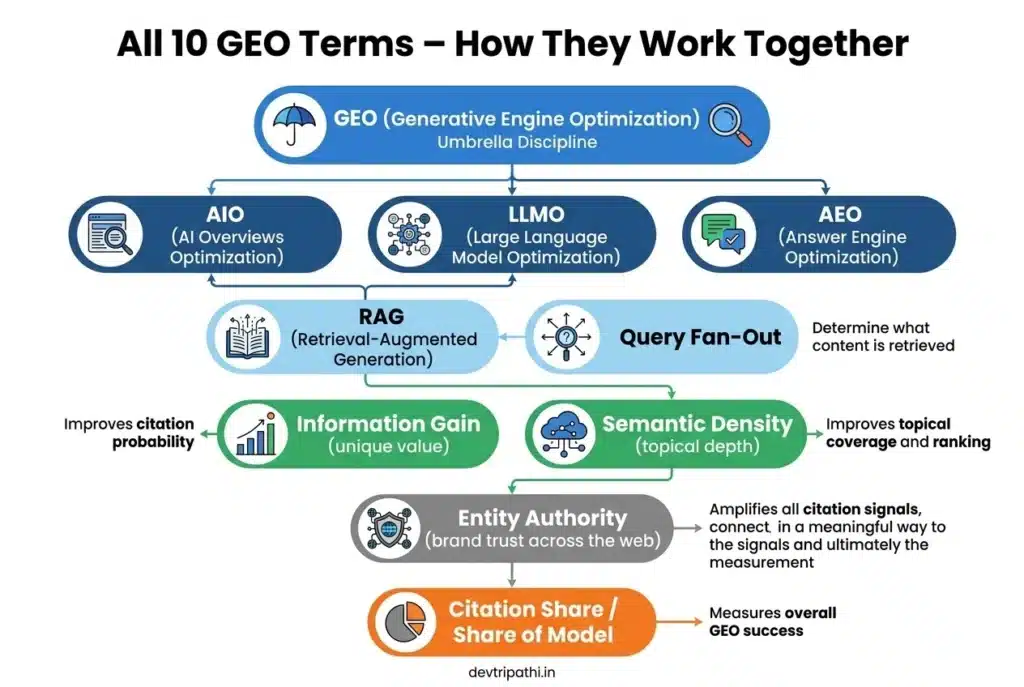
GEO is the umbrella discipline – the goal. RAG is the technical mechanism that makes GEO work – AI systems use RAG to retrieve your content. Query Fan-Out determines what content gets retrieved by breaking queries into sub-queries. Information Gain and Semantic Density determine whether your content scores highly enough to be cited once retrieved. Entity Authority amplifies citation likelihood across all queries in your topic area. AIO, LLMO, and AEO are platform-specific applications of GEO for Google AI Overviews, LLMs broadly, and direct answer formats respectively. Citation Share is the metric that tells you how well all of this is working.
→ For the practical application of all these terms together, our complete guide on how GEO works walks through the entire citation pipeline from query to citation with real examples.
4. The Terms That Are Often Confused – Quick Clarification Guide
GEO vs LLMO – What Is the Actual Difference?
GEO (Generative Engine Optimization) was coined by Princeton academics and covers all generative AI search systems. LLMO (Large Language Model Optimization) emerged from marketing practitioners and focuses specifically on LLMs like GPT, Claude, and Gemini. In practice, they share approximately 80% functional overlap (Onely, December 2025). The distinction matters mainly when a vendor uses one term but not the other – ask them to clarify whether they cover all generative platforms or just LLMs specifically.
AIO – Two Different Meanings
▲ AIO Means Two Different Things Depending on Context: AIO = AI Overview Optimization (specific to Google’s AI Overviews feature) – used by Google, BrightEdge, and most enterprise SEO tools. AIO = AI Optimization (broad umbrella for all AI search optimization) – used by some agencies and platforms as a catch-all term. Wikipedia groups GEO, LLMO, AEO, and AI SEO under the broader AIO umbrella. When a guide or agency says ‘AIO’, always check which meaning they are using – the two require significantly different implementation approaches. |
AEO vs GEO – Is There Still a Difference?
In 2026, the practical differences between AEO and GEO have narrowed considerably. Both optimize for direct answer extraction. Both use FAQ sections and structured data. The main remaining distinction: AEO was designed for featured snippets and voice search (typically one concise answer per query), while GEO targets conversational AI synthesis (often citing multiple sources for a multi-faceted answer). If you are doing good AEO, you are already implementing the foundational layer of GEO. Add entity authority building, multi-platform optimization, and Information Gain to upgrade from AEO to full GEO.
Citation Share vs Organic Market Share – Why They Are Measured Differently
Organic search market share is measured through ranking positions and click volume – data that is directly available in Google Search Console. Citation Share is measured through AI citation monitoring – data that requires either dedicated tools or manual testing. The key difference: Citation Share can be high even when organic market share is low (because AI systems sometimes cite lower-ranking pages if they have better content structure), and organic market share can be high while Citation Share is zero (because the page ranks well but lacks the structural signals for AI extraction). Track both independently.
→ As we explored in our guide on how AI Mode is changing search behaviour, these measurement differences are one of the most significant practical challenges in building a dual SEO + GEO strategy in 2026.
5. Bonus Terms Worth Knowing
Chunking
Chunking is the process by which RAG systems break content into smaller units for indexing and retrieval. Content is typically chunked by paragraph or heading section. Each chunk is converted into a vector embedding and stored in a searchable database. When a sub-query is processed, the RAG system retrieves the chunks most semantically similar to that sub-query. The practical implication: write in 40-60 word paragraphs that work as independent answer units, because each paragraph is a potential retrieval chunk.
Vector Embeddings
A vector embedding is a numerical representation of the meaning of a piece of text – a list of numbers that captures the semantic relationships between words and concepts. RAG systems convert both user queries and content chunks into vector embeddings, then find the chunks most semantically similar to the query embedding. This is why keyword density is irrelevant in GEO: the AI is measuring conceptual similarity through embeddings, not word frequency. Write for meaning and conceptual coverage, not for keyword placement.
llms.txt
An llms.txt file is an emerging standard (similar to robots.txt) that helps AI systems understand your site structure, identify your most important pages, and access efficiently structured content summaries. Adding llms.txt to your site is a forward-looking technical step recommended by SearchEngineLand and LLMrefs as a 2026 best practice for sites serious about GEO accessibility.
Zero-Click Search
A zero-click search is a search session that ends without the user clicking through to any external website – because the answer was provided directly on the search results page (by a featured snippet, AI Overview, knowledge panel, or other SERP feature). Semrush found 93% of AI Mode searches end without a click. Zero-click is the environment GEO is specifically designed for: earning brand visibility and authority through AI citations even when no click occurs.
“The terminology might evolve, but optimizing for AI visibility is here to stay. AI search adoption grew from 8% to 40% in just one year. McKinsey predicts $750 billion in revenue flowing through AI search by 2028. Whether you call it GEO, LLMO, AIO, or something else entirely – the discipline is real, the results are measurable, and the competitive window is still open.” – DOJO AI – What Is GEO? Generative Engine Optimization Explained, 2026 |
External reference: Avenue Z – GEO Glossary of AIO Terms | ALLMO.ai – AI Search Acronyms Explained
- What Is GEO? The Complete 2026 Guide →
- GEO vs SEO: What’s the Difference and Why You Need Both →
- How GEO Works: A Technical Deep Dive for Bloggers →
- GEO in 2026: The State of Generative Engine Optimization →
- GEO for Absolute Beginners: Everything You Need to Know →
- User Intent vs Keywords: Why GEO Changed the SEO Game Forever →
- Google AI Mode: Transforming Search and SEO Strategies in 2025 →
- Understanding AI Mode Analytics: Measuring GEO Success →
- Optimizing for AI Mode: New SEO Strategies →
- The Ultimate On-Page SEO Checklist for 2025 →
Frequently Asked Questions: GEO Terms and Vocabulary
What does GEO stand for in marketing? ▼
GEO stands for Generative Engine Optimization. It is the practice of structuring content so that AI-powered search systems – including ChatGPT, Google AI Overviews, Perplexity, and Gemini – can retrieve, understand, and cite it when generating answers to user queries. The term was formally coined by Princeton University researchers in a paper published at KDD 2024.
What is RAG in the context of GEO? ▼
RAG stands for Retrieval-Augmented Generation. It is the technical architecture that most AI search systems use to find and use web content. When a user asks a question, the RAG system searches the web, retrieves relevant passages from multiple pages, and feeds those passages to the AI model as context for generating the answer. RAG is why paragraph structure matters so much for GEO – the system retrieves individual chunks of content, not full articles. Every paragraph must work as a standalone answer.
What is the difference between GEO and AIO? ▼
AIO has two different meanings depending on context. In its narrow sense, AIO means AI Overview Optimization – specifically optimizing for Google’s AI Overviews feature. In its broad sense, AIO means AI Optimization – an umbrella term covering all optimization for AI-powered platforms. GEO is more specific than the broad AIO definition but more broad than the narrow AIO definition. When you see AIO used, check the context to determine which meaning is intended.
What is LLMO and how is it different from GEO? ▼
LLMO stands for Large Language Model Optimization. It originated from marketing practitioners and focuses specifically on making content easy for LLMs like GPT-4, Claude, and Gemini to read and cite. GEO, coined by Princeton researchers, covers all generative AI search engines. In practice, GEO and LLMO share approximately 80% of their tactics and goals (Onely, December 2025). The distinction is primarily academic versus practitioner origin and a slight difference in scope.
What is query fan-out and why does it matter? ▼
Query fan-out is the process AI systems use to decompose a complex user question into multiple smaller sub-queries and search for each separately. For example, ‘best laptop for a student studying graphic design under £800’ might become three separate searches. Your content needs to be discoverable for these component sub-queries, not just the main head term. This is the core reason why topical content clusters outperform single pillar posts in GEO.
What is Information Gain in GEO? ▼
Information Gain is the degree to which your content adds new knowledge that AI systems cannot find in other sources. It includes original research, first-hand test results, proprietary data, unique expert quotes, and specific attributed statistics. Generic content that restates what ten other articles already say has near-zero Information Gain and is rarely cited. Content with original data receives 2.5x more LLM citations than derivative content (EEATMinds, 2026).
What is Entity Authority and how do I build it? ▼
Entity Authority is how well AI systems and search engines recognize your brand as a reliable, comprehensive source on specific topics. You build it by publishing 20+ interconnected posts on your core topic, earning mentions on Reddit, Quora, LinkedIn, and industry publications, maintaining a named credentialled author presence, and ensuring brand information is consistent across all platforms. Branded web mentions have a 0.664 correlation with AI Overview appearances – higher than backlinks at 0.218 (Position Digital, 2026).
What is Citation Share and how do I measure it? ▼
Citation Share measures how often your content is cited by AI systems for queries in your topic area, expressed as a percentage of total available citations. Dedicated tools include AthenaHQ, Ahrefs Brand Radar, and Semrush AI Visibility Toolkit. For a free method: monthly manual testing – search your top 10 target queries in ChatGPT, Perplexity, and Google AI Overviews and track citation appearances in a spreadsheet.
What is Semantic Density in content writing? ▼
Semantic Density is the degree to which your content covers a topic with depth and precision – using relevant sub-topics, related entities, and the specific technical vocabulary of your field. Using precise technical terminology increases AI visibility by 28% compared to generic language (DigitalApplied, 2026). Practical check: after drafting a post, ask ChatGPT what related concepts an expert would include – add the gaps.
Are GEO, AEO, and LLMO all the same thing? ▼
They are closely related but not identical. AEO was originally designed for featured snippets and voice search. GEO targets all AI-powered generative search systems and emphasizes comprehensive depth, entity authority, and multi-platform optimization. LLMO focuses on the technical content structure that makes content easy for LLMs to parse. In practice, the three overlap significantly – approximately 80% of the tactics are the same.
What is a zero-click search and how does GEO address it? ▼
A zero-click search is a search session where the user gets their answer directly from the search results page without clicking through to any website. With AI Mode, 93% of search sessions end without a click (Semrush, 2025). GEO addresses zero-click environments by shifting the success metric from click volume to citation frequency and brand authority. The visitors who do click through convert at 4.4x the rate of traditional organic visitors.
What is chunking in RAG and why should bloggers care? ▼
Chunking is the process by which RAG systems break web content into smaller units for storage and retrieval. Each chunk is converted to a vector embedding and stored in a searchable database. Every paragraph you write is a potential retrieval chunk. Paragraphs written as standalone, complete answers produce clean, citable chunks. This is the technical reason behind the concise paragraph rule in GEO writing.
How do I know if my site is blocked for AI crawlers? ▼
Check your robots.txt file at yoursite.com/robots.txt and look for Disallow rules affecting GPTBot, PerplexityBot, Google-Extended, or ClaudeBot. Check your server logs for ChatGPT-User user agent. Many sites using Cloudflare are blocking AI crawlers automatically after a default configuration change in 2024. Unblocking AI crawlers is the single highest-priority technical GEO action for any site that has not already checked.
What is the difference between GEO and traditional SEO? ▼
Traditional SEO focuses on ranking in Google’s organic results through keywords, backlinks, and technical optimization. GEO focuses on being cited inside AI-generated responses from ChatGPT, Perplexity, and Google AI Overviews. The key difference: SEO earns you a position in a list of links, GEO earns you inclusion in a synthesized AI answer. In 2026, you need both – 99.5% of AI Overview sources already rank in Google’s top 10, meaning strong SEO feeds GEO performance.
How does GEO affect my organic click-through rate? ▼
Being cited inside a Google AI Overview increases your CTR by 35% compared to non-cited brands on the same SERP (Seer Interactive/Dataslayer). Not being cited while competitors are cited on the same page means a 64% reduction in click-through rate for your organic result. This makes AI citation not just a visibility metric but a direct revenue driver – even for pages that already rank well in traditional organic search.
What schema markup types are most important for GEO? ▼
The most impactful schema combination for GEO is triple schema stacking: Article schema, FAQPage schema for FAQ sections, and ItemList schema for list-format content. Pages using all three receive 1.8x more AI citations than pages with Article schema alone (GenOptima). BrightEdge confirms schema markup enables AI engines to extract information with 300% higher accuracy versus unstructured content. In WordPress, Rank Math Pro supports all three schema types simultaneously.
How do I write a BLUF introduction for GEO? ▼
BLUF stands for Bottom Line Up Front. Write a 50-100 word paragraph in the first 200 words of your post that directly answers the main question without any preamble or build-up. AI systems extract 44% of all citations from the opening section of a page. A strong BLUF introduction creates an answer island – a self-contained passage the AI can extract cleanly. Start with the direct answer, add one supporting sentence with a specific stat or data point, then one sentence on why it matters.
Does GEO work differently for informational vs commercial content? ▼
Yes – AI Overviews appear most heavily on informational queries, which is where GEO has the highest impact. Informational content is most heavily displaced by zero-click AI answers but also most frequently cited as AI sources. Commercial intent content sees fewer AI Overview appearances but higher click-through rates when cited. The GEO fundamentals – structured answers, FAQ schema, entity authority – apply to both, but informational content benefits most from comprehensive FAQ depth.
What is an llms.txt file and should I add one to my site? ▼
An llms.txt file is a proposed standard – similar to robots.txt – that helps AI crawlers understand your site structure, key pages, and content summaries. It is placed at yoursite.com/llms.txt and contains a structured summary of your most important content. While not yet universally adopted by all AI platforms, it is a forward-looking technical step that costs nothing to implement. It is recommended as best practice for GEO-focused sites in 2026.
How important is author E-E-A-T for GEO citations? ▼
Critically important and growing. Websites with author schema are 3x more likely to appear in AI answers (BrightEdge). Author credentials carry 16% weight in AI citation decisions – up from 8% in 2024. Every GEO-priority page needs a named author with a verifiable external presence: LinkedIn profile, published work, or industry mentions. Anonymous content and generic Staff Writer bylines are effectively citation penalties in 2026.
How often do AI citation sources rotate and what does that mean for my strategy? ▼
40-60% of cited sources rotate monthly according to Semrush’s AI Visibility Index. AirOps found that AI Overview content changes roughly 70% of the time for the same query. This means a single snapshot of your citation performance is not reliable data. GEO requires continuous monitoring and regular content refreshes every 60-90 days to maintain citation positions against competitors who are also updating their content.
What is the minimum word count for a GEO-optimised blog post? ▼
There is no universal minimum, but posts under 800 words rarely provide enough depth for AI systems to extract multiple useful citation chunks. The recommended range for core cluster posts is 2,000 to 3,500 words with strong structure including FAQs, statistics, and question-based headings. Interestingly, 53.4% of AI-cited pages are under 1,000 words – suggesting that a well-structured shorter post with a strong BLUF and FAQ section can outperform a poorly structured long post.
How do I track AI referral traffic in Google Analytics 4? ▼
Create a custom segment in GA4 filtering sessions where the session source matches chatgpt.com, perplexity.ai, claude.ai, gemini.google.com, and copilot.microsoft.com. This gives you a dedicated view of AI-referred sessions, their conversion rates, pages visited, and behaviour patterns. AI-referred visitors currently convert at 4.4x the rate of organic search visitors (Semrush), making this segment one of your highest-value traffic sources even at low volume.
What branded signals matter most for GEO visibility? ▼
In order of measured impact: branded web mentions across trusted platforms (0.664 correlation with AI Overview appearances), named author credentials with verifiable external presence, consistent brand information across all platforms including schema markup, participation in Reddit and Quora discussions in your niche, and industry publication citations. Backlinks still matter but their correlation with AI visibility (0.218) is significantly lower than branded mentions. The shift from link-building to mention-building is one of the most important strategic changes in the move from SEO to GEO.
What is the competitive window for GEO and is it still worth starting? ▼
The window is real but narrowing. 47% of brands still have no dedicated GEO strategy (Digital Applied, 2026), meaning most competitors have not started. But the brands that have started are building citation authority and topical cluster depth that compounds over time. GEO tools market has grown to 20+ dedicated platforms and is valued at $848 million – projected to reach $33.7 billion by 2034. Starting in 2026 still puts you ahead of most competitors in most niches. Waiting until 2027 will be meaningfully harder as citation positions calcify around early movers.
Conclusion: The Vocabulary Is Not the Point – The Strategy Is
Here is the most important thing to remember after reading this glossary: knowing the terminology is not the goal. Using it to build a better content strategy is.
GEO, RAG, LLMO, AIO – these are not competing approaches. They are different lenses on the same challenge: getting your content seen, trusted, and cited by AI systems that increasingly mediate between your audience and the information they need. Every term in this glossary corresponds to a specific optimization decision you can make: structure paragraphs for RAG extraction, build a cluster to address query fan-out sub-queries, add original data for Information Gain, publish consistently to build Entity Authority, and track Citation Share to measure whether it is working.
As the Backlinko/Semrush team accurately summarized: ‘Whether you call it SEO, GEO, AIO, or LLMO – the fundamentals of optimization and creating great content don’t change.’ The acronyms will keep evolving. The AI search landscape will keep shifting. But content that genuinely helps people, structured so AI systems can extract and trust it, will remain the most durable GEO strategy regardless of what the industry decides to call it next year.
Start with the term that is most relevant to your immediate situation. If your AI crawler is blocked, start with the RAG and technical access section. If your content is thin and generic, start with Information Gain and Semantic Density. If you have no idea how you are performing, start with Citation Share measurement. The vocabulary exists to help you take action – not to overwhelm you.

Devyansh Tripathi
I’m Devyansh Tripathi, an SEO strategist and digital growth expert, helps businesses and individuals rank higher and drive organic traffic. Through DevTripathi., he shares cutting-edge SEO insights, content strategies, and marketing hacks. Passionate about digital success, he’s on a mission to make SEO simple, effective, and result-driven!
Posts
- What Google’s New AI Search Documentation Means for SEO Teams
- Google I/O 2026 Search: AI Agents, Gemini 3.5 and the Unified Box
- Google’s AI Optimization Guide: The Technical and Content Checklist
- July 2026 SEO Update: AI Overviews, llms.txt and Search Console
- Prompt Optimization Beyond Page One: The Position-21 Citation Opportunity
Categories
- AI Citation Optimization
- AI Search Optimization (AISEO)
- AI Visibility Tracking
- Answer Engine Optimization (AEO)
- Brand Authority SEO
- Brand SERP Optimization
- Community Signal SEO
- Conversational Search Optimization
- Generative Engine Optimization (GEO)
- Knowledge Graph Optimization
- Modern SEO Strategies
- Multimodal Search Optimization
- Prompt Optimization
- SEO Trends
- Social Search Optimization
- Topical Authority SEO
- Uncategorized
- Video Search SEO
- Visual Search Optimization
- Voice Engine Optimization (VEO)
- Zero Click Search Optimization
Latest News
Text Widget
Empowering brands with insights, strategies, and stories that drive digital growth.