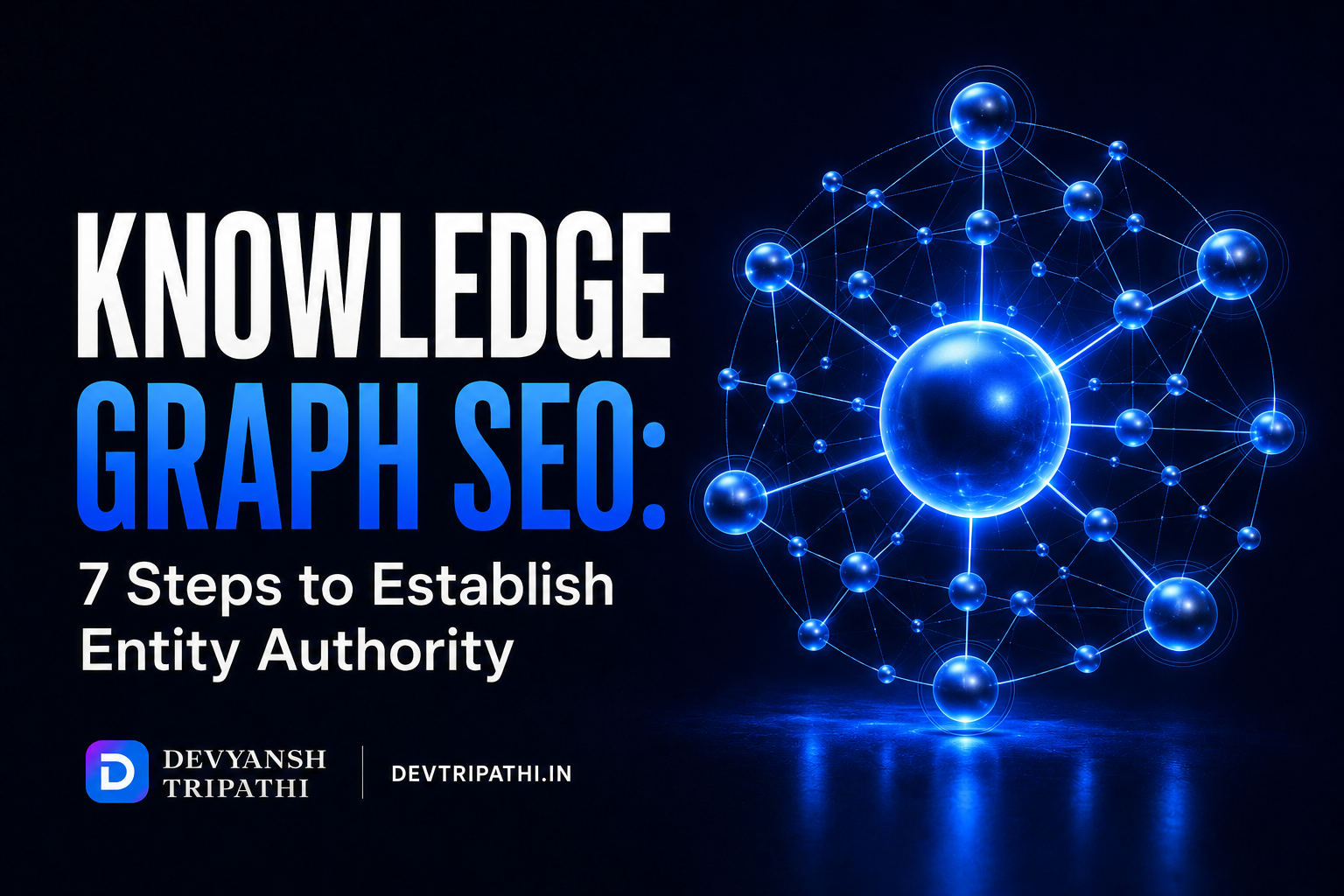
Knowledge Graph SEO: 7 Steps to Establish Entity Authority
25 May 2026
Knowledge Graph Optimization is the practice of ensuring your brand or personal entity is recognized, correctly understood, and trusted within Google’s Knowledge Graph so that search engines and AI platforms confidently surface your brand across rankings, Knowledge Panels, AI Overviews, and voice answers.
In 2026, with AI systems mediating an increasing share of all discovery, entity recognition is not a nice-to-have optimization layer. It is foundational. AI platforms including ChatGPT, Perplexity, Gemini, and Google AI Overviews make citation decisions based partly on entity authority. Brands that are recognized, consistent, and well-documented across trusted sources earn higher citation confidence from AI systems. Brands that are entity-ambiguous or inconsistently represented across the web are passed over.
This guide covers what the Knowledge Graph is, how Google builds entity understanding, and the specific optimization steps that establish your brand as a trusted entity in Google’s semantic framework.
What Is the Google Knowledge Graph?
The Google Knowledge Graph is a structured database that organizes information about real-world entities, including people, businesses, places, organizations, events, and concepts, and maps the relationships between them.
Unlike traditional search indexes that match keywords to pages, the Knowledge Graph stores information about entities as discrete, identifiable things. An entity is defined by Google as something that is “singular, unique, well-defined, and distinguishable.” The entity “Anthropic” is not the word Anthropic. It is the specific AI safety company founded in 2021, with specific founders, a specific mission, and specific products, all connected to other entities in a semantic network.
The Knowledge Graph is how Google understands meaning rather than just matching words. When a user searches “who founded OpenAI,” Google does not find pages that contain those words. It looks up the entity “OpenAI” in its Knowledge Graph, retrieves the relationship “founded by,” and returns the associated entities. This entity-relationship-context framework powers featured snippets, Knowledge Panels, AI Overviews, voice answers, and semantic search rankings.
Knowledge Graph Optimization is the discipline of ensuring your entity (your brand, your professional identity, your organization) is correctly registered, consistently represented, and authoritatively documented within this system.
For the broader context of how entity SEO connects to topical authority and AI citation, read: Entity SEO, GEO, and Topic Authority in AI Search at https://devtripathi.in/blogs/entity-seo-geo-topic-authority-ai-search/ and What Is Generative Engine Optimization (GEO)? at https://devtripathi.in/blogs/what-is-generative-engine-optimization-geo/
How Google Builds Entity Understanding: The 3 Core Sources
Google constructs Knowledge Graph entity profiles by synthesizing information from three primary source categories. Understanding these sources is essential for building an effective Knowledge Graph Optimization strategy.
Source 1: Structured Reference Sources
Wikipedia is the single strongest Knowledge Graph input signal. When Google’s systems encounter an entity on Wikipedia, they treat that as the most authoritative structured definition of that entity available on the web. Wikipedia provides a clear entity name, description, category, relationships, and cross-references that Google’s Knowledge Graph can directly ingest.
Wikidata is the machine-readable counterpart to Wikipedia. It stores structured entity data in a format that Google’s systems can process programmatically, making it an equally important Knowledge Graph input source. Unlike Wikipedia, Wikidata accepts entries for entities that may not meet Wikipedia’s notability threshold, making it more accessible for brand and personal entity registration.
Source 2: Structured Data on Your Own Website
Schema markup on your website provides Google with an explicit, machine-readable declaration of what your entity is. Organization schema, Person schema, LocalBusiness schema, and WebSite schema all contribute to Google’s entity profile for your brand. When your website’s structured data is consistent with the information Google finds on Wikipedia, Wikidata, Google Business Profile, and LinkedIn, it reinforces entity confidence and increases Knowledge Graph recognition probability.
Source 3: Multi-Source Entity Corroboration
Google uses multiple independent sources to cross-reference and validate entity information before assigning high confidence to an entity profile. The same entity name, description, founding information, and category appearing consistently across LinkedIn, Crunchbase, Google Business Profile, industry directories, and authoritative publications significantly accelerates Knowledge Graph recognition.
According to Forest SD’s entity SEO research, a combination of a Wikipedia page, consistent structured data, authoritative source mentions, and verified social profiles is required for a reliable personal Knowledge Panel. The same multi-source principle applies to brand entities.
The 7 Steps to Knowledge Graph Optimization
Step 1: Define and Document Your Entity
Before optimizing for any external platform, define your entity clearly and document it consistently. Every representation of your brand across the web should describe your entity using the same: official brand name, category and business type, founding date and location, key people and their roles, core products or services, and mission or positioning statement.
Even minor inconsistencies in how your brand is described across different platforms reduce Google’s entity confidence. “Dev Tripathi SEO” on one platform, “Devtripathi.in” on another, and “Dev Tripathi Digital Marketing” on a third are three entity signals that may not resolve to a single confident Knowledge Graph entry.
Step 2: Register Your Entity on Wikidata
Wikidata is the most accessible high-authority entity registration platform available to brands that do not yet have Wikipedia coverage. Creating a Wikidata entry for your brand provides Google’s Knowledge Graph with a machine-readable, authoritative reference for your entity.
A Wikidata entry should include: entity type (organization, person), official name, description, founding date, location, website URL, social media profile links, and links to any related Wikipedia articles. Keep all information exactly consistent with how your entity is described on your website’s structured data and Google Business Profile.
Step 3: Implement Organization or Person Schema on Your Website
Deploy JSON-LD structured data on your homepage and About page that explicitly describes your entity to Google. For a business, use Organization schema. For a personal brand, use Person schema.
Key fields to populate:
@type: Organization or Person
name: Your exact official brand name
url: Your homepage URL
sameAs: An array of URLs to your profiles on LinkedIn, Twitter, Facebook, Wikidata, Wikipedia (if applicable), and any other authoritative reference pages. The sameAs property is the most critical field for Knowledge Graph recognition because it explicitly tells Google that all of these different URLs represent the same entity.
foundingDate: Your brand’s founding year
description: A concise 2 to 3 sentence entity description matching your Wikidata and Wikipedia descriptions exactly
logo: URL to your official logo image
The sameAs property creates the explicit entity disambiguation signal that Google needs to unify your brand presence across multiple platforms into a single Knowledge Graph entry.
Step 4: Complete Your Google Business Profile
Google Business Profile is a direct Knowledge Graph input source for local and commercial entities. A complete, verified Google Business Profile with your brand name, category, address, phone, website, hours, and a detailed service description provides Google with structured entity data in a format it processes with high confidence.
Ensure every piece of information on your Google Business Profile matches your website’s schema markup and your Wikidata entry exactly. Complete all available fields including products, services, attributes, and business description. A fully complete GBP is one of the fastest paths to Knowledge Panel creation for local and commercial entities.
Step 5: Build a Comprehensive LinkedIn Company Page
LinkedIn is treated by Google as a high-authority reference source for brand entities, particularly in B2B and professional service contexts. A fully complete LinkedIn Company Page with your official brand name, description, website URL, industry category, founding year, and regular content activity significantly strengthens your entity signal for Google’s Knowledge Graph.
For personal brands, a fully complete LinkedIn personal profile with consistent name, professional headline, summary, experience, and education sections is an important entity corroboration source. Microsoft Copilot also pulls directly from LinkedIn for B2B and professional queries, making LinkedIn entity completeness relevant for AI citation as well as Knowledge Graph optimization.
Step 6: Establish a Wikipedia Presence
Wikipedia remains the strongest single Knowledge Graph input signal. For entities that meet Wikipedia’s notability guidelines, creating or improving a Wikipedia article about your brand accelerates Knowledge Graph recognition faster than any other single action.
Wikipedia notability for companies typically requires: significant coverage in multiple independent, reliable published sources, not primarily based on the subject’s own claims. For SEO professionals and digital marketing brands, publication in recognized industry outlets such as Search Engine Journal, Search Engine Land, or equivalent publications can contribute to meeting the notability threshold.
If full Wikipedia notability is not yet established, focus on Step 2 (Wikidata) and Steps 3 to 5 while continuing to build the third-party publication record that will eventually support a Wikipedia entry.
Step 7: Build Multi-Source Entity Corroboration Through Digital PR
Google’s Knowledge Graph requires multi-source corroboration to assign high entity confidence. The more independent, authoritative sources that mention your brand with consistent information, the stronger your entity signal becomes.
Build entity corroboration through: guest articles and expert quotes in recognized industry publications, press releases distributed through wire services, mentions in industry research reports, podcast appearances where you are introduced by your full name and professional title, and directory listings on category-relevant platforms.
Each authoritative external mention that includes your brand name, professional role, and a link to your website contributes a corroboration data point to your entity profile. Over time, the accumulation of these consistent signals produces a Knowledge Graph entity with sufficient confidence for a Knowledge Panel to be generated automatically.
For the complete off-site authority building strategy that drives entity corroboration, see: Brand Authority SEO: How to Build Brand Authority at https://devtripathi.in/blogs/brand-authority-seo-complete-guide/
Knowledge Graph Optimization and AI Citation: The Direct Connection
Entity authority in Google’s Knowledge Graph directly feeds AI citation confidence across all major AI platforms. AI systems including ChatGPT, Perplexity, Gemini, and Google AI Overviews use entity recognition as a trust signal when deciding which sources to cite.
According to research from GenOptima, brands with optimized brand SERPs featuring consistent information, positive reviews, and Knowledge Panel entities receive 2.8 times more AI citations than brands without these signals. The logic is straightforward: AI language models are trained on structured information from authoritative sources. Brands that are well-documented in Wikipedia, Wikidata, and consistent structured data have richer entity profiles in the training data and index sources these models draw from.
The sameAs property in your website’s Organization or Person schema is particularly important for AI citation because it creates explicit entity disambiguation: it tells AI retrieval systems that your domain URL, LinkedIn profile, Wikidata entry, and Wikipedia page all refer to the same entity. This prevents citation fragmentation where AI systems may reference your brand inconsistently or attribute information to similar-sounding entities.
For the complete AI citation optimization strategy that builds on entity authority, see: Generative Engine Optimization (GEO): Complete Strategy Guide at https://devtripathi.in/blogs/generative-engine-optimization-geo-strategy-guide/ and AI Search Optimization (AISEO): The Complete Guide at https://devtripathi.in/blogs/ai-search-optimization-aiseo-complete-guide/
How to Claim and Optimize Your Google Knowledge Panel
A Knowledge Panel is the clearest indicator that your entity has been successfully recognized by Google’s Knowledge Graph. When Google displays a Knowledge Panel for your brand in the right sidebar of desktop results and at the top of mobile results, it means Google is confident enough in your entity profile to surface it prominently to users conducting branded searches.
Claiming your Knowledge Panel: Once Google generates a Knowledge Panel for your entity, you can claim it through the “Claim this knowledge panel” button that appears at the bottom of the panel. Claiming requires verifying your identity through Google Search Console or one of your connected social accounts. Once claimed, you can suggest edits to ensure the displayed information is accurate.
Optimizing a claimed Knowledge Panel:
Update the primary description to match your current brand positioning exactly.
Verify that all social profile links are accurate and point to your active accounts.
Ensure the entity category is correctly classified.
Add or update product and service information where applicable.
Upload an up-to-date official logo image.
Monitoring your Knowledge Panel: Check your branded search results weekly. Knowledge Panel content can change automatically as Google updates its entity information from web sources. Any unexpected changes should be investigated and corrected through the claims process.
Measuring Knowledge Graph Optimization Progress
Knowledge Panel Presence: Check whether your brand name search displays a Knowledge Panel. Its presence confirms successful Knowledge Graph entity recognition. Monitor weekly.
Entity Consistency Audit: Quarterly audit of all major platforms to confirm your entity information (name, description, category, founding date, website URL) remains identical across Wikidata, Google Business Profile, LinkedIn, Crunchbase, and your website’s schema markup.
Branded Search Impression Growth: Track branded query impressions in Google Search Console monthly. Growth in branded impressions indicates increasing entity recognition and branded search volume, both of which correlate with Knowledge Graph authority.
AI Citation Rate for Branded Queries: Test “[your brand] + category” queries in ChatGPT, Perplexity, and Google AI Mode weekly. A recognized Knowledge Graph entity receives more accurate, more frequent, and more favorably framed AI citations than an entity-ambiguous brand.
sameAs Validation: Use Google’s Rich Results Test to verify your Organization or Person schema sameAs property is correctly formatted and all linked URLs are returning 200 status codes.
Frequently Asked Questions About Knowledge Graph Optimization
What is the Google Knowledge Graph and why does it matter for SEO?
The Google Knowledge Graph is a structured database Google uses to understand and connect real-world entities including people, businesses, concepts, and places. It powers featured snippets, Knowledge Panels, AI Overviews, and voice search answers. It matters for SEO because Google’s ranking algorithms increasingly evaluate entity trust and entity consistency rather than just keyword relevance. Brands with recognized Knowledge Graph entities receive faster indexing, more stable rankings, and higher AI citation rates.
How is a Knowledge Graph different from a Knowledge Panel?
The Knowledge Graph is Google’s internal database that stores entity information and relationships. It is not visible to users. The Knowledge Panel is the visible display element that Google shows on the SERP when a user searches for a recognized entity. The Knowledge Panel is the front-end evidence that your entity has been successfully recognized by the Knowledge Graph. Optimizing for the Knowledge Graph is the process that eventually produces a Knowledge Panel as an outcome.
Do I need a Wikipedia page to appear in the Knowledge Graph?
Wikipedia is the strongest single signal for Knowledge Graph recognition, but it is not the only path. Google can build Knowledge Graph entity profiles from Wikidata entries, consistent structured data across multiple authoritative platforms, Google Business Profile, and multi-source entity corroboration from high-authority publications. For personal brands and smaller businesses, Wikidata plus consistent Organization or Person schema plus thorough Google Business Profile completion plus several authoritative third-party mentions is a viable path to Knowledge Graph recognition without a Wikipedia page.
What is the sameAs property in schema markup and why is it important?
The sameAs property in JSON-LD structured data explicitly tells Google that multiple different URLs (your website, LinkedIn profile, Wikidata entry, Wikipedia page, and other profiles) all represent the same real-world entity. It is the most important field for Knowledge Graph recognition because it creates unambiguous entity disambiguation: Google can confidently unify all of these separate web presences into a single entity profile with high confidence. Without sameAs, Google must infer these connections, which takes longer and results in lower entity confidence.
How long does it take to appear in the Knowledge Graph?
Timeline varies significantly by brand size, existing web presence, and the strength of corroboration signals. For brands with Wikipedia coverage, a Knowledge Panel can appear within days to weeks of consistent structured data implementation. For brands without Wikipedia, building sufficient entity authority through Wikidata, structured data, Google Business Profile, and multi-source corroboration typically takes 3 to 12 months depending on the pace of digital PR and the number of authoritative sources mentioning the brand.
What is Wikidata and how does it help Knowledge Graph optimization?
Wikidata is a free, open, machine-readable knowledge base operated by the Wikimedia Foundation. It stores structured entity data that Google’s Knowledge Graph directly ingests. Unlike Wikipedia, Wikidata accepts entries for entities that may not meet Wikipedia’s full notability guidelines, making it accessible to more brands and professionals. A complete, accurate Wikidata entry with your entity’s name, type, founding date, website, and social profile links is one of the fastest accessible paths to Knowledge Graph entity registration.
Can Knowledge Graph Optimization help with AI search citations?
Yes, directly. AI platforms including ChatGPT, Perplexity, Gemini, and Google AI Overviews use entity recognition as a citation confidence signal. Brands with clearly defined, consistently documented entity profiles in the Knowledge Graph receive higher confidence citations from AI systems. Research shows brands with optimized entity signals and Knowledge Panels receive 2.8 times more AI citations than comparable brands without these signals. Every step in Knowledge Graph Optimization simultaneously improves AI citation eligibility.
What happens if incorrect information appears in my Knowledge Panel?
Claim your Knowledge Panel immediately through the “Claim this knowledge panel” button in Google Search results. Once claimed, you can submit correction requests through the Knowledge Panel management interface in Google Search Console. For stubborn inaccuracies that Google is pulling from incorrect third-party sources, update those sources directly (Wikidata, Wikipedia, or directory listings) to remove the incorrect information at the source. Update your website’s schema markup to clearly state the correct information. Google typically reflects corrections within 2 to 6 weeks.
How does local business schema relate to Knowledge Graph Optimization?
LocalBusiness schema is a specific entity type in the schema.org vocabulary that provides Google with structured information about a business location including name, address, phone, opening hours, service area, and price range. Implementing LocalBusiness schema with complete and accurate information directly contributes to Knowledge Graph entity recognition for local businesses and feeds the entity data that appears in Knowledge Panels, Google Maps, and local pack results. For any business with physical locations or defined service areas, LocalBusiness schema is a non-negotiable Knowledge Graph Optimization element.
What is entity disambiguation and why does it matter?
Entity disambiguation is the process by which Google resolves potential confusion between different things that share the same name. “Apple” can refer to the fruit, the technology company, the record label, or multiple other things. Google’s Knowledge Graph resolves this disambiguation using entity context signals including your website’s schema markup, surrounding content, sameAs links, and the overall entity profile Google has built from multiple sources. Without clear disambiguation signals, Google may serve uncertain or incorrect entity information about your brand, or fail to generate a Knowledge Panel even if your brand has sufficient corroboration signals.
Conclusion
Knowledge Graph Optimization is foundational to modern SEO and AI search visibility. It is the discipline that converts your brand from a collection of keywords and web pages into a recognized, trusted entity that Google and AI systems understand, reference, and recommend with confidence.
The investment required is not particularly technical or expensive. Define your entity consistently. Register on Wikidata. Implement Organization or Person schema with a complete sameAs property. Complete your Google Business Profile. Build your LinkedIn presence. Earn mentions in authoritative publications. These steps, executed systematically, build the entity authority that supports Knowledge Panel creation, stable rankings, and increasing AI citation rates simultaneously.
Begin with an entity consistency audit this week. Check whether your brand name, description, and category are identical across every major platform you appear on. Fix any inconsistencies. Then implement the sameAs property in your website’s Organization schema and link it to your most authoritative profiles.
Entity recognition in Google’s Knowledge Graph is the foundation on which every other search optimization strategy builds. The brands that establish clear, trusted entity profiles now will find every subsequent SEO and GEO effort more effective, more resilient, and more durable.
Google Knowledge Graph Overview: https://blog.google/products/search/introducing-the-knowledge-graph-things-not/
Wikidata — Entity Registration: https://www.wikidata.org/wiki/Wikidata:Main_Page
Schema.org — Organization Schema: https://schema.org/Organization
Google Rich Results Test: https://search.google.com/test/rich-results
Google Knowledge Panel Help: https://support.google.com/knowledgepanel/

Devyansh Tripathi
I’m Devyansh Tripathi, an SEO strategist and digital growth expert, helps businesses and individuals rank higher and drive organic traffic. Through DevTripathi., he shares cutting-edge SEO insights, content strategies, and marketing hacks. Passionate about digital success, he’s on a mission to make SEO simple, effective, and result-driven!
Posts
- What Google’s New AI Search Documentation Means for SEO Teams
- Google I/O 2026 Search: AI Agents, Gemini 3.5 and the Unified Box
- Google’s AI Optimization Guide: The Technical and Content Checklist
- July 2026 SEO Update: AI Overviews, llms.txt and Search Console
- Prompt Optimization Beyond Page One: The Position-21 Citation Opportunity
Categories
- AI Citation Optimization
- AI Search Optimization (AISEO)
- AI Visibility Tracking
- Answer Engine Optimization (AEO)
- Brand Authority SEO
- Brand SERP Optimization
- Community Signal SEO
- Conversational Search Optimization
- Generative Engine Optimization (GEO)
- Knowledge Graph Optimization
- Modern SEO Strategies
- Multimodal Search Optimization
- Prompt Optimization
- SEO Trends
- Social Search Optimization
- Topical Authority SEO
- Uncategorized
- Video Search SEO
- Visual Search Optimization
- Voice Engine Optimization (VEO)
- Zero Click Search Optimization
Latest News
Text Widget
Empowering brands with insights, strategies, and stories that drive digital growth.