
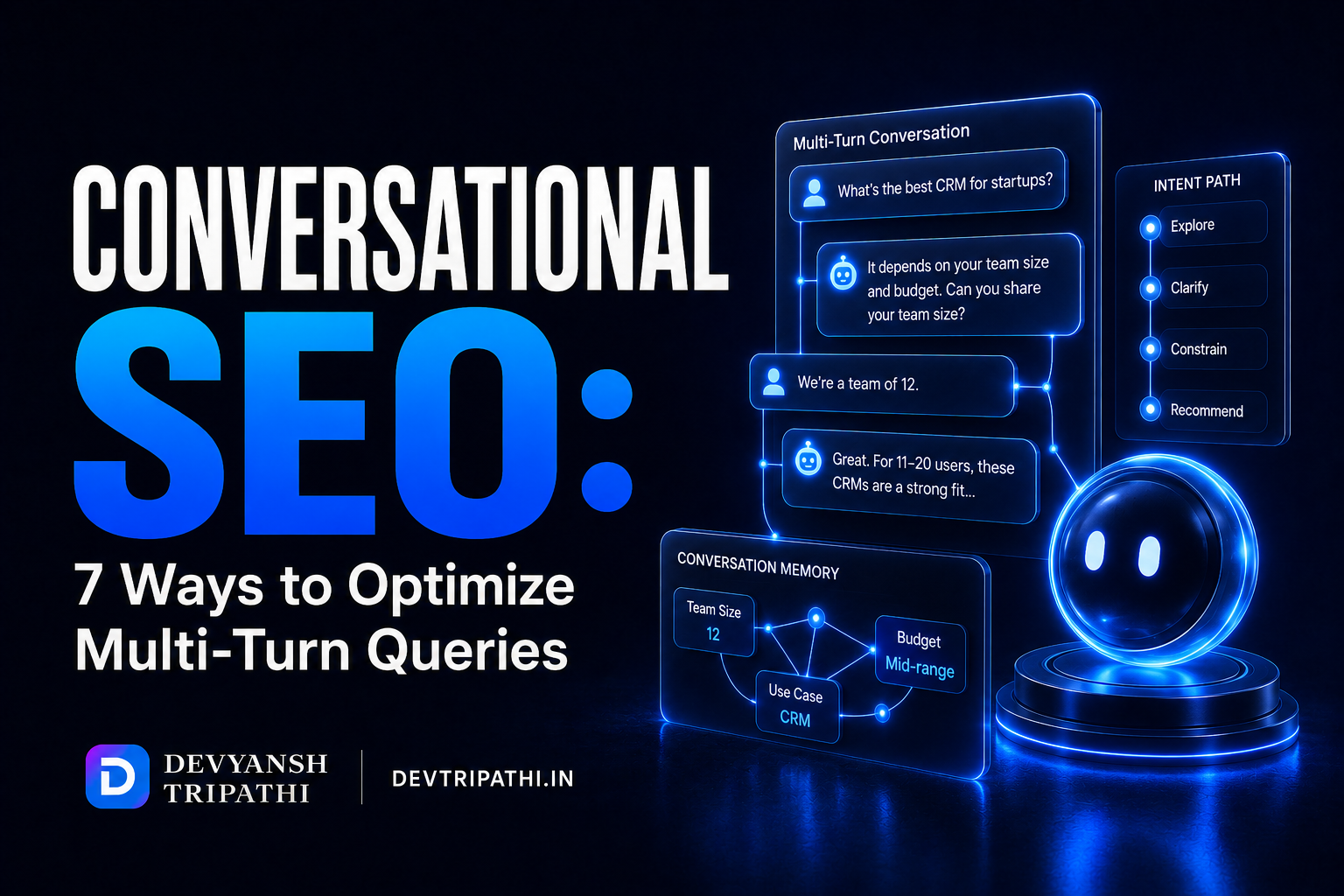
Conversational SEO: 7 Ways to Optimize Multi-Turn Queries
27 May 2026
That compression is no longer necessary.
AI-powered search platforms including ChatGPT, Perplexity, Google AI Mode, and voice assistants understand and respond to full, natural-language questions. Users are reverting to their natural communication style. According to Citescope AI research, 67% of all AI search queries in 2026 are full questions or conversational phrases rather than traditional keyword fragments. Voice search has crossed 27% of all global queries. The era of the keyword fragment as the dominant search input is ending.
Conversational Search Optimization (CSO) is the practice of structuring your content to perform well in this new environment: optimizing for the natural questions real users actually ask rather than the abbreviated keywords they used to type.
This guide covers what conversational search is, how AI systems process conversational queries, and the specific strategies that make your content the answer across every major conversational search platform.
What Is Conversational Search Optimization?
Conversational Search Optimization is the practice of structuring content to perform well in AI-driven search environments where users interact using natural language questions, multi-turn dialogue, and spoken queries rather than short keyword fragments.
Traditional SEO focused on matching short keyword strings. A page optimized for “GEO strategy 2026” targeted users who typed that specific phrase. Conversational search optimization targets the same user asking “what is the best strategy for getting my content cited in AI search results in 2026?” The intent is identical. The phrasing is completely different.
AI systems including ChatGPT, Perplexity, and Google AI Mode do not care about the keyword fragment. They interpret the full intent, context, and relationships expressed in the natural language query and retrieve the most relevant, clearly structured content that satisfies that intent completely.
Content optimized for conversational search satisfies three requirements: it mirrors how users naturally explain problems and ask questions, it provides complete and self-contained answers that AI can extract without requiring surrounding context, and it anticipates the follow-up questions a user is likely to ask next.
For context on how conversational search fits within the broader AI search optimization landscape, see: AI Search Optimization (AISEO): The Complete Guide at https://devtripathi.in/blogs/ai-search-optimization-aiseo-complete-guide/ and What Is Generative Engine Optimization (GEO)? at https://devtripathi.in/blogs/what-is-generative-engine-optimization-geo/
How AI Systems Process Conversational Queries
Understanding how AI systems interpret conversational queries is the foundation of effective conversational search optimization. The processing pipeline differs significantly from traditional keyword matching.
Step 1: Intent Parsing
AI language models parse conversational queries at the level of full intent, not keyword overlap. When a user asks “I am running a small e-commerce store and I want to know if GEO is worth my time as a non-technical person,” the AI identifies: the entity type (small e-commerce business owner), the decision context (evaluating GEO investment), the expertise level (non-technical), and the desired information type (practical ROI assessment with plain-language explanation). It retrieves content that addresses all of these dimensions, not just pages that contain the words “GEO” and “e-commerce.”
Step 2: Context Retention
Unlike traditional search engines that treat each query independently, AI platforms retain context across multiple turns in a conversation. A user who asks “what is GEO” followed by “how is it different from traditional SEO” followed by “which tools should I use” is engaged in a single coherent research session. AI systems track this context and retrieve content that fits the ongoing conversation rather than resetting to zero intent with each query.
This multi-turn context has a direct implication for content optimization: comprehensive guides that address a topic across multiple layers of depth, from introduction to implementation to measurement, serve conversational research sessions far better than narrow single-question pages.
Step 3: Entity and Relationship Recognition
AI systems interpret conversational queries through entity recognition. “The best tool for tracking how ChatGPT cites my brand” is interpreted as a query about “AI visibility tracking tools” even though neither of those exact phrases appears in the query. The AI understands entities (brand, citations, ChatGPT), their relationships (tracking citations from ChatGPT), and the implicit intent (finding tools for AI citation monitoring). Content that clearly defines and discusses the relevant entities is retrieved and cited preferentially.
The 7 Core Conversational Search Optimization Strategies
Strategy 1: Source Questions from Real User Language
The most impactful first step in conversational search optimization is replacing keyword research as your content planning input with natural language question research. Keyword tools tell you that “GEO strategy” gets 2,400 monthly searches. They do not tell you that users are actually asking “how do I get ChatGPT to recommend my business instead of my competitor.”
Collect actual conversational questions from:
Customer support tickets and sales call recordings where prospects describe their problems in natural language
Reddit threads in your niche where community members ask questions in the same way they would ask a friend
Quora questions in your topic area
Google’s People Also Ask box, which surfaces natural language variants of search queries
Google Search Console query report, filtered for queries of 6 or more words which are most likely conversational
AnswerThePublic, which maps natural language question variants across all five W questions and How
These sources surface the actual phrasing real users use when thinking through problems, which is the phrasing conversational AI systems are trained to recognize and respond to.
Strategy 2: Write Complete, Self-Contained Answer Sections
Every section of your content must work as a standalone, self-contained answer. When an AI system retrieves a section of your page to include in a conversational response, it extracts that section without the surrounding context of the full article. If the extracted section requires reading the surrounding content to make sense, it will not be cited.
Structure every H2 and H3 section as a mini-article: a question-format heading, a direct complete answer, supporting detail, and any essential context needed to understand the answer without reading the rest of the page.
Test this by reading any single section in isolation. If it makes complete sense and provides genuine value on its own, it is well-structured for conversational search extraction. If it depends on context from earlier sections to understand, rewrite it to be self-contained.
Strategy 3: Mirror the Language Patterns of Your Audience
Conversational AI systems are optimized to understand the language patterns of the communities they serve. Content that uses the same vocabulary, sentence structure, and terminology that your target audience uses in their natural problem-solving conversation is more likely to be retrieved as a relevant match.
This does not mean informal or low-quality writing. It means writing in the clear, direct, accessible language that experts use when explaining concepts to engaged peers, not the keyword-dense, marketing-inflected language that traditional SEO content optimized for machines rather than humans.
According to AdsAgenz’s Conversational Search Optimization guide, at its core, conversational search optimization is an exercise in empathy: genuinely inhabiting the perspective of someone working through a real problem, understanding not just what they are asking but why, and what they will need to know next.
Strategy 4: Build Multi-Depth Content Architectures
Conversational research sessions progress through layers of depth. A user researching GEO typically moves from “what is GEO” to “how does GEO work” to “what tools do I need for GEO” to “how do I measure GEO success.” Content that addresses only one layer of this journey is visible in only one stage of the conversational research process.
Build content architectures that serve the full conversational journey: foundational definitions for entry-level queries, strategic overviews for planning-stage queries, tactical how-to guides for implementation queries, tool comparisons for evaluation queries, and measurement frameworks for optimization queries.
Internal linking between these content layers is what creates the multi-depth architecture that AI systems can traverse to find the most relevant layer for each specific conversational query.
For the content cluster strategy that creates multi-depth topical coverage, see: Topical Authority SEO: The Complete Guide at https://devtripathi.in/blogs/topical-authority-seo-complete-guide/
Strategy 5: Optimize for Multi-Turn Query Context
Because AI platforms retain context across multi-turn conversations, optimize your content to anticipate and address the questions that naturally follow your primary topic. If a user asks “what is answer engine optimization,” the follow-up questions are predictable: how is it different from SEO, how long does it take, what tools do I need, and where do I start.
Structure your content to address these natural follow-on questions within the same page, either as H3 subsections or within a comprehensive FAQ section. This approach ensures your content remains relevant through multiple turns of a conversational research session rather than being cited only for the initial query.
For a comprehensive framework on building FAQ sections that address the full conversational query landscape, see: How to Write FAQ Sections for AI Overviews at https://devtripathi.in/blogs/how-to-write-faq-sections-ai-overviews/
Strategy 6: Use Conversational Sentence Structures in Answer Blocks
The sentence structure of your answer blocks matters for conversational search extraction. AI systems that deliver spoken answers or synthesize conversational responses favor content that reads naturally when spoken aloud or paraphrased.
Write answer blocks using:
Subject is Predicate structure: “Conversational Search Optimization is the practice of…” rather than “In the realm of modern digital marketing, the optimization of content for conversational search queries involves…”
Active voice throughout answer sections
Second-person phrasing where appropriate: “You can improve your conversational search visibility by…” rather than “Practitioners may improve visibility through…”
Concrete specifics rather than abstract generalizations: “Add a 40 to 60 word direct answer immediately after each H2 header” rather than “Provide appropriately concise content”
These structural principles make your answer blocks more extractable, more readable when synthesized into AI responses, and more useful to the humans receiving them.
Strategy 7: Apply Schema Markup for Conversational Content Types
Structured data explicitly communicates to AI retrieval systems what type of content each section contains and what question it answers.
The priority schema types for conversational search optimization:
FAQPage schema: Directly maps question-answer pairs for extraction. Each FAQ entry is a conversational question with a standalone answer. This is the most directly conversational-search-relevant schema type available.
HowTo schema: Structures step-by-step answers to “how to” conversational queries. Voice assistants and AI systems can extract and deliver numbered steps directly in response to process-based conversational queries.
Speakable schema: Marks specific content sections as suitable for audio delivery. When a user asks a voice assistant a question, Speakable-marked content is prioritized for spoken response selection.
QAPage schema: Used for content structured as a single question with a detailed answer, like a forum answer or a dedicated Q&A page. Useful for pages targeting specific high-volume conversational queries with comprehensive single-question coverage.
For a complete guide on deploying schema for AI extraction, see: GEO Checklist Before Publishing a Blog Post at https://devtripathi.in/blogs/geo-checklist-before-publishing-blog-post/
Conversational Search Optimization Across Different Query Types
Not all conversational queries are the same. Each query type requires slightly different content optimization approaches.
Definitional queries: “What is [term]?” Optimize with a clear, concise definition in the first two sentences. Use Subject Is Predicate structure. Define in plain language before introducing any technical nuance. Keep the opening definition under 50 words.
Comparison queries: “What is the difference between [A] and [B]?” Optimize with a comparison table near the top of the page and a direct summary sentence answering the question before the table. AI systems frequently cite comparison tables directly.
How-to queries: “How do I [task]?” Optimize with numbered steps using action verbs. Each step should be a single clear action. Use HowTo schema markup.
Recommendation queries: “What is the best [product/service/approach] for [use case]?” Optimize with a direct recommendation in the first paragraph, followed by the criteria used to make that recommendation, followed by alternatives. This structure mirrors how a knowledgeable friend would answer the question.
Troubleshooting queries: “Why is [problem] happening?” Optimize by leading with the most common cause, then listing secondary causes with brief diagnostic questions. Structure the page so AI can extract the relevant cause without the user needing to read the entire troubleshooting guide.
For related guidance on how user intent shapes content structure across all these query types, read: User Intent vs Keywords in GEO and SEO at https://devtripathi.in/blogs/user-intent-vs-keywords-geo-seo/
Frequently Asked Questions About Conversational Search Optimization
What is conversational search and how is it different from traditional search?
Conversational search is the interaction model where users ask full, natural-language questions of AI-powered search systems rather than typing abbreviated keyword fragments. Traditional search was built around keyword matching: users compressed their intent into short phrases and search engines matched those phrases to page content. Conversational search uses natural language processing to understand full intent, context, and relationships in queries, delivering synthesized answers rather than lists of links.
Why are 67% of AI search queries now conversational phrases?
AI platforms including ChatGPT, Perplexity, and Google AI Mode understand and respond to natural language questions as effectively as they respond to keyword fragments. Users no longer need to compress their intent into keyword abbreviations. They can ask questions in their natural communication style and receive relevant, synthesized answers. This reversal to natural language phrasing is a reflection of how AI has removed the language compression requirement that traditional search engines imposed on users for two decades.
Does conversational search optimization replace traditional SEO keyword strategy?
No. Conversational search optimization extends keyword strategy rather than replacing it. Keywords remain useful as signals of topic relevance, but they are no longer sufficient as the primary content planning input. Effective content planning in 2026 combines traditional keyword volume data with natural language question research from community sources, People Also Ask, and Search Console query data to capture both keyword-driven and conversational query traffic.
How do I find the conversational questions my audience is actually asking?
The most reliable sources for real conversational query research are: customer support tickets and sales call recordings where prospects describe problems in their own words, Reddit threads and Quora questions in your niche, Google’s People Also Ask box for your target topics, Google Search Console queries filtered for 6 or more words, and AnswerThePublic for systematic question variant mapping. These sources surface the actual natural language phrasing that AI systems are trained to recognize as relevant matches.
What does it mean for a content section to be “self-contained”?
A self-contained content section is one that provides complete value and makes complete sense when read in isolation without the surrounding article context. AI systems extract individual sections from pages to include in synthesized responses. If an extracted section requires reading the earlier paragraphs to understand, it will not be cited. Test self-containedness by reading any H2 or H3 section alone. If it needs surrounding context to make sense, add a brief setup sentence at the opening of that section.
How does multi-turn conversation context affect content strategy?
AI platforms retain context across multiple turns in a conversation. A user researching a topic typically asks 3 to 7 related questions in sequence. Content that addresses the natural follow-on questions within the same page or within a closely linked content cluster stays relevant across the full conversational research session. This means building comprehensive multi-depth content architectures that cover a topic from initial definition through advanced implementation, with clear internal linking between each depth layer.
Does conversational search optimization help with voice search?
Yes, directly. Voice search is a subset of conversational search where the query is spoken rather than typed. The same optimization principles apply: natural language question phrasing, 40 to 60 word answer blocks, FAQPage and Speakable schema, and self-contained answer sections. A page well-optimized for conversational search is simultaneously well-optimized for voice search eligibility. The additional voice-specific requirement is page speed on mobile (LCP under 2.5 seconds), as voice search is predominantly mobile-initiated.
What is the role of FAQPage schema in conversational search?
FAQPage schema explicitly maps each question-answer pair in your FAQ section as a distinct, machine-readable unit. AI retrieval systems can extract individual FAQ entries directly and use them as standalone answers to matching conversational queries. Without FAQPage schema, AI systems must infer question-answer structure from your content formatting. With it, you provide an explicit map that makes extraction reliable and accurate. FAQPage schema is the highest-ROI schema type for conversational search optimization.
How long should conversational answer blocks be?
The optimal length for a direct answer block in conversational search content is 40 to 60 words. This is long enough to provide a complete, self-contained answer to a specific question but short enough for AI systems to extract cleanly and, where applicable, deliver aloud without losing a listener’s attention. The answer block is distinct from the full section content: the answer block is the first 40 to 60 words after a question-format header, followed by expanded detail for readers who want more depth.
Can I optimize existing content for conversational search without rewriting everything?
Yes. The highest-ROI conversational search optimization changes to existing content are: (1) rewrite H2 and H3 headers as natural language questions, (2) add a direct 40 to 60 word answer block immediately after each question-format header, (3) add or expand the FAQ section with at least 10 real conversational questions and standalone answers, (4) deploy FAQPage JSON-LD schema on all FAQ sections, and (5) add a brief self-contained setup sentence to any section that depends on surrounding context to make sense. These five changes can be applied to existing pages without a full rewrite and typically produce measurable improvements in AI citation rates within 30 to 60 days.
Conclusion
Conversational Search Optimization is not a future discipline to begin planning for. Sixty-seven percent of AI search queries are already conversational phrases. Voice search has already crossed 27% of global queries. The AI platforms processing these queries are already selecting content based on how naturally, completely, and self-containedly it answers real human questions.
The content strategy shift required is real but entirely achievable. Source questions from real user language instead of keyword tools alone. Structure each content section as a complete, self-contained answer. Mirror the natural language patterns of your audience. Build multi-depth content architectures that serve the full conversational research journey. Apply FAQPage, HowTo, and Speakable schema markup systematically.
These changes do not require abandoning your existing SEO foundation. They require extending it to serve the users who are already searching conversationally, in the natural language they have always used when thinking through problems, now finally free from the keyword fragment constraints that traditional search imposed on them for twenty years.
Start with your highest-traffic informational articles. Rewrite their H2 and H3 headers as the natural questions your audience asks. Add direct 40 to 60 word answer blocks. Expand and schema-mark your FAQ sections. Then measure your AI citation rate and conversational search impression growth over the following 60 days.
The brands that meet users where they already are, in natural conversation, will be the brands that AI systems recommend first.
Google — How Search Works with Natural Language: https://www.google.com/search/howsearchworks/
AnswerThePublic: https://answerthepublic.com/
Google Search Console — Query Research: https://search.google.com/search-console/
Schema.org FAQPage: https://schema.org/FAQPage
Schema.org Speakable: https://schema.org/speakable

Devyansh Tripathi
I’m Devyansh Tripathi, an SEO strategist and digital growth expert, helps businesses and individuals rank higher and drive organic traffic. Through DevTripathi., he shares cutting-edge SEO insights, content strategies, and marketing hacks. Passionate about digital success, he’s on a mission to make SEO simple, effective, and result-driven!
Posts
- What Google’s New AI Search Documentation Means for SEO Teams
- Google I/O 2026 Search: AI Agents, Gemini 3.5 and the Unified Box
- Google’s AI Optimization Guide: The Technical and Content Checklist
- July 2026 SEO Update: AI Overviews, llms.txt and Search Console
- Prompt Optimization Beyond Page One: The Position-21 Citation Opportunity
Categories
- AI Citation Optimization
- AI Search Optimization (AISEO)
- AI Visibility Tracking
- Answer Engine Optimization (AEO)
- Brand Authority SEO
- Brand SERP Optimization
- Community Signal SEO
- Conversational Search Optimization
- Generative Engine Optimization (GEO)
- Knowledge Graph Optimization
- Modern SEO Strategies
- Multimodal Search Optimization
- Prompt Optimization
- SEO Trends
- Social Search Optimization
- Topical Authority SEO
- Uncategorized
- Video Search SEO
- Visual Search Optimization
- Voice Engine Optimization (VEO)
- Zero Click Search Optimization
Latest News
Text Widget
Empowering brands with insights, strategies, and stories that drive digital growth.