
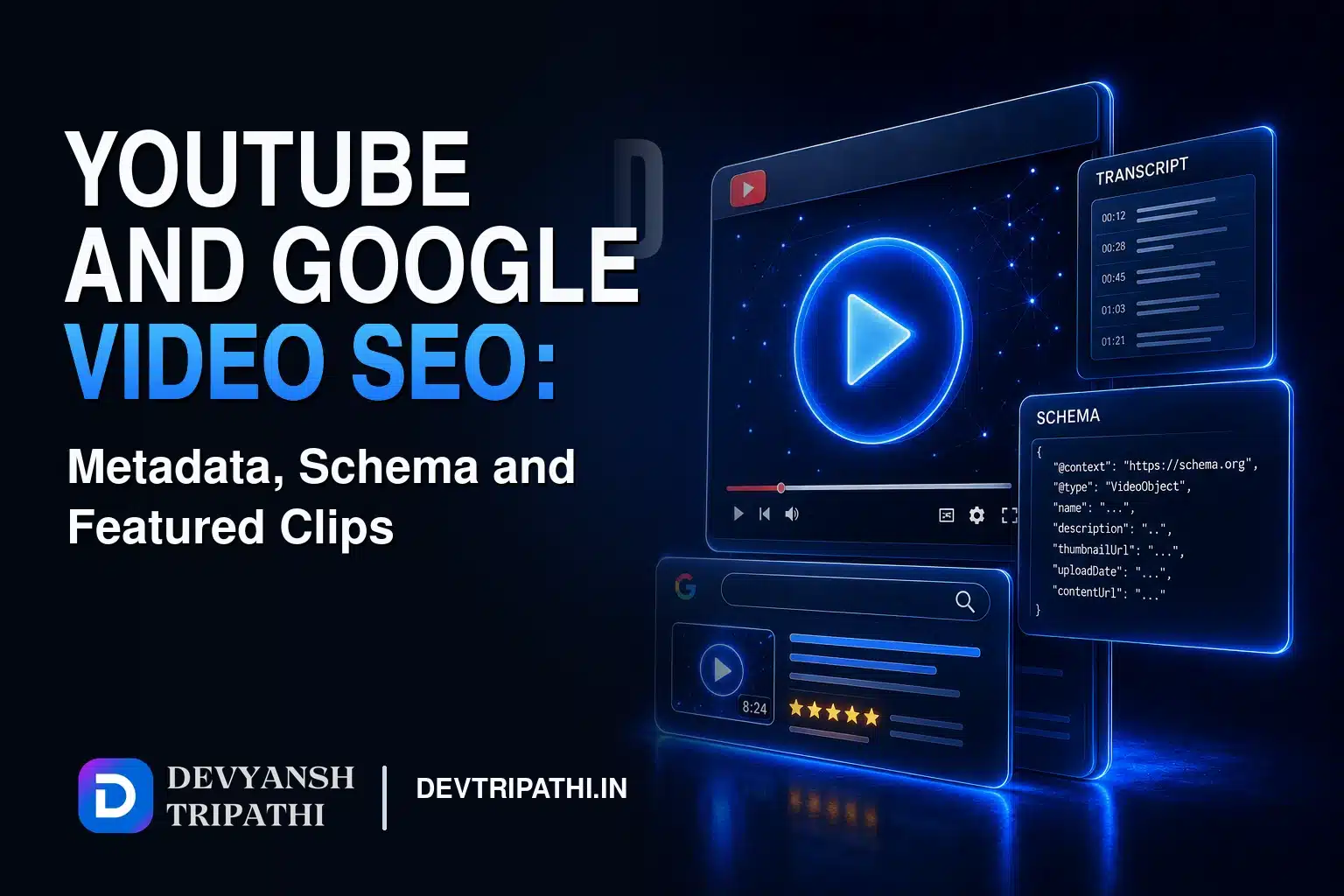
YouTube and Google Video SEO: Metadata, Schema and Featured Clips
05 June 2026
The commercial case for Video Search SEO is equally compelling. A landmark Milestone Research study found that rich results including video rich snippets achieved 58% CTR compared to 41% for non-rich results. Pages with embedded video are dramatically more likely to rank on page one. Video rich snippets capture attention in ways standard blue links cannot. And nearly 70% of total YouTube watch time comes from algorithmic recommendations, meaning the same optimization signals that rank your videos in search also feed the recommendation algorithm that grows your channel reach exponentially.
Video Search SEO is the practice of optimizing your video content, channel, and surrounding web infrastructure so that YouTube’s search algorithm, Google’s Video carousel, and AI-powered search systems surface your videos for relevant queries.
This guide covers the complete Video Search SEO system: how YouTube’s algorithm works in 2026, the specific ranking factors that matter most, the on-page optimization checklist, VideoObject schema implementation, and how to connect your video strategy to your broader GEO and traditional SEO goals.
What Is Video Search SEO?
Video Search SEO is the discipline of optimizing video content and its associated metadata, transcripts, structured data, and hosting infrastructure so that search platforms including YouTube, Google, and AI-powered search systems can understand, index, and rank it for relevant user queries.
YouTube SEO and Google Video SEO are distinct disciplines with overlapping principles. YouTube SEO focuses on the signals the YouTube algorithm uses to rank videos within YouTube’s internal search results and recommendation system. Google Video SEO focuses on the signals Google uses to surface videos in its standard search results through the Video carousel, video-featured snippets, and AI Overview video citations.
The two are not in competition. In fact, a single well-optimized video can earn visibility in both YouTube search, Google’s Video carousel, Google AI Overviews, and Gemini’s video analysis layer simultaneously, making video content one of the highest-leverage multi-surface assets in a modern search strategy.
For the multimodal context that positions Video Search SEO within the broader optimization landscape, see: Multimodal Search Optimization: The Complete Guide at https://devtripathi.in/blogs/multimodal-search-optimization-complete-guide/ and Social Search Optimization: The Complete Guide at https://devtripathi.in/blogs/social-search-optimization-complete-guide/
How YouTube’s Algorithm Works in 2026
YouTube’s algorithm in 2026 looks less like a basic ranking system and more like a prediction engine. Its job is not just to rank videos but to predict what a user is most likely to watch next and for how long. That is a fundamental shift from older SEO thinking.
YouTube still works like a search engine at its core: users type queries and YouTube returns results based on relevance. But search is only one piece of the puzzle. Videos are surfaced across multiple surfaces: search results, the Home feed, suggested videos, Shorts, and the subscription tab.
Nearly 70% of total YouTube watch time now comes from algorithmic recommendations rather than direct searches. This means YouTube SEO in 2026 operates on two parallel tracks simultaneously: the search track (keyword relevance signals that ensure your video appears when users search for your topic) and the recommendation track (satisfaction signals including watch time, CTR, and retention that determine whether YouTube’s algorithm distributes your video beyond search into recommended feeds).
Optimizing for both tracks simultaneously is the defining characteristic of effective Video Search SEO in 2026.
The 6 Core YouTube Ranking Factors in 2026
Factor 1: Click-Through Rate (CTR)
CTR is the primary YouTube ranking signal. A video that earns a 10% CTR will dramatically outperform an identical video earning 3% CTR in both search rankings and algorithmic distribution. High CTR signals to YouTube that your thumbnail and title are accurately communicating the value of your video to users who encounter it in search results or recommendations.
A good CTR falls between 4 and 10%. A sustained CTR above 6% across a wide audience is considered strong. However, CTR must be paired with strong retention for continued growth, because a high-CTR video that users abandon immediately hurts algorithmic distribution.
Custom thumbnails with high contrast, readable 3 to 5 word text, and an expressive face outperform standard screenshots by 8 to 15 times in CTR. Thumbnail optimization is therefore the single fastest YouTube SEO improvement available for underperforming videos.
Quick win: Sort your videos by impressions in YouTube Studio Analytics for the last 28 days. Identify the videos with the lowest CTR. Design new thumbnails for the bottom three. Watch CTR improve within 48 hours.
Factor 2: Watch Time and Audience Retention
YouTube evaluates retention rate (the percentage of the video watched) more than total minutes. A 7-minute video with 85% average view duration ranks higher than a 15-minute video with 50% retention because retention percentage is a direct measure of content quality relative to viewer expectations.
Videos between 5 and 10 minutes hold viewers best with 31.5% average retention, outperforming both shorter and longer formats. This retention advantage translates directly into watch time, which is YouTube’s most important ranking metric by volume.
Videos maintaining 50-plus percent average view duration consistently rank significantly higher in search results and suggested videos than videos with the same keywords but lower retention. Structure every video with a strong hook in the first 15 seconds that clearly states what the viewer will get, delivers the promised value quickly, and uses chapter markers to let viewers navigate to the sections most relevant to their specific query.
Factor 3: Keyword Relevance in Title, Description, and Transcript
YouTube keyword research must target YouTube-native search intent. YouTube searchers use different phrases than Google searchers for the same topic. Use YouTube’s search autocomplete feature and tools like TubeBuddy or vidIQ to find the exact phrases your audience types into YouTube, not just the keywords driving Google traffic.
Keyword placement priority for YouTube SEO:
Primary keyword in the first 5 words of the video title (before mobile truncation at approximately 40 characters)
Primary keyword in the first sentence of the video description
Primary keyword spoken naturally in the video audio within the first 60 seconds
Primary keyword in at least one chapter marker title where relevant
YouTube’s automatic speech recognition (ASR) indexes spoken audio. Every word you say in your video becomes searchable metadata. Saying your target keyword naturally and clearly within the first 60 seconds creates an additional relevance signal beyond the text-based metadata.
Factor 4: Engagement Signals in the First 48 Hours
The algorithm A/B tests your video against small audiences immediately after publication. If CTR and retention are above average for the topic in the first 48 hours, distribution expands to larger audiences. If below average, distribution contracts.
Comments and likes within the first 24 to 48 hours carry more algorithmic weight than the same engagement 2 weeks later. Concentrate community notification, sharing, and engagement requests in the first 48 hours for maximum algorithmic lift on every new video.
Factor 5: Accurate Transcripts and Captions
Transcripts serve dual purposes in Video Search SEO: accessibility and indexation. YouTube auto-generates captions but accuracy varies significantly depending on audio quality and vocabulary. In 2026, AI-generated transcripts from tools like Rev or Descript are more accurate than YouTube’s auto-generated alternative.
Accurate transcripts matter because Google indexes transcript text for search ranking, creating searchable content within your video that expands the keyword footprint beyond your title and description. Captions also increase average watch time by approximately 7% when enabled, because they support viewers watching in sound-off environments such as public transport.
Upload custom SRT transcripts to any high-priority video where auto-generated captions contain errors. For your most commercially important videos, this single action improves both search indexation quality and watch time simultaneously.
Factor 6: Channel Authority and Topic Consistency
YouTube’s algorithm builds channel-level authority signals over time. A channel that consistently publishes videos on a specific topic area develops topical authority within YouTube’s classification system, similar to how domain-level topical authority works in Google search. New videos published on an established topical authority channel rank faster and distribute more broadly than identical videos published on a new or scattered channel.
For SEO professionals, this means maintaining consistent topical focus on your YouTube channel rather than publishing across unrelated subjects. Build channel authority around the same topical clusters you are building website authority around. The two reinforce each other: strong website topical authority feeds Gemini’s citation confidence, and strong YouTube channel authority feeds YouTube search rankings and Google Video carousel appearances for the same topic.
The Complete YouTube SEO Optimization Checklist
Before publishing any YouTube video, verify every item in this checklist:
Title: Primary keyword in first 5 words. Total length under 60 characters. Reads naturally for human viewers. Includes a clear benefit or outcome signal.
Description: Primary keyword in the first sentence. Total length at least 200 words. Includes chapter timestamps for key sections. Links to related blog posts and the pillar page for the topic. Includes a clear call to action.
Thumbnail: Custom thumbnail (not auto-generated). High contrast between subject and background. Readable text of 3 to 5 words maximum. Expressive human face visible where topic allows. Visually consistent with channel branding.
Tags: Include the exact target keyword phrase. Include 2 to 3 closely related keyword variations. Total tags: 5 to 10. Do not stuff with unrelated terms.
Captions: Custom SRT transcript uploaded, not relying on auto-generated captions for high-priority videos. Accuracy verified for the first 2 minutes of the video.
Schema markup: VideoObject JSON-LD schema implemented on the hosting page with name, description, uploadDate, thumbnailUrl, contentUrl, and duration fields populated.
Chapters: Timestamp-based chapter markers added to description for videos over 4 minutes. Each chapter label includes a keyword-relevant section description.
End screen: Calls to action added in the final 20 seconds directing viewers to subscribe, watch a related video, or visit a website URL.
VideoObject Schema: The Bridge Between YouTube and Google
VideoObject schema is the structured data markup that makes your video content eligible for Google Video rich results, video-featured snippets, and AI Overview video citations. A landmark Milestone Research study found that pages with Video rich snippets achieved 58% CTR compared to 41% for standard blue links, a 17-percentage-point advantage from this single technical implementation.
VideoObject schema should be implemented as JSON-LD on every page that embeds or features a video as primary content. The critical fields to populate:
@type: VideoObject
name: The video title (matching YouTube title exactly)
description: A descriptive summary of the video content (at least 150 words)
thumbnailUrl: URL of the video thumbnail image
uploadDate: Date the video was published in ISO 8601 format
duration: Video duration in ISO 8601 duration format (e.g., PT7M30S for 7 minutes 30 seconds)
contentUrl: Direct URL to the video file or YouTube embed URL
embedUrl: The YouTube embed URL for the video
Additional fields that strengthen Video rich result eligibility: regionsAllowed, interactionStatistic (for view count), and hasPart with Clip schema for chapter markers.
Validate VideoObject schema using Google’s Rich Results Test after implementation. Eligible videos typically appear in Google’s Video carousel and video-featured snippets within 1 to 4 weeks of indexing.
Google Video SEO: Ranking in Standard Google Search Results
Video Search SEO extends beyond YouTube’s internal ranking to Google’s standard search results, where Video carousels, video-featured snippets, and AI Overview video citations create additional organic visibility opportunities.
Google surfaces video results for queries where video content clearly satisfies user intent better than text, primarily: how-to and tutorial queries, product demonstration queries, review and comparison queries, and event or news queries.
To maximize Google Video Search visibility:
Embed YouTube videos on related blog posts and pillar pages. Google indexes embedded videos and surfaces them in Video carousels for the page’s target queries. This creates dual visibility: the written page ranks for text-based queries and the embedded video ranks for video-intent queries simultaneously.
Write a dedicated transcript page or transcript section below each embedded video. This increases the keyword footprint of the video on the hosting page and creates additional indexable text that connects the video’s spoken content to the page’s search relevance signals.
Use VideoObject schema on all video-hosting pages, as described above. Without VideoObject schema, Google cannot reliably identify your video content as eligible for rich result treatments.
Include the video’s primary keyword in the hosting page’s title tag, H1, and first paragraph. The page-level relevance signals reinforce the video’s topical classification for both YouTube search and Google Video carousel eligibility.
For the complete structured data implementation guide, see: Knowledge Graph Optimization: The Complete Guide at https://devtripathi.in/blogs/knowledge-graph-optimization-complete-guide/
Video SEO for YouTube Shorts
YouTube Shorts use a completely independent ranking system from standard YouTube videos. Shorts ranking factors differ significantly:
Completion rate is the primary Shorts ranking signal, not total watch time. A 30-second Short watched to completion is weighted more heavily than a 45-second Short abandoned at 60%. Create Shorts that deliver their core value completely before the viewer has any reason to swipe away.
Loop count also contributes to Shorts distribution. Shorts that viewers replay (a behavior the platform’s short format naturally encourages) receive additional algorithmic distribution signals.
For search optimization within Shorts: include the target keyword in the Shorts title, use on-screen text overlay to reinforce the keyword visually in the first 3 seconds, and write the caption as a direct answer to a question the Short addresses.
Shorts and standard videos have different algorithmic trajectories. Shorts provide initial rapid discovery through the Shorts feed. Standard videos provide compounding search-driven traffic over time. Build a channel content mix that uses both: Shorts for initial audience acquisition and brand awareness, standard videos for compounding keyword-driven search traffic and AI citation eligibility.
Measuring Video Search SEO Performance
YouTube Studio Analytics: The primary measurement tool for YouTube SEO performance. Monitor: impressions CTR (primary signal — target 6 to 10%), average view duration percentage (target 50-plus percent), traffic source breakdown (Search percentage is your direct YouTube SEO metric), watch time from search versus browse versus suggested, and top-performing search terms driving views to each video.
Google Search Console Video Performance: Filter the Performance report for video-rich result appearances. Track impressions, clicks, and CTR for video-rich results separately from standard web results. Identify which videos are appearing in Google Video carousels for target keywords and track position changes over time.
Rich Results Test: Regular validation of VideoObject schema on all video-hosting pages. Monitor for schema errors that would remove video rich result eligibility.
AI Citation Tracking: Test your most important topic queries in Google AI Mode, ChatGPT, and Perplexity. Monitor whether your videos or the pages hosting them are cited as sources. Gemini specifically analyzes video transcripts for citation decisions, making accurate transcript quality directly relevant to AI citation performance.
For the complete AI visibility measurement framework, see: AI Visibility Tracking: The Complete Guide at https://devtripathi.in/blogs/ai-visibility-tracking-complete-guide/
Frequently Asked Questions About Video Search SEO
What is Video Search SEO?
Video Search SEO is the practice of optimizing video content, metadata, transcripts, and structured data so that YouTube’s search algorithm, Google’s Video carousel, and AI-powered search systems surface videos for relevant user queries. It encompasses YouTube-internal search ranking optimization, Google Video rich result eligibility, and the emerging AI citation layer where Gemini and other AI systems analyze video transcripts and metadata for citation decisions.
What is the most important YouTube ranking factor in 2026?
Click-through rate (CTR) is the primary YouTube ranking signal. A video with above-average CTR for its topic receives expanded distribution from YouTube’s algorithm. CTR is primarily controlled by thumbnail design and title quality. Custom thumbnails with high contrast, readable 3 to 5 word text, and an expressive face outperform auto-generated screenshots by 8 to 15 times in CTR. Improving CTR on existing videos through thumbnail redesign is the fastest available YouTube SEO improvement.
How do video transcripts affect SEO?
Accurate video transcripts create indexable text from spoken audio, expanding a video’s keyword footprint beyond its title and description metadata. Google indexes transcript text for search ranking, creating searchable content within the video. Transcripts also enable AI systems like Gemini to analyze video content for citation decisions. For accessibility, captions increase average watch time by approximately 7%, which improves the retention signal YouTube’s algorithm weighs heavily. Upload custom SRT transcripts for all high-priority videos.
What is VideoObject schema and why does it matter?
VideoObject schema is JSON-LD structured data that explicitly tells Google’s systems what your video is, when it was published, how long it runs, and where it is hosted. Pages with VideoObject schema are eligible for Video rich result treatments in Google search, including video-featured snippets and Video carousels. A Milestone Research study found that video rich snippets achieved 58% CTR compared to 41% for standard results. VideoObject schema is one of the most accessible paths to a significant CTR improvement through structured data.
How long does it take for YouTube videos to rank in search?
Well-optimized new videos on established channels typically show initial ranking movement within 2 to 4 weeks. New channels building authority typically take 3 to 6 months of consistent video publishing to show meaningful search traffic growth. Shorts may appear in the Shorts feed within hours but may take longer to rank consistently in YouTube search results. Early videos on any channel benefit from concentrated engagement in the first 48 hours to trigger the algorithm’s initial distribution expansion.
What is the ideal video length for YouTube SEO?
Videos between 5 and 10 minutes hold viewers best with 31.5% average retention according to research, outperforming both shorter and longer formats. This retention advantage translates directly into watch time. For YouTube search specifically, the ideal length is whatever length it takes to fully and clearly answer the search query the video targets, without padding. A query like “what is GEO” can be answered comprehensively in 5 to 7 minutes. A query like “complete guide to building topical authority” warrants 15 to 20 minutes of depth. Match length to query depth.
How do YouTube Shorts differ from standard videos in SEO?
YouTube Shorts and standard videos use completely independent ranking algorithms. Shorts ranking is primarily driven by completion rate and loop count rather than total watch time. Shorts provide rapid initial discovery through the Shorts feed but typically generate less compounding search traffic than standard videos. Standard videos generate compounding keyword-driven search traffic over time and have stronger AI citation potential through Gemini’s transcript analysis. Build a content mix using Shorts for audience acquisition and standard videos for search authority.
Can video SEO help with Google AI Overviews and AI citations?
Yes. Google AI Overviews increasingly incorporate video references, particularly for queries where video content provides the clearest demonstration of a concept or process. Gemini specifically analyzes video transcripts to understand and cite video content. Well-optimized YouTube videos with accurate transcripts, VideoObject schema, and strong underlying page authority have meaningful AI citation potential. Embedding videos in comprehensive text articles strengthens both the page’s AI citation eligibility and the video’s Google Video carousel visibility simultaneously.
What tools are best for Video Search SEO?
For YouTube optimization: YouTube Studio Analytics (primary analytics tool), TubeBuddy (keyword research and A/B title testing), vidIQ (competitive keyword and tag analysis). For transcript creation: Rev or Descript (AI transcript generation). For Google Video SEO: Google Search Console (video rich result tracking), Google Rich Results Test (schema validation). For AI citation monitoring: Gemini testing through Google AI Mode, Passionfruit Labs (AI citation tracking across platforms).
How does embedding YouTube videos on my website improve SEO?
Embedding YouTube videos on related blog posts creates multiple compounding benefits: it adds watch time to the YouTube video from an external source (improving YouTube’s distribution signals), it makes the hosting page eligible for VideoObject schema and Video rich results in Google search, it improves page dwell time by giving visitors video content to engage with (a positive engagement signal for traditional SEO), and it connects the video’s spoken content to the page’s search relevance through the embedded transcript section. This cross-platform reinforcement is one of the highest-ROI Video Search SEO tactics available.
Conclusion
Video Search SEO is one of the highest-leverage investments available in modern search strategy precisely because it generates returns across multiple discovery surfaces simultaneously. A single well-optimized YouTube video earns YouTube search rankings, Google Video carousel appearances, Gemini citation eligibility, and AI Overview video reference potential, all from one piece of content.
The formula for consistent Video Search SEO success in 2026 is direct: optimize thumbnails and titles to maximize CTR, structure video content to maximize retention above 50%, upload accurate custom transcripts to expand keyword indexation, implement VideoObject schema on every hosting page, embed videos in related blog posts for cross-surface reinforcement, and measure performance across YouTube Studio analytics and Google Search Console simultaneously.
The brands building systematic Video Search SEO alongside their text content strategy are building search visibility across the full surface area of modern search: text results, image results, video results, voice answers, and AI citations. That multi-surface presence compounds over time in the same way that topical authority compounds, making early and consistent investment in video the most durable search channel development available today.
Start by identifying the top 10 queries in your niche that regularly surface video results in Google. Create targeted YouTube videos for each query with proper optimization. Implement VideoObject schema on hosting pages. Measure the CTR improvement and search traffic growth over the following 8 weeks.
The search real estate available through video has never been larger or more accessible. The brands that claim it now will hold it for years.
YouTube Creator Academy: https://creatoracademy.youtube.com/
TubeBuddy — YouTube SEO Tool: https://www.tubebuddy.com/
Google Rich Results Test: https://search.google.com/test/rich-results
Schema.org VideoObject: https://schema.org/VideoObject
Google Search Central — Video SEO Best Practices: https://developers.google.com/search/docs/appearance/video

Devyansh Tripathi
I’m Devyansh Tripathi, an SEO strategist and digital growth expert, helps businesses and individuals rank higher and drive organic traffic. Through DevTripathi., he shares cutting-edge SEO insights, content strategies, and marketing hacks. Passionate about digital success, he’s on a mission to make SEO simple, effective, and result-driven!
Posts
- What Google’s New AI Search Documentation Means for SEO Teams
- Google I/O 2026 Search: AI Agents, Gemini 3.5 and the Unified Box
- Google’s AI Optimization Guide: The Technical and Content Checklist
- July 2026 SEO Update: AI Overviews, llms.txt and Search Console
- Prompt Optimization Beyond Page One: The Position-21 Citation Opportunity
Categories
- AI Citation Optimization
- AI Search Optimization (AISEO)
- AI Visibility Tracking
- Answer Engine Optimization (AEO)
- Brand Authority SEO
- Brand SERP Optimization
- Community Signal SEO
- Conversational Search Optimization
- Generative Engine Optimization (GEO)
- Knowledge Graph Optimization
- Modern SEO Strategies
- Multimodal Search Optimization
- Prompt Optimization
- SEO Trends
- Social Search Optimization
- Topical Authority SEO
- Uncategorized
- Video Search SEO
- Visual Search Optimization
- Voice Engine Optimization (VEO)
- Zero Click Search Optimization
Latest News
Text Widget
Empowering brands with insights, strategies, and stories that drive digital growth.