AEO Across the Buyer Journey: From Citation to Revenue
06 June 2026
The brands gaining significant citation advantages are moving beyond the fundamentals. They are implementing content freshness systems, mapping their AEO strategy to the buyer journey, building local AEO pages, tracking AI-generated revenue in real-time, and addressing the technical gaps that block even well-structured content from AI citation pools.
This advanced AEO playbook covers the strategies that separate brands capturing growing AI-referred revenue from brands still optimizing without measurable results.
For the foundational AEO guide that covers core concepts and basic implementation, see: Answer Engine Optimization (AEO): The Complete Guide for SEO Professionals at https://devtripathi.in/blogs/answer-engine-optimization-aeo-complete-guide/
The 2026 AEO Landscape: What Has Changed
AEO in 2026 is a more measurable, more competitive, and more commercially significant discipline than it was 12 months ago.
Research from AirOps shows that for commercial and evaluation-stage queries, 83% of AI citations came from pages updated within the past 12 months, with more than 60% refreshed within the last six months. Content freshness is no longer a nice-to-have quality signal. For commercial AEO, it is the primary citation eligibility filter.
Research from Brandlight suggests that the overlap between top Google links and AI-cited sources has dropped from 70% to below 20%. This widening gap has created a fundamental shift: ranking first on Google no longer correlates as strongly with being cited in AI responses as it did even 12 months ago. AI systems are increasingly developing their own citation preferences independent of traditional organic rankings.
According to a 2025 paper on citation bias in AI search, AI engines strongly favor earned media — authoritative third-party sources — over brand-owned content. AEO has become as much an off-site discipline as an on-site one.
The practical implication for SEO professionals: AEO cannot be managed as a content quality checklist applied quarterly. It requires an ongoing operational system covering freshness cycles, off-site authority building, local page expansion, and revenue attribution.
For the AI citation monitoring framework that tracks these changes week over week, see: AI Visibility Tracking: The Complete Guide at https://devtripathi.in/blogs/ai-visibility-tracking-complete-guide/
The 6 Advanced AEO Strategies for 2026
Strategy 1: The Content Freshness System
The single most impactful advanced AEO change available to most content teams in 2026 is a systematic content freshness program. Answer engines have a strong recency bias. From real-world citation data, content that becomes more than 3 months old sees AI citations drop sharply. Revisit important pages at least once per quarter.
A content freshness system is not about rewriting articles. It is a structured process of updating specific signals that AI citation systems evaluate for recency:
Update the “last updated” timestamp with each revision. AI retrieval systems use modification timestamps as a freshness signal.
Refresh all statistics with the most current data available. A statistic dated two years ago reduces citation confidence in fast-moving topics.
Add one new finding, case study, or development that was not available in the previous version. This demonstrates ongoing monitoring of the topic.
Review and update internal links to ensure they point to the most current related content on your site.
Add a brief “Updated [Month Year]” note at the top of each refreshed article with a one-sentence summary of what was changed.
Build the freshness program into a content calendar. Assign each important page a quarterly review date. For high-velocity topics (AI search, algorithm updates, emerging technology), schedule monthly reviews.
Strategy 2: Buyer Journey AEO Mapping
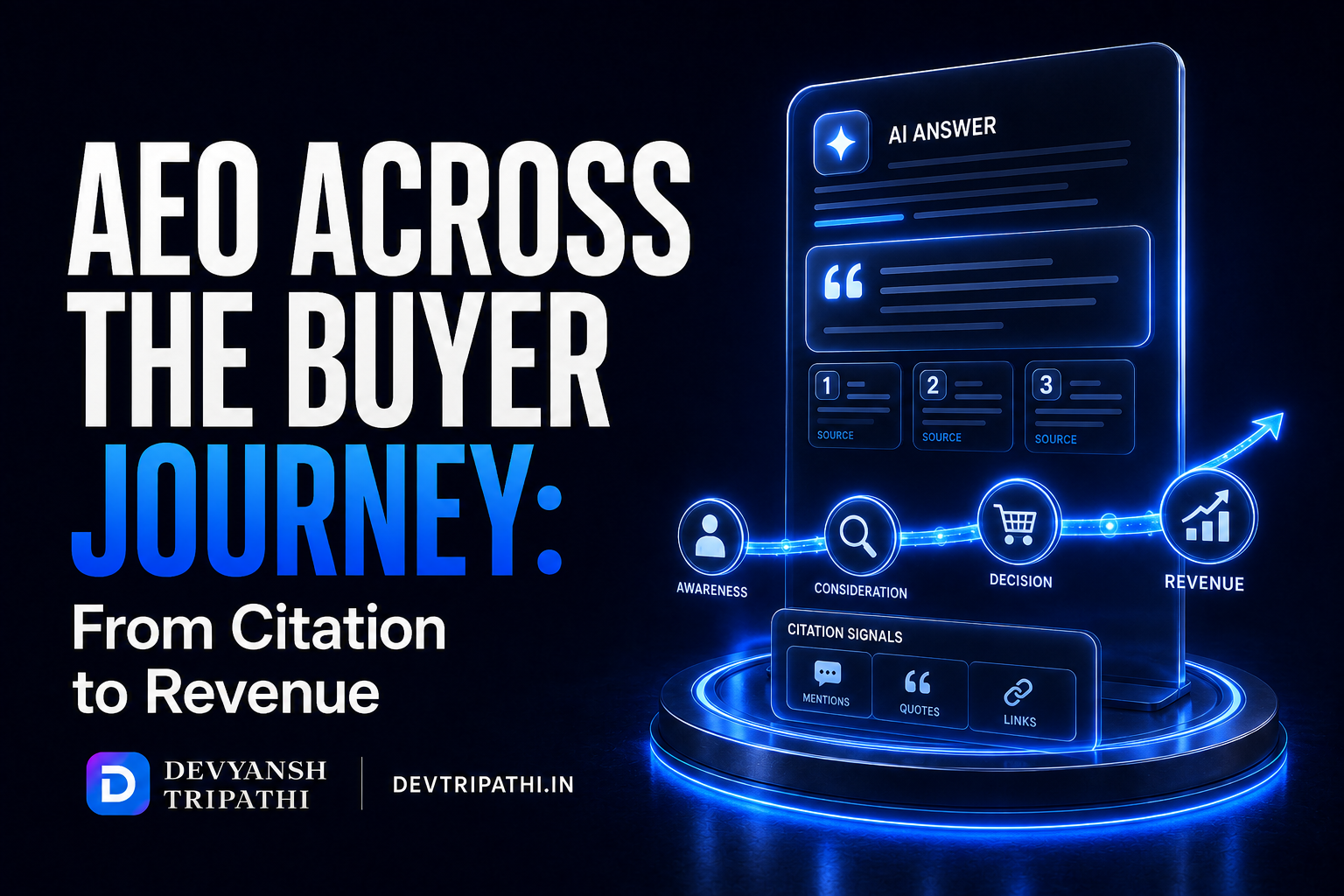
Most AEO strategies target awareness-stage informational queries. The more commercially significant AEO opportunity is mapping citation strategy across the full buyer journey, from awareness through evaluation to decision.
According to AirOps research, answer engines now handle a growing share of early and mid-stage research. Buyers can form preferences before they ever reach your site. AEO directly impacts revenue by influencing these early and mid-stage research interactions.
Map your AEO content to three buyer journey stages:
Awareness stage: Queries like “what is [category]” and “how does [category] work.” These are definitional and educational. Optimize with comprehensive pillar content, direct answer blocks, and high E-E-A-T signals. Citations here build brand familiarity before the buyer starts evaluating options.
Evaluation stage: Queries like “[your brand] vs [competitor],” “best [category] for [use case],” and “[category] alternatives.” These are comparison and selection queries. Optimize with structured comparison tables, clear recommendation criteria, and evidence-backed positioning. Citations here directly influence purchase consideration.
Decision stage: Queries like “[your brand] review,” “is [your brand] worth it,” and “[your brand] pricing.” These are high-intent queries occurring immediately before purchase. Optimize with specific proof points, verified customer outcomes, and transparent pricing information. Citations here influence the final conversion decision.
Build dedicated, updated pages for each buyer journey stage within each product or service cluster. Each page should have AEO-optimized structure (answer block, schema, expert quotes, statistics) tailored to the specific query intent at that buyer stage.
Strategy 3: Local AEO Page Strategy
Local AEO is one of the highest-opportunity areas in answer engine optimization in 2026, and one of the most underutilized.
According to AirOps research, conversions from AI tools saw a notable surge following the launch of additional local pages. Creating location-specific content with direct answer blocks and LocalBusiness schema not only improves local search rankings but directly increases AI citation rates for geographic queries.
For each service area your brand operates in, create a dedicated local AEO page that includes:
A direct answer to the most common local intent query for your service: “What is the best [service] in [city]?” answered with a direct 40 to 60 word response naming your brand and its key differentiators.
Location-specific details: the service area name, specific local context, and localized social proof.
LocalBusiness JSON-LD schema with consistent Name, Address, Phone, and service area data.
A FAQ section addressing the top local intent questions for your service area.
Consistent NAP information matching your Google Business Profile exactly.
Local AEO pages create citation eligibility for the geographic queries that are among the highest commercial-intent AI search interactions.
For the complete local voice and AI search strategy, see: Voice Engine Optimization (VEO): The Complete Guide at https://devtripathi.in/blogs/voice-engine-optimization-veo-complete-guide/
Strategy 4: Revenue Attribution from AI Platforms
AEO can directly impact revenue. Moving AEO strategy from a visibility discipline to a revenue discipline requires connecting AI citations to conversion outcomes.
The revenue attribution framework for AEO:
Step 1 — GA4 AI channel setup: Create a custom channel group in Google Analytics 4 that captures sessions from all AI platform referrers: chatgpt.com, perplexity.ai, bing.com (for Copilot), gemini.google.com, and any other AI referrers appearing in your acquisition data.
Step 2 — Conversion tracking per AI channel: Configure conversion events in GA4 that track the specific actions that indicate commercial intent: form submissions, demo requests, pricing page visits, and checkout initiations. Monitor conversion rates from AI-referred sessions separately from standard organic sessions.
Step 3 — Revenue per AI platform: For e-commerce or subscription businesses, track revenue directly attributed to AI-referred sessions. AI-referred visitors convert at 4.4 times higher rates than standard organic traffic according to GetReviewFast research, making AI-referred revenue per session significantly higher than the organic channel average.
Step 4 — Page-level citation to conversion mapping: Track which specific pages are generating AI-referred sessions. Correlate citation frequency (measured through AI visibility tools) with conversion outcomes. Identify your highest-value citation pages and prioritize their freshness updates accordingly.
Strategy 5: The Technical AEO Audit — 5 Commonly Missed Blockers
Many AEO optimization efforts fail not because of content quality issues but because of technical blockers preventing AI systems from accessing or processing the content at all.
Blocker 1 — AI crawler blocks in robots.txt: Cloudflare recently changed its default configuration to block AI bots. If you use Cloudflare (which powers approximately 20% of all websites), your AI bot traffic may have been shut off automatically. Check your server logs for blocked AI crawlers and update your robots.txt to explicitly allow GPTBot, PerplexityBot, ClaudeBot, and Google-Extended.
Blocker 2 — JavaScript-rendered content: AI engines often have timeout limits when fetching live web data. If your page requires JavaScript to hydrate the main content, the AI may time out before the answer content is rendered. Ensure your critical answer content is available in the initial HTML payload, not injected via JavaScript after page load.
Blocker 3 — Slow page load speed: Pages with LCP above 4 seconds are deprioritized in AI retrieval because slow pages signal lower quality content. Run Google PageSpeed Insights on your top 10 AEO pages and fix any LCP failures that could cause retrieval timeouts.
Blocker 4 — Schema markup errors: Invalid or incomplete schema markup reduces AI extraction confidence. Use Google’s Rich Results Test to validate FAQPage, Article, and ItemList schema on all key AEO pages. Fix all errors and warnings before attributing any AEO underperformance to content quality.
Blocker 5 — Missing Bing indexing: ChatGPT Search and Microsoft Copilot depend on Bing. Verify your key AEO pages are indexed in Bing Webmaster Tools. Submit your sitemap to Bing if it has not been submitted previously.
Strategy 6: The Hard Fact Bundle Approach
Research consistently shows that AI models treat specificity as a trust signal. Replace vague claims with precisely quantified outcomes. Instead of “Our approach helped clients grow,” write “Our approach resulted in a 42.3% increase in monthly lead velocity for a Series B SaaS client over 90 days.”
Build what content strategists are calling Hard Fact Bundles: tightly grouped, specifically quantified claim-evidence-source units within your content. Each bundle contains:
A specific, quantified claim: “42.3% increase”
A context qualifier: “for a Series B SaaS client”
A timeframe: “over 90 days”
A methodology note: “using GEO-optimized content cluster restructuring”
AI models extract and cite Hard Fact Bundles at significantly higher rates than vague performance claims because they provide the verifiable, specific data that AI systems need to cite a claim with confidence.
Build three to five Hard Fact Bundles into every major article and every case study on your website. Use real data from your own client work or industry research you can attribute precisely.
AEO Measurement: Moving Beyond Impressions to Revenue
The strongest AEO programs in 2026 measure four levels of performance simultaneously:
Visibility level: AI citation frequency across ChatGPT, Perplexity, Google AI Mode, and Gemini for target queries. Measured weekly using Otterly.AI, Profound, or manual testing.
Traffic level: AI-referred sessions in GA4 by source (chatgpt.com, perplexity.ai, bing.com). Measured monthly. Track session volume, page depth, and time on site to assess traffic quality.
Engagement level: Conversion rates from AI-referred sessions versus standard organic sessions. Track form submissions, demo requests, and checkout actions. AI-referred visitors consistently show 60% higher time-on-page and 35% better conversion rates according to Otterly research.
Revenue level: Revenue attributed to AI-referred sessions in GA4 or your CRM. For B2B, track which deals have AI-referred attribution in their first-touch or multi-touch conversion path. The 2026 AEO and GEO Benchmarks Report from Conductor confirmed that having data-driven KPIs for both SEO and AEO enables teams to measure total search visibility and adapt strategies to account for zero-click citations alongside traditional click-through traffic.
Frequently Asked Questions About Advanced AEO Strategy
What is content freshness in AEO and how often should I update pages?
Content freshness in AEO refers to how recently a page was substantively updated with new data, statistics, or findings. Answer engines have a strong recency bias: from real-world citation data, content more than 3 months old sees AI citations drop sharply. For high-priority AEO pages covering commercial and evaluation-stage queries, schedule quarterly reviews as a minimum. For high-velocity topics like AI search and algorithm updates, monthly reviews maintain competitive citation eligibility.
Why is the overlap between Google rankings and AI citations shrinking?
Research from Brandlight found the overlap between top Google results and AI-cited sources dropped from 70% to below 20% between 2024 and 2026. AI systems are increasingly developing independent citation preferences that favor content with specific structural signals (answer blocks, schema markup, expert quotes, Hard Fact Bundles, and content freshness) rather than simply mirroring Google’s organic rankings. This creates both a risk (strong Google rankings no longer guarantee AI citations) and an opportunity (brands that invest in AEO-specific optimization can earn AI citations even from lower Google ranking positions).
What are Hard Fact Bundles and why do they improve AEO?
Hard Fact Bundles are tightly grouped, specifically quantified claim-evidence-source units within your content. A Hard Fact Bundle includes a precise numeric claim (“42.3% increase”), a context qualifier (“for a Series B SaaS client”), a timeframe (“over 90 days”), and a methodology note. AI models treat specificity as a trust signal and extract Hard Fact Bundles at significantly higher rates than vague performance claims. Building three to five Hard Fact Bundles into every major article directly improves AI citation probability.
How do I track revenue from AEO and AI citations?
Set up a GA4 custom channel group capturing sessions from AI platform domains (chatgpt.com, perplexity.ai, bing.com, gemini.google.com). Configure conversion events for your commercial actions (form submissions, demo requests, checkout initiations). Monitor conversion rates and revenue per session from the AI channel versus standard organic. For B2B brands, track AI channel attribution in your CRM first-touch and multi-touch conversion paths. AI-referred visitors convert at 4.4 times higher rates than standard organic visitors, making revenue attribution from this channel commercially significant.
What are the most common technical AEO blockers?
The five most common technical AEO blockers are: (1) AI crawlers blocked in robots.txt (Cloudflare users are particularly at risk after a default configuration change); (2) JavaScript-rendered content that is not available in the initial HTML payload, causing AI retrieval timeouts; (3) slow page load speed with LCP above 4 seconds; (4) schema markup errors in FAQPage, Article, or ItemList structured data; and (5) missing Bing indexing for pages that need to be cited by ChatGPT Search and Microsoft Copilot.
What makes local AEO different from standard AEO?
Local AEO targets geographic queries with high commercial intent: “best [service] in [city],” “top [service provider] near me,” and “[service] [city]” queries. These queries generate AI-cited responses that directly influence purchase decisions for local services. Local AEO requires dedicated location-specific pages with LocalBusiness schema, consistent NAP data, geographic content context, and local FAQ sections addressing common questions about the service in that specific location. According to AirOps research, clients saw a notable surge in AI-driven conversions following the launch of additional local AEO pages.
How do buyer journey stages affect AEO content strategy?
Different buyer journey stages generate different query patterns in AI search. Awareness-stage queries are definitional (“what is GEO”). Evaluation-stage queries are comparative (“best GEO agency for SaaS”). Decision-stage queries are brand-specific (“devtripathi.in reviews”). Each stage requires different AEO content structure: awareness content needs comprehensive depth and E-E-A-T signals; evaluation content needs structured comparison data and clear recommendation criteria; decision content needs specific proof points and transparent pricing. Building dedicated, well-optimized pages for each buyer journey stage maximizes AI citation coverage across the full purchase funnel.
Is AEO worth investing in for small businesses with limited resources?
Yes. AEO often provides faster returns for small businesses than traditional competitive keyword SEO because the citation quality signals (answer blocks, schema markup, freshness) are within reach regardless of domain authority. According to AirOps research, AI engines surface answers based on consensus and content clarity, not solely on traditional search rankings. Small businesses with genuine expertise and well-structured content can earn AI citations for competitive queries even from mid-page Google ranking positions. The highest-ROI starting point for resource-constrained teams is: implement FAQPage schema and answer blocks on the five most commercially important pages, and establish a quarterly freshness update cycle.
What is the AEO Benchmarks Report and what does it show?
The 2026 AEO and GEO Benchmarks Report from Conductor is the most comprehensive published research on AEO performance measurement to date. Its key finding for SEO professionals: digital teams that develop data-driven KPIs for both SEO and AEO can measure their total search visibility and adapt strategies to account for zero-click citations and AI mentions alongside traditional rankings and click-through traffic. The report provides benchmark data for AI citation rates, AI-referred traffic growth, and conversion performance across industries, offering a competitive reference for evaluating AEO program performance.
How does AEO relate to conversion rate optimization (CRO)?
AEO influences conversion outcomes before a user visits your website by shaping the AI-generated answer they receive during their research. If a potential customer’s first encounter with your brand is a well-framed citation in a ChatGPT response that clearly communicates your value proposition, they arrive at your website with a higher-quality initial impression than a user who clicked a standard blue link. This pre-visit brand shaping function means AEO and CRO work together: AEO influences the quality of the visitor before they arrive, CRO converts them once they do. Optimizing both in coordination produces compounding conversion efficiency improvements.
Conclusion
Advanced AEO in 2026 is an operational discipline, not a content checklist. The brands earning growing AI-referred revenue are running freshness programs, mapping citation strategy to buyer journey stages, tracking conversion attribution from AI channels in GA4, expanding local AEO pages for geographic queries, and auditing technical blockers that prevent AI retrieval systems from accessing their content.
The gap between basic AEO implementation (which is now becoming table stakes in competitive niches) and advanced operational AEO is where the meaningful competitive advantages are being built.
Start by auditing your robots.txt for AI crawler blocks. Fix that first since it is the single most common blocker preventing even excellent AEO content from being accessed. Then run a content freshness audit across your top 10 commercial pages and identify which ones are older than 90 days without updates. Build a quarterly freshness calendar. Set up your GA4 AI channel group to begin tracking revenue attribution.
These four actions alone will meaningfully advance your AEO program in the next 30 days.
AirOps — AEO Guide and Research: https://www.airops.com/blog/aeo-answer-engine-optimization
Conductor — AEO and GEO Benchmarks Report: https://conductor.com
Brandlight — AI Citation Overlap Research: https://brandlight.org
Google Rich Results Test: https://search.google.com/test/rich-results
Bing Webmaster Tools — Sitemap Submission: https://www.bing.com/webmasters

Devyansh Tripathi
I’m Devyansh Tripathi, an SEO strategist and digital growth expert, helps businesses and individuals rank higher and drive organic traffic. Through DevTripathi., he shares cutting-edge SEO insights, content strategies, and marketing hacks. Passionate about digital success, he’s on a mission to make SEO simple, effective, and result-driven!
Posts
- What Google’s New AI Search Documentation Means for SEO Teams
- Google I/O 2026 Search: AI Agents, Gemini 3.5 and the Unified Box
- Google’s AI Optimization Guide: The Technical and Content Checklist
- July 2026 SEO Update: AI Overviews, llms.txt and Search Console
- Prompt Optimization Beyond Page One: The Position-21 Citation Opportunity
Categories
- AI Citation Optimization
- AI Search Optimization (AISEO)
- AI Visibility Tracking
- Answer Engine Optimization (AEO)
- Brand Authority SEO
- Brand SERP Optimization
- Community Signal SEO
- Conversational Search Optimization
- Generative Engine Optimization (GEO)
- Knowledge Graph Optimization
- Modern SEO Strategies
- Multimodal Search Optimization
- Prompt Optimization
- SEO Trends
- Social Search Optimization
- Topical Authority SEO
- Uncategorized
- Video Search SEO
- Visual Search Optimization
- Voice Engine Optimization (VEO)
- Zero Click Search Optimization
Latest News
Text Widget
Empowering brands with insights, strategies, and stories that drive digital growth.