Multi-Platform AISEO: Technical SEO, Content and Off-Site Authority
07 June 2026
For SEO professionals, this is no longer a channel to monitor. It is a channel to optimize for right now.
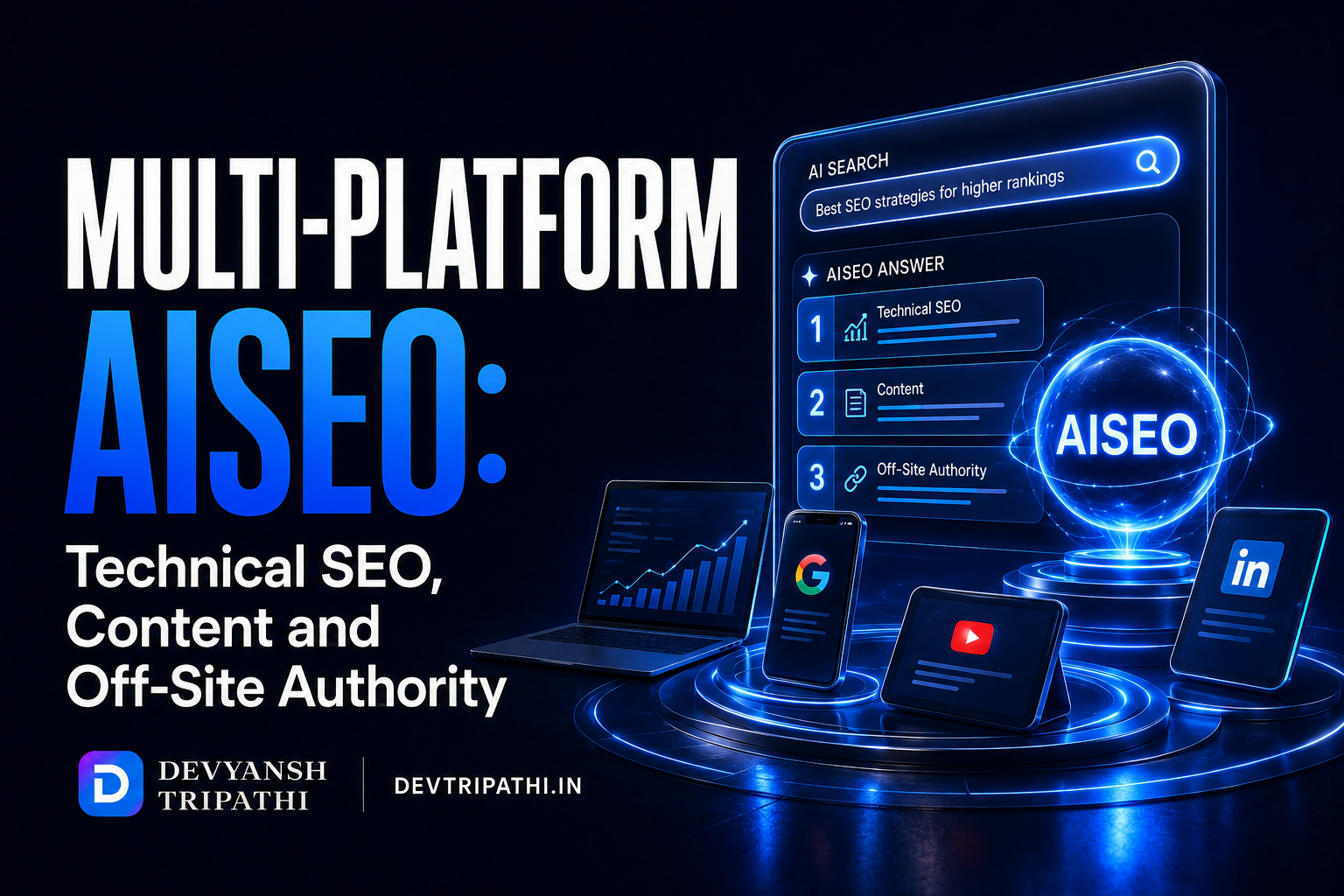
AI Search Optimization (AISEO) is the unified discipline that makes your content discoverable, extractable, and citable across every AI-powered search platform simultaneously. It combines the technical foundation of traditional SEO with the content structure of AEO, the citation authority of GEO, and the entity clarity of Knowledge Graph optimization into one coordinated strategy.
This guide covers the complete 2026 AISEO framework: the latest data on AI search growth, the specific ranking and citation mechanisms across each major platform, the content and technical requirements, and the action plan to start building compounding AI search visibility this week.
Ranking and being cited are two different outcomes requiring two different optimization approaches. SEO handles the first. AISEO handles both.
AI Mode queries have a 93% zero-click rate, making AI citation presence a brand visibility play, not only a traffic strategy.
ChatGPT Search primarily cites pages ranking at position 21 and above in approximately 90% of cases, meaning it often surfaces different pages than Google’s top 10. AISEO requires platform-specific strategy, not a one-size-fits-all approach.
AI Overviews reduce organic clicks on the top result by an average of 34.5%, making AI Overview citation simultaneously a threat to traditional clicks and an opportunity for brand exposure.
52% of AI Overview citations come from URLs already in the top 10 organic positions, confirming that SEO remains the prerequisite for AISEO success.
Google has officially confirmed that AEO and GEO are extensions of SEO, not separate disciplines, through its May 2026 AI Optimization Guide.
The brands building systematic AISEO programs now will compound citation authority in the same way that early domain authority investments compounded in traditional SEO.
[CTA — Beginning]
Is your content visible in AI-generated answers? Get a free AISEO audit at devtripathi.in/contact/ and find out exactly where your brand appears, and where it does not.
What Is AI Search Optimization (AISEO)?
AI Search Optimization is the practice of making your content discoverable, extractable, and citable by AI-powered search engines and answer systems across every major platform.
Traditional SEO optimizes for position in a ranked list of results. AISEO optimizes for inclusion in a synthesized AI-generated answer. These are meaningfully different goals. A page can rank first on Google and still have zero presence in ChatGPT, Perplexity, or Gemini responses for the same query.
The cleanest way to understand the relationship between all related disciplines is this: SEO makes you findable, AEO makes you extractable, GEO makes you citable, and AISEO coordinates all three as one unified operational strategy applied across every AI platform where your audience now searches.
The 2026 AI Search Landscape: Numbers That Demand Urgency
Understanding the current scale of AI search is essential context for every strategy decision that follows.
US AI search ad spending is projected to reach $2.08 billion in 2026, representing 1.3% of total search ad spending, growing to $25.93 billion by 2029 at 13.6%.
Zero-click searches have risen to 60 to 83% depending on whether AI Overviews are present. Traditional queries without AI features average around 60% zero-click rates. When AI Overviews are present, the zero-click rate reportedly climbs to 83%. AI Mode queries show an even more extreme 93% zero-click rate.
By 2026, SEO will no longer be defined by position on a results page. It will be defined by presence within AI-generated answers and citations. The search bar will not simply retrieve information. It will interpret, evaluate and influence decisions.
AI search engines do not just rank pages. They evaluate concepts, entities, relationships, expertise, and credibility. That means brands must evolve beyond simplistic keyword strategies and start building true digital authority ecosystems.
These numbers mean one thing: optimizing exclusively for traditional click-through traffic while ignoring AI citation presence leaves an expanding majority of search interactions unaddressed.
How AI Search Platforms Work: The Mechanisms You Must Understand
Before optimizing for any AI platform, you must understand how each one selects its sources. The mechanisms differ significantly and require genuinely different optimization approaches.
Retrieval-Augmented Generation (RAG)
All major AI search platforms use RAG: a two-stage process where the system first retrieves relevant documents from an index, then generates a synthesized response from those documents. Traditional SEO ranking determines retrieval eligibility. Content structure, entity authority, and freshness determine citation selection.
Query Fan-Out
When a user submits a complex query, AI systems decompose it into multiple concurrent sub-queries. Google’s official documentation confirms this: a query about “how to fix a lawn full of weeds” generates sub-queries including “best herbicides for lawns,” “remove weeds without chemicals,” and “how to prevent weeds in lawn.” Content covering the full semantic scope of a topic cluster matches more sub-queries and earns more citations than narrow single-keyword pages.
How Each Platform Selects Citations Differently
| Platform | Primary Index | Top Citation Signal | Key On-Site Requirement |
|---|---|---|---|
| Google AI Overviews | Google index | Top-20 organic ranking | Answer block in first 150 words plus FAQPage schema |
| ChatGPT Search | Google index plus training data | Entity authority, Wikipedia presence | Long-form comprehensive guides, schema markup |
| Perplexity | Own crawler plus Google | Content freshness, multi-source authority | Regular updates, third-party brand mentions |
| Gemini | Google index, multimodal | Google ecosystem signals, video transcripts | YouTube presence, Google Business Profile, structured data |
| Microsoft Copilot | Bing index, LinkedIn | Bing indexing, LinkedIn Company Page | Professional authority content, Bing sitemap submission |
| Claude | Brave Search | Content depth, logical structure | Comprehensive guides, clear entity signals |
The AISEO Technical Foundation: 5 Non-Negotiable Requirements
Before any content optimization can produce results, these five technical requirements must be verified and corrected.
Multi-Index Verification
Verify your content is indexed in both Google Search Console and Bing Webmaster Tools. ChatGPT Search primarily cites pages ranking at position 21 and above, often surfacing different pages than Google’s top 10. This means Bing indexing is a non-negotiable AISEO requirement. Submit your XML sitemap to Bing Webmaster Tools if you have not already done so.
AI Crawler Access in robots.txt
Review your robots.txt file to ensure you are not accidentally blocking AI crawlers. The crawlers to explicitly allow: Googlebot, Bingbot, GPTBot (ChatGPT), PerplexityBot, ClaudeBot, and Google-Extended (Gemini training data). Cloudflare changed its default configuration in 2025 to block AI bots, meaning any site running Cloudflare should verify its crawler access settings manually.
Core Web Vitals Compliance
Pages that rank for voice search load 52% faster than average search results. The same performance signals that feed voice search eligibility feed AI retrieval priority. Target LCP under 2.5 seconds, INP under 200 milliseconds, and CLS under 0.1 across all priority pages.
Schema Markup Stack
Deploy Article, FAQPage, and ItemList schema as interconnected JSON-LD on every priority page. Google’s own AI Optimization Guide confirms that content structure and schema help AI systems understand what your content is and how it should be used in response generation.
JavaScript Rendering
Critical answer content must be available in the initial HTML payload, not injected via JavaScript after page load. AI retrieval systems may not execute JavaScript before evaluating page content, meaning JavaScript-rendered content is effectively invisible to citation systems regardless of how well it ranks in traditional search.
The AISEO Content Strategy: 6 Proven Tactics
With the technical foundation in place, these six content tactics determine whether retrieved pages are selected for citation.
Tactic 1: Answer-First Structure in Every Section
In 2026, the most effective SEO and AEO strategies are built around search intent: understanding not just what someone typed, but what they were actually trying to accomplish.
Place a direct, self-contained answer to the primary query within the first 150 words of every page. At the section level, the first 1 to 2 sentences after every H2 or H3 heading must directly answer the question posed by that heading. AI systems extract the opening of each section to evaluate relevance. Sections that open with context-building prose rather than direct answers are passed over for sections that lead with the answer.
Tactic 2: Question-Format Headers Matching Real Sub-Queries
Rewrite H2 and H3 headings as natural language questions that mirror the sub-queries AI systems generate through fan-out. Use Google Search Console query data to identify the exact conversational questions real users are asking, then make those questions your headers. A header reading “What Is AISEO?” matches AI sub-queries far more precisely than a header reading “AISEO Overview.”
Tactic 3: Expert Quotes With Full Attribution
According to Princeton University’s GEO research published at KDD 2024, adding expert quotes to content boosts AI visibility by approximately 41%, making it the single highest-impact on-page content tactic tested across 10,000 queries. Include 2 to 3 quotes per major article from recognized experts with their full name, title, and organization clearly stated.
Tactic 4: Specific Statistics With Source Attribution
Adding statistics with specific data boosts AI visibility by approximately 30% according to Princeton research. Statements with specific numbers are far more likely to be cited than vague performance claims. Include 3 to 5 statistics per major article, each attributed to a named source.
Tactic 5: Non-Commodity Content With Original Insight
Google’s official AI Optimization Guide, published May 19, 2026, explicitly identifies this as the most important long-term factor for generative AI search performance. Content that “could easily be produced by a generative AI model” will not be cited by a generative AI model. Add original case data, first-hand professional experience, proprietary research, or unique expert analysis that no competitor or AI system can replicate.
Tactic 6: Comprehensive FAQ Sections With Schema
Include a minimum of 10 real user questions per article, sourced from People Also Ask, Search Console data, Reddit, Quora, and AI platform query testing. Apply FAQPage JSON-LD schema to every FAQ section. Each entry must have a direct, standalone 40 to 60 word answer that makes complete sense in isolation.
AISEO Off-Site Authority: The 95.7% Most Brands Miss
Research from Profound’s analysis of 27 million citations found that owned content (your own website) represents only 4.3% of citations on category-level queries. The remaining 95.7% comes from earned media, PR wire content, review platforms, community discussions, Wikipedia, and social profiles.
This means a brand that only optimizes its own website addresses 4.3% of the citation surface that AI systems evaluate. Build the off-site presence systematically:
Earned media in recognized industry publications provides both direct citation signals and the multi-source consensus that AI systems require before confidently recommending a brand.
Community presence on Reddit, Quora, and LinkedIn builds the training data recognition and consensus signals that feed AI citation confidence.
Review platform profiles on G2, Trustpilot, and Clutch contribute to entity corroboration that AI systems cross-reference when evaluating brand authority.
Press releases distributed through wire services begin generating AI citations approximately 14 to 21 days after publication and indexing.
Wikipedia or Wikidata entries provide structured entity data that AI systems including ChatGPT treat as the highest-confidence reference source for brand entity verification.
Measuring AISEO Performance
Traditional keyword ranking reports capture none of AISEO performance. Build a dedicated measurement framework covering all four layers.
AI Citation Frequency: Manually test your top 20 target queries in ChatGPT, Perplexity, Gemini, and Google AI Mode weekly. Record whether your brand appears, whether the citation is linked or unlinked, and your position within the response.
Share of Model (SoM): Compare your citation frequency against top competitors for the same query set. This competitive benchmark shows whether your AISEO efforts are gaining ground in relative terms, not just absolute citation counts.
AI-Referred Traffic in GA4: Create a custom channel group capturing sessions from AI platform domains including chatgpt.com, perplexity.ai, and bing.com. Monitor this channel monthly. Quantifying AI-driven traffic and citation tracking is essential because without measurable AI-driven traffic, organisations cannot connect AI search optimisation efforts to marketing ROI.
Branded Search Volume in Google Search Console: Track month-over-month growth in branded queries. AI citations drive branded search as users encounter your brand in AI answers and subsequently search for your brand name directly on Google.
[CTA — Middle]
Download the free AISEO Implementation Checklist at devtripathi.in/resources/ and start auditing your AI search visibility against every requirement in this guide.
Your AISEO Action Plan: Week by Week
Week 1: Technical Audit
Verify Google and Bing indexing for all priority pages. Check robots.txt for AI crawler access. Run Core Web Vitals audit. Validate schema markup using Google’s Rich Results Test. Test key pages with JavaScript disabled to verify content availability.
Weeks 2 to 4: Content Optimization
Add direct answer blocks in the first 150 words of your top 10 articles. Rewrite H2 and H3 headers as questions. Add expert quotes with full attribution to all major articles. Deploy Article, FAQPage, and ItemList JSON-LD schema. Expand FAQ sections to 10 entries minimum per article.
Month 2: Off-Site Authority
Identify 5 to 10 target publications for digital PR outreach. Build or complete your Wikidata entity entry. Initiate Reddit and Quora community presence. Distribute one press release through wire services. Complete all review platform profiles.
Month 3 and Ongoing: Measure and Iterate
Run weekly AI citation audits. Monitor AI-referred traffic in GA4 monthly. Track Share of Model versus top competitors. Identify queries where competitors are cited but you are not. Create targeted content to close those gaps.
Frequently Asked Questions About AISEO
What is AI Search Optimization (AISEO)?
AI Search Optimization is the unified practice of making your content discoverable, extractable, and citable by AI-powered search platforms including ChatGPT, Perplexity, Google AI Overviews, Gemini, and Copilot. It combines traditional SEO (for retrieval eligibility), AEO (for answer extraction), and GEO (for citation authority) into one coordinated strategy applied across every AI search platform where your audience currently searches.
Is AISEO replacing traditional SEO?
No. AISEO extends traditional SEO rather than replacing it. Google’s official AI Optimization Guide confirmed in May 2026 that generative AI features use RAG to retrieve pages from the core Search index. This means traditional SEO ranking is the prerequisite for AI search retrieval. Strong SEO is the foundation on which AISEO optimization is built.
Why does Bing indexing matter for AISEO?
ChatGPT Search and Microsoft Copilot both use Bing as their primary web retrieval source. A page that is indexed in Google but not in Bing is completely invisible to ChatGPT and Copilot regardless of its Google ranking or content quality. Submitting your sitemap to Bing Webmaster Tools is one of the highest-ROI technical AISEO actions available.
What is the zero-click rate for AI Mode?
AI Mode queries show a 93% zero-click rate, meaning 93 out of every 100 AI Mode interactions end without the user visiting any external website. This makes AI Mode citation a brand visibility play in addition to a traffic strategy. The brand impression from an AI citation influences brand recall and future branded search behavior even when no click occurs.
How long does AISEO take to produce results?
New content typically enters AI citation pools within 3 to 5 business days of indexing. On-page optimization changes (answer blocks, schema, expert quotes) typically show citation rate improvements within 30 to 60 days of the updated content being re-indexed. Off-site authority building from digital PR and community presence typically takes 60 to 120 days to materially affect citation rates. Plan for a 90-day horizon when evaluating full AISEO program results.
What is the most commonly missed AISEO technical issue?
AI crawler blocking in robots.txt is the single most commonly missed technical issue. Many SEO teams verify Googlebot access but do not check for GPTBot, PerplexityBot, or ClaudeBot access. Sites using Cloudflare should verify AI crawler access specifically, as Cloudflare’s default configuration changed to block AI bots in 2025 without necessarily notifying site owners.
What content format performs best for AISEO?
Research from GenOptima found that 74.2% of all AI citations come from structured listicle-format content. For commercial and comparison queries, listicle pages with H3 subheadings per item and a comparison table near the top perform best. For informational queries, comprehensive pillar guides with answer-first section structure, expert quotes, and FAQ sections perform best. For local and service queries, dedicated location-specific pages with LocalBusiness schema perform best.
How do I measure AISEO results?
Measure AISEO performance across four layers: AI citation frequency (manual testing weekly in ChatGPT, Perplexity, Gemini, and Google AI Mode), Share of Model versus competitors (using tools like Otterly.AI, Profound, or AthenaHQ), AI-referred traffic in GA4 (custom channel group capturing AI platform referrers), and branded search volume growth in Google Search Console (as a downstream indicator of AI citation activity).
Can small websites compete with large brands in AI search?
Yes. Princeton University research found that pages ranked fifth in traditional search saw a 115.1% visibility increase in AI responses when proper GEO signals were added. AI systems evaluate content structure, entity clarity, and citation-worthy specificity rather than only domain authority. A small website with genuinely non-commodity content, proper schema markup, and multi-source brand mentions can earn AI citations that outperform larger competitors with better Google rankings but weaker content structure.
What is the most important first step in AISEO?
Run a manual citation audit. Submit your top 10 target queries in ChatGPT, Perplexity, and Google AI Mode. Record whether your brand appears, which competitors appear, and what format of content is being cited. This baseline establishes your current Share of Model, identifies your highest-priority citation gaps, and creates the comparative reference against which all future AISEO optimization will be measured.
Conclusion
AI search is no longer a future consideration. Google AI Mode has one billion monthly users. AI search traffic is growing at 394% year over year. The platforms processing these queries are selecting sources based on content structure, entity authority, and genuine expertise, not only keyword rankings.
The AISEO framework makes this navigable. Verify your technical foundation across both Google and Bing indexes. Structure every piece of content with answer-first sections and question-format headers. Add expert quotes and specific statistics to every major article. Deploy schema markup systematically. Build off-site brand authority across the platforms AI systems cross-reference.
The brands that build this discipline into their marketing operations now will earn compounding AI citation authority as the channel continues to grow. AI search is becoming less like a library catalog and more like talking to an intelligent assistant. The brands that intelligent assistants recommend first are the ones that have done the work to become genuinely, demonstrably, verifiably worth recommending.
Start with the citation audit this week. The competitive window is still open. The compounding begins with the first systematic step.
Google Official AI Optimization Guide: https://developers.google.com/search/docs/fundamentals/ai-optimization-guide
Princeton University GEO Research — KDD 2024: https://arxiv.org/abs/2311.09735
Bing Webmaster Tools: https://www.bing.com/webmasters
Google Search Console: https://search.google.com/search-console/
Profound — AI Citation Research: https://www.helloprofound.com
Answer Engine Optimization (AEO): The Complete Guide: https://devtripathi.in/blogs/answer-engine-optimization-aeo-complete-guide/
Generative Engine Optimization (GEO): Complete Strategy Guide: https://devtripathi.in/blogs/generative-engine-optimization-geo-strategy-guide/
Knowledge Graph Optimization: The Complete Guide: https://devtripathi.in/blogs/knowledge-graph-optimization-complete-guide/
AI Visibility Tracking: The Complete Guide: https://devtripathi.in/blogs/ai-visibility-tracking-complete-guide/
AI Citation Optimization: The Complete Guide: https://devtripathi.in/blogs/ai-citation-optimization-complete-guide/
[CTA — End]
Ready to build a complete AISEO strategy for your brand? Book a strategy session at devtripathi.in/contact/ and get a personalized AI search visibility roadmap built on the exact framework in this guide.

Devyansh Tripathi
I’m Devyansh Tripathi, an SEO strategist and digital growth expert, helps businesses and individuals rank higher and drive organic traffic. Through DevTripathi., he shares cutting-edge SEO insights, content strategies, and marketing hacks. Passionate about digital success, he’s on a mission to make SEO simple, effective, and result-driven!
Posts
- What Google’s New AI Search Documentation Means for SEO Teams
- Google I/O 2026 Search: AI Agents, Gemini 3.5 and the Unified Box
- Google’s AI Optimization Guide: The Technical and Content Checklist
- July 2026 SEO Update: AI Overviews, llms.txt and Search Console
- Prompt Optimization Beyond Page One: The Position-21 Citation Opportunity
Categories
- AI Citation Optimization
- AI Search Optimization (AISEO)
- AI Visibility Tracking
- Answer Engine Optimization (AEO)
- Brand Authority SEO
- Brand SERP Optimization
- Community Signal SEO
- Conversational Search Optimization
- Generative Engine Optimization (GEO)
- Knowledge Graph Optimization
- Modern SEO Strategies
- Multimodal Search Optimization
- Prompt Optimization
- SEO Trends
- Social Search Optimization
- Topical Authority SEO
- Uncategorized
- Video Search SEO
- Visual Search Optimization
- Voice Engine Optimization (VEO)
- Zero Click Search Optimization
Latest News
Text Widget
Empowering brands with insights, strategies, and stories that drive digital growth.