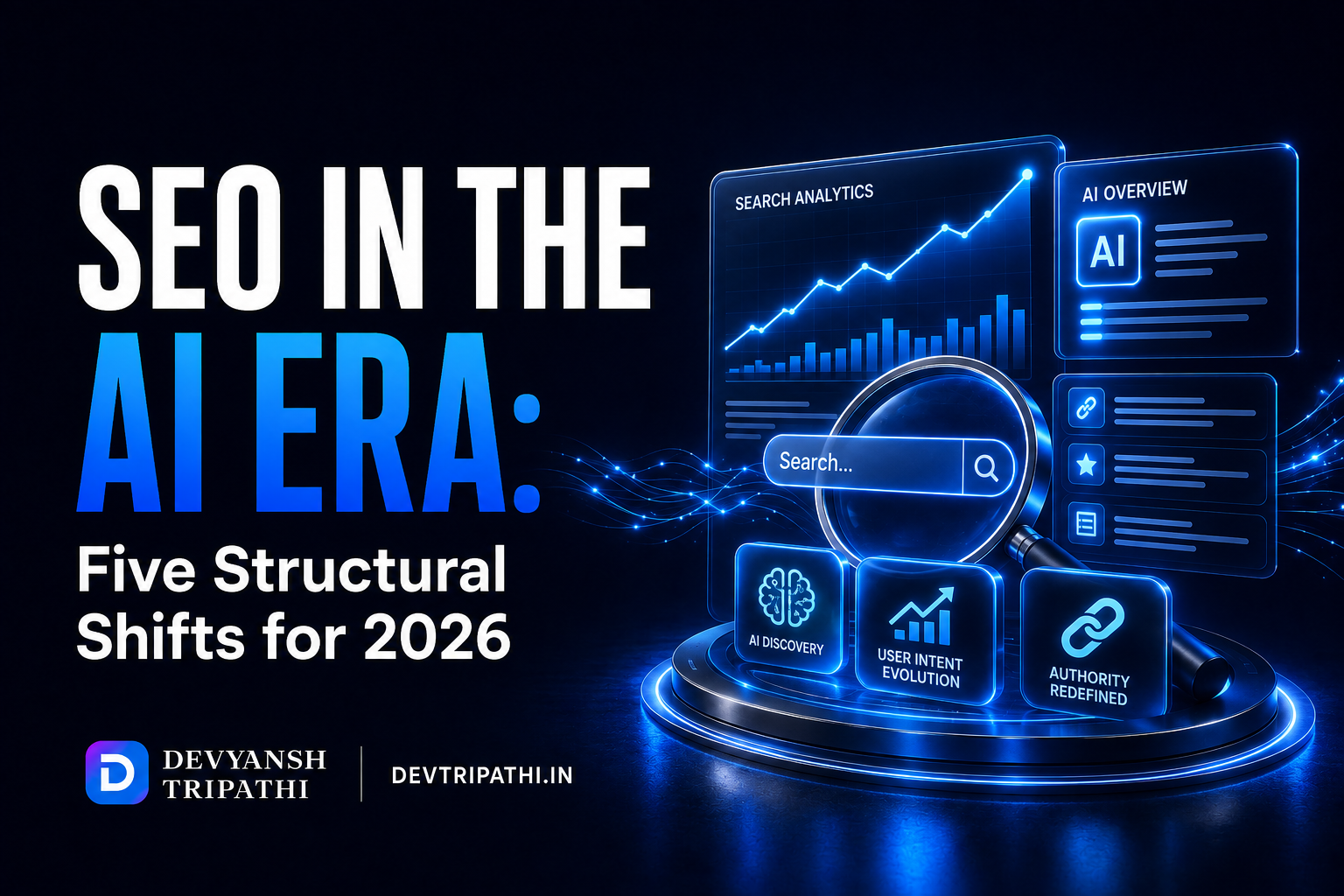
SEO in the AI Era: Five Structural Shifts for 2026
08 June 2026
The numbers confirm the urgency. AI Overviews reduce organic clicks on the top result by an average of 34.5%. AI Mode queries now show a 93% zero-click rate. Brand building becomes more important: websites with strong brand signals and presence on various platforms are demonstrably more resistant to Google updates. And yet Google still processes approximately 14 billion search queries daily, vastly more than any AI platform. Google processes 14 billion search queries daily, while ChatGPT only reaches 37.5 million, a ratio of 373:1 in Google’s favor.
This is not a moment to panic and abandon traditional SEO. It is a moment to extend it systematically into the AI search layer that is growing rapidly alongside the traditional layer.
This guide covers the most significant SEO trends of 2026, what the data shows about each, and the specific strategy adjustments that separate the brands gaining ground from the brands losing it.
AI Overviews are present in more than 55% of all Google searches, making AI Overview citation a mainstream visibility goal, not a niche optimization.
Google still processes 14 billion searches daily versus ChatGPT’s 37.5 million, confirming traditional SEO remains the largest single visibility channel.
Brand signals and presence across multiple platforms are now one of the strongest predictors of algorithm update resilience, according to multiple 2026 SEO research sources.
SEO becomes more holistic in 2026: successful search optimization requires integration of editorial, IT, UX, PR, and product management, not just a dedicated SEO team.
Successful search engine optimization in 2026 requires integration across departments. This is no longer a one-team job.
Google’s official AI Optimization Guide, published May 19, 2026, confirms that AEO and GEO are extensions of SEO, not replacements, and that traditional ranking remains the prerequisite for AI search retrieval.
The zero-click rate for AI Mode queries is 93%, meaning brand visibility in AI responses is now a primary goal alongside click-through traffic.
[CTA — Beginning]
Is your 2026 SEO strategy accounting for all the changes covered in this guide? Get a complete strategy audit at devtripathi.in/contact/ and find out exactly where your gaps are.
The State of SEO in 2026: What the Data Shows
Before diving into individual trends, it is worth grounding the full picture in current data.
Google still dominates. Google processes approximately 14 billion search queries daily. ChatGPT reaches 37.5 million. The ratio is 373:1. Traditional SEO remains the largest organic visibility channel by an enormous margin and will continue to be for the foreseeable future.
But AI search is capturing high-intent users. The users turning to ChatGPT, Perplexity, and AI Mode are often more research-oriented, further along in decision-making, and more likely to be in a commercial consideration mode than the average Google searcher. AI-referred visitors convert at 4.4 times higher rates than standard organic traffic according to research from GetReviewFast.
The combined picture: optimize for both. Traditional SEO for volume. AI search optimization for quality and conversion. The two reinforce each other because Google’s own AI features use traditional ranking as the retrieval prerequisite.
Trend 1: AI Overviews Have Become the Primary Information Layer for Informational Queries
AI Overviews now appear in more than 55% of all Google searches. When they are present, the zero-click rate for organic results climbs to 83%, and the top organic result sees a 34.5% average CTR drop.
This trend has two direct implications for SEO strategy.
The threat: informational content that previously generated steady organic traffic from position 1 through 5 is seeing traffic decline as AI Overviews satisfy the query directly on the results page without requiring a click.
The opportunity: brands cited inside AI Overviews reach users at the exact moment of intent formation, before a single competitor website is considered. A user whose research begins with an AI Overview mentioning your brand carries a different awareness level into any subsequent visit than a user who found you through a cold organic click.
The strategy: optimize for AI Overview citation rather than resisting the format. Add direct answer blocks in the first 150 words of every informational article. Deploy FAQPage and Article schema. Build the topical authority that makes your domain a systematic AI Overview source for your target topic cluster.
For the complete AI Overview optimization guide, see: Answer Engine Optimization (AEO): The Complete Guide for SEO Professionals at https://devtripathi.in/blogs/answer-engine-optimization-aeo-complete-guide/
Trend 2: Brand Authority Has Become the Most Algorithm-Resilient SEO Asset
Following the early 2026 Google algorithm updates, sites that relied solely on keyword matching and high-volume link building saw massive drops, while brands with real-world footprints surged. Google now uses AI-driven models to identify entities, and brands recognized by Google’s Knowledge Graph receive a trust buffer that means faster indexing and protection against minor algorithm fluctuations.
The evidence is direct: brand building becomes more important. Websites with strong brand signals and presence on various platforms are more resistant to Google updates.
The specific brand signals driving this resilience are branded search volume, unlinked brand mentions across authoritative platforms, Knowledge Graph entity recognition, review volume and sentiment, E-E-A-T author signals, and consistent NAP and entity data across all major reference platforms.
One of the strongest Google ranking brand signals is branded search volume. If users are searching for your brand name specifically rather than just a generic category term, Google registers this as a significant vote of confidence. Brands that run consistent content marketing, email newsletters, and thought leadership campaigns tend to see branded search volume grow in parallel with organic rankings.
This is not a soft, unmeasurable brand-building concept. Branded searches are tracked directly in Google Search Console. Unlinked brand mentions are tracked with monitoring tools. Knowledge Panel presence is observable in branded search results. All of these are measurable, improvable signals.
For the complete brand authority strategy, see: Brand Authority SEO: How to Build Brand Authority That Ranks and Gets Cited by AI at https://devtripathi.in/blogs/brand-authority-seo-complete-guide/
Trend 3: SEO Has Become a Cross-Departmental Discipline
One of the most practically significant trends in 2026 is organizational: successful search engine optimization in 2026 requires integration of editorial, IT, UX, PR, and product management teams.
This is not a philosophical observation. It reflects the specific technical and strategic requirements of modern SEO:
Editorial teams create the non-commodity content, expert authorship, and topical depth that E-E-A-T and AI citation require.
IT and development teams handle Core Web Vitals compliance, schema markup implementation, JavaScript rendering for AI crawlers, and multi-index verification.
UX teams build the page experience signals that determine whether users engage with content after clicking, influencing Google’s behavioral signals.
PR teams generate the earned media, wire-distributed press releases, and authoritative third-party mentions that feed brand authority and AI citation confidence.
Product teams manage the structured data for product listings, pricing, and availability that feeds Google Shopping, Google AI Overviews for commercial queries, and the agentic booking capabilities announced at Google I/O 2026.
For SEO professionals, this organizational reality means the discipline requires both technical depth and cross-departmental coordination skills. The most effective SEO teams in 2026 function as orchestrators of a broader visibility strategy rather than as isolated technical specialists.
Trend 4: Structured Data Has Moved From Nice-to-Have to Mission-Critical
Structured data has been around for a long time, but in 2026, it is a focal point. The reason is direct: schema markup is how AI systems read and extract content with machine precision rather than inferring it from prose.
Google’s official AI Optimization Guide confirms that structured data helps AI systems understand what content is about and how it should be used in AI response generation. Pages with properly implemented FAQPage, Article, and ItemList schema receive measurably more AI citations than pages with equivalent content but no schema markup.
The critical schema types for 2026 SEO performance are FAQPage (for question-answer extraction in AI Overviews and voice search), Article (for E-E-A-T verification), VideoObject (for video rich results and Gemini video analysis), LocalBusiness (for local AI search responses and Google Maps integration), Product (for commercial AI responses and Google Shopping visibility), and Organization or Person (for Knowledge Graph entity recognition with sameAs property linking all profiles).
Every page type should have its corresponding schema type implemented and validated in Google’s Rich Results Test before publishing.
For the complete schema implementation guide, see: Knowledge Graph Optimization: The Complete Guide at https://devtripathi.in/blogs/knowledge-graph-optimization-complete-guide/
Trend 5: Topical Authority Has Replaced Page-Level Keyword Optimization
Excellent SEO in 2026 no longer optimizes just for individual search queries but orchestrates the entire user experience along a three-dimensionally mapped customer journey, cross-channel, platform-aware, and thought far beyond Google.
The March 2026 Google Core Update reinforced that domain-level topical authority, demonstrated through comprehensive, interconnected content clusters, consistently outperforms isolated page-level keyword optimization. A site with 20 interconnected articles demonstrating comprehensive expertise in a specific subject area outranks a site with one strong isolated page on the same topic, even if that single page is technically superior in isolation.
This shift has three specific implications for content planning.
First, content gaps are now liabilities. If your site covers a topic broadly but misses important subtopics that competitors address, Google recognizes the gap and reduces confidence in your overall authority signal for that topic.
Second, internal linking is now an authority signal. Well-structured internal links between cluster pages communicate topical structure to Google’s systems. Systematic internal linking is infrastructure, not an afterthought.
Third, thin pages hurt the entire domain. Google’s Helpful Content System evaluates site-level helpfulness. A domain with many thin or unhelpful pages sees ranking suppression across its entire content library, including individually strong pages.
For the complete topical authority implementation guide, see: Topical Authority SEO: The Complete Guide at https://devtripathi.in/blogs/topical-authority-seo-complete-guide/
Trend 6: E-E-A-T Is Now Algorithmically Enforced, Not Just a Guideline
Google’s E-E-A-T framework (Experience, Expertise, Authoritativeness, Trustworthiness) was a quality rater guideline for years before becoming algorithmically evaluated through AI-based content quality systems. In 2026, it is fully enforced.
The specific requirement that has become most practically important is the Experience dimension. Google’s official AI Optimization Guide explicitly states that content should be “created yourself based on what you know about the topic” and that first-hand reviews “provide a unique perspective based on personal experience, whereas a summary of existing content simply restates information already available elsewhere.”
For SEO professionals, this means anonymous, unverified, expertise-claiming content is no longer competitively viable. Every published article needs a named, credentialed author with a linked bio page. Every article should contain language that reflects genuine first-hand experience rather than generic synthesis. And every article should link to authoritative external sources for specific claims.
E-E-A-T is cross-functional. Named, credentialed authors with verifiable profiles are among the most important E-E-A-T pages on any site. Include high-resolution photos, professional credentials, links to external portfolios, and a clear expertise statement. Google needs to know exactly who is standing behind the content.
Trend 7: Content Freshness Has Become a Continuous Competitive Signal
AI systems deprioritize stale content. Research from AirOps shows that for commercial and evaluation-stage queries, 83% of AI citations came from pages updated within the past 12 months, with more than 60% refreshed within the last six months. This is the most operationally significant data point for content teams in 2026.
Static content strategies, where articles are published once and left unchanged for years, are incompatible with AI citation performance. Content more than 3 months old sees AI citations drop sharply.
The sustainable approach is a systematic content freshness program: a calendar that assigns every high-value article a scheduled quarterly review, updates statistics and data points on each review cycle, adds new findings where available, and updates the visible “last updated” timestamp. For high-velocity topics, monthly reviews are appropriate. For evergreen comprehensive guides, quarterly reviews maintain competitive freshness.
This is not about rewriting articles. It is about maintaining the recency signals AI retrieval systems evaluate when selecting which sources to cite.
Trend 8: Local SEO and AI Search Are Converging
For businesses with any local or geographic dimension, the convergence of local SEO and AI search is the most commercially significant trend of 2026. Google’s AI Mode, Perplexity, and voice assistants are all increasingly delivering local commercial answers without requiring users to click through to a website.
The platforms delivering local AI answers draw from Google Business Profile data, structured LocalBusiness schema, NAP consistency across directories, review volume and sentiment, and location-specific page content. A business that has comprehensive, consistent, and current data across all of these sources is systematically preferred for local AI recommendations over a business with gaps or inconsistencies.
Agentic booking capabilities announced at Google I/O 2026 allow Google to surface pricing, availability, and direct booking links for local services within Search, and for select categories to call businesses on behalf of users. For local service businesses, the transition from “click-through traffic source” to “AI-recommended booking agent” is underway.
For the complete local AEO strategy, see: Voice Engine Optimization (VEO): The Complete Guide at https://devtripathi.in/blogs/voice-engine-optimization-veo-complete-guide/
SEO in 2026: What Has Stopped Working
Understanding what no longer works is as important as knowing what is gaining traction.
Generic listicles without original evaluation are being actively suppressed by Google’s Helpful Content System. The top 10 SEO tools articles with no testing criteria, no real opinions, and no data beyond what the tool vendors publish themselves are a liability.
AI-generated content without expert review is increasingly flagged by Google’s automated quality evaluation systems. AI-assisted content with human expert editing and original insight performs well. AI-only content published at scale damages domain authority.
High-volume low-quality link building carries active risk of spam penalties following the March 2026 core update and the spam update that preceded it. Link quality and contextual relevance have entirely replaced link volume as the relevant dimension.
Keyword-density optimization with no regard for user intent is penalized by modern semantic understanding systems. Pages optimized for a keyword but not for the actual intent behind that keyword are losing visibility regardless of technical optimization.
| What No Longer Works | What Works in 2026 |
|---|---|
| Keyword-density optimization | Intent-aligned topical cluster coverage |
| Generic listicles with no original perspective | Non-commodity content with first-hand expertise |
| AI-generated content without expert review | AI-assisted content with genuine human expertise layer |
| Link volume campaigns | Digital PR for niche-relevant high-authority citations |
| Page-level keyword targeting only | Domain-level topical authority architecture |
| Anonymous author content | Named, credentialed authors with verifiable E-E-A-T |
| Publishing and abandoning articles | Systematic content freshness with quarterly update cycles |
| Ignoring AI search as a separate channel | AISEO integrated with traditional SEO as one unified strategy |
The SEO Strategy Framework for 2026
The brands consistently gaining ground in 2026 operate across three layers simultaneously.
Layer 1: Traditional SEO Foundation
Technical health, Core Web Vitals compliance, authoritative backlinks from relevant sources, systematic internal linking, and site architecture clarity. This is the prerequisite for everything that follows.
Layer 2: Content and Authority
Topical depth through content clusters, intent-aligned content structure, E-E-A-T signals through named authors and first-hand experience, systematic content freshness, and structured data deployment across all key page types.
Layer 3: AI Search Integration
Direct answer blocks in the first 150 words, question-format H2 and H3 headers, expert quotes with attribution, specific statistics with source references, comprehensive FAQ sections with FAQPage schema, and multi-source off-site entity authority across earned media, review platforms, and community channels.
For the complete AI search integration layer, see: AI Search Optimization (AISEO): The 2026 Strategy Guide at https://devtripathi.in/blogs/ai-search-optimization-aiseo-strategy-guide-2026/
[CTA — Middle]
Not sure which layer of your SEO strategy needs the most attention in 2026? Take the free SEO audit at devtripathi.in/contact/ and get a prioritized action plan based on your current visibility gaps.
Frequently Asked Questions About SEO Trends in 2026
What is the biggest SEO change in 2026?
The biggest structural SEO change in 2026 is the integration of AI-generated answer layers across Google Search. AI Overviews appear in more than 55% of all Google searches, AI Mode has one billion monthly users, and AI Mode queries show a 93% zero-click rate. The most significant strategic implication is that ranking and being cited in AI responses are now two different outcomes that require two different but complementary optimization approaches.
Is traditional SEO still relevant in 2026?
Absolutely yes. Google still processes 14 billion daily searches versus ChatGPT’s 37.5 million. The 373:1 ratio confirms traditional SEO remains the largest single organic visibility channel. Additionally, Google’s AI features use Retrieval-Augmented Generation (RAG) to retrieve pages from the traditional Google index, meaning strong traditional SEO ranking is the prerequisite for AI search retrieval.
What does the March 2026 Google Core Update mean for SEO?
The March 2026 Core Update was one of the most volatile updates in recent years, with nearly 80% of top-three positions shifting. It reinforced Google’s direction toward rewarding genuine topical authority, first-hand expertise, and brand entity recognition, while penalizing sites relying primarily on keyword optimization and link volume without genuine expertise signals. Sites with strong brand footprints and comprehensive topical coverage gained or maintained visibility.
How important is content freshness for SEO in 2026?
Extremely important, especially for AI search visibility. Research from AirOps shows that 83% of AI citations on commercial queries came from pages updated within the past 12 months. Content older than three months sees AI citations drop sharply. Establish a quarterly content freshness review cycle for all high-value pages, updating statistics, adding new findings, and refreshing the visible last-updated timestamp on each cycle.
What role does brand authority play in SEO in 2026?
Brand authority has become the most algorithm-resilient SEO asset available. Following the early 2026 algorithm updates, sites with strong brand signals (branded search volume, Knowledge Graph entity recognition, multi-platform presence, review volume) maintained or gained visibility while sites relying solely on technical optimization saw significant drops. Brand authority is now both a ranking signal and an AI citation authority signal simultaneously.
How should keyword research change in 2026?
Keyword research should be expanded to include intent research and natural language question mapping. The new intelligent Google Search box introduced at I/O 2026 actively helps users formulate longer, more conversational queries. Keyword volume data remains useful for understanding demand, but content planning must also address the full conversational intent landscape: what users actually want, what format they expect, and what follow-up questions they will likely ask.
What is the difference between AEO, GEO, and SEO?
Traditional SEO makes your content findable by search engines through technical optimization, content quality, and backlink authority. AEO (Answer Engine Optimization) makes your content extractable as a direct answer in AI Overviews, voice search, and featured snippets. GEO (Generative Engine Optimization) makes your content citable as a named source in AI-generated responses. Google’s official AI Optimization Guide confirms all three are extensions of the same core discipline, not separate fields.
Does structured data still matter in 2026?
More than ever. Structured data has moved from a nice-to-have enhancement to a mission-critical AISEO signal. Schema markup is how AI systems extract content with machine precision rather than inferring it from prose. FAQPage, Article, VideoObject, Product, and LocalBusiness schema are the highest-priority types for most websites in 2026.
How should SEO teams measure performance in 2026?
Expand measurement beyond keyword rankings and organic traffic. Add AI citation frequency (manual testing across ChatGPT, Perplexity, and Google AI Mode weekly), Share of Model versus competitors (using Otterly.AI, Profound, or AthenaHQ), AI-referred traffic in GA4 (custom channel group for AI platform referrers), and branded search volume growth in Google Search Console (as a leading indicator of brand authority momentum).
What is the single most important SEO action to take right now?
Conduct a content quality audit on your top 10 commercial pages. For each page: is this non-commodity content with original expertise and first-hand experience? Does it have a named, credentialed author with a linked bio page? Is there a direct answer block in the first 150 words? Are there expert quotes with attribution and statistics with source references? Is FAQPage schema deployed? Is there a visible last-updated timestamp? Pages failing three or more of these criteria are highest-priority improvement targets.
Conclusion
SEO in 2026 is more demanding, more nuanced, and more organizationally complex than at any previous point in the discipline’s history. The March 2026 Core Update, Google I/O announcements, and the rapid growth of AI search have collectively raised the technical bar, the content quality bar, and the brand authority bar simultaneously.
But the underlying principle that has always governed durable SEO success has not changed: be the most genuinely useful, expert, and accessible answer to your target user’s query on every platform where that query occurs.
The platforms have multiplied. The quality bar has risen substantially. The measurement framework has expanded. But the work is clear: build topical authority through comprehensive content clusters, establish genuine E-E-A-T through named expert authors and first-hand experience, maintain content freshness systematically, deploy structured data across all key page types, and build the brand entity signals that make your domain resistant to algorithm volatility and visible in AI-generated answers.
The brands doing this work now are building compounding advantages. The brands waiting are building compounding disadvantages. The choice is straightforward.
Google I/O 2026 Search Announcements: https://blog.google/products-and-platforms/products/search/search-io-2026/
Google Official AI Optimization Guide: https://developers.google.com/search/docs/fundamentals/ai-optimization-guide
AirOps AEO Research: https://www.airops.com/blog/aeo-answer-engine-optimization
Evergreen Media SEO Trends 2026: https://www.evergreen.media/en/guide/seo-this-year/
Digital Applied AI Search Statistics: https://www.digitalapplied.com/blog/ai-search-seo-statistics-2026-definitive-collection
Answer Engine Optimization (AEO): https://devtripathi.in/blogs/answer-engine-optimization-aeo-complete-guide/
Topical Authority SEO: https://devtripathi.in/blogs/topical-authority-seo-complete-guide/
Brand Authority SEO: https://devtripathi.in/blogs/brand-authority-seo-complete-guide/
Knowledge Graph Optimization: https://devtripathi.in/blogs/knowledge-graph-optimization-complete-guide/
AISEO Strategy Guide: https://devtripathi.in/blogs/ai-search-optimization-aiseo-strategy-guide-2026/
[CTA — End]
Want a personalized 2026 SEO strategy built around your specific situation? Book a free strategy session at devtripathi.in/contact/ and get a roadmap that covers all eight trends in this guide.

Devyansh Tripathi
I’m Devyansh Tripathi, an SEO strategist and digital growth expert, helps businesses and individuals rank higher and drive organic traffic. Through DevTripathi., he shares cutting-edge SEO insights, content strategies, and marketing hacks. Passionate about digital success, he’s on a mission to make SEO simple, effective, and result-driven!
Posts
- What Google’s New AI Search Documentation Means for SEO Teams
- Google I/O 2026 Search: AI Agents, Gemini 3.5 and the Unified Box
- Google’s AI Optimization Guide: The Technical and Content Checklist
- July 2026 SEO Update: AI Overviews, llms.txt and Search Console
- Prompt Optimization Beyond Page One: The Position-21 Citation Opportunity
Categories
- AI Citation Optimization
- AI Search Optimization (AISEO)
- AI Visibility Tracking
- Answer Engine Optimization (AEO)
- Brand Authority SEO
- Brand SERP Optimization
- Community Signal SEO
- Conversational Search Optimization
- Generative Engine Optimization (GEO)
- Knowledge Graph Optimization
- Modern SEO Strategies
- Multimodal Search Optimization
- Prompt Optimization
- SEO Trends
- Social Search Optimization
- Topical Authority SEO
- Uncategorized
- Video Search SEO
- Visual Search Optimization
- Voice Engine Optimization (VEO)
- Zero Click Search Optimization
Latest News
Text Widget
Empowering brands with insights, strategies, and stories that drive digital growth.