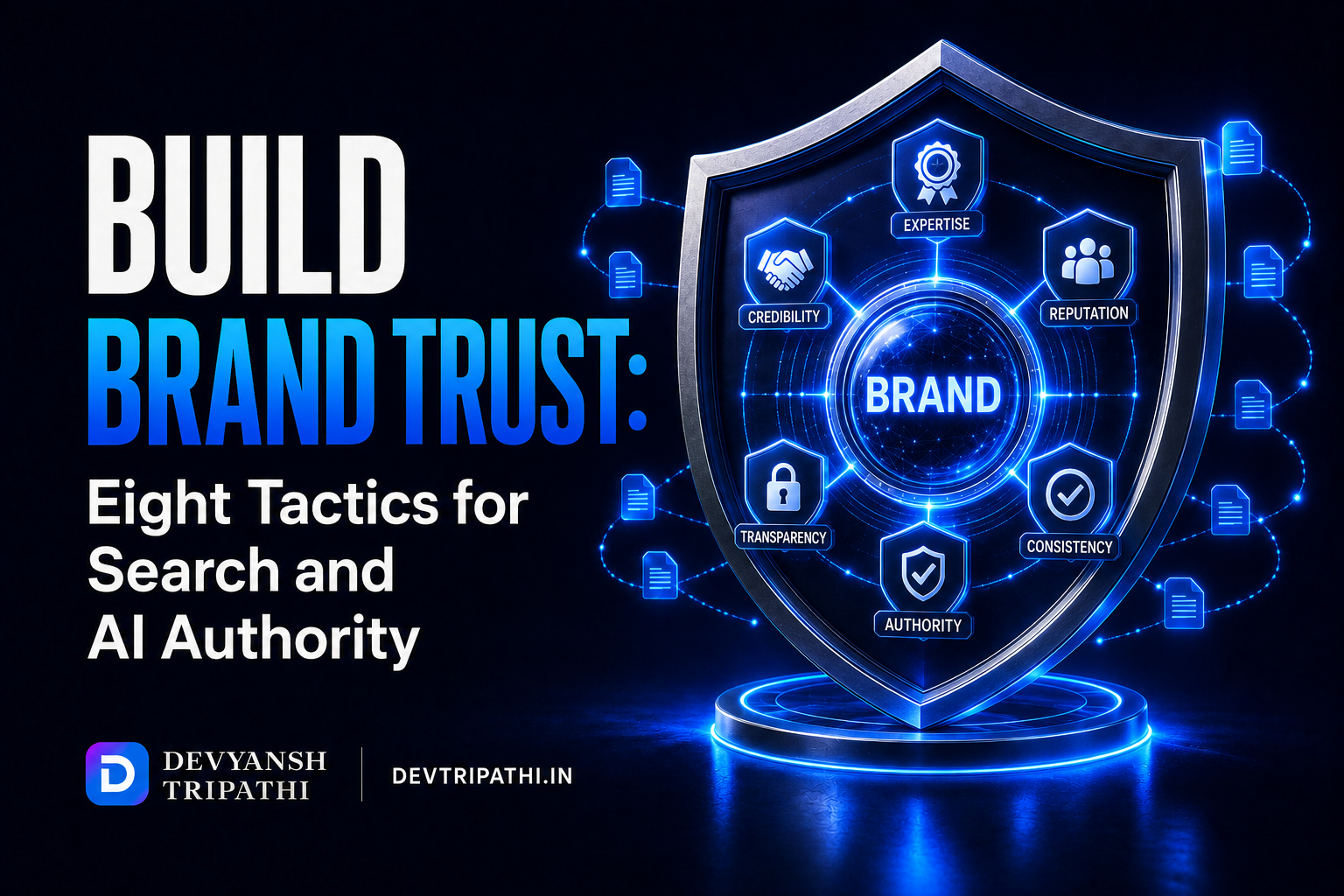
Build Brand Trust: Eight Tactics for Search and AI Authority
10 June 2026
An analysis of 177 brands across healthcare, SaaS, and financial services found that 90% of brands have zero AI search mentions, according to Search Engine Journal, May 2026. That is not a niche finding. It is a systemic gap between where search visibility is being built and where discovery is increasingly happening.
In 2026, brand authority is no longer a soft marketing concept that sits alongside SEO strategy. It is a direct ranking signal, an AI citation eligibility factor, and the most resilient asset any brand can build in an environment of continuous algorithm volatility. Following the early 2026 Google algorithm updates, sites that relied solely on keyword matching and high-volume link building saw significant drops. Brands with real-world footprints, recognized entities, and consistent multi-platform presence surged.
This guide covers the complete Brand Authority SEO strategy for 2026: what brand authority means to Google and AI systems, the specific signals that build it, the data behind each signal, and the step-by-step implementation plan that turns brand authority from an abstract goal into a measurable competitive advantage.
What Is Brand Authority in SEO?
Brand authority in SEO refers to the level of trust, recognition, and credibility a brand has earned from both users and search engines based on its consistent presence, demonstrated expertise, and multi-platform reputation.
It differs from Domain Authority in one critical way: Domain Authority is a third-party metric based primarily on backlink counts. Brand authority is a broader, Google-evaluated signal reflecting how much the search engine and AI systems perceive your brand as a genuine, trustworthy entity with real expertise in a specific field.
When your brand has strong authority signals, Google treats your content as inherently more credible. New pages index faster. Rankings are more resilient during algorithm volatility. And critically: AI platforms including ChatGPT, Google AI Overviews, and Perplexity are significantly more likely to cite your brand. The 0.664 correlation coefficient between brand mentions and AI Overview appearances, compared to 0.218 for backlinks, suggests brand entity authority is three times more predictive of AI citation than traditional link building, according to Ahrefs 2026 research.
Is Your Brand Visible Where Buyers Are Searching?
90% of brands have zero AI search mentions. Find out where your brand authority stands today with a free audit.
Get My Free Brand Authority AuditHow Google Evaluates Brand Authority: The 6 Core Signals
Google’s shift from a document search engine to what practitioners are calling a trust engine means that brand-level signals now carry weight that page-level keyword optimization alone cannot match. Google now uses AI-driven models to identify entities, and brands recognized by the Knowledge Graph receive a trust buffer: faster indexing and protection against the algorithm fluctuations that damage lesser-known sites.
The six signals Google and AI systems evaluate most directly are covered below.
Signal 1: Branded Search Volume
Branded search volume is one of the strongest single brand authority inputs Google processes. When users search your brand name specifically rather than a generic category term, Google interprets this as a vote of confidence that users specifically want your perspective, not just any content on a topic.
High branded search volume often correlates with better rankings and stronger visibility for both branded and non-branded queries. Brands that run consistent content marketing, email newsletters, thought leadership campaigns, and podcast appearances see branded search volume grow in parallel with organic rankings. This is not coincidence. It is causation through the trust signal mechanism.
Track branded query volume monthly in Google Search Console under the Performance report filtered by brand name queries. Month-over-month growth above 15% indicates strong brand authority momentum.
Signal 2: Unlinked Brand Mentions
In 2026, Google’s LLM-based scrapers can identify when your brand is mentioned on high-authority sites without a hyperlink. These unlinked mentions act as digital citations. If a major industry publication discusses your brand alongside a specific topic, Google creates a semantic link between you and that expertise.
The brand mention correlation with AI Overview appearances at 0.664 compared to 0.218 for backlinks confirms this mechanism directly. Unlinked mentions from authoritative sources carry more AI citation signal than traditional linked citations from lower-authority domains.
Building unlinked mentions requires the same activities as building linked ones: digital PR, expert commentary, podcast appearances, wire-distributed press releases, and community presence. The difference is that even placements without a link contribute meaningfully to brand entity authority.
Signal 3: Knowledge Graph Entity Recognition
Google’s Gemini AI is trained on the Knowledge Graph. That means how your brand is represented in the Knowledge Graph directly influences whether and how you appear in AI Overviews, AI Mode answers, and other Gemini-powered surfaces. The chain is: entity establishment, then Knowledge Graph inclusion, then Gemini training data, then AI Overview and AI Mode citations.
If your brand is not resolved as a clear entity with verified attributes, AI systems have no reliable signal to attribute claims to you, even if your content is the most comprehensive source on the topic.
Knowledge Graph recognition is built through consistent entity data across Wikidata, Google Business Profile, LinkedIn, and your website’s Organization schema with sameAs property linking all profiles to the same entity.
For the complete Knowledge Graph implementation guide, see our article on Knowledge Graph Optimization at https://devtripathi.in/blogs/knowledge-graph-optimization-complete-guide/
Signal 4: E-E-A-T Author and Entity Signals
Google’s quality evaluation now algorithmically enforces E-E-A-T signals. Content created by anonymous or unverified authors does not carry the same authority weight as content from named, credentialed experts whose expertise can be independently verified.
Named, credentialed authors with verifiable profiles are among the most important E-E-A-T elements on any site. Include high-resolution photos, professional credentials, links to external portfolios, and a clear mission statement or expertise description. Google needs to know exactly who is standing behind the content.
Every published article should have a clearly identified author with a linked bio page that documents relevant qualifications, experience, and external references. Author bio pages should connect to LinkedIn profiles, industry publication pages, and any other verifiable external reference that corroborates the stated expertise.
Signal 5: Review Platform Presence
The Seer Interactive May 2026 research produced the most striking single data point in brand authority research this year: brands with even a minimal Trustpilot profile of 1 to 13 reviews achieve a 53.5% AI citation rate. Brands with no profile have a median 1% rate. That is a 52-percentage-point swing from the presence of a minimal review profile alone.
Domains with profiles on platforms like Trustpilot, G2, Capterra, Sitejabber, and Yelp have 3 times higher chances of being chosen by ChatGPT as a source compared to sites without such presence, per SE Ranking November 2025. Brands with fully optimized Trustpilot profiles received 9.5 times more co-mentions than brands with no profile, meaning AI is recommending these brands when consumers are asking about someone else’s competitors.
These numbers make review platform optimization one of the highest-ROI brand authority investments available for most businesses: the implementation cost is low, the impact on AI citation rates is large, and the competitive window is wide given that only a minority of brands currently maintain optimized review profiles.
Signal 6: Multi-Platform Entity Consistency
AI systems apply multi-source corroboration before confidently citing a brand. When your brand appears consistently across Reddit discussions, YouTube content, G2 reviews, industry publications, and your own website with consistent naming, description, and positioning, AI systems gain confidence in recommending you. This is the consensus signal that separates cited brands from absent ones.
Inconsistency across platforms, different brand names in different directories, different descriptions on different review sites, different entity types in different schema implementations, reduces AI citation confidence even when all individual signals are present.
The 6 Brand Authority Signals: Impact Data at a Glance
Get in TouchThe 8 Brand Authority SEO Tactics That Build Measurable Results
Tactic 1: Claim and Complete Every Major Platform Profile
Register and fully complete your brand profile on every directory and platform Google and AI systems treat as trusted reference sources. The priority list for 2026 is: Wikidata, Google Business Profile, LinkedIn Company Page, Crunchbase, G2 or Capterra (for software and services businesses), Trustpilot, Yelp (for local and consumer businesses), AngelList, industry-specific directories relevant to your niche, and Wikipedia where notability criteria are met.
Ensure your Name, Address, Phone number, and entity description are absolutely identical across every platform. Even minor inconsistencies in formatting reduce Google’s entity confidence and AI citation probability.
Tactic 2: Publish Original Research — The Authority Loop
Publish original research. Google’s Helpful Content system loves data that nobody else has. If you are the source of a new statistic, everyone else in your niche has to cite you, creating a brand authority loop. These are the most powerful E-E-A-T pages on any site because they demonstrate genuine expertise through original data contribution.
A business installing bathrooms for elderly residents conducting a survey about challenges their customers face produced statistics that belonged exclusively to them. When AI tools or search engines were asked about this topic, these became the reliable statistics cited in answers. The mainstream media picked up on the data months later because journalists needed something to quantify the points they were making.
Original research does not require a formal academic study. A survey of your existing audience, an analysis of data you collect through client work, or a benchmark study comparing industry performance metrics qualifies as original research. Create at least one original research piece per quarter. Promote it through your newsletter, social media, and direct outreach to relevant publications.
Tactic 3: Build a Digital PR and Earned Media Program
Secure regular mentions in recognized industry publications. For the SEO and digital marketing niche, target publications including Search Engine Journal, Search Engine Land, Ahrefs Blog, Semrush Blog, and relevant Indian marketing publications.
Brands are 6.5 times more likely to be cited in AI answers through third-party sources than through their own domains. This makes earned media the highest-leverage brand authority investment available. A single article in a top-tier industry publication delivers more AI citation signal than dozens of pages on your own website covering the same topic.
Beyond links, the brand mention itself functions as an unlinked co-occurrence signal. Google’s 2026 AI-driven scrapers identify when your brand is discussed on high-authority sites even without a hyperlink, creating a semantic association between your entity and the expertise topic.
Tactic 4: Optimize Author Entity Pages
Create a dedicated author page for every content creator on your website functioning as a mini-reference entry for that person’s expertise. Include professional credentials, links to external publications, areas of specialization, a professional headshot, and a clear expertise statement. Link every article to its author page. This creates an attribution chain that Google’s E-E-A-T evaluation systems can verify.
Review profiles correlate with significantly higher AI citation rates across all platforms, verticals, and brand sizes. The same verification logic applies to author entities: a named, credentialed author with verifiable external references is more citable than anonymous content regardless of the content’s quality.
Tactic 5: Build Community Authority on Third-Party Platforms
Domains with millions of brand mentions on Quora and Reddit have roughly 4 times higher chances of being cited than domains with minimal community activity, according to SE Ranking November 2025. This makes community platform presence a direct AI citation signal, not just a brand awareness activity.
AI language models are trained on public community platform data. Brands consistently mentioned in community spaces benefit from implicit training data recognition that on-site optimization cannot replicate. Apply the 80/20 rule: 80% of contributions should be genuinely helpful with no brand promotion agenda, 20% can mention your brand content where it directly serves a community member’s actual need.
For the complete community signal strategy, see our guide on Community Signal SEO at https://devtripathi.in/blogs/community-signal-seo-complete-guide/
Tactic 6: Optimize Your Review Platform Presence
Given the extraordinary impact of review platform presence on AI citations, this is the single fastest brand authority action available to most businesses in 2026.
Claim and complete profiles on Trustpilot, G2, Clutch, and Capterra where applicable. Generate reviews systematically by asking satisfied clients at the moment of a positive outcome delivery. Respond professionally to all reviews including negative ones. Professional responses to criticism demonstrate brand character and reduce conversion damage from isolated negative experiences.
Brands with fully optimized Trustpilot profiles received 9.5 times more co-mentions in AI responses compared to brands with no profile. That is not incremental improvement. It is a fundamental citation eligibility difference created by one hour of profile setup.
Tactic 7: Build Your Knowledge Graph Entity Systematically
Because Google’s Gemini is trained on the Knowledge Graph, brands with high-quality entity representations have a structural advantage in AI-generated answers that no amount of content optimization can fully compensate for.
The Knowledge Graph entity building sequence:
First: Create a Wikidata entry with entity type, official name, description, founding date, website URL, and social media profile links.
Second: Implement Organization or Person schema on your homepage with all required fields including the sameAs property linking to your Wikidata entry, LinkedIn, and all major profile pages.
Third: Complete your Google Business Profile with every available field populated.
Fourth: Build third-party corroboration through digital PR and earned media mentions.
Fifth: Create a Wikipedia article where notability criteria are met, or contribute to existing Wikipedia content that references your brand entity.
For the complete implementation guide, see our article on Knowledge Graph Optimization at https://devtripathi.in/blogs/knowledge-graph-optimization-complete-guide/
Tactic 8: Monitor and Protect Your Brand Reputation
Negative reviews, unaddressed brand criticism, or conflicting entity information across platforms all weaken authority signals. Monitor brand mentions weekly using Google Alerts, Mention, or Brand24. Respond professionally to negative reviews. Correct factual inaccuracies in third-party mentions promptly.
Position 3 from a known brand often outperforms position 1 from an unknown brand. Backlinko’s analysis found branded keywords generate significantly higher CTR than non-branded equivalents at every ranking position. Brand reputation is not a soft metric. It is a directly observable performance variable in click-through behavior.
Build Brand Authority That Compounds Over Time
Only 19% of SEO professionals prioritize brand authority despite it being the most algorithm-resilient asset available. Book a strategy session and build yours before competitors do.
Book My Strategy SessionBrand Authority SEO and AI Citations: The Revenue Connection
Brand authority directly determines AI citation eligibility. The data connecting brand signals to AI visibility is now comprehensive enough to treat brand authority as a primary AI search optimization investment rather than a secondary consideration.
The chain of causation runs clearly: brand mentions on authoritative platforms raise AI citation confidence. AI citations drive brand awareness among high-intent users. AI-referred visitors convert at 4.4 times higher rates than standard organic traffic according to GetReviewFast research. Brands with optimized brand SERPs featuring consistent information, positive reviews, and Knowledge Panel entities receive 2.8 times more AI citations than brands without these signals.
Only 19% of SEO professionals name brand authority as a strategic priority despite 81% already practicing backlink acquisition. The brands investing systematically in brand authority signals now are building the most defensible competitive position in search: one based on genuine entity recognition that neither algorithm updates nor competitor keyword campaigns can easily displace.
For the complete AI citation measurement framework that tracks how brand authority investment translates into citation rates and traffic, see our guide on AI Visibility Tracking at https://devtripathi.in/blogs/ai-visibility-tracking-complete-guide/
The Brand Authority SEO Action Plan: 90 Days
Your 90-Day Brand Authority SEO Roadmap
Search your brand name on Google. Document every element in the top 10. Check Knowledge Panel presence. Test your brand in ChatGPT and Perplexity. Record your current AI citation rate as the baseline.
Get in TouchMeasuring Brand Authority SEO Performance
Brand authority is not unmeasurable. Every core signal has a corresponding measurement approach.
Branded Search Volume: Track monthly in Google Search Console under the Performance report. Filter for queries containing your brand name. Month-over-month growth above 15% indicates strong momentum.
Knowledge Panel Presence: Weekly branded search check. Knowledge Panel presence confirms Google has recognized your brand as a Knowledge Graph entity.
AI Citation Rate: Weekly manual testing in ChatGPT, Perplexity, Gemini, and Google AI Mode for your top 10 target queries. Track whether your brand is mentioned, whether citations are linked or unlinked, and your position within the response.
Brand Mention Volume: Weekly tracking using Google Alerts, Mention, or Brand24. Monitor both linked and unlinked mentions. Growth in unlinked mentions from high-authority sources is a particularly strong early indicator.
Review Platform Score: Monthly check of star ratings and review count on Google, Trustpilot, G2, and any other platforms where your brand is listed.
AI-Referred Traffic in GA4: Create a custom channel group capturing sessions from chatgpt.com, perplexity.ai, bing.com, and gemini.google.com. Monitor monthly alongside conversion rates from this channel.
Frequently Asked Questions About Brand Authority SEO
What is brand authority in SEO and why does it matter in 2026?
Brand authority in SEO is the level of trust, recognition, and credibility your brand has earned from users and search engines through consistent presence, demonstrated expertise, and multi-platform reputation. It matters in 2026 because following early 2026 algorithm updates, sites with real-world brand footprints surged while keyword-only sites saw significant drops. Brand authority is now both the most algorithm-resilient ranking signal and the primary determinant of AI citation eligibility.
How does brand authority affect AI search citations?
Brand mentions show a 0.664 correlation with AI Overview appearances compared to 0.218 for backlinks, making brand entity authority three times more predictive of AI citation than traditional link building according to Ahrefs 2026 research. Brands are also 6.5 times more likely to be cited in AI answers through third-party sources than through their own domains. Building brand authority across earned media, review platforms, and community channels is therefore the most direct path to AI citation growth.
What is the fastest brand authority improvement available?
Claiming and completing a review platform profile on Trustpilot, G2, or Yelp is the fastest available brand authority action with measurable AI citation impact. Seer Interactive May 2026 research found that brands with even 1 to 13 Trustpilot reviews achieve a 53.5% AI citation rate compared to 1% for brands with no profile, a 52-percentage-point improvement from one hour of profile setup.
What is the Trust Buffer that Google gives recognized brands?
Google’s Trust Buffer is the competitive advantage granted to brands recognized as named entities in Google’s Knowledge Graph. This means content is indexed faster, minor algorithm fluctuations affect performance less severely, and AI systems including Gemini have stronger confidence in citing the brand because its entity data is verified in the Knowledge Graph. Building the Trust Buffer requires entity registration on Wikidata, Organization schema on your website, and consistent entity data across all major reference platforms.
How is brand authority different from domain authority?
Domain Authority (DA) is a third-party metric from Moz estimating ranking potential based primarily on backlink profile strength. Brand authority is broader and is evaluated directly by Google’s systems based on branded search volume, entity recognition, multi-platform presence, review sentiment, E-E-A-T signals, and earned media mentions. Both contribute to search performance, but brand authority is the more algorithm-resilient of the two because it reflects genuine real-world recognition rather than a technical proxy metric.
Does brand authority help small businesses compete with large brands?
Yes. Entity recognition, review platform presence, and community authority can be built by any brand regardless of size. A small brand with a fully complete Wikidata entry, a well-maintained Trustpilot profile, consistent community participation, and strong author E-E-A-T signals will earn more AI citations than a larger brand with higher domain authority but weak entity clarity. The 52-percentage-point AI citation rate difference between having and not having a minimal review profile applies equally to small and large brands.
How long does it take to build brand authority?
Meaningful improvements in branded search volume and entity recognition typically begin to show within 3 to 6 months of consistent investment. Trustpilot and review platform profile creation can produce AI citation improvements within 14 to 30 days of the profile being indexed. Wikipedia entry creation (where notability criteria are met) can produce Knowledge Panel generation within days to weeks. Full competitive brand authority in an established niche takes 12 to 24 months of sustained effort but compounds significantly over time.
What role does original research play in brand authority?
Original research is one of the most efficient brand authority accelerators available. When your brand publishes data no other source has, you become the required citation for any content addressing that topic. This generates natural high-authority backlinks, increases unlinked brand mentions, improves AI citation rates, builds branded search volume, and reinforces topical authority simultaneously. One strong original research piece can generate brand authority signals that would take years to build through other methods alone.
What is the relationship between branded search volume and Google rankings?
Branded search volume signals to Google that users specifically want your brand’s content rather than any content on a topic. This preference signal is one of the strongest brand authority inputs Google’s algorithms process. Brands with growing branded search volume consistently maintain better rankings during core algorithm updates and appear more frequently in AI-generated answers than brands with equivalent content but minimal branded search activity. Branded keywords also generate significantly higher CTR than non-branded equivalents at every ranking position.
How does the Google I/O 2026 Personal Intelligence feature affect brand authority?
Personal Intelligence, announced at Google I/O 2026 and now expanding to 200 countries, connects AI Mode to users’ Gmail, Google Photos, and Calendar data. Brands that appear in users’ email communication, newsletter subscriptions, and transactional records have an observable presence in Personal Intelligence data. Genuine positive brand communication relationships create recall advantages in personalised AI Mode sessions. This makes email communication quality and brand recall from newsletter and content programs directly relevant to search personalization for the first time.
How do I track brand authority SEO results?
Track brand authority through five measurable signals: branded search volume growth in Google Search Console (target 15%+ month-over-month growth), Knowledge Panel presence (weekly branded search check), AI citation rate across ChatGPT and Perplexity (weekly manual testing), brand mention volume using Google Alerts or Brand24 (weekly), and AI-referred traffic in GA4 (monthly custom channel group). Together these five metrics provide a comprehensive view of brand authority momentum and its downstream business impact.
What is the single most important first step in brand authority SEO?
Conduct a brand audit. Search your brand name in Google and document every element in the top 10 results. Check whether a Knowledge Panel exists. Test your brand name in ChatGPT and Perplexity and record whether it appears. Check Wikidata for an existing entity entry. Review your Trustpilot and G2 profiles. This 30-minute audit identifies your three highest-priority brand authority gaps and creates the baseline against which all future improvement is measured.
Conclusion
Brand authority is the most durable and algorithm-resilient SEO asset available in 2026. It cannot be purchased in bulk, gamed through shortcuts, or replicated by competitors overnight. It is built through genuine expertise, consistent entity presence, original knowledge contribution, and earned recognition from independent authoritative sources.
The data makes the case compellingly. Brand mentions are three times more predictive of AI citation than backlinks. A minimal review profile produces a 52-percentage-point lift in AI citation rates. Brands with Knowledge Graph entity recognition receive faster indexing and protection against algorithm volatility. And only 19% of SEO professionals are currently prioritizing this as a strategic objective, creating a significant competitive window for brands that move now.
Start this week with the 30-minute brand audit. Check Knowledge Panel presence. Test your AI citation rate baseline. Create or complete your Wikidata entry. Claim your Trustpilot profile. Begin the earned media outreach program.
Brand authority compounds. Every mention earned, every entity signal verified, every research piece published makes the next one easier and the overall system more resilient. The brands that build it systematically now will own the citation layer in their category for years ahead.
For the complete AI citation measurement framework, see AI Visibility Tracking: The Complete Guide at https://devtripathi.in/blogs/ai-visibility-tracking-complete-guide/
For the topical authority architecture that amplifies brand authority signals, see Topical Authority SEO: The Complete Guide at https://devtripathi.in/blogs/topical-authority-seo-complete-guide/
Ready to Build Brand Authority That Ranks and Gets Cited by AI?
Get a personalised Brand Authority SEO roadmap built on the exact framework in this guide. Free strategy session — no obligation.
Get My Free Strategy SessionInfographic Title: Brand Authority vs Backlinks — AI Citation Predictability Gap
Objective: Visually demonstrate that brand mentions are 3x more predictive of AI citations than backlinks, establishing urgency for brand authority investment.
Content: Two horizontal bars side by side. Bar 1 labeled “Brand Mentions Correlation” shows 0.664 in brand blue (#0064d8). Bar 2 labeled “Backlinks Correlation” shows 0.218 in a muted grey. Below: “Brand mentions are 3x more predictive of AI Overview appearances than backlinks.” Source: Ahrefs April 2026. Background: #1A1B20. Text: rgb(216,216,216).
Infographic Title: The Trustpilot Effect — How a Review Profile Changes Your AI Citation Rate
Objective: Visualise the extraordinary 52-percentage-point AI citation rate difference between having and not having a review platform profile.
Content: Two large stat cards side by side. Card 1: “No Trustpilot Profile — Median AI Citation Rate: 1%.” Card 2: “Minimal Trustpilot Profile (1-13 reviews) — AI Citation Rate: 53.5%.” Center bridge between cards: “+52 percentage points.” Below both cards: “Brands with fully optimised Trustpilot profiles receive 9.5x more AI co-mentions.” Source: Seer Interactive May 2026.
Infographic Title: The Brand Authority Compound Loop — How Every Signal Reinforces the Next
Objective: Show how brand authority signals compound over time, with each action strengthening subsequent ones.
Content: A circular flywheel with six stages: (1) Original Research Published → (2) Earned Media Mentions Generated → (3) Branded Search Volume Grows → (4) Knowledge Graph Entity Recognised → (5) AI Citation Rate Increases → (6) More Audience Exposure → back to (1). Center label: “Compounding Brand Authority.” Background: #1A1B20. Accent color: #0064d8.
RESEARCH AND PLANNING
META DATA
CONTENT STRUCTURE
KEYWORDS
EEAT AND STATISTICS
LINKING
CONTENT ELEMENTS
INFOGRAPHICS
QUALITY

Devyansh Tripathi
I’m Devyansh Tripathi, an SEO strategist and digital growth expert, helps businesses and individuals rank higher and drive organic traffic. Through DevTripathi., he shares cutting-edge SEO insights, content strategies, and marketing hacks. Passionate about digital success, he’s on a mission to make SEO simple, effective, and result-driven!
Posts
- What Google’s New AI Search Documentation Means for SEO Teams
- Google I/O 2026 Search: AI Agents, Gemini 3.5 and the Unified Box
- Google’s AI Optimization Guide: The Technical and Content Checklist
- July 2026 SEO Update: AI Overviews, llms.txt and Search Console
- Prompt Optimization Beyond Page One: The Position-21 Citation Opportunity
Categories
- AI Citation Optimization
- AI Search Optimization (AISEO)
- AI Visibility Tracking
- Answer Engine Optimization (AEO)
- Brand Authority SEO
- Brand SERP Optimization
- Community Signal SEO
- Conversational Search Optimization
- Generative Engine Optimization (GEO)
- Knowledge Graph Optimization
- Modern SEO Strategies
- Multimodal Search Optimization
- Prompt Optimization
- SEO Trends
- Social Search Optimization
- Topical Authority SEO
- Uncategorized
- Video Search SEO
- Visual Search Optimization
- Voice Engine Optimization (VEO)
- Zero Click Search Optimization
Latest News
Text Widget
Empowering brands with insights, strategies, and stories that drive digital growth.