
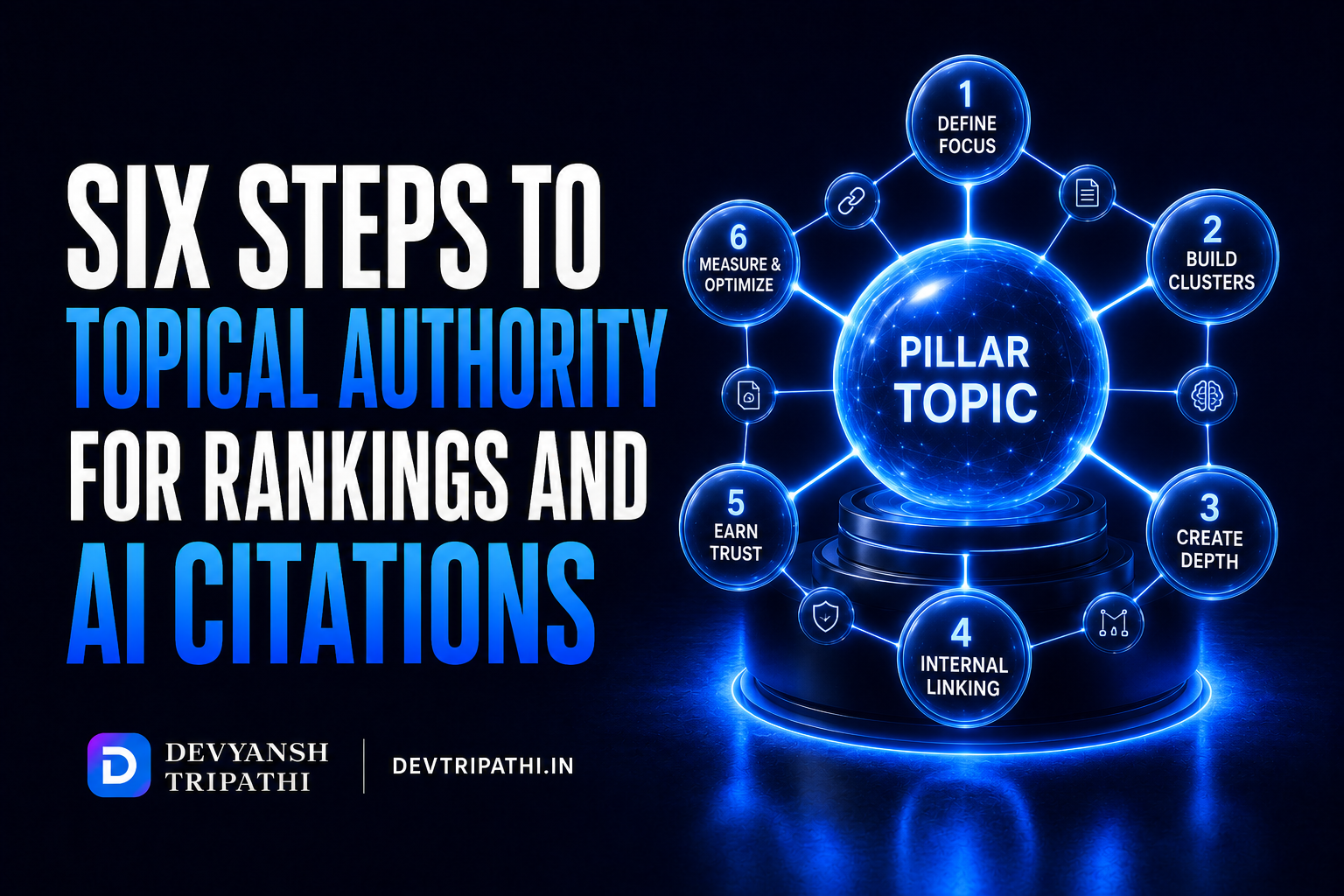
Six Steps to Topical Authority for Rankings and AI Citations
12 June 2026
This guide covers the complete 2026 topical authority framework: what it is, how Google and AI platforms evaluate it, and the step-by-step implementation process from topical map to fully interconnected content cluster. You will find the three-component architecture of pillar pages, cluster pages, and internal link networks, the six-step implementation process for building topical authority systematically, the connection between topical coverage and AI citation rates across ChatGPT, Perplexity, and Google AI Overviews, and the four leading indicators that signal topical authority growth before rankings and traffic confirm the outcome. This guide is built on verified 2026 research and the specific data points that prove why topical depth now outperforms individual page keyword optimization.
Key Takeaways
- According to Slate's 2026 AI SEO research, topical authority clusters of 5 to 7 or more interlinked pages consistently outperform isolated pages for both Google rankings and AI citation likelihood.
- Topical depth of coverage on a subject matters more than individual page optimization in 2026, following Google's March Core Update and AI-driven quality evaluation systems.
- Vefogix's post-Google-I/O-2026 SEO strategy analysis identifies topical authority signals built through interlinked content clusters as the ranking factor that matters most in 2026.
- According to Digital Applied's content cluster research, the fastest topical authority wins come from queries with 100 to 2,000 monthly searches where competitors have thin pages, outdated content, or misaligned intent.
- Sites with strong editorial structure and topical coverage scale more easily because new content fits into an existing topical system and indexes faster, per ClickRank's 2026 topical authority research.
- Topical authority is simultaneously a traditional ranking signal and an AI citation eligibility signal, meaning the same content investment delivers returns across both search surfaces.
- The fastest topical authority implementation path is to build one pillar page per core topic and five to seven cluster pages per pillar before expanding breadth, prioritizing depth within one topic area over shallow coverage across many.
Free Topical Authority Audit for SEO Professionals
Does Your Website Have Real Topical Authority or Just Scattered Content?
Find out where your coverage gaps are, which competitors own the topical clusters you need, and what it takes to dominate your niche in Google and AI search in 2026.
Get My Topical Authority AuditWhat Is Topical Authority in SEO and Why It Now Drives Rankings
Topical authority means a website is recognized by search engines as a trusted expert on a specific subject, not just optimized for a single keyword. It reflects the depth and breadth of a domain’s coverage across an entire topic area, demonstrating to Google and AI systems that the domain provides comprehensive, consistent, and interconnected knowledge on that subject.
The clearest reference point for understanding topical authority is Wikipedia. Wikipedia ranks for nearly any informational query not primarily because of its backlink profile but because it has complete, interlinked coverage of virtually every topic it addresses. No important question within any covered subject is left unanswered. That completeness is topical authority at its most developed. Building topical authority for your domain means becoming the Wikipedia of your specific niche: covering every important angle comprehensively and connecting all those pages into a coherent, navigable knowledge structure that leaves no sub-query unaddressed.
When topical authority is established, three outcomes occur simultaneously. Rankings stabilize and scale because new content on related topics indexes faster and ranks more quickly than it would on a domain without topical authority context. AI systems including ChatGPT, Perplexity, and Google AI Overviews cite the domain disproportionately because comprehensive topic coverage signals to AI retrieval systems that the domain is a reliable and complete reference source. And individual page performance improves because strong topical authority pages receive internal PageRank distribution from an interconnected cluster, not from isolated backlinks alone.
Why 2026 Is the Year Topical Authority Became Non-Negotiable
Two converging developments elevated topical authority from one signal among many to the primary content quality signal in 2026. The first is Google’s Helpful Content System, which now assesses site-level helpfulness rather than only individual page quality. A domain with many thin or unhelpful pages sees ranking suppression across its entire content library, including individually strong pages. Topical completeness removes the content gap signals that suppress domain-level authority by ensuring comprehensive coverage of every important subtopic within the domain’s expertise area.
The second development is the emergence of AI citation systems as a parallel search surface. Slate’s 2026 AI SEO research confirms that topical authority clusters of 5 to 7 or more interlinked pages outperform isolated pages for AI citation likelihood. The mechanism is query fan-out: when a user submits a complex query to ChatGPT or Google AI Mode, the AI decomposes it into multiple sub-queries. A domain with comprehensive cluster coverage matches more sub-queries and earns more citations across the full breadth of the AI response generation process. For the complete AI citation framework that topical authority feeds into, see our AI Citation Optimization guide.
The Architecture of Topical Authority: Three Core Components
Topical authority is not built by publishing more content. It is built by publishing the right content in the right structure with the right connections between pages. The three-component architecture of pillar pages, cluster pages, and internal link networks works together as a system rather than as three separate tactics.
| Level | Page Type | Word Count | Keyword Target | Internal Linking Role |
|---|---|---|---|---|
| Level 1 | Pillar Page | 3,000 to 5,000 words | Broad head-term keyword | Links outward to all cluster pages. Receives links from every cluster page. |
| Level 2 | Cluster Pages | 1,500 to 3,000 words | Long-tail subtopic keyword | Links back to pillar. Links to 2 to 4 adjacent cluster pages within the same silo. |
| Level 3 | Supporting Content | 800 to 1,500 words | Specific question or use case | Links to the relevant cluster page. Adds depth to niche sub-queries within the silo. |
Component 1: The Pillar Page
A pillar page is a comprehensive, definitive overview of a major topic covering the subject at a high level and linking to all cluster pages within that topical silo. It is the hub of the hub-and-spoke content model. A strong pillar page covers the definition, importance, key concepts, practical overview, and strategic framework of the topic without going deep on every subtopic, because that depth is handled by the cluster pages it links to.
Pillar pages typically run 3,000 to 5,000 words. They target a broad, high-volume primary keyword. They carry the strongest authority signals on the site, including the highest concentration of inbound internal links from cluster pages. And they link explicitly to every cluster page within the silo, creating the topical hub that Google’s crawl systems identify as the authoritative reference point for the subject area. According to ClickRank’s 2026 topical authority research, sites with strong editorial structure and topical coverage scale more easily because new content fits into an existing topical system and indexes faster than content published without structural context.
Component 2: Cluster Pages
Cluster pages are dedicated, in-depth articles covering specific subtopics within a pillar’s topic area. Each cluster page addresses one aspect of the broader topic that the pillar page covers at summary level, going deep on that specific subtopic with the comprehensive coverage that a pillar page cannot provide across every area it references.
Cluster pages target specific long-tail keywords within the broader topic. They link back to the pillar using descriptive anchor text containing the pillar’s primary keyword. They also link to two to four adjacent cluster pages within the same silo using descriptive anchor text, creating the lateral connections that build the topical mesh Google’s systems use to evaluate subject matter depth. The fastest topical authority wins come from queries with 100 to 2,000 monthly searches where competitors have thin pages, outdated content, or misaligned search intent, according to Digital Applied’s content cluster research. These gap queries represent the highest-ROI cluster additions because minimal competition means they rank quickly.
Component 3: The Internal Link Architecture
Internal linking converts individual pages into a topical authority system. Without systematic internal linking, even a complete set of cluster pages fails to communicate topical structure to Google effectively. The links between pages are the infrastructure that creates the topical graph Google’s crawl systems traverse to understand and evaluate your domain’s subject matter expertise.
The three-way linking rule governs every cluster silo. Every cluster page links back to its pillar using descriptive anchor text. Every cluster page links to two to four adjacent cluster pages within the same silo. The pillar page links outward to every cluster page within its silo. This three-directional structure creates the topical mesh that signals comprehensive expertise to both Google’s traditional ranking systems and the AI retrieval systems that evaluate domains as citation sources. Efficient crawling also helps new content rank faster because it joins an existing topical system with established authority context, rather than being indexed as a standalone disconnected page.
The 6-Step Process to Build Topical Authority That Ranks and Gets Cited
Building topical authority requires a planned, sequential process. Search engines and AI systems reward sites that demonstrate intentional topic coverage with systematic depth, not sites that publish content reactively across scattered keyword targets. The following six steps create the foundation for topical authority that compounds over time.
Step 1: Define Your Niche Focus
Topical authority requires focus. A website covering five unrelated subject areas spreads its topical signals too thin across each of them. Choose one core topic area and niche down within it relentlessly before considering expansion. For a new or growing site, the strongest strategy is to identify a specific sub-niche where comprehensive coverage is achievable faster than in the broader category.
Instead of all of SEO, focus on AI search optimization. Instead of all of digital marketing, focus on GEO and AEO for SaaS brands. A narrow, deep focus builds topical authority faster than broad shallow coverage and generates more targeted organic traffic and higher AI citation rates than surface-level coverage of a wider field. The goal is to become the definitive source in a specific subject area before expanding outward. For the modern SEO foundation that supports topical authority building, see our Modern SEO Strategies guide.
Step 2: Build Your Topical Map
A topical map is a structured inventory of every important subtopic, question, and use case within your target topic area. It is the planning document that prevents content gaps and ensures the cluster has complete coverage before you begin creating pages. Build your topical map from four primary research sources.
Google’s People Also Ask box surfaces the real questions users ask about each subtopic in the natural language they actually use. The Ahrefs Content Gap tool identifies topics competitors cover that your site ranks for nothing on. Google Search Console query data filtered for six or more word queries surfaces impression-generating conversational questions you lack dedicated pages for. Reddit and Quora threads in your niche reveal the natural language questions real users ask when thinking through problems, providing the clearest available signal of how your audience describes their needs before they shorten queries for a search box.
Step 3: Publish the Pillar Page First
Before building cluster pages, create the pillar page for your primary topic. The pillar establishes the topical hub and provides the internal link destination that all future cluster pages will reference. A strong pillar page includes a clear definition of the topic, an explanation of why it matters, a high-level overview of all key strategies and subtopics, a structured comparison table or framework, a quick-start action plan, and a comprehensive FAQ section covering the most common questions across the full topic area.
Link explicitly to each cluster page you plan to create, even before those cluster pages exist, using the planned URL slugs you will publish to. This forward-linking signals to Google’s crawl systems that additional depth is coming, and it establishes the topical structure as Google begins building its entity model for your domain’s coverage of the subject.
Step 4: Build Cluster Pages in Priority Order
Create cluster pages in priority order from your topical map, publishing at a consistent sustainable pace rather than in bursts that leave long gaps between publications. Each cluster page must target a specific long-tail keyword, go deep on one subtopic rather than covering multiple superficially, link back to the pillar using descriptive anchor text, link to two to four adjacent cluster pages, and meet all content quality requirements including direct answer blocks in the first 150 words, expert quotes with attribution, statistics with source references, FAQPage schema, and a last-updated timestamp.
Prioritize the gap queries with 100 to 2,000 monthly searches where competitors have thin or outdated coverage. These are the highest-ROI cluster additions because they rank quickly and each one strengthens the topical authority signal for the entire cluster, not just the new page.
Step 5: Fill Content Gaps Aggressively Every Quarter
Conduct a content gap audit quarterly using Ahrefs Content Gap to identify topics driving competitor traffic that your site ranks for nothing on. Cross-reference the gaps against your topical map. Prioritize creating pages for the highest-volume, highest-relevance gaps first.
A website with 95% topical coverage of its niche dramatically outperforms a website with 70% coverage in both traditional rankings and AI citation frequency. Every unanswered question within your topic area is a point of authority that a competitor can claim before you do. Completeness is the goal, and the gap audit is the mechanism that keeps the coverage expanding systematically rather than opportunistically. For the complete brand authority strategy that amplifies topical authority signals through entity recognition, see our Brand Authority SEO guide.
Step 6: Maintain and Refresh Your Cluster Quarterly
Topical authority is not static. New subtopics emerge as search behavior evolves, competitors fill gaps you previously owned, and older content loses the freshness signals that affect AI citation eligibility. Research shows 83% of AI citations come from pages updated within the past 12 months, with over 60% refreshed within the last six months. Establish a quarterly content maintenance cycle for all cluster pages.
Update statistics and data points on all cluster pages older than six months. Add new cluster pages as emerging questions appear in your Search Console query report. Review and update internal links as new cluster pages are added. Conduct a content quality audit to identify thin or underperforming cluster pages that need expansion or consolidation. For the complete GEO strategy that topical authority feeds into, see our Generative Engine Optimization guide.
How Topical Authority Directly Drives AI Citation Rates in 2026
Topical authority is not only a traditional ranking signal. It is one of the primary factors determining whether AI platforms including ChatGPT, Perplexity, Google AI Overviews, and Gemini cite your domain when generating answers. The connection is direct and measurable.
The Query Fan-Out Mechanism: Why Cluster Coverage Multiplies AI Citations
When a user submits a complex query to an AI search platform, the AI decomposes it into multiple sub-queries covering different aspects of the topic. A domain with comprehensive cluster coverage that addresses every important subtopic within the topic area matches more sub-queries and earns more citations across the full breadth of the AI response generation process.
For example, a user asking “what is the best content strategy for AI search in 2026” generates AI sub-queries covering topical authority, answer engine optimization, GEO content structure, AI citation tactics, and content freshness requirements. A domain with a complete cluster covering all five subtopics qualifies as a citation source across all five sub-queries. A domain with one strong isolated article on topical authority qualifies for citation on one of the five. The difference compounds across every query the domain targets.
Domain authority is the strongest single predictor of AI citations, and high-authority domains get cited at approximately three times the rate of lower-authority domains according to SE Ranking research. But within domains at similar authority levels, topical coverage breadth becomes the decisive differentiator. The domain with a complete cluster of ten interconnected pages on a topic earns citations across a wider range of related queries than the domain with one strong isolated page, even if that single page is individually superior in quality. For the complete AI citation measurement framework, see our AI Citation Optimization guide.
What Princeton Research Says About Content Depth and AI Visibility
Princeton University’s GEO research published at KDD 2024, the first formal academic study of AI citation optimization, found that content structure, depth, and completeness directly influence AI citation probability across major platforms. Pages that comprehensively addressed the full semantic landscape of a topic earned disproportionately higher citation rates than pages targeting only a single keyword aspect of the same topic.
The research also found that pages ranked fifth in traditional search saw a 115.1% AI visibility increase when proper GEO signals, including comprehensive content structure and topical depth, were added. This confirms that topical authority-level content depth can produce AI citation results that exceed what traditional ranking position alone would predict, creating an optimization opportunity that is independent of link-building investment.
Build the Topical Authority That Makes AI Systems Choose You
Most Sites Have Content Without Topical Structure. Build the Cluster Architecture That Wins.
Get a personalised topical authority roadmap covering your topical map, pillar-and-cluster architecture, content gap prioritisation, and the internal link framework that Google and AI systems reward.
Get My Content Cluster StrategyMeasuring Topical Authority Progress: Four Leading Indicators
Topical authority builds gradually and requires leading indicators to track momentum before rankings and traffic confirm the outcome. The four metrics below signal authority growth before the lagging indicators of keyword rankings and organic traffic sessions begin to reflect the underlying structural improvement.
The 4 Topical Authority Leading Indicators
Topical Coverage Score
Calculate the percentage of your topical map that has dedicated quality pages. Track month over month. Rising coverage score is the primary leading indicator of authority growth before rankings move.
Ranking Velocity
Track how quickly new cluster pages begin ranking after publication. Domains with established topical authority rank new pages within days to weeks. Without it, new pages take months. Improving velocity confirms authority is building.
AI Citation Rate
Test your target topic cluster keywords weekly in ChatGPT, Perplexity, and Google AI Mode. Count responses that cite your pages. Strong topical authority produces disproportionate AI citation rates relative to competitors with equal individual page quality but weaker cluster structure.
Cluster Traffic Growth
Monitor combined organic traffic across all pages in a topical cluster measured month over month in GA4. Rising cluster-level traffic confirms that the internal link architecture is distributing authority effectively across all pages in the silo, not only the strongest individual pages.
Frequently Asked Questions About Topical Authority SEO
The following questions address the most common areas of uncertainty when implementing a topical authority strategy and measuring its impact on both traditional search rankings and AI citation performance.
What is topical authority in SEO and why does it matter in 2026?
Topical authority is the depth and breadth of a website’s content coverage on a specific subject, as recognized by search engines and AI systems. It matters in 2026 because Google’s Helpful Content System evaluates site-level expertise rather than only individual page quality, and because AI citation systems reward domains with comprehensive topic coverage over domains with isolated strong pages. Topical authority is simultaneously a traditional ranking signal and an AI citation eligibility signal.
How many pages does a topical authority content cluster need?
Research from Slate’s 2026 AI SEO dataset found topical authority clusters of 5 to 7 or more interlinked pages consistently outperform isolated pages for both Google rankings and AI citation likelihood. The minimum viable cluster for meaningful topical authority recognition is 8 to 10 well-interconnected pages covering a topic and its primary subtopics. Mature competitive authority typically requires 20 to 30 or more pages covering the full topic landscape.
What is a topical map and how do I build one?
A topical map is a structured inventory of every important subtopic, question, and use case within your target topic area. Build it using Google’s People Also Ask box, the Ahrefs Content Gap tool, Google Search Console query data filtered for six-plus word conversational queries, and Reddit or Quora discussions in your niche. Score each entry on search volume, topical relevance, and business alignment. Use the scored topical map as your content calendar foundation.
How long does it take to build topical authority?
Meaningful topical authority in a specific niche typically requires 6 to 18 months of consistent content investment. The timeline depends on niche competitiveness, current content library state, and publication frequency. The compounding nature of topical authority means progress accelerates over time rather than being linear: each new cluster page that indexes and links correctly strengthens the authority of all existing pages simultaneously.
What is the fastest topical authority win available?
The fastest wins come from identifying queries with 100 to 2,000 monthly searches where competitors have thin pages, outdated content, or misaligned search intent, per Digital Applied content cluster research. These gap queries represent high-ROI cluster additions because minimal competition means they rank quickly and each one strengthens the topical authority signal for the entire cluster, not only the new page added.
Does topical authority replace backlink building?
No. Topical authority and backlinks are complementary signals. Domain authority, which correlates with backlink quality and quantity, is the strongest single predictor of AI citations. Topical authority determines which specific pages and topics you can rank for within the authority envelope your backlink profile creates. The strongest competitive position combines comprehensive editorial backlinks from authority publishers with complete topical coverage within the subject area.
How does topical authority affect AI search citations?
Topical authority clusters outperform isolated pages for AI citation likelihood because AI systems use query fan-out: decomposing complex user queries into multiple sub-queries. A domain with comprehensive cluster coverage matches more sub-queries and earns citations across more of the AI response generation process. Princeton University GEO research published at KDD 2024 confirms that content depth and comprehensive topic coverage directly influence AI citation probability across major platforms.
What is the difference between topical authority and domain authority?
Domain authority is a third-party metric estimating ranking potential based on backlink profile strength. Topical authority is a content-based signal Google evaluates based on how comprehensively and consistently a site covers a specific subject area. A site with low domain authority but deep topical coverage in a narrow niche can outrank sites with higher domain authority but scattered coverage. Both signals matter and the strongest competitive position combines both.
Should I niche down or build broad topical coverage?
For most sites below established authority levels, niching down is the stronger strategy. A narrow, deep focus builds topical authority faster than broad shallow coverage because you reach the coverage threshold that triggers Google’s authority recognition more quickly. Once strong authority is established in a narrow niche, expanding into adjacent subtopics is more effective than trying to build broad authority from scratch across many unrelated areas simultaneously.
What is the role of E-E-A-T in topical authority?
E-E-A-T and topical authority are complementary and mutually reinforcing. Topical authority signals that your site comprehensively covers a subject area. E-E-A-T signals that the people behind the content have genuine expertise in it. Google’s March 2026 Core Update amplified E-E-A-T signals and rewarded first-hand experience content, confirming that topical authority built on genuine expertise outperforms topical authority built on content volume alone. Name your authors, credential them, and document first-hand experience throughout cluster content.
How do I know if my topical authority strategy is working?
Track four signals as leading indicators: topical coverage score (percentage of topical map with dedicated quality pages), ranking velocity (how quickly new cluster pages begin ranking after publication), AI citation rate (how often cluster pages are cited in ChatGPT, Perplexity, and Google AI Mode weekly testing), and cluster traffic growth (combined organic sessions across all cluster pages in GA4 measured month over month). Rising signals across all four confirm topical authority is compounding at domain level.
How does internal linking contribute to topical authority?
Internal linking is the mechanism that converts individual pages into a topical authority system. Without systematic three-way linking between pillar and cluster pages, even a complete set of cluster pages fails to communicate topical structure to Google effectively. Every cluster page must link to its pillar, every pillar must link to all cluster pages, and adjacent cluster pages must link to each other. This topical graph is what Google and AI systems traverse to evaluate subject matter expertise at the domain level.
Ready to Build Topical Authority That Compounds Over Time?
Get a Personalised Topical Authority Roadmap Built on Your Current Content Library
Free strategy session covering your topical map, the highest-ROI content gaps in your niche, your pillar-and-cluster architecture, and the exact internal link structure that makes Google and AI platforms treat your domain as the definitive source.
Get My Free Topical Authority RoadmapConclusion
Topical authority is the most durable, compounding, and algorithm-resilient SEO investment available in 2026. It cannot be purchased in bulk, gamed with shortcuts, or replicated by competitors overnight. It is built through consistent, structured, comprehensive content investment that leaves no important question in your niche unanswered, and maintained through quarterly gap audits and freshness updates that keep the coverage current as search behavior evolves.
The March 2026 Core Update confirmed what leading SEO practitioners had observed across multiple algorithm cycles: Google rewards domains that own topics, not pages that target individual keywords. Topical authority clusters outperform isolated pages for AI citation likelihood. Depth of coverage on a subject matters more than individual page optimization. And the investment required is clear and achievable: build your topical map, create the pillar page first, add cluster pages in priority order, fill gaps aggressively, and maintain freshness every quarter.
The brands that build topical authority now will own their subject areas in both traditional search and AI-generated answers. Every cluster page added strengthens the entire system. Every internal link added strengthens the topical graph. Every content gap filled removes a competitor’s citation opportunity. Start by building your topical map this week, auditing your current cluster coverage against it, and identifying the three largest gaps. For the complete Knowledge Graph strategy that amplifies topical authority through entity recognition, see our Knowledge Graph Optimization guide.

Devyansh Tripathi
I’m Devyansh Tripathi, an SEO strategist and digital growth expert, helps businesses and individuals rank higher and drive organic traffic. Through DevTripathi., he shares cutting-edge SEO insights, content strategies, and marketing hacks. Passionate about digital success, he’s on a mission to make SEO simple, effective, and result-driven!
Posts
- What Google’s New AI Search Documentation Means for SEO Teams
- Google I/O 2026 Search: AI Agents, Gemini 3.5 and the Unified Box
- Google’s AI Optimization Guide: The Technical and Content Checklist
- July 2026 SEO Update: AI Overviews, llms.txt and Search Console
- Prompt Optimization Beyond Page One: The Position-21 Citation Opportunity
Categories
- AI Citation Optimization
- AI Search Optimization (AISEO)
- AI Visibility Tracking
- Answer Engine Optimization (AEO)
- Brand Authority SEO
- Brand SERP Optimization
- Community Signal SEO
- Conversational Search Optimization
- Generative Engine Optimization (GEO)
- Knowledge Graph Optimization
- Modern SEO Strategies
- Multimodal Search Optimization
- Prompt Optimization
- SEO Trends
- Social Search Optimization
- Topical Authority SEO
- Uncategorized
- Video Search SEO
- Visual Search Optimization
- Voice Engine Optimization (VEO)
- Zero Click Search Optimization
Latest News
Text Widget
Empowering brands with insights, strategies, and stories that drive digital growth.