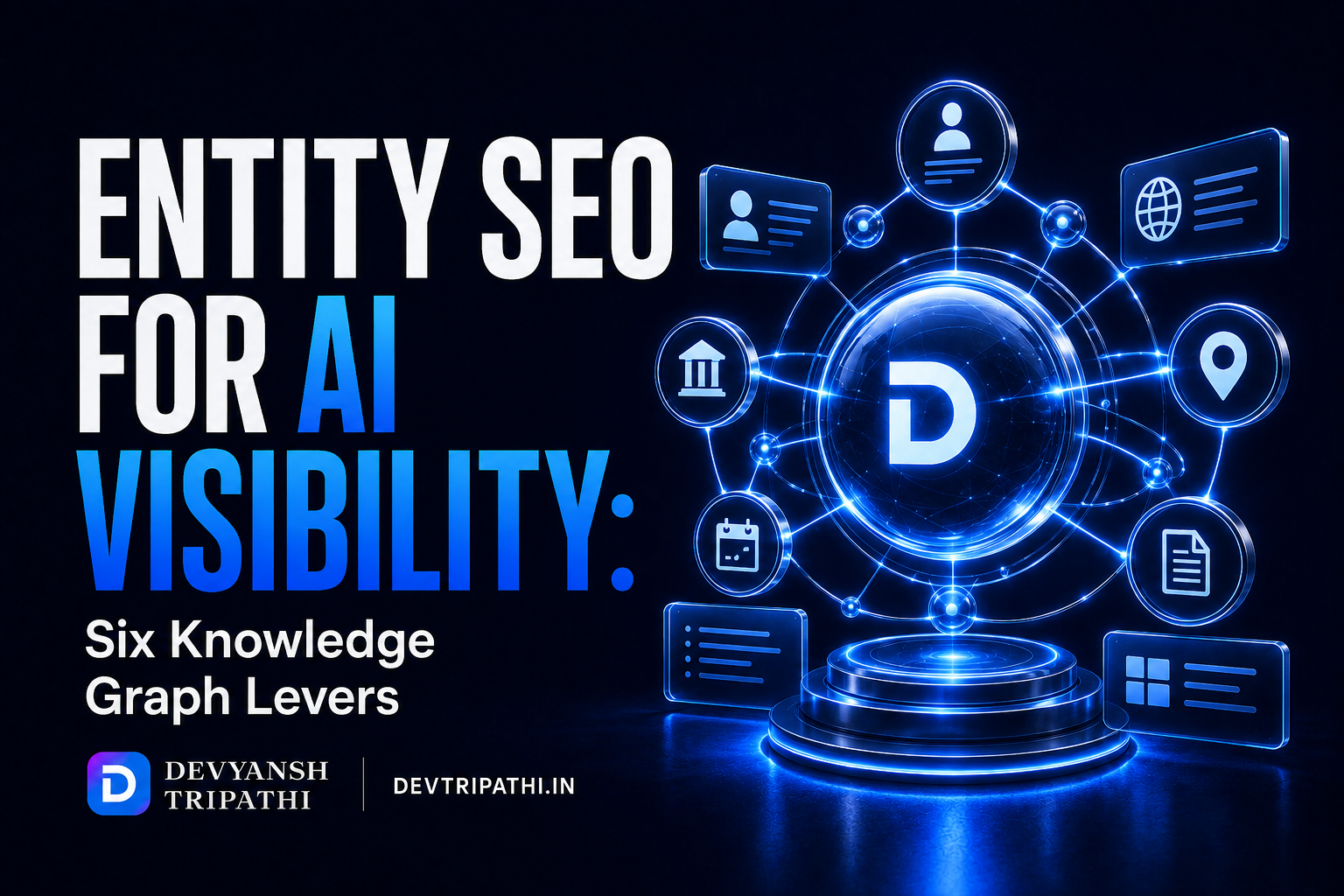
Entity SEO for AI Visibility: Six Knowledge Graph Levers
13 June 2026
This guide covers the complete 2026 Knowledge Graph Optimization framework: what the Knowledge Graph is and why it has become the foundational layer of AI search visibility, the key statistics that confirm entity optimization now outperforms traditional keyword signals for AI citation eligibility, the six entity levers that determine your brand’s Knowledge Graph authority, the step-by-step implementation sequence from Wikidata entry to sameAs schema to Knowledge Panel claim, and the ongoing maintenance process that keeps entity signals accurate and current as AI systems update their training data. The guide also covers the new entity home concept introduced in 2026, how to audit your current entity clarity across Google’s systems, and how entity strength connects to AI Overview selection probability.
Key Takeaways
- According to Digital Applied's Entity SEO Guide published May 2026, Google's Knowledge Graph now holds 500 billion+ facts on 5 billion+ entities, and Gemini AI is trained directly on the Knowledge Graph.
- Wellows' AI Overviews ranking factors research found content with 15 or more connected entities shows 4.8 times higher AI Overview selection probability, and properly structured content with schema shows 73% higher selection rates than unmarked content.
- Domain authority now shows only an r=0.18 correlation with AI Overviews, down from 0.23 in 2024. Entity clarity has overtaken link metrics as the primary AI citation eligibility signal.
- Entity establishment is the prerequisite for AI Overview citations, Knowledge Panel cards, and AI Mode answers. Being accurately represented in the Knowledge Graph determines whether your brand gets cited at all.
- The sameAs property in Organization JSON-LD schema is officially supported by Google and is the single most technically impactful field for Knowledge Graph recognition, creating explicit entity disambiguation across all your brand's web properties.
- The same signals that build a Google Knowledge Panel also drive visibility in AI Overviews and generative answer engines. Entity optimization and AI citation optimization are not separate disciplines.
- A structured entity optimization program following the six-lever framework (entity definitions, Wikidata presence, Organization+sameAs schema, consistent NAP, topical clusters, external citations) covers every input Google cross-checks when building entity confidence.
Free Entity SEO Audit for SEO Professionals
Is Your Brand Recognized as a Trusted Entity in Google's Knowledge Graph?
Get a complete audit of your entity clarity score, Knowledge Panel status, sameAs schema implementation, Wikidata entry, and the specific gaps preventing AI systems from citing your brand with high confidence.
Get My Entity SEO AuditWhat Is Google’s Knowledge Graph and Why It Now Powers AI Search
Google’s Knowledge Graph is a structured database that organizes information about real-world entities, including people, businesses, places, organizations, events, and concepts, and maps the relationships between them. It is not a search index of web pages. It is a semantic knowledge base of real-world things and the connections between them.
The Knowledge Graph’s significance in 2026 extends far beyond the traditional search features it has powered since 2012. Digital Applied’s May 2026 entity SEO research confirms that Google’s Knowledge Graph now holds 500 billion+ facts on 5 billion+ entities, and Gemini AI is trained directly on it. This single fact transforms Knowledge Graph Optimization from a specialized SEO concern for large branded enterprises into a foundational requirement for every brand that wants AI visibility: being accurately represented in the Knowledge Graph determines whether your brand gets cited in Gemini-powered AI Overviews and AI Mode answers at all.
The Google Knowledge Graph is no longer just a search feature. It is the foundational layer of how Google understands the internet, powers AI answers, and decides which brands deserve visibility. In 2026, optimizing for the Knowledge Graph means thinking beyond keywords and building a clear, consistent, authoritative entity presence across the web through schema markup, external profiles, and topical content that establishes expertise, according to CleverClicks’ 2026 Knowledge Graph guide. For the complete brand authority strategy that Knowledge Graph optimization amplifies, see our Brand Authority SEO guide.
Knowledge Graph vs Knowledge Panel: Understanding the Difference
The Knowledge Graph and the Knowledge Panel are frequently confused but represent fundamentally different things. The Knowledge Graph is Google’s internal database, storing entity information and the relationships between entities. It is not visible to users. The Knowledge Panel is the visible display element that Google shows on the SERP when a user searches for a recognized entity, typically appearing in the right sidebar on desktop and at the top of results on mobile.
The Knowledge Panel is the front-end evidence that your entity has been successfully recognized by the Knowledge Graph. You cannot create a Knowledge Panel directly. You earn it by establishing sufficient entity signals that Google builds a confident entity profile about your brand and chooses to display it publicly. The relationship is clear: optimize for the Knowledge Graph, and the Knowledge Panel follows once the entity is properly established.
Why Entity Clarity Now Determines AI Citation Eligibility
Wellows’ research into AI Overviews ranking factors produced two statistics that quantify the importance of entity optimization with precision: content with 15 or more connected entities shows 4.8 times higher AI Overview selection probability, and properly structured content with schema markup shows 73% higher selection rates compared to unmarked content. Meanwhile, domain authority correlation with AI Overviews has dropped to r=0.18, down from 0.23 in 2024. The signal that used to dominate ranking predictions is losing ground to entity clarity and structured data as AI selection criteria.
The mechanism is direct. AI Overviews, Knowledge Panels, and conversational search tools rely on structured knowledge, not traditional keyword signals. If your brand is not recognized as a clear entity with verified attributes in Google’s knowledge systems, AI systems cannot attribute claims to you, cannot cite you as a source, and cannot display accurate brand information in Knowledge Panel format, even if your content ranks in the top 10 for target queries. For the AI citation strategy that builds on entity authority, see our AI Citation Optimization guide.
The Six Entity Levers That Determine Knowledge Graph Authority
Knowledge Graph authority is built by optimizing across six interconnected levers that together create a high-confidence entity profile. Each lever contributes a different type of signal that Google cross-checks against the others. Missing any one creates gaps in entity confidence that reduce AI citation probability, Knowledge Panel eligibility, and AI Overview selection rates.
| Lever | What It Does | Primary Action | Impact Priority |
|---|---|---|---|
| Entity Definition | Clearly defines what your entity is, its type, attributes, and relationships | Write a consistent entity description used identically across all platforms | Critical — foundation of all other levers |
| Wikidata and Wikipedia | Provides machine-readable structured entity data Google ingests directly | Create Wikidata entry with QID. Create Wikipedia article where notability criteria are met. | Highest — especially for Knowledge Panel creation |
| Organization Schema + sameAs | Explicitly declares the entity on your own domain and links all profiles to one entity | Deploy Organization JSON-LD with full sameAs array linking all authoritative profiles | Very high — the primary technical disambiguation signal |
| Consistent NAP and Brand Data | Confirms the entity's real-world identity across independent trusted sources | Ensure identical Name, Address, Phone, URL across GBP, directories, and schema | High — inconsistency reduces entity confidence |
| Topical Content Clusters | Associates the entity with specific subject matter expertise through connected content | Build pillar-and-cluster content architecture targeting the entity's expertise area | High — entity-topic association drives AI topic citations |
| External Citations and Authority | Validates the entity through independent third-party recognition | Earn mentions in industry publications, press coverage, and community discussions | Cumulative and long-term — most durable signal |
The Knowledge Graph Optimization Implementation Sequence
The six entity levers do not carry equal weight at all stages of entity building. Some are prerequisites for others and must be completed first. The following implementation sequence produces the fastest path to Knowledge Graph entity recognition by addressing the highest-confidence inputs before the longer-term authority-building steps.
Step 1: Define and Document Your Entity Consistently
Before optimizing for any external platform, define your entity clearly and document it in a single canonical form. Your entity definition should include your official brand name exactly as it appears on legal documentation, a 2 to 3 sentence entity description that clearly states what your brand does, for whom, and what makes it distinctive, your entity type (organization, person, product, local business), your founding date, primary location, and website URL.
Every representation of your brand across the web must use this canonical definition identically. Even minor inconsistencies in how your brand is described across different platforms reduce Google’s entity confidence. A canonical entity definition document shared across your marketing, PR, and SEO teams prevents the drift that silently erodes entity authority over months of content production.
Step 2: Create or Complete Your Wikidata Entry
Wikidata is the machine-readable counterpart to Wikipedia. It stores structured entity data in a format Google’s Knowledge Graph can directly ingest, and unlike Wikipedia, it accepts entries for entities that may not yet meet Wikipedia’s full notability requirements. Creating a Wikidata entry is one of the fastest accessible paths to Knowledge Graph entity registration for brands that are not yet Wikipedia-notable.
A complete Wikidata entry must include your entity type (Q instance of), official name, entity description, founding date, headquarters location, website URL, and links to your Wikipedia article where one exists. Each attribute you add increases the number of cross-referenceable data points Google has for building entity confidence. Once your Wikidata entry is created and indexed, you have a QID that serves as a unique, persistent identifier for your entity across the entire linked data web.
Step 3: Deploy Organization Schema With the Complete sameAs Array
The sameAs property in Organization JSON-LD schema is the single most technically impactful field for Knowledge Graph recognition. Digital Applied’s entity SEO research confirms that sameAs schema is officially supported by Google and creates explicit entity disambiguation: it tells Google’s Knowledge Graph that your website URL, LinkedIn Company Page, Wikidata QID, and any other authoritative profiles all represent the same real-world entity, enabling it to build a unified entity profile from multiple independent sources with high confidence.
The minimum required sameAs array should include your LinkedIn Company Page URL, your Wikidata entity URL using the format https://www.wikidata.org/wiki/Q[your QID], your Wikipedia article URL where applicable, your Google Business Profile URL, your Crunchbase profile URL, and your Twitter or X profile URL. Deploy this as JSON-LD on your homepage and About page. Validate using Google’s Rich Results Test after deployment.
Step 4: Complete Google Business Profile and Directory Listings
Google Business Profile is a direct Knowledge Graph input source for local and commercial entities. A complete, verified Google Business Profile with every available field populated, including business category, service area, opening hours, services list, and a detailed business description using your canonical entity definition, provides Google with structured entity data in a format it processes with high confidence for Knowledge Panel generation.
NAP consistency across all directories amplifies the GBP signal. Ensure your business Name, Address, and Phone number are formatted identically across your website’s LocalBusiness schema, Google Business Profile, Apple Maps, LinkedIn, JustDial, and all relevant directories. Even formatting differences such as “Street” versus “St.” register as inconsistency in automated entity matching systems.
Step 5: Build Author Entity Pages for Every Content Creator
Author entities are as important as brand entities for Knowledge Graph authority in 2026. Google’s E-E-A-T evaluation systems verify that the person whose name appears on content has the expertise they claim. A named, credentialed author with a verifiable entity profile receives higher content trust scoring than content published under a brand name alone.
Create a dedicated author page for every content creator on your website. Each page should function as a mini-entity profile: professional credentials and qualifications, links to external publications and portfolios, areas of subject matter expertise, a professional headshot, and a brief expertise statement. Link the author’s schema to their LinkedIn profile in the sameAs array. Every article published on your site should include an author byline linking to this author entity page. For the complete E-E-A-T implementation strategy, see our Answer Engine Optimization guide.
Step 6: Build the Entity Home and Connected Content Ecosystem
The entity home concept, introduced in 2026 by advanced practitioners, refers to the single canonical page on your website that functions as the primary reference for your entity. It is the page where your Organization or Person schema is deployed, where your canonical entity description appears, and where all other pages on your site as well as external profiles ultimately point back to through internal links and sameAs references.
For a brand entity, the entity home is typically the About page or homepage. For a personal brand, it is the bio or author page. Ensuring every topical cluster page, every blog article, and every external profile reference links back to the entity home reinforces its status as the authoritative on-site reference for the entity.
Connected content entities multiply this effect. Wellows’ research found content with 15 or more connected entities shows 4.8 times higher AI Overview selection probability. Building a topical cluster of interconnected pages that consistently reference your brand entity, your author entities, and the relevant subject matter entities in your niche creates the entity relationship network that Google’s AI systems evaluate for Knowledge Graph authority. For the complete topical cluster strategy that builds this content-entity relationship network, see our Topical Authority SEO guide.
Ongoing Entity Maintenance: Keeping Your Knowledge Graph Profile Current
Entity optimization is not a one-time project. Knowledge Graph entity profiles are dynamic: they update as Google processes new information from web crawls, third-party sources, and user feedback. Without ongoing maintenance, entity data drifts, inconsistencies accumulate, and AI systems that were previously citing your brand with high confidence may begin generating inaccurate information or reducing citation frequency.
The Quarterly Entity Consistency Audit
Schedule a quarterly entity consistency audit across all major platforms where your entity data appears. The audit checks four consistency dimensions: name formatting (identical across all profiles), description language (aligned with your canonical entity definition), URL references (all sameAs URLs returning 200 status), and category classification (your entity type is consistent across Wikidata, GBP, LinkedIn, and schema).
Use Google’s Rich Results Test to validate Organization schema and sameAs property formatting. Check your Wikidata entry for any user-submitted edits that may have introduced inaccuracies. Search your brand name in Google and verify that Knowledge Panel information is accurate. If a Knowledge Panel displays incorrect information, claim it through Google Search Console using the Claim this knowledge panel option and submit correction requests. For the complete AI visibility measurement framework that tracks how entity improvements affect citation rates, see our AI Visibility Tracking guide.
Monitoring and Correcting AI Hallucinations About Your Brand
AI language models sometimes generate inaccurate information about brands, including wrong founding dates, incorrect pricing, fabricated product features, or misattributed quotes. These hallucinations are directly traceable to weak or inconsistent entity signals in the training data and knowledge sources AI systems use.
Test your brand name as a query in ChatGPT, Perplexity, Gemini, and Google AI Mode monthly. Record any factual inaccuracies in the generated responses. When inaccuracies are found, address them at the source: update Wikidata, correct Wikipedia where applicable, update your GBP description, and publish corrective content on your own domain that clearly states the accurate information using your canonical entity definition. AI systems update their knowledge over time from current web sources, and accurate, consistent source information progressively corrects hallucinated data.
Build Entity Authority That Makes AI Systems Cite You Accurately
Most Brands Are Invisible to AI Systems Because They Have No Clear Entity Identity
Book a strategy session and get a complete Knowledge Graph optimization roadmap covering Wikidata entry creation, sameAs schema deployment, entity consistency audit, and the ongoing maintenance process that keeps your entity signals accurate and current.
Book My Strategy SessionFrequently Asked Questions About Knowledge Graph Optimization
The following questions address the most common practical uncertainties SEO professionals encounter when building and maintaining entity presence in Google’s Knowledge Graph for AI search visibility.
What is Knowledge Graph Optimization in SEO?
Knowledge Graph Optimization is the practice of making your brand, people, and content recognizable as trusted entities within Google’s Knowledge Graph so that AI systems can accurately identify, classify, and cite your brand across AI Overviews, Knowledge Panels, AI Mode answers, and Gemini-powered responses. In 2026, entity establishment is the prerequisite for AI citation eligibility, making it foundational to any complete AI search visibility strategy.
How many facts does Google’s Knowledge Graph contain?
According to Digital Applied’s May 2026 entity SEO research, Google’s Knowledge Graph now holds 500 billion or more facts on 5 billion or more entities. This scale confirms why entity optimization has become the foundational layer of AI search visibility: Gemini AI is trained on the Knowledge Graph, meaning brands that are accurately and comprehensively represented in it have a structural advantage in every AI-generated response that Gemini powers, including AI Overviews and AI Mode answers.
What is the sameAs property and why is it the most important schema field?
The sameAs property in Organization JSON-LD schema explicitly tells Google’s Knowledge Graph that multiple different URLs — your website, LinkedIn page, Wikidata entry, and other profiles — all represent the same real-world entity. It creates unambiguous entity disambiguation, enabling Google to unify all your brand’s separate web presences into one confident entity profile. Without sameAs, Google must infer these connections, which takes longer and results in lower entity confidence and reduced AI citation probability.
Do I need a Wikipedia page to get a Knowledge Panel?
Wikipedia is the strongest single Knowledge Graph input signal, but it is not the only path to a Knowledge Panel. Brands that establish consistent entity data through Wikidata, Organization schema with a complete sameAs array, Google Business Profile, LinkedIn, and multiple authoritative third-party mentions can earn Knowledge Panel recognition without a Wikipedia page. However, a Wikipedia article where notability criteria are met accelerates Knowledge Panel creation significantly and should be pursued alongside other entity building activities.
What is Wikidata and how is it different from Wikipedia?
Wikidata is the machine-readable structured data counterpart to Wikipedia, operated by the Wikimedia Foundation. It stores entity data in a format Google’s Knowledge Graph directly ingests, including entity type, attributes, relationships, and links to external identifiers. Unlike Wikipedia, Wikidata has lower notability requirements and accepts entries for entities that do not yet meet Wikipedia’s full editorial standards. Creating a Wikidata entry is one of the fastest accessible paths to Knowledge Graph entity registration for growing brands.
How does entity optimization connect to AI Overview citation rates?
Content with 15 or more connected entities shows 4.8 times higher AI Overview selection probability, according to Wellows’ AI Overviews ranking factors research. Entity clarity tells Google which top-10 result is the authoritative source for a specific claim, even when multiple pages cover the same topic. Structured data with schema markup shows 73% higher AI selection rates compared to unmarked content. Entity optimization and structured data together address the citation selection layer that determines which retrieved pages are cited in AI responses.
What is the entity home concept introduced in 2026?
The entity home is the single canonical page on a website that functions as the primary reference for a brand or person entity. It is the page where Organization or Person schema is deployed, where the canonical entity description appears, and where all other pages on the site and all external profiles ultimately link back to. For a brand, the entity home is typically the homepage or About page. Ensuring all internal links and sameAs references point to the entity home reinforces its status as the authoritative on-site entity reference for AI and search systems.
How long does it take to earn a Google Knowledge Panel?
Timeline varies significantly by existing brand recognition and entity signal strength. Brands with Wikipedia articles can see Knowledge Panel generation within days to weeks of deploying complete Organization schema with sameAs. Brands without Wikipedia typically require 3 to 12 months of entity signal building through Wikidata, schema deployment, directory consistency, and multi-source third-party corroboration. Once a Knowledge Panel appears, claim it through Google Search Console to manage the displayed information accurately.
What happens if AI systems are generating inaccurate information about my brand?
AI hallucinations about brands are directly traceable to weak, inconsistent, or absent entity signals in training data and knowledge sources. Address inaccuracies at the source: update Wikidata with correct information, correct Wikipedia where applicable, update Google Business Profile description, and publish clear corrective content on your own domain stating accurate information using your canonical entity definition. AI systems update their knowledge from current web sources over time, and consistent accurate source information progressively corrects hallucinated data across models.
How does Knowledge Graph Optimization relate to zero click search?
Knowledge Panel presence in branded search results is a primary zero click SERP feature that delivers brand information directly on the results page without requiring a click. A well-maintained Knowledge Panel ensures that the 65% of branded searches that end without a click still encounter accurate, authoritative, and positive brand information. For the complete zero click optimization strategy that covers all SERP features including Knowledge Panels, see our Zero Click Search Optimization guide.
What tools are available to monitor Knowledge Graph entity status?
Google’s Rich Results Test validates Organization schema and sameAs property formatting. Google Search Console shows index coverage and enables Knowledge Panel claiming. The Wikidata SPARQL endpoint allows querying entity data programmatically. Google Search itself is the most direct monitoring tool: search your brand name weekly and observe the Knowledge Panel, if present, for accuracy. For monitoring AI-generated brand descriptions that reflect Knowledge Graph data in AI systems, manual testing in ChatGPT, Perplexity, and Google AI Mode weekly provides the most actionable entity accuracy feedback.
Should small businesses prioritize Knowledge Graph Optimization?
Yes, particularly for local commercial queries. For businesses with any local or geographic presence, LocalBusiness schema, Google Business Profile completeness, and NAP consistency across directories are the highest-ROI Knowledge Graph optimization actions available. These directly feed local Knowledge Panel creation and local AI search citation eligibility. The investment is low, the implementation is straightforward, and the impact on local AI search visibility, where brands are recommended to users asking for nearby services, is disproportionately large relative to the effort required.
How does entity optimization affect GEO and AI citation performance?
Entity authority is one of the primary factors AI citation systems use to assign confidence to brand recommendations. Brands with clearly defined, consistently documented entity profiles in the Knowledge Graph receive higher citation confidence from AI platforms including ChatGPT, Perplexity, Gemini, and Google AI Overviews. Research shows brands with optimized entity signals and Knowledge Panels receive significantly more AI citations than brands with ambiguous or inconsistent entity representations. Every entity optimization step simultaneously improves traditional search, Knowledge Panel visibility, and AI citation probability. For the complete GEO strategy that entity optimization feeds into, see our Generative Engine Optimization guide.
Ready to Build Entity Authority That Earns AI Citations?
Get a Complete Knowledge Graph Optimization Roadmap for Your Brand
Free strategy session covering entity definition, Wikidata entry creation, sameAs schema deployment, NAP consistency audit, and the six-lever entity authority programme that builds compounding Knowledge Graph recognition over time.
Get My Free Knowledge Graph RoadmapConclusion
Knowledge Graph Optimization is foundational to modern SEO and AI search visibility in a way it has never been before. Google’s Knowledge Graph holds 500 billion facts on 5 billion entities and Gemini AI is trained directly on it. Content with 15 or more connected entities shows 4.8 times higher AI Overview selection probability. Structured data shows 73% higher selection rates than unmarked content. Domain authority correlation with AI Overviews has fallen to r=0.18. Entity clarity has become the primary differentiator for AI citation eligibility, and brands without clear entity signals are simply absent from AI-generated answers regardless of their ranking positions.
The implementation path is structured and achievable. Define your entity canonically. Create your Wikidata entry. Deploy Organization schema with a complete sameAs array. Complete your Google Business Profile. Build author entity pages for all content creators. Construct the entity home and connected content ecosystem. Maintain entity consistency through quarterly audits and monthly AI accuracy testing. Each step builds on the previous one and creates compounding entity authority that makes every subsequent SEO and GEO investment more effective.
The brands that invest in Knowledge Graph entity building now will be the brands AI systems cite most confidently, most accurately, and most frequently as the AI search ecosystem continues to expand. Entity authority is the prerequisite that makes all other search optimization efforts perform at their full potential. For the complete brand authority strategy that Knowledge Graph optimization amplifies, see our Brand Authority SEO guide.

Devyansh Tripathi
I’m Devyansh Tripathi, an SEO strategist and digital growth expert, helps businesses and individuals rank higher and drive organic traffic. Through DevTripathi., he shares cutting-edge SEO insights, content strategies, and marketing hacks. Passionate about digital success, he’s on a mission to make SEO simple, effective, and result-driven!
Posts
- What Google’s New AI Search Documentation Means for SEO Teams
- Google I/O 2026 Search: AI Agents, Gemini 3.5 and the Unified Box
- Google’s AI Optimization Guide: The Technical and Content Checklist
- July 2026 SEO Update: AI Overviews, llms.txt and Search Console
- Prompt Optimization Beyond Page One: The Position-21 Citation Opportunity
Categories
- AI Citation Optimization
- AI Search Optimization (AISEO)
- AI Visibility Tracking
- Answer Engine Optimization (AEO)
- Brand Authority SEO
- Brand SERP Optimization
- Community Signal SEO
- Conversational Search Optimization
- Generative Engine Optimization (GEO)
- Knowledge Graph Optimization
- Modern SEO Strategies
- Multimodal Search Optimization
- Prompt Optimization
- SEO Trends
- Social Search Optimization
- Topical Authority SEO
- Uncategorized
- Video Search SEO
- Visual Search Optimization
- Voice Engine Optimization (VEO)
- Zero Click Search Optimization
Latest News
Text Widget
Empowering brands with insights, strategies, and stories that drive digital growth.