AI Search Analytics: Five Metrics and a Four-Step Program
14 June 2026
This guide covers the complete 2026 AI visibility tracking framework: the five core metrics that define AI search performance and how each one is measured, the data points that reveal what content formats and structural choices drive the highest AI citation rates, the complete tool stack covering both free and paid platforms across eight major AI systems, the step-by-step process for building a baseline AI visibility measurement programme from scratch, and how to connect AI citation data to downstream business metrics including branded search growth and AI-referred revenue in Google Analytics 4. You will also find the competitive benchmarking framework for tracking Share of Model against top competitors and the weekly and monthly reporting cadence that keeps AI visibility measurement actionable and accountable to commercial outcomes.
Key Takeaways
- According to Track My Visibility's 2026 AI search statistics research, listicles achieve a 25% AI citation rate compared to only 11% for opinion pieces, and 44.2% of ChatGPT citations come from the first 30% of page text.
- Reddit and YouTube now account for nearly 26% of AI Overview citations, per Track My Visibility research, making community platform presence a directly measurable AI citation input for the first time.
- Three primary AI visibility metrics define the discipline: citation share of voice, source URL inclusion rate, and sentiment accuracy when your brand is mentioned, according to GrowByData's AI search visibility research.
- The goal of AI visibility is no longer simply to rank but to be cited and recommended within AI-generated answers, requiring a fundamentally different measurement framework than traditional keyword ranking reports.
- Visiblie's 2026 AI tools comparison confirms that manual checking does not work at scale: automated AI visibility tools now track brand mention rate, citation rate, share of voice, sentiment, and accuracy across up to 8 AI models simultaneously.
- One of the most valuable connections in AI visibility data is between AI citations and branded search traffic: when an AI assistant mentions your brand, users frequently search for the brand name directly afterward, making branded search growth a measurable downstream signal of AI citation activity.
- Most brands use a hybrid measurement approach: a traditional SEO tool for technical audits and keyword research, plus a specialized AI monitoring module that tracks AI-generated brand mentions across major platforms independently.
Free AI Visibility Baseline Assessment
Do You Know Your Brand's Current Share of Model Across ChatGPT, Perplexity, and Google AI?
Get a complete AI visibility baseline covering your citation frequency, Share of Model versus competitors, sentiment accuracy, and the specific content and structural gaps suppressing your AI citation rate across all major platforms.
Get My AI Visibility BaselineWhy Traditional SEO Analytics Misses Most of Your AI Search Performance
Every SEO professional has a keyword ranking dashboard. Most have Google Analytics 4, Google Search Console, and some form of backlink monitoring. These tools together answer one question well: how is your content performing in traditional Google search results?
They answer a fundamentally different question almost not at all: how visible is your brand in AI-generated answers? When a potential buyer asks ChatGPT to recommend the best SEO consultant in their city, or queries Perplexity for GEO agencies, or uses Google AI Mode to research content optimization strategies, those interactions produce no impressions in Search Console, no sessions in GA4, and no ranking movement in keyword trackers. They are completely invisible to standard analytics infrastructure.
According to GrowByData’s 2026 AI search visibility research, the goal is no longer simply to rank but to be cited and recommended within AI-generated answers. That shift requires a fundamentally different measurement framework built around citation frequency, Share of Model, sentiment accuracy, and AI-referred traffic, not keyword position and click-through rate alone. For the optimization strategies that improve the metrics this guide teaches you to measure, see our Generative Engine Optimization guide.
The Scale of the Measurement Gap in 2026
Google AI Mode queries show a 93% zero click rate. AI Overviews appear in over 55% of all Google searches. ChatGPT processes over 2 billion queries daily and has 800 million weekly active users. Perplexity processes 780 million monthly queries. AI-referred traffic to websites grew 527% year over year through mid-2025.
The brands not tracking AI visibility are not just missing a new metric. They are missing the measurement of a search surface that is already larger than Bing, Yahoo, and every other non-Google search engine combined by query volume, and growing at triple-digit rates. Brands that do not know their AI citation rate, their Share of Model versus competitors, or which of their pages are being cited across AI platforms are operating with less than half of the performance data their search strategy actually requires.
The Five Core AI Visibility Metrics Every SEO Professional Must Track
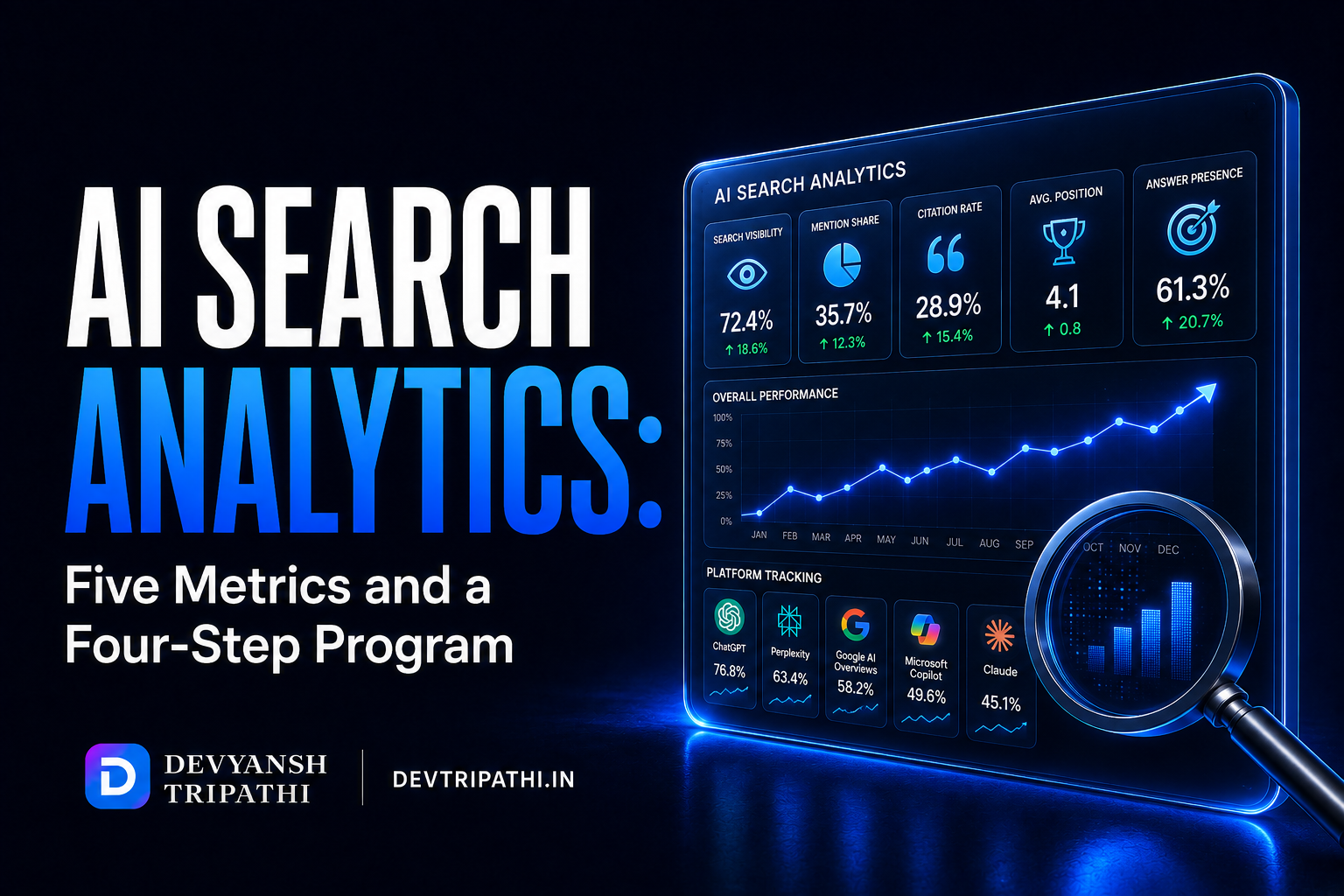
AI visibility performance in 2026 is defined by five distinct metrics that together provide a complete picture of how your brand performs across the AI search ecosystem. Each metric captures a different dimension of AI search performance that the others cannot replace.
| Metric | What It Measures | Tracking Method | Reporting Cadence |
|---|---|---|---|
| Brand Mention Rate | Percentage of target queries where your brand appears in AI responses | Automated tools (Visiblie, Otterly.AI) or manual testing across platforms | Weekly |
| Share of Model (SoM) | Your citation frequency vs competitors for the same target queries | Authoritas, SE Ranking AI Tracker, AthenaHQ, or Profound | Weekly |
| Citation URL Rate | Which of your specific pages are being linked as sources in AI responses | Profound, Botify AI Visibility Dashboard, or manual source tracking | Weekly |
| Sentiment and Accuracy | Whether AI systems describe your brand positively and accurately | Visiblie accuracy tracking, Scrunch AI, or manual response review | Monthly |
| AI-Referred Traffic | Sessions and revenue from users clicking through from AI platform citations | GA4 custom channel group for chatgpt.com, perplexity.ai, gemini.google.com | Monthly |
Metric 1: Brand Mention Rate
Brand Mention Rate is the percentage of relevant AI search responses that include your brand name across a defined set of target queries. It is the primary AI visibility metric and the direct equivalent of Share of Voice in traditional media measurement. When tracking Brand Mention Rate, segment your prompt set by topic cluster, query type (informational, commercial, comparison), and AI platform. A brand might have 66% visibility on awareness-stage queries but only 18% at the decision stage, and treating aggregate visibility without this segmentation obscures the most actionable insights.
Tracking at a category level rather than on individual prompts produces more reliable patterns due to the non-deterministic nature of large language models. The same query submitted twice to ChatGPT may produce different responses with different brand mentions. Averaging results across multiple query iterations and time periods at the category level provides statistically meaningful visibility scores that individual prompt checks cannot.
Metric 2: Share of Model (SoM)
Share of Model is the AI search equivalent of Share of Voice in traditional marketing. It measures what percentage of AI-generated responses for your target queries include your brand, compared to the total brands mentioned for those same queries. If your brand appears in 4 out of 10 AI responses for your target query set and your top competitor appears in 7 out of 10, your Share of Model is 40% and your competitor’s is 70%. This competitive benchmark shows whether your optimization efforts are improving your position relative to the market, not just in absolute citation count.
Share of Model is particularly valuable because it surfaces competitive gaps: the queries where competitors dominate AI responses while your brand is absent. These gaps identify precisely which topics need content investment or digital PR effort to improve citation rate, making SoM the most actionable competitive intelligence available in AI search measurement. For the complete GEO strategy that improves Share of Model, see our AI Citation Optimization guide.
Metric 3: Citation URL Rate
Citation URL Rate distinguishes between two types of AI brand presence: a linked citation where the AI includes a hyperlink to your domain as a source, and an unlinked mention where your brand is referenced in the response text without a link. Both matter but measure different outcomes. Linked citations drive measurable referral traffic sessions visible in GA4. Unlinked mentions build brand association without generating direct traffic.
According to Daily Emerald’s 2026 AI rank tracking research, placement and prominence within AI responses matters significantly: a brand mentioned first in an AI response receives disproportionately more engagement than a brand mentioned eighth in a long list. Track not just whether your pages are cited, but where in the response the citation appears. Citation URL Rate and citation position together provide a complete picture of your sourcing authority across AI platforms.
Metric 4: Sentiment and Accuracy
Sentiment and accuracy monitoring detect two distinct problems. Sentiment tracking identifies whether AI platforms describe your brand positively, neutrally, or negatively when it appears in responses. Accuracy tracking identifies when AI platforms generate incorrect information about your brand, including wrong pricing, fabricated features, incorrect founding dates, or misattributed quotes.
AI hallucinations about brands are directly traceable to weak or inconsistent entity signals in training data and knowledge sources. Visiblie’s 2026 AI tools comparison identifies accuracy tracking as a distinctive feature that detects when AI platforms hallucinate incorrect information about a brand. Catching and correcting AI hallucinations requires both monitoring and active entity signal management through Wikidata, Organization schema, and consistent on-site entity data. For the entity management strategy that prevents AI hallucinations, see our Knowledge Graph Optimization guide.
Metric 5: AI-Referred Traffic and Revenue
AI-referred traffic is the click-through component of AI citation performance. When a user encounters your brand cited in a ChatGPT, Perplexity, or Google AI Overview response and clicks through to your site, that session is recorded in GA4 with a referral source from the AI platform’s domain. Set up a custom channel group in GA4 that captures all AI-referred sessions by filtering for source domains including chatgpt.com, perplexity.ai, bing.com (for Copilot traffic), and gemini.google.com. Monitor this channel monthly for session volume, conversion rate, and revenue attribution.
One of the most valuable connections in AI visibility data is the relationship between AI citations and branded search traffic, according to Digital Applied’s AI visibility tools research. When an AI assistant mentions your brand, users frequently search for the brand name directly afterward. Monitor branded query impression growth in Google Search Console monthly as the downstream signal that AI citation activity is generating brand recall that converts to direct intent.
What the 2026 Data Reveals About AI Citation Patterns
Understanding the structural patterns in AI citation selection gives AI visibility tracking a predictive dimension: you can identify which content types, formats, and structural choices are most likely to produce measurable citation improvements before committing resources to creating them.
Content Format Directly Determines Citation Rate
Track My Visibility’s 2026 AI search statistics research found that listicles achieve a 25% AI citation rate compared to only 11% for opinion pieces. That is a 127% difference in citation probability based solely on content format. AI systems can parse structured listicle content more reliably than unstructured prose, making format selection one of the highest-ROI AI citation optimization decisions available before a page is even written.
The positioning of content within the page also determines citation probability. 44.2% of ChatGPT citations come from the first 30% of page text, according to Search Engine Land research cited by Track My Visibility. This data confirms the critical importance of answer-first content structure: the content most likely to be cited must appear at the beginning of the page, not buried after several introductory paragraphs. For every page targeting an AI citation, the most citable content must appear in the first 150 words.
Reddit and YouTube Now Account for 26% of AI Overview Citations
One of the most commercially significant AI visibility data points of 2026 is the emergence of community platforms as major citation sources. Reddit and YouTube now account for nearly 26% of AI Overview citations, according to Track My Visibility’s research. This transforms community platform presence from a brand awareness activity into a directly measurable AI citation input.
For brands not actively participating in Reddit communities, Quora, and YouTube content in their niche, this 26% of AI Overview citations is being captured entirely by competitors and community members discussing alternative options. Building authentic community presence is no longer a soft brand building activity. It is a measurable AI citation optimization strategy with a directly trackable impact on Share of Model performance. For the complete community signal strategy, see our Brand Authority SEO guide.
The Complete AI Visibility Tool Stack for 2026
The AI visibility tools category emerged in 2024 to 2025 as AI-powered search shifted from niche experiment to board-level priority. The combined keyword cluster around AI visibility tools now exceeds 1,860 monthly searches at premium CPCs of $29 to $52, according to Visiblie’s DataForSEO research. The market has matured rapidly and the current tool landscape offers solutions across every budget level and use case.
| Tool | AI Models Covered | Key Strength | Best For |
|---|---|---|---|
| SE Ranking AI Tracker | ChatGPT, Perplexity, Gemini, Copilot | Brand Visibility Index + Competitive Benchmarking module for purchase-intent prompts | Agencies and marketing teams needing traditional SEO plus AI tracking in one platform |
| Visiblie | Up to 8 models: ChatGPT, Gemini, Perplexity, Claude, DeepSeek, Grok, Meta AI, Mistral | Accuracy tracking for hallucination detection plus broadest model coverage available | Brands needing cross-model monitoring with AI accuracy and hallucination detection |
| Authoritas | Google AI Overviews, Bing Copilot, ChatGPT, Perplexity | Branded vs unbranded query separation keeping AI Share of Voice analysis clean | Brands separating brand-specific queries from generic industry questions for precise SoM |
| Profound | ChatGPT, Gemini, AI Overviews and expanding | Eight-category citation taxonomy (Owned, Earned Media, PR Wire, Social, Institutional) | Deep citation source analysis and connecting AI mention data to analytics platforms |
| Semrush AI Visibility Checker | ChatGPT, AI Overviews, Gemini | Free access for initial baseline checks and periodic branded and unbranded monitoring | Teams needing a free initial assessment before committing to a paid monitoring platform |
| GA4 Custom Channel Group | All platforms via referral domain filtering | Direct revenue attribution for AI-referred sessions connecting citations to commercial outcomes | All brands — essential complement to every other tool in the AI visibility stack |
Building Your AI Visibility Measurement Programme: The Four-Step Process
A systematic AI visibility measurement programme requires four sequential steps that establish a baseline, implement consistent tracking, connect metrics to business outcomes, and create the reporting cadence that makes AI visibility data actionable for strategy decisions and stakeholder reporting.
Step 1: Define Your Target Prompt Set
Create a structured set of 20 to 50 queries representing the AI search interactions most relevant to your business. Organise them into four categories: awareness queries covering your topic area at an educational level, comparison queries where users are evaluating options, decision queries where users are ready to choose, and branded queries where users already know your brand and are doing pre-purchase research.
Concentrate your prompt set on 15 to 20 high-value prompts rather than broad tracking sets of 100 or more. Research from Citation Labs found that concentrated efforts on 15 to 20 high-value prompts outperformed broader tracking by 73% in terms of conversion-driven insights. Quality and relevance of prompt selection matters far more than quantity. Maintain the same prompt set across time periods so tracking data is comparable week over week as optimizations are implemented.
Step 2: Establish Your Baseline
Before implementing any GEO optimization, measure your current AI visibility across your full prompt set. For each query in each platform, record: whether your brand appears (mention rate), whether any of your pages are linked as sources (citation URL rate), your position within the response if mentioned (prominence), which competitors appear (competitive benchmark), and whether the brand description is accurate (accuracy).
According to Digital Applied’s AI visibility tools research, this baseline is the benchmark against which all future optimization results are measured. Without it, you cannot demonstrate improvement, identify which optimizations produced the most significant citation rate changes, or make the ROI case for continued AI visibility investment. Set up automated alerts for significant mention drops or competitor gains after establishing the baseline, so the team is notified of changes between formal reporting cycles.
Step 3: Set Up GA4 AI-Referred Traffic Tracking
Create a custom channel group in Google Analytics 4 that captures sessions from all known AI platform domains. Navigate to Admin, then Data Display, then Channel Groups in GA4. Create a new channel called AI Search and include session source conditions matching: chatgpt.com, perplexity.ai, bing.com (for Copilot), gemini.google.com, and claude.ai. Apply the custom channel group to your reports and monitor sessions, engagement rate, conversion rate, and revenue attributed to this channel monthly.
Configure conversion events in GA4 that track your commercial actions: form submissions, demo requests, pricing page visits, and checkout initiations. Monitor conversion rates from AI-referred sessions separately from standard organic sessions. AI-referred visitors consistently convert at 4.4 times higher rates than standard organic traffic according to GetReviewFast research, making this channel’s conversion efficiency one of the strongest arguments for sustained AI visibility investment.
Step 4: Create Weekly and Monthly Reporting Cadence
Weekly AI visibility reports should cover Brand Mention Rate across all target platforms for the defined prompt set, Share of Model movement versus top three competitors, any significant citation URL additions or losses (which pages started or stopped being cited), and any prompt-level anomalies requiring investigation.
Monthly AI visibility reports should cover the complete five-metric performance summary, competitor gap analysis identifying queries where competitors dominate that your brand should be winning, sentiment and accuracy audit results, AI-referred traffic and revenue from GA4 with conversion rate benchmarks, branded search volume trend from Google Search Console as the downstream brand recall signal, and content and PR recommendations for improving citation rate on the lowest-performing queries in the target prompt set. Most tools support Slack or email notifications for automated alerts between formal reporting cycles.
For the complete AEO strategy that connects measurement insights to content optimization actions, see our AEO Advanced Strategy guide.
Build an AI Visibility Measurement Programme That Drives Strategy
Stop Guessing at Your AI Search Performance. Start Measuring It Systematically.
Get a complete AI visibility measurement setup covering your target prompt set definition, baseline assessment, GA4 AI channel configuration, tool selection, and weekly reporting template tailored to your specific business and competitive landscape.
Get My AI Visibility SetupFrequently Asked Questions About AI Visibility Tracking
The following questions address the most common practical uncertainties when building and operating an AI visibility measurement programme for the first time in 2026.
What is AI visibility tracking?
AI visibility tracking is the systematic monitoring of how often, how prominently, and how accurately your brand appears in AI-generated responses across ChatGPT, Perplexity, Google AI Overviews, Gemini, and Copilot. It uses citation frequency, Share of Model, sentiment, citation URL rate, and AI-referred traffic as the primary performance metrics that measure the AI search visibility that traditional keyword ranking reports cannot capture.
Why do keyword rankings not capture AI search performance?
Keyword ranking dashboards measure position in a list of ten blue links on a traditional SERP. AI search platforms do not produce ranked lists. They produce synthesized conversational responses that may mention zero brands, one brand, or several brands depending on the query. A page can rank first on Google for a target keyword and have zero mentions in ChatGPT, Perplexity, or Google AI Mode responses for related queries. The metrics that matter for AI performance are citation frequency and Share of Model, not keyword position.
What is Share of Model (SoM)?
Share of Model is the AI search equivalent of Share of Voice in traditional media measurement. It measures what percentage of AI-generated responses for your target queries include your brand, compared to the total brands mentioned for those same queries. If your brand appears in 4 out of 10 AI responses for your target query set and your top competitor appears in 7, your Share of Model is 40% and your competitor’s is 70%. Tracking SoM weekly provides the competitive benchmark that makes AI visibility progress relative to market position rather than only absolute citation count.
What content format produces the highest AI citation rate?
Listicle-format content achieves a 25% AI citation rate compared to only 11% for opinion pieces, according to Track My Visibility’s 2026 AI search statistics research. That is a 127% difference in citation probability based solely on content format. AI systems parse structured listicle content more reliably than unstructured prose. For every commercial or comparison query where you want AI citation, building a structured listicle page with clear items, comparison tables, and H3 subheadings per item is the highest-probability content format choice available.
How much of a page do AI systems cite from?
44.2% of ChatGPT citations come from the first 30% of page text, according to Search Engine Land research cited in Track My Visibility’s 2026 AI statistics compilation. This data confirms that the content most likely to be cited must appear at the beginning of the page in the first 150 words, not after introductory paragraphs. An answer-first content structure where the most important, most citable content appears before any supporting context is the single highest-impact structural change available for improving AI citation probability on existing pages.
How do I set up AI-referred traffic tracking in GA4?
Create a custom channel group in Google Analytics 4 under Admin, Data Display, Channel Groups. Add a new channel called AI Search and include session source conditions matching: chatgpt.com, perplexity.ai, bing.com, gemini.google.com, and claude.ai. Apply the custom channel group to your reports and monitor sessions, conversion rate, and revenue from this channel monthly. Configure conversion events for your commercial actions so you can track conversion rates from AI-referred sessions separately from standard organic traffic.
What is the difference between a linked citation and an unlinked mention?
A linked citation is when an AI platform includes a clickable hyperlink to your domain as a source within its generated response. This drives measurable referral traffic sessions visible in GA4 as AI-referred sessions. An unlinked mention is when your brand name is referenced in the AI response text without a hyperlink. This builds brand association and awareness without generating direct click-through traffic. Both have value but measure different outcomes, and professional AI visibility tools track both types separately by platform.
How often should I run AI visibility tracking?
Weekly tracking is the recommended frequency for Brand Mention Rate, Share of Model, and Citation URL Rate across your defined target prompt set. Weekly data allows correlation of content updates and digital PR activities with citation rate changes within a measurable timeframe. Monthly tracking for Sentiment and Accuracy, AI-referred traffic in GA4, and branded search volume in Google Search Console provides the business outcome context that makes weekly citation data commercially meaningful for stakeholder reporting.
Can AI visibility tracking reveal competitor strategy?
Yes. Tracking which competitors appear in AI responses for your target queries reveals which brands have stronger entity authority, better content structure, or more extensive digital PR programs in your category. Competitor citation patterns identify the specific topics and platforms where competitors have citation advantages, providing a direct content and PR gap analysis that guides GEO strategy priorities. Share of Model tracking against top competitors makes this competitive intelligence systematic and trackable over time.
What role does community platform presence play in AI citation rates?
Reddit and YouTube now account for nearly 26% of AI Overview citations, according to Track My Visibility’s 2026 research. This makes community platform presence a directly measurable AI citation input rather than a soft brand awareness activity. For brands not actively present on Reddit and YouTube in their niche, that 26% of AI Overview citations is being captured entirely by competitors and community members discussing alternative options. Building authentic, consistent community presence is now a measurable GEO strategy with trackable Share of Model impact.
How do I track branded search as a downstream AI citation signal?
Filter your Google Search Console Performance report for queries containing your brand name variations. Track the monthly impressions and clicks for branded queries as a trend over time. When AI citation activity increases, users who encounter your brand in AI-generated responses frequently search for your brand name directly afterward. Month-over-month branded search impression growth above 15% consistently correlates with active AI citation activity and represents the most accessible downstream signal of AI citation performance available without specialized AI visibility tools.
What is the minimum viable AI visibility tracking setup for a small team?
A minimum viable setup requires three elements. First, a defined prompt set of 15 to 20 target queries tested manually in ChatGPT, Perplexity, and Google AI Mode once per week, with results recorded in a simple tracking spreadsheet. Second, a GA4 custom channel group capturing sessions from chatgpt.com, perplexity.ai, and bing.com. Third, a Google Search Console branded query filter tracking monthly branded impression volume. This three-element setup costs nothing in tool fees, requires approximately two hours per week, and captures the three most important signals: citation frequency, AI-referred traffic, and branded search momentum.
Ready to Build AI Visibility Measurement That Drives Real Strategy?
Get a Complete AI Visibility Tracking Programme Built for Your Business
Free strategy session covering your target prompt set, baseline AI citation assessment, GA4 AI channel setup, tool selection from the 2026 stack, weekly reporting template, and the competitive gap analysis that shows exactly where your brand needs to close Share of Model ground against top competitors.
Get My Free AI Visibility SessionConclusion
AI visibility tracking is the measurement layer that makes every GEO and AEO optimization accountable, measurable, and improvable. Without it, brands are optimizing for an outcome they cannot measure, investing in content and PR changes without knowing whether they produced citation rate improvements, and reporting search performance to stakeholders with less than half the data their search strategy actually generates.
The framework is clear and immediately actionable. Define your target prompt set. Establish your baseline across ChatGPT, Perplexity, Gemini, and Google AI Mode. Set up GA4 AI-referred traffic tracking. Select the tools that match your budget and model coverage requirements. Create weekly and monthly reporting cadences that connect citation rate data to branded search growth and AI-referred revenue. Monitor competitor Share of Model to identify the gaps that content and PR investment should close.
The data that shapes strategy is already available in the platforms your audience is already using daily. Listicles earn citation at more than twice the rate of opinion pieces. 44.2% of citations come from the first 30% of page text. Reddit and YouTube drive 26% of AI Overview citations. Community platform presence is measurable. Entity clarity determines hallucination risk. Every one of these insights is actionable this week with existing content and tools. For the complete AISEO strategy framework that this measurement guide supports, see our AI Search Optimization guide.

Devyansh Tripathi
I’m Devyansh Tripathi, an SEO strategist and digital growth expert, helps businesses and individuals rank higher and drive organic traffic. Through DevTripathi., he shares cutting-edge SEO insights, content strategies, and marketing hacks. Passionate about digital success, he’s on a mission to make SEO simple, effective, and result-driven!
Posts
- What Google’s New AI Search Documentation Means for SEO Teams
- Google I/O 2026 Search: AI Agents, Gemini 3.5 and the Unified Box
- Google’s AI Optimization Guide: The Technical and Content Checklist
- July 2026 SEO Update: AI Overviews, llms.txt and Search Console
- Prompt Optimization Beyond Page One: The Position-21 Citation Opportunity
Categories
- AI Citation Optimization
- AI Search Optimization (AISEO)
- AI Visibility Tracking
- Answer Engine Optimization (AEO)
- Brand Authority SEO
- Brand SERP Optimization
- Community Signal SEO
- Conversational Search Optimization
- Generative Engine Optimization (GEO)
- Knowledge Graph Optimization
- Modern SEO Strategies
- Multimodal Search Optimization
- Prompt Optimization
- SEO Trends
- Social Search Optimization
- Topical Authority SEO
- Uncategorized
- Video Search SEO
- Visual Search Optimization
- Voice Engine Optimization (VEO)
- Zero Click Search Optimization
Latest News
Text Widget
Empowering brands with insights, strategies, and stories that drive digital growth.