
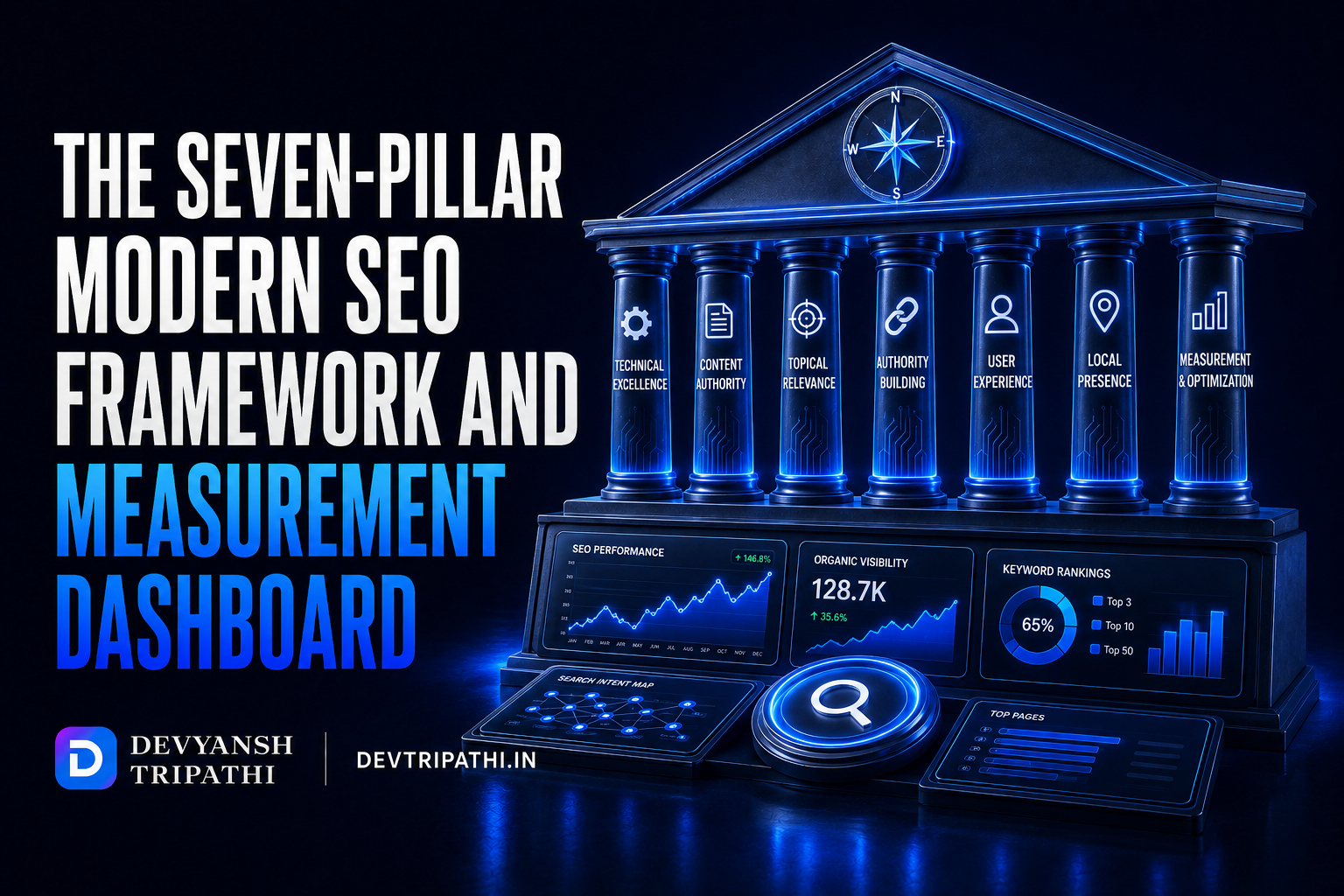
The Seven-Pillar Modern SEO Framework and Measurement Dashboard
19 June 2026
Modern SEO strategies in 2026 require optimizing simultaneously for traditional Google rankings and AI-generated search surfaces, because the number one organic position no longer guarantees visibility when AI Overviews intercept 83% of informational queries and only 14% of marketers currently track the AI citation performance that determines brand discovery across the fastest-growing search channel available.
This guide covers the complete Modern SEO Strategies framework: what the data confirms has and has not changed in search ranking, the seven pillars of multi-surface SEO, the specific content quality and entity optimization actions that drive the highest measured ROI, the 91% single-platform citation problem that most GEO strategies fail to address, and the six-dimension measurement dashboard that replaces keyword-ranking-only reporting with complete visibility intelligence across both traditional and AI search surfaces in 2026.
Modern SEO Audit for 2026
Is Your SEO Strategy Built for the Search Landscape That Exists in 2026?
Get a complete modern SEO audit covering your seven-pillar performance, multi-surface visibility gaps, content quality score, entity authority, AI citation rate, and the priority actions that generate the highest ROI for your domain in the current search environment.
Get My Modern SEO AuditWhat Modern SEO Strategies Mean in 2026
Modern SEO strategies in 2026 mean optimizing for two parallel search surfaces with different ranking mechanisms, different content preferences, and different measurement requirements. Traditional Google search still drives the majority of clicked traffic for commercial and transactional queries. AI-generated search, comprising AI Overviews, AI Mode, ChatGPT, Perplexity, and Gemini, now intercepts the majority of informational queries and delivers synthesized answers that either cite your brand or exclude it entirely.
The critical framing is that these surfaces are not alternatives. Traditional rankings are the prerequisite for AI Overview citation: 93.67% of AI Overview citations come from URLs in the top-10 organic results. But ranking in the top 10 is no longer sufficient to guarantee AI citation selection. Content must also be structured, attributed, and entity-verified in ways that convert ranking eligibility into actual citation. Modern SEO addresses both layers as one integrated system rather than as competing priorities.
What Has Not Changed in Modern SEO
Before addressing new requirements, establishing what has not changed is essential. High-quality content, backlinks, and search intent alignment remain the top three ranking factors in 2026. The first organic result still captures 39.8% of all clicks. Moving from position two to position one still generates 74.5% more clicks. Rich results earn 58% of clicks versus 41% for non-rich results. Only 0.78% of users click results on page two.
These traditional mechanics have not been replaced. They have been augmented. AI search did not replace traditional SEO. It added a second optimization requirement on top of the traditional foundation. Brands that abandon traditional SEO fundamentals in favor of AI-only optimization lose both games. Brands that maintain traditional SEO excellence while adding AI citation optimization win across every available search surface simultaneously.
54%of SEO professionals name content quality as their number one active strategy in 2026 (Goodfirms)
325%more AI citations from earned media distribution versus own-domain publishing (Stacker Dec 2025)
14%of marketers track AI visibility despite 2 billion monthly AI Overview users (Goodfirms 2026)
91%of AI citations appear in only one AI engine — requiring platform-specific optimization (Growth Memo May 2026)
The Seven Pillars of Modern SEO Strategy
Modern SEO in 2026 operates across seven interdependent pillars that together create compounding search visibility across both traditional rankings and AI-generated surfaces. Optimizing one pillar in isolation produces diminishing returns. Building all seven systematically creates the compound authority that separates consistently dominant domains from those that win individual battles but lose the overall visibility competition.
| Pillar | Primary Outcome | Top 2026 Action | Measurement Signal |
|---|---|---|---|
| Content Quality and Intent | Rankings, featured snippets, AI citations | Answer-first structure, information gain, expert attribution | Organic CTR, featured snippet ownership |
| Technical SEO Foundation | Crawlability, indexing, Core Web Vitals | AI crawler access in robots.txt, Bing indexing, schema stack | Core Web Vitals, index coverage reports |
| Entity and Brand Authority | Knowledge Panel, AI citation eligibility | Wikidata, Organization sameAs, review profiles | Knowledge Panel status, AI citation rate |
| Topical Authority Clusters | Broad ranking coverage, AI fan-out matching | Pillar-and-cluster architecture, internal link mesh | Cluster traffic growth, ranking velocity |
| Digital PR and Earned Media | Domain authority, AI citation expansion 325% | Industry publication mentions, wire distribution | Referring domain growth, Share of Model |
| Multi-Surface AI Visibility | AI Overview citations, community signals | GEO optimization, FAQPage schema, Reddit presence | AI citation frequency per platform |
| Trust Architecture | E-E-A-T compliance, conversion rate | Author credentialing, review generation, transparency | Organic conversion rate, branded CTR |
Pillar 1: Content Quality and Search Intent
Content quality and search intent alignment is the top active modern SEO strategy named by 54% of professionals. This is not a coincidence or sentiment. It reflects the consistent outcome of every major Google quality algorithm update: there is no technical shortcut that produces lasting rankings without content that genuinely satisfies user intent better than every competing page.
In 2026, content quality has a precise definition: the degree to which content provides the most complete, accurate, helpful, and trustworthy answer for the specific search intent of a target query. The most impactful structural improvement for existing content is the answer-first format, placing the direct answer in the first 150 words before any background. This simultaneously improves featured snippet eligibility, AI Overview citation probability, and traditional CTR. For the complete topical architecture that governs this at cluster level, see our Topical Authority SEO guide.
Pillar 2: Technical SEO Foundation
Technical SEO in 2026 includes three new requirements alongside traditional page speed, mobile-friendliness, and crawlability checks. First, verify that AI crawlers including GPTBot, ClaudeBot, and PerplexityBot are not blocked in your robots.txt file — many sites inadvertently block them with broad disallow rules. Second, confirm Bing indexing independently of Google, because 87% of ChatGPT citations match Bing’s top-10 results and ChatGPT performance is invisible in Google Search Console. Third, deploy the full JSON-LD schema stack: FAQPage, Article, HowTo, Speakable, and Organization with sameAs, which rich results research confirms drives 58% of clicks versus 41% for non-structured results.
Core Web Vitals compliance remains essential. Pages with LCP above 2.5 seconds receive lower page experience signals and are deprioritized in voice search retrieval. A 100-millisecond LCP improvement produces approximately 1% conversion rate improvement according to Google’s own research, making speed investment dual-purpose for both rankings and commercial performance.
Pillar 3: Entity and Brand Authority
Trust has become the primary filter for AI inclusion. Every respondent in Goodfirms’ 2026 survey agreed that trust signals are increasingly critical as AI systems decide which sources to surface. AI systems use entity signals, brand recognition, and multi-source corroboration as trustworthiness proxies because they cannot independently verify content quality.
Entity building in 2026 requires the six-lever sequence: Wikidata entry, Organization schema with sameAs array, verified Google Business Profile, review platform profiles, credentialed author pages, and earned media mentions. The 52-percentage-point AI citation lift from a minimal review profile (1% to 53.5% citation rate per Seer Interactive) represents the highest single-action ROI in modern SEO: one hour of profile setup produces citation authority that years of content investment cannot independently achieve. For the complete entity building sequence, see our Knowledge Graph Optimization guide.
Pillar 4: Topical Authority Clusters
Topical authority clusters of five to seven or more interlinked pages outperform isolated pages for both Google rankings and AI citation likelihood. This reflects the query fan-out mechanism: AI systems decompose complex queries into multiple sub-queries, and domains with comprehensive cluster coverage match more sub-queries and earn more citations across the full breadth of the AI response generation process than domains with isolated strong pages.
Building clusters requires a pillar page per core topic linking outward to all cluster pages, cluster pages linking back to the pillar and laterally to adjacent pages, and the three-way internal link architecture that communicates topical domain expertise. Each new cluster page published strengthens all existing pages in the silo simultaneously through the internal authority distribution that isolated pages never receive.
Pillar 5: Digital PR and Earned Media
Earned media distribution increases AI citations by up to 325% compared to publishing only on your own domain according to Stacker’s December 2025 research. This reframes digital PR from brand awareness into a core AI citation optimization strategy with a specific, measurable ROI that most SEO strategies have not yet factored into resource allocation decisions.
The mechanism is multi-source corroboration: AI systems gain citation confidence from brands mentioned in multiple independent authoritative sources. A brand mentioned in three industry publications creates a consensus signal that AI retrieval systems treat as significantly higher confidence than the same brand appearing only in self-published content. Building three to five industry publication placements per month simultaneously builds domain authority and AI citation authority. For the brand authority framework this feeds, see our Brand Authority SEO guide.
Pillar 6: Multi-Surface AI Visibility
The 91% single-platform citation finding from Growth Memo’s May 2026 analysis has a direct and underappreciated strategic implication: only 2% of cited URLs appear across AI Overviews, ChatGPT, and Perplexity simultaneously. Comprehensive AI visibility requires platform-specific optimization for each major AI surface independently.
Google AI Overviews require traditional top-10 ranking plus answer-first content structure and FAQPage schema. ChatGPT requires Bing indexing plus long-form comprehensive depth and expert attribution. Perplexity requires content freshness updated at least quarterly plus statistics with named source citations. The platforms share foundational requirements but diverge on selection criteria in ways that produce almost entirely non-overlapping citation pools. For the complete platform-specific strategy, see our GEO Advanced Playbook.
Pillar 7: Trust Architecture
E-E-A-T in 2026 is evaluated through off-site validation rather than only on-page signals. Which authoritative publications mention your brand, which trusted platforms reference your expertise, and what the web consensus is about your credibility are now the primary E-E-A-T evaluation inputs that AI systems rely on because they can be independently verified from multiple sources rather than being self-declared on-page signals.
The practical trust architecture requirements are: named credentialed authors on all published content with author pages linking to external credentials, review platform presence with professional response to all reviews, HTTPS and security hygiene, transparent business information including founding date, team, and location, and consistent factual accuracy across all content that can be independently verified. For the complete brand SERP trust strategy, see our Brand SERP Optimization guide.
The Modern SEO Measurement Dashboard for 2026
Modern SEO measurement requires expanding from a three-metric traditional dashboard to a six-dimension visibility framework that captures performance across both search surfaces simultaneously. The 86% of marketing teams without AI visibility tracking are making resource allocation decisions with less than half the data their search strategy actually generates.
The Six-Dimension Modern SEO Dashboard
Traditional Rank Tracking
Monitor positions for top 50 commercial queries monthly. Focus on positions one through three where 68.7% of clicks concentrate. Moving from position two to one generates 74.5% more clicks, making top-three the threshold that matters most.
Organic CTR and Impressions
Track in Google Search Console weekly. Rising impressions with stable or declining CTR indicates increasing AI Overview interception on target queries, signaling precisely where GEO investment should be prioritized to recover visibility.
AI Citation Share per Platform
Test top 50 queries weekly in ChatGPT, Perplexity, and Google AI Mode separately. Track citation rate per platform independently because 91% of citations appear in only one AI engine, making aggregate tracking misleading.
AI-Referred Traffic in GA4
Configure a custom channel group for chatgpt.com, perplexity.ai, and gemini.google.com. This channel converts at up to 15.9% from ChatGPT versus 1.76% from organic, making it the highest-value acquisition channel to monitor monthly.
Branded Search Volume Growth
Track branded query impressions monthly in Search Console. Growth above 15% month over month confirms multi-surface visibility investment is generating brand recall that converts to direct intent across all acquisition channels over time.
SERP Feature Ownership
Track featured snippet and People Also Ask ownership for target queries in Semrush or Ahrefs monthly. Each SERP feature won represents both direct zero-click brand visibility and voice search answer eligibility simultaneously.
Build Modern SEO That Wins Across Every Search Surface
Most SEO Strategies Are Optimizing for the 35% of Searches That End in a Click While Missing the 65% That Do Not
Book a strategy session and get a complete modern SEO framework covering your seven-pillar audit, multi-surface visibility gaps, AI citation measurement setup, and the specific priority actions that generate the highest ROI for your domain right now.
Book My Modern SEO Strategy SessionFrequently Asked Questions About Modern SEO Strategies
What are the most important modern SEO strategies in 2026?
The most important modern SEO strategies operate across seven pillars: content quality and search intent alignment (named by 54% of professionals as the top strategy), technical SEO including AI crawler access, entity and brand authority through Knowledge Graph optimization, topical authority clusters, digital PR for 325% AI citation expansion, multi-surface AI visibility optimization, and trust architecture covering E-E-A-T and review signals. All seven work together rather than in isolation.
Has AI search replaced the need for traditional SEO?
No. High-quality content, backlinks, and search intent remain the top three ranking factors in 2026. The first organic result still receives 39.8% of all clicks. Traditional rankings are the prerequisite for AI Overview citation eligibility, with 93.67% of AI Overview citations coming from top-10 organic URLs. AI search has added a second optimization requirement on top of traditional SEO rather than replacing it, making both simultaneously necessary for comprehensive search visibility.
Why do only 14% of marketers track AI visibility?
AI visibility tracking requires tools and measurement frameworks beyond standard SEO analytics platforms that most teams have not yet adopted. Standard tools track keyword rankings, organic sessions, and CTR but not AI citation frequency, Share of Model, or AI-referred traffic. The 14% figure from Goodfirms’ 2026 survey reflects the early stage of AI measurement adoption. This gap gives brands that build AI tracking now a significant intelligence advantage over 86% of competitors operating without this data.
What is the 91% single-platform citation problem?
Growth Memo’s May 2026 analysis found only 2% of cited URLs appear across AI Overviews, ChatGPT, and Perplexity simultaneously, while 91% of citations appear in only one AI engine. This means a single unified GEO strategy leaves 98% of potential cross-platform citation opportunities unaddressed. Modern SEO requires platform-specific optimization for each major AI surface independently, because citation pools are almost entirely non-overlapping between platforms despite serving users with similar intents.
How does earned media produce a 325% AI citation lift?
AI systems gain citation confidence from seeing a brand mentioned in multiple independent, authoritative sources rather than relying on self-published claims alone. Stacker’s December 2025 research found that distributing content across a wide range of publications produces 325% more AI citations compared to only publishing on your own domain. The mechanism is multi-source corroboration: a brand appearing in three industry publications creates a consensus signal that AI retrieval systems treat as dramatically higher confidence than the same brand in only owned content.
What is the information gain requirement?
Information gain is the requirement that every piece of content add original value unavailable in the same quality on any competing page. Google’s Helpful Content System rewards content that provides something competitors do not: additional data, better explanations, unique frameworks, original research, or deeper practical guidance. Content that only summarizes existing coverage produces no information gain and receives no lasting benefit from Google’s quality evaluation systems regardless of its technical optimization.
How important is E-E-A-T in modern SEO?
E-E-A-T has become the primary evaluation framework for both Google quality assessment and AI system citation eligibility. In 2026, it is evaluated through off-site validation: which authoritative publications mention your brand, which trusted platforms reference your expertise, and what the broader web consensus is about your credibility. Named credentialed authors with verifiable external profiles and earned media presence in recognized publications produce significantly stronger E-E-A-T signals than on-page credentials alone.
What technical SEO changes does AI search require?
AI search adds three new technical requirements. First, verify AI crawlers (GPTBot, ClaudeBot, PerplexityBot) are not blocked in robots.txt, as many sites inadvertently exclude them with broad disallow rules. Second, confirm Bing indexing separately from Google, because 87% of ChatGPT citations match Bing results and ChatGPT performance is invisible in Google Search Console. Third, deploy the complete JSON-LD schema stack (FAQPage, Article, HowTo, Speakable, Organization with sameAs) that rich results research confirms drives 58% of clicks versus 41% for non-structured content.
How should I prioritize the seven modern SEO pillars?
Priority depends on your current performance gaps. For domains with weak entity signals, entity and brand authority including Wikidata, sameAs schema, and review platform setup should be the first investment because the ROI is measurable and fast (1% to 53.5% AI citation rate from a minimal review profile). For domains already ranking well, multi-surface AI visibility and earned media distribution (325% AI citation lift) deliver the highest marginal return. Technical SEO gaps should always be resolved first as a prerequisite for all other pillars to perform at capacity.
What content format works best in modern SEO?
Answer-first content with a 40 to 60 word direct answer in the first 150 words of the page is the highest-performing format for both featured snippet capture and AI Overview citation selection. Listicle-format content achieves a 25% AI citation rate versus 11% for opinion pieces (Track My Visibility 2026). FAQs with standalone 35 to 75 word answers applying FAQPage schema directly target both People Also Ask positions and AI Overview FAQ extraction. Comprehensive pillar guides covering full topical scope match AI fan-out sub-queries across broader query sets.
How do modern SEO strategies apply differently by industry?
AI Overview exposure varies significantly by industry, creating different strategic priorities. B2B technology faces 70% AI Overview exposure, making GEO and AEO the highest-priority investments. E-commerce queries trigger AI Overviews only 4% of the time, meaning traditional ranking and conversion optimization remain the primary focus. Healthcare and education face high AI interception rates but require additional E-E-A-T compliance for YMYL content categories. Local services benefit most from Google Business Profile optimization and Local Pack visibility rather than AI Overview citation strategies.
What is the first step to modernizing an existing SEO strategy?
The first step is the seven-pillar audit: assess your current performance across content quality, technical foundation, entity authority, topical cluster coverage, earned media presence, AI citation rate per platform, and trust architecture. Identify the two or three pillars with the largest gaps relative to your competitive set. Build the improvement roadmap starting with the highest-ROI gap (typically entity authority and earned media for brands with minimal AI visibility) while maintaining the traditional SEO foundation that AI citation eligibility still depends on.
Ready to Build Modern SEO That Compounds Across Every Search Surface?
Get a Complete Modern SEO Framework Built on the Seven Pillars That Drive Rankings and AI Visibility in 2026
Free strategy session covering your seven-pillar assessment, the highest-priority visibility gaps in your domain, your six-dimension measurement dashboard setup, and the specific content and PR actions that generate the fastest measurable ROI in the current search environment.
Get My Free Modern SEO StrategyConclusion
Modern SEO strategies in 2026 require expanding from single-surface keyword optimization to a seven-pillar multi-surface framework that compounds visibility across both traditional Google rankings and AI-generated search surfaces. The data that should define this expansion is verified and substantial: 54% of professionals confirm content quality is still the top strategy. Earned media produces 325% more AI citations than own-domain publishing. Only 14% of teams track AI visibility despite 2 billion monthly AI Overview users. And 91% of AI citations appear in only one platform, making platform-specific optimization essential rather than optional.
The most common modern SEO mistake is treating these discoveries as reasons to abandon the traditional foundation. High-quality content, backlinks, and search intent alignment are still the top three ranking factors. Traditional rankings are still the prerequisite for AI Overview citation eligibility. The modern SEO advantage goes to brands that maintain traditional excellence while systematically adding the entity authority, earned media distribution, platform-specific GEO optimization, and six-dimension measurement framework that converts traditional ranking eligibility into comprehensive multi-surface visibility dominance.
Start with the seven-pillar audit this week. Build your GA4 AI channel group. Verify Bing indexing. Add the complete JSON-LD schema stack. Claim your Trustpilot profile. Pitch one industry publication. These six actions, executable within a single workweek, address the six highest-impact modern SEO gaps for most brands simultaneously. For the complete AI citation strategy that operationalizes multi-surface GEO within this framework, see our AI Citation Optimization guide.

Devyansh Tripathi
I’m Devyansh Tripathi, an SEO strategist and digital growth expert, helps businesses and individuals rank higher and drive organic traffic. Through DevTripathi., he shares cutting-edge SEO insights, content strategies, and marketing hacks. Passionate about digital success, he’s on a mission to make SEO simple, effective, and result-driven!
Posts
- What Google’s New AI Search Documentation Means for SEO Teams
- Google I/O 2026 Search: AI Agents, Gemini 3.5 and the Unified Box
- Google’s AI Optimization Guide: The Technical and Content Checklist
- July 2026 SEO Update: AI Overviews, llms.txt and Search Console
- Prompt Optimization Beyond Page One: The Position-21 Citation Opportunity
Categories
- AI Citation Optimization
- AI Search Optimization (AISEO)
- AI Visibility Tracking
- Answer Engine Optimization (AEO)
- Brand Authority SEO
- Brand SERP Optimization
- Community Signal SEO
- Conversational Search Optimization
- Generative Engine Optimization (GEO)
- Knowledge Graph Optimization
- Modern SEO Strategies
- Multimodal Search Optimization
- Prompt Optimization
- SEO Trends
- Social Search Optimization
- Topical Authority SEO
- Uncategorized
- Video Search SEO
- Visual Search Optimization
- Voice Engine Optimization (VEO)
- Zero Click Search Optimization
Latest News
Text Widget
Empowering brands with insights, strategies, and stories that drive digital growth.