From Answer Engines to Action Engines: AEO for Information Agents
26 June 2026
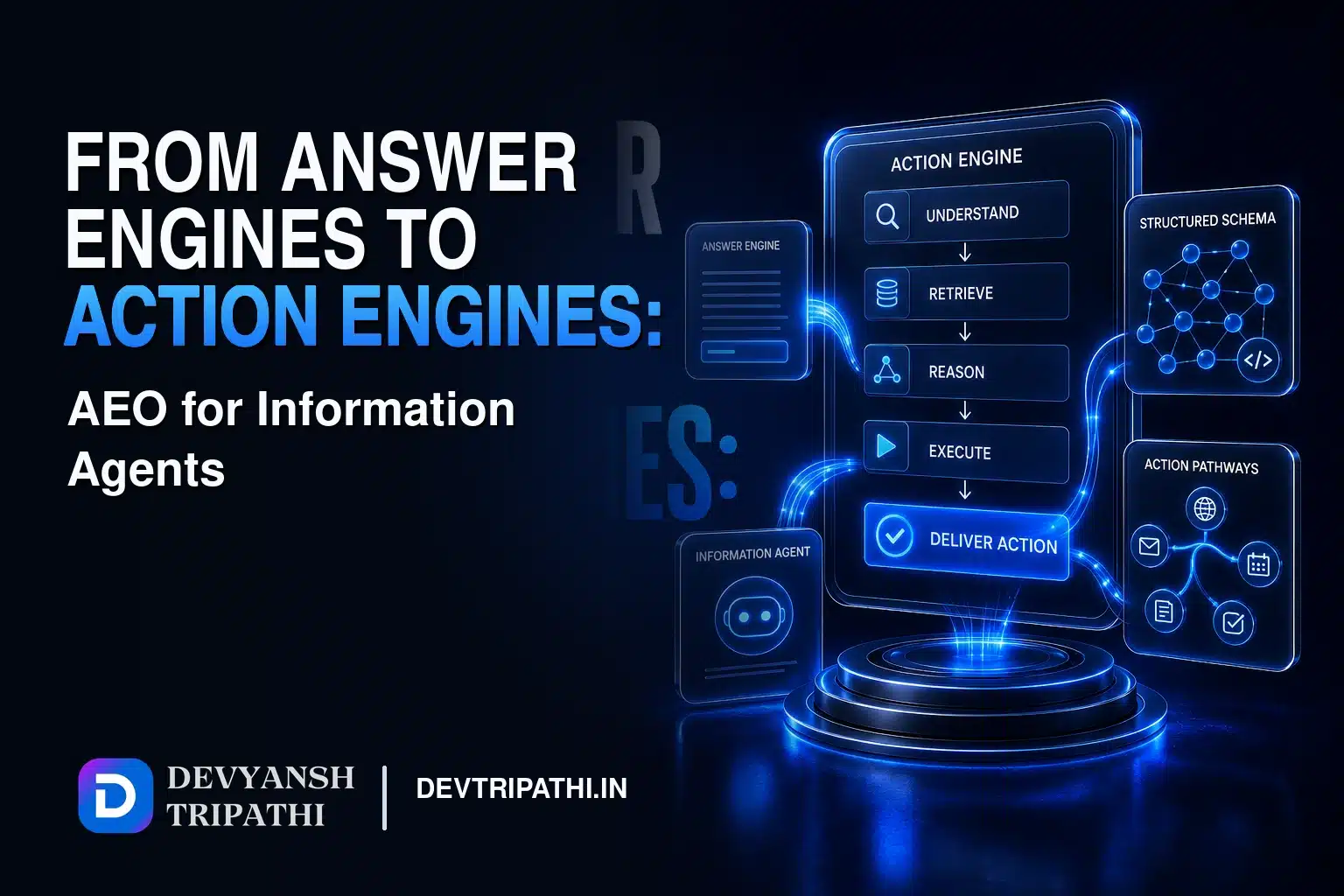
Answer Engine Optimization in 2026 has evolved beyond writing concise answers that AI systems might quote into preparing brand content, entity signals, and operational data for a chain of AI-assisted decisions where Google’s Information Agents, ChatGPT’s Agentic Commerce Protocol, and Bing’s citation reporting create a new optimization target: being the brand AI systems act on, not just cite.
This guide covers the complete AEO framework for the 2026 action engine era. You will learn why answer engines are becoming action engines following Google I/O 2026 and what that means for AEO strategy beyond content optimization, why 45% of consumers now use AI to find local services (up from just 6% in 2025), how AI Mode and AI Overviews cite the same URLs only 13.7% of the time requiring separate optimization tracks, the role of Information Agents as the first proactive AEO surface that rewards content verified on a cadence rather than published once, and the six-part AEO framework for the post-click era that connects answer extraction directly to commercial action rather than stopping at citation presence.
Free AEO Visibility Assessment
Is Your Brand Being Found by the 45% of Consumers Now Using AI to Find Services Like Yours?
Get a complete AEO baseline covering your AI Mode citation rate, AI Overviews citation rate, FAQ schema implementation, content freshness score, Information Agent readiness, and the specific content and technical gaps preventing your brand from appearing in AI-generated answers for your highest-value queries.
Get My AEO AssessmentAnswer Engines Are Becoming Action Engines: What Changed in 2026
Answer Engine Optimization began as a content discipline: write clear, direct answers that AI systems can extract and cite. In mid-2026, that definition is no longer complete. The biggest AEO development of 2026 is that answer engines are becoming action engines. Google’s Information Agents, ChatGPT’s Agentic Commerce Protocol, Bing’s publisher citation reporting, and OpenAI’s expanded product discovery framework have transformed the optimization target from being cited in an AI answer to being the brand AI systems act on behalf of users.
The practical shift is from optimizing a page for an answer to preparing a brand’s content, evidence, entities, and operational data for a chain of AI-assisted decisions, according to VisRank’s July 6, 2026 AEO industry update. A user asking Google’s Information Agent to track when a specific consultant publishes new content will receive proactive notifications with source-linked updates, a referral surface that never existed before. A user asking ChatGPT to find and purchase a specific type of software triggers the Agentic Commerce Protocol, which surfaces brands with structured merchant data feeds. AEO in this new environment requires brands to be structured for answers, actions, and agent-mediated commerce simultaneously.
Google officially confirmed this direction on June 5, 2026 through John Mueller’s Google Search Central Blog post, which explicitly named GEO and AEO as legitimate SEO services and confirmed that strong foundational SEO applied to AI surfaces remains the complete framework without a separate optimization layer required. For the foundational GEO framework that AEO sits on top of, see our GEO Advanced Playbook.
45%of consumers now use AI to find local services, up from 6% in 2025 (BrightLocal 2026)
3.4xmore AI visibility for early AEO adopters vs late adopters (RevvGrowth AEO analysis 2026)
13.7%URL overlap between AI Mode and AI Overviews despite 86% conclusion similarity (Ahrefs, 540K query pairs)
97%of AI Mode responses include at least one citation — making citation optimization universally relevant
Information Agents: The Most Significant New AEO Surface
Google’s Information Agents, announced at Google I/O 2026, are background-running AI agents that monitor the web continuously on a user’s behalf and deliver proactive, source-linked notifications when relevant content is published, updated, or changes. Unlike traditional search where users initiate each query, Information Agents create a persistent monitoring relationship between users and content sources across multiple platforms simultaneously.
For AEO strategy, Information Agents change the optimization target from one-time answer extraction to continuous content verification and freshness. Brands whose content is recognized as authoritative on a topic that users have asked agents to monitor will receive ongoing source-linked notification placements without any user-initiated search. This is the first proactive AEO referral surface: not requiring a user query to generate brand visibility.
What Information Agents Mean for Content Freshness Requirements
The freshness requirements that Information Agents impose go beyond quarterly updates. If an Information Agent is monitoring a topic on behalf of millions of users, the agent will cite content that has been recently verified and updated rather than static pages that may have been accurate when published but have not been maintained. The teams winning AEO in the Information Agent era are tracking when content was last verified, not just when it was published.
Pages not refreshed quarterly are already 3 times more likely to lose AI citations versus recently updated pages according to AirOps’ 2026 State of AI Search Report. Information Agents intensify this penalty. Static pages from previous years will fade from agent recommendations faster than they fade from standard organic results, because agents prioritize content confidence — verifiable, current, maintained — over content that was once well-written but has not been updated to reflect the current state of the topic. The practical requirement is treating your top 50 pages as living documents with a mandatory verification cadence rather than a publish-and-forget content model. For the complete AI visibility measurement framework that tracks these agent-driven citation signals, see our AI Visibility Tracking guide.
The AI Mode and AI Overviews Dual-Track AEO Requirement
One of the most counterintuitive findings in 2026 AEO research is from Ahrefs’ analysis of 540,000 query pairs: AI Mode and AI Overviews cite the same URLs only 13.7% of the time, despite reaching similar conclusions 86% of the time. These two major Google AI surfaces operate from the same search infrastructure but apply different retrieval and selection criteria that produce almost entirely different citation pools.
AI Mode uses a query fan-out technique, issuing multiple related searches across subtopics and data sources before synthesizing, while AI Overviews use a more direct extraction model from the standard search index. The 13.7% URL overlap confirms that optimization for one surface does not automatically transfer to the other. Brands need two scorecards: organic ranking and AI Overview citation as a combined first track, and AI Mode citation as a separate second track with its own optimization requirements. For AEO teams that have been treating AI Mode and AI Overviews as equivalent optimization targets, this finding requires a strategy revision to address both surfaces independently.
Platform-Specific AEO Requirements for 2026
The differences between major AEO platforms are now documented with sufficient precision to require platform-specific content and technical strategies rather than a single universal AEO approach.
| Platform | Query Volume | Top AEO Requirement | Schema Priority | Key Differentiator |
|---|---|---|---|---|
| Google AI Overviews | 2 billion monthly users | Top-10 organic ranking + answer-first content | FAQPage inside Article (60% higher inclusion) | Traditional ranking is the primary eligibility filter |
| Google AI Mode | 1 billion monthly users (surpassed June 2026) | Fan-out sub-query coverage, multimodal content | VideoObject, Product, HowTo | Cites different URLs from AI Overviews 86% of the time |
| ChatGPT Search | 2 billion weekly active users | Bing indexing + entity authority + Wikipedia | Organization sameAs, Article | Agentic Commerce Protocol for product discovery |
| Perplexity | 780 million monthly queries | Content freshness within 30 days | Article with last-modified date | 46.7% Reddit citations — community presence essential |
| Google Information Agents | Expanding from Ultra subscribers | Continuous content verification and freshness cadence | All schema types + freshness signals | Proactive notifications — no user query required |
The Six-Part AEO Framework for the Action Engine Era
The 2026 AEO framework must extend beyond the three-part content structure approach that defined AEO in 2024 and 2025. Action engines require optimization across six dimensions that together prepare a brand for both citation extraction and agent-mediated commercial action.
Part 1: Technical Eligibility (The Non-Negotiable Foundation)
Technical SEO remains the cost of entry for AEO. A site that loads slowly, is not mobile-friendly, blocks AI crawlers in robots.txt, or has poor internal linking cannot win AEO regardless of content quality, schema deployment, or brand authority. Google confirmed at I/O 2026 that AI Mode and AI Overviews still depend on normal Search eligibility and SEO fundamentals. AEO adds answer structure and evidence signals on top of crawlability, indexability, and helpful content, not instead of them.
Verify these six technical prerequisites before any content or schema investment: AI crawlers are not blocked in robots.txt, Bing indexing is confirmed for ChatGPT citation eligibility, Core Web Vitals pass for page experience eligibility, HTTPS is implemented across all pages, internal link architecture connects all content within relevant topical clusters, and the full JSON-LD schema stack is deployed including FAQPage nested inside Article schema for the 60% higher AI Overview inclusion rate that Semrush research identifies.
Part 2: Answer Architecture (The Content Structure Layer)
Content formatted specifically for LLM extraction is 3 times more likely to be cited than unstructured equivalents. The answer architecture requirements for 2026 AEO have five specific structural elements: a direct answer to the primary query in the first 150 words (44.2% of AI citations come from the first 30% of content), Q&A-formatted H2 and H3 headings that mirror target prompt patterns (2 times more AI citations than generic headings), FAQ sections with standalone 35 to 75 word answers per question with FAQPage schema nested inside Article schema, data-dense content with 19 or more data points per pillar page (2 to 3 times more citations), and paragraph length of 2 to 3 sentences maximum for efficient AI extraction.
Part 3: Entity Clarity (The Trust Prerequisite)
Entity clarity — consistent, verified brand identity across Wikidata, Organization schema with sameAs, Google Business Profile, LinkedIn, and major review platforms — is the trust prerequisite that determines whether AI systems cite a brand with high confidence or low confidence. The 45% of consumers using AI to find local services in 2026 receive brand recommendations based significantly on entity clarity signals: a brand with incomplete, inconsistent, or missing entity data receives citations with lower confidence and lower recommendation priority. For the complete entity building sequence, see our Knowledge Graph Optimization guide.
Part 4: Authority Signals (The Brand-Level Citation Driver)
AEO is not just the content team’s job and it is not just an on-page optimization discipline. The Seer Interactive finding that AI systems may decide which brands to recommend from training data before selecting citation pages confirms that brand authority building through earned media, YouTube presence (0.737 correlation), LinkedIn authority (now the number one cited domain for professional queries), and review platform profiles are AEO investments as much as content structure improvements. HubSpot reports 3 times better lead conversion from AEO traffic versus other sources, and early AEO adopters capture 3.4 times more AI visibility, confirming that authority-driven AEO investment produces compounding commercial returns over time.
Part 5: Freshness and Verification Cadence (The Maintenance Layer)
The freshness requirements for AEO in 2026 are more demanding than for traditional SEO. Cited content runs 25.7% fresher than organic top-10 results. Pages not refreshed quarterly are 3 times more likely to lose AI citations. Information Agents reward content that gets verified and updated on a cadence rather than published once and left static. Set up a top-50-page verification cadence: monthly updates for fast-moving topic pages, quarterly updates for evergreen pages, and immediate updates when statistics or expert positions change materially. Track last-verified dates separately from last-published dates, because from the AI system’s perspective, a 2023 statistic in a 2026 article signals stale content regardless of the publication date displayed.
Part 6: Commercial Action Readiness (The 2026 Addition)
The action engine era requires AEO strategies to extend into commercial action readiness. For e-commerce and product brands, OpenAI’s Agentic Commerce Protocol means ChatGPT can now facilitate product discovery through structured merchant feeds, making product feed completeness an AEO requirement for commercial queries. For service brands, the 45% of consumers using AI to find local services means Google Business Profile completeness, LocalBusiness schema, and review generation are now AEO investments rather than only local SEO tactics. For B2B brands, LinkedIn authority and consistent expert content are AEO investments because Copilot for Microsoft 365 specifically integrates LinkedIn data for professional query responses.
Build AEO for the Action Engine Era
88% of Local Businesses Have No AI-Search Strategy Despite 45% of Consumers Using AI to Find Services
Book a strategy session and get a complete AEO programme covering your six-part framework assessment, dual-track AI Mode and AI Overviews optimization, Information Agent freshness cadence, FAQ schema nesting implementation, commercial action readiness audit, and the monitoring programme that tracks citation performance across all five major AEO platforms weekly.
Book My AEO Strategy SessionFrequently Asked Questions About Answer Engine Optimization in 2026
What is Answer Engine Optimization in 2026?
Answer Engine Optimization in 2026 is the practice of preparing brand content, entity signals, and operational data for a chain of AI-assisted decisions across ChatGPT, Perplexity, Google AI Mode, AI Overviews, and Information Agents. It extends beyond writing direct answers that AI can cite to include structured merchant data for Agentic Commerce Protocol, content verification cadences for Information Agent freshness signals, and entity clarity that enables high-confidence brand recommendations before any user query is submitted.
Why have 45% of consumers shifted to using AI for local services?
The 45% consumer AI adoption for local services (up from 6% in 2025) reflects the combination of AI Mode reaching 1 billion monthly users globally, Google’s integration of AI into standard search results for local queries through AI Overviews, ChatGPT becoming a mainstream consumer tool with 2 billion weekly active users, and the natural preference for conversational AI responses over parsing a list of search results when seeking local business recommendations. For local services specifically, AI recommendations name one or two businesses rather than showing 10 options, making AEO visibility more commercially decisive than ranking position.
What are Google’s Information Agents and why do they matter for AEO?
Information Agents, announced at Google I/O 2026, are background-running AI agents that continuously monitor the web on a user’s behalf and deliver proactive, source-linked updates when relevant content is published or changes. They are the most structurally significant AEO development of 2026 because they create a persistent monitoring relationship between users and content sources without requiring any user query. Brands with verified, current, well-structured content on topics users have asked agents to monitor receive ongoing source-linked notification placements, the first proactive AEO referral surface available in search history.
Why do AI Mode and AI Overviews need separate optimization tracks?
Ahrefs’ analysis of 540,000 query pairs found AI Mode and AI Overviews cite the same URLs only 13.7% of the time despite reaching similar conclusions 86% of the time. AI Mode uses query fan-out issuing multiple related sub-searches before synthesizing, while AI Overviews use more direct extraction from the standard index. The different retrieval mechanisms produce almost entirely different citation pools, requiring brands to build two optimization tracks: traditional ranking plus answer structure for AI Overviews, and topical cluster coverage plus multimodal content plus fan-out sub-query matching for AI Mode.
What does “nesting FAQPage inside Article schema” mean and why does it improve AEO?
Nesting FAQPage schema inside Article schema means declaring the parent schema type as Article and including FAQPage as a child component within the same JSON-LD block, rather than using FAQPage as a standalone schema or deploying both separately. Frase research found this nested deployment improves LLM extraction confidence by roughly 40% versus flat schema because it signals to AI systems that the FAQ content is part of an expert-attributed article rather than a standalone Q&A collection, adding E-E-A-T context to each question-answer pair. Semrush found FAQ-schema pages are approximately 60% more likely to be featured in AI Overviews.
How fast is the shift from answer engines to action engines happening?
The shift is already underway across all three major AI platforms simultaneously. ChatGPT expanded product discovery in March 2026 through the Agentic Commerce Protocol enabling agent-mediated purchases. Google announced Information Agents at I/O 2026 for proactive content monitoring and delivery. Bing started reporting AI citations to publishers as a trackable performance signal. OpenAI’s broader agentic framework enables sequential task completion across web services. For most brands the practical impact begins in the second half of 2026 as these features scale from early adopter users to mainstream adoption, making preparation now the optimal timing strategy.
How should AEO and SEO be positioned relative to each other?
Google’s May 15, 2026 official documentation published by John Mueller confirmed that AEO and GEO are not separate disciplines from foundational SEO. Strong technical SEO, unique expert-led content, and existing SEO best practices remain the complete strategy foundation. AEO adds answer structure, FAQ schema, entity clarity, freshness cadence, and citation monitoring on top of the SEO foundation, not instead of it. Teams that frame AEO as a replacement for SEO will discover that lacking traditional rankings eliminates retrieval eligibility for most AI citation opportunities, since 93.67% of AI Overview citations still come from top-10 organic URLs.
What is the Agentic Commerce Protocol and how does it affect AEO?
OpenAI’s Agentic Commerce Protocol, announced with its March 2026 product discovery update, enables ChatGPT to facilitate product discovery and purchasing through structured merchant data feeds. For product and e-commerce brands, it means ChatGPT agents can now surface, compare, and facilitate purchase of products that have complete structured merchant data available, making product feed completeness a new AEO requirement for commercial queries. Brands without structured merchant data are excluded from ChatGPT’s agentic product recommendation layer regardless of their content quality or search ranking position.
Why is content freshness more critical for AEO than for traditional SEO?
Traditional SEO rankings are relatively stable for established pages even without frequent updates. AI citation selection actively deprioritizes stale content because AI systems are evaluated on response accuracy, and outdated statistics or superseded expert opinions reduce response quality. Pages not refreshed quarterly are 3 times more likely to lose AI citations. Information Agents specifically reward content maintained on a verification cadence rather than published once. The practical requirement is tracking when content was last verified as a separate metric from when it was published, and treating top commercial pages as living documents updated on a defined schedule.
How does AEO affect conversion rates compared to traditional SEO?
AEO traffic converts at dramatically higher rates than traditional organic search traffic. HubSpot reports 3 times better lead conversion from AEO traffic versus other sources. Semrush’s June 2025 study of 500+ high-value topics found AI search visitors convert at 4.4 times the rate of traditional organic visitors. ChatGPT referrals specifically convert at 14.2 to 15.9% compared to Google organic’s 1.76%, a 9-times differential. The conversion advantage occurs because AI-referred users arrive having already received a brand recommendation from a trusted AI system, with prior brand familiarity and established consideration that cold organic search clicks do not carry.
What is the most important AEO action for local service businesses in 2026?
For local service businesses, claiming and completing a Google Business Profile with every available field populated is the most important single AEO action, because 45% of consumers now use AI to find local services but 88% of local businesses have no AI-search strategy. Local AI recommendations pull heavily from Google Business Profile data, LocalBusiness schema, and review platform presence. A business with a complete Google Business Profile, consistent NAP data, LocalBusiness schema on its location page, and active review generation strategy is 60 to 80% more likely to appear in local AI service recommendations than a business with an incomplete or unmanaged Google Business Profile.
Ready to Build AEO That Wins in the Action Engine Era?
Get a Complete AEO Programme Built for Google AI Mode, Information Agents, ChatGPT, and Perplexity in 2026
Free strategy session covering your six-part AEO framework assessment, AI Mode and AI Overviews dual-track optimization, FAQ schema nesting implementation, Information Agent freshness cadence, commercial action readiness audit, and the weekly monitoring programme that tracks your citation performance and Share of Model across all major AEO platforms simultaneously.
Get My Free AEO ProgrammeConclusion
Answer Engine Optimization in 2026 is both more complex and more commercially significant than at any point in its development. 45% of consumers now use AI to find local services (up from 6% in 2025). AI Mode surpassed 1 billion monthly users. Early AEO adopters capture 3.4 times more AI visibility than late adopters. AEO traffic converts at 4.4 times the rate of organic search visitors. And 88% of local businesses still have no AI-search strategy, creating one of the largest competitive gaps available in modern marketing.
The action engine era requires expanding AEO beyond content structure into a six-part framework: technical eligibility, answer architecture, entity clarity, authority signals, freshness cadence, and commercial action readiness. Each part addresses a different layer of the AI-assisted decision chain that now mediates an increasing share of commercial discovery interactions.
Start with the technical eligibility audit this week. Verify AI crawler access. Confirm Bing indexing. Nest FAQPage schema inside Article schema on your five highest-traffic commercial pages. Update each of those pages with current statistics and a visible last-verified date. Test your brand in Google AI Mode and ChatGPT for your three highest-value service queries. Record your current citation rate as the baseline for measuring every improvement from here forward. The compounding advantage of early AEO adoption that the data documents starts with the first systematic step. For the complete AI citation strategy that underpins every AEO investment, see our AI Citation Optimization Advanced Guide.

Devyansh Tripathi
I’m Devyansh Tripathi, an SEO strategist and digital growth expert, helps businesses and individuals rank higher and drive organic traffic. Through DevTripathi., he shares cutting-edge SEO insights, content strategies, and marketing hacks. Passionate about digital success, he’s on a mission to make SEO simple, effective, and result-driven!
Posts
- What Google’s New AI Search Documentation Means for SEO Teams
- Google I/O 2026 Search: AI Agents, Gemini 3.5 and the Unified Box
- Google’s AI Optimization Guide: The Technical and Content Checklist
- July 2026 SEO Update: AI Overviews, llms.txt and Search Console
- Prompt Optimization Beyond Page One: The Position-21 Citation Opportunity
Categories
- AI Citation Optimization
- AI Search Optimization (AISEO)
- AI Visibility Tracking
- Answer Engine Optimization (AEO)
- Brand Authority SEO
- Brand SERP Optimization
- Community Signal SEO
- Conversational Search Optimization
- Generative Engine Optimization (GEO)
- Knowledge Graph Optimization
- Modern SEO Strategies
- Multimodal Search Optimization
- Prompt Optimization
- SEO Trends
- Social Search Optimization
- Topical Authority SEO
- Uncategorized
- Video Search SEO
- Visual Search Optimization
- Voice Engine Optimization (VEO)
- Zero Click Search Optimization
Latest News
Text Widget
Empowering brands with insights, strategies, and stories that drive digital growth.