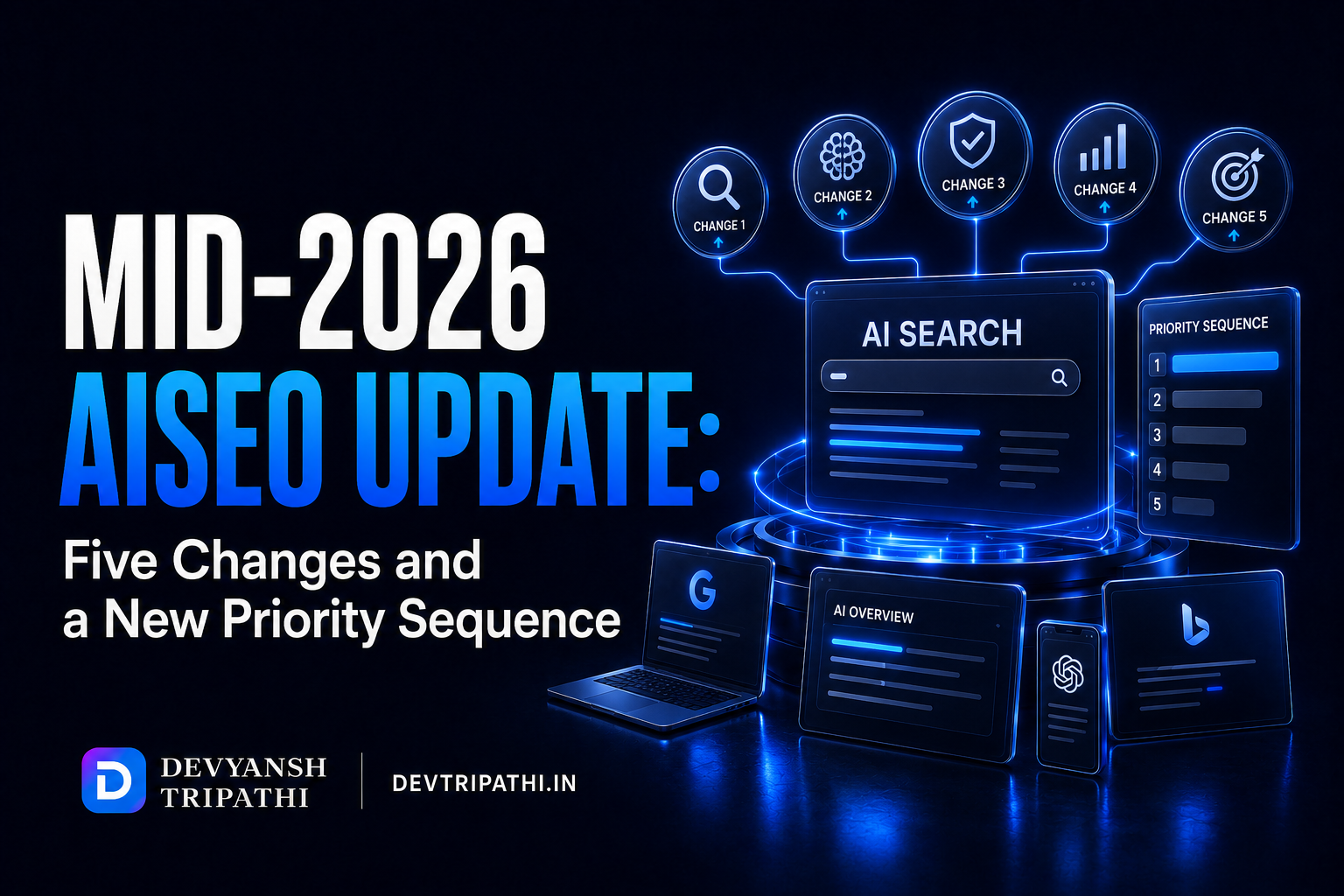
Mid-2026 AISEO Update: Five Changes and a New Priority Sequence
27 June 2026
AI Search Optimization is the unified framework for building brand visibility, content authority, and citation presence across every AI-powered search surface simultaneously, recognizing that the average ChatGPT prompt is now 23 words versus 3.37 words for traditional Google search, that Gemini 3.5 Flash powers AI Mode for 1 billion monthly users, and that only 36 brands worldwide maintained top-100 visibility across all four major AI platforms in the largest citation study conducted to date.
This mid-2026 strategy update covers the most significant developments in AI search since the beginning of the year: the five structural changes that have altered AISEO strategy since January 2026, the platform-specific developments that now require separate optimization tracks across AI Mode, AI Overviews, ChatGPT, and Perplexity, the SynthID and C2PA content verification signals that are reshaping how AI systems evaluate content authenticity, the Personalization era beginning with Google’s Personal Intelligence expansion, and the updated implementation priority sequence that reflects the current state of the AI search landscape rather than where it was twelve months ago.
Free AISEO Mid-2026 Strategy Assessment
Is Your AI Search Strategy Updated for the Five Structural Changes That Have Occurred Since January 2026?
Get a complete AISEO mid-year assessment covering your citation performance across all four major AI platforms, your SynthID and content authenticity signals, your Personal Intelligence optimization readiness, and the specific strategy gaps between your current approach and the mid-2026 AI search environment.
Get My AISEO Strategy AssessmentThe Five Structural Changes That Have Altered AISEO Strategy in Mid-2026
AI search has changed more in the first half of 2026 than in the entire preceding year. Five structural changes have collectively altered what AISEO requires, and strategies built on the 2025 understanding of AI search are already partially outdated.
Change 1: Gemini 3.5 Flash Raises the Content Quality Bar for AI Mode Citations
Gemini 3.5 Flash became the default model powering AI Mode globally on May 19, 2026. It surpasses Gemini 3.1 Pro on coding, agentic, and multimodal benchmarks while running approximately four times faster. The content strategy implication is the most underestimated consequence of this model upgrade. A more capable model means higher quality AI Mode answers, which means the content bar for being cited rises.
When AI Mode used a weaker model, content with partial relevance and acceptable structure could earn citations. Gemini 3.5 Flash has better direct-answer extraction, stronger entity recognition, and more accurate comparative claim evaluation. Content structured for direct-answer extraction, entity consistency, and clear comparative claims is more likely to be surfaced and synthesized accurately by the new model. Content that passed Gemini 3.1’s citation threshold may no longer pass Gemini 3.5’s. The practical recommendation is to audit your top AI Mode citation pages immediately for the three quality dimensions Gemini 3.5 prioritizes: direct-answer extractability, entity clarity, and claim verifiability.
Change 2: SynthID and C2PA Create Content Authenticity as an AISEO Signal
SynthID and C2PA (Coalition for Content Provenance and Authenticity) content verification expanded to Search and Chrome at Google I/O 2026. Google can now identify and label AI-generated content at scale across its entire search index. Brands using unreviewed AI content at volume face active downside risk in the second half of 2026 as Google’s ability to identify AI-generated content with low human expert review reaches operational scale.
The AISEO implication is direct: content provenance and authenticity have become ranking and citation signals in a way they were not before May 2026. Content with clear expert authorship, verifiable claims from named sources, and transparent AI-use disclosure where applicable is positioned better than content that is algorithmically indistinguishable from AI generation without expert review. The C2PA framework allows brands to embed verifiable content authenticity metadata in published assets, creating a provenance signal that AI systems can validate. Brands that disclose AI usage transparently in 2026 will not need to retrofit this later when verification requirements become more explicit.
Change 3: Personal Intelligence Fragments the SERP Beyond One-Size Optimization
Google’s Personal Intelligence expansion to 200 countries connects AI Mode to users’ Gmail, Google Photos, and Calendar data, personalizing AI search responses in a way that no universal content strategy can fully address. Content written for a generic “everyone” persona gets cited for nobody in particular under Personal Intelligence personalization. Content built for specific user states, specific professional contexts, and specific query patterns earns disproportionate citation share for the user segments it genuinely serves.
The AISEO adaptation requires narrowing content focus rather than broadening it. Brands that have been writing for the widest possible audience to maximize keyword coverage should segment their content more precisely by professional role, use case, expertise level, and decision stage. Personalized AI responses favor sources that match the specific context the AI can infer about the user, making niche-specific expert content more valuable than general-audience overviews that match no one’s context precisely.
Change 4: AI Mode and AI Overviews Diverge to a 13.7% Citation URL Overlap
The Ahrefs analysis finding only 13.7% URL overlap between AI Mode and AI Overviews citations despite 86% conclusion similarity is the most operationally significant AISEO finding of 2026 for most marketing teams. Teams optimizing for AI Overviews and assuming AI Mode will follow are missing 86.3% of their AI Mode citation opportunities. Teams that have not yet built an AI Mode optimization track alongside their AI Overviews track are operating with a fundamental strategic gap that competitors who discovered this data are already addressing.
The two-track AISEO requirement is now non-negotiable. AI Overviews track: traditional Google top-10 ranking plus answer-first content structure plus nested FAQPage-in-Article schema. AI Mode track: topical cluster coverage for fan-out sub-query matching, multimodal content for the one-in-six non-text AI Mode queries, VideoObject schema for Featured Clip inclusion, and comprehensive depth for the 3-times-longer AI Mode queries versus traditional Google queries.
Change 5: Google Officially Validates AISEO, GEO, and AEO as Legitimate Disciplines
John Mueller’s Google Search Central Blog post on June 5, 2026 confirmed that AEO and GEO are legitimate SEO disciplines and not separate from foundational SEO. This is significant for AISEO practitioners and their clients: the primary authoritative source in SEO has officially acknowledged that AI search optimization is a valid specialization built on foundational SEO rather than a fringe or speculative practice. It removes the objection that AEO or GEO are separate from real SEO and repositions AISEO as the natural extension of existing SEO practice into AI search surfaces. For the complete AI citation optimization strategy, see our AI Citation Optimization Advanced Guide.
23words — average ChatGPT prompt vs 3.37 words for traditional Google search (The Growth Memo via Omnibound 2026)
36brands worldwide maintained top-100 AI visibility across all 4 major platforms (Semrush, 126M prompts)
37.2%of marketing teams actively optimizing for AI search — 83.6% recognize the term AI SEO (On Marketing, n=250)
4.4xhigher conversion rate for AI search visitors vs traditional organic (Semrush, June 2025, 500+ topics)
The AISEO Platform Landscape in Mid-2026
The AI search platform landscape has changed significantly in the first half of 2026. Understanding the current state of each major platform — its user scale, citation mechanisms, and optimization priority — is the prerequisite for building an AISEO strategy that reflects where users are searching rather than where they were searching six months ago.
| Platform | Scale | Mid-2026 Development | Top AISEO Priority |
|---|---|---|---|
| Google AI Mode | 1B+ monthly users | Gemini 3.5 Flash upgrade raises content bar; Personal Intelligence personalization expands | Topical cluster coverage for fan-out, multimodal content, two separate scorecard from AI Overviews |
| Google AI Overviews | 2B monthly users | FAQPage-in-Article schema shows 60% higher inclusion; SynthID verification active | Top-10 ranking + nested FAQPage schema + content authenticity signals |
| ChatGPT | 2B weekly active users | Agentic Commerce Protocol expands product discovery for structured merchants | Bing indexing + entity authority + product feed for Agentic Commerce |
| Perplexity | 780M monthly queries | Reddit still dominates citations at 46.7%; mandatory citation model maintained | Monthly freshness updates + Reddit community presence + multi-source statistics |
| Gemini | Expanding via Google ecosystem | Knowledge Graph integration deepened; YouTube citations prominent at 16% of LLM answers | Knowledge Panel + YouTube channel + Organization sameAs |
The Updated AISEO Implementation Priority Sequence for Mid-2026
The implementation priority sequence for AISEO has been updated to reflect the mid-2026 structural changes. The core hierarchy remains consistent — technical eligibility first, traditional ranking second, brand presence third, content structure fourth — but the specific actions within each priority level have evolved.
AISEO Mid-2026 Updated Priority Sequence
Priority 1: Technical Foundation
AI crawler access verified (GPTBot, ClaudeBot, PerplexityBot). Bing indexing confirmed. Core Web Vitals passing. New addition: C2PA and SynthID compliance for content authenticity. Gemini 3.5 Flash quality standards met for extraction confidence.
Priority 2: Traditional Search Ranking
Top-10 ranking maintained for target queries. This is unchanged and still the primary eligibility filter for AI Overviews (93.67% citations from top-10) and ChatGPT via Bing top-10 (87% overlap). No change from the fundamental priority.
Priority 3: Schema Stack
Updated priority: FAQPage nested inside Article schema (60% higher AI Overview inclusion per Semrush). VideoObject with hasPart for AI Mode Featured Clips. Product schema for Agentic Commerce Protocol eligibility. Organization sameAs for entity clarity.
Priority 4: Multi-Platform Brand Presence
YouTube presence now the #1 correlation signal at 0.737. LinkedIn #1 cited domain for professional queries. Reddit dominant across ChatGPT, AI Overviews, Perplexity. Review platform profiles. Four or more platforms = 2.8x ChatGPT citation rate.
Priority 5: Content Quality and Depth
23-word average ChatGPT prompt requires deep comprehensive content. Pages with 19+ data points earn 2-3x more citations. Expert quotes add 41% AI visibility (Princeton GEO). Keyword stuffing actively lowers visibility in Gemini 3.5. Data density over keyword density.
Priority 6: Freshness Verification Cadence
Monthly verification for high-value commercial pages. Quarterly minimum for all content. Track last-verified date separately from last-published. Information Agents reward cadence verification. Pages not refreshed quarterly are 3x more likely to lose AI citations.
Frequently Asked Questions About AISEO in Mid-2026
What is AI Search Optimization (AISEO)?
AI Search Optimization is the unified framework for building brand visibility, content authority, and citation presence across every AI-powered search surface simultaneously. It encompasses the technical requirements, content structure, entity authority, and multi-platform brand presence that ChatGPT, Perplexity, Google AI Mode, AI Overviews, Gemini, and Copilot evaluate when deciding which sources to cite in AI-generated answers. AISEO treats all AI search surfaces as a single integrated optimization system rather than as separate tactics.
Why does it matter that the average ChatGPT prompt is 23 words?
The 23-word average ChatGPT prompt (versus 3.37 words for Google) reveals the fundamental difference in search behavior that AISEO must address. AI platform users describe full situations with context, constraints, and specific intent rather than submitting abbreviated keyword fragments. Content optimized only for 3-word keywords is structurally misaligned with the full natural language questions AI search users actually submit. AISEO requires content that addresses the full prompt including contextual qualifiers, not just the abbreviated keyword core of that prompt.
What are the implications of Gemini 3.5 Flash for AISEO?
Gemini 3.5 Flash, which became the default model for AI Mode globally on May 19, 2026, raised the citation quality bar because a more capable model applies stricter extraction quality criteria. Content with partial relevance and acceptable structure that earned citations under the previous model may no longer meet Gemini 3.5’s extraction thresholds. The three quality dimensions Gemini 3.5 prioritizes are direct-answer extractability in the first 150 words, entity clarity through consistent brand and topic signal use, and claim verifiability through named source citations that the model can cross-reference.
What does SynthID mean for AISEO content strategy?
SynthID and C2PA content verification, expanded to Search and Chrome at Google I/O 2026, enable Google to identify AI-generated content at scale. Brands using unreviewed AI content at volume face active downside risk as this verification reaches operational scale in the second half of 2026. The AISEO adaptation is expert-reviewed content with clear authorship attribution, verifiable claims from named sources, and transparent AI-use disclosure where applicable. Brands that establish content authenticity practices in 2026 will not need to retrofit them when verification requirements become more explicit.
How does Personal Intelligence affect AISEO targeting strategy?
Personal Intelligence, now expanding to 200 countries, connects AI Mode to users’ Gmail, Calendar, and Photos data to personalize AI search responses. Content written for generic audiences gets cited for nobody in particular under personalization. AISEO content strategy must narrow its focus to specific professional roles, use cases, expertise levels, and decision stages rather than writing for the widest possible audience. Niche-specific expert content earns disproportionate citation share for the user segments it precisely serves, while general-audience overviews match no personalized context effectively.
Why do AI Mode and AI Overviews need two separate optimization tracks?
Ahrefs’ analysis of 540,000 query pairs found AI Mode and AI Overviews cite the same URLs only 13.7% of the time. The 86.3% citation divergence occurs because they use different retrieval mechanisms: AI Overviews applies more direct extraction from the standard search index while AI Mode uses query fan-out issuing multiple related sub-searches before synthesizing. Teams optimizing only for AI Overviews miss 86.3% of AI Mode citation opportunities. The two-track AISEO requirement means separate scorecard, separate optimization actions, and separate measurement for each surface.
What is the Agentic Commerce Protocol and why does it matter for AISEO?
ChatGPT’s Agentic Commerce Protocol, launched with OpenAI’s March 2026 product discovery update, enables ChatGPT to facilitate product discovery and purchases through structured merchant data feeds. For product and e-commerce brands, it means AISEO now requires complete merchant data feeds in addition to content optimization and citation authority, because brands without structured merchant data are excluded from ChatGPT’s agentic product recommendation layer regardless of their content quality or search position. This is the first commercial action layer in AISEO that goes beyond citation into transaction facilitation.
How does the 37.2% active AISEO adoption rate create competitive opportunity?
Only 37.2% of marketing teams are actively optimizing for AI search despite 83.6% recognizing the term, according to On Marketing’s 2025 survey. The gap between awareness (83.6%) and active implementation (37.2%) represents 46.4 percentage points of marketing teams that know AISEO exists but have not built a systematic programme. For brands that build comprehensive AISEO infrastructure now, this adoption gap provides a window of competitive advantage in AI citation share that grows more difficult to access as the remaining 46.4% of teams move from awareness to implementation.
What is the most important AISEO insight from the Semrush 126-million-prompt study?
Only 36 brands maintained top-100 AI visibility across all four major platforms simultaneously in Semrush’s 126-million-prompt study. This finding reveals that cross-platform AI search dominance is extremely rare — concentrated in a small number of brands that have invested systematically in multi-platform optimization rather than platform-specific tactics. For most brands, the path to cross-platform AI visibility requires building from platform-specific strengths outward rather than attempting simultaneous optimization across all platforms with limited resources.
How should AISEO strategy adapt to the Information Agents era?
Google’s Information Agents create a proactive referral surface that rewards content maintained on a verification cadence rather than published once and left static. AISEO strategy must extend from one-time optimization into continuous content verification: tracking when content was last verified (not just published), refreshing statistics monthly on high-value commercial pages, updating expert attribution when positions or affiliations change, and treating the top 50 content pages as living documents with a mandatory freshness schedule that Information Agents can rely on for consistent, current accuracy.
What does Google’s official validation of AEO and GEO mean for AISEO practitioners?
John Mueller’s June 5, 2026 Google Search Central Blog post confirmed that AEO and GEO are legitimate SEO disciplines built on foundational SEO rather than parallel or replacement strategies. For AISEO practitioners, this removes the primary client objection that AI search optimization is speculative or separate from real SEO. For marketing leadership evaluating AISEO investment, Google’s own confirmation that strong foundational SEO applied to AI surfaces is the complete framework validates the integrated AISEO approach and removes ambiguity about whether AI search requires a fundamentally different content strategy rather than an extension of proven SEO practices.
Ready to Build a Mid-2026-Updated AISEO Strategy?
Get a Complete AISEO Strategy Built for the Five Structural Changes That Have Reshaped AI Search in 2026
Free strategy session covering your updated six-priority AISEO implementation sequence, AI Mode and AI Overviews dual-track assessment, Gemini 3.5 content quality audit, SynthID and content authenticity review, Personal Intelligence targeting strategy, and the measurement framework that tracks cross-platform AI citation performance separately from traditional SEO metrics.
Get My Free AISEO Strategy UpdateConclusion
AI Search Optimization in mid-2026 is more structured, more data-driven, and more operationally demanding than at any point in its development. The average ChatGPT prompt is 23 words. Gemini 3.5 Flash has raised the content quality bar for AI Mode citations. SynthID and C2PA have made content authenticity an active search signal. Personal Intelligence has fragmented the SERP beyond one-size optimization. AI Mode and AI Overviews now cite only 13.7% of the same URLs. And Google has officially validated AEO and GEO as legitimate SEO disciplines.
The 37.2% of marketing teams actively optimizing for AI search and the 36 brands maintaining cross-platform top-100 visibility confirm that the competitive window is still wide. The brands investing in systematic AISEO infrastructure now are building the compound citation authority, multi-platform brand presence, and content quality foundation that early first-movers in any emerging search surface consistently leverage into lasting competitive dominance. For the complete GEO playbook that implements this AISEO framework, see our GEO Advanced Playbook.

Devyansh Tripathi
I’m Devyansh Tripathi, an SEO strategist and digital growth expert, helps businesses and individuals rank higher and drive organic traffic. Through DevTripathi., he shares cutting-edge SEO insights, content strategies, and marketing hacks. Passionate about digital success, he’s on a mission to make SEO simple, effective, and result-driven!
Posts
- What Google’s New AI Search Documentation Means for SEO Teams
- Google I/O 2026 Search: AI Agents, Gemini 3.5 and the Unified Box
- Google’s AI Optimization Guide: The Technical and Content Checklist
- July 2026 SEO Update: AI Overviews, llms.txt and Search Console
- Prompt Optimization Beyond Page One: The Position-21 Citation Opportunity
Categories
- AI Citation Optimization
- AI Search Optimization (AISEO)
- AI Visibility Tracking
- Answer Engine Optimization (AEO)
- Brand Authority SEO
- Brand SERP Optimization
- Community Signal SEO
- Conversational Search Optimization
- Generative Engine Optimization (GEO)
- Knowledge Graph Optimization
- Modern SEO Strategies
- Multimodal Search Optimization
- Prompt Optimization
- SEO Trends
- Social Search Optimization
- Topical Authority SEO
- Uncategorized
- Video Search SEO
- Visual Search Optimization
- Voice Engine Optimization (VEO)
- Zero Click Search Optimization
Latest News
Text Widget
Empowering brands with insights, strategies, and stories that drive digital growth.