Brand SERPs in the AI Era: Seven Assets and Reputation Defense
01 July 2026
Brand SERP optimization in 2026 requires managing a fundamentally more complex search results page than existed even two years ago. The branded SERP now combines traditional organic results, sitelinks, Knowledge Panel, and review stars with AI Overview summaries about your brand, People Also Ask boxes generated from AI knowledge, and AI Mode panels that synthesize your brand’s reputation, offerings, and user reviews into a single AI generated brand assessment that users may read instead of visiting your website.
This guide covers the advanced Brand SERP framework for the AI era: how AI Overviews are appearing on branded search results pages and what they say about your brand, why the Knowledge Panel is now the most important single element on the branded SERP for both traditional trust signals and AI citation authority, the seven-component AI-era Brand SERP and how to control each one, the zero-click optimization strategy for branded queries where 65% of searchers never visit your website, and the monthly Brand SERP monitoring protocol that catches reputation risks, entity inconsistencies, and AI inaccuracies before they influence prospects at scale.
What Does Your Brand SERP Say About You Right Now?
Search your brand name in a private browser and document every element from position one through ten. Then get a professional Brand SERP audit that identifies Knowledge Panel gaps, AI Overview accuracy issues, review platform weaknesses, and the specific actions that will produce the highest-impact improvements in your branded first impression.
Get My Brand SERP AuditHow AI Search Changed the Brand SERP in 2026
The branded search results page in 2026 is no longer a simple list of your own pages dominated by your website. It is a composite of owned content, third-party reviews, community discussions, Knowledge Panel data, and AI generated brand summaries that users can read without clicking anything. The shift matters because the impression your branded SERP creates is now formed partly by AI systems synthesizing information about your brand from across the web, not only by the pages your SEO team has optimized.
AI Overviews now appear on branded search queries for many established brands, producing a generated summary of the brand’s offerings, reputation, and public reception that appears above the organic results. This AI Overview draws from your website, your review profiles, community discussions, news coverage, and Knowledge Graph data. A brand with accurate, positive signals across all these sources receives an AI Overview that reinforces brand value. A brand with inconsistent information, negative community discussions, or missing Knowledge Graph data may receive an AI Overview that misrepresents or underrepresents what it offers. For the complete strategy connecting Brand SERP optimization to AI citation authority, see our Brand Authority SEO Cycle 3 guide.
81%of consumers research brand online before purchasing (Elite Solution Expert 2026)
35%higher CTR for brands with optimized SERPs vs unmanaged results
65%of branded searches end without a click (SparkToro 2026)
2.8xmore AI citations for brands with Knowledge Panels vs brands without
The Seven-Component AI-Era Brand SERP
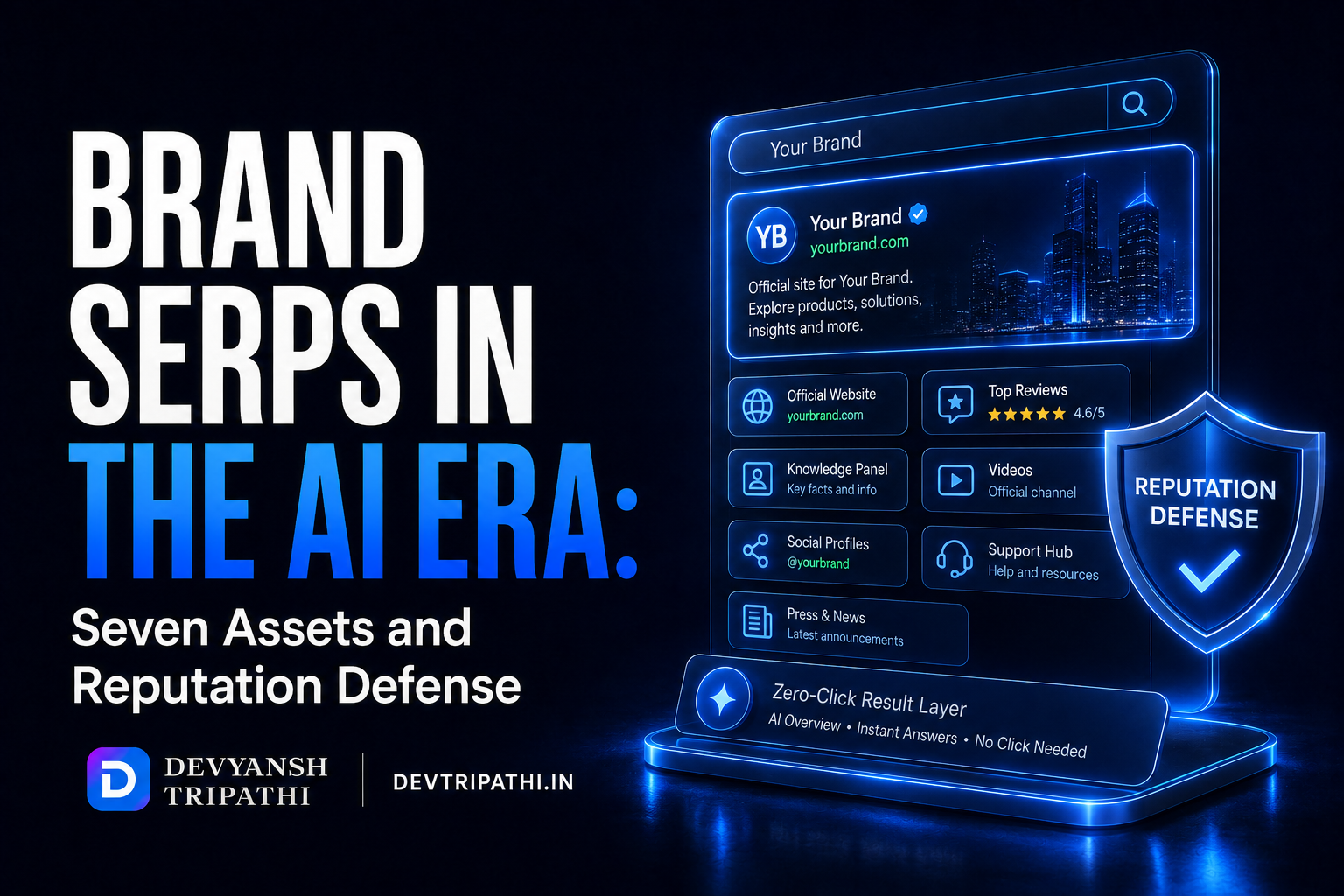
A fully optimized AI-era Brand SERP contains seven distinct components, each with different optimization requirements and different commercial significance. The composition of these components has evolved significantly since 2024 as AI Overviews, People Also Ask panels, and AI Mode integration have added new elements to what users see when they search a brand name.
AI Significance: Critical
1. Knowledge Panel
The Knowledge Panel is the most important single Brand SERP element for both traditional trust signals and AI citation authority. It displays your logo, brand description, founding information, social profile links, and entity category data drawn directly from Google's Knowledge Graph. Brands with Knowledge Panels receive 2.8 times more AI citations. Build Knowledge Panel eligibility through the six-lever entity sequence covered in detail in our Knowledge Graph Optimization guide. Once a panel appears, claim it through Google Search Console and verify all information is current and accurate quarterly.
AI Significance: High — New in 2026
2. AI Overview on Branded Queries
AI Overviews on branded queries synthesize information from across the web into a generated brand summary. The content of this summary is determined by your website, review profiles, community discussions, news coverage, and Knowledge Graph data combined. You cannot directly control what the AI Overview says about your brand, but you can systematically improve the source signals it draws from. High-quality About pages with clear service descriptions, positive review platforms, accurate Wikipedia or Wikidata entries, and positive earned media all feed better AI Overview content about your brand. Monitor your brand's AI Overview monthly by testing "[your brand name]", "[your brand name] reviews", and "[your brand name] vs [competitor]" queries in Google.
AI Significance: High
3. Review Platform Listings
Review platforms including Google Business Profile, Trustpilot, G2, Clutch, and industry-specific platforms appear prominently in branded SERPs and provide the third-party social proof that prospects specifically seek when evaluating brands they have just discovered. The commercial impact is direct: the Seer Interactive 53.5% AI citation rate for brands with minimal review profiles versus 1% for those without confirms the AI-era importance of review platform presence extending far beyond traditional local SEO value. Establish profiles on every major platform relevant to your category, maintain a professional response strategy for all reviews, and generate reviews consistently from satisfied clients at the point of positive outcome delivery.
AI Significance: High — Evolved in 2026
4. People Also Ask Boxes
The People Also Ask boxes on branded SERPs in 2026 are increasingly AI-generated from knowledge graph queries about your brand rather than being purely search-volume driven keyword clusters. They signal exactly what AI systems believe users most want to know about your business. Typical branded PAA questions cover your pricing, your comparison to competitors, whether your service is legitimate, and specific claims about your methodology or results. The content answering these PAA boxes on your website directly determines what users see when they expand a PAA, creating a direct owned-content optimization opportunity for what is functionally AI knowledge about your brand.
AI Significance: Medium
5. Sitelinks
Sitelinks are the six to eight sub-links appearing below your main branded listing, surfacing your most important internal pages directly in the branded SERP. Google generates sitelinks algorithmically based on your navigation architecture and page title clarity. Optimize sitelinks by ensuring your highest-value pages (About, Services, Pricing, Case Studies, Contact) are prominently linked in your main navigation with descriptive, keyword-specific page titles. Monitor which pages appear as sitelinks quarterly and adjust navigation prominence for pages you want added or elevated.
AI Significance: High for B2C, Medium for B2B
6. Social Profile Listings
Your active social profiles (LinkedIn, Twitter, Instagram, YouTube, Facebook) rank for your brand name and provide additional positive brand touchpoints while occupying SERP positions that would otherwise be available for third-party or negative content. Optimize social profiles for branded SERP presence by using your exact brand name as the username or handle, completing all biographical fields with keyword-rich descriptions, linking to your website from every profile, and maintaining consistent posting frequency. Include social profile URLs in your Organization schema sameAs array to create explicit entity connections between profiles and your website entity.
AI Significance: Medium
7. News and Earned Media
Recent news and media coverage appearing in the branded SERP's news panel provides third-party credibility that review platforms alone cannot match. A Search Engine Journal article or an industry publication feature in your brand SERP signals to prospects that independent authoritative voices have covered your brand. AI systems treat earned media mentions as high-confidence entity corroboration, and brands with consistent earned media presence in their branded SERPs receive significantly higher AI citation rates than brands whose SERPs show only owned and review content. Build earned media through the strategic syndication and expert placement programmes covered in our Brand Authority Cycle 3 guide.
Zero-Click Optimization for Branded Searches
65% of branded searches end without a click, meaning the majority of users who search your brand name form their entire brand impression from what they see on the SERP without visiting your website. This zero-click reality transforms Brand SERP optimization from a traffic driver into a brand communication channel that must deliver its complete message at the SERP level to serve the majority of branded searchers.
What Zero-Click Branded Searchers See and Why It Matters
A zero-click branded searcher sees your Knowledge Panel with logo, description, and social links. They see your main website listing with title and meta description. They may see a star rating and review count if you have Google Business Profile reviews. They may see a review platform listing with aggregate score. They may see a branded AI Overview summarizing your offerings. They may see PAA boxes about your pricing or legitimacy. Every element they see without clicking is an impression that influences whether they subsequently click through, whether they search for more information about you, or whether they abandon their evaluation of your brand.
Optimizing for zero-click branded searchers means treating every SERP element as a micro-communication rather than as a traffic driver. Your meta description functions as an advertising headline for the 35% who do click but also as the only description text the 65% who do not click will ever read. Your Knowledge Panel description is your brand elevator pitch visible to every branded searcher who scrolls past your main listing. Your review rating is the most visible trust signal available at the SERP level. For the complete zero-click strategy that addresses both branded and non-branded zero-click optimization, see our Zero-Click Search Optimization guide.
The Branded Meta Description as a Zero-Click Communication Tool
Your homepage meta description appears beneath your main branded listing and is the primary text communication available at the SERP level for zero-click branded searchers. Most brands write meta descriptions for click optimization, which is correct but incomplete. In 2026 you must also write it for the 65% who will never click: the description must communicate your primary value proposition, your target audience, and your differentiation clearly enough that a user reading only the 155 characters forms an accurate and positive brand impression without additional research.
A meta description optimized for zero-click branded searchers reads as a positioning statement rather than a click prompt. Compare “Professional SEO services for businesses looking to grow their organic traffic” (click-prompt format) with “AI Search and GEO Specialist helping B2B brands earn citations in ChatGPT, Perplexity, and Google AI Overviews” (positioning format). The second version communicates specific expertise to the right audience even if the user never clicks, building brand recognition that may convert to a direct search, a referral mention, or a future contact form submission.
Every Day Your Brand SERP Is Unmanaged Is a First Impression You Are Leaving to Chance
Dev Tripathi builds complete Brand SERP optimization programmes covering Knowledge Panel development, AI Overview accuracy management, review platform strategy, zero-click communication design, and the monthly monitoring protocol that catches issues before they influence prospects at scale.
Build My Brand SERP ProgrammeThe Monthly Brand SERP Monitoring Protocol
Brand SERP monitoring must be systematic rather than reactive to provide sufficient lead time for addressing issues before they influence purchasing decisions at scale. A structured monthly monitoring protocol with specific weekly escalation triggers provides the right frequency for most brands while concentrating effort where issues actually occur.
The 30-Minute Monthly Brand SERP Audit
The monthly Brand SERP audit requires one private browser window, a structured recording template, and 30 minutes of focused attention. Search five branded query variations: your exact brand name, your brand name plus your primary service category, your brand name plus the word “reviews”, your brand name plus “vs” and your primary competitor name, and a question your prospects commonly ask about your brand. Record every element visible in the first 10 results for each query: Knowledge Panel presence and accuracy, AI Overview content and accuracy, review platform ratings, social profile positioning, news panel content, and any third-party pages with content about your brand.
Document any inaccurate information in AI Overviews, any review platforms showing below-average ratings without management response, any third-party negative content appearing in positions one through five, and any Knowledge Panel information that is outdated or incorrect. Each issue type has a specific correction pathway: AI Overview inaccuracies are corrected through schema markup and content updates on owned pages; review platform rating issues require active review generation; negative third-party content requires a content displacement strategy through earned media; Knowledge Panel inaccuracies are corrected through the Google Search Console panel management tool.
Weekly Monitoring for High-Risk Brands
Brands with active reputation management challenges, major campaign launches, or competitor activity targeting their branded terms should supplement monthly full audits with weekly spot checks on their top three branded queries. Set up Google Alerts for your brand name plus relevant modifiers such as “scam”, “review”, “vs”, and “alternative” to receive immediate notification when new third-party content about your brand is indexed. Weekly monitoring allows rapid response to emerging issues before they accumulate significant search impressions at positions that influence brand consideration.
Negative SERP Content and Brand Defense
Negative content appearing in branded SERPs is a direct commercial risk because prospects who search your brand name and encounter criticism, comparisons positioning you unfavorably, or accuracy-questionable review aggregators form negative impressions that neither your website content nor your paid advertising can counter at that moment. Brand SERP defense strategy addresses negative content through two parallel approaches: content displacement for inaccurate or harmful content and proactive SERP domination through owned and positive third-party content at scale.
Content Displacement Strategy
Content displacement suppresses negative or harmful branded SERP results by creating and amplifying higher-authority positive content that earns the positions currently occupied by the negative content. This requires publishing additional owned content targeting the exact branded query generating the negative result, earning positive coverage in publications with higher authority than the negative content source, and building review platform profiles with positive sentiment that outrank lower-authority negative review aggregators. The target timeline for significant displacement of established negative content at positions one through five is 3 to 6 months of consistent effort, with earlier results possible when the negative content source has low domain authority. For the complete AI citation strategy that extends Brand SERP defense into AI-generated brand assessment improvement, see our AI Citation Optimization Advanced Guide.
Frequently Asked Questions About Brand SERP Optimization
What is Brand SERP optimization in the AI era?
Brand SERP optimization in the AI era is the practice of managing every element that appears when someone searches your brand name on Google, including the new AI-specific elements introduced in 2025 and 2026: AI Overviews on branded queries, AI-generated People Also Ask boxes, and AI Mode brand assessment panels. It ensures that the complete branded search experience, across both traditional and AI-generated elements, accurately represents your brand and builds the trust required for commercial consideration.
What AI Overviews appear on branded searches and what do they say?
AI Overviews on branded queries synthesize information from your website, review profiles, community discussions, news coverage, and Knowledge Graph data into a generated brand summary that may appear above your organic results. The content covers your core service categories, general reputation signals drawn from reviews and community mentions, and any notable recent news or coverage. You cannot directly edit this AI Overview, but you can improve its accuracy and sentiment by optimizing the source signals it draws from: clearer service descriptions on your website, positive review profiles, accurate Wikipedia or Wikidata entries, and positive earned media coverage.
Why do 65% of branded searches end without a click?
The 65% zero-click rate on branded searches reflects the completeness of information now available at the SERP level through Knowledge Panels, AI Overviews, review platform snippets, and People Also Ask boxes. Many users can answer their primary brand evaluation questions directly from SERP-level information without visiting any website. This makes the Brand SERP itself the primary first impression for the majority of branded searchers, requiring it to communicate brand value, credibility, and differentiation completely without a website visit.
How does the Knowledge Panel affect AI citation rates?
Google's Gemini AI is trained on Knowledge Graph data, and brands recognized as Knowledge Graph entities receive higher citation confidence from AI systems because entity recognition enables the AI to distinguish your brand from similarly-named alternatives and attribute claims accurately. Brands with Knowledge Panels receive 2.8 times more AI citations than brands without them. The Knowledge Panel functions as Google's official confirmation that your brand is a recognized entity, which AI systems treat as the highest available credibility signal when deciding whether to recommend and cite your brand in generated responses.
What is the highest-priority Brand SERP improvement for most brands?
Establishing a Knowledge Panel through the entity building sequence is the highest-priority Brand SERP improvement for brands that do not yet have one, because it simultaneously improves the branded SERP trust signal, increases AI citation rates by 2.8 times, and establishes the entity foundation that enables all other Brand SERP components to perform more effectively. For brands that already have a Knowledge Panel, verifying and updating its accuracy is the first step, followed by establishing or optimizing the review platform profiles that produce the next-highest-ROI improvement in both branded SERP quality and AI citation rate.
How do I optimize my meta description for zero-click branded searchers?
Write your homepage meta description as a positioning statement rather than only a click prompt. It should communicate your primary value proposition, your target audience, and your key differentiator clearly in 155 characters, written so that a user who reads only the description forms an accurate and positive brand impression without any additional research. The 65% of branded searchers who never click your website will read only this description and whatever the Knowledge Panel and AI Overview communicate. Optimize for that majority, not only for the 35% who do click through.
How often should I conduct a Brand SERP audit?
Conduct the 30-minute Brand SERP audit monthly for all brands and weekly for brands actively managing reputation challenges, running major campaigns, or operating in categories where competitor negative SEO against brand terms is documented. Set up Google Alerts for your brand name plus modifiers such as reviews, scam, vs, and alternative to receive real-time notification of new third-party content about your brand between scheduled audits. Weekly monitoring allows rapid response to emerging issues before they accumulate significant search impressions.
What queries should I test during a Brand SERP audit?
Test five branded query variations during each monthly audit: your exact brand name, your brand name plus your primary service category, your brand name plus the word reviews, your brand name plus vs and your primary competitor name, and the most common question your prospects ask about your brand. Each variation produces a different SERP composition because Google's intent detection serves different elements for navigational, comparison, and evaluation intents even when the brand name appears in all five queries.
How do I address inaccurate information in my brand's AI Overview?
AI Overview inaccuracies on branded queries are corrected through the source signals that AI Overview draws from rather than through direct editing. Update your website's About page and service pages with clear, accurate information using structured data. Update your Organization schema with accurate sameAs references. Correct any Wikidata or Wikipedia information that might be feeding the inaccuracy. Publish targeted content addressing the specific inaccuracy if it stems from an outdated fact or a misrepresented claim in an indexed publication. Changes typically take 4 to 8 weeks to propagate into AI Overview content updates.
What is content displacement and when do I need it?
Content displacement is the strategy of suppressing negative or harmful branded SERP results by creating and amplifying higher-authority positive content that earns the positions currently occupied by the negative content. You need it when third-party content with negative or inaccurate information about your brand appears in positions one through five of your branded SERP. The strategy involves publishing additional owned content targeting the exact query, earning positive coverage in higher-authority publications than the negative source, and building review platform profiles that outrank lower-authority negative aggregators. Expect 3 to 6 months for significant displacement of established negative content.
How do People Also Ask boxes on branded SERPs work in 2026?
People Also Ask boxes on branded SERPs in 2026 are increasingly AI-generated from knowledge graph queries about your brand rather than being purely search-volume driven clusters. They reflect what AI systems believe users most want to know about your business. The questions typically cover your pricing, comparison to competitors, legitimacy, specific methodology claims, and service scope. The content answering these PAA questions is often pulled directly from your own pages, competitor comparison pages, or review platforms. Owning the PAA answers by publishing clear, direct responses to each typical branded PAA question on your website gives you control over what these users see.
What is the relationship between Brand SERP optimization and the broader GEO strategy?
Brand SERP optimization and GEO strategy reinforce each other through shared entity signals and trust indicators. The Knowledge Panel that improves your Brand SERP is the same entity recognition signal that produces 2.8 times more AI citations in GEO contexts. The review platforms that improve your Brand SERP review components produce the multi-source validation that AI citation systems require for confident brand recommendation. The earned media that improves your Brand SERP news panel provides the third-party corroboration that drives 82% of AI citations. Optimizing your Brand SERP and implementing GEO strategy simultaneously produces the compounding authority that neither investment achieves as efficiently in isolation. Our GEO Advanced Playbook covers the citation optimization layer that Brand SERP quality enables.
Build a Brand SERP That Works as Hard as Your Best Sales Page
Your Brand SERP is the first impression for 81% of buyers who research your brand before purchasing and the only impression for 65% who never click through. Get a complete Brand SERP optimization programme covering Knowledge Panel development, AI Overview management, review platform strategy, zero-click communication design, and monthly monitoring for sustained brand SERP control.
Start My Brand SERP ProgrammeConclusion
Brand SERP optimization in 2026 demands a significantly more sophisticated approach than managing your homepage ranking and review star rating. The branded search results page now includes AI Overviews synthesizing public brand information, AI-generated People Also Ask boxes reflecting AI knowledge about your business, and a Knowledge Panel whose presence directly multiplies AI citation rates across all major platforms. Together with the established components of sitelinks, social profiles, review platforms, and earned media, these seven elements form the complete branded first impression that 81% of buyers consult before purchasing and 65% consume without ever visiting your website.
The optimization priorities are clear. Build the Knowledge Panel that doubles your AI citation rate. Establish review platform profiles that lift citation rates from 1% to 53.5%. Write your meta description for the 65% of zero-click searchers, not only for click-through optimization. Monitor five branded query variations monthly with a 30-minute structured audit. Address AI Overview inaccuracies through schema and content updates. Displace negative SERP content through earned media and authority-building activity. Each of these actions is independently valuable and compound in impact when implemented as a coordinated brand SERP programme.

Devyansh Tripathi
I’m Devyansh Tripathi, an SEO strategist and digital growth expert, helps businesses and individuals rank higher and drive organic traffic. Through DevTripathi., he shares cutting-edge SEO insights, content strategies, and marketing hacks. Passionate about digital success, he’s on a mission to make SEO simple, effective, and result-driven!
Posts
- What Google’s New AI Search Documentation Means for SEO Teams
- Google I/O 2026 Search: AI Agents, Gemini 3.5 and the Unified Box
- Google’s AI Optimization Guide: The Technical and Content Checklist
- July 2026 SEO Update: AI Overviews, llms.txt and Search Console
- Prompt Optimization Beyond Page One: The Position-21 Citation Opportunity
Categories
- AI Citation Optimization
- AI Search Optimization (AISEO)
- AI Visibility Tracking
- Answer Engine Optimization (AEO)
- Brand Authority SEO
- Brand SERP Optimization
- Community Signal SEO
- Conversational Search Optimization
- Generative Engine Optimization (GEO)
- Knowledge Graph Optimization
- Modern SEO Strategies
- Multimodal Search Optimization
- Prompt Optimization
- SEO Trends
- Social Search Optimization
- Topical Authority SEO
- Uncategorized
- Video Search SEO
- Visual Search Optimization
- Voice Engine Optimization (VEO)
- Zero Click Search Optimization
Latest News
Text Widget
Empowering brands with insights, strategies, and stories that drive digital growth.