
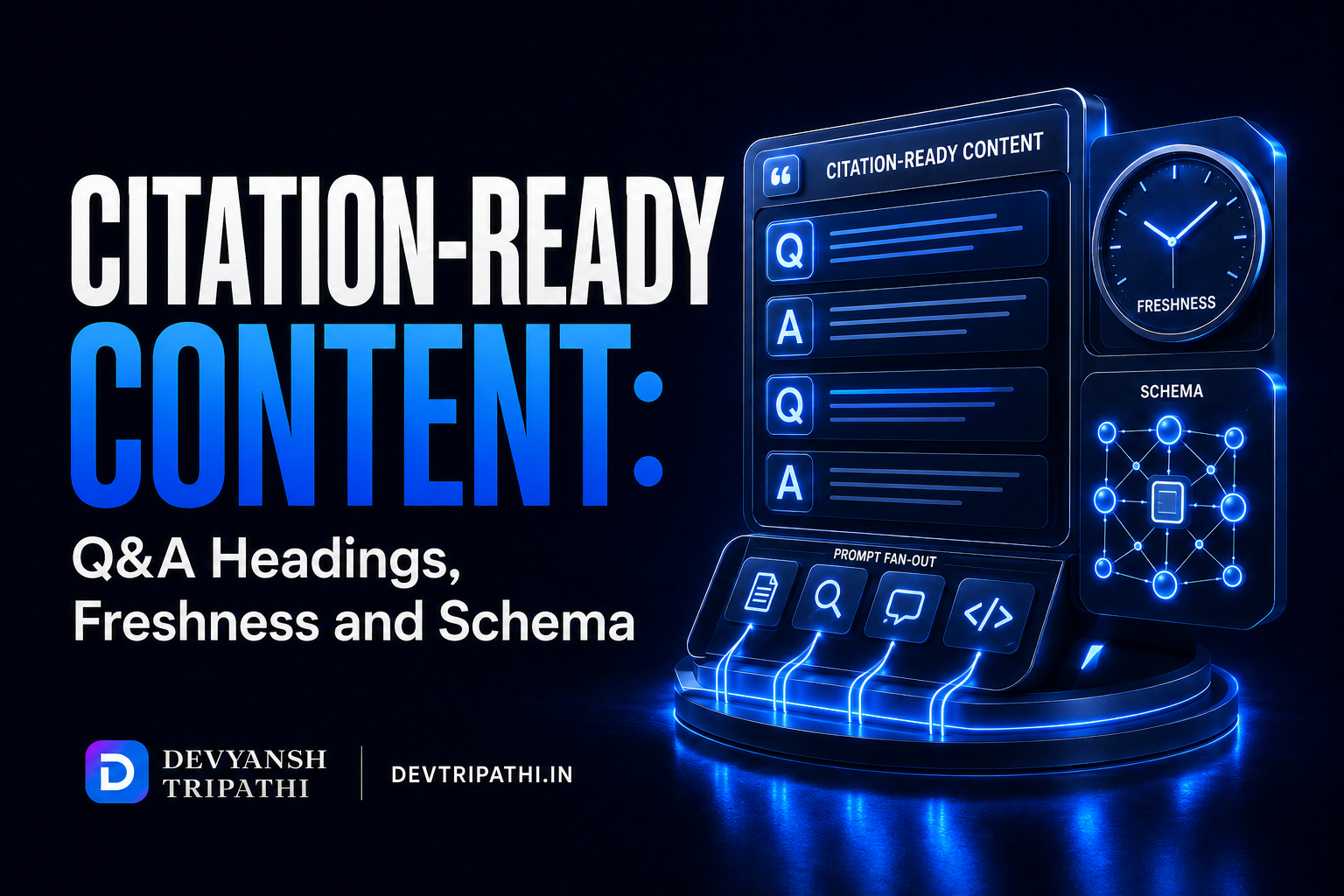
Citation-Ready Content: Q&A Headings, Freshness and Schema
08 July 2026
Prompt Optimization: Advanced Strategy for AI Search Visibility in 2026
Prompt optimization in 2026 is the practice of structuring content to match the specific patterns, phrasing, and format that AI systems favor when generating cited responses, built on quantified evidence showing that Q&A-formatted headings double AI citation rates, content refreshed within the past 30 days earns 3.2 times more citations, and the first 30% of any page’s content accounts for 44.2% of AI citations, transforming prompt optimization from an intuition-based practice into a measurable content engineering discipline.
This advanced guide covers the prompt optimization framework built on the largest available citation pattern research: the Q&A heading structure that doubles citation rates according to Kevin Indig’s analysis of 1.2 million data points, the content freshness cadence that produces the 3.2x citation multiplier, the schema deployment pattern showing 82% of ChatGPT-cited domains carry structured data, the prompt length and structure research revealing the 10.9-word average AI query, the positional content strategy responding to the finding that 44.2% of citations draw from the first 30% of page content, and the systematic prompt research methodology for identifying the exact phrasing patterns your target audience uses when querying AI systems about your category.
Is Your Content Structured for the Exact Prompts Your Buyers Are Asking AI Systems?
Get a complete prompt optimization audit covering your Q&A heading coverage, content freshness cadence, schema deployment rate, positional content structure, and a prompt research report showing the exact phrasing patterns your target audience uses when querying AI systems about your category.
Get My Prompt Optimization AuditWhy Prompt Optimization Requires Its Own Discipline in 2026
Prompt optimization addresses a specific and measurable gap between how content is traditionally structured for search engines and how AI systems actually select content for citation in generated responses. Traditional SEO content structure evolved around keyword density, header hierarchy for scannability, and search intent categories. AI citation selection operates on a different set of pattern-matching criteria that recent large-scale research has finally quantified with enough precision to guide specific content structure decisions rather than general best-practice intuition.
The scale of the underlying research base is what makes 2026 prompt optimization guidance qualitatively different from earlier practitioner advice. Kevin Indig’s analysis of 1.2 million AI citation data points, Wellows’ analysis of 11.1 million individual citations, and Digital Bloom’s schema analysis across ChatGPT-cited domains collectively provide the evidence base to move prompt optimization from theory to specific, measurable content engineering practice. For the foundational prompt optimization framework this Cycle 3 guide extends, see our Prompt Optimization guide.
2xAI citation rate for Q&A-formatted headings vs generic headings (Kevin Indig, 1.2M data points)
3.2xmore citations for content refreshed within 30 days vs stale content (Kevin Indig)
82%of ChatGPT-cited domains carry schema markup (Digital Bloom via Loamly)
44.2%of AI citations draw from the first 30% of page content (Search Engine Land)
The Q&A Heading Structure That Doubles Citation Rates
Kevin Indig’s analysis of 1.2 million AI citation data points found that content structured with Q&A-formatted headings earns twice the citation rate of content using generic declarative headings addressing the same underlying topics. This finding has a clear mechanism: AI systems match query patterns most efficiently against headings that mirror the actual phrasing structure of user prompts, and question-formatted headings create that direct pattern match far more reliably than topic-labeled section headers.
Converting Declarative Headings to Q&A Format
The practical implementation of this finding requires converting existing declarative section headings into question format that mirrors actual prompt phrasing. A heading reading “Benefits of Entity-First Content Design” should become “What Are the Benefits of Entity-First Content Design” or more specifically phrased to match likely prompt patterns such as “Why Does Entity-First Content Design Improve AI Citation Rates.” The conversion is not merely cosmetic: the question format signals to AI systems that the following content is structured as a direct, complete answer to that specific question, increasing extraction confidence and citation probability for that section.
Prioritize Q&A heading conversion on your highest-traffic and highest-commercial-value pages first, since the citation rate improvement compounds most valuably where existing traffic and conversion potential are already established. A systematic audit of your top 20 pages by organic traffic, converting all H2 and H3 headings to question format where doing so does not compromise readability or keyword relevance, typically produces measurable citation rate improvement within 4 to 6 weeks of re-indexing across the major AI platforms.
Matching Heading Phrasing to Actual Prompt Patterns
Generic question conversion alone produces some improvement, but the highest citation rate gains come from matching heading phrasing to the actual prompt patterns your target audience uses, which requires prompt research rather than assumption. Test your target topics directly in ChatGPT, Perplexity, and Google AI Mode, recording the exact phrasing patterns these systems use in their own generated sub-questions and follow-up suggestions. These AI-generated phrasings often differ from the phrasing a content team would intuitively choose, and matching your headings to the AI system’s own phrasing patterns produces stronger pattern-matching signal than generic question conversion alone. For the complete Q&A architecture framework, see our AEO Advanced Strategies guide.
Technique 1
Q&A Heading Conversion (2x Citation Rate)
Convert declarative H2 and H3 headings to direct question format matching actual AI-generated prompt phrasing patterns discovered through platform testing rather than assumption-based question writing.
Technique 2
30-Day Freshness Cadence (3.2x Citation Rate)
Establish a monthly verification and update cycle for priority pages, refreshing at minimum one statistic with a current-year source and updating the visible last-modified date each cycle.
Technique 3
Complete Schema Deployment (82% Citation Correlation)
Deploy Article, FAQPage nested within Article, and Organization schema consistently across all priority pages to match the near-universal schema presence found in ChatGPT-cited domains.
Technique 4
Front-Loaded Answer Positioning (44.2% Citation Share)
Restructure content so the most data-dense, directly responsive, and citable material appears within the first 30% of the page rather than being distributed evenly or saved for later sections.
The 30-Day Freshness Cadence and the 3.2x Citation Multiplier
The finding that content refreshed within the past 30 days earns 3.2 times more AI citations than stale content represents one of the most operationally significant discoveries in 2026 prompt optimization research, because it converts freshness from a general best practice into a specific, schedulable operational requirement with a quantified return.
Designing a Sustainable 30-Day Freshness Cycle
A sustainable 30-day freshness cycle does not require rewriting entire pages monthly, which would be operationally unsustainable across a content library of any significant size. Instead, the cycle should focus on three specific, time-efficient update actions applied to priority pages on a rotating monthly schedule: updating at least one statistic with a current-year data point and source link, adding any significant development or change in the topic area that has occurred since the last update, and refreshing the visible last-modified date to signal the verification action to both AI systems and human readers evaluating content currency.
Prioritize the 30-day cycle for pages covering fast-moving topics where information changes frequently, such as AI search platform statistics, algorithm updates, and competitive landscape content, since these topics both need frequent updates for accuracy and benefit most from the citation rate multiplier that freshness signals produce. Pages covering stable, foundational topics can operate on a quarterly cycle without materially reducing citation performance, since the underlying content accuracy does not degrade as quickly for those topic types.
The Freshness Signal Beyond Content Changes
Beyond content-level updates, the freshness signal that AI systems evaluate includes technical indicators such as the sitemap lastmod date, HTTP last-modified headers, and any visible “last updated” display on the page itself. Ensuring these technical freshness signals are accurately synchronized with actual content update activity prevents a common implementation gap where content has genuinely been refreshed but the technical signals that AI crawlers evaluate still reflect an outdated timestamp, undermining the freshness benefit that the content update was intended to produce.
Schema Deployment as a Near-Universal Citation Characteristic
The finding that 82% of ChatGPT-cited domains carry schema markup confirms that structured data deployment has moved from a competitive advantage to a near-baseline requirement for AI citation eligibility. Brands without schema markup are competing against a citation pool where the overwhelming majority of cited competitors have deployed structured data, making schema absence an increasingly significant competitive disadvantage rather than a neutral omission.
Priority schema types for prompt optimization purposes are Article schema on all substantial content pages, FAQPage schema nested within Article schema for pages containing question-and-answer content (which Semrush research separately found produces 60% higher AI Overview inclusion rates), and Organization schema with a complete sameAs array establishing entity authority. Implementing all three schema types consistently across your priority content library aligns your technical foundation with the 82% baseline that ChatGPT-cited domains have already established, removing a potential citation eligibility barrier that content quality alone cannot overcome.
Build Content Structured for How AI Systems Actually Select Citations
Prompt optimization in 2026 is measurable content engineering, not intuition. Dev Tripathi implements the four-technique stack of Q&A heading conversion, 30-day freshness cadence, complete schema deployment, and front-loaded answer positioning that produces quantified AI citation rate improvements.
Build My Prompt Optimization StackThe Positional Content Strategy: Front-Loading for Maximum Citation Capture
Search Engine Land’s finding that 44.2% of AI citations draw from the first 30% of a page’s content has a direct structural implication for content architecture: the most citable material on any page, meaning the most data-dense, most directly responsive, and most quotable content, should be positioned early in the page rather than distributed evenly throughout or reserved for later sections as a traditional narrative or persuasive structure might dictate.
Restructuring Existing Content for Positional Advantage
Audit your priority pages for where the most citable content currently sits in the page structure. Content that opens with extensive scene-setting, background context, or narrative buildup before reaching the core data or direct answers is structurally misaligned with the 44.2% first-30% citation concentration. Restructure these pages to move the direct answer, the key statistic, or the core actionable information into the opening sections, reserving extended context, methodology explanation, and narrative elaboration for later in the page where it still serves readers who continue past the initial answer without competing for the citation-favored positional real estate.
Balancing Positional Optimization with Comprehensive Coverage
Front-loading citable content does not mean abandoning comprehensive topic coverage in favor of a single early answer followed by thin content. Comprehensive pillar pages that address the complete research arc for a topic, as covered in our Conversational Search Optimization Cycle 3 guide, remain essential for multi-turn AI Mode session citation retention. The positional strategy applies within that comprehensive structure: ensure that each major section, not only the page’s opening, front-loads its own most citable content within its first few sentences, so that the 44.2% concentration principle applies at the section level throughout a long-form page rather than only at the page’s absolute opening.
Systematic Prompt Research Methodology
Effective prompt optimization requires knowing the actual phrasing patterns your target audience uses when querying AI systems, which differs measurably from traditional keyword research data. The average AI search query length of 10.9 words, positioned between traditional Google’s 3.37 words and ChatGPT’s 23-word conversational average, indicates that AI query patterns require dedicated research rather than adaptation of existing keyword lists.
| Query Environment | Average Length | Research Method | Content Implication |
|---|---|---|---|
| Traditional Google Search | 3.37 words | Traditional keyword research tools | Keyword-focused titles and meta data |
| General AI Search Average | 10.9 words | Direct platform testing across Perplexity, AI Mode | Mid-length Q&A headings matching specific intent |
| ChatGPT Conversational | 23 words | Conversational prompt testing with full context | Comprehensive content addressing full contextual intent |
Conduct systematic prompt research by testing your 15 to 20 priority topics directly across ChatGPT, Perplexity, and Google AI Mode, recording the exact follow-up questions and sub-query suggestions each platform generates. These AI-generated phrasings represent the platform’s own internal model of how users are likely to continue their research on that topic, providing a direct data source for Q&A heading phrasing that is more accurate than inferring likely phrasing from traditional keyword tools built for a fundamentally different query length and structure pattern. For the complete topical cluster architecture that systematic prompt research should inform, see our Topical Authority SEO guide.
Frequently Asked Questions About Advanced Prompt Optimization
What is prompt optimization in the context of AI search?
Prompt optimization is the practice of structuring content, particularly headings, freshness signals, and schema markup, to match the specific patterns AI systems favor when selecting citation sources for generated responses. It differs from traditional keyword optimization by focusing on question-based phrasing that mirrors actual AI query patterns, systematic content freshness cadences, and positional content structure rather than keyword density and traditional on-page ranking factors alone.
Why do Q&A-formatted headings double AI citation rates?
Q&A-formatted headings double AI citation rates because AI systems match query patterns most efficiently against headings that mirror the actual phrasing structure of user prompts. A question-formatted heading such as "What Are the Benefits of X" signals directly to AI systems that the following content is structured as a complete answer to that specific question, increasing extraction confidence compared to generic declarative headings like "Benefits of X" that require more interpretive work to match against a user's question-based prompt.
How does the 30-day freshness cadence produce a 3.2x citation improvement?
Content refreshed within the past 30 days earns 3.2 times more AI citations because AI systems prioritize source accuracy and current information when generating responses, and freshness signals (recent statistics, updated last-modified dates, current developments) indicate content that has been actively verified rather than potentially outdated. A sustainable 30-day cycle involves updating at least one statistic with a current source, adding significant developments, and refreshing the visible last-modified date on priority pages monthly rather than requiring complete page rewrites.
What does the 82% schema deployment statistic mean for content strategy?
The finding that 82% of ChatGPT-cited domains carry schema markup confirms that structured data deployment has become a near-baseline characteristic of AI-cited content rather than a competitive differentiator. Brands without schema markup are competing in a citation pool where the vast majority of cited competitors have deployed Article, FAQPage, and Organization schema. This makes schema deployment an increasingly necessary technical foundation for AI citation eligibility rather than an optional enhancement that only sophisticated competitors implement.
How should content be restructured based on the 44.2% first-30% citation finding?
The finding that 44.2% of AI citations draw from the first 30% of a page requires front-loading the most data-dense, directly responsive, and quotable content early in the page structure rather than reserving it for later sections. Pages with extensive narrative buildup or background context before reaching core answers should be restructured to lead with direct answers and key statistics, moving extended context and methodology explanation to later sections. This principle applies at both the page level and the section level throughout longer comprehensive content.
Why is the average AI query length of 10.9 words significant for content strategy?
The 10.9-word average AI query length, positioned between traditional Google's 3.37 words and ChatGPT's 23-word conversational average, indicates that general AI search represents a distinct mid-length query pattern requiring its own research and optimization approach. Content optimized purely for short traditional keywords or purely for long conversational prompts may not match this middle-length pattern effectively, making dedicated prompt research across multiple AI platforms necessary to identify the specific phrasing length and structure that matches actual AI search behavior for a given topic.
How do I conduct systematic prompt research for my content topics?
Conduct systematic prompt research by testing your 15 to 20 priority topics directly in ChatGPT, Perplexity, and Google AI Mode, recording the exact follow-up questions and sub-query suggestions each platform generates in response. These AI-generated phrasings reveal how the platform's own model anticipates users continuing their research on that topic, providing a more accurate phrasing source for Q&A heading optimization than traditional keyword research tools, which were built for a different query length and structural pattern than AI search queries exhibit.
Should all headings be converted to question format for prompt optimization?
Not all headings require question format conversion. Prioritize Q&A conversion for headings on your highest-traffic and highest-commercial-value pages first, and for sections that directly answer a specific, well-defined question a user might ask. Headings that serve primarily as organizational or navigational labels within a broader narrative structure, rather than as standalone answerable questions, can remain declarative without materially reducing citation performance, since the 2x citation benefit applies specifically to genuinely question-answerable content sections.
What is the relationship between schema markup and Q&A heading structure?
Schema markup and Q&A heading structure work together rather than independently for AI citation optimization. FAQPage schema nested within Article schema formally structures question-and-answer content in machine-readable format, while the visible Q&A headings provide the same signal in human-readable format that also benefits traditional featured snippet extraction. Implementing both together, ensuring the FAQPage schema accurately mirrors the visible Q&A heading content on the page, produces stronger combined citation signal than either technique deployed in isolation.
How often should the freshness cadence be applied across different content types?
Apply the 30-day freshness cadence to pages covering fast-moving topics such as AI search platform statistics, algorithm updates, and competitive landscape content, where information both changes quickly and benefits most from the citation multiplier freshness produces. Pages covering stable, foundational topics with content that does not degrade quickly in accuracy can operate on a quarterly freshness cycle without materially reducing citation performance, allowing content teams to allocate the more resource-intensive monthly cycle to the topics where it produces the greatest return.
How does prompt optimization connect to the broader GEO and AEO frameworks?
Prompt optimization provides the specific, quantified content structure techniques that operationalize the broader GEO and AEO strategic frameworks. Where GEO strategy addresses the overall citation authority-building investment sequence and AEO addresses the answer format architecture for different query intent types, prompt optimization provides the tactical, measurable techniques (Q&A headings, freshness cadence, schema deployment, positional structuring) that directly implement both frameworks at the content production level with quantified expected returns for each technique.
What is the highest-priority prompt optimization action for a content team just starting this discipline?
For content teams beginning systematic prompt optimization, the highest-priority action is auditing the top 20 traffic-driving pages for schema markup completeness, since the 82% ChatGPT-cited domain schema correlation represents both the most measurable gap and the most straightforward technical implementation. Following schema deployment, establish the 30-day freshness cadence for the same top 20 pages, since the 3.2x citation multiplier represents the largest single quantified improvement available from a single technique. Q&A heading conversion and positional restructuring should follow once the foundational schema and freshness practices are operational and sustainable.
Ready to Engineer Content for Measurable AI Citation Improvement?
Get a complete prompt optimization programme covering Q&A heading conversion for your priority pages, a sustainable 30-day freshness cadence, complete schema deployment to match the 82% ChatGPT-cited domain baseline, positional content restructuring, and a systematic prompt research report showing the exact phrasing patterns your audience uses across AI platforms.
Start My Prompt Optimization ProgrammeConclusion
Prompt optimization in 2026 has moved from an intuition-based practice to a quantified content engineering discipline supported by research spanning millions of citation data points. Q&A-formatted headings that mirror actual AI query patterns double citation rates. A sustainable 30-day freshness cadence produces a 3.2 times citation multiplier. Complete schema deployment matches the near-universal 82% baseline that ChatGPT-cited domains already exhibit. And front-loading the most citable content into the first 30% of every page captures a disproportionate share of the 44.2% citation concentration that positional research has identified.
The four-technique stack of Q&A heading conversion, freshness cadence implementation, schema deployment, and positional restructuring provides a specific, measurable implementation sequence rather than general content quality guidance. Combined with systematic prompt research that identifies the exact phrasing patterns your target audience uses across ChatGPT, Perplexity, and Google AI Mode, this framework transforms prompt optimization from guesswork into a repeatable content production system with quantified expected returns for each investment. For the complete AI citation strategy that this content-level prompt optimization framework feeds into, see our AI Citation Optimization Advanced Guide.

Devyansh Tripathi
I’m Devyansh Tripathi, an SEO strategist and digital growth expert, helps businesses and individuals rank higher and drive organic traffic. Through DevTripathi., he shares cutting-edge SEO insights, content strategies, and marketing hacks. Passionate about digital success, he’s on a mission to make SEO simple, effective, and result-driven!
Posts
- What Google’s New AI Search Documentation Means for SEO Teams
- Google I/O 2026 Search: AI Agents, Gemini 3.5 and the Unified Box
- Google’s AI Optimization Guide: The Technical and Content Checklist
- July 2026 SEO Update: AI Overviews, llms.txt and Search Console
- Prompt Optimization Beyond Page One: The Position-21 Citation Opportunity
Categories
- AI Citation Optimization
- AI Search Optimization (AISEO)
- AI Visibility Tracking
- Answer Engine Optimization (AEO)
- Brand Authority SEO
- Brand SERP Optimization
- Community Signal SEO
- Conversational Search Optimization
- Generative Engine Optimization (GEO)
- Knowledge Graph Optimization
- Modern SEO Strategies
- Multimodal Search Optimization
- Prompt Optimization
- SEO Trends
- Social Search Optimization
- Topical Authority SEO
- Uncategorized
- Video Search SEO
- Visual Search Optimization
- Voice Engine Optimization (VEO)
- Zero Click Search Optimization
Latest News
Text Widget
Empowering brands with insights, strategies, and stories that drive digital growth.