
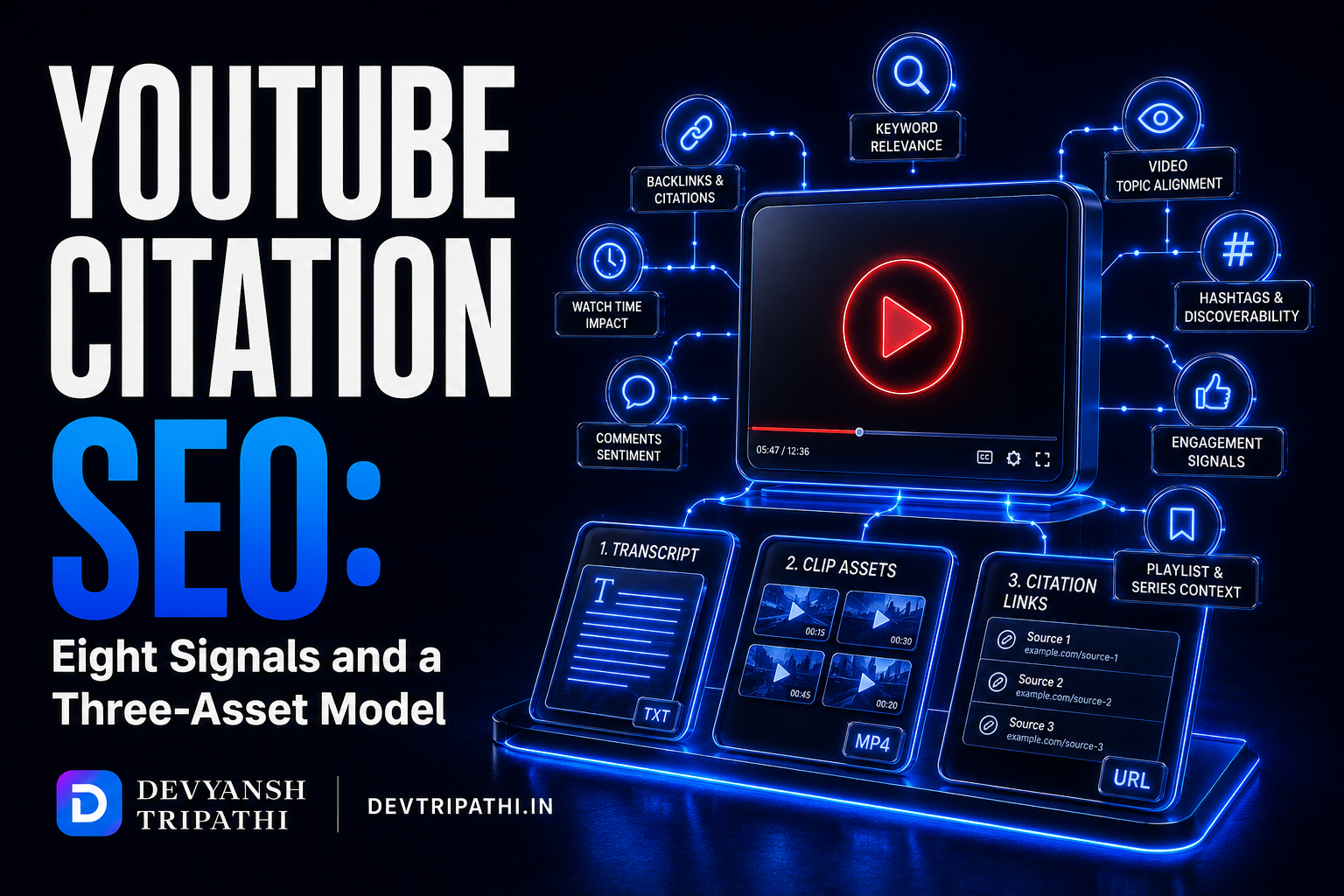
YouTube Citation SEO: Eight Signals and a Three-Asset Model
12 July 2026
Video search SEO in 2026 centers on a finding that has reordered every previous video optimization priority: YouTube mentions correlate with AI engine visibility at 0.737, the strongest predictor measured across a 75,000-brand Ahrefs analysis, stronger than backlinks, domain authority, or any traditional SEO signal, while the correlation between view count and AI citation rate is effectively zero at negative 0.03, confirming that AI citation eligibility depends entirely on structural signals, not popularity metrics.
This advanced guide covers the video search SEO framework built on the newest 2026 AI citation research: the counterintuitive finding that view count has no bearing on citation likelihood while transcript and chapter structure determine everything, the platform-specific citation data showing Perplexity and Google AI Overviews drive 75% of YouTube citations while ChatGPT, Copilot, Gemini, and Perplexity never cite timestamped videos outside Google’s ecosystem, the eight-element optimization checklist that transforms a video into machine-readable citation material, the VideoObject and Clip schema implementation that gives Google’s systems the cleanest possible input for AI Overview inclusion, and the three-asset distribution model that compounds citation value across the video itself, an embedding blog post, and short-form distribution clips.
Is Your Video Content Structured for AI Citation or Only for Views?
Get a complete video search SEO audit covering your transcript accuracy, chapter structure and formatting compliance, VideoObject and Clip schema implementation, platform-specific citation readiness, and the specific structural gaps preventing your video content from being cited by ChatGPT, Perplexity, and Google AI Overviews.
Get My Video Search SEO AuditThe View Count Irrelevance Finding That Changes Video SEO Priorities
The single most consequential finding in 2026 video search SEO research is the near-zero correlation between view count and AI citation rate, measured at negative 0.03 by DOJO AI’s analysis. This finding inverts the assumption that has guided video content strategy for over a decade: that popularity, measured through views, subscribers, and engagement volume, is the primary driver of a video’s discoverability and authority. For AI citation purposes specifically, popularity is essentially irrelevant. A video with 500 views and precise structural optimization is exactly as citable as a video with 5 million views lacking that structure.
This does not mean view count and audience size have become worthless business metrics. They remain essential for advertising revenue, brand awareness, and the traditional YouTube algorithm’s own discovery and recommendation systems. What has changed is that AI citation eligibility now operates as a genuinely separate optimization objective from view-driving content strategy, requiring brands to treat structural optimization, transcript accuracy, and chapter formatting as a distinct investment rather than assuming that content designed purely to maximize views will naturally also earn AI citations. For the broader correlation data confirming YouTube’s role in overall AI citation authority, see our Brand Authority SEO Cycle 3 guide.
0.737YouTube mention correlation with AI visibility — strongest predictor measured (Ahrefs, 75,000 brands)
-0.03correlation between view count and AI citation rate — essentially zero (DOJO AI 2026)
75%of YouTube citations driven by Perplexity and Google AI Overviews combined (DOJO AI)
32.1%of cited videos fall in the 10-20 minute length range, the single largest cluster (OtterlyAI)
The Platform Divergence: Google’s Ecosystem vs Everyone Else
OtterlyAI’s YouTube AI Citation Study revealed a platform divergence with direct strategic implications: timestamped video citations are concentrated exclusively within Google’s ecosystem, with no timestamped videos cited by ChatGPT, Copilot, Gemini, or Perplexity in their research dataset. This confirms that Google is parsing video structure at a technical level, treating timestamps as navigational data it can index and reference at the segment level, while other major AI platforms currently cite YouTube content without engaging with that same timestamp-level structure.
The practical implication is that timestamp and chapter optimization should be understood specifically as a Google AI ecosystem investment, valuable for Google AI Overviews, AI Mode, and the Key Moments feature in standard search results, rather than a universal AI citation lever that automatically benefits ChatGPT or Perplexity citation rates equally. This does not diminish the value of chapters, since Google’s ecosystem alone represents an enormous share of total AI-mediated search volume, but it does mean brands should calibrate expectations correctly: chapter optimization drives Google-specific citation gains, while transcript quality and content structure remain the universal signals that matter across every AI platform including those outside Google’s ecosystem.
Why Perplexity and Google AI Overviews Dominate YouTube Citations
Perplexity and Google AI Overviews driving 75% of all YouTube citations reflects the retrieval-augmented architecture both platforms share: they actively search and retrieve current web and video content rather than relying primarily on static training data, giving YouTube’s constantly updating content library a structural advantage in these two platforms specifically. ChatGPT, Copilot, and Gemini, while increasingly capable of processing video transcripts when directly provided or accessed through browsing features, have not yet developed the same systematic YouTube retrieval integration that Perplexity and Google’s own AI products have built natively into their core architecture.
The Eight-Element Video Citation Optimization Checklist
Transforming a video into citation-ready material requires addressing eight specific structural elements, each contributing a distinct signal that AI systems evaluate when determining whether to reference a video as a source. Missing any single element can prevent citation even when the remaining seven are executed well.
Element 1
Accurate, Manually Reviewed Transcripts
Auto-generated captions with errors lead to misquotes, and AI engines that detect inconsistencies between title claims and transcript content may skip the video entirely as an unreliable source. Upload a manually reviewed transcript in SRT format rather than relying solely on YouTube's automatic captioning, since AI systems parse the transcript first, searching for a clean, self-contained answer to the target query.
Element 2
Timestamped Chapters Meeting YouTube's Formatting Requirements
Chapters must follow YouTube's exact formatting rules to render correctly: the first timestamp must start at 00:00, a minimum of three timestamps must appear in ascending order, and each chapter must be at least 10 seconds long. Use keyword-rich, question-format chapter titles such as "How to Research Video Keywords" rather than generic labels like "Step One," since question-formatted titles align directly with how AI systems match content to conversational queries.
Element 3
Self-Contained Answers Within Each Chapter Segment
Structure the transcript so each chapter contains a self-contained answer to its own implicit question, rather than requiring the viewer or AI system to reference content from earlier or later chapters to understand any single segment. This segment-level completeness is what allows AI systems to cite a specific chapter or timestamp rather than requiring citation of the entire video.
Element 4
VideoObject Schema on the Embedding Page
Deploy VideoObject schema on any page embedding the video, including name, description, thumbnailUrl, uploadDate, duration, and transcript properties. This schema gives search engines and AI systems structured, machine-readable metadata about the video that supplements the transcript-based content understanding, particularly valuable on owned website pages where the brand controls the complete technical implementation.
Element 5
Clip Schema for Individual Chapter Segments
Adding Clip schema for individual chapters, combined with SeekToAction markup for jump-to-timestamp behavior, gives Google's systems cleaner inputs to feed directly into AI Overviews and the Key Moments search feature. This is the most direct technical path to appearing in Google's segment-level video citation features beyond what chapter formatting alone provides.
Element 6
Factual, Specific, Verifiable Claims
Videos including specific data points, step-by-step processes, or verifiable information are more likely to be cited than opinion-heavy content, because AI engines prefer sources they can cross-reference against other sources for accuracy confirmation. Opinion and subjective commentary content, while valuable for audience engagement, provides weaker citation material than content built around specific, checkable facts and processes.
Element 7
Optimal Length: 10 to 20 Minutes for Maximum Citation Probability
OtterlyAI's citation dataset skews heavily toward 5 to 20 minute videos, with the largest single cluster at 10 to 20 minutes representing 32.1% of citations, followed by 5 to 10 minutes at 26.1%. Videos exceeding 20 minutes still earn meaningful citation share at 17.6%, but the 10 to 20 minute range represents the evidence-based sweet spot for content specifically targeting AI citation optimization.
Element 8
Established Topical Authority and Channel Consistency
Videos from channels demonstrating consistent topical focus, strong engagement signals, and quality embeds on authoritative external sites rank higher in AI citation evaluation, mirroring how generative engine optimization functions for standard web content. A channel publishing consistently within a focused topic area builds the same kind of topical authority signal covered in our Prompt Optimization Cycle 3 guide, applied specifically to video content.
| Video Length Range | Share of AI Citations | Optimal Use Case |
|---|---|---|
| 5 to 10 minutes | 26.1% | Focused single-topic explainers, quick tutorials |
| 10 to 20 minutes | 32.1% (largest cluster) | Comprehensive topic coverage, primary AI citation target |
| Over 20 minutes | 17.6% | Deep-dive comprehensive guides, multi-part processes |
| Under 5 minutes (Shorts) | Minimal outside Google's ecosystem | Discovery and reach, not primary citation target |
YouTube Is Now the Number One Most-Cited Domain in Google AI Overviews
Dev Tripathi builds complete video search SEO programmes covering transcript optimization, chapter structuring to YouTube's exact formatting requirements, VideoObject and Clip schema implementation, and the three-asset distribution model that compounds citation value across your video, blog, and social presence.
Build My Video Search SEO StrategyThe Three-Asset Distribution Model for Compounding Citation Value
Maximum video search SEO citation value comes not from the YouTube video in isolation but from a coordinated three-asset distribution model where each asset serves a distinct role in the overall citation economics. This model addresses both the platform divergence findings and the reality that AI systems cite different formats of the same underlying content differently depending on the platform and query type.
Asset 1: The YouTube Video Itself
The YouTube video, with verified transcript, question-format chapters, and a description of 300 words or more incorporating target keywords naturally, serves as the primary discovery and native YouTube search asset. This is the version most likely to be cited directly by Google AI Overviews and AI Mode given Google’s demonstrated ability to parse timestamp-level structure within its own ecosystem.
Asset 2: The Embedding Blog Post with Full Transcript
A blog post embedding the video with complete VideoObject schema and the full transcript reproduced in readable text format represents the highest-value AEO surface most brands do not currently control or optimize adequately. This asset compounds citation economics because it gives every AI platform, not only Google’s ecosystem, a text-based version of the video’s content that can be parsed, cited, and referenced using the same mechanisms that apply to standard web content citation. For brands whose video content exists only on YouTube without a corresponding owned-domain blog post, this represents the single highest-leverage gap to close for cross-platform AI citation performance.
Asset 3: Short Clips Distributed for Social Reach
Short clips distributed to TikTok, Instagram, and YouTube Shorts, with links back to the full video and the blog post, serve a discovery and reach function rather than a primary citation-earning function, consistent with the finding that timestamped short-form content shows minimal AI citation benefit outside Google’s specific ecosystem. These clips remain valuable for the broader social search visibility covered in our Social Search Optimization Cycle 3 guide, but should not be expected to independently drive the AI citation performance that the full-length video and its transcript-complete blog companion are structurally positioned to achieve.
AEO and GEO as Distinct Video Citation Objectives
Video search SEO in 2026 benefits from distinguishing between AEO and GEO as genuinely different citation objectives with different optimization targets. AEO, answer engine optimization, is about earning direct citation as the answer in AI search results, typically through a specific chapter or timestamp being referenced as the source for a focused, well-defined query. GEO, generative engine optimization, is about earning a quotation or reference within the longer, synthesized responses that AI engines generate for broader, more complex queries.
AEO wins the zero-click direct answer citation, typically at the segment or chapter level, while GEO wins the brand mention embedded within a longer generative summary that may synthesize information from multiple sources including your video alongside other content. Optimizing for both requires the self-contained chapter-level answers that AEO citation depends on, combined with the broader topical authority and factual density that makes a video a valuable reference source within a longer synthesized GEO response. For the complete answer format architecture that applies these principles across content types, see our AEO Advanced Strategies guide.
Frequently Asked Questions About Video Search SEO in 2026
What is video search SEO in the context of AI citations?
Video search SEO in the AI citation context is the practice of structuring YouTube video content, including transcripts, chapters, and schema markup, so that AI systems including ChatGPT, Perplexity, and Google AI Overviews can parse, understand, and cite specific segments as source material for generated responses. It extends beyond traditional YouTube ranking factors like views and watch time into the structural signals that determine AI citation eligibility, which research confirms are largely independent of video popularity metrics.
Why is view count irrelevant to AI citation rate?
View count shows only a negative 0.03 correlation with AI citation rate because AI systems evaluate videos for citation based on structural clarity and content accessibility rather than popularity signals. A video's citation eligibility depends on whether its transcript is accurate, whether its chapters are properly formatted and self-contained, and whether it contains specific, verifiable information the AI can confidently reference, none of which correlate meaningfully with how many people have watched the video. This makes AI citation optimization a genuinely separate objective from traditional view-maximizing content strategy.
Why does YouTube mention correlation with AI visibility reach 0.737?
YouTube mentions correlating with AI engine visibility at 0.737, the strongest predictor in Ahrefs' 75,000-brand analysis, reflects both YouTube transcripts constituting a significant portion of AI model training data and the independent, cross-source corroboration pattern that consistent YouTube presence generates. Brands regularly discussed, reviewed, or referenced across multiple independent YouTube videos build entity representation in AI systems that outperforms even strong backlink profiles, which showed a much weaker correlation in the same research.
Why are timestamped video citations concentrated only within Google's ecosystem?
OtterlyAI's research found no timestamped videos cited by ChatGPT, Copilot, Gemini, or Perplexity, with timestamped citations appearing exclusively within Google AI Overviews and AI Mode. This suggests Google has built specific technical infrastructure for parsing YouTube's chapter and timestamp structure at a segment level, functionality that other major AI platforms have not yet developed to the same degree. Chapter optimization should therefore be understood as a Google-ecosystem-specific investment rather than a universal AI citation lever.
What are YouTube's exact formatting requirements for chapters to render correctly?
YouTube requires the first timestamp to start at exactly 00:00, a minimum of three timestamps listed in ascending order, and each individual chapter to be at least 10 seconds in length. These are strict formatting requirements: violating any one of them prevents chapters from rendering as YouTube's Key Moments feature, meaning the video loses both the user-facing navigation benefit and the machine-readable structural signal that AI systems use for segment-level citation, regardless of how well-organized the underlying content itself is.
What is the optimal video length for AI citation eligibility?
The 10 to 20 minute range represents the single largest citation cluster at 32.1% of OtterlyAI's dataset, followed by 5 to 10 minutes at 26.1% and videos over 20 minutes at 17.6%. This suggests that comprehensive but focused content in the 10 to 20 minute range provides the strongest balance of topical depth and structural manageability for AI citation purposes, though shorter and longer formats both retain meaningful citation share when structured correctly with accurate transcripts and proper chapter formatting.
What is the difference between VideoObject schema and Clip schema?
VideoObject schema describes the video as a whole, including name, description, thumbnailUrl, uploadDate, and duration, and is deployed on the page embedding the video to give search engines and AI systems structured metadata about the complete asset. Clip schema describes individual segments or chapters within that video, allowing search engines to reference and cite specific timestamped sections independently. Combining Clip schema with SeekToAction markup gives Google's systems the cleanest possible input for surfacing specific video segments in AI Overviews and the Key Moments search feature.
Why does Perplexity and Google AI Overviews driving 75% of YouTube citations matter for strategy?
This concentration means that video search SEO investment should prioritize the structural elements these two platforms specifically favor, comprehensive transcripts and properly formatted chapters, since they represent the majority of total YouTube citation opportunity. While ChatGPT, Copilot, and Gemini remain worth optimizing for through strong transcript quality and factual content density, brands with limited resources should recognize that Perplexity and Google's AI ecosystem currently offer the highest-volume citation opportunity for video content specifically.
What is the three-asset distribution model for video content?
The three-asset distribution model treats the YouTube video, an embedding blog post with full transcript and VideoObject schema, and short-form distribution clips as distinct assets serving different citation functions. The YouTube video drives native platform discovery and Google ecosystem citation. The blog post with complete transcript provides the highest-value cross-platform AEO surface, giving every AI system a text-parseable version of the content. Short clips serve discovery and social reach rather than direct citation earning, since timestamped short-form content shows minimal citation benefit outside Google's ecosystem specifically.
How does AEO differ from GEO for video content specifically?
AEO for video means earning direct citation as the answer to a focused query, typically through a specific chapter or timestamp being referenced as the definitive source, winning the zero-click direct answer position. GEO for video means earning a quotation or brand mention embedded within a longer, synthesized AI response that draws from multiple sources including your video alongside others. AEO requires self-contained, chapter-level answers; GEO requires broader topical authority and factual density that makes a video a valuable reference within a longer generative summary covering the wider topic.
Why do factual, specific claims outperform opinion-heavy video content for AI citation?
AI engines prefer sources they can cross-reference for accuracy confirmation, and specific data points, step-by-step processes, and verifiable information provide exactly the kind of checkable content that supports this cross-referencing. Opinion and subjective commentary, while valuable for building audience engagement and channel personality, cannot be verified against other sources in the same way, making it structurally weaker citation material regardless of how well-produced or popular the content is with human viewers.
Ready to Build Video Content That Earns AI Citations, Not Just Views?
Get a complete video search SEO programme covering your eight-element citation optimization audit, chapter formatting compliance with YouTube's exact requirements, VideoObject and Clip schema implementation, three-asset distribution strategy, and platform-specific optimization for the Google ecosystem versus ChatGPT, Perplexity, and Gemini.
Start My Video Search SEO ProgrammeConclusion
Video search SEO in 2026 has been fundamentally reshaped by two converging findings: YouTube mentions represent the single strongest AI citation correlation measured at 0.737, while view count shows essentially no relationship to citation likelihood at negative 0.03. Together these findings confirm that AI citation eligibility for video content is a distinct structural optimization objective, independent from the popularity-focused strategies that have historically defined YouTube success, requiring dedicated investment in transcript accuracy, properly formatted chapters, and schema implementation regardless of a channel’s existing subscriber base or view history.
The platform divergence between Google’s ecosystem, which drives 75% of citations and uniquely parses timestamp-level structure, and the other major AI platforms that currently cite video content without that same segment-level engagement, requires calibrated expectations for chapter optimization specifically while maintaining universal transcript quality investment across all platforms. The three-asset distribution model, treating the YouTube video, an embedding blog post with complete transcript, and social distribution clips as distinct citation-earning roles, provides the practical framework for maximizing cross-platform citation value from a single content investment. For the complete multimodal search framework that video content operates within, see our Multimodal Search Optimization guide.

Devyansh Tripathi
I’m Devyansh Tripathi, an SEO strategist and digital growth expert, helps businesses and individuals rank higher and drive organic traffic. Through DevTripathi., he shares cutting-edge SEO insights, content strategies, and marketing hacks. Passionate about digital success, he’s on a mission to make SEO simple, effective, and result-driven!
Posts
- What Google’s New AI Search Documentation Means for SEO Teams
- Google I/O 2026 Search: AI Agents, Gemini 3.5 and the Unified Box
- Google’s AI Optimization Guide: The Technical and Content Checklist
- July 2026 SEO Update: AI Overviews, llms.txt and Search Console
- Prompt Optimization Beyond Page One: The Position-21 Citation Opportunity
Categories
- AI Citation Optimization
- AI Search Optimization (AISEO)
- AI Visibility Tracking
- Answer Engine Optimization (AEO)
- Brand Authority SEO
- Brand SERP Optimization
- Community Signal SEO
- Conversational Search Optimization
- Generative Engine Optimization (GEO)
- Knowledge Graph Optimization
- Modern SEO Strategies
- Multimodal Search Optimization
- Prompt Optimization
- SEO Trends
- Social Search Optimization
- Topical Authority SEO
- Uncategorized
- Video Search SEO
- Visual Search Optimization
- Voice Engine Optimization (VEO)
- Zero Click Search Optimization
Latest News
Text Widget
Empowering brands with insights, strategies, and stories that drive digital growth.