AI Search Market Fragmentation: ChatGPT, Gemini and Grok in 2026
17 July 2026
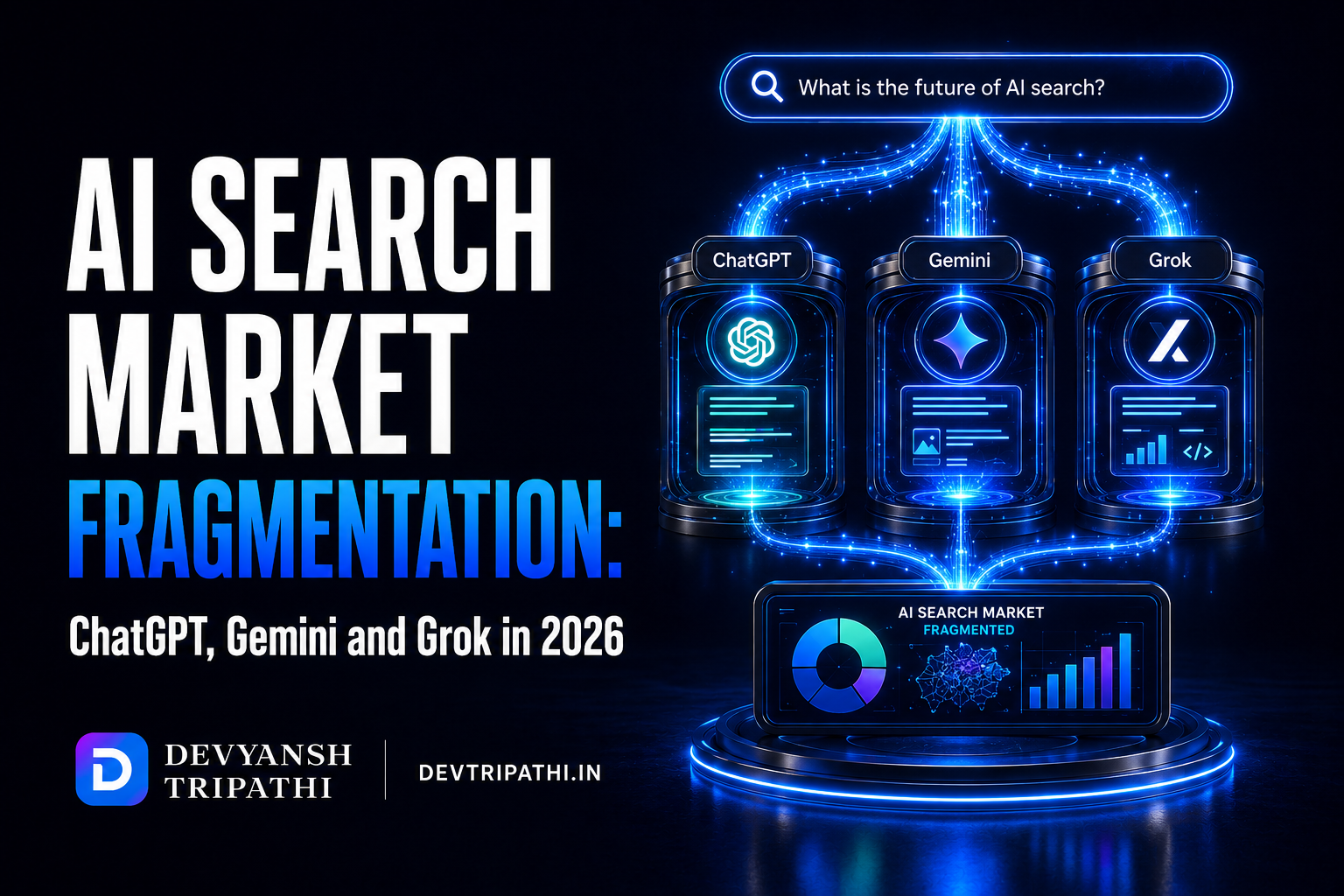
AI search optimization entering the second half of 2026 must respond to the most significant platform market share shift since AI search began: ChatGPT’s global AI web traffic share fell from approximately 86% a year earlier to 64.6% by mid-January 2026 according to Similarweb, while Google’s Gemini traffic share grew 315% over the same period to nearly 22%, and Elon Musk’s Grok surged from 1.6% to 15.2% market share according to Apptopia data, confirming that the single-platform ChatGPT-first optimization strategy many brands adopted in 2024 and 2025 now systematically underserves a rapidly fragmenting AI search landscape.
This Cycle 4 guide covers the platform fragmentation reshaping AISEO strategy for the remainder of 2026: the complete market share collapse data from Similarweb and Apptopia showing ChatGPT’s declining dominance, the specific growth drivers behind Gemini’s surge including native Android distribution advantages, Grok’s unprecedented rise as a genuine third force in the platform landscape, the 133-million-user US genAI market that now represents 39% of the population and continues growing, and the practical multi-platform optimization framework that fragmentation now makes mandatory rather than optional for brands seeking comprehensive AI search visibility.
Is Your AISEO Strategy Still Built Around ChatGPT's 2025 Market Dominance?
With ChatGPT's traffic share falling from 86% to 64.6% in a single year and Gemini and Grok both surging, a single-platform strategy now leaves a growing share of your addressable AI search audience unaddressed. Get a complete platform fragmentation assessment covering your visibility across ChatGPT, Gemini, Grok, and Perplexity.
Get My Multi-Platform AISEO AssessmentThe Collapse of ChatGPT’s Near-Monopoly
The defining structural development in AI search for 2026 is the rapid erosion of ChatGPT’s once near-total dominance of the conversational AI market. Similarweb’s Global AI Tracker recorded ChatGPT at approximately 86% of direct web traffic among AI chatbot sites a year earlier, a figure that had fallen to 64.6% by mid-January 2026, the platform’s lowest share since its 2023 peak. This is not a marginal fluctuation. It represents a genuine structural shift in how AI search traffic is distributed across the competitive landscape, with direct and immediate implications for any brand whose AI search optimization strategy has assumed ChatGPT represents the overwhelming majority of relevant AI search traffic.
The scale of this shift is significant enough that industry observers have characterized it as the end of a “near-monopoly” period, with OpenAI reportedly responding internally with what has been described as a “Code Red” competitive posture. For AI search optimization strategy, the practical implication is immediate: brands that concentrated their AI citation and structural optimization efforts primarily around ChatGPT’s specific retrieval and citation patterns during 2024 and 2025 are now addressing a shrinking proportion of the total AI search traffic their target audience generates.
64.6%ChatGPT's global AI traffic share, down from ~86% a year earlier (Similarweb)
315%Gemini's traffic share growth over the past 12 months (Similarweb via eMarketer)
15.2%Grok's market share, up from 1.6% one year prior (Apptopia)
133MUS genAI users in 2026, roughly 39% of the US population (eMarketer forecast)
Why Gemini Is Growing So Rapidly
Gemini’s 315% traffic share growth reflects several compounding structural advantages that AI search optimization strategy must account for specifically. The most significant is distribution: Gemini’s native integration into Android, the operating system running the substantial majority of smartphones globally, provides seamless access for roughly twice as many US users compared to standalone competitor apps that require separate download and account creation. This distribution advantage functions similarly to how Google’s search engine achieved dominance through default browser and device integration decades earlier, an advantage no competitor AI platform can easily replicate without comparable device-level distribution.
Gemini’s integration into the broader Google ecosystem, including direct connections to Google Search, AI Overviews, and AI Mode, also means content optimized for Google’s traditional search and AI Overview citation eligibility increasingly serves Gemini citation eligibility simultaneously. This creates a compounding optimization efficiency for brands already investing in strong Google-ecosystem GEO practices, since the same entity authority, schema markup, and content structure signals that drive AI Overview citations feed directly into Gemini’s growing standalone traffic base as well.
Grok’s Unprecedented Rise as a Genuine Third Force
Grok’s growth from 1.6% to 15.2% market share represents one of the fastest platform share gains in the AI search landscape’s short history, surpassing DeepSeek for the first time and establishing itself as a genuine third competitive force alongside ChatGPT and Gemini rather than a niche or experimental alternative. This growth trajectory means brands that have not yet evaluated their content and entity visibility specifically within Grok are likely missing a rapidly growing segment of AI search traffic that a strategy built only around ChatGPT and Gemini would not capture.
Grok’s integration with X (formerly Twitter) creates a distinct citation and training data pathway compared to the other major platforms, drawing more heavily from real-time social discourse and public conversation patterns. Brands with active, substantive presence in the conversations Grok’s training and retrieval systems draw from, particularly on X itself, may find disproportionate visibility opportunity on this specific platform relative to their general AI search authority on other platforms, making Grok-specific evaluation a distinct diagnostic step rather than an assumption that general AI citation authority transfers uniformly across all platforms.
64.6% Traffic Share, Declining from ~86%
ChatGPT: Still Dominant, No Longer Unchallenged
ChatGPT remains the largest single AI search platform by a wide margin, with 900 million weekly active users and more than 50 million paying consumer subscribers according to Reporter Outreach's 2026 compilation. The optimization fundamentals covered throughout our AI Citation Optimization Cycle 4 guide remain fully relevant for ChatGPT specifically, but should no longer be treated as sufficient for comprehensive AI search coverage given the platform's declining relative share of total AI search traffic.
~22% Traffic Share, Growing 315% Year-Over-Year
Gemini: The Distribution-Advantaged Challenger
Gemini's growth is structurally different from organic content-driven growth because it stems substantially from device-level distribution through Android integration. This means Gemini visibility optimization should weight Google ecosystem signals, including traditional SEO fundamentals, AI Overview citation performance, and Knowledge Graph entity recognition, more heavily than platform-specific tactics unique to Gemini's standalone interface.
15.2% Market Share, Up from 1.6%
Grok: The Fastest-Growing Third Force
Grok's growth trajectory and distinct X-integrated training and retrieval pathway make it a platform requiring dedicated evaluation rather than an assumption of automatic visibility transfer from broader AI citation authority. Brands should specifically test their visibility on Grok using representative target queries as part of a comprehensive multi-platform AI visibility audit, given its unprecedented growth rate and distinct source weighting.
The 133-Million-User US Market and What It Means for AISEO Priority
eMarketer’s forecast that 133 million people in the US alone will use generative AI in 2026, representing approximately 39% of the US population, confirms that AI search has crossed from an early-adopter behavior into genuinely mainstream usage affecting nearly two in five Americans. This scale of adoption means AI search optimization can no longer be treated as a specialized, forward-looking investment relevant primarily to technology-forward brands or audiences; it addresses a mainstream consumer and business behavior pattern relevant across nearly every industry category and demographic segment.
The same eMarketer data notes that Perplexity and Microsoft Copilot continue losing share while Anthropic’s Claude usage has remained comparatively stable, providing useful context for platform prioritization: brands with limited resources for comprehensive multi-platform optimization should weight their investment toward the platforms showing sustained or growing share (ChatGPT, Gemini, and Grok specifically) over platforms currently losing relative market position, while still maintaining baseline optimization for Claude given its stable usage base among specific professional and technical audience segments.
39% of the US Population Now Uses Generative AI. Your Content Must Be Visible Across a Fragmenting Platform Landscape.
Dev Tripathi builds complete multi-platform AISEO programmes covering ChatGPT, Gemini, Grok, and Perplexity visibility testing, platform-specific optimization prioritization based on current market share trends, and the entity authority foundation that transfers citation eligibility across the fragmenting AI search landscape.
Build My Multi-Platform AISEO StrategyThe Multi-Platform Optimization Framework for a Fragmenting Landscape
Platform fragmentation requires AISEO strategy to move decisively beyond the single-platform, ChatGPT-first approach that was reasonably defensible when ChatGPT held an 86% or greater share of AI search traffic. With that share now down to 64.6% and continuing to decline as Gemini and Grok grow, brands need a genuine multi-platform optimization framework that allocates testing and optimization effort proportionally to current and projected platform share rather than historical assumptions.
| Platform | 2026 Share Trend | Primary Growth Driver | AISEO Priority Weighting |
|---|---|---|---|
| ChatGPT | Declining (86% to 64.6%) | Established base, slowing new growth | Still highest single-platform priority despite decline |
| Gemini | Surging (+315% YoY) | Android native distribution, Google ecosystem integration | Rapidly rising priority, aligns with traditional SEO investment |
| Grok | Surging (1.6% to 15.2%) | X integration, real-time discourse training data | Emerging priority requiring dedicated visibility testing |
| Perplexity / Copilot | Declining share | Losing ground to larger platforms | Maintain baseline, lower relative priority increase |
Practical Steps for Multi-Platform Visibility Testing
Given the pace of platform share change documented in this data, brands should establish a quarterly platform visibility re-testing cadence rather than a one-time assessment, since the market share distribution that justified a given optimization allocation six months ago may no longer reflect the current competitive landscape. Test the same 15 to 20 priority queries across ChatGPT, Gemini, Grok, and Perplexity on a consistent schedule, recording citation presence and accuracy for each platform independently, since the near-zero cross-platform citation overlap documented in prior GEO research means strong performance on one platform provides no reliable signal about performance on another. For the complete measurement infrastructure that supports this quarterly re-testing discipline, see our AI Visibility Tracking guide.
Entity Authority as the Cross-Platform Transfer Mechanism
While citation patterns differ significantly across platforms, the underlying entity authority signals, including Knowledge Graph recognition, review platform coverage, and consistent brand entity data, continue to function as a foundation that transfers benefit across all platforms simultaneously, even as the specific retrieval mechanisms and citation weighting differ. This makes the entity authority investment covered in our Brand Authority SEO Cycle 3 guide a platform-agnostic foundation that remains valuable regardless of how the specific market share percentages continue shifting through the remainder of 2026, providing a stable strategic anchor amid the platform-level volatility this fragmentation data documents.
Frequently Asked Questions About AI Search Optimization in a Fragmenting Platform Landscape
Why has ChatGPT's market share declined so significantly in 2026?
ChatGPT's global AI web traffic share fell from approximately 86% a year earlier to 64.6% by mid-January 2026 according to Similarweb, driven primarily by the accelerating growth of competitors, particularly Google's Gemini, which benefits from native Android device-level distribution advantages that ChatGPT's standalone app cannot easily replicate. While ChatGPT's absolute user base and traffic volume remain dominant with 900 million weekly active users, its relative share of the total, rapidly growing AI search market has declined as competing platforms capture a disproportionate share of new user growth.
What is driving Gemini's 315% traffic share growth?
Gemini's growth is driven substantially by its native integration into Android, the operating system running the majority of smartphones globally, which provides seamless access for roughly twice as many US users compared to standalone competitor apps requiring separate download and setup. Gemini's deep integration with Google's broader ecosystem, including Google Search, AI Overviews, and AI Mode, also means the same entity authority and content structure signals that drive Google Search visibility increasingly contribute to Gemini's standalone growth simultaneously.
How significant is Grok's growth from 1.6% to 15.2% market share?
Grok's growth represents one of the fastest platform share gains in the AI search landscape's history, surpassing DeepSeek for the first time and establishing itself as a genuine third competitive force alongside ChatGPT and Gemini. This growth is significant enough that brands relying solely on ChatGPT and Gemini optimization are now likely missing a meaningful and rapidly growing segment of AI search traffic, making dedicated Grok visibility testing a necessary addition to comprehensive AI search optimization strategy rather than an optional consideration.
Why does Grok require a distinct optimization approach from ChatGPT and Gemini?
Grok's integration with X creates a distinct citation and training data pathway compared to other major platforms, drawing more heavily from real-time social discourse and public conversation patterns rather than primarily indexed web content or search infrastructure. This means brands with active, substantive presence in the conversations Grok's systems draw from, particularly on X itself, may find disproportionate visibility opportunity on Grok specifically that does not necessarily correlate with their general AI citation authority on ChatGPT or Gemini.
How large is the US generative AI user market in 2026?
eMarketer forecasts 133 million people in the US will use generative AI in 2026, representing approximately 39% of the US population. This scale confirms AI search has moved from an early-adopter behavior into genuinely mainstream usage affecting nearly two in five Americans, meaning AI search optimization is now relevant across nearly every industry category and demographic segment rather than remaining a specialized consideration for technology-forward brands and audiences alone.
Should brands abandon ChatGPT-focused optimization given its declining market share?
No. ChatGPT remains the single largest AI search platform by a wide margin even at 64.6% share, with 900 million weekly active users and more than 50 million paying subscribers. The strategic shift required is not abandoning ChatGPT optimization but expanding beyond it to include dedicated Gemini and Grok visibility work, allocating optimization effort proportionally across the fragmenting landscape rather than concentrating exclusively on any single platform, including the platform that remains largest.
How often should brands re-test their multi-platform AI visibility given how fast market share is changing?
Given the pace of platform share change documented in 2026 data, including Gemini's 315% growth and Grok's near-tenfold increase within a single year, brands should establish a quarterly platform visibility re-testing cadence rather than relying on a one-time assessment. The market share distribution that justified a given optimization allocation six months ago may no longer reflect the current competitive landscape, making regular re-evaluation essential for maintaining an accurately prioritized multi-platform strategy.
Does strong AI citation performance on one platform predict performance on others?
No. Near-zero cross-platform citation overlap has been documented across major AI platforms in prior 2026 GEO research, meaning strong citation performance on ChatGPT provides no reliable signal about performance on Gemini, Grok, or Perplexity specifically. Each platform must be tested independently as part of a comprehensive multi-platform visibility audit, since the underlying retrieval mechanisms, training data composition, and citation weighting differ meaningfully across platforms despite superficial similarities in their conversational AI interface.
What platform-agnostic investments remain valuable despite the market share volatility?
Entity authority signals, including Knowledge Graph recognition, complete review platform coverage, consistent brand entity data across sameAs references, and strong first-party website structure, continue to function as a foundation that transfers benefit across all AI platforms simultaneously, even as specific citation patterns and platform market share continue shifting. This makes entity authority investment a stable strategic anchor that remains valuable regardless of how platform-level market share percentages continue to evolve through the remainder of 2026 and beyond.
Why did BrightEdge's December 2025 data show ChatGPT at 90.7% share when Similarweb shows 64.6% by January 2026?
The apparent discrepancy reflects both different measurement methodologies (BrightEdge's AI Market Pulse versus Similarweb's Global AI Tracker) and the genuine speed of the underlying market shift, which accelerated significantly in exactly this window. BrightEdge's December 2025 figure captured AI-specific search traffic specifically, while Similarweb's January 2026 figure captured broader direct web traffic among AI chatbot sites. Both figures are directionally consistent with a rapid decline in ChatGPT's relative dominance, even if the precise percentages differ due to measurement scope and the compressed timeframe in which the shift occurred.
How does platform fragmentation affect AI visibility measurement and tracking priorities?
Platform fragmentation makes single-platform AI visibility tracking, common in earlier 2025 measurement practices when ChatGPT dominance made this a reasonable simplification, insufficient for accurate strategic decision-making in 2026. Measurement programmes must now track citation rate independently across at minimum ChatGPT, Gemini, and Grok, given each platform's substantial and shifting share of total AI search traffic, with quarterly re-prioritization of tracking effort as relative platform share continues to change. For the complete measurement framework addressing this multi-platform tracking requirement, see our AI Visibility Tracking guide.
Build AISEO Strategy for the Platform Landscape That Actually Exists in 2026
Get a complete multi-platform AISEO programme covering ChatGPT, Gemini, and Grok visibility testing, platform-specific optimization prioritization based on current market share data, entity authority foundation building, and the quarterly re-testing cadence that keeps your strategy aligned with a rapidly fragmenting AI search landscape.
Start My Multi-Platform AISEO ProgrammeConclusion
AI search optimization in the second half of 2026 must reckon with the most significant platform market share shift the discipline has yet seen: ChatGPT’s traffic share falling from approximately 86% to 64.6% within a single year, Gemini surging 315% to nearly 22% of the market, and Grok rising from 1.6% to 15.2% to become a genuine third competitive force. With 133 million US users, representing 39% of the population, now engaging with generative AI, the addressable audience for AI search optimization has become both larger and more distributed across platforms than at any prior point in the discipline’s history.
The strategic response is clear even if the execution requires sustained effort: expand beyond ChatGPT-only optimization into genuine multi-platform coverage, weight investment toward the platforms showing sustained growth, maintain the platform-agnostic entity authority foundation that transfers value regardless of shifting market share, and re-test visibility quarterly given the documented pace of change. Brands that adapt their AISEO strategy to this fragmenting reality now are positioned to capture disproportionate visibility across a landscape where most competitors are still operating on assumptions the market share data from just twelve months ago no longer supports. For the complete GEO framework that underlies this multi-platform strategy, see our GEO Cycle 3 guide.

Devyansh Tripathi
I’m Devyansh Tripathi, an SEO strategist and digital growth expert, helps businesses and individuals rank higher and drive organic traffic. Through DevTripathi., he shares cutting-edge SEO insights, content strategies, and marketing hacks. Passionate about digital success, he’s on a mission to make SEO simple, effective, and result-driven!
Posts
- What Google’s New AI Search Documentation Means for SEO Teams
- Google I/O 2026 Search: AI Agents, Gemini 3.5 and the Unified Box
- Google’s AI Optimization Guide: The Technical and Content Checklist
- July 2026 SEO Update: AI Overviews, llms.txt and Search Console
- Prompt Optimization Beyond Page One: The Position-21 Citation Opportunity
Categories
- AI Citation Optimization
- AI Search Optimization (AISEO)
- AI Visibility Tracking
- Answer Engine Optimization (AEO)
- Brand Authority SEO
- Brand SERP Optimization
- Community Signal SEO
- Conversational Search Optimization
- Generative Engine Optimization (GEO)
- Knowledge Graph Optimization
- Modern SEO Strategies
- Multimodal Search Optimization
- Prompt Optimization
- SEO Trends
- Social Search Optimization
- Topical Authority SEO
- Uncategorized
- Video Search SEO
- Visual Search Optimization
- Voice Engine Optimization (VEO)
- Zero Click Search Optimization
Latest News
Text Widget
Empowering brands with insights, strategies, and stories that drive digital growth.