Why 15 Domains Capture 68% of AI Citations—and How to Compete
19 July 2026
Answer engine optimization in the second half of 2026 must confront an uncomfortable structural reality: the top 15 domains capture 68% of all AI citation share across a combined dataset of 680 million citations, meaning the vast majority of brands are competing for a shrinking remainder of citation opportunity within an already extremely concentrated landscape, at the same time as 51% of B2B buyers now begin their research directly in an AI chatbot rather than a search engine, making the AEO layer the actual first touchpoint of the buying journey for the majority of business purchases.
This Cycle 4 guide covers the AEO reality defined by extreme citation concentration and early-funnel capture: the 5WPR citation source concentration data and what it means for realistic AEO goal-setting, the G2 Answer Economy finding that 51% of B2B buyers start research in a chatbot before ever reaching a brand’s website, the Similarweb discovery-phase data showing AI tools already dominate the earliest stage of the buyer journey, the specific structural tactics including the “one backlink, 85 citations” case study that AirOps and HubSpot research have validated with concrete outcome data, and the platform-specific overlap findings that confirm just how differently ChatGPT selects sources compared to Google’s traditional top-10 results.
51% of B2B Buyers Now Start Research in a Chatbot. Is Your Brand There When They Arrive?
Get a complete AEO assessment covering your citation presence against the top-15-domain concentration benchmark, first-party data opportunities that could replicate the one-backlink-85-citations outcome, structured content audit for the 2.8x citation lift, and your visibility specifically at the earliest discovery stage of the buyer journey.
Get My AEO AssessmentThe Extreme Concentration Reality: Top 15 Domains, 68% of Citations
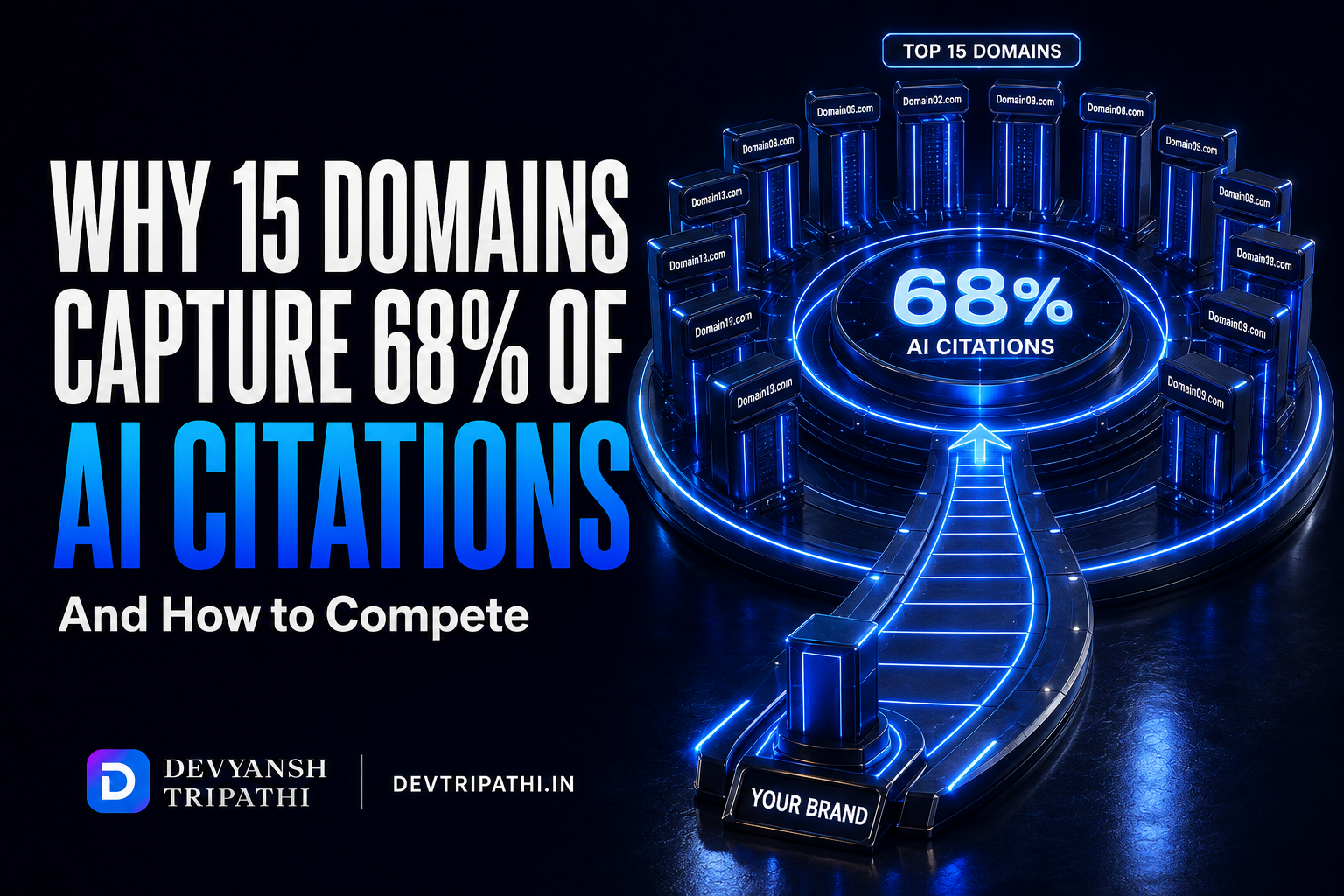
The single most sobering data point for AEO strategy in 2026 is 5WPR’s finding, based on an analysis of 680 million citations, that the top 15 domains capture 68% of all AI citation share across platforms. This is a level of concentration that exceeds even the well-documented winner-take-most dynamics of traditional organic search, where the top-ranking position still shares meaningful visibility with positions two through ten. In AI citation, a small number of already-dominant domains, predominantly Wikipedia, major news publications, and category-leading platforms, absorb the substantial majority of total citation volume, leaving the remaining thousands of brands competing for the smaller residual share.
This finding does not mean AEO investment is futile for brands outside the top 15 domains. It means AEO goal-setting must be realistic about what “success” looks like: capturing citations for the specific, narrow, high-intent queries where a brand has genuine first-party expertise and data that the dominant generalist domains cannot replicate, rather than expecting to compete broadly against Wikipedia-level citation volume across an entire category. For the complete data density and original research strategy that directly addresses this concentration challenge, see our GEO Cycle 3 guide.
68%of all AI citations captured by just the top 15 domains (5WPR, 680M citations)
51%of B2B buyers now begin research directly in an AI chatbot (G2, n=1,076)
35%of consumers find AI tools most useful at initial discovery, vs 13.6% for search (Similarweb)
2.8xcitation lift for structured pages vs unstructured equivalents (AirOps 2026)
The 51% B2B Chatbot-First Reality
G2’s Answer Economy 2026 B2B Buyer Behavior Report, surveying 1,076 B2B decision-makers in March 2026, found that 51% now begin their research directly in an AI chatbot rather than a search engine. This single statistic reframes the entire strategic priority of B2B AEO: for the majority of B2B purchase journeys, the AI chatbot interaction is not a supplementary research channel alongside traditional search, it is the primary entry point where brand consideration first forms.
The implication for B2B marketing organizations is direct: a brand invisible in ChatGPT, Perplexity, or Gemini for its category’s evaluation queries is not merely missing incremental traffic, it is potentially absent from the majority of prospective buyers’ very first exposure to the category’s available options. This makes AEO a top-of-funnel investment with outsized strategic importance relative to its current budget allocation in most B2B marketing organizations still weighting the majority of spend toward traditional SEO and paid search channels built for a search-engine-first buyer journey that no longer reflects how the majority of B2B buyers actually begin their process.
The Discovery-Stage Advantage and Where It Narrows
Similarweb’s 2026 AI Brand Visibility Report provides the most granular stage-by-stage data available on where AI’s advantage over traditional search is concentrated within the buyer journey. At the initial discovery stage specifically, 35% of consumers find AI tools most useful compared to only 13.6% for search engines at that same stage, a more than two-and-a-half times advantage for AI at the exact moment brand consideration sets are first being formed.
Critically, this advantage narrows substantially as buyers progress through their journey. By the time a buyer reaches the specific “finding where to buy” stage, AI and search have become nearly level at 24.3% versus 22.1% respectively. This stage-specific data has a direct strategic implication: AEO investment produces its highest relative impact at the top of the funnel, shaping which brands even enter a buyer’s consideration set, while traditional SEO and transactional content retain comparable importance at the bottom of the funnel where purchase-ready buyers are more evenly split between AI and search-driven final research. Missing the AEO layer risks losing buyers before their consideration set is even formed, a risk that bottom-funnel optimization alone cannot mitigate. For the complete conversational search framework addressing this early-stage capture requirement, see our AEO Advanced Strategies guide.
The One-Backlink, 85-Citations Case Study
HubSpot’s finding that a page with just one single backlink earned 85 AI citations, purely because its underlying data was original and specific to a defined use case, is the single most concrete validation available of the “data density over domain authority” principle that has emerged as a central theme across 2026 AEO and GEO research. This case study directly demonstrates that within the extreme citation concentration reality documented by 5WPR, individual pages with genuinely original, narrowly-scoped data can still achieve outsized citation performance regardless of the broader domain’s overall authority level.
Why Original Data Overcomes Weak Domain Authority
The Citation-Necessity Mechanism
When an AI system generates a response requiring a specific data point, a business benchmark, a customer outcome statistic, or a defined use-case result, it must cite whatever source actually contains that specific claim, regardless of that source's overall backlink profile or domain authority. A page with a single backlink that contains the only available answer to a narrow, specific question will be cited over a high-authority generalist page that does not contain that specific data point at all. This is the mechanism through which the one-backlink-85-citations outcome becomes replicable rather than anomalous.
Pairing original first-party data with the structured content format that produces AirOps’ documented 2.8 times citation lift compounds this effect further: original data gives AI systems a reason to cite a page, while clear heading hierarchy and schema markup make the specific claim easy to extract and attribute correctly. Business benchmarks, customer outcomes, internal experiment results, and product usage patterns all represent accessible first-party data sources that most brands already possess internally but have not yet published in a citable, structured format. For the systematic data density strategy that operationalizes this principle at scale, see our Topical Authority SEO guide.
One Original Data Point Earned 85 Citations From a Single Backlink. What First-Party Data Are You Sitting On?
Dev Tripathi helps brands identify and structure the internal business benchmarks, customer outcomes, and product usage data that create the citation-necessity effect, pairing original first-party research with the structured formatting that produces documented citation lift.
Find My Original Data OpportunitiesThe Platform Overlap Data: Just 12%, and ChatGPT at Only 8%
SEOScaleUp’s analysis of a 15,000-prompt study conducted via Ahrefs Brand Radar found only 12% overall overlap between AI-cited sources and Google’s top-10 results, with ChatGPT specifically showing just 8% overlap, the lowest of any major platform measured in the study. This finding provides important nuance to the broader industry conversation about the relationship between traditional ranking and AI citation: while some prior research has suggested a stronger correlation between top-10 ranking and AI Overview citation specifically, this more granular platform-by-platform breakdown confirms that ChatGPT in particular operates with source selection criteria substantially independent from Google’s traditional ranking algorithm.
| Platform | Overlap with Google Top-10 | Primary Source Preference | AEO Implication |
|---|---|---|---|
| ChatGPT | 8% (lowest measured) | Training data authority, Wikipedia, established domains | Traditional ranking is a weak predictor of ChatGPT citation |
| Google AI Overviews | Higher than ChatGPT specifically | Top-10 organic results, live index | Traditional SEO remains the strongest predictor for this surface |
| All Platforms Combined | 12% overall | Varies significantly by platform | Platform-specific optimization tracks required, not unified strategy |
This platform-specific variance reinforces the multi-platform optimization requirement covered in our AISEO Cycle 4 guide: given that ChatGPT alone represents such a low overlap with traditional ranking, brands cannot assume that strong Google Search Console performance translates into ChatGPT citation eligibility, making dedicated ChatGPT-specific visibility testing a necessary component of any comprehensive AEO measurement programme rather than an assumption safely extrapolated from traditional SEO performance data.
Practical AEO Priorities Given the Concentration Reality
Given the extreme citation concentration documented by the 5WPR data, realistic AEO strategy for brands outside the top 15 dominant domains should concentrate on narrow, defensible citation territory rather than attempting to compete broadly for high-volume generic queries where the dominant domains have already captured the substantial majority of citation share. Identify the 10 to 20 highest-value queries where your brand possesses genuine first-party data, direct customer experience, or specific expertise that generalist high-authority domains cannot replicate, and concentrate structured content and freshness investment specifically on that narrow, defensible territory.
This concentrated approach, combined with the structural fundamentals of freshness maintenance (targeting the 83% of citations from content updated within the past 12 months) and structured formatting (targeting the 2.8 times citation lift), provides a realistic path to meaningful AEO performance even within a citation landscape where the top 15 domains capture the majority of total volume. Brands should measure success not against total category citation share but against citation performance specifically within their defensible, first-party-data-supported query territory.
Frequently Asked Questions About Answer Engine Optimization in 2026
What does the 68% citation concentration finding mean for AEO strategy?
The finding that the top 15 domains capture 68% of all AI citation share across 680 million citations means most brands should set realistic AEO goals focused on narrow, defensible query territory where they possess genuine first-party data or expertise, rather than expecting to compete broadly against dominant generalist domains like Wikipedia and major news publications for high-volume category queries. Realistic success looks like strong citation performance within a specific, well-defined niche rather than broad category dominance.
Why do 51% of B2B buyers now start research in a chatbot rather than a search engine?
G2's 2026 research found 51% of B2B decision-makers begin research directly in an AI chatbot because conversational AI can synthesize comparative information across multiple options in a single interaction, reducing the effort required compared to manually researching and comparing options across multiple search results and websites. This behavioral shift means the AI chatbot interaction has become the primary entry point for the majority of B2B purchase journeys rather than a supplementary research channel alongside traditional search.
Why is the one-backlink-85-citations case study significant for AEO strategy?
HubSpot's finding that a page with just one backlink earned 85 AI citations demonstrates that original, narrowly-scoped first-party data can overcome weak traditional domain authority signals entirely. When an AI system needs a specific data point that only one source contains, it must cite that source regardless of its overall backlink profile. This validates first-party data publication, business benchmarks, customer outcomes, and internal experiment results, as a citation strategy accessible to brands without high traditional domain authority.
Where in the buyer journey does AI provide the strongest advantage over traditional search?
AI provides its strongest advantage at the initial discovery stage of the buyer journey, where 35% of consumers find AI tools most useful compared to only 13.6% for search engines according to Similarweb's research. This advantage narrows substantially by the time buyers reach the "finding where to buy" stage, where AI and search become nearly level at 24.3% versus 22.1%. This means AEO investment produces its highest relative impact shaping which brands enter a buyer's consideration set in the first place, rather than at the final purchase decision stage.
Why does ChatGPT show only 8% overlap with Google's top-10 results?
ChatGPT's 8% overlap with Google's top-10 results, the lowest of any major platform measured in the 15,000-prompt Ahrefs Brand Radar study, reflects that ChatGPT's citation selection draws substantially from training data authority and established domain recognition rather than primarily from live search ranking signals. This means strong Google Search Console performance provides a weak predictor of ChatGPT citation eligibility specifically, requiring brands to test ChatGPT visibility independently rather than assuming it correlates with traditional SEO performance.
What is the citation-necessity mechanism and how does it help smaller brands compete?
The citation-necessity mechanism describes how AI systems must cite whatever source contains a specific required data point, regardless of that source's overall authority level, when generating a response that depends on that exact claim. A page with a single backlink containing the only available answer to a narrow, specific question will be cited over a high-authority generalist page lacking that specific data. This mechanism allows smaller brands with genuine first-party expertise to achieve citation performance disproportionate to their overall domain authority by publishing genuinely original, specific data.
How much does content freshness matter for commercial and evaluation-stage AEO queries specifically?
For commercial and evaluation-stage queries specifically, 83% of AI citations came from pages updated within the past 12 months, with more than 60% refreshed within the last six months, according to AirOps' 2026 State of AI Search Report. This makes freshness maintenance particularly critical for high-intent, buyer-journey-relevant content compared to purely informational or definitional content, where freshness requirements may be somewhat less stringent given the more stable nature of foundational conceptual information.
What is the citation lift for structured content compared to unstructured content?
Structured pages earn a 2.8 times citation lift compared to unstructured equivalents according to AirOps' 2026 research. This lift compounds specifically with original first-party data: content that combines genuinely proprietary data points with clear heading hierarchy and schema markup gives AI systems both a substantive reason to cite the content and a format that makes the specific claim easy to extract and attribute correctly, producing the strongest combined citation performance available from any single content optimization approach.
Should brands prioritize B2C or B2B AEO investment differently given the 2026 data?
The 51% B2B chatbot-first research statistic and the G2 Answer Economy findings suggest B2B brands specifically should prioritize AEO investment at least as urgently as B2C brands, given that the majority of B2B purchase journeys, which typically involve longer research cycles and higher-consideration decisions, now begin in an AI chatbot rather than a search engine. This makes AEO a top-of-funnel B2B marketing investment with outsized strategic importance relative to its current budget allocation in most B2B organizations still weighted toward traditional search-engine-focused channels.
How should brands identify their defensible AEO query territory given the 68% concentration finding?
Identify the 10 to 20 highest-value queries where your brand possesses genuine first-party data, direct customer experience, internal benchmarks, or specific expertise that generalist high-authority domains cannot replicate, rather than attempting to compete broadly for high-volume generic category queries already dominated by the top 15 citation-concentrated domains. Concentrate structured content and freshness investment specifically on this narrow, defensible territory, and measure AEO success against citation performance within that territory rather than against broad category citation share. For the systematic methodology for this identification process, see our AI Citation Optimization Cycle 4 guide.
Build AEO Strategy for the Concentrated, Chatbot-First Reality of 2026
Get a complete AEO programme covering defensible query territory identification given the 68% citation concentration reality, first-party data opportunities modeled on the one-backlink-85-citations outcome, structured content formatting for the 2.8x citation lift, and platform-specific ChatGPT visibility testing given its uniquely low 8% ranking overlap.
Start My AEO ProgrammeConclusion
Answer engine optimization in the second half of 2026 requires confronting two structural realities simultaneously: extreme citation concentration, with the top 15 domains capturing 68% of all AI citation share, and early-funnel dominance, with 51% of B2B buyers now beginning research directly in a chatbot and AI holding a more than two-and-a-half times advantage over search at the initial discovery stage specifically. Neither reality makes AEO investment futile; both make realistic goal-setting and precise strategic focus essential.
The path forward for brands outside the dominant citation-concentrated domains runs through first-party data, as the one-backlink-85-citations case study demonstrates concretely, combined with the structured formatting that produces a documented 2.8 times citation lift and the freshness discipline that governs 83% of commercial-query citations. Brands that concentrate this approach on genuinely defensible, first-party-data-supported query territory, tested independently across platforms given ChatGPT’s uniquely low 8% overlap with traditional rankings, are positioned to capture meaningful citation share even within a landscape where a small number of dominant domains hold the majority of total volume. For the complete measurement framework that tracks this defensible-territory citation performance, see our AI Visibility Tracking guide.

Devyansh Tripathi
I’m Devyansh Tripathi, an SEO strategist and digital growth expert, helps businesses and individuals rank higher and drive organic traffic. Through DevTripathi., he shares cutting-edge SEO insights, content strategies, and marketing hacks. Passionate about digital success, he’s on a mission to make SEO simple, effective, and result-driven!
Posts
- What Google’s New AI Search Documentation Means for SEO Teams
- Google I/O 2026 Search: AI Agents, Gemini 3.5 and the Unified Box
- Google’s AI Optimization Guide: The Technical and Content Checklist
- July 2026 SEO Update: AI Overviews, llms.txt and Search Console
- Prompt Optimization Beyond Page One: The Position-21 Citation Opportunity
Categories
- AI Citation Optimization
- AI Search Optimization (AISEO)
- AI Visibility Tracking
- Answer Engine Optimization (AEO)
- Brand Authority SEO
- Brand SERP Optimization
- Community Signal SEO
- Conversational Search Optimization
- Generative Engine Optimization (GEO)
- Knowledge Graph Optimization
- Modern SEO Strategies
- Multimodal Search Optimization
- Prompt Optimization
- SEO Trends
- Social Search Optimization
- Topical Authority SEO
- Uncategorized
- Video Search SEO
- Visual Search Optimization
- Voice Engine Optimization (VEO)
- Zero Click Search Optimization
Latest News
Text Widget
Empowering brands with insights, strategies, and stories that drive digital growth.