AI Shortlists Drive 88% of Decisions: What Conversational SEO Must Do
23 July 2026
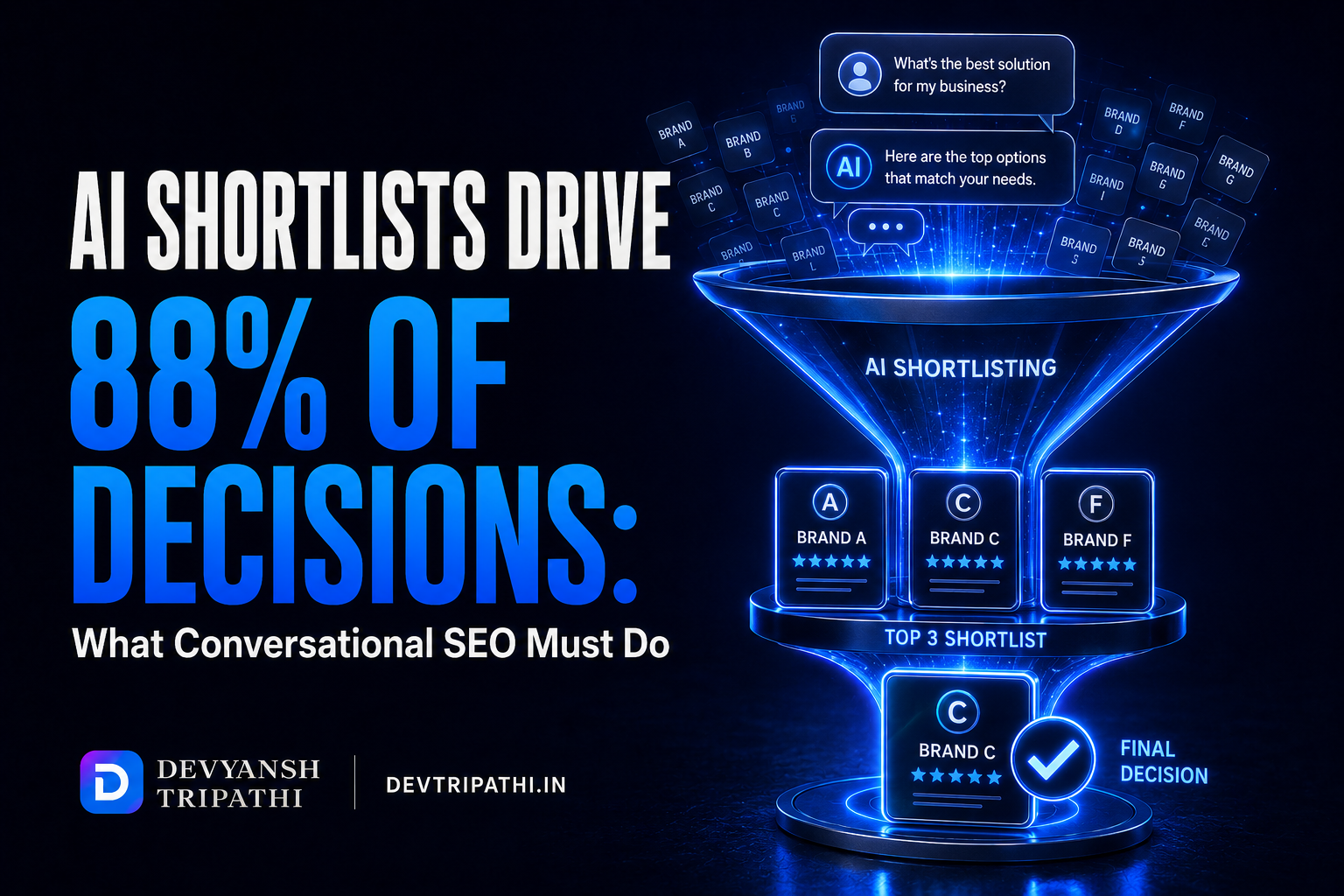
Conversational search optimization in the second half of 2026 must reckon with Growth Memo’s April 2026 finding that fundamentally changes what winning a citation actually means: in classic search, 56% of users built their own shortlist by comparing multiple sources, but in Google AI Mode, 88% of users took the AI’s shortlist without an external check, with the AI’s top pick becoming the user’s actual choice 74% of the time and only 10% of users selecting anything ranked third or lower, meaning the position an AI system assigns a brand within its conversational response has become dramatically more decisive than any equivalent position in traditional search results ever was.
This Cycle 4 guide covers conversational search optimization built on the newest behavioral and platform data reshaping the discipline: the complete shortlist adoption findings and their direct implication for why first-position AI Mode citation now functions as a near-deterministic outcome rather than one influential factor among several, the critical counterpoint that 26% of AI Mode users still override rank order specifically due to brand recognition, confirming brand authority remains a meaningful check on pure algorithmic ranking, the scale data showing AI Mode has reached 75 million daily active users and doubled its query volume every quarter since launch, the Apple-Gemini distribution deal that placed Google’s conversational AI on 2 billion active devices in a single announcement, and the specific session-length and follow-up-query growth data that must inform multi-turn content architecture for the remainder of 2026.
The AI's Top Pick Becomes the User's Pick 74% of the Time. Are You the Top Pick?
Get a complete conversational search assessment covering your current AI Mode ranking position for priority commercial queries, brand recognition strength as a potential override factor, and the multi-turn content architecture readiness needed to maintain citation across the follow-up questions AI Mode sessions increasingly generate.
Get My Conversational Search AssessmentThe 88% Shortlist Adoption Finding and Why It Changes Everything
Growth Memo’s April 2026 research produced the single most consequential behavioral finding for conversational search optimization strategy in 2026: in classic search, 56% of users built their own shortlist by comparing multiple sources before making a decision, but in Google AI Mode, 88% of users took the AI’s shortlist without conducting any external check of their own. This is not a marginal shift in user behavior. It represents a near-complete transfer of the comparison and evaluation function that users previously performed themselves onto the AI system’s synthesis and ranking.
The downstream consequence of this adoption pattern is stark: the AI’s top pick becomes the user’s actual choice 74% of the time, and only 10% of users select anything ranked third or lower within the AI’s presented shortlist. In traditional search, ranking position mattered, but a meaningful share of users still clicked through multiple results, formed independent impressions, and made comparison-informed decisions that diluted the advantage of any single ranking position. In AI Mode, that dilution has largely disappeared: achieving the AI’s first-position recommendation now functions as something close to a deterministic outcome for a large majority of the resulting decision, making the stakes of AI Mode citation position dramatically higher than the stakes of equivalent traditional ranking position ever were.
88%of AI Mode users take the AI's shortlist without an external check (Growth Memo, April 2026)
74%of the time, the AI's top pick becomes the user's actual choice (Growth Memo)
26%of AI Mode users override rank order specifically due to brand recognition (Growth Memo)
75Mdaily active users on Google AI Mode by early 2026, a 4x increase since May 2025 launch
The Brand Recognition Override: A Critical Counterweight
Alongside the 88% shortlist adoption finding, Growth Memo’s research surfaced an equally important counterpoint that prevents the shortlist-adoption story from becoming purely deterministic: 26% of AI Mode users overrode the AI’s rank order specifically due to brand recognition, spotting a brand positioned lower on the AI’s presented list and preferring it anyway, regardless of the AI’s stated ranking. This finding confirms that established brand authority functions as a genuine, measurable check on pure algorithmic position, even within a behavioral pattern where the substantial majority of users otherwise defer entirely to the AI’s synthesis.
Strategic Implication
Two Distinct Optimization Objectives, Not One
The combination of these two findings, 74% deterministic top-pick adoption and 26% brand-recognition override, establishes conversational search optimization as requiring two genuinely distinct, complementary investment tracks: winning the AI Mode citation position itself through the technical and content optimization covered throughout Cycle 3 and Cycle 4 research, and building the underlying brand recognition strength that provides a meaningful override capability even when first-position citation is not achieved. Brands strong in only one dimension remain vulnerable: a brand with strong citation position but minimal brand recognition risks losing the 26% of users who might otherwise override in their favor to a competitor with stronger brand recall, while a brand with strong recognition but poor citation position is depending entirely on that smaller override population to compensate for weak AI Mode visibility.
This reinforces the direct connection between conversational search optimization and the brand authority system covered in our Brand Authority SEO Cycle 4 guide: brand recognition strong enough to trigger the override effect requires the same cross-functional, systematic investment in entity coherence, earned media, and community presence that broader brand authority research identifies as essential, now demonstrated to have a direct, quantified behavioral payoff specifically within the AI Mode shortlist-adoption pattern.
The Scale and Distribution Data Reshaping Conversational Search Priority
Google AI Mode’s growth trajectory confirms conversational search optimization addresses a genuinely mainstream and rapidly scaling audience rather than an early-adopter niche. The platform reached 75 million daily active users and more than 100 million monthly active users by early 2026, a fourfold increase since its May 2025 launch, with expansion to 53 additional languages and more than 40 markets confirming this is a global rather than English-language-only phenomenon. Google reports AI Mode queries have more than doubled every quarter since launch, a sustained growth rate that shows no sign of the plateau that might be expected from a maturing product.
The most significant distribution development of 2026, however, may be the Apple-Gemini partnership: on January 12, 2026, Apple confirmed a multi-year deal to embed Google’s Gemini into the core of Siri and Apple Intelligence, placing Gemini-powered conversational search on more than 2 billion active Apple devices in a single distribution announcement. This deal represents a device-level distribution advantage comparable to the Android integration effects covered in our AISEO Cycle 4 guide, extending Gemini’s conversational search reach into the entire Apple device ecosystem that had previously operated with Siri’s more limited, largely non-generative assistant capability.
Follow-Up Query Growth and the Multi-Turn Content Requirement
Google’s own first-year AI Mode data, reported through MarketingProfs’ July 10, 2026 roundup, confirms follow-up searches within AI Mode sessions have grown more than 40% per month, with more than one in six searches now using voice, image, or video input rather than typed text alone. Planning, comparison, and brainstorming query types are growing especially quickly, reflecting users increasingly providing extended personal context and asking AI Mode to help complete multi-step decisions or tasks rather than submitting single, isolated queries.
This follow-up growth rate has a direct content architecture implication: many existing SEO programmes still target brief keyword phrases and isolated questions, creating a widening gap between how content is structured and how AI-search users now actually seek answers across extended, multi-turn conversational sessions. Content built to address only a single entry-point query, without anticipating and addressing the predictable follow-up questions a topic naturally generates, increasingly fails to maintain citation presence across the full arc of an AI Mode conversation, even when it successfully earns the initial citation. For the complete multi-turn research arc mapping methodology that addresses this specific gap, see our Conversational Search Optimization Cycle 3 guide.
Follow-Up Searches Are Growing 40% Per Month. Is Your Content Built for the Full Conversation?
Dev Tripathi builds complete conversational search content systems that address the full multi-turn research arc AI Mode sessions now generate, combined with the brand authority investment that produces the 26% recognition-based override effect even outside the top citation position.
Build My Conversational Search StrategySession Depth Data: AI Mode as a Genuinely Different Engagement Surface
AI Mode sessions average 49 seconds of user time per query, rising to 77 seconds specifically for brand-comparison queries, compared to approximately 21 seconds for standard AI Overview sessions according to Seer Interactive’s data. This session-depth differential confirms AI Mode supports meaningfully deeper user engagement than the summary-oriented AI Overview surface, reflecting AI Mode’s design as a full conversational interface rather than a search-results-page enhancement.
| Metric | AI Overviews | AI Mode | AI Mode (Brand-Comparison Queries) |
|---|---|---|---|
| Average Session Time | ~21 seconds | 49 seconds | 77 seconds |
| Zero-Click Rate | 83% | 93% | Comparable to standard AI Mode rate |
| Cited URL Top-10 Overlap | 17% to 54% (varies by study) | 14% | Likely comparable to standard AI Mode rate |
The extended session time for brand-comparison queries specifically, 77 seconds against the 49-second AI Mode average, indicates users engage most deeply with AI Mode precisely at the decision point where the 88% shortlist adoption and 74% top-pick selection findings apply most directly. This convergence, the query type generating the longest engagement is also the query type where the AI’s ranking most decisively determines the outcome, confirms that brand-comparison and evaluation content deserves the highest priority within any conversational search optimization content investment plan for the remainder of 2026.
Why Only 14% of AI Mode Citations Overlap with Traditional Top-10 Rankings
SE Ranking data confirms only 14% of cited URLs in AI Mode specifically rank in Google’s traditional top 10, a notably lower overlap than the 17% to 54% range reported for AI Overviews depending on the specific study referenced. This gap reflects AI Mode’s query fan-out retrieval architecture, which decomposes complex conversational prompts into multiple sub-searches and synthesizes across a broader source pool than the more direct extraction approach AI Overviews typically use from the standard search index.
This 14% figure reinforces the platform-specific optimization requirement covered extensively throughout Cycle 3 and Cycle 4 research: brands cannot assume strong traditional organic ranking translates into AI Mode citation eligibility, given that the substantial majority of AI Mode citations now originate from pages outside the traditional top-10 positions that most SEO investment has historically prioritized. Dedicated AI Mode visibility testing, independent from standard rank tracking, remains essential for accurately measuring performance on this specific, rapidly scaling conversational surface. For the complete measurement framework addressing this platform-specific tracking requirement, see our Brand SERP Optimization Cycle 4 guide.
Frequently Asked Questions About Conversational Search Optimization in 2026
What is the 88% shortlist adoption finding and why does it matter?
Growth Memo's April 2026 research found that while 56% of classic search users built their own shortlist by comparing multiple sources, 88% of AI Mode users took the AI's shortlist without conducting any external check. This matters because it confirms AI Mode has largely transferred the comparison and evaluation function users previously performed themselves onto the AI's synthesis, making the AI's presented ranking dramatically more decisive to the final outcome than equivalent traditional search ranking position ever was.
How often does the AI's top pick become the user's actual choice?
The AI's top pick becomes the user's actual choice 74% of the time according to Growth Memo's research, with only 10% of users selecting anything ranked third or lower within the AI's presented shortlist. This confirms that achieving first-position citation within an AI Mode response functions as something close to a deterministic outcome for the substantial majority of resulting user decisions, raising the stakes of AI Mode citation position significantly above equivalent traditional search ranking position.
What is the brand recognition override effect and why is it strategically important?
The brand recognition override effect refers to the 26% of AI Mode users who overrode the AI's rank order specifically because they recognized a brand positioned lower on the AI's presented list and preferred it anyway. This is strategically important because it confirms established brand authority functions as a genuine, measurable check on pure algorithmic ranking, meaning brand recognition investment retains real behavioral value even for brands that have not achieved the top AI Mode citation position for a given query.
How large is Google AI Mode's user base as of early 2026?
Google AI Mode reached 75 million daily active users and more than 100 million monthly active users by early 2026, a fourfold increase since its May 2025 launch, with expansion to 53 additional languages and more than 40 markets. Google reports AI Mode queries have more than doubled every quarter since launch, confirming sustained rapid growth rather than a short-term adoption spike, making conversational search optimization relevant to a genuinely mainstream and still rapidly expanding global audience.
What is the significance of the Apple-Gemini deal announced in January 2026?
On January 12, 2026, Apple confirmed a multi-year deal to embed Google's Gemini into the core of Siri and Apple Intelligence, placing Gemini-powered conversational search on more than 2 billion active Apple devices in a single distribution announcement. This represents a device-level distribution advantage comparable to Gemini's existing Android integration, extending conversational AI search reach into the entire Apple ecosystem and further accelerating the mainstream adoption of AI Mode-style conversational search behavior.
Why have follow-up searches within AI Mode sessions grown more than 40% per month?
Follow-up searches have grown more than 40% per month according to Google's own first-year AI Mode data, reflecting users increasingly providing extended personal context and asking AI Mode to help complete multi-step decisions rather than submitting single, isolated queries. This growth is driven partly by planning, comparison, and brainstorming query types growing especially quickly, confirming users are treating AI Mode as a genuine multi-turn research and decision-support tool rather than a single-answer lookup interface.
Why does content built for single-query optimization increasingly fail in AI Mode?
Content built to address only a single entry-point query, without anticipating the predictable follow-up questions a topic naturally generates, increasingly fails to maintain citation presence across the full arc of an AI Mode conversation, even when it successfully earns the initial citation. Given that follow-up searches have grown more than 40% per month, comprehensive content addressing the complete research arc for a topic, rather than only its most common entry-point query, is now required to maintain citation performance throughout extended multi-turn AI Mode sessions.
Why do brand-comparison queries show the longest AI Mode session times?
Brand-comparison queries show the longest AI Mode session times at 77 seconds, compared to the 49-second AI Mode average and approximately 21 seconds for standard AI Overview sessions, because these queries represent the exact decision point where users are actively evaluating options before making a choice. This extended engagement at precisely the query type where the 88% shortlist adoption and 74% top-pick selection findings apply most directly confirms brand-comparison content deserves the highest priority within conversational search optimization investment.
Why does AI Mode show only 14% overlap with traditional top-10 rankings?
AI Mode's 14% overlap with traditional top-10 rankings, notably lower than the 17% to 54% range reported for AI Overviews, reflects AI Mode's query fan-out retrieval architecture, which decomposes complex conversational prompts into multiple sub-searches and synthesizes across a broader source pool than the more direct extraction approach AI Overviews typically use. This confirms traditional organic ranking is an even weaker predictor of AI Mode citation eligibility specifically than it is for AI Overviews, requiring dedicated AI Mode visibility testing independent from standard rank tracking.
How should brands balance investment between AI Mode citation optimization and brand recognition building?
Given that 74% of outcomes follow the AI's top pick while 26% of users override based on brand recognition, brands should invest in both tracks simultaneously rather than treating them as alternatives. Technical and content optimization for AI Mode citation position addresses the larger, more deterministic 74% outcome, while sustained brand authority investment, covering entity coherence, earned media, and community presence, addresses the smaller but still meaningful 26% override population that provides a genuine behavioral safety net even when first-position citation is not achieved for a given query.
Win the AI's Top Pick, or Build the Brand Recognition That Overrides It
Get a complete conversational search optimization programme covering AI Mode citation position testing for your priority commercial queries, multi-turn content architecture for the growing follow-up query pattern, and the brand recognition investment that provides a measurable override effect even when first-position citation is not achieved.
Start My Conversational Search ProgrammeConclusion
Conversational search optimization in the second half of 2026 operates within a behavioral reality that has fundamentally raised the stakes of AI Mode citation position: 88% of users now take the AI’s shortlist without an external check, and the AI’s top pick becomes the actual user choice 74% of the time, a near-deterministic outcome that traditional search ranking position never approached. Yet the 26% brand-recognition override finding confirms that established brand authority retains genuine, measurable behavioral influence even within this highly AI-deferential pattern, making brand authority investment a necessary complement to citation-position optimization rather than a separate or lower-priority consideration.
With AI Mode reaching 75 million daily active users, extending across more than 2 billion Apple devices through the January 2026 Gemini-Siri integration, and generating follow-up queries growing more than 40% per month, conversational search optimization addresses a scaling, increasingly multi-turn audience that content built for single-query optimization can no longer adequately serve. Brands that combine strong AI Mode citation performance with the cross-functional brand authority investment covered throughout 2026 research are positioned to capture both the 74% deterministic outcome and the 26% override population, a combined strategy that neither citation optimization nor brand building alone can fully achieve. For the complete platform fragmentation context this conversational search strategy operates within, see our AISEO Cycle 4 guide.

Devyansh Tripathi
I’m Devyansh Tripathi, an SEO strategist and digital growth expert, helps businesses and individuals rank higher and drive organic traffic. Through DevTripathi., he shares cutting-edge SEO insights, content strategies, and marketing hacks. Passionate about digital success, he’s on a mission to make SEO simple, effective, and result-driven!
Posts
- What Google’s New AI Search Documentation Means for SEO Teams
- Google I/O 2026 Search: AI Agents, Gemini 3.5 and the Unified Box
- Google’s AI Optimization Guide: The Technical and Content Checklist
- July 2026 SEO Update: AI Overviews, llms.txt and Search Console
- Prompt Optimization Beyond Page One: The Position-21 Citation Opportunity
Categories
- AI Citation Optimization
- AI Search Optimization (AISEO)
- AI Visibility Tracking
- Answer Engine Optimization (AEO)
- Brand Authority SEO
- Brand SERP Optimization
- Community Signal SEO
- Conversational Search Optimization
- Generative Engine Optimization (GEO)
- Knowledge Graph Optimization
- Modern SEO Strategies
- Multimodal Search Optimization
- Prompt Optimization
- SEO Trends
- Social Search Optimization
- Topical Authority SEO
- Uncategorized
- Video Search SEO
- Visual Search Optimization
- Voice Engine Optimization (VEO)
- Zero Click Search Optimization
Latest News
Text Widget
Empowering brands with insights, strategies, and stories that drive digital growth.