
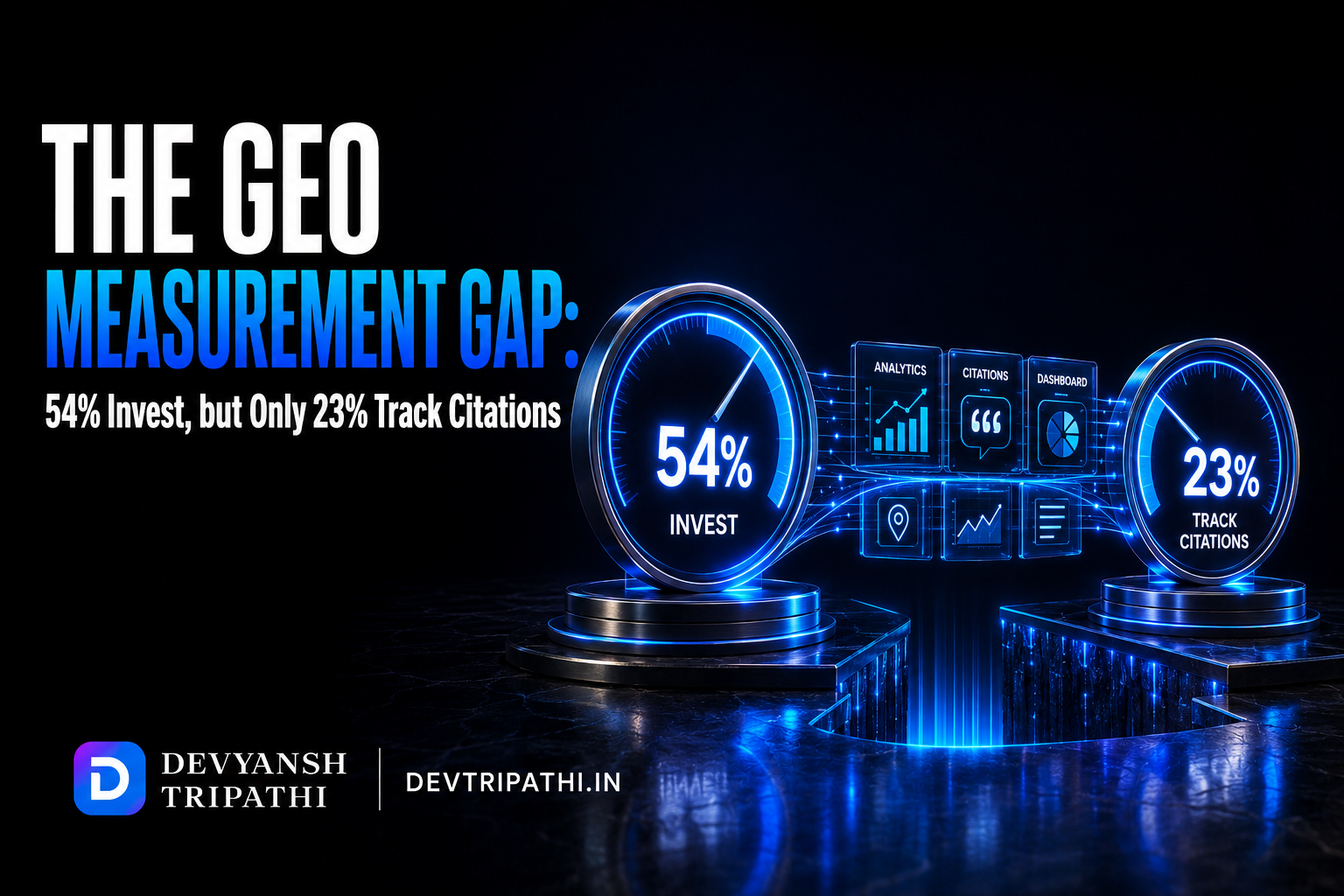
The GEO Measurement Gap: 54% Invest, but Only 23% Track Citations
24 July 2026
Generative engine optimization enters the second half of 2026 defined by what may be its most consequential unresolved problem: 54% of brands plan to invest in GEO, but only 23% actually measure citation share, a maturity gap that exists precisely because GEO ROI is structurally harder to track than traditional SEO, since zero-click AI answers generate no referral session and the shortlist influence covered in conversational search research, the single most commercially valuable AI impact, occurs before any trackable touchpoint exists at all.
This Cycle 4 guide covers GEO built on the newest 2026 measurement and academic research: the complete 54%-versus-23% planning-to-measurement gap and why it represents the defining GEO maturity challenge of the year, the specific 24-to-1 conversion ratio Ahrefs documented between AI search visitors and organic visitors despite AI representing a tiny fraction of total traffic, the academically validated Princeton, Georgia Tech, and IIT Delhi research identifying the exact content techniques that lift AI answer visibility by up to 40%, the staggering 4,700% year-over-year growth in AI-referred traffic to US retail sites, and the practical framework for closing the measurement gap before it becomes a permanent competitive disadvantage relative to the minority of brands already building the tracking infrastructure this moment requires.
54% of Brands Plan to Invest in GEO. Only 23% Can Actually Measure Whether It Is Working.
Get a complete GEO measurement assessment covering your current citation share tracking infrastructure, AI-referred conversion attribution setup, and the specific measurement framework that closes the gap between planning to invest in GEO and actually knowing whether that investment is producing results.
Get My GEO Measurement AssessmentThe 54%-Versus-23% Gap: GEO’s Defining Maturity Challenge
The single most important structural finding for GEO strategy in 2026 is not a citation statistic or a conversion rate, it is a maturity gap: 54% of brands plan to invest in generative engine optimization, but only 23% currently measure citation share. This 31-percentage-point gap between strategic intention and measurement capability means the majority of brands planning GEO investment have no reliable way to determine whether that investment is producing results, a structural problem that Omnibound’s research identifies as the defining GEO maturity challenge of the current period.
This gap exists for a specific, well-understood reason rather than simple organizational neglect: GEO ROI is structurally harder to measure than traditional SEO ROI, because zero-click AI answers generate no referral session that standard analytics can capture, and shortlist influence, the conversational search phenomenon covered in our Conversational Search Optimization Cycle 4 guide where users adopt an AI’s recommendation before any trackable touchpoint exists, represents the single most commercially valuable AI impact and is nearly invisible to conventional measurement approaches. Teams building measurement frameworks now, despite this genuine technical difficulty, will accumulate a compounding data advantage over teams that delay addressing this gap until it becomes an urgent competitive liability.
54%of brands plan to invest in GEO, but only 23% currently measure citation share (Omnibound 2026)
24:1conversion ratio for AI search visitors vs organic despite representing just 0.5% of traffic (Ahrefs)
40%visibility lift from Princeton-validated GEO techniques (Aggarwal et al., KDD 2024)
4,700%year-over-year growth in AI-generated traffic to US retail sites, July 2025 (Envive)
The 24-to-1 Conversion Ratio: Small Volume, Enormous Value
Ahrefs’ finding that AI search visitors generated 12.1% of signups despite accounting for only 0.5% of total visitors, a 24-to-1 conversion ratio relative to organic search, provides the clearest single data point available for justifying GEO investment despite its currently small traffic share for most brands. LLM visitors convert at rates of 15.9% from ChatGPT, 10.5% from Perplexity, and 5% from Claude, compared to a 1.76% organic search conversion rate, a differential wide enough that even a small volume of AI-referred traffic produces disproportionate business value relative to its share of total site traffic.
The mechanism behind this ratio is intent concentration: AI search users arrive with specific, researched queries and, per the shortlist-adoption behavior documented in 2026 conversational search research, frequently arrive with a pre-formed preference already established by the AI’s synthesis and recommendation before ever reaching the destination website. Clicking through from an AI answer is therefore not a casual browsing behavior comparable to a typical organic search click; it represents a high-intent action from a buyer already deep in an evaluation process the AI has substantially completed on their behalf. This reframes the small current traffic volume from AI referrals as a temporary limitation of adoption scale rather than a signal of limited underlying value, given that the per-visitor value documented is dramatically higher than any other acquisition channel available.
The Princeton-Backed Technique Data: What Actually Lifts Citation Visibility by 40%
The original academic study behind modern GEO practice, conducted by researchers from Princeton, Georgia Tech, and IIT Delhi and published as Aggarwal et al. at KDD 2024, remains the most rigorously validated foundation available for specific content optimization techniques, proving that particular GEO methods can lift content visibility in AI answers by up to 40%. Three techniques from this research produced the largest measurable gains and continue to anchor evidence-based GEO practice in 2026.
Highest-Impact Technique
Statistics Addition
Adding specific, quantified statistics to content produced the largest single visibility lift among the techniques tested in the original Princeton-Georgia Tech-IIT Delhi research. A statement quantifying an outcome, such as citing a specific percentage improvement, is measurably more likely to be selected for AI citation than an equivalent unquantified claim, reinforcing the data-density principle that has recurred consistently across nearly every major GEO research effort published since the original 2024 study.
High-Impact Technique
Cite Sources
Content that explicitly cites its own sources, attributing claims to specific, named, verifiable references rather than presenting unattributed assertions, earns measurably higher AI citation visibility. This technique reinforces the credibility signal that AI systems evaluate when selecting sources, functioning similarly to how a well-sourced academic paper earns more downstream citations than an equivalent paper lacking clear source attribution.
High-Impact Technique
Quotation Addition
Including direct, attributable quotations from identifiable experts or sources within content produces a measurable citation visibility lift, reflecting AI systems' preference for content that demonstrates verifiable, specific expertise input rather than only generalized or paraphrased claims. This technique connects directly to the entity authority and author credibility signals covered throughout Cycle 3 and Cycle 4 brand authority research.
These three Princeton-validated techniques, statistics addition, source citation, and quotation addition, provide a specific, academically rigorous starting checklist for any content team beginning systematic GEO implementation, distinct from the many less rigorously validated tactical recommendations that have proliferated across the broader 2026 GEO content landscape. For the complete data density and original research strategy this validated technique set supports, see our AEO Cycle 4 guide.
Princeton Research Identified Three Techniques That Lift Citation Visibility by 40%. Are You Using All Three?
Dev Tripathi implements the academically validated GEO technique set, statistics addition, source citation, and quotation addition, alongside the measurement infrastructure that closes the 54%-to-23% planning-versus-tracking gap most brands still have not addressed.
Build My Evidence-Based GEO StrategyThe Ecommerce Traffic Explosion: 4,700% Growth and $262 Billion in AI-Influenced Revenue
The scale of AI’s impact on ecommerce specifically has moved from significant to genuinely transformative within a single year. AI-generated traffic to US retail sites increased 4,700% year-over-year as of July 2025, with AI-driven traffic to US retail websites growing a further 693% year-over-year during the 2025 holiday season specifically, tracking over 1 trillion visits according to Adobe Analytics. Generative AI and AI agents drove an estimated $262 billion in global retail revenue during the 2025 holiday season alone, representing roughly 20% of total sales according to Salesforce data.
These traffic and revenue figures are reinforced by conversion quality data specific to ecommerce: AI-referred shoppers convert 31% higher and show 27% lower bounce rates compared to other organic sources, closely paralleling the broader engagement quality findings covered in our Brand Authority SEO Cycle 4 guide. Morgan Stanley’s estimate that approximately 33% of online retailers will use advanced AI shopping agents by 2028, potentially influencing $385 billion in US ecommerce, confirms this trajectory is expected to continue accelerating rather than plateauing at its current, already dramatic scale.
| Metric | 2026 Data Point | Source |
|---|---|---|
| AI-Generated Retail Traffic Growth (YoY) | 4,700% (July 2025) | Envive 2026 GEO Statistics |
| Holiday Season AI Traffic Growth (YoY) | 693%, over 1 trillion visits | Adobe Analytics via Digital Agency Network |
| AI-Influenced Holiday Retail Revenue | $262 billion globally, ~20% of total sales | Salesforce via Digital Agency Network |
| Projected AI Agent Ecommerce Influence by 2028 | $385 billion, 33% of online retailers using AI agents | Morgan Stanley via Digital Agency Network |
The Citation Halo Effect Resolves the SEO Cannibalization Objection
A common objection to GEO investment holds that AI citation success might cannibalize traditional organic traffic rather than adding incremental value. BrightEdge’s finding that AI Overview citations increase adjacent organic click-through rate by 35% directly resolves this objection: being cited in an AI Overview does not merely substitute for organic clicks, it demonstrably increases them, confirming that GEO and traditional SEO function as complementary rather than competing investments for the same underlying traffic opportunity.
This finding, combined with the 38% click lift and 39% paid ad click increase Envive’s research documents for brands appearing in AI-generated answers, establishes a citation-driven multiplier effect that compounds across organic, AI-referred, and paid channels simultaneously. A brand achieving strong AI citation performance is not trading organic visibility for AI visibility; it is amplifying the value of every other marketing investment through the credibility and awareness effect that AI citation demonstrably produces. For the complete brand SERP framework that captures this multiplier effect at the query level, see our AI Citation Optimization Cycle 4 guide.
Closing the Measurement Gap: A Practical Starting Framework
Given that the 54%-versus-23% gap exists primarily because standard analytics cannot capture zero-click AI exposure or shortlist influence, closing this gap requires deliberately constructed measurement infrastructure rather than waiting for a standard analytics platform to solve the problem automatically. Begin with weekly manual citation testing across ChatGPT, Perplexity, Google AI Mode, and Claude for a defined set of priority commercial queries, recording citation presence, position, and accuracy consistently over time.
Supplement citation testing with branded search volume tracking as a proxy for the shortlist-influence effect that direct referral analytics cannot capture, since a user who receives an AI-generated brand recommendation and later searches for that brand directly generates a branded search lift with no corresponding trackable referral session. Configure GA4 custom channel groups for AI platform referrers specifically to isolate the conversion rate premium documented across ChatGPT, Perplexity, and Claude referral traffic from standard organic and paid channel reporting. This three-part measurement foundation, citation testing, branded search tracking, and AI-referral channel isolation, provides the specific infrastructure needed to move from the 54% planning majority into the 23% measurement minority that current data confirms most brands have not yet achieved. For the complete measurement tooling landscape and selection framework, see our AI Visibility Tracking Cycle 4 guide.
Frequently Asked Questions About Generative Engine Optimization in 2026
What is the 54%-versus-23% GEO measurement gap?
The gap refers to Omnibound's 2026 finding that 54% of brands plan to invest in generative engine optimization, but only 23% currently measure citation share, meaning the substantial majority of brands planning GEO investment have no reliable way to determine whether that investment is producing results. This gap exists because GEO ROI is structurally harder to measure than traditional SEO ROI, since zero-click AI answers generate no referral session and the most valuable AI impact, shortlist influence, occurs before any trackable touchpoint exists.
Why does AI search traffic convert at a 24-to-1 ratio compared to organic traffic?
Ahrefs found AI search visitors generated 12.1% of signups despite accounting for only 0.5% of total visitors, a 24-to-1 conversion ratio, because AI search users arrive with specific, researched queries and frequently arrive with a pre-formed preference the AI's synthesis has already established. Clicking through from an AI answer represents a high-intent action from a buyer already deep in an evaluation process the AI has substantially completed on their behalf, unlike a typical organic search click that often represents earlier-stage browsing behavior.
What are the three Princeton-validated GEO techniques that lift citation visibility by 40%?
The original Princeton, Georgia Tech, and IIT Delhi study (Aggarwal et al., KDD 2024) identified Statistics Addition, Cite Sources, and Quotation Addition as the three techniques driving the largest measurable visibility gains, up to 40% overall. Statistics Addition means including specific, quantified data points rather than unquantified claims. Cite Sources means explicitly attributing claims to named, verifiable references. Quotation Addition means including direct, attributable quotations from identifiable experts, reflecting AI systems' preference for verifiable, specific expertise input.
How large has AI-generated traffic growth been for ecommerce specifically?
AI-generated traffic to US retail sites increased 4,700% year-over-year as of July 2025, with AI-driven traffic growing a further 693% year-over-year during the 2025 holiday season specifically, tracking over 1 trillion visits according to Adobe Analytics. Generative AI and AI agents drove an estimated $262 billion in global retail revenue during the 2025 holiday season alone, roughly 20% of total sales according to Salesforce data, confirming this shift has moved from significant to genuinely transformative within a single year for the ecommerce sector specifically.
Does GEO success cannibalize traditional organic search traffic?
No. BrightEdge's finding that AI Overview citations increase adjacent organic click-through rate by 35% directly resolves this common objection, confirming that being cited in an AI Overview does not substitute for organic clicks but demonstrably increases them. Combined with the 38% click lift and 39% paid ad click increase documented for AI-cited brands, GEO and traditional SEO function as complementary, mutually reinforcing investments rather than competing for the same underlying traffic opportunity.
How should brands practically begin closing the GEO measurement gap?
Brands should begin with weekly manual citation testing across ChatGPT, Perplexity, Google AI Mode, and Claude for a defined set of priority commercial queries, supplemented by branded search volume tracking as a proxy for shortlist influence that standard referral analytics cannot capture, and GA4 custom channel groups configured specifically for AI platform referrers to isolate their documented conversion rate premium from standard organic and paid channel reporting. This three-part foundation provides the specific infrastructure needed to move from the 54% planning majority into the 23% measurement minority.
Why is shortlist influence so difficult to measure using standard analytics?
Shortlist influence, where a user adopts an AI system's recommendation and forms a preference before ever reaching a brand's website, generates no trackable referral session because the influence occurs entirely within the AI conversation itself, before any click or website visit takes place. A user who later searches for the recommended brand directly or navigates to it through a bookmark or memorized URL produces no analytics signal connecting that visit back to the original AI-influenced decision, making this the most commercially valuable but least measurable AI impact currently documented in 2026 research.
What conversion rates do different AI platforms produce compared to organic search?
LLM visitors convert at rates of 15.9% from ChatGPT, 10.5% from Perplexity, and up to 16.8% from Claude according to combined Seer Interactive and First Page Sage 2026 data, compared to a 1.76% organic search conversion rate. This differential, ranging from roughly 6 to nearly 10 times the organic conversion rate depending on the specific AI platform, confirms AI-referred traffic as one of the highest-value acquisition channels currently available across the digital marketing landscape.
How significant is the projected growth of AI shopping agents by 2028?
Morgan Stanley estimates approximately 33% of online retailers will use advanced AI shopping agents by 2028, potentially influencing $385 billion in US ecommerce. Combined with B2B SaaS sites already seeing AI search grow to approximately 4.5% of organic traffic by September 2025, up 127% in just three months, this confirms the current dramatic growth trajectory is expected to continue accelerating across both consumer and B2B commercial categories rather than plateauing at its already substantial current scale.
How does the Princeton-validated technique set connect to broader 2026 GEO and AEO research?
The Princeton-validated techniques of statistics addition, source citation, and quotation addition provide the original, most rigorously tested academic foundation that subsequent 2026 research, including the data density and first-party data findings covered in AEO citation concentration research, has continued to reinforce and extend. This academic grounding gives content teams a specific, evidence-based starting checklist distinct from the broader ecosystem of less rigorously validated tactical GEO recommendations, ensuring core content investment decisions rest on the strongest available research foundation. For the complete citation concentration context this technique set operates within, see our AEO Cycle 4 guide.
Close the Gap Between Planning GEO Investment and Actually Measuring Its Impact
Get a complete GEO programme covering the three Princeton-validated content techniques, the citation testing and branded search tracking infrastructure that closes the measurement maturity gap, and the AI-referral channel isolation setup that reveals the true 24-to-1 conversion value your current AI traffic is already producing.
Start My GEO Measurement ProgrammeConclusion
Generative engine optimization in the second half of 2026 confronts its defining maturity challenge directly: 54% of brands plan to invest, but only 23% can actually measure whether that investment produces results, a gap rooted in the genuine technical difficulty of tracking zero-click AI exposure and pre-touchpoint shortlist influence rather than simple organizational oversight. The 24-to-1 conversion ratio Ahrefs has documented, alongside the 4,700% AI-referred ecommerce traffic growth and the $262 billion in AI-influenced holiday retail revenue, confirms the commercial stakes of closing this measurement gap have never been higher.
The academically validated Princeton, Georgia Tech, and IIT Delhi research provides the strongest available evidence base for specific content technique investment: statistics addition, source citation, and quotation addition together lift citation visibility by up to 40%, a rigorously tested foundation that content teams should implement before layering in the less validated tactical approaches that have proliferated across the broader GEO content landscape. Brands that build citation testing, branded search tracking, and AI-referral channel isolation now, moving from the 54% planning majority into the 23% measurement minority, are positioned to compound a data and strategic advantage that will only grow more valuable as AI-driven commerce continues its documented trajectory toward Morgan Stanley’s projected $385 billion 2028 ecommerce influence. For the complete AI citation optimization strategy this GEO measurement foundation directly supports, see our AI Citation Optimization Cycle 4 guide.

Devyansh Tripathi
I’m Devyansh Tripathi, an SEO strategist and digital growth expert, helps businesses and individuals rank higher and drive organic traffic. Through DevTripathi., he shares cutting-edge SEO insights, content strategies, and marketing hacks. Passionate about digital success, he’s on a mission to make SEO simple, effective, and result-driven!
Posts
- What Google’s New AI Search Documentation Means for SEO Teams
- Google I/O 2026 Search: AI Agents, Gemini 3.5 and the Unified Box
- Google’s AI Optimization Guide: The Technical and Content Checklist
- July 2026 SEO Update: AI Overviews, llms.txt and Search Console
- Prompt Optimization Beyond Page One: The Position-21 Citation Opportunity
Categories
- AI Citation Optimization
- AI Search Optimization (AISEO)
- AI Visibility Tracking
- Answer Engine Optimization (AEO)
- Brand Authority SEO
- Brand SERP Optimization
- Community Signal SEO
- Conversational Search Optimization
- Generative Engine Optimization (GEO)
- Knowledge Graph Optimization
- Modern SEO Strategies
- Multimodal Search Optimization
- Prompt Optimization
- SEO Trends
- Social Search Optimization
- Topical Authority SEO
- Uncategorized
- Video Search SEO
- Visual Search Optimization
- Voice Engine Optimization (VEO)
- Zero Click Search Optimization
Latest News
Text Widget
Empowering brands with insights, strategies, and stories that drive digital growth.