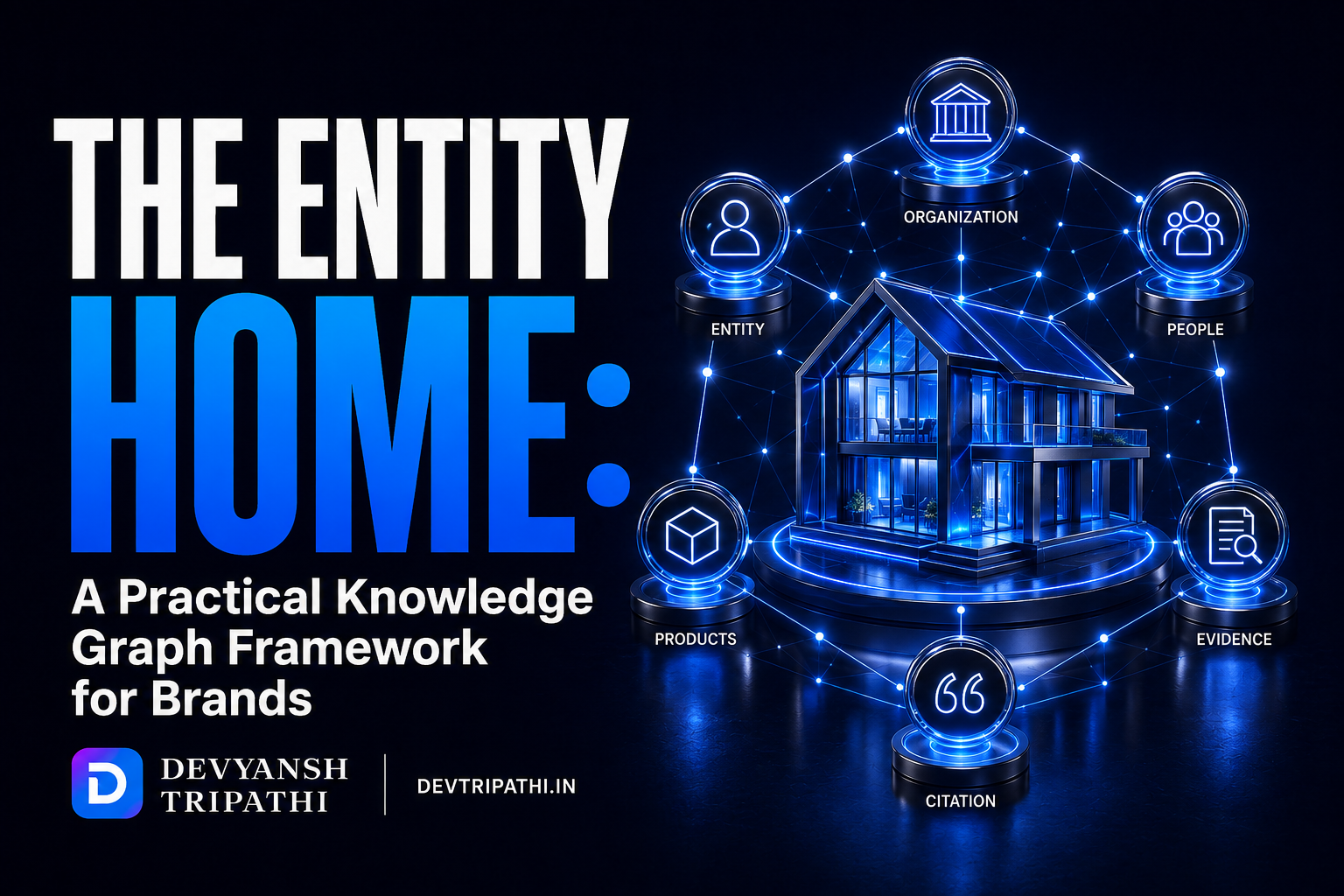
The Entity Home: A Practical Knowledge Graph Framework for Brands
25 July 2026
Knowledge graph optimization in the second half of 2026 is built on a growing body of quantified case study evidence that moves entity work from theoretical best practice into measured business outcome: Schema App documented a 19.72% increase in AI Overview visibility after implementing entity linking that connected on-page entities to Wikipedia, Wikidata, and Google’s Knowledge Graph, while Brightview Senior Living achieved a 25% increase in clicks for non-branded queries purely through schema-based entity disambiguation, confirming that entity clarity investment now produces specific, trackable returns rather than remaining an abstract technical improvement.
This Cycle 4 guide covers knowledge graph optimization built on the newest 2026 practitioner evidence: the entity home concept introduced this year as a formalized framework for centralizing a brand’s canonical entity data, the critical distinction that Wikidata entry requires no notability threshold unlike Wikipedia, making it accessible to brands of any size, the specific three-stage process AI systems use to extract, link, and cross-validate entities that determines citation eligibility, the concrete quantified case studies now available to justify entity investment, and the realistic three-to-nine-month timeline data that sets accurate expectations for when entity recognition work begins producing measurable results.
One Verified Case Study Showed a 19.72% AI Overview Visibility Lift From Entity Linking Alone
Get a complete knowledge graph optimization audit covering your Wikidata entry status, sameAs schema completeness across every authoritative platform, entity home consolidation opportunity, and a realistic three-to-nine-month implementation roadmap toward Knowledge Panel and AI Overview citation eligibility.
Get My Knowledge Graph AuditThe Entity Home Concept: A New Framework for 2026
Digital Applied’s 2026 research introduces the entity home concept as a formalized framework for how brands should think about centralizing their canonical entity data. Rather than treating a website, a Wikidata entry, a LinkedIn page, and various directory listings as separate, loosely-connected properties, the entity home concept treats a brand’s own website as the authoritative center from which every other entity signal radiates outward, with the structured data block on that central page functioning as the machine-readable version of the exact same facts represented across every linked external source.
This framework matters because it clarifies a practical implementation priority that had previously been somewhat ambiguous: rather than treating Wikidata, LinkedIn, and directory listings as independent optimization targets each requiring separate strategic thinking, the entity home concept establishes the brand’s own website as the single source of truth that every other platform’s entity data must accurately mirror. Practitioner forecasts included in this research project a significant channel shift over the coming years, from a 2026 baseline weighted toward traditional search at approximately 60%, assistive AI at approximately 35%, and agential AI at approximately 5%, moving toward a future distribution weighted more heavily toward assistive and agential AI channels, reinforcing why establishing a strong entity home now positions a brand advantageously for that anticipated distribution shift.
19.72%increase in AI Overview visibility from entity linking to Wikidata/Wikipedia (Schema App case study)
25%increase in non-branded query clicks from schema-based entity disambiguation (Brightview case study)
500B+facts on 5B+ entities in Google's Knowledge Graph, which trains Gemini AI directly
3-9months typical timeline for entity recognition once consistent signals are in place
Wikidata Requires No Notability Threshold: The Accessibility Breakthrough
One of the most practically important clarifications in 2026 Knowledge Graph research addresses a common misconception that has historically discouraged smaller brands from pursuing entity optimization: unlike Wikipedia, which requires meeting a formal notability threshold before an article can be created and sustained, a Wikidata entry needs no notability requirement whatsoever. This distinction means brands of any size, without the media coverage or public profile that Wikipedia’s editorial standards demand, can establish a structured, machine-readable entity presence that feeds directly into Google’s Knowledge Graph.
This accessibility breakthrough directly supports the broader 2026 finding that entity establishment is no longer a specialized concern reserved for large brands with dedicated PR budgets. A small or mid-sized business unable to clear Wikipedia’s notability bar can still register a complete Wikidata entity with name, official website, logo, founding date, and social profile links, providing a legitimate primary sameAs target that Google’s Knowledge Graph verification systems recognize as a strong, structured signal regardless of the brand’s overall public profile or media coverage history.
How AI Systems Actually Process Entity Recognition
Growthvibe’s 2026 research, citing Will Scott’s foundational GEO work, documents the specific three-stage pipeline AI systems use to process brand entities, providing a clear mechanistic explanation for why entity signal strength produces such divergent AI visibility outcomes even between brands with comparable content quality.
Stage 1
Entity Extraction
AI models parse published content to identify entities, people, organizations, products, and concepts, along with the relationships that connect them within the text. This stage determines whether an AI system recognizes that a specific piece of content is discussing a particular brand entity at all, a prerequisite that clear, consistent entity naming and structured markup make measurably more reliable.
Stage 2
Entity Linking
Once extracted, models map identified entities to canonical identifiers, Wikidata QIDs, Knowledge Graph MIDs, or internal entity representations specific to a given AI system. This linking stage is where a well-established Wikidata entry and complete sameAs schema array provide direct, structured connection points that make correct entity resolution significantly more reliable than relying on unstructured text alone to convey the same identity information.
Stage 3
Cross-Source Validation
Trust is established when the same entity appears consistently across multiple authoritative sources with consistent attributes. This is the stage where citation networks and being referenced by authoritative sources directly signal E-E-A-T to AI models, and where the entity home concept's emphasis on consistent, mirrored facts across every linked platform produces the strongest possible validation signal.
This three-stage model explains why two brands with identical content quality can receive vastly different AI visibility outcomes: the brand with stronger entity signals, consistent schema, an established Wikidata presence, and cross-platform validation, gets cited, while the brand without these signals gets overlooked regardless of how well-written its underlying content actually is. For the complete brand authority framework that generates the cross-source validation this three-stage process requires, see our Brand Authority SEO Cycle 4 guide.
A Brand With Weak Entity Signals Gets Overlooked Regardless of Content Quality. Fix the Foundation First.
Dev Tripathi implements the complete entity home framework, connecting your Wikidata entry, sameAs schema array, and cross-platform validation into the coherent entity signal AI systems require for the extraction, linking, and validation pipeline that determines citation eligibility.
Build My Entity Home StrategyThe Quantified Case Study Evidence: Entity Work Now Produces Trackable Returns
Knowledge graph optimization has moved from theoretical best practice into a discipline supported by specific, quantified case study evidence in 2026, providing practitioners with concrete ROI justification that earlier entity SEO guidance largely lacked. Schema App’s documented 19.72% increase in AI Overview visibility, measured after implementing entity linking that connected on-page entities to Wikipedia, Wikidata, and Google’s Knowledge Graph, provides a specific, attributable outcome directly tied to a defined technical implementation rather than a general directional claim about entity importance.
Brightview Senior Living’s case study provides an equally concrete example from a different implementation angle: using schema properties to define and disambiguate community location and service entities produced a 25% increase in clicks for non-branded queries specifically, demonstrating that entity disambiguation work benefits discovery-phase, non-branded search performance in addition to the AI citation eligibility that most entity SEO discussion emphasizes. Together, these two case studies establish that entity optimization investment now has a defensible, quantified business case that content and marketing teams can present to stakeholders who require concrete ROI evidence before approving technical SEO investment.
| Entity Signal | Notability Requirement | Google Verification Weight | Implementation Priority |
|---|---|---|---|
| Wikipedia Article | Formal notability threshold required | Highest, but not universally accessible | Pursue if eligible, not a blocker if not |
| Wikidata Entry | No notability requirement | Highest structured, machine-readable input | Critical, accessible to brands of any size |
| Organization Schema + sameAs | None | Officially supported verification signal | Foundational, immediate implementation |
| LinkedIn, Crunchbase, Directories | None | Secondary verification sources | Supporting, reinforces primary signals |
Setting Realistic Timeline Expectations
Jottler’s 2026 research provides the clearest available timeline guidance for knowledge graph optimization, confirming that entity recognition typically takes three to nine months once consistent signals are in place, with the specific timeline depending significantly on category competition. Niche topics with low entity competition see faster recognition, while crowded categories where established entities already dominate require longer, more sustained signal-building before achieving comparable recognition.
The most specific and actionable timeline benchmark available states that brands combining Schema.org markup, a Wikidata entry, sameAs equity, and 30 or more entity-defining content pieces tend to see panel features and AI Overview citations within two quarters. This benchmark provides a concrete implementation target: rather than treating entity optimization as an indefinite, open-ended investment, brands can plan toward this specific two-quarter milestone provided they execute the complete signal set, schema, Wikidata, sameAs equity, and sufficient entity-defining content volume, rather than implementing only a partial subset of these requirements and expecting comparable results on a comparable timeline. For the complete AI citation optimization strategy this entity foundation directly enables, see our AI Citation Optimization Cycle 4 guide.
Frequently Asked Questions About Knowledge Graph Optimization in 2026
What is the entity home concept introduced in 2026 Knowledge Graph research?
The entity home concept treats a brand's own website as the authoritative center from which every other entity signal, Wikidata, LinkedIn, directory listings, and sameAs references, radiates outward, with the structured data block on that central page functioning as the machine-readable version of the exact same facts represented across every linked external source. This framework clarifies implementation priority by establishing the brand's own website as the single source of truth every other platform's entity data must accurately mirror, rather than treating each platform as an independent optimization target.
Why does Wikidata not require a notability threshold like Wikipedia does?
Wikidata operates as a structured, machine-readable knowledge base rather than an encyclopedic article platform, and its inclusion criteria focus on whether an entity has verifiable identifying information rather than whether it meets Wikipedia's editorial notability standards for sustained public interest and media coverage. This distinction makes Wikidata accessible to brands of any size, allowing a small or mid-sized business unable to clear Wikipedia's notability bar to still establish a legitimate, structured entity presence that feeds directly into Google's Knowledge Graph.
What specific AI Overview visibility increase did the Schema App case study document?
Schema App measured a 19.72% increase in AI Overview visibility after implementing entity linking that connected on-page entities to Wikipedia, Wikidata, and Google's Knowledge Graph, providing a specific, attributable outcome directly tied to entity linking implementation rather than a general directional claim. This case study represents one of the clearest quantified examples currently available demonstrating the measurable business impact of structured entity linking investment.
What is the three-stage process AI systems use to recognize brand entities?
AI systems process brand entities through entity extraction (identifying entities and relationships within content), entity linking (mapping extracted entities to canonical identifiers such as Wikidata QIDs), and cross-source validation (establishing trust when the same entity appears consistently across multiple authoritative sources). This three-stage pipeline explains why two brands with identical content quality can receive vastly different AI visibility outcomes based purely on the strength and consistency of their underlying entity signals.
How long does entity recognition typically take once consistent signals are in place?
Entity recognition typically takes three to nine months once consistent signals are in place, faster for niche topics with low entity competition and slower for crowded categories where established entities already dominate. Brands combining Schema.org markup, a Wikidata entry, sameAs equity, and 30 or more entity-defining content pieces tend to see panel features and AI Overview citations within two quarters specifically, providing a concrete implementation benchmark rather than an indefinite timeline expectation.
What is the sameAs schema property and why does Google officially support it?
The sameAs schema property connects a brand's Organization schema entity to authoritative external sources including Wikipedia, Wikidata, LinkedIn, and Crunchbase, functioning as verification points that reduce entity ambiguity and improve trust across both search and AI systems. Google officially supports sameAs as a Knowledge Graph verification signal because it provides structured, machine-readable cross-references that help Google's systems confidently resolve which specific entity a piece of content is discussing, particularly valuable when brand names could otherwise be ambiguous or shared with unrelated entities.
Why did Brightview Senior Living see a 25% increase in non-branded query clicks?
Brightview Senior Living used schema properties to define and disambiguate community location and service entities, resulting in a 25% increase in clicks for non-branded queries. This demonstrates that entity disambiguation work benefits discovery-phase, non-branded search performance in addition to the AI citation eligibility that most entity SEO discussion emphasizes, since clearer entity signals help search systems correctly match the brand's specific locations and services to relevant non-branded searches rather than only improving branded query performance.
Why does entity extraction fail without consistent schema and structured markup?
Entity extraction, the first stage of AI entity processing, depends on AI models correctly identifying that a piece of content discusses a particular brand entity, a determination made significantly more reliable through clear, consistent entity naming and structured markup rather than relying on unstructured prose alone. Without this structural clarity, AI systems may fail to reliably recognize the entity being discussed even when the underlying content quality is strong, causing the extraction stage to fail before entity linking or cross-source validation can even occur.
How does brand mention correlation compare to backlink correlation for AI visibility?
Brand mentions correlate with AI visibility at 0.664, more than three times stronger than backlinks at 0.218, according to 2026 entity SEO research. This confirms entity-building activity conducted off a brand's own website, earning genuine mentions and references across authoritative sources, now matters more for AI citation eligibility than traditional link acquisition alone, reinforcing why the cross-source validation stage of AI entity processing weighs authentic, corroborated brand mentions so heavily.
How does knowledge graph optimization connect to the broader AI citation and brand authority strategy?
Knowledge graph optimization provides the foundational entity clarity that both AI citation optimization and brand authority strategy depend on for effectiveness. Without the entity extraction, linking, and cross-source validation this guide covers, even strong content and earned media investment cannot translate into reliable AI citation, because AI systems cannot confidently resolve which brand entity that content and coverage actually refers to. For the complete measurement framework tracking how entity investment translates into citation performance, see our GEO Cycle 4 guide.
Build the Entity Home That Makes AI Systems Confidently Recognize and Cite Your Brand
Get a complete knowledge graph optimization programme covering Wikidata entry establishment, complete sameAs schema deployment, the entity home consolidation strategy, and a realistic two-quarter implementation roadmap toward measurable Knowledge Panel and AI Overview citation outcomes backed by the same evidence base behind the 19.72% and 25% case study results.
Start My Knowledge Graph ProgrammeConclusion
Knowledge graph optimization in the second half of 2026 has moved decisively from theoretical best practice into a discipline supported by specific, quantified case study evidence: Schema App’s documented 19.72% AI Overview visibility increase and Brightview Senior Living’s 25% non-branded click increase provide concrete, attributable outcomes that justify entity investment to stakeholders requiring defensible ROI evidence. The entity home concept provides the organizing framework for this investment, establishing a brand’s own website as the authoritative center that every other entity signal should consistently mirror.
The clarification that Wikidata requires no notability threshold, unlike Wikipedia, removes a significant accessibility barrier that had previously discouraged smaller brands from pursuing serious entity optimization. Combined with the documented three-stage AI entity processing pipeline, extraction, linking, and cross-source validation, and the realistic three-to-nine-month timeline with a specific two-quarter benchmark for brands implementing the complete signal set, knowledge graph optimization in 2026 offers both the evidence base and the practical roadmap needed to move from ambiguous, uncited brand status into the confident entity recognition that determines Knowledge Panel eligibility, AI Overview citation, and Gemini-powered answer inclusion. For the complete brand SERP framework this entity foundation directly supports, see our Brand SERP Optimization Cycle 4 guide.

Devyansh Tripathi
I’m Devyansh Tripathi, an SEO strategist and digital growth expert, helps businesses and individuals rank higher and drive organic traffic. Through DevTripathi., he shares cutting-edge SEO insights, content strategies, and marketing hacks. Passionate about digital success, he’s on a mission to make SEO simple, effective, and result-driven!
Posts
- What Google’s New AI Search Documentation Means for SEO Teams
- Google I/O 2026 Search: AI Agents, Gemini 3.5 and the Unified Box
- Google’s AI Optimization Guide: The Technical and Content Checklist
- July 2026 SEO Update: AI Overviews, llms.txt and Search Console
- Prompt Optimization Beyond Page One: The Position-21 Citation Opportunity
Categories
- AI Citation Optimization
- AI Search Optimization (AISEO)
- AI Visibility Tracking
- Answer Engine Optimization (AEO)
- Brand Authority SEO
- Brand SERP Optimization
- Community Signal SEO
- Conversational Search Optimization
- Generative Engine Optimization (GEO)
- Knowledge Graph Optimization
- Modern SEO Strategies
- Multimodal Search Optimization
- Prompt Optimization
- SEO Trends
- Social Search Optimization
- Topical Authority SEO
- Uncategorized
- Video Search SEO
- Visual Search Optimization
- Voice Engine Optimization (VEO)
- Zero Click Search Optimization
Latest News
Text Widget
Empowering brands with insights, strategies, and stories that drive digital growth.