
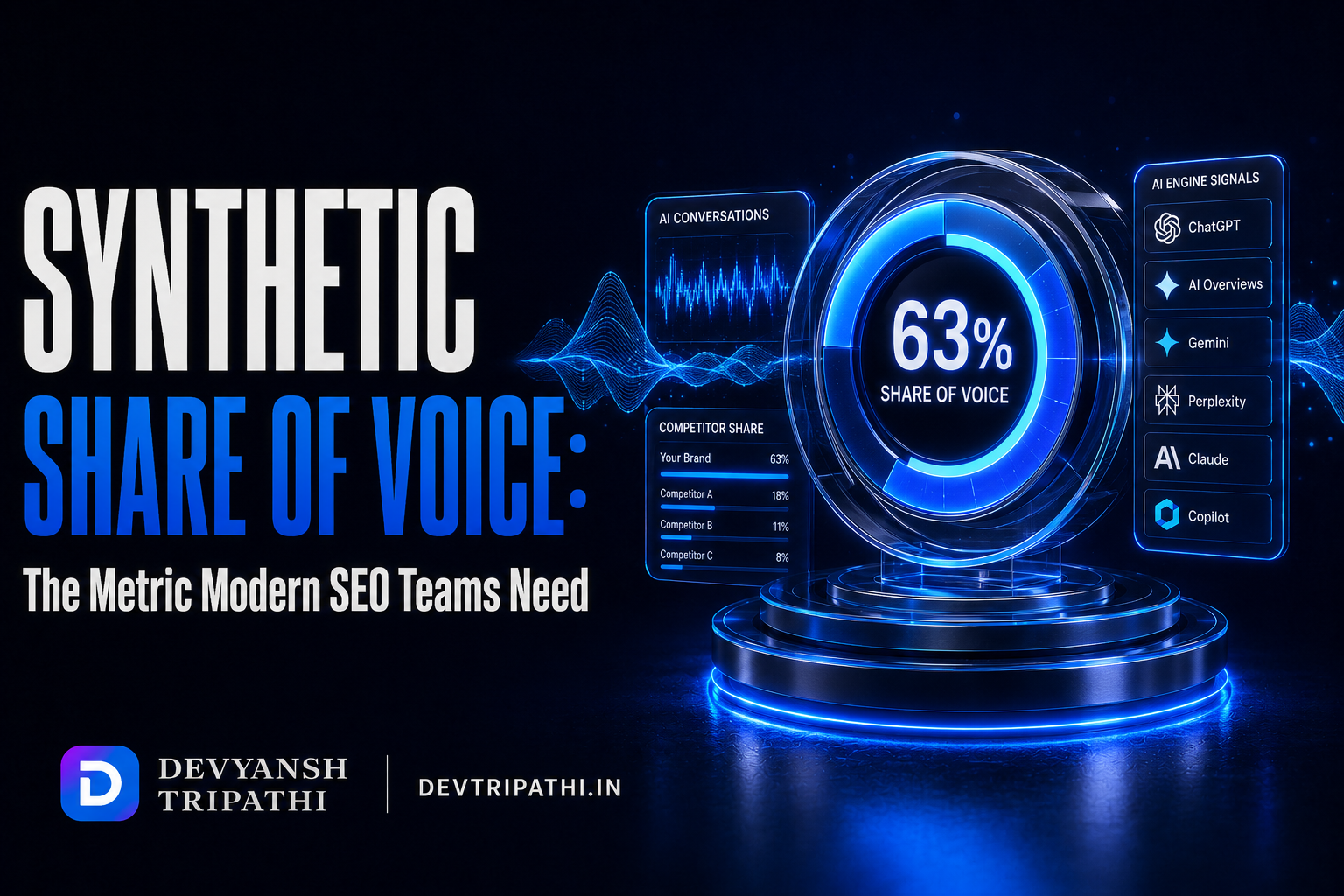
Synthetic Share of Voice: The Metric Modern SEO Teams Need
26 July 2026
Modern SEO strategies in the second half of 2026 are converging on a new central metric that Tinuiti’s research calls synthetic share of voice, replacing traditional keyword rankings as the primary measure of search performance by tracking how often and how prominently a brand is cited within AI-generated responses rather than where its pages rank in a static list of blue links, a shift driven by the reality that 38% of business decision-makers have already allocated budget specifically for AI search optimization while McKinsey projects unprepared brands may experience 20 to 50% traffic decline from traditional search.
This Cycle 4 guide covers modern SEO strategy built on the newest 2026 practitioner and research consensus: the synthetic share of voice concept and why traditional position no longer maps cleanly to either exposure or revenue, the six-pillar strategic framework that has emerged as the current standard for 2026 SEO planning, the specific budget allocation data confirming AI search investment has moved from experimental to mainstream, the McKinsey and Gartner projections quantifying the risk of inaction, and the “zero-click does not equal zero value” reframing that resolves the measurement anxiety many organizations still carry about investing in visibility that does not always produce a trackable click.
Traditional Rankings Are Being Replaced by Synthetic Share of Voice. Are You Measuring the Right Metric?
Get a complete modern SEO strategy assessment covering your current synthetic share of voice against priority commercial queries, your six-pillar 2026 framework readiness, and a revenue-aligned reporting structure that maps directly to the decisions your executives actually need to make.
Get My Modern SEO AssessmentSynthetic Share of Voice: The New Central SEO Metric
Tinuiti’s 2026 Future of SEO report introduces the concept most likely to define how SEO performance gets measured for the remainder of the decade: synthetic share of voice, a metric tracking how often and how prominently a brand is cited within AI-generated responses across ChatGPT, Perplexity, Gemini, and Google’s AI-powered search surfaces, replacing the traditional keyword ranking position that governed SEO measurement for the previous two decades. The report’s framing is direct: SEO has shifted from driving website traffic to managing synthetic share of voice within AI-generated summaries and answer engines.
The reasoning behind this metric shift addresses a structural problem that traditional rank-and-click measurement can no longer resolve. Traditional rank-and-click metrics were built for a world where users saw a static SERP, clicked to a site, and moved through a linear funnel, a model where “position” cleanly and predictably mapped to a specific level of exposure. In AI search, answers are composed probabilistically, personalized, and often served in a closed loop, meaning a position no longer maps cleanly to exposure, much less to revenue. Synthetic share of voice addresses this gap directly by measuring the actual outcome that matters, citation frequency and prominence, rather than a proxy metric, ranking position, that has become progressively less reliable as a predictor of that outcome.
38%of business decision-makers have already allocated budget specifically for AI search optimization
20-50%projected traffic decline for unprepared brands from traditional search (McKinsey)
25%projected drop in traditional search engine volume by 2026 (Gartner)
60%+/77%of Google searches / mobile searches ending in zero-click by end of 2025 (Digital Bloom)
The Six-Pillar 2026 SEO Strategy Framework
Digital Applied’s 2026 SEO Strategy Template consolidates current best practice into a coordinated six-pillar programme rather than the checklist-style approach that characterized earlier SEO planning documents. Each pillar compounds over 90-day execution cycles, with measurement functioning as the discipline that keeps every other pillar honest and accountable to actual business outcomes rather than vanity metrics.
Pillar 1
Business Goal Alignment
Sets the revenue envelope for the entire programme, connecting SEO strategy directly to specific business outcomes rather than treating traffic growth as an end goal in itself.
Pillar 2
Keyword and Competitive Research
Names the battlefield, identifying the specific query territory and competitive landscape the strategy must address across both traditional and AI-mediated search surfaces.
Pillar 3
Technical Foundation
Clears the floor rather than raising the ceiling: Core Web Vitals, rendering, crawl budget, and schema markup are prerequisites that enable every other pillar to function, not differentiating advantages in themselves.
Pillar 4
Content Architecture
A pillar-and-cluster architecture with deliberate internal linking outperforms 200 disconnected articles covering the same broad topic area, reinforcing the concentration-over-volume principle established throughout 2026 topical authority research.
Pillar 5
AEO and GEO as a Distinct Workstream
Being cited by AI answers requires entity SEO, structured answers, and authoritative co-mentions, not simply ranking in the traditional ten blue links, making this pillar explicitly separate from traditional on-page and technical work rather than an assumed byproduct of it.
Pillar 6
Measurement
Applies the dashboard rule discipline throughout: if a metric does not change a decision, it gets cut from reporting, ensuring every executive-facing chart triggers an action or a strategic adjustment rather than existing as passive activity documentation.
This six-pillar structure directly reflects the synthetic share of voice shift by explicitly treating AEO and GEO as a distinct, dedicated workstream (Pillar 5) rather than folding AI citation work into traditional content or technical SEO pillars where it would receive insufficient dedicated strategic attention. For the complete measurement infrastructure that operationalizes Pillar 6’s dashboard rule discipline specifically for AI citation tracking, see our AI Visibility Tracking Cycle 4 guide.
The Budget Allocation Shift: From Experimental to Mainstream
The finding that 38% of business decision-makers have already allocated budget specifically for AI search optimization confirms this investment category has moved decisively from experimental pilot programme status into mainstream, board-approved budget allocation within little more than a year of AI search reaching meaningful consumer scale. This adoption rate, while still leaving a majority of organizations without dedicated AI search budget, represents rapid maturation for a discipline that barely existed as a distinct budget category before 2025.
The urgency behind this budget shift is quantified directly by the risk data organizations are responding to: McKinsey’s projection that unprepared brands may experience 20 to 50% traffic decline from traditional search, combined with Gartner’s projection that traditional search engine volume itself will drop 25% by 2026, together establish that inaction carries a specific, quantified downside rather than representing a neutral, low-risk default posture. Organizations still treating AI search optimization as an optional, future consideration are operating against risk projections that industry analysts have already formally quantified and published.
38% of Decision-Makers Have Already Moved. McKinsey Projects a 50% Traffic Risk for Those Who Have Not.
Dev Tripathi builds complete modern SEO strategies structured around the six-pillar 2026 framework, with AEO and GEO treated as a dedicated workstream and synthetic share of voice tracked alongside traditional performance metrics for a complete, revenue-aligned reporting picture.
Build My Modern SEO StrategyZero-Click Does Not Equal Zero Value: Resolving the Measurement Anxiety
A persistent organizational anxiety about AI search investment stems from a reasonable but incomplete assumption: if AI Overviews and AI Mode responses reduce click-through rates, does the resulting visibility carry any value at all? Kkonect Us Agency’s 2026 research directly addresses this concern with a specific reframing: zero-click does not equal zero value, because brand recall increases when users repeatedly see a brand cited inside AI answers or rich snippets, with presence building familiarity and familiarity building trust even when no click and no trackable session results from a given individual exposure.
This reframing connects directly to the enterprise brand measurement shift the same research documents: enterprise brands are increasingly monitoring how organic visibility supports assisted conversions rather than last-click conversions specifically, reflecting the recognition that a purchase decision influenced by repeated AI citation exposure across multiple prior sessions cannot be fully captured by attribution models built exclusively around the final, trackable click. Modern SEO reporting dashboards in 2026 look meaningfully different from their equivalents five years earlier precisely because visibility, engagement quality, and brand amplification now matter as much as, or more than, raw impression and click volume alone.
Aligning Organic Performance to Revenue Rather Than Traffic
Digital Applied’s framework articulates one of the most consequential strategic reframings in current modern SEO practice: align organic performance to revenue, not traffic, connecting keyword groups and content pillars directly to pipeline stages rather than reporting session and traffic growth as the primary success indicator. This reframing exists because executives fund strategies that map to deals, not dashboards showing sessions, meaning SEO programmes that cannot demonstrate a clear connection between their activity and revenue outcomes face increasing difficulty securing sustained budget commitment regardless of how strong their traditional traffic metrics appear.
| Traditional Metric | 2026 Revenue-Aligned Equivalent | Why the Shift Matters |
|---|---|---|
| Keyword Ranking Position | Synthetic Share of Voice | Position no longer maps cleanly to exposure or revenue |
| Organic Sessions | Pipeline Stage Attribution | Executives fund strategies mapped to deals, not sessions |
| Last-Click Conversions | Assisted Conversion Tracking | AI citation exposure influences decisions before any click occurs |
| Raw Impression Volume | Brand Recall and Familiarity Metrics | Zero-click exposure still builds trust and future consideration |
Implementing this revenue-aligned measurement approach requires connecting specific keyword groups and content pillars to defined pipeline stages within a brand’s existing sales and marketing funnel, allowing SEO reporting to demonstrate influence on pipeline velocity and deal volume rather than only top-of-funnel traffic metrics that executives increasingly treat as insufficient justification for continued investment on their own. For the complete brand authority framework that supports this revenue-aligned reporting through demonstrable trust and recall effects, see our Brand Authority SEO Cycle 4 guide.
Frequently Asked Questions About Modern SEO Strategies in 2026
What is synthetic share of voice and why is it replacing traditional keyword rankings?
Synthetic share of voice is a metric introduced in Tinuiti's 2026 Future of SEO report that measures how often and how prominently a brand is cited within AI-generated responses across platforms like ChatGPT, Perplexity, and Google's AI-powered search surfaces. It is replacing traditional keyword rankings because AI search answers are composed probabilistically and personalized, meaning a static ranking position no longer maps cleanly to actual user exposure or revenue outcomes the way it did in traditional search results pages.
Why does McKinsey project unprepared brands may see a 20 to 50% traffic decline?
McKinsey's projection reflects the compounding effect of Gartner's separately projected 25% decline in traditional search engine volume combined with the additional click-through rate reduction AI Overviews and AI Mode produce for brands not achieving AI citation eligibility. Brands relying solely on traditional organic ranking, without corresponding investment in AI citation optimization, face this combined traffic risk from both the shrinking traditional search volume and their absence from the AI-mediated search surfaces increasingly capturing the queries that remain.
What are the six pillars of the 2026 SEO strategy framework?
The six pillars are business goal alignment (setting the revenue envelope), keyword and competitive research (naming the battlefield), technical foundation (clearing the floor through Core Web Vitals and schema), content architecture (pillar-and-cluster structure over scattered posts), AEO and GEO as a distinct workstream (separate from traditional content and technical work), and measurement (applying a strict dashboard rule that cuts any metric failing to change a decision).
Why must AEO and GEO be treated as a distinct workstream rather than part of traditional SEO?
Being cited by AI answers requires entity SEO, structured answers, and authoritative co-mentions, distinct technical and content requirements that differ meaningfully from what earns a traditional top-10 organic ranking. Treating AEO and GEO as an assumed byproduct of general content and technical SEO work, rather than a dedicated workstream with its own specific requirements and resource allocation, results in insufficient strategic attention to the exact signals that determine AI citation eligibility.
What does "zero-click does not equal zero value" mean in practice?
This principle means that when a user sees a brand cited within an AI-generated answer or rich snippet without clicking through to the website, that exposure still builds brand recall and familiarity, which in turn builds trust that influences future consideration and purchase decisions even without generating a trackable session in that specific instance. Enterprise brands increasingly monitor how organic visibility supports assisted conversions rather than relying solely on last-click attribution, which cannot capture this cumulative brand-building effect.
Why should SEO reporting align to revenue rather than traffic?
Executives fund strategies that map to deals, not dashboards showing sessions, meaning SEO programmes reporting only traffic and session growth face increasing difficulty securing sustained budget commitment regardless of how strong those traditional metrics appear. Connecting keyword groups and content pillars directly to specific pipeline stages allows SEO reporting to demonstrate measurable influence on pipeline velocity and deal volume, providing the revenue-linked evidence that modern executive stakeholders increasingly require before approving continued SEO investment.
What is the dashboard rule and why does it matter for modern SEO measurement?
The dashboard rule states that if a metric does not change a decision, it should be cut from reporting entirely, ensuring every executive-facing chart triggers an action or a strategic adjustment rather than existing as passive activity documentation. This discipline matters because modern SEO programmes generate an overwhelming volume of potentially trackable metrics, and without this filtering principle, reporting can become cluttered with data that consumes stakeholder attention without informing any actual strategic or budgetary decision.
Why does 38% budget allocation for AI search optimization represent a significant shift?
The 38% figure confirms AI search optimization has moved from experimental pilot programme status into mainstream, board-approved budget allocation within roughly a year of AI search reaching meaningful consumer scale, a rapid maturation rate for a distinct budget category. While this still leaves a majority of organizations without dedicated AI search budget, it represents a significant early-adoption signal that organizations still treating AI search optimization as optional are increasingly operating behind a documented and accelerating industry trend.
How does the concentration-over-volume content principle fit into the six-pillar framework?
The content architecture pillar explicitly states that a pillar-and-cluster architecture with deliberate internal links outperforms 200 disconnected articles on the same topic area, directly reinforcing the concentration-over-volume principle established throughout 2026 topical authority research. This confirms the six-pillar framework treats content depth and structural coherence, rather than raw publishing volume, as the standard for effective content architecture investment in 2026.
How does modern SEO strategy in 2026 connect to the broader synthetic share of voice measurement shift?
Modern SEO strategy in 2026 operationalizes the synthetic share of voice concept by explicitly building AEO and GEO into the strategic framework as Pillar 5, applying the dashboard rule to ensure citation and visibility metrics actually inform decisions, and aligning reporting to revenue and pipeline attribution rather than raw traffic. This connects directly to the broader measurement infrastructure covered in AI visibility tracking research, since synthetic share of voice as a strategic concept requires the same citation testing and tracking tools that operationalize it into an actual measurable metric. For the complete measurement tooling landscape, see our AI Visibility Tracking Cycle 4 guide.
Build Modern SEO Strategy Around Synthetic Share of Voice, Not Static Rankings Alone
Get a complete modern SEO strategy programme covering the six-pillar 2026 framework implementation, synthetic share of voice measurement across your priority commercial queries, revenue-aligned reporting structure, and the dedicated AEO/GEO workstream that most competing organizations have not yet properly resourced.
Start My Modern SEO StrategyConclusion
Modern SEO strategy in the second half of 2026 is defined by a fundamental measurement reframing: synthetic share of voice, tracking citation frequency and prominence within AI-generated responses, is replacing traditional keyword ranking position as the primary indicator of search performance, because position no longer maps cleanly to exposure or revenue in an AI-mediated search environment that composes answers probabilistically and often serves them within a closed conversational loop. With 38% of business decision-makers already allocating dedicated AI search budget and McKinsey projecting 20 to 50% traffic decline for unprepared brands, the strategic risk of continued inaction is now quantified and publicly documented rather than speculative.
The six-pillar framework, spanning business goal alignment, competitive research, technical foundation, content architecture, dedicated AEO/GEO investment, and disciplined revenue-aligned measurement, provides the current practitioner consensus structure for organizing modern SEO strategy against this evolving reality. Combined with the “zero-click does not equal zero value” reframing that resolves lingering measurement anxiety about AI-mediated visibility, and the dashboard rule discipline that keeps reporting focused on decision-relevant metrics, brands now have both the conceptual framework and the practical structure needed to build SEO strategy genuinely fit for the synthetic-share-of-voice era rather than continuing to optimize for a ranking-position metric whose predictive value has measurably declined. For the complete platform fragmentation context this modern SEO framework must account for, see our AISEO Cycle 4 guide.

Devyansh Tripathi
I’m Devyansh Tripathi, an SEO strategist and digital growth expert, helps businesses and individuals rank higher and drive organic traffic. Through DevTripathi., he shares cutting-edge SEO insights, content strategies, and marketing hacks. Passionate about digital success, he’s on a mission to make SEO simple, effective, and result-driven!
Posts
- What Google’s New AI Search Documentation Means for SEO Teams
- Google I/O 2026 Search: AI Agents, Gemini 3.5 and the Unified Box
- Google’s AI Optimization Guide: The Technical and Content Checklist
- July 2026 SEO Update: AI Overviews, llms.txt and Search Console
- Prompt Optimization Beyond Page One: The Position-21 Citation Opportunity
Categories
- AI Citation Optimization
- AI Search Optimization (AISEO)
- AI Visibility Tracking
- Answer Engine Optimization (AEO)
- Brand Authority SEO
- Brand SERP Optimization
- Community Signal SEO
- Conversational Search Optimization
- Generative Engine Optimization (GEO)
- Knowledge Graph Optimization
- Modern SEO Strategies
- Multimodal Search Optimization
- Prompt Optimization
- SEO Trends
- Social Search Optimization
- Topical Authority SEO
- Uncategorized
- Video Search SEO
- Visual Search Optimization
- Voice Engine Optimization (VEO)
- Zero Click Search Optimization
Latest News
Text Widget
Empowering brands with insights, strategies, and stories that drive digital growth.