A Four-Layer Measurement Framework for Zero-Click SEO
11 June 2026
This guide covers the complete zero click search strategy for 2026: the verified data behind the shift, why zero click SERP visibility still creates measurable commercial value, and how to win each of the five major SERP features that now deliver the majority of brand impressions in search. You will find the exact optimization approach for Google AI Overviews, featured snippets, People Also Ask boxes, Knowledge Panels, and the local three-pack, a six-part strategy framework for capturing zero click brand authority, and a four-layer measurement system that replaces traffic-only analytics with a complete SERP visibility framework that captures what standard Google Analytics 4 dashboards miss entirely.
Key Takeaways
- According to Digital Applied's 2026 zero click research, 65% of all Google searches end without a click. When AI Overviews are present, that figure rises to 83%.
- AI Overviews reduce position-one CTR by an average of 34.5%, according to Ahrefs research across 300,000 keywords published in December 2025.
- Mobile searches generate a 77% zero click rate versus 56% on desktop, according to Searchlab's 2026 zero click statistics.
- Brands cited inside AI Overviews receive measurably more clicks than non-cited competitors on the same SERP, making AI Overview citation simultaneously a zero click brand play and a CTR improvement strategy.
- Zero click visibility delivers commercial value through three mechanisms: brand impression at intent formation, branded search lift from SERP exposure, and AI citation authority that influences later purchase decisions.
- The fastest zero click win available is winning a featured snippet for an existing top-10-ranking query by restructuring the page with a 40 to 60 word direct answer after a question-format header.
- Measuring zero click performance requires four metrics that GA4 alone cannot capture: SERP feature ownership rate, total impression volume growth, branded query volume, and AI-referred traffic from AI platform referrers.
Free Zero Click Audit for SEO Professionals
Find Out Exactly How Much SERP Visibility Your Brand Is Capturing
65% of searches never reach your website. Get a complete audit of your featured snippet ownership, AI Overview citation rate, and People Also Ask inclusion across your top 50 target queries.
Get My Free Zero Click AuditWhat Is Zero Click Search and Why It Demands a New Strategy
Zero click search occurs when a user’s query is answered directly within Google’s search results page, eliminating any need to visit an external website. The user submits a query, gets their answer from an AI Overview, featured snippet, Knowledge Panel, or direct answer box, and leaves without clicking any result.
Traditional SEO measurement captures only the 35% of searches that still generate clicks. The 65% majority of search interactions, where users read, form opinions, and sometimes make decisions based purely on SERP-level information, are completely invisible to standard analytics dashboards. Brands optimizing solely for clicks are measuring less than half of their search influence.
According to SparkToro’s zero click research, 58.5% of US searches ended without a click even before AI Overviews reached scale. That was the 2024 baseline. The 2026 figure stands at 65% for all searches and 83% when AI Overviews are present. The strategic implication is direct: optimizing only for clicks misses the majority of modern search interactions. For a complete framework on capturing value in zero click contexts through AI citation, see our guide on Answer Engine Optimization.
Why Zero Click Visibility Still Creates Real Commercial Value
A common misreading of zero click data is that declining clicks mean declining SEO value. This conflates the metric with the outcome. Zero click visibility delivers commercial value through three distinct mechanisms that standard analytics cannot capture directly.
Brand impression at intent formation is the first mechanism. When a user’s query triggers an AI Overview citing your brand, they encounter your name, positioning, and expertise at the exact moment they are forming an opinion about a topic. This is top-of-funnel influence at scale, without ad spend.
Branded search lift is the second mechanism. Users who encounter a brand name in an AI Overview, featured snippet, or Knowledge Panel frequently search for that brand name directly afterward. This lift is measurable in Google Search Console as branded query impression growth and represents one of the clearest downstream signals that zero click SERP presence is generating commercial value. For the complete brand authority strategy that turns zero click presence into compounding commercial advantage, see our guide on Brand Authority SEO.
AI citation authority is the third mechanism. Brands cited as AI Overview sources receive measurably more clicks than non-cited competitors on the same SERP, making AI Overview citation simultaneously a zero click brand play and a CTR improvement strategy. Being the cited source positions your brand as the authoritative recommendation inside the AI answer, which carries more credibility than being the fifth blue link below it.
The 2026 Zero Click Data: What the Research Actually Shows
Three major CTR impact studies give different answers on exactly how much AI Overviews suppress organic clicks. Ahrefs’ 300,000-keyword study found a 34.5% drop at position one. Amsive’s 700,000-keyword study found a 15.49% average decline across all positions. Seer Interactive’s 15-month longitudinal study of 3,119 informational queries found a 61% organic CTR decline. The differences reflect different methodologies, keyword mixes, and time periods rather than conflicting findings.
The device split adds commercial significance. Searchlab’s 2026 analysis found mobile generates 77% zero click versus 56% on desktop. Since mobile accounts for the majority of global Google searches, the weighted zero click rate is pulled upward by the higher mobile proportion. AI Mode queries show an even more extreme 93% zero click rate according to Seer Interactive data covering 25.1 million impressions.
| Metric | Figure | Source | Year |
|---|---|---|---|
| All Google searches ending without a click | 65% | Digital Applied | 2026 |
| Zero click rate when AI Overview is present | 83% | Digital Applied / Seer Interactive | 2026 |
| Zero click rate inside AI Mode | 93% | Seer Interactive (25.1M impressions) | 2026 |
| Mobile zero click rate | 77% | Searchlab | 2026 |
| Desktop zero click rate | 56% | Searchlab | 2026 |
| Position-one CTR drop from AI Overviews | 34.5% | Ahrefs (300,000 keywords) | Dec 2025 |
| Informational CTR decline over 15 months | 61% | Seer Interactive (longitudinal study) | 2026 |
The 5 Zero Click SERP Features and How to Win Each One
Zero click experiences in 2026 are delivered through five distinct SERP features, each with different selection criteria and different optimization requirements. Winning zero click visibility means building a deliberate strategy for each feature rather than hoping that general SEO performance will generate SERP feature inclusion as a byproduct.
Feature 1: Google AI Overviews
AI Overviews are the dominant zero click feature in 2026, appearing in approximately 30% of informational queries and generating an 83% zero click rate when present. They synthesize answers from 3 to 5 sources and cite those sources with clickable attribution links.
Winning AI Overview citations requires three non-negotiable elements working together. Traditional SEO ranking is the prerequisite: approximately 52% of AI Overview citations come from URLs already in the top-10 organic positions, and Google’s RAG retrieval system draws from its traditional search index. Content structure is the selection factor: place a direct, self-contained answer to the primary query within the first 150 words of every page. Schema deployment is the technical signal: deploy FAQPage, Article, and ItemList JSON-LD schema to help AI systems identify and extract specific content sections accurately.
For the complete AI Overview optimization framework including the direct answer block method, expert quote attribution, and schema stacking guide, see our detailed breakdown in our Answer Engine Optimization guide.
Feature 2: Featured Snippets
Featured snippets appear above all organic results for approximately 12.3% of queries. Three snippet formats exist, and each requires a different content structure to win.
Paragraph snippets target definitional and explanation queries. Write a 40 to 60 word answer in Subject Is Predicate sentence structure immediately after a question-format H2 or H3 header. Never begin the answer by restating the question. List snippets target process and step queries. Write a numbered list where each item begins with an action verb and contains one clear instruction per line. Table snippets target comparison queries. Build clean HTML comparison tables with 3 to 5 rows, clear headers, and concise cell content that reads as useful information in isolation.
Feature 3: People Also Ask Boxes
People Also Ask boxes appear in over 40% of Google searches and expand dynamically as users interact with them, placing your brand name beside your answer even without a click. Each expanded answer displays the source domain, providing a brand impression at scale.
Source FAQ entries directly from the PAA boxes that appear for your target queries using live Google searches. Write each answer as a standalone 40 to 60 word paragraph that makes complete sense without surrounding context. Apply FAQPage JSON-LD schema to all FAQ content. Validate using Google’s Rich Results Test after deployment. For a complete guide on building FAQs specifically optimized for PAA and AI Overview extraction, see our Conversational Search Optimization guide.
Feature 4: Knowledge Panels
Knowledge Panels appear in the right sidebar for branded queries and provide comprehensive brand information to users conducting pre-purchase research. They are the clearest visible indicator of Google Knowledge Graph entity recognition and carry significant brand trust signals for users who never need to click through to learn what your brand does.
Build Knowledge Panel eligibility through consistent entity data across your Wikidata entry, Organization schema with sameAs property on your homepage, a complete and verified Google Business Profile, and consistent entity data across LinkedIn and major directories. For the complete Knowledge Panel strategy and the step-by-step entity building sequence, see our Knowledge Graph Optimization guide.
Feature 5: Local Pack
The Google Maps three-pack appears for local intent queries and delivers business name, rating, address, and hours directly on the SERP. For any business with a geographic presence, local pack inclusion is the highest commercial-intent zero click feature available, capturing users who are ready to make a purchase decision.
Win local pack placement through a fully complete and verified Google Business Profile with every available field populated, identical NAP data across all directories and listings, LocalBusiness JSON-LD schema on your location and contact pages, and a strong review volume and positive sentiment profile on Google.
The 6-Part Zero Click Optimization Strategy
Winning zero click SERP visibility requires a coordinated six-part strategy that addresses content structure, schema deployment, entity authority, topical coverage, branded search monitoring, and the technical requirements that make content accessible to AI retrieval systems.
Strategy 1: The Inverted Pyramid Content Method
Structure every page with the most important answer first, before any context-building prose. AI systems and featured snippet algorithms scan for extractable answer patterns. A page with the answer in the first 150 words provides a clear extraction target. A page with the answer buried after three paragraphs of introduction forces the algorithm to read the entire piece before finding citable content, significantly reducing selection probability.
Apply this at both the page level and the section level. Every H2 and H3 section should open with the direct answer to its heading’s question in the first 1 to 2 sentences. Test by reading any single section in isolation. If it makes complete sense and provides genuine value without surrounding context, it is structured correctly for zero click extraction.
Strategy 2: Featured Snippet Engineering by Query Type
Different query types produce different featured snippet formats. Analyze the SERPs for your target queries to identify which format Google currently selects, then mirror that format precisely in your content. For definitional queries, use a 40 to 60 word paragraph immediately after a question-format header. For process queries, use a numbered list with action verb-led items. For comparison queries, use a clean HTML table.
Winning a featured snippet for a query you already rank in the top 10 for is the single fastest zero click optimization action available. The page is already in Google’s retrieval pool. Restructuring the content to lead with the correct format typically produces snippet wins within 1 to 4 weeks of the updated content being re-indexed.
Strategy 3: FAQ Architecture for People Also Ask Dominance
People Also Ask placements are powered by FAQ content with FAQPage schema. Build a minimum of 10 real user questions per pillar article, sourced directly from the PAA boxes that appear for your target queries in live Google searches. Do not guess what questions to include. Copy the exact phrasing from the PAA boxes and use those as your FAQ question headers.
Write each FAQ answer as a standalone 40 to 60 word paragraph beginning with the direct answer. Apply FAQPage JSON-LD schema to all FAQ sections. Track PAA inclusion using Semrush or Ahrefs position tracking filtered for featured snippet and PAA appearances.
Strategy 4: Entity Consistency for Knowledge Panel Authority
Knowledge Panels are built from entity data Google cross-references across multiple trusted sources. Ensure your brand entity information is identical in format and content across your website’s Organization schema, your Wikidata entry, your Google Business Profile, LinkedIn, and Crunchbase. Even minor inconsistencies in brand name formatting reduce Google’s entity confidence and delay or prevent Knowledge Panel creation.
The sameAs property in your Organization JSON-LD schema is the most technically impactful single field for Knowledge Panel eligibility. It tells Google explicitly that your website URL, LinkedIn profile, and Wikidata entry all represent the same entity, enabling it to build a confident entity profile from multiple sources simultaneously.
Strategy 5: Topical Cluster Coverage for Broad SERP Presence
Sites with comprehensive topical coverage appear across more SERP features because they qualify as citation sources for more sub-queries in the AI fan-out process. Build content clusters of 5 to 7 or more interlinked pages per major topic rather than relying on isolated pages. Topical authority clusters outperform isolated pages for AI citation likelihood, and depth of coverage matters more than individual page optimization according to Slate’s 2026 AI SEO research.
For the complete implementation guide covering topical maps, pillar-and-cluster architecture, internal link architecture, and the quarterly content gap audit process, see our Topical Authority SEO guide.
Strategy 6: Branded Search Volume as Zero Click Measurement
Since zero click interactions do not generate website sessions, the primary downstream signal in standard analytics is branded search volume. Users who encounter your brand in an AI Overview, featured snippet, or Knowledge Panel frequently search for your brand name directly afterward. Track branded query impressions monthly in Google Search Console under the Performance report filtered for your brand name. Month-over-month branded search impression growth above 15% confirms that zero click SERP presence is generating brand recall that compounds toward commercial outcomes.
Build a Zero Click SEO Strategy That Compounds
Most Brands Are Measuring Zero Click SEO Wrong and Missing Most of Their Search Influence
Book a strategy session and get a complete zero click visibility roadmap covering AI Overview citation, featured snippet strategy, People Also Ask optimization, and a four-layer measurement framework.
Book My Strategy SessionMeasuring Zero Click Performance: The Four-Layer Framework
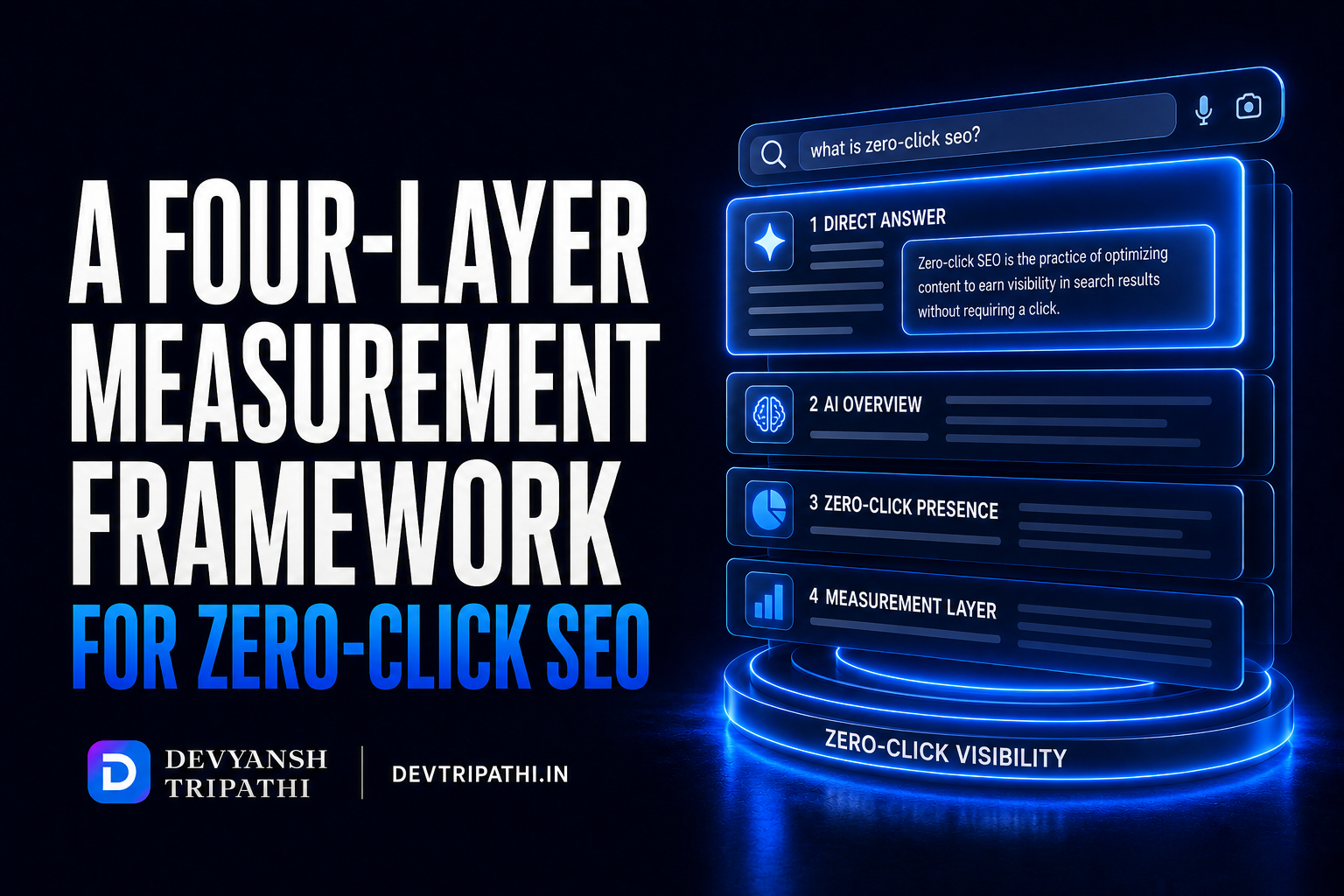
Traditional SEO dashboards only capture the 35% of searches that generate a click. Measuring zero click performance accurately requires expanding the framework to cover four distinct metric layers that together provide a complete picture of your SERP visibility and its downstream commercial impact.
The Four Zero Click Measurement Layers
Layer 1: SERP Feature Ownership
Track featured snippet ownership, PAA inclusion rate, and AI Overview citation frequency for your target keywords. Tool: Semrush, Ahrefs, or manual Google Search testing.
Layer 2: Impression Volume Growth
Monitor total impressions in Google Search Console even when click counts decline. Impression growth without click growth signals increasing zero click SERP feature appearances. Tool: Google Search Console.
Layer 3: Branded Query Volume
Track branded search impressions monthly as the downstream signal of zero click brand recall. Month-over-month growth above 15% confirms SERP visibility is generating awareness. Tool: Google Search Console brand filter.
Layer 4: AI-Referred Traffic
Create a GA4 custom channel group capturing sessions from chatgpt.com, perplexity.ai, and bing.com. AI-referred visitors convert at 4.4x higher rates than standard organic. Tool: Google Analytics 4 custom channel groups.
For the complete AI visibility measurement framework covering Share of Model tracking, AI citation frequency testing, and the tool stack for automated cross-platform monitoring, see our AI Visibility Tracking guide.
Frequently Asked Questions About Zero Click Search Optimization
The following questions address the most common areas of confusion and concern SEO professionals raise when adapting their strategy to the zero click search reality of 2026.
What is zero click search optimization?
Zero click search optimization is the practice of structuring content and brand signals to earn maximum visibility on the search results page itself through AI Overviews, featured snippets, Knowledge Panels, and PAA boxes. It generates brand awareness and authority even when users never click through to the website, capturing the 65% of search interactions that never produce a website session.
What percentage of Google searches end without a click in 2026?
According to Digital Applied’s 2026 zero click statistics, approximately 65% of all Google searches end without a click to any external website. When AI Overviews are present, that figure rises to 83%. On mobile devices specifically, the zero click rate has reached 77%, compared to 56% on desktop. AI Mode queries show the most extreme rate at 93% according to Seer Interactive data.
Does zero click search mean SEO is no longer worth investing in?
No. Zero click changes the metric that matters from clicks to visibility, but it does not eliminate the commercial value of appearing prominently in search. Brands cited in AI Overviews receive more clicks than non-cited competitors on the same SERP. Featured snippet ownership builds brand recognition. Knowledge Panel presence increases trust during pre-purchase research. Zero click redistributes SEO value rather than destroying it.
How do AI Overviews affect organic click-through rates?
Three major studies quantify the impact differently: Ahrefs found a 34.5% position-one CTR drop, Amsive found a 15.49% average decline across all positions, and Seer Interactive found a 61% CTR decline for informational queries over 15 months. The range reflects different methodologies and keyword mixes. For informational content where AI Overviews appear most frequently, the impact is largest. For commercial and transactional content, the impact is significantly smaller.
What is the fastest path to zero click SERP visibility?
Winning a featured snippet for a query you already rank in the top 10 for is the fastest available action. Your page is already in Google’s retrieval pool. Restructuring the page to lead with a 40 to 60 word direct answer after a question-format header, adding FAQPage schema, and applying the correct snippet format for the query type typically produces snippet wins within 1 to 4 weeks of the updated content being re-indexed.
Can zero click visibility drive business results without website traffic?
Yes, through two mechanisms. Consistent zero click SERP presence builds brand recall through repeated impressions, which converts into branded searches and direct visits during later purchase-stage sessions. AI-referred visitors, those who first encounter your brand in an AI Overview or AI search result and then navigate directly to your site, convert at 4.4 times higher rates than standard organic visitors because they arrive with prior brand awareness and established intent.
What schema markup matters most for zero click optimization?
FAQPage schema is the highest-impact single schema type for zero click optimization because it maps directly to People Also Ask extraction and AI Overview FAQ section citation. Article schema is required for E-E-A-T verification that makes content eligible for AI Overview sourcing. LocalBusiness schema is essential for local pack zero click visibility. Organization schema with sameAs property builds the entity clarity needed for Knowledge Panel creation and branded search authority.
How do I track zero click performance in Google Analytics 4?
Set up a custom channel group in GA4 capturing sessions from AI platform referrers including chatgpt.com, perplexity.ai, and bing.com. Monitor total impressions in Google Search Console as the primary zero click visibility metric, since impressions capture SERP appearances regardless of whether clicks occurred. Track branded query impression volume monthly in Search Console as the downstream brand recall indicator from zero click SERP exposure.
What is the Inverted Pyramid Method for zero click content?
The Inverted Pyramid Method places the direct answer to the primary query in the first 150 words of the page, before any supporting context or background introduction. Every H2 and H3 section also leads with a direct answer in the first 1 to 2 sentences. This structure provides AI systems and featured snippet algorithms with a clear, immediate extraction target rather than forcing them to read an entire article to find citable content.
Should I stop creating informational content because of high zero click rates?
No. Informational content with high zero click rates should be restructured for AI Overview citation rather than abandoned. A brand consistently cited in AI Overviews for informational queries in its category builds the topical authority and entity recognition that improves commercial query performance over time. The informational content layer feeds the authority signals that make commercial content more competitive in both traditional and AI search.
How does zero click search affect e-commerce and transactional queries?
Significantly less than informational queries. AI Overviews largely avoid recommending specific products directly due to liability considerations, and transactional intent queries still drive click-through behavior at significantly higher rates than informational queries. For e-commerce brands, the zero click challenge is primarily an informational content issue. Product pages and service pages targeting commercial and transactional intent keywords still benefit from traditional click-through SEO, supported by the brand awareness built through zero click informational content.
What is the competitive opportunity in zero click optimization for 2026?
The majority of SEO programs still measure only clicks and keyword rankings, making SERP feature ownership, AI Overview citation rates, and branded search volume largely unmonitored by most competitors. Brands that build systematic zero click optimization and measurement programs now capture the SERP visibility that competitors are not tracking, earning brand impressions at the moment of intent formation across the 65% of searches that never generate a click to any website.
Ready to Win the Zero Click Search Game?
Get a Personalised Zero Click Visibility Strategy Built on the Exact Framework in This Guide
Free consultation covering your current SERP feature ownership, AI Overview citation gaps, branded search momentum, and the specific actions that will have the fastest impact on your zero click visibility.
Get My Free ConsultationConclusion
Zero click search is the defining structural shift in search behavior in 2026. With 65% of all searches ending on the SERP, 83% when AI Overviews are present, and AI Mode generating a 93% zero click rate, optimizing exclusively for website traffic captures less than half of the available search influence your brand could be winning.
The opportunity this creates is real. A brand consistently cited in AI Overviews, appearing in featured snippets, and displaying a Knowledge Panel for branded queries builds recognition, authority, and trust at the scale of the full search interaction, not only the fraction that generates a click. The measurement framework must evolve alongside the strategy: track SERP feature ownership, monitor branded search volume growth as the downstream signal, and measure AI-referred traffic as the sessions that do convert to clicks.
Every element of the zero click optimization strategy covered in this guide, from the Inverted Pyramid Method and featured snippet engineering to entity consistency for Knowledge Panels and the four-layer measurement framework, can be implemented on your existing content without a full content overhaul. Start with a featured snippet audit of your top 10 ranking pages this week. Add FAQPage schema. Add direct 40 to 60 word answer blocks after question-format headers. Monitor impression growth in Search Console alongside clicks. For the complete AI citation strategy that maximizes the commercial value of zero click visibility, see our AI Citation Optimization guide.

Devyansh Tripathi
I’m Devyansh Tripathi, an SEO strategist and digital growth expert, helps businesses and individuals rank higher and drive organic traffic. Through DevTripathi., he shares cutting-edge SEO insights, content strategies, and marketing hacks. Passionate about digital success, he’s on a mission to make SEO simple, effective, and result-driven!
Posts
- What Google’s New AI Search Documentation Means for SEO Teams
- Google I/O 2026 Search: AI Agents, Gemini 3.5 and the Unified Box
- Google’s AI Optimization Guide: The Technical and Content Checklist
- July 2026 SEO Update: AI Overviews, llms.txt and Search Console
- Prompt Optimization Beyond Page One: The Position-21 Citation Opportunity
Categories
- AI Citation Optimization
- AI Search Optimization (AISEO)
- AI Visibility Tracking
- Answer Engine Optimization (AEO)
- Brand Authority SEO
- Brand SERP Optimization
- Community Signal SEO
- Conversational Search Optimization
- Generative Engine Optimization (GEO)
- Knowledge Graph Optimization
- Modern SEO Strategies
- Multimodal Search Optimization
- Prompt Optimization
- SEO Trends
- Social Search Optimization
- Topical Authority SEO
- Uncategorized
- Video Search SEO
- Visual Search Optimization
- Voice Engine Optimization (VEO)
- Zero Click Search Optimization
Latest News
Text Widget
Empowering brands with insights, strategies, and stories that drive digital growth.