Advanced AEO: Five Answer Formats, Intent Design and Schema at Scale
29 June 2026
Advanced answer engine optimization is the structured practice of engineering content to earn direct citations across AI systems, voice assistants, and featured snippets by designing multi-format answer libraries, aligning content architecture with specific query intent types, and systematically measuring citation performance across every major AI search platform. It moves beyond basic AEO principles to build scalable answer content systems that compound in authority over time.
Most organizations implement answer engine optimization as a series of individual page improvements without a governing architecture that connects those improvements into a coherent content system. Advanced AEO replaces that scattered approach with a structured answer library framework where content is designed from the start to serve five distinct answer formats, calibrated to specific query intent types, implemented with appropriate schema markup at scale, and measured through attribution reporting that connects AEO activity to business outcomes. This guide covers the complete advanced AEO framework, including the five answer format architecture, intent-specific content design, cross-platform performance differences, schema implementation methodology, competitive AEO gap analysis, and the attribution model that demonstrates AEO value to stakeholders who measure performance in clicks and conversions rather than citation rates.
Is Your Content Architecture Built for AI Answer Systems?
Most brands optimize individual pages without a governing AEO framework. Dev Tripathi builds complete answer engine optimization systems that produce consistent citations across Google AI Overviews, ChatGPT, Perplexity, and voice search platforms.
Get Your AEO Architecture AuditWhat Advanced Answer Engine Optimization Involves
Advanced answer engine optimization extends the foundational principles covered in our foundational AEO guide into a systematic content architecture program. Where foundational AEO focuses on optimizing individual pages to answer specific questions, advanced AEO designs an entire content ecosystem where every major topic is covered across multiple answer formats, every content piece targets a specific query intent type, and the combined library provides AI systems with a comprehensive source for every relevant question in the brand’s category.
The shift from page-level optimization to system-level architecture is what distinguishes advanced AEO from basic implementation. Statista reports that Google processes over 8.5 billion searches per day, representing an enormous volume of queries that AI systems are increasingly answering through generated responses rather than directing users to organic results. Capturing a systematic share of those AI generated citations requires a structured content approach rather than opportunistic page optimization.
The Shift from Page Optimization to Answer Architecture
Page-level AEO optimization treats each piece of content as an independent asset and applies optimization techniques individually. A team optimizes a page’s introduction for featured snippets, adds an FAQ section, and moves to the next page. This produces incremental improvements in individual pages but does not build the interconnected authority structure that earns high citation rates across a broad range of query types.
Answer architecture treats the entire content library as a single coordinated system. It maps every query category in the brand’s topic space, assigns the appropriate answer format to each query type, creates content that fills every format slot for every major topic, and builds internal linking structures that help AI systems understand the depth and breadth of the brand’s expertise. This systematic approach compounds over time as the library grows and AI systems recognize the brand as a comprehensive authority across its category.
Why Most AEO Programs Plateau
Most AEO programs achieve early citation gains from basic optimizations and then plateau when those gains slow. The plateau typically occurs because basic AEO covers the easiest citation opportunities, such as adding FAQ sections to existing pages, but does not address the underlying content architecture gaps that prevent citation rate from growing beyond 20 to 30% of tested queries. Breaking through a citation rate plateau requires the systematic content gap analysis and multi-format answer library development that characterizes advanced AEO.
The Five Answer Format Architecture
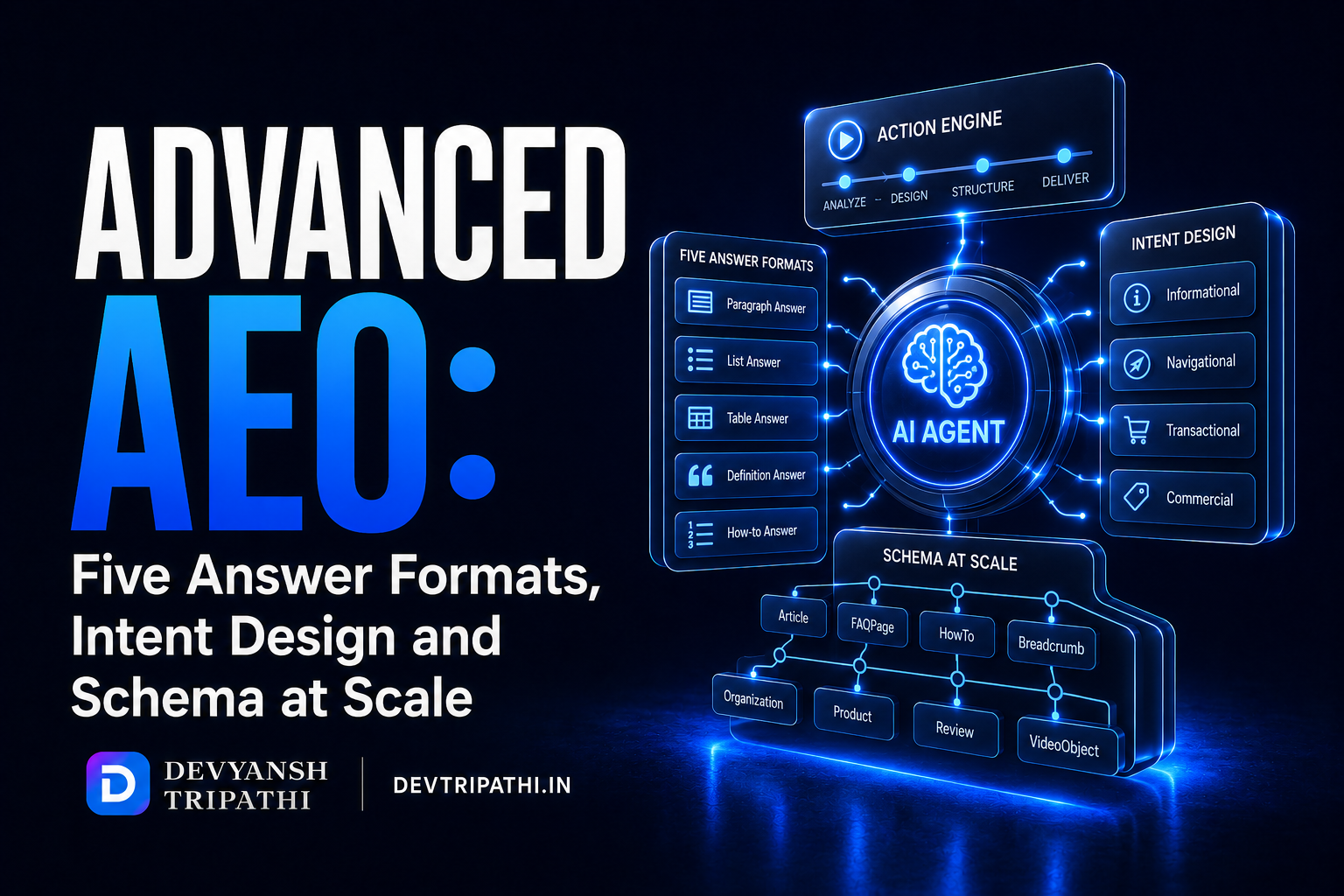
AI systems and search engines select content for citation based partly on how well the content format matches the query intent type. Five distinct answer formats address the complete range of query types your target audience submits. An advanced AEO content library ensures that every major topic in your category is covered in every applicable format, preventing citation gaps that arise when content exists for some intent types but not others.
Format 1: Definitional Answer
Target Query Intent: What is, What does, Define, Explain
Structure: A direct definition in 40 to 60 words followed by a 60 to 80 word expansion covering mechanism, application, and relevance. The definition paragraph must function as a complete standalone answer without requiring the expansion to be read.
Why It Works: AI systems overwhelmingly prefer definitional content for informational queries because the self-contained format allows direct extraction without synthesis. This is the most cited content format across Google AI Overviews, Perplexity, and ChatGPT.
Format 2: Procedural Answer
Target Query Intent: How to, Steps to, Process for, Guide to
Structure: A numbered list of four to eight steps where each step begins with a clear action verb and is described in one to two sentences. Include a brief introductory line before step one stating the total number of steps and the outcome.
Why It Works: Procedural queries are among the highest-volume query types for service businesses and informational content. AI systems favor numbered step content for procedural queries because the format makes the sequence and individual actions directly extractable.
Format 3: Comparative Answer
Target Query Intent: Vs, Versus, Difference between, Compare, Which is better
Structure: A structured table comparing two or three options across four to six specific criteria, preceded by a 30 to 40 word summary stating the key distinction. Follow the table with a brief contextual recommendation paragraph.
Why It Works: Comparative queries are high-conversion intent queries where users are evaluating options before making a decision. AI systems select comparative content in table format because it allows them to extract specific comparison points without interpreting prose descriptions.
Format 4: Attributive Answer
Target Query Intent: Who, When, Where, How much, How many, What is the cost of
Structure: A single factual statement providing the requested attribute followed by context explaining the basis for the figure and any relevant ranges or conditions. The factual statement must appear in the first sentence.
Why It Works: Attributive queries have a specific correct answer and AI systems select the source that provides that answer most directly and accurately. Being the source of record for specific attributive facts in your category builds a distinctive form of AI citation authority.
Format 5: Evaluative Answer
Target Query Intent: Is it worth, Should I, Is a good, Pros and cons, Advantages of
Structure: A brief verdict in the first sentence (yes with conditions, no with explanation, or it depends with criteria), followed by a structured pros and cons list or conditions-based recommendation framework of four to six points.
Why It Works: Evaluative queries represent commercial investigation intent where users are close to a decision. AI systems select evaluative content that provides a clear verdict with supporting reasoning rather than content that avoids commitment and presents only neutral information.
| Answer Format | Primary Query Triggers | Optimal Length | Schema Type |
|---|---|---|---|
| Definitional | What is, Define, Explain, What does mean | 40 to 60 words for the core definition, 100 to 140 total | Article with speakable, FAQPage |
| Procedural | How to, Steps to, Process for, How do I | 4 to 8 numbered steps, 10 to 20 words each step | HowTo schema |
| Comparative | Vs, Versus, Difference between, Which is better | Comparison table plus 30 to 50 word recommendation | Article, Table structured data |
| Attributive | Who is, When did, How much does, How many | One factual sentence plus 40 to 60 words of context | FAQPage, Article with speakable |
| Evaluative | Is it worth, Should I, Pros and cons, Is good for | Verdict sentence plus 4 to 6 point structured list | FAQPage, Review schema where applicable |
Intent-Specific AEO Content Design
Intent-specific AEO goes further than matching content format to query type. It aligns the depth, specificity, vocabulary, and structural signals of each content piece with the specific user goal represented by the query intent. A page optimized for a definitional intent query must demonstrate different content characteristics than a page targeting a procedural intent query, even when both pages cover the same underlying topic.
Designing for Informational Intent
Informational intent queries seek to understand a concept, fact, or situation without immediate purchase or action intent. Content designed for informational intent should open with a direct definition or factual statement, cover the topic with sufficient depth to demonstrate genuine expertise, include supporting statistics from authoritative sources, and address the most common follow-up questions the user would logically have after understanding the core concept. Informational content that stops at the surface level without addressing follow-up questions scores lower on AI system source selection because it requires the AI to retrieve additional sources to complete its response.
For AI search optimization practitioners, informational intent content should demonstrate expertise by covering implementation nuance, not just conceptual definition. AI systems frequently select sources that show genuine practitioner knowledge rather than content written purely for SEO with no real-world experience embedded in the text.
Designing for Commercial Intent
Commercial intent queries represent users researching before making a decision, selecting a provider, or comparing options. Content designed for commercial intent should provide specific, verifiable claims about capabilities, outcomes, and differentiators. Vague superlatives without supporting evidence do not satisfy commercial intent queries. Specific case examples, measurable results, and transparent descriptions of process and approach perform significantly better in AI citations for commercial queries because they provide the specific information users need to make a comparison decision.
Designing for Procedural Intent
Procedural intent queries require content that walks users through a process from start to finish with enough specificity that they can complete the action without additional research. The most common AEO mistake with procedural content is writing steps that are too general to be actionable. AI systems select procedural content where each step contains a specific action verb, a clear description of what to do, and an indication of the expected outcome or what the user should see when the step is completed correctly. General process overviews earn far fewer citations than specific implementation guides.
Transform Your Content into an AI Citation System
Advanced answer engine optimization requires a complete content architecture, not individual page tweaks. Dev Tripathi designs AEO frameworks that systematically build AI citation authority across every major query type in your category.
Build Your AEO Content SystemAEO Schema Implementation at Scale
Schema markup is the technical layer of advanced AEO that communicates answer structure to AI systems and search engines in machine-readable format. At scale, schema implementation requires a systematic approach that matches the schema type to the answer format, implements schema consistently across all content in the same category, and validates schema output to ensure AI systems receive accurate signals.
FAQPage Schema for Maximum Citation Coverage
FAQPage schema is the most broadly applicable schema type for AEO implementation because it covers the widest range of query types and is recognized by Google AI Overviews, Google Search rich results, and Bing. According to Schema.org vocabulary specifications, FAQPage schema requires a page that presents a list of questions and answers where each question has a single accepted answer. Each FAQ answer in the schema markup should be a complete, standalone answer in 35 to 75 words, matching the content length requirement for AI citation eligibility.
Implement FAQPage schema on every page containing an FAQ section. The schema should exactly mirror the visible content on the page rather than containing additional answer text not visible to users. Schema markup that contains information not mirrored in visible content is treated as deceptive by Google’s quality systems and can result in manual actions against the property.
HowTo Schema for Procedural Content
HowTo schema signals to search engines and AI systems that a page contains step-by-step procedural instructions. Google Search Central documentation specifies that HowTo schema is appropriate for content that describes how to complete a task using a sequence of numbered steps. Each step in HowTo schema should contain a step name (the action verb and primary action), an image if available, and a text description. Pages with properly implemented HowTo schema earn higher procedural intent citation rates than equivalent content without schema because the machine-readable step structure reduces AI system interpretation workload.
Article and Speakable Schema
Speakable schema identifies the specific sections of a page most suitable for text-to-speech rendering in voice search responses. For voice search AEO, the speakable section should be the definitional paragraph in the introduction, the direct answer to the primary query. Speakable schema implementation is particularly valuable for brands targeting voice search platforms including Google Assistant, Amazon Alexa, and Siri, where conversational query responses draw from speakable-marked content when available.
Schema Implementation Workflow
A systematic schema implementation workflow for larger content libraries assigns schema type to content category, builds reusable schema templates for each format type, applies templates to all content in the category, validates each implementation using Google’s rich results testing tool, and monitors search results for rich result appearance as a proxy for successful schema recognition. Implementing schema reactively on individual pages as they are published is less efficient than building category-level templates that can be applied consistently across entire content groups.
Cross-Platform AEO Performance Differences
Advanced AEO practitioners must account for the fact that different AI platforms evaluate and select content using different criteria. Content that earns consistent citations in Perplexity may underperform in Google AI Overviews for the same query because the platforms use different retrieval logic, weigh different authority signals, and produce different response formats. Understanding these platform differences allows targeted optimization rather than generic improvements applied uniformly across all platforms.
Google AI Overviews vs Perplexity AI
Google AI Overviews draw heavily from pages that already rank in the top positions for a given query, creating a strong correlation between organic search authority and AI Overview citation rate. Perplexity AI uses a retrieval-augmented generation architecture that actively searches the web for the best current sources, giving newer content with strong structural signals an opportunity to earn citations even before building substantial organic authority. This difference means that new content optimized with strong AEO structure can earn Perplexity citations faster than Google AI Overview citations for the same topic.
ChatGPT and Claude for Established Expertise
ChatGPT and Claude base responses primarily on training data, meaning content that was published, indexed, and cited widely before the training data cutoff date has the highest visibility in these platforms. For established brands with significant content history, training data-based AI systems often represent strong citation sources. For newer brands or recently published content, retrieval-augmented systems like Perplexity and Google AI Overviews represent more immediate AEO opportunities because they draw from live web content rather than historical training data.
The GEO advanced playbook covers the technical content signals that training data-based AI systems weight most heavily, providing specific optimization guidance for brands targeting ChatGPT and Claude citation presence in addition to retrieval-first platforms.
Voice Search AEO Optimization
Voice search AEO requires optimizing for conversational query phrasing rather than keyword-centric phrasing. Voice queries are typically longer than typed queries, often phrased as complete questions, and expect a response that can be spoken aloud naturally in 20 to 40 seconds. Content designed for voice AEO should include conversational question-and-answer pairs where the answer is a complete, natural-language response to the exact phrasing of the question rather than a bullet-point list that reads awkwardly when spoken. Voice search accounts for a significant and growing share of mobile queries, and brands that optimize specifically for spoken query formats earn citations in voice platforms that standard text-optimized content misses.
Measuring AEO Attribution and Performance
Measuring AEO performance requires combining citation tracking data with business outcome metrics that demonstrate the downstream value of AI citations to stakeholders who evaluate performance in terms of leads, revenue, and return on investment rather than citation rates and content metrics.
Primary AEO Performance Metrics
The three primary AEO metrics are citation rate across target platforms, featured snippet capture rate for target queries in Google Search, and voice search response rate for conversational query variants of target topics. According to research from Ahrefs, featured snippets earn an average click-through rate of approximately 8.6%, demonstrating that AEO content earns direct traffic in addition to citation visibility. These three metrics should be tracked monthly for the full target query set and weekly for highest-priority queries.
Downstream Business Outcome Metrics
AI citations generate business outcomes through pathways that do not appear in standard session-based analytics. A user who encounters your brand in an AI generated response for a research query may navigate directly to your website later by typing your brand name rather than clicking from the AI response. Direct navigation traffic, branded search volume, and contact form submissions that begin with brand-navigational sessions all represent downstream AEO impact. Tracking month-over-month changes in branded search volume alongside AEO content publishing activity reveals the brand recognition compounding effect of sustained AI citation presence.
AEO Content Audit and Gap Analysis
Quarterly AEO content audits should evaluate the complete answer library against the five format architecture, identify topic areas with incomplete format coverage, compare citation rate performance by format type to identify which formats are producing the strongest results for your specific audience, and prioritize content creation to fill the highest-impact gaps. For brands also pursuing zero-click search optimization, the AEO content audit should align with the featured snippet capture strategy because the content that earns featured snippets frequently also earns AI citations for the same queries.
Advanced AEO Competitive Analysis
Competitive AEO analysis identifies which brands earn the most AI citations in your category, what content types and formats they use to earn those citations, and where their content architecture has gaps that your brand can exploit to capture citation share. Unlike traditional competitive SEO analysis that focuses primarily on keyword rankings, competitive AEO analysis evaluates the structural and topical characteristics of content that earns AI citations rather than the link or authority metrics that drive organic rankings.
Identifying Competitor Citation Patterns
Test your target query set across the AI platforms you monitor and record which competitor brands appear in responses and which content types are cited. Identify the specific pages earning citations by noting any source URLs displayed (most visible in Perplexity) and analyzing those pages for content structure, format type, schema markup, and answer length. Competitor citation analysis reveals the specific content characteristics AI systems in your category reward, providing a reverse-engineered blueprint for content that will compete for the same citations.
Finding Competitor Format Gaps
Most competitors in any category have uneven format coverage. They may have strong definitional content but weak procedural content, or strong comparison tables but no evaluative answer content. Format gaps represent AEO opportunities where your brand can earn citations for queries that competitors are not optimized to answer in the format AI systems expect. A systematic competitor format analysis identifies these gaps across each of the five answer format types, revealing where targeted content creation will produce the fastest citation gains relative to investment required.
Connecting competitive AEO gap analysis with the broader brand authority SEO strategy ensures that the content created to fill AEO gaps also contributes to the long-term authority signals that support both AI citation eligibility and organic search performance. AEO content and brand authority content are most effective when designed as part of a unified content strategy rather than parallel but disconnected programs.
Frequently Asked Questions About Advanced Answer Engine Optimization
What is the difference between basic and advanced answer engine optimization?
Basic answer engine optimization focuses on optimizing individual pages with direct answers, FAQ sections, and featured snippet formatting. Advanced AEO builds a systematic answer library architecture that covers every major topic in five distinct answer formats calibrated to specific query intent types, implements schema markup consistently at scale, and measures performance through a complete attribution model that connects citation rates to downstream business outcomes.
What are the five answer formats in the AEO architecture framework?
The five answer formats are definitional (for what-is and explain queries), procedural (for how-to and step-by-step queries), comparative (for versus and difference-between queries), attributive (for who, when, where, and how-much queries), and evaluative (for should-I, is-it-worth, and pros-and-cons queries). Each format requires different structure, length, and schema implementation to maximize citation rate for the targeted intent type.
Which schema types are most important for AEO implementation?
FAQPage schema is the most broadly applicable for AEO because it covers the widest range of query types and is recognized by Google AI Overviews, rich results, and Bing. HowTo schema is essential for procedural content targeting step-by-step queries. Speakable schema within Article markup is critical for voice search AEO. The appropriate schema type should match the answer format of the content rather than being applied generically across all pages.
How does AEO performance differ between Google AI Overviews and Perplexity AI?
Google AI Overviews strongly favor pages with established organic authority for the target query, creating a correlation between traditional ranking performance and AI Overview citation rate. Perplexity uses live retrieval that evaluates structural content signals more directly, giving newer content with strong AEO optimization a faster path to citations. Brands should pursue both platforms with adapted strategies rather than treating them as a single optimization target.
How long should each answer format be for maximum AI citation eligibility?
Definitional answers should be 40 to 60 words for the core definition with 60 to 80 words of supporting context. Procedural answers should use 4 to 8 numbered steps with 10 to 20 words per step. Comparative answers should use a structured table plus a 30 to 50 word recommendation. Attributive answers need one factual sentence plus 40 to 60 words of context. Evaluative answers need a verdict sentence plus 4 to 6 structured points with one to two sentences each.
What makes voice search AEO different from standard AEO optimization?
Voice search AEO requires conversational query phrasing in both the question and the answer. Voice queries are typically complete spoken questions rather than keyword fragments, and the expected response format is natural-language text that reads clearly when spoken aloud in 20 to 40 seconds. Bullet-point lists and table-format answers that work well for text-based AEO do not perform well in voice response contexts where the content must flow naturally as spoken language.
How do I identify AEO content gaps in my current library?
Map your current content against the five answer format types for each of your primary topic categories. For every topic, check whether you have definitional, procedural, comparative, attributive, and evaluative content. Topics with format gaps are the most direct AEO improvement opportunities. Then test target queries for each topic category across AI platforms and record which competitor content earns citations your content does not, identifying the structural characteristics your content needs to develop for each gap format.
What downstream business metrics indicate that AEO is working?
Downstream indicators of AEO effectiveness include increases in branded search volume (users searching your brand name after encountering it in AI responses), increases in direct navigation traffic, growth in contact form submissions beginning with branded navigation sessions, and improvement in the rate at which new visitors complete a conversion action. These metrics may take 60 to 120 days to show measurable change following AEO content improvements because brand recognition building is a gradual compounding process.
How many FAQ questions should an AEO-optimized page include?
A minimum of seven FAQ questions is necessary for AEO value, with a preferred count of 10 to 15 for pillar-level content on high-value topics. Each answer must be 35 to 75 words and begin with a direct, standalone response to the question before adding supporting context. FAQ sections shorter than seven questions do not provide sufficient coverage of the user's follow-up questions to earn consistent AI citations for the full range of question variants associated with the topic.
Should AEO content always target one query type per page or can pages cover multiple formats?
Comprehensive pillar pages should cover multiple query intent types for the same topic, incorporating definitional content in the introduction, procedural content in how-to sections, comparative content in evaluation sections, and FAQ sections that address attributive and evaluative queries. Single-format content is more appropriate for targeted landing pages or topic-specific cluster content. Pillar pages that systematically cover all five answer formats for a single topic tend to earn the broadest range of AI citations from a single URL.
How does competitive AEO gap analysis work?
Competitive AEO gap analysis tests your target query set across AI platforms, records which competitor content earns citations you do not receive, identifies the answer format types where competitors consistently outperform you, and maps the specific content characteristics of high-performing competitor pages. The output is a prioritized content creation plan focused on the format types and topic categories where competitive citation gaps are largest and where your existing authority positions you to compete most effectively.
What is the relationship between answer engine optimization and generative engine optimization?
Answer engine optimization focuses specifically on structuring content to earn direct answer citations in AI systems, featured snippets, and voice search. Generative engine optimization addresses the broader set of signals AI systems use to evaluate source credibility and content quality for inclusion in generated responses, including authority signals, citation patterns, and content comprehensiveness. AEO is a content-level practice within the broader GEO framework, with schema implementation and answer format architecture serving as AEO's contribution to the overall generative search strategy.
Build the AEO Content System That Earns Citations at Scale
Advanced answer engine optimization requires a complete content architecture strategy, not incremental page improvements. Dev Tripathi designs AEO systems covering all five answer formats, full schema implementation, and cross-platform measurement to produce compounding citation growth across Google AI Overviews, Perplexity, ChatGPT, and voice search platforms.
Start Your Advanced AEO ProgramConclusion
Advanced answer engine optimization is the transition from optimizing individual pages to building a coordinated content architecture that earns AI citations systematically across every major query type in your category. The five answer format framework provides the structural blueprint for that architecture. Intent-specific content design ensures that each format is calibrated to the query types it targets. Schema implementation at scale communicates the answer structure to AI systems and search engines in machine-readable format. Cross-platform performance analysis ensures that optimization investments are allocated to the platforms where your target audience is most active.
The brands that achieve the highest AEO citation rates in their categories are not those that have optimized the most individual pages. They are the brands that have built the most complete, best-structured answer libraries for their topic categories, supported by consistent schema implementation and informed by systematic competitive gap analysis. Building that library is the work of advanced AEO, and the citation rate compounding it produces is the mechanism by which AI search authority translates into long-term business impact.

Devyansh Tripathi
I’m Devyansh Tripathi, an SEO strategist and digital growth expert, helps businesses and individuals rank higher and drive organic traffic. Through DevTripathi., he shares cutting-edge SEO insights, content strategies, and marketing hacks. Passionate about digital success, he’s on a mission to make SEO simple, effective, and result-driven!
Posts
- What Google’s New AI Search Documentation Means for SEO Teams
- Google I/O 2026 Search: AI Agents, Gemini 3.5 and the Unified Box
- Google’s AI Optimization Guide: The Technical and Content Checklist
- July 2026 SEO Update: AI Overviews, llms.txt and Search Console
- Prompt Optimization Beyond Page One: The Position-21 Citation Opportunity
Categories
- AI Citation Optimization
- AI Search Optimization (AISEO)
- AI Visibility Tracking
- Answer Engine Optimization (AEO)
- Brand Authority SEO
- Brand SERP Optimization
- Community Signal SEO
- Conversational Search Optimization
- Generative Engine Optimization (GEO)
- Knowledge Graph Optimization
- Modern SEO Strategies
- Multimodal Search Optimization
- Prompt Optimization
- SEO Trends
- Social Search Optimization
- Topical Authority SEO
- Uncategorized
- Video Search SEO
- Visual Search Optimization
- Voice Engine Optimization (VEO)
- Zero Click Search Optimization
Latest News
Text Widget
Empowering brands with insights, strategies, and stories that drive digital growth.