
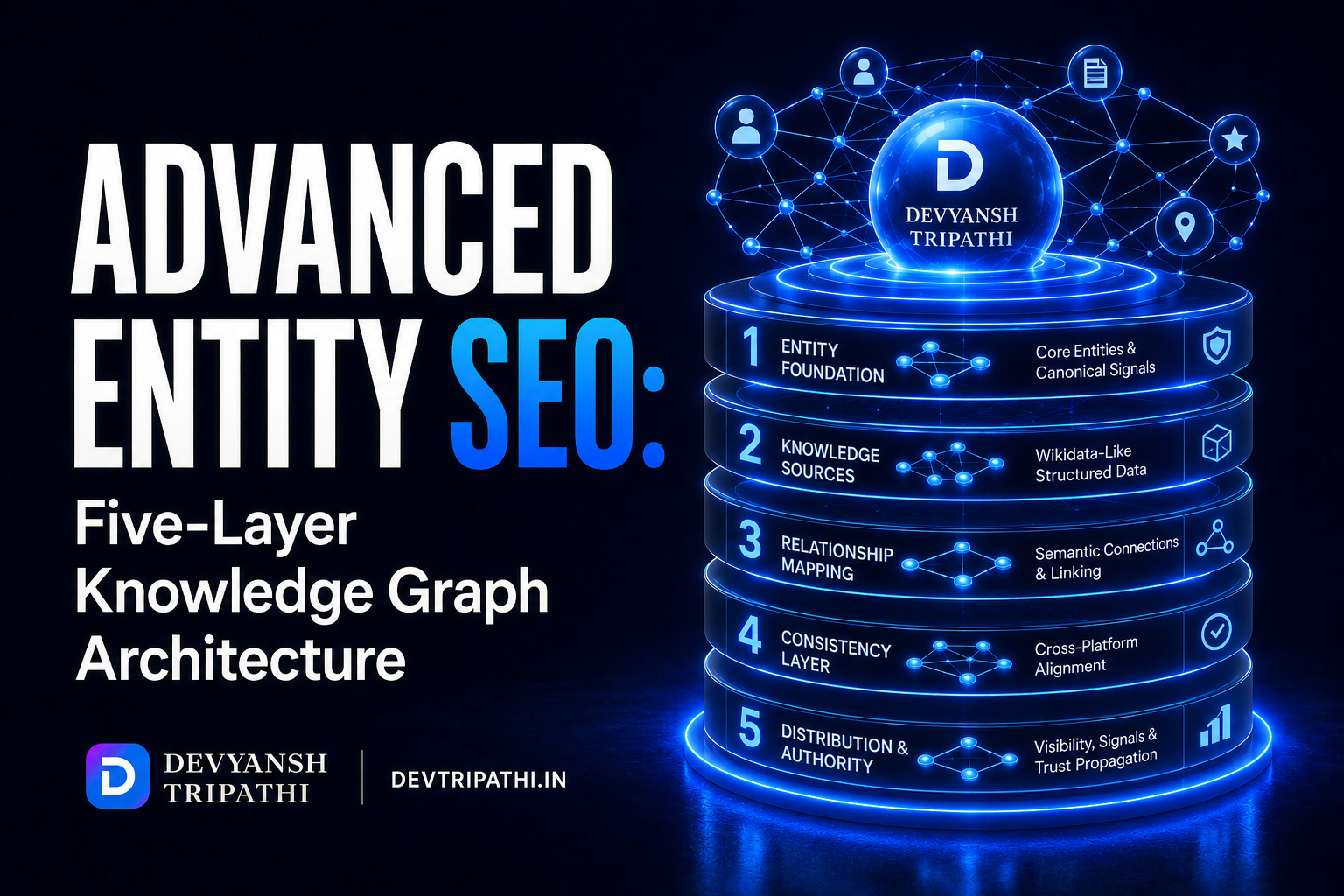
Advanced Entity SEO: Five-Layer Knowledge Graph Architecture
05 July 2026
Knowledge graph optimization in 2026 is the practice of building precise, consistent, and multi-source entity representations that allow Google’s AI systems, Gemini, ChatGPT, Perplexity, and other generative platforms to recognize your brand as a trusted authority with high citation confidence, because AI systems that cannot confidently identify and validate an entity from its knowledge graph signals consistently underweight or exclude it from generated recommendations regardless of content quality.
This advanced guide covers the entity SEO framework that goes beyond basic schema deployment and Wikidata registration: the five-layer entity architecture that produces compound AI citation authority, the advanced sameAs array strategy that maximizes entity recognition across different AI retrieval systems, the Gemini Knowledge Graph training data connection that makes entity optimization the highest-leverage AI citation investment for Google’s AI products, the entity consistency audit methodology that identifies and corrects the conflicting entity signals that suppress citation confidence without any visible technical error, and the multi-entity management framework for brands operating multiple products, services, or locations that each require distinct entity representation.
Does Google's Knowledge Graph Recognize Your Brand as a Trusted Entity?
Get a complete entity audit covering your Knowledge Panel status, Wikidata entry completeness, Organization sameAs array coverage, review platform validation, entity consistency across platforms, and the specific gaps suppressing your AI citation confidence and Knowledge Panel eligibility.
Get My Entity SEO AuditWhy the Knowledge Graph Has Become the Foundation of AI Citation Authority
Google’s Knowledge Graph is a database of entities and the relationships between them that Google built to power its semantic search and now uses to train Gemini AI. When Gemini generates responses that recommend or cite brands, it draws on Knowledge Graph entity data for entity recognition, factual verification, and citation confidence evaluation. This direct training data connection makes Knowledge Graph representation the most upstream AI citation signal available: brands that exist in the Knowledge Graph as well-defined entities with consistent properties and multi-source corroboration are recognized by Gemini at the training-data level, while brands that are not Knowledge Graph entities must compete on retrieval-level signals alone.
The 2.8 times citation rate advantage for brands with Knowledge Panels reflects this upstream advantage. A Knowledge Panel confirms Knowledge Graph entity recognition, which means Gemini was trained with that brand as a recognized entity in its knowledge base. When Gemini generates responses involving that entity’s category, it can identify the brand with high confidence and cite it consistently across a wide range of query contexts rather than only in queries where the brand name appears in the retrieved content text. For the complete brand authority framework that Knowledge Graph optimization supports, see our Brand Authority SEO Cycle 3 guide.
2.8xmore AI citations for brands with Knowledge Panels vs brands without (verified 2026 research)
53.5%AI citation rate with minimal Trustpilot profile vs 1% without (Seer Interactive May 2026)
6+sameAs references in Organization schema for maximum entity disambiguation across AI systems
47.9%of ChatGPT citations include Wikipedia (Wellows 11.1M citation analysis), confirming Wikidata-Wikipedia priority
The Five-Layer Entity Architecture for Maximum AI Recognition
Advanced knowledge graph optimization builds entity authority across five interconnected layers that together create the multi-source entity recognition pattern AI systems treat as high-confidence identification. Weakness in any single layer reduces the effectiveness of all others because entity disambiguation requires corroborating signals from multiple independent sources rather than a single strong signal from one source.
Layer 1 — Foundation
Wikidata Entity Registration with Complete Properties
Wikidata is the open knowledge graph that Wikipedia draws from and that multiple AI systems including ChatGPT and Perplexity index for entity data. Register your brand as a Wikidata item with the following required properties: P31 (instance of: organization), P17 (country), P856 (official website), P154 (logo image), P112 (founded by), P571 (inception date), and P366 (has use). Advanced Wikidata optimization adds P2002 (Twitter username), P2003 (Instagram username), P6634 (LinkedIn personal profile), P4264 (LinkedIn company profile), and cross-references to related entity items through P21 (field of work) and P463 (member of industry associations). A complete Wikidata entry with 12 or more populated properties signals a well-documented entity with verifiable attributes to AI systems that use Wikidata as a knowledge source.
Layer 2 — Schema
Organization Schema with Advanced sameAs Architecture
Organization JSON-LD schema on your homepage with a comprehensive sameAs array is the primary technical mechanism for entity disambiguation across AI retrieval systems. The sameAs array should include at minimum: your Wikidata entity URL (wikidata.org/entity/Q[number]), your Wikipedia article URL where applicable, your LinkedIn company page URL, your Crunchbase company URL, your Trustpilot or G2 profile URL, and your Google Business Profile URL. Six or more sameAs references creates the cross-platform validation pattern that allows AI systems to confirm entity identity from multiple independent sources simultaneously rather than relying on a single cross-reference. Advanced implementations also add the foundingDate, foundingLocation, description, and knowsAbout properties to provide AI systems with structured context about your brand's specific expertise domain.
Layer 3 — Review Platforms
Multi-Platform Review Validation as Entity Corroboration
Review platforms function as entity validation signals because they are independent third-party databases that confirm your brand's existence, service category, and reputation from sources with no commercial relationship to your brand. The Seer Interactive finding of a 53.5% AI citation rate with minimal review platform presence versus 1% without confirms that review platform coverage is an entity authority signal that AI systems evaluate for citation confidence. Establish profiles on all major platforms relevant to your category: Trustpilot for general professional services, G2 for software and SaaS, Clutch for agencies and consulting, Google Business Profile for local presence, and any industry-specific review platform where your category buyers research vendors. Each platform provides an additional sameAs corroboration source that should be included in your Organization schema array. For the complete brand SERP strategy that review platforms support, see our Brand SERP Optimization Cycle 3 guide.
Layer 4 — Author Entity
Person Schema for Individual Expert Entity Recognition
Author entity recognition is the individual-level complement to brand entity recognition for knowledge graph optimization. Creating a verified expert identity for key team members through Person schema, LinkedIn profiles with complete professional history, published expert commentary in recognized publications, and where applicable a Wikipedia article or Wikidata entry for the individual, generates the authoritativeness signals that content quality raters look for and that AI systems use to evaluate whether a brand's published content comes from genuine domain experts or anonymous sources without verifiable credentials.
Person schema on author bio pages should include: name, jobTitle, affiliation (linking to the Organization schema entity), url (the author's profile URL), sameAs references to the author's LinkedIn and Wikidata entries, and worksFor. This creates the expert-to-brand entity relationship in structured data that allows AI systems to connect individual expert credibility to brand citation authority.
Layer 5 — Earned Validation
External Publication Citations as Entity Corroboration
External publications that cite or reference your brand constitute the fifth entity layer: earned validation from independent authoritative sources that exist entirely outside your control. When authoritative publications mention your brand with accurate information, they create indexed records that AI systems discover and incorporate into their entity knowledge. The 47.9% ChatGPT citation rate for Wikipedia, the 82% of AI citations coming from earned media, and the 325% earned media citation multiplier all reflect the weight that AI systems assign to external validation as an entity authority signal. Build this layer through the earned media distribution strategy covered in our AI Citation Optimization Advanced Guide.
The Advanced Wikidata Optimization Strategy
Most knowledge graph optimization guides treat Wikidata registration as a single action: create a Wikidata item with basic properties and move on. Advanced Wikidata optimization treats Wikidata as a living entity record that requires ongoing maintenance, progressive property enhancement, and relationship building between entities to maximize the knowledge graph authority it generates.
Progressive Property Population
Wikidata entity items with more populated properties have stronger entity signals in AI systems that use Wikidata as a knowledge source. After initial entity creation with the required properties, add properties progressively on a quarterly schedule. Priority additions in the first quarter after creation include industry classification properties, geographic scope properties, notable achievements or publications as references, and cross-references to related industry associations or professional bodies your brand is a member of. Each new property makes the entity more specifically identifiable and reduces the risk of confusion with similarly named entities that could dilute citation attribution.
Document all Wikidata property additions with references where possible. Wikidata items with referenced properties, where the source of each claim is cited to an authoritative external document, are treated as higher-quality entity records than items with unreferenced claims. For properties such as founding date, founding location, and key personnel, reference the source URL where that information is publicly documented to create a verifiable entity record rather than an unverified self-report.
Relationship Building in Wikidata
Advanced Wikidata optimization creates entity relationship data that positions your brand within the broader knowledge graph ecosystem rather than as an isolated entity. Add properties that define your brand’s relationships to industry categories (P452 industry), geographic markets (P17 country, P131 located in administrative entity), and related organizations (P463 member of, P1365 replaces for acquisitions). These relationships allow AI systems to retrieve your entity in response to category and industry queries rather than only in response to direct brand name queries, expanding the range of prompts for which your entity knowledge contributes to citation selection.
Build the Entity Architecture That Makes AI Systems Recognize and Cite Your Brand
Knowledge Graph optimization is the upstream investment that determines whether AI systems can identify your brand with high confidence before selecting it for citation. Dev Tripathi builds complete five-layer entity architectures covering Wikidata, Organization schema, review platform validation, author entity recognition, and earned media corroboration.
Build My Entity ArchitectureEntity Consistency Auditing at Scale
Entity consistency errors are the most common and most underdiagnosed cause of suppressed Knowledge Panel eligibility and reduced AI citation confidence. When the same brand appears with different names, different founding dates, different descriptions, or different addresses across Wikidata, its website, LinkedIn, review platforms, and indexed publications, AI systems encounter conflicting entity signals that reduce their confidence in making definitive entity identification. This reduced confidence directly suppresses Knowledge Panel generation and AI citation rates regardless of how many entity signals have been built.
The Entity Consistency Audit Process
Conduct an entity consistency audit quarterly by compiling all instances of your brand name, description, founding information, and key factual claims across every indexed platform and publication where they appear. Compare each instance against your authoritative entity record (typically your Wikidata entry or Organization schema) and document every discrepancy. Discrepancies to prioritize for correction are: different legal name versus trading name inconsistencies, founding date differences between sources, geographic headquarters inconsistencies, and service category description misalignments that could associate your entity with the wrong category in AI knowledge graphs.
After identifying all discrepancies, correct them in the following priority order: Wikidata first (as the upstream entity data source for many AI systems), Organization schema second (as the primary structured data signal for Google’s systems), Google Business Profile third (as the primary local entity signal), LinkedIn company page fourth (as the primary professional entity signal), and then review platforms and indexed publications through publisher contact or content updates on owned pages.
Brand Name Disambiguation for Multi-Word Brand Names
Brands with multi-word names or names that share terms with other entities face particular disambiguation challenges in knowledge graph optimization. “Dev Tripathi” as an entity must be distinguished from other individuals with similar names in AI training data. Advanced disambiguation strategies include: using the full legal or registered brand name consistently rather than abbreviations, registering the brand entity on Wikidata with the P742 (nickname) property linking common abbreviations to the canonical name, and ensuring that the sameAs array includes URLs that use the canonical name rather than abbreviations that could create ambiguous matches in AI retrieval systems. For the AISEO strategy framework that entity disambiguation feeds, see our AISEO Cycle 3 guide.
Multi-Entity Management for Complex Brands
Brands operating multiple products, services, or locations face a specific knowledge graph challenge: the AI systems they need to reach may be queried for different entities at different times, each requiring distinct entity recognition. A software company with three distinct products should have a parent Organization entity and a separate SoftwareApplication entity for each product, each with its own schema block, Wikidata item, and sameAs references. A professional services firm with multiple practice areas should have a parent entity plus HasOfferCatalog references to each practice area’s specific service entity.
| Entity Type | Schema Vocabulary | Required Properties | Wikidata Property | Priority Platform Refs |
|---|---|---|---|---|
| Brand Organization | Organization | name, url, logo, description, foundingDate, sameAs array | P31: organization, P856: website | Wikidata, LinkedIn, Crunchbase, Trustpilot |
| Individual Expert | Person | name, jobTitle, affiliation, sameAs, worksFor | P31: human, P108: employer | LinkedIn, Wikipedia where applicable |
| SaaS Product | SoftwareApplication | name, description, applicationCategory, offers, provider | P31: software, P178: developer | G2, Capterra, Product Hunt |
| Service Offering | Service | name, description, provider, serviceType, areaServed | P31: service, P1056: product or material | Google Business Profile, Clutch |
| Local Business | LocalBusiness | name, address, telephone, openingHours, geo | P31: enterprise, P276: location | Google Business Profile, Yelp, Maps |
Frequently Asked Questions About Knowledge Graph Optimization
What is knowledge graph optimization in the context of AI search?
Knowledge graph optimization is the practice of building precise, consistent, and multi-source entity representations in Google's Knowledge Graph and related knowledge bases so that AI systems can recognize your brand with high confidence when generating responses. It is the upstream investment that determines whether AI systems treat your brand as a known, trusted entity before they select citation sources, making it the most foundational layer of any AI citation strategy.
Why do Knowledge Panel brands earn 2.8x more AI citations?
Knowledge Panel brands earn 2.8 times more AI citations because Google's Gemini AI is trained directly on Knowledge Graph data. Brands with Knowledge Panels are recognized as Knowledge Graph entities in Gemini's training data, enabling the AI to identify and recommend them across a broad range of query contexts with high confidence. Brands without Knowledge Panel recognition must compete on retrieval-level signals alone, missing the training-data-level brand recognition that produces consistent citation presence across diverse query types.
What is the Organization schema sameAs array and why does it matter?
The Organization schema sameAs array is an attribute that lists URLs of other web pages that confirm the same entity's identity. Including references to your Wikidata entry, Wikipedia article, LinkedIn company page, Crunchbase profile, and review platforms in the sameAs array provides AI systems and search engines with machine-readable cross-references that enable confident entity disambiguation. Six or more sameAs references creates the multi-source corroboration pattern that AI systems require for high-confidence entity identification before citation selection.
How does Wikidata connect to AI citation rates?
Wikidata is the open structured knowledge base that Wikipedia draws from and that multiple AI systems including ChatGPT index for entity data. ChatGPT cites Wikipedia in 47.9% of its citations partly because Wikipedia's entity descriptions are backed by Wikidata's structured properties. Brands registered in Wikidata with complete properties are represented in AI training data through both direct Wikidata indexing and Wikipedia-level entity descriptions, making Wikidata registration a multi-channel entity authority signal that influences citation rates on ChatGPT, Perplexity, and Google's AI systems simultaneously.
What are entity consistency errors and how do they affect AI citations?
Entity consistency errors occur when the same brand appears with different names, founding dates, descriptions, or service categories across different platforms and indexed publications. These inconsistencies create conflicting entity signals that reduce AI system confidence in making definitive entity identification. When AI systems cannot confidently identify which entity a set of conflicting signals refers to, they reduce that entity's citation rate to avoid making inaccurate recommendations. Quarterly entity consistency audits that identify and correct discrepancies across all indexed brand representations are essential for maintaining maximum Knowledge Panel eligibility and AI citation rates.
How many Wikidata properties should I populate for maximum entity authority?
A minimum of 8 properties is required for a useful Wikidata entity item, including instance of, official website, logo, country, founding date, founding location, description, and at least two social platform references. Advanced knowledge graph optimization populates 12 or more properties with verified references documenting the source of each claim. Wikidata items with referenced properties are treated as higher-quality entity records than items with unreferenced claims, because referenced items provide AI systems with the chain of evidence verification that increases entity identification confidence.
How does review platform presence function as an entity signal?
Review platforms function as entity validation signals because they are independent third-party databases confirming your brand's existence, service category, and market presence from sources with no commercial relationship to your brand. The 53.5% AI citation rate for brands with minimal Trustpilot presence versus 1% without demonstrates that AI systems weigh review platform coverage as a corroboration signal for entity credibility. Each review platform profile should be referenced in your Organization sameAs array, creating a documented cross-reference between your schema entity and the third-party validation source.
What is Person schema and when should I implement it?
Person schema is structured data vocabulary for individual people that creates machine-readable expert entity records linked to the Organization entities they are affiliated with. Implement Person schema on all author bio pages for team members who publish content, with properties including name, jobTitle, affiliation (linking to your Organization schema entity), sameAs references to LinkedIn and Wikidata, and worksFor. Person schema enables AI systems to connect individual expert credibility to brand citation authority, contributing the Experience and Authoritativeness dimensions of E-E-A-T to AI citation confidence evaluations.
How should multi-product or multi-location brands structure their entity architecture?
Multi-product or multi-location brands should implement a hierarchical entity architecture with a parent Organization entity as the primary brand entity and separate child entity definitions for each distinct product, service, or location. Each child entity requires its own schema type (SoftwareApplication for products, Service for offerings, LocalBusiness for locations), its own sameAs references to platform-specific pages, and where sufficient public information exists, its own Wikidata item linked to the parent organization through the appropriate relationship properties. This hierarchical approach enables AI systems to identify the correct entity for each query type rather than presenting a single undifferentiated parent entity for all queries.
How long does it take to build a Knowledge Panel through entity optimization?
Knowledge Panel establishment through the five-layer entity architecture typically takes 8 to 24 weeks from initial implementation, depending on the brand's existing notability signals, the comprehensiveness of entity data already indexed from the brand, and how frequently Google's Knowledge Graph is updated for the brand's industry category. Brands with existing Wikipedia articles, active Wikidata entries, and established review platform profiles may see Knowledge Panel emergence within 8 to 12 weeks of completing Organization schema and sameAs array optimization. Brands starting from minimal entity signal presence typically require 16 to 24 weeks of consistent entity building before Knowledge Panel eligibility thresholds are met.
What entity signals matter most for Perplexity AI citations specifically?
Perplexity AI uses live retrieval rather than primarily training data, making website-level entity signals more immediately impactful than Wikidata registration for Perplexity citation rates. Complete Organization schema with a comprehensive sameAs array on your homepage, content freshness signals showing regular verification cadence, and review platform profiles that Perplexity can retrieve as independent third-party validation are the three highest-impact entity signals for Perplexity citation performance. Reddit community presence also significantly influences Perplexity citations, as Reddit accounts for 46.7% of Perplexity citations and brand mentions in high-quality Reddit discussions function as community-level entity corroboration that Perplexity's retrieval system actively seeks.
How does knowledge graph optimization connect to the broader AI search strategy?
Knowledge graph optimization is the entity foundation that all other AI search optimization disciplines build on. GEO content structure optimization, AEO answer formatting, community signal SEO, and earned media distribution all produce higher citation rates for brands that have established Knowledge Graph entity recognition than for brands without it, because entity recognition enables AI systems to confidently associate retrieved content with the brand entity rather than treating each page as an unattributed document. The five-layer entity architecture covered in this guide provides the foundation for the GEO programme to produce maximum citation rates across all major AI platforms.
Ready to Build the Entity Architecture That Powers AI Citation Authority?
Get a complete five-layer entity architecture programme covering Wikidata optimization, Organization schema sameAs build-out, review platform validation, Person schema for team authority, entity consistency audit, and the Knowledge Panel development timeline for your brand's current entity signal status.
Start My Entity Architecture ProgrammeConclusion
Knowledge graph optimization in 2026 is the upstream entity investment that determines whether AI systems can recognize and confidently cite your brand before content quality, schema structure, or earned media authority have any opportunity to influence citation selection. The 2.8 times citation advantage for Knowledge Panel brands, the 53.5% versus 1% Trustpilot citation differential, and the direct Gemini Knowledge Graph training data connection all confirm that entity architecture is the prerequisite layer in any AI citation strategy.
The five-layer entity architecture covering Wikidata registration, Organization schema sameAs, review platform validation, Person schema for author authority, and earned publication corroboration creates the multi-source entity recognition that AI systems require for high-confidence brand identification. Entity consistency auditing maintains that recognition by identifying and correcting the conflicting signals that suppress Knowledge Panel eligibility without producing any visible technical error. And multi-entity management ensures that complex brands receive distinct entity recognition for each significant offering rather than losing citation precision through undifferentiated parent entity representations.
Content: Central node labeled “Organization Schema sameAs array on devtripathi.in” with six spokes radiating outward to six platform nodes. Node 1 Wikidata (Priority Critical): Entity disambiguation foundation. Node 2 LinkedIn (Priority Critical): Professional identity corroboration. Node 3 Crunchbase (Priority High): Business entity verification. Node 4 Trustpilot or G2 (Priority High): Review validation and 53.5% citation rate. Node 5 Wikipedia (Priority High where eligible): Training data authority. Node 6 Google Business Profile (Priority Medium): Local entity validation. Each node color coded by priority. Caption: Six or more sameAs references creates the multi-source corroboration pattern AI systems treat as high-confidence entity identification. Footer: devtripathi.in.

Devyansh Tripathi
I’m Devyansh Tripathi, an SEO strategist and digital growth expert, helps businesses and individuals rank higher and drive organic traffic. Through DevTripathi., he shares cutting-edge SEO insights, content strategies, and marketing hacks. Passionate about digital success, he’s on a mission to make SEO simple, effective, and result-driven!
Posts
- What Google’s New AI Search Documentation Means for SEO Teams
- Google I/O 2026 Search: AI Agents, Gemini 3.5 and the Unified Box
- Google’s AI Optimization Guide: The Technical and Content Checklist
- July 2026 SEO Update: AI Overviews, llms.txt and Search Console
- Prompt Optimization Beyond Page One: The Position-21 Citation Opportunity
Categories
- AI Citation Optimization
- AI Search Optimization (AISEO)
- AI Visibility Tracking
- Answer Engine Optimization (AEO)
- Brand Authority SEO
- Brand SERP Optimization
- Community Signal SEO
- Conversational Search Optimization
- Generative Engine Optimization (GEO)
- Knowledge Graph Optimization
- Modern SEO Strategies
- Multimodal Search Optimization
- Prompt Optimization
- SEO Trends
- Social Search Optimization
- Topical Authority SEO
- Uncategorized
- Video Search SEO
- Visual Search Optimization
- Voice Engine Optimization (VEO)
- Zero Click Search Optimization
Latest News
Text Widget
Empowering brands with insights, strategies, and stories that drive digital growth.