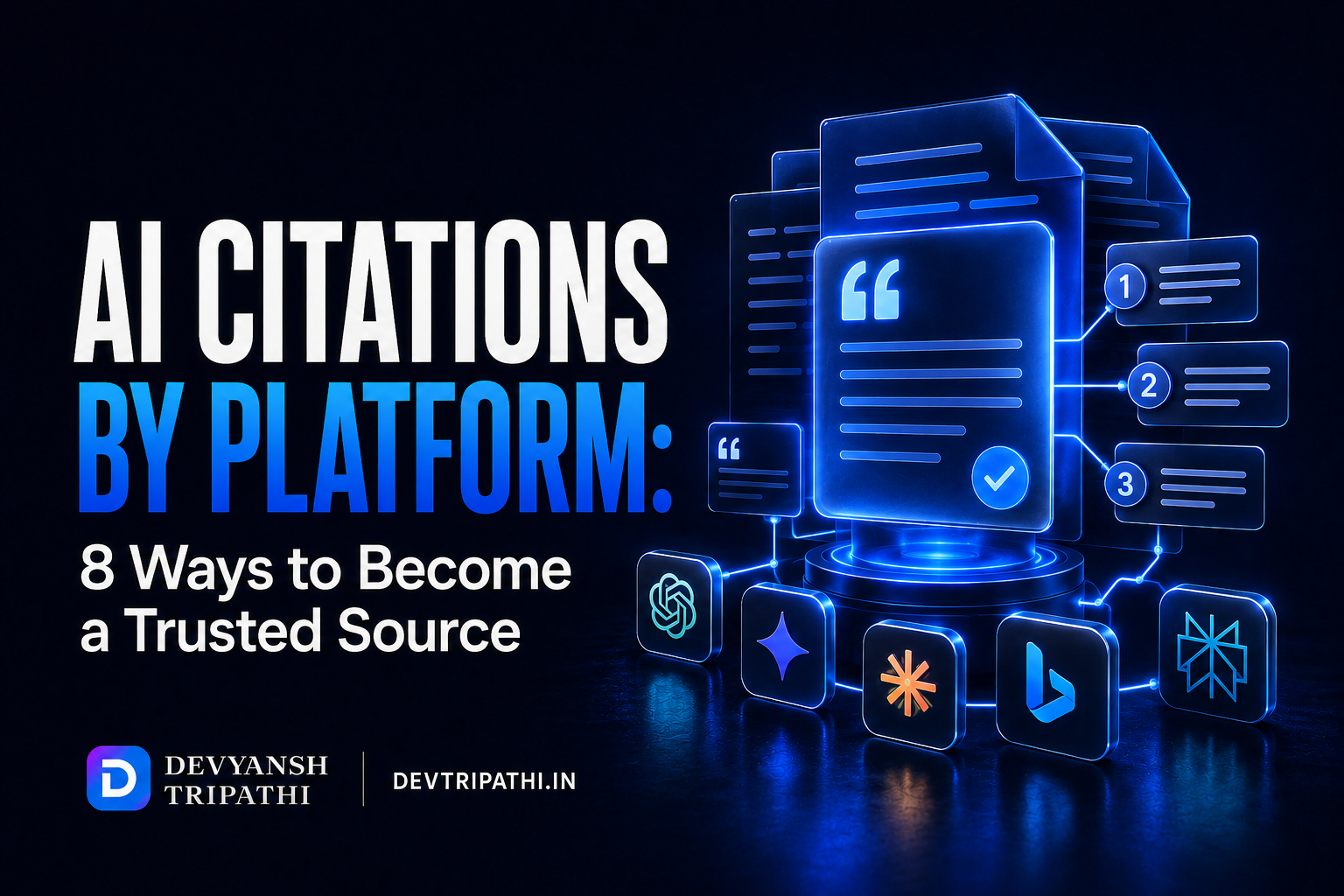
AI Citations by Platform: 8 Ways to Become a Trusted Source
29 May 2026
In each of these moments, the AI selects 2 to 5 sources from the entire web and names them in its response. Every other website that covers those topics is invisible. The brands that get cited earn brand exposure, authority positioning, and qualified referral traffic. The brands that do not are simply absent from a discovery channel that is growing at triple-digit rates year over year.
AI Citation Optimization is the discipline of making your content the source AI platforms choose.
This guide covers exactly how AI systems decide what to cite, why most content fails the citation test, and the specific strategies that reliably improve citation rates across every major AI platform.
What Is AI Citation Optimization?
AI Citation Optimization is the practice of structuring content, building authority signals, and establishing entity credibility so that AI-powered search platforms including ChatGPT, Perplexity, Google AI Overviews, Gemini, and Copilot select your content as a cited source when generating responses.
Answer Engine Optimization is the process of optimizing content to be retrieved, selected, and cited by AI-powered answer engines when they generate responses to user queries. When someone asks ChatGPT a question or runs a search on Perplexity, these platforms do not simply link to websites. They synthesize answers from multiple sources, cite the most authoritative content, and deliver a direct response.
AI Citation Optimization differs from traditional SEO in one critical way: the audience is not a human clicking a blue link. It is a language model evaluating whether your content is trustworthy, complete, and structured enough to be extracted and presented to a human as part of a synthesized answer. Both audiences matter, but they evaluate content differently.
For the broader strategic context of how AI citation optimization fits within GEO and AEO, see: Generative Engine Optimization (GEO): Complete Strategy Guide at https://devtripathi.in/blogs/generative-engine-optimization-geo-strategy-guide/ and Answer Engine Optimization (AEO): The Complete Guide at https://devtripathi.in/blogs/answer-engine-optimization-aeo-complete-guide/
Why 90% of AI Citations Come From Off-Site Sources
The most important insight in AI Citation Optimization is also the most commonly ignored one.
We’ll go into how ChatGPT, Perplexity, and Google AI Overviews actually work differently from each other, because they do, and most AEO guides treat them as one thing.
According to Profound’s analysis of 27 million citations across ChatGPT, Gemini, and AI Overviews, owned content (your own website) represents only 4.3% of citations on category-level queries. The remaining 95.7% comes from earned media, PR wire content, institutional sources, social platforms, and community discussions.
This means a brand that only optimizes its own website for AI citation is addressing 4.3% of the citation surface. The other 95.7% requires a completely different set of activities: digital PR, community presence, third-party review profiles, and industry publication mentions.
Effective AI Citation Optimization is both an on-site content discipline and an off-site brand authority program running simultaneously.
For the off-site authority building framework that feeds the 95.7%, see: Brand Authority SEO: How to Build Brand Authority at https://devtripathi.in/blogs/brand-authority-seo-complete-guide/
How Each AI Platform Selects Citations Differently
The AI doesn’t process the user’s original question as a single search query. It breaks the question into multiple smaller sub-queries and runs separate searches for each one. If someone asks “What’s the best AEO strategy for a small agency in 2026?”, the AI might search for “AEO strategy 2026,” “answer engine optimization for agencies,” and “AI citation best practices” as three distinct queries. This is called a fan-out query, and it means your content needs to match the sub-queries the AI generates — not just the full question the user typed.
Each AI platform has a distinct citation selection mechanism. Treating them as identical is the most common AI Citation Optimization mistake.
Google AI Overviews
Google AI Overviews pull almost exclusively from Google’s traditional search index. Google’s AI Overviews draw primarily from existing organic results — 97% of cited sources come from the top 20. This means strong traditional SEO is the prerequisite for AI Overview citations. You cannot earn AI Overview citations without first ranking in the top 20 for the target query. After achieving that foundation, structured answer blocks, FAQPage schema, and direct answer formatting in the first 150 words convert ranking eligibility into actual citation selection.
ChatGPT Search
ChatGPT’s real-time search capability uses Google’s search index as its primary retrieval source. For non-search ChatGPT conversations, it draws from training data where Wikipedia, academic sources, and high-authority publications dominate. ChatGPT can respond without citing sources, and when it does cite, it favors high-authority content like Wikipedia. For ChatGPT citation optimization, long-form comprehensive guides, strong entity authority, and Wikipedia or Wikidata presence are the highest-impact signals.
Perplexity
Perplexity works differently on several crucial points: Systematic search — every query triggers a real-time web search, no responding “from memory.” Mandatory citations — Perplexity always cites its sources, with clickable links integrated into the response. Freshness valued — recent content is clearly favored compared to other platforms.
For Perplexity specifically, companies cited 10 or more times monthly report 40% higher brand recognition in their target markets compared to those without AI search visibility. The traffic quality from Perplexity citations typically exceeds traditional search traffic. Users arriving through AI citations show 60% higher time-on-page and 35% better conversion rates.
Perplexity’s mandatory citation model makes it the highest-quality referral traffic source among all AI platforms.
Claude
Claude (from Anthropic) uses Brave Search as its primary web retrieval source, making it the only major AI platform where Brave indexing is a meaningful optimization signal. Claude rewards comprehensive, well-structured long-form content with clear entity signals and logical content architecture.
Microsoft Copilot
Copilot pulls from Bing’s web index for general queries and from LinkedIn for B2B and professional queries. Bing indexing and LinkedIn Company Page completeness are the two highest-priority Copilot citation signals.
The 8 Core AI Citation Optimization Strategies
Strategy 1: Build the Multi-Source Consensus Signal
AI platforms scan for agreement across multiple independent sources before confidently citing a brand. If your product appears consistently across Reddit discussions, YouTube tutorials, industry publications, review sites like G2, and your own website — all with similar positioning and messaging — AI systems gain confidence in recommending you. This is the “consensus signal” that triggers citations.
Build the consensus signal systematically: earn mentions across industry publications, build review profiles on G2, Clutch, and Trustpilot, participate authentically on Reddit and Quora, and distribute press releases through wire services. The goal is consistent, positive brand presence across 5 to 10 independent authoritative source types.
Strategy 2: Structure Every Page with the Fan-Out Query in Mind
Because AI systems break user queries into multiple sub-queries, your content must match the sub-queries the AI generates — not just the primary keyword. A page about “GEO strategy” must also clearly address “how GEO works,” “what GEO tools to use,” and “how to measure GEO results” to match the full fan-out of queries an AI might generate when answering a complex question about GEO.
Structure comprehensive pages that address the primary topic and all of its natural sub-topics within the same content cluster. Use question-format H3 headers to explicitly match sub-query patterns.
Strategy 3: Place Citable Answer Blocks in the First 150 Words
Every section of your content should lead with a direct answer. AI engines extract the first 1 to 2 sentences of a section to determine if it answers a query. If your opening is vague context-setting, the engine moves on to a competitor.
Apply this principle at two levels: the page level (a direct answer to the primary query within the first 150 words of the article) and the section level (a direct answer within the first 1 to 2 sentences after each H2 and H3 header). Both levels of answer-first structure improve citation probability simultaneously.
Strategy 4: Deploy the Triple Schema Stack
Research from 2026 shows that pages with properly implemented schema markup receive 35% more citations than those without structured data.
Deploy Article schema, FAQPage schema, and ItemList schema (for listicle pages) as a single interconnected JSON-LD structured data block on every priority page. The triple schema stack gives AI retrieval systems three separate extraction hooks: the article-level authority signal, the question-answer extraction map, and the ranked list structure that covers comparison and recommendation queries.
Strategy 5: Add Expert Quotes with Full Attribution
According to Princeton University’s GEO research published at KDD 2024, adding expert quotes to content boosts AI visibility by approximately 41%, making it the single highest-impact on-site content tactic tested across 10,000 queries. The mechanism is straightforward: AI systems treat content with properly attributed expert quotes as more authoritative and citable than content with only the author’s own perspective.
Add 2 to 3 expert quotes per major article. Attribute each quote with the expert’s full name, professional title, and organization. Source quotes from recognizable figures whose names AI systems would recognize from their training data when possible.
Strategy 6: Add Specific Statistics with Source Attribution
Adding statistics with specific numbers and source references boosts AI visibility by approximately 30% according to Princeton research. Statistics make content more citable because they give AI systems a specific, verifiable claim to extract and reference.
Include 3 to 5 specific statistics per major article. Always attribute each statistic to its source with the organization name and, where appropriate, the year of the research. This both improves AI citation probability and satisfies E-E-A-T requirements for trustworthiness.
Strategy 7: Earn High-Value Third-Party Mentions
Large language models operate through an entirely different paradigm. Models like ChatGPT and Claude generate responses by predicting the most probable next tokens based on their training data — vast corpuses of text they have processed during training. This means brands that appear in the training data sources (Wikipedia, major publications, academic papers, high-authority blogs) have a structural advantage in non-search AI citation over brands that exist only on their own websites.
Build a systematic digital PR program targeting the publications that AI systems trust most: recognized industry outlets, Wikipedia (where eligible), wire-distributed press releases, and video content on YouTube. Each placement builds citation confidence in training data and real-time retrieval pools simultaneously.
For the complete off-site authority program, see: Brand Authority SEO: How to Build Brand Authority at https://devtripathi.in/blogs/brand-authority-seo-complete-guide/
Strategy 8: Maintain Content Freshness Cycles
Perplexity values content freshness more than ChatGPT. To get cited by Perplexity: publish fresh and regular content, structure your pages with clear and factual answers, optimize your indexing and loading speed, use schema.org structured data, and build solid domain authority.
Content freshness is relevant across all AI platforms, not only Perplexity. Establish a systematic update cycle: every 7 to 30 days for trending topic articles and every 30 to 90 days for evergreen comprehensive guides. Add a visible “last updated” timestamp. Refresh statistics, update any outdated data, and add new findings from recent research.
The AI Citation Audit: Assess Your Current Citation Performance
Before optimizing, measure your baseline. Run this four-step audit across your top 10 target queries.
Step 1 — Manual Platform Testing: Open ChatGPT, Perplexity, Gemini, and Google AI Mode. Submit each of your top 10 target queries. Record whether your brand appears, whether it is linked or unlinked, its position in the response, and which competitors are cited. Do this across all four platforms for each query.
Step 2 — Source Analysis: For queries where competitors are cited but you are not, examine the pages being cited. What structure do they use? What schema do they have? Do they have expert quotes and statistics you do not? What is their content freshness compared to yours? The cited competitor pages are your optimization benchmark.
Step 3 — Off-Site Presence Audit: Search your brand name plus your top topics across Reddit, Quora, G2, Trustpilot, and the major industry publications in your niche. Identify where your brand is present and where it is absent. Gaps in off-site presence are directly contributing to low citation rates because AI systems cannot find your brand through multi-source corroboration.
Step 4 — Technical Access Check: Verify that PerplexityBot, GPTBot, ClaudeBot, and Googlebot all have access to your key pages via your robots.txt file. Verify Bing indexing via Bing Webmaster Tools. According to Pixelmojo’s research, there are 10 distinct crawler bots across the four major AI platforms, and each must be explicitly allowed in robots.txt to access your content for citation consideration.
Measuring AI Citation Optimization Results
Citation Rate Per Platform: Track how many of your top 20 queries result in your brand being cited on each platform weekly. Calculate a separate citation rate for Google AI Overviews, ChatGPT, Perplexity, Gemini, and Copilot.
Share of Model: Compare your citation frequency against your top 3 competitors for the same query set. This relative measure shows whether your optimization efforts are improving your competitive position, not just your absolute citation count.
AI-Referred Traffic in GA4: Monitor sessions from AI platform domains monthly. Configure a custom channel group in GA4 capturing chatgpt.com, perplexity.ai, bing.com, and gemini.google.com referrers.
Branded Search Growth in Google Search Console: Track month-over-month growth in branded query impressions. AI citation activity drives branded search as users who encounter your brand in an AI response later search for your brand name directly.
For the complete AI visibility measurement framework, see: AI Visibility Tracking: The Complete Guide at https://devtripathi.in/blogs/ai-visibility-tracking-complete-guide/
Frequently Asked Questions About AI Citation Optimization
What is AI citation optimization?
AI Citation Optimization is the practice of structuring content, building authority signals, and establishing entity credibility so that AI-powered search platforms select your content as a cited source when generating responses. It combines on-site content structure (direct answer blocks, expert quotes, statistics, schema markup) with off-site brand authority building (digital PR, community presence, review profiles, Wikipedia entry) to maximize the probability that AI systems choose your brand as a reference when answering target queries.
Why does my website rank well on Google but not get cited by AI systems?
Top Google rankings are a necessary but not sufficient condition for AI citations. AI platforms evaluate additional signals beyond keyword relevance and backlinks: content structure (whether answers are clearly extractable), entity authority (whether your brand is recognized across multiple independent trusted sources), content freshness, and off-site corroboration. A page can rank first on Google but still fail AI citation tests if it lacks a direct answer block, expert quotes, schema markup, or sufficient third-party brand mentions. Audit your top-ranking pages against these signals.
Which AI platform is most valuable for citation optimization?
For most brands, Google AI Overviews should be the primary focus because they appear inline in standard Google searches and reach the largest audience. Perplexity is the second highest priority because of its mandatory citation model, high traffic quality, and the fact that cited brands receive 60% higher time-on-page and 35% better conversion rates. Prioritize the platforms where your target audience is most active and then expand coverage systematically.
How many sources does an AI typically cite per response?
AI platforms typically cite 2 to 5 sources per response for most query types. Google AI Overviews tend toward 3 to 5 sources. Perplexity consistently cites 4 to 6 sources with clickable links. ChatGPT Search cites 3 to 5 sources when using its web search capability. Being in that 2 to 5 citation window for your target queries is the primary objective of AI Citation Optimization. Given that there are millions of pages competing for those positions, content structure, entity authority, and off-site presence are the competitive differentiators.
What is a fan-out query and why does it matter for AI citation?
A fan-out query is the process by which AI systems break a user’s complex question into multiple smaller sub-queries and run separate searches for each. If a user asks “what is the best AI search optimization strategy for a B2B SaaS company,” the AI might generate sub-queries for “AI search optimization strategy,” “B2B SaaS SEO,” and “GEO for SaaS” as three separate retrieval operations. Your content must match these sub-queries to qualify for citation, not just the full original question. Structuring comprehensive pages that address the primary topic and all natural sub-topics improves fan-out query coverage.
How long does it take to see results from AI citation optimization?
New content typically enters AI citation pools within 3 to 5 business days of indexing. However, building consistent citation rates for competitive queries typically takes 30 to 90 days of sustained optimization effort. Off-site authority building takes longer: press releases begin generating AI citations approximately 14 to 21 days after publication, while digital PR in major industry publications can take 30 to 90 days from pitch to publication to citation. Plan for a 60 to 90 day horizon when evaluating full AI citation optimization results.
Does schema markup directly cause AI citations?
Schema markup does not directly cause AI citations in a mechanical sense. It makes your content more reliably extractable by AI retrieval systems by providing explicit machine-readable signals about what your content is, what questions it answers, and how it is structured. Pages with proper Article, FAQPage, and ItemList schema receive 35% more citations than pages without structured data according to research, because AI systems can confidently extract and attribute specific claims from well-structured pages.
What is the most common reason brands fail to get AI citations?
Based on analysis of citation patterns, the most common reason is the absence of the multi-source consensus signal. Brands with strong websites but minimal third-party presence across Reddit, review platforms, industry publications, and wire-distributed press releases fail the multi-source corroboration check that AI systems apply before confidently citing a brand. The fix is off-site brand authority building, not more on-site content optimization. The second most common reason is content without direct answer blocks at the section level, forcing AI extraction systems to read entire articles before finding citable content.
Can AI citations replace traditional SEO?
No. AI citations and traditional SEO are complementary. For Google AI Overviews specifically, 97% of cited sources come from the top 20 organic results. This means traditional SEO is the prerequisite for AI Overview citation eligibility. For ChatGPT and Perplexity, traditional SEO creates the indexed, authoritative content that AI retrieval systems pull from. Brands that abandon traditional SEO in favor of AI-specific tactics lose the foundational visibility that feeds most AI citation systems.
What is the consensus signal in AI citation optimization?
The consensus signal is the multi-source agreement pattern that AI systems use to gain confidence in a brand recommendation before citing it. When your brand appears consistently and positively across Reddit discussions, YouTube content, G2 and Trustpilot reviews, industry publications, and your own website with consistent positioning and messaging, AI systems treat this as evidence that your brand is legitimately recognized by the market. This consensus is what converts AI systems from uncertain to confident about recommending your brand. Building the consensus signal is the highest-leverage off-site AI citation optimization activity.
How do I optimize specifically for Perplexity citations?
For Perplexity specifically: publish fresh content regularly (Perplexity values freshness more than any other major AI platform), structure pages with clear direct answer blocks, ensure PerplexityBot has access in your robots.txt, use schema.org structured data, build solid domain authority through relevant high-quality backlinks, and maintain active third-party brand presence on platforms Perplexity’s crawler indexes. Monitor the perplexity.ai referrer in your GA4 to track direct citation-generated traffic.
Conclusion
AI Citation Optimization is the discipline that bridges the gap between SEO performance and AI search visibility. It is not a single tactic or a technical checklist. It is a complete strategy that operates on two levels simultaneously: on-site content optimization that makes your pages reliably extractable by AI retrieval systems, and off-site authority building that establishes the multi-source consensus signal AI systems require before confidently citing any brand.
The data makes the opportunity clear. Perplexity-cited brands see 60% higher time-on-page and 35% better conversion rates than standard organic traffic. AI-referred visitors convert at 4.4 times higher rates than traditional organic visitors. The AEO software category grew over 2000% as businesses discovered the gap between their Google rankings and their AI visibility.
The competitive window in AI citation optimization remains open in most niches. The brands investing in the full program — content structure, schema markup, expert attribution, digital PR, community presence, and consistent entity management — are building citation authority that compounds over time, exactly as domain authority did in the early years of SEO.
Begin with the four-step citation audit. Then fix the highest-impact gaps first: direct answer blocks, expert quotes, and schema markup on your top 10 pages. Then build the consensus signal through off-site presence. Measure citation rate weekly and compound the advantage.
Princeton University GEO Research — KDD 2024: https://arxiv.org/abs/2311.09735
Frase.io — AEO Guide: https://www.frase.io/blog/what-is-answer-engine-optimization-the-complete-guide-to-getting-cited-by-ai
Moonrank — Perplexity Citation Guide: https://www.moonrank.ai/blog/how-to-get-cited-by-perplexity-ai-complete-2026-guide
Profound — AI Citation Research: https://www.helloprofound.com
Google Search Central — Structured Data: https://developers.google.com/search/docs/appearance/structured-data

Devyansh Tripathi
I’m Devyansh Tripathi, an SEO strategist and digital growth expert, helps businesses and individuals rank higher and drive organic traffic. Through DevTripathi., he shares cutting-edge SEO insights, content strategies, and marketing hacks. Passionate about digital success, he’s on a mission to make SEO simple, effective, and result-driven!
Posts
- What Google’s New AI Search Documentation Means for SEO Teams
- Google I/O 2026 Search: AI Agents, Gemini 3.5 and the Unified Box
- Google’s AI Optimization Guide: The Technical and Content Checklist
- July 2026 SEO Update: AI Overviews, llms.txt and Search Console
- Prompt Optimization Beyond Page One: The Position-21 Citation Opportunity
Categories
- AI Citation Optimization
- AI Search Optimization (AISEO)
- AI Visibility Tracking
- Answer Engine Optimization (AEO)
- Brand Authority SEO
- Brand SERP Optimization
- Community Signal SEO
- Conversational Search Optimization
- Generative Engine Optimization (GEO)
- Knowledge Graph Optimization
- Modern SEO Strategies
- Multimodal Search Optimization
- Prompt Optimization
- SEO Trends
- Social Search Optimization
- Topical Authority SEO
- Uncategorized
- Video Search SEO
- Visual Search Optimization
- Voice Engine Optimization (VEO)
- Zero Click Search Optimization
Latest News
Text Widget
Empowering brands with insights, strategies, and stories that drive digital growth.