AISEO Foundations: Technical, Content and Authority Signals
19 May 2026
That model is not broken. But it is no longer complete.
Today’s searchers do not only open Google. Millions of people start their research in ChatGPT, ask Perplexity for cited answers, use Google’s AI Overviews for quick synthesis, or query Gemini for comparisons. Each of these platforms discovers, evaluates, and presents content differently from traditional search. Each has its own signals for deciding which brand to mention, which source to cite, and which content to synthesize into an answer.
AI Search Optimization, or AISEO, is the unified strategy that addresses all of it.
This guide covers what AISEO is, how it combines traditional SEO with AEO and GEO, and the specific implementation steps that help your brand become the source AI platforms choose when answering questions in your space.
What Is AI Search Optimization (AISEO)?
AI Search Optimization is the practice of making your content discoverable, extractable, and citable by AI-powered search engines and answer systems.
Traditional SEO focuses on winning rankings and clicks in search engine results pages. AISEO expands that goal so your content can also become the answer itself. That means combining strong SEO fundamentals with answer-first writing, structured data, clear entity signals, off-site authority building, and ongoing measurement across AI-driven search experiences.
The cleanest way to understand the relationship between the disciplines is this: SEO helps you rank, AEO helps you get extracted, GEO helps you get cited, and AISEO coordinates the whole effort as one unified strategy.
AISEO works best as a continuous loop: audit your current AI visibility, optimize content and technical foundations, test citation performance, refine based on results, and repeat. It is not a one-time project. It is an ongoing operational discipline built on the same foundation as traditional SEO but extended to cover the entire AI search ecosystem.
For a deeper understanding of how this fits within the broader shift happening in search, start with: What Is Generative Engine Optimization (GEO)? at https://devtripathi.in/blogs/what-is-generative-engine-optimization-geo/ and GEO vs SEO: What Is the Difference and Why You Need Both in 2026 at https://devtripathi.in/blogs/geo-vs-seo-difference-2026/
Why AISEO Is Now a Core Marketing Discipline
The numbers make the case for urgency clearly.
According to a Search Engine Land study published in January 2026, 37% of consumers now start their product and service searches with AI, not Google. ChatGPT has over 800 million weekly active users. Google AI Overviews appear in more than 55% of all Google searches and reach nearly 1 billion searchers. AI-referred traffic to websites grew 527% year over year through mid-2025. Gartner projects traditional search engine volume will decline 25% as users shift to AI-driven discovery.
The shift is not coming. It has arrived.
The businesses that adapt to AISEO now will reach users at the exact moment they are forming decisions — inside the AI answer, before a single click happens. The businesses that wait will watch their organic visibility erode as competitors earn citations and brand recommendations they cannot see in a traditional keyword ranking report.
For context on how AI Overviews are reshaping traffic patterns specifically, see: What Is Google AI Overview and How It Affects Blog Traffic at https://devtripathi.in/blogs/what-is-google-ai-overview-blog-traffic/
How AI Search Engines Discover and Cite Your Content
Understanding the technical mechanism behind AI search is essential for building an effective AISEO strategy. Different AI platforms use different discovery and retrieval mechanisms, and each has implications for how you optimize.
ChatGPT and Microsoft Copilot depend on Bing for web search. If Bing has not indexed your content, ChatGPT and Copilot cannot cite it regardless of how well it performs on Google. This is one of the most commonly overlooked AISEO gaps. Many SEO professionals optimize exclusively for Google indexing without verifying Bing coverage.
Google AI Overviews and Gemini build on the Google index and Knowledge Graph. Strong traditional Google SEO directly feeds citation probability in these platforms. Research shows a 92% correlation between domains ranking in Google’s traditional top 10 and domains cited in AI Overviews.
Perplexity operates its own crawler alongside proprietary content processing. It rewards fresh, authoritative content with strong multi-channel web presence, drawing citations from both Google-ranking domains and non-ranking but highly authoritative sources.
Claude uses Brave Search as its primary search engine, making it the only major AI platform where Brave indexing is a relevant signal.
This means AISEO requires a multi-index strategy: verify your content is indexed in both Google and Bing, and that it is accessible to all major AI crawlers through a clean robots.txt configuration.
The AISEO Technical Foundation: 6 Non-Negotiable Requirements
Before any content strategy can succeed in AI search, these technical requirements must be in place.
- Multi-Index Verification
Confirm your content is indexed in Google Search Console and Bing Webmaster Tools. Submit your sitemap to both. Check for key pages that may be indexed in Google but blocked from Bing, as this is a common cause of missing ChatGPT and Copilot citations.
- AI Crawler Access
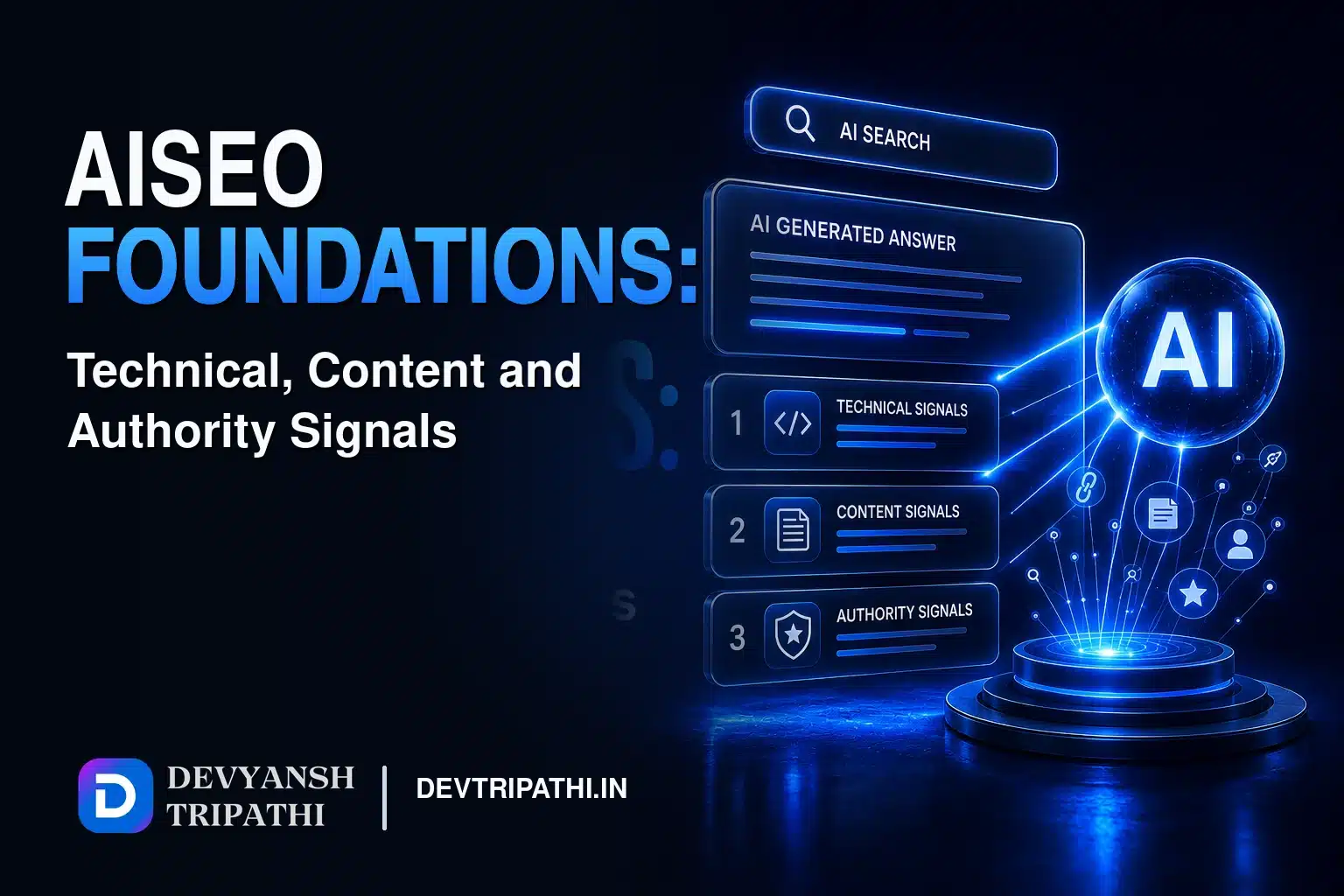
Configure your robots.txt to allow access to the following AI crawlers: Googlebot, Bingbot, PerplexityBot, ClaudeBot, and GPTBot. Blocking any of these prevents that platform’s AI from accessing your content for citation consideration. Verify access regularly as platforms update their crawler identifications.
- Core Web Vitals Compliance
AI crawlers assess websites partly based on technical performance. The key thresholds are: Largest Contentful Paint under 2.5 seconds, First Input Delay under 100 milliseconds, and Cumulative Layout Shift under 0.1. Sites failing these thresholds signal lower quality to both Google and AI retrieval systems.
- Schema Markup Implementation
Deploy structured data that helps AI systems understand your content without ambiguity. The AISEO minimum stack is: Article schema for E-E-A-T verification, FAQPage schema for question-answer extraction, BreadcrumbList schema for site architecture clarity, and ItemList schema for comparison and listicle content. Implement these as interconnected JSON-LD in a single @graph block.
- Topical Silo Architecture
Organize your content in clearly defined topical silos with a pillar page for each major topic and satellite cluster pages covering subtopics. This structure helps both Google and AI language models understand your website’s area of specialization. AI systems favor domains with clear, consistent topical focus over generalist sites with scattered coverage.
For a full understanding of how topical authority connects to AI citation, read: Entity SEO, GEO, and Topic Authority in AI Search at https://devtripathi.in/blogs/entity-seo-geo-topic-authority-ai-search/
- Mobile and Accessibility Compliance
AI crawlers must be able to render your content correctly. Sites with heavy JavaScript dependencies, poor mobile performance, or accessibility barriers create rendering failures that make content invisible to AI retrieval systems even if the page appears correct in a browser.
The AISEO Content Strategy: 8 Proven Tactics
Tactic 1: Answer-First Content Structure
Begin every article by answering the primary query directly within the first 150 words. Research from Search Engine Land shows 55% of AI Overview citations come from the first 30% of page content. The strongest AISEO pages open with a clear, self-contained answer, then expand into detailed analysis, examples, frameworks, comparisons, and FAQs below.
Tactic 2: Question-Format Headers
Rewrite H2 and H3 headers as questions that mirror actual user queries submitted to AI platforms. Use Google Search Console query data to identify the exact questions driving impressions on each key page, then turn those questions into your headers. This is one of the highest-ROI content changes available in AISEO.
Tactic 3: Expert Quotes with Full Attribution
Include quotes from recognized industry experts with their full name, title, and organization. According to Princeton University’s GEO research, adding expert quotes boosts AI visibility by approximately 41%, making it the single highest-impact content tactic tested. Identify 2 to 3 relevant experts per article and include directly attributable statements.
Tactic 4: Statistics and Original Data
Include specific numbers, percentages, and data points throughout every major article. Statements with specific data are far more likely to be cited by AI engines than vague claims. If you have access to original research or proprietary data, publish it: AI engines have a strong reason to cite content that offers data no other source can replicate.
Tactic 5: Comprehensive FAQ Sections
Include a minimum of 10 real frequently asked questions per article, sourced from Google’s People Also Ask box, search autocomplete, Quora, Reddit, and actual queries submitted to AI platforms. Each FAQ entry must have a direct, standalone answer that makes complete sense without requiring the surrounding content to understand it.
For a complete guide to writing FAQ sections that get cited by AI Overviews, see: How to Write FAQ Sections for AI Overviews at https://devtripathi.in/blogs/how-to-write-faq-sections-ai-overviews/
Tactic 6: Regular Content Freshness Updates
AI models deprioritize stale content. Establish a content update cycle: every 7 to 30 days for trending topic articles, every 30 to 90 days for comprehensive evergreen guides. Add a visible “last updated” timestamp to every updated page. Refresh statistics, update any outdated data points, and add new findings from recent research.
Tactic 7: Internal Linking for Topical Depth
Strong internal linking helps AI systems understand the relationship between your pages and reinforces your topical authority signals. Every major article should link to at least 3 to 5 related pages on your own site using descriptive anchor text that clearly communicates the target page’s topic.
Tactic 8: Listicle-Format Pages for Commercial Queries
Research from GenOptima found that 74.2% of all AI citations come from structured listicle-format content. For every commercial keyword cluster in your niche, build at least one listicle page with a comparison table near the top, H3 subheadings for each item, and a clear “Best For” designation per item.
AISEO Off-Site Authority: Building the External Signals That Matter
On-site optimization is necessary but not sufficient for AISEO. AI engines cross-reference your brand across multiple independent sources before assigning citation authority. According to industry research, 85% of AI brand mentions originate from third-party sources.
Building off-site AISEO authority requires:
Digital PR and Earned Media: Secure mentions, reviews, and links in reputable third-party publications. A mention in a major industry publication such as Search Engine Journal, Search Engine Land, or a recognized sector-specific outlet is weighted heavily by AI language models.
Community Authority: AI models actively crawl Reddit, Quora, product review sites, and niche forums to understand real-world brand sentiment. Building a genuine, consistent presence in these communities is an underused AISEO signal.
Consistent Entity Profiles: Ensure your brand entity is consistent and verified across Google Business Profile, LinkedIn, industry directories, and any platform that AI engines use as trusted reference sources. Entity inconsistency across platforms reduces AI citation confidence.
Press and Wire Distribution: Original research or expert commentary distributed through major PR wire services begins generating AI citations approximately 14 to 21 days after publication, once the content is indexed and corroborated across multiple sources.
For a detailed breakdown of how E-E-A-T signals connect to AI citation authority, see: What Is E-E-A-T and How It Connects to GEO at https://devtripathi.in/blogs/what-is-eeat-and-how-it-connects-to-geo/
Measuring AISEO Performance: The Metrics That Matter
Traditional keyword ranking reports capture only a portion of AISEO performance. Build a dedicated measurement framework:
AI Citation Frequency: Test your top 20 target queries manually in ChatGPT, Perplexity, Gemini, and Google AI Mode each week. Record which pages are cited. Track changes over time.
Share of Model (SoM): Compare how often your brand appears in AI responses versus competitors for the same set of target queries. This is your AISEO equivalent of Share of Voice.
AI-Referred Traffic in GA4: Create a custom channel group in Google Analytics 4 tracking sessions from AI platform domains: chatgpt.com, perplexity.ai, bing.com (for Copilot), and any other AI referrers appearing in your analytics. Monitor this source monthly.
Branded Query Growth in Google Search Console: Monitor month-over-month growth in branded search queries. AI citations drive branded search: users who encounter your brand in an AI answer often then search for your brand name directly on Google.
Featured Snippet and People Also Ask Inclusion: Traditional SERP features remain a strong indicator of content quality that feeds into AI citation probability. Track these alongside AI-specific metrics.
Recommended tools: Geoptie, Otterly.AI, AthenaHQ, HubSpot AEO tool, Semrush AI Toolkit, Frase.io, GA4, and Google Search Console.
AISEO Implementation Roadmap
Phase 1 — Technical Audit (Week 1)
Verify Google and Bing indexing for all key pages. Check robots.txt for AI crawler access. Run Core Web Vitals audit and fix failures. Audit schema markup across top 20 pages. Map your topical silo architecture.
Phase 2 — Content Optimization (Weeks 2 to 4)
Add direct answer blocks to the first 150 words of your top 20 articles. Rewrite H2 and H3 headers as questions across priority pages. Add expert quotes with full attribution to all major articles. Deploy triple JSON-LD schema (Article, FAQPage, ItemList) across priority pages. Expand or add FAQ sections to 10 questions minimum per article.
Phase 3 — Off-Site Authority (Month 2)
Identify 5 to 10 industry publications for digital PR outreach. Build consistent entity profiles across all major reference platforms. Initiate community presence on Reddit and Quora in your topic area. Distribute original research or expert commentary through wire services.
Phase 4 — Measure and Optimize (Month 3 and ongoing)
Run weekly AI citation audits across all major platforms. Monitor AI-referred traffic in GA4 monthly. Track Share of Model versus top competitors. Identify citation gaps. Create targeted content to close those gaps. Update existing high-value pages on a freshness cycle.
Frequently Asked Questions About AI Search Optimization
What is the difference between AISEO, AEO, and GEO?
These three terms represent related but distinct layers of AI search strategy. AEO (Answer Engine Optimization) focuses on the answer-retrieval layer — getting content extracted as a direct answer in featured snippets, AI Overviews, and voice responses. GEO (Generative Engine Optimization) focuses on getting cited and recommended across generative AI platforms including ChatGPT and Perplexity. AISEO (AI Search Optimization) is the umbrella strategy that combines traditional SEO with AEO and GEO into one unified framework covering all aspects of AI search visibility.
Do I need separate strategies for each AI platform?
No. Focus first on universal principles that work across all systems: comprehensive authority, clear structure, specific data, expert attribution, and multi-index technical accessibility. Then layer in platform-specific tactics for the platforms most important to your audience. Universal GEO signals perform well across all major AI engines.
Is Bing indexing really necessary if I already rank well on Google?
Yes, absolutely. ChatGPT Search and Microsoft Copilot depend on Bing for their web retrieval. If Bing has not indexed your content, you will not be cited by ChatGPT or Copilot regardless of your Google rankings. Submitting your sitemap to Bing Webmaster Tools takes less than 10 minutes and is one of the highest-ROI AISEO technical tasks available.
How does AISEO affect my existing SEO strategy?
AISEO does not replace your existing SEO strategy. It extends it. Your current investments in technical SEO, quality content, and backlink building remain valuable because they feed directly into AI retrieval systems. AISEO adds specific requirements on top: answer-first content structure, schema stacking, expert attribution, FAQ sections, and multi-platform measurement.
How important is content freshness for AISEO?
Very important. AI models deprioritize stale content, with older articles progressively losing citation priority to newer, updated alternatives on the same topic. Establish a structured content freshness cycle: every 7 to 30 days for trending articles and every 30 to 90 days for comprehensive evergreen guides. Add a visible “last updated” timestamp to every updated page.
What is the role of E-E-A-T in AISEO?
E-E-A-T (Experience, Expertise, Authoritativeness, Trustworthiness) is one of the most significant authority signals for AI citation. AI systems use Article schema to verify author credentials, cross-reference authors against third-party mentions, and assess brand authority through multi-platform entity consistency. Strong E-E-A-T signals increase the probability that AI engines treat your content as a trusted, citable source.
Can I optimize for AISEO without a large budget?
Yes. The foundational AISEO tactics require skill and time, not budget. Adding direct answer blocks, rewriting headers as questions, deploying schema markup, building FAQ sections, and verifying Bing indexing are all achievable without paid tools. Manual citation testing across AI platforms is free. Off-site authority building through community participation and earned media outreach is also low-cost.
What happens if I ignore AISEO?
Brands that ignore AISEO will experience declining organic visibility over time even if their traditional keyword rankings remain stable. AI-driven discovery is capturing a growing share of total search activity. As users increasingly form first impressions of brands through AI answers rather than traditional SERP clicks, brands absent from the AI answer layer lose influence, brand exposure, and consideration even before a potential customer ever visits their website.
How do voice search and AISEO relate?
Voice search assistants including Siri, Alexa, and Google Assistant are answer engines that deliver spoken responses. They are a component of the AI search ecosystem and respond well to the same AISEO signals: concise direct answers, Speakable schema markup, question-format content, and conversational language. Voice commerce is projected to reach $80 billion in annual value, making voice-specific AISEO optimization increasingly relevant for product and service businesses.
What are the most commonly overlooked AISEO opportunities?
The four most commonly overlooked AISEO opportunities are: (1) Bing indexing verification for ChatGPT and Copilot citation, (2) AI crawler access in robots.txt, (3) expert quotes with full attribution in existing content, and (4) branded search growth tracking in Google Search Console as an indirect AI citation signal. These four alone can meaningfully improve AI citation rates for most sites within 30 to 60 days of implementation.
How does user intent fit into AISEO?
User intent is the foundation of AISEO content strategy. AI systems interpret queries at the level of intent, context, and entity relationships, not just keywords. Content that addresses the full depth of user intent — covering what, why, how, and compared-to-what for each query — is far more likely to be retrieved and cited than content that addresses only the surface-level keyword. For a detailed guide on this, see: User Intent vs Keywords in GEO and SEO at https://devtripathi.in/blogs/user-intent-vs-keywords-geo-seo/
What is conversational content and why does it matter for AISEO?
Conversational content is written in the natural language patterns that users actually use when asking AI assistants questions. It uses plain language, anticipates follow-up questions, and avoids jargon-heavy or promotional phrasing. AI engines are trained on conversational text and reward content that matches natural conversational patterns. This does not mean informal writing — it means clear, direct, accessible language that reads as helpful explanation rather than keyword-stuffed SEO copy.
Conclusion
AI Search Optimization is not a temporary trend or a niche experiment. It is the operational extension of SEO into the world that already exists: one where millions of people form first impressions of brands through AI answers, not search result pages.
The framework is clear. Technical accessibility across both Google and Bing. Answer-first content structure. Expert attribution and specific data for citability. Schema markup for machine readability. FAQ sections for extraction. Off-site authority across multiple trusted reference sources. Ongoing measurement of AI citation frequency and Share of Model.
None of these tactics require abandoning what you already do well. They require extending your existing SEO foundation to cover the new search layer that is rapidly capturing a significant share of the discovery journey.
The brands that build AISEO discipline into their marketing operations now will be the brands AI systems recommend first. Those that wait will find themselves building from behind in a competitive landscape that compounds against latecomers.
Start with the technical audit. Verify Bing indexing. Deploy schema. Add a direct answer block to your best-performing article. Add expert quotes to your top three pages. Then measure what changes in your citation rate over the next 30 days.
Google Search Central — AI Overviews Documentation: https://developers.google.com/search/docs/appearance/ai-overviews
Bing Webmaster Tools — Submit Sitemap: https://www.bing.com/webmasters
Princeton University GEO Research — KDD 2024: https://arxiv.org/abs/2311.09735
Search Engine Land — Consumer AI Search Study: https://searchengineland.com/consumers-start-searches-ai-not-google-study-467159
Google Schema Markup Documentation: https://developers.google.com/search/docs/appearance/structured-data

Devyansh Tripathi
I’m Devyansh Tripathi, an SEO strategist and digital growth expert, helps businesses and individuals rank higher and drive organic traffic. Through DevTripathi., he shares cutting-edge SEO insights, content strategies, and marketing hacks. Passionate about digital success, he’s on a mission to make SEO simple, effective, and result-driven!
Posts
- What Google’s New AI Search Documentation Means for SEO Teams
- Google I/O 2026 Search: AI Agents, Gemini 3.5 and the Unified Box
- Google’s AI Optimization Guide: The Technical and Content Checklist
- July 2026 SEO Update: AI Overviews, llms.txt and Search Console
- Prompt Optimization Beyond Page One: The Position-21 Citation Opportunity
Categories
- AI Citation Optimization
- AI Search Optimization (AISEO)
- AI Visibility Tracking
- Answer Engine Optimization (AEO)
- Brand Authority SEO
- Brand SERP Optimization
- Community Signal SEO
- Conversational Search Optimization
- Generative Engine Optimization (GEO)
- Knowledge Graph Optimization
- Modern SEO Strategies
- Multimodal Search Optimization
- Prompt Optimization
- SEO Trends
- Social Search Optimization
- Topical Authority SEO
- Uncategorized
- Video Search SEO
- Visual Search Optimization
- Voice Engine Optimization (VEO)
- Zero Click Search Optimization
Latest News
Text Widget
Empowering brands with insights, strategies, and stories that drive digital growth.