
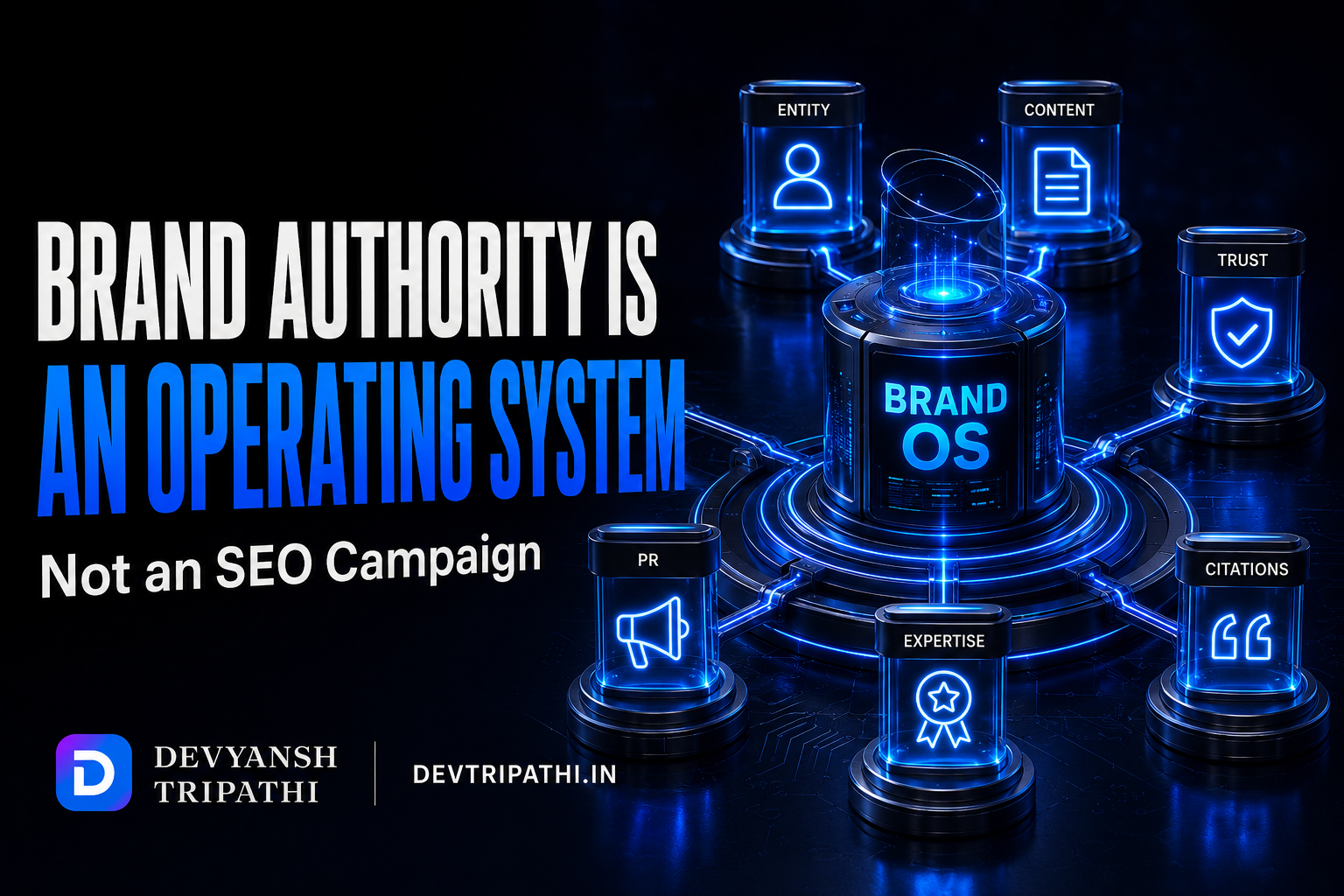
Brand Authority Is an Operating System, Not an SEO Campaign
20 July 2026
Brand authority SEO in the second half of 2026 is defined by two converging findings: every single respondent in Goodfirms’ 2026 survey of SEO professionals agreed that trust and credibility signals are becoming more important as AI systems take over source selection, yet authoritative backlinks and digital PR remain the least-adopted organic practice at only 81% despite Goodfirms identifying external validation as the primary signal AI systems use to evaluate brand trust, and AI-referred visitors now browse 12% more pages per visit with a 23% lower bounce rate than non-AI referrals according to Adobe’s 2026 analysis, confirming that AI-driven traffic has become measurably higher quality, not merely higher volume.
This Cycle 4 guide covers brand authority SEO as a system rather than a campaign, the framing 79 Development’s 2026 State of AI Search research identifies as the defining difference between organizations that succeed and those that fail at AI visibility: the complete Goodfirms consensus and adoption gap data, the specific engagement quality metrics Adobe has now documented for AI-referred traffic, the entity coherence principle captured in the memorable “AI sees a Picasso” framing for inconsistent brand data, the scale of Google’s Knowledge Graph that brand entities must successfully register within, and the organizational structure implication that brand authority requires cross-functional ownership rather than assignment to a single SEO practitioner working in isolation.
100% of Practitioners Agree Trust Signals Matter More. Only 81% Are Actually Building Them.
Get a complete brand authority audit covering your digital PR and external validation gap against the 81% adoption benchmark, entity coherence check across every platform where your brand appears, and the cross-functional system design that 79 Development's research identifies as the key differentiator between organizations that succeed and fail at AI visibility.
Get My Brand Authority AuditThe Complete Consensus, the Incomplete Execution
Goodfirms’ 2026 survey of SEO professionals produced a striking data point: every single respondent agreed that trust and credibility signals are becoming more important as AI systems take over the work of deciding which sources to surface in generated responses. This is not a majority or a strong plurality; it is complete, unanimous practitioner consensus on the strategic direction of the discipline.
Yet the same research found authoritative backlinks and digital PR, the specific practice Goodfirms identifies as the primary signal AI systems use to evaluate brand trust, remains the least-adopted organic practice at only 81%. This gap between universal strategic agreement and incomplete tactical execution represents what Goodfirms characterizes as the most consequential finding in the entire dataset: roughly one in five brands are not actively building the exact trust signal category that practitioners unanimously agree matters most for AI-era visibility. For brands seeking a single highest-leverage action informed by this research, closing this specific digital PR and external validation gap represents the most direct, evidence-backed opportunity available. For the complete controllable-source framework this gap sits within, see our AI Citation Optimization Cycle 4 guide.
100%of surveyed SEO professionals agree trust signals matter more now (Goodfirms 2026)
81%adoption of digital PR/backlinks — the least-adopted yet most consequential practice
12%more pages browsed per visit by AI-referred traffic vs non-AI referrals (Adobe 2026)
23%lower bounce rate for AI-referred visitors vs standard traffic (Adobe 2026)
The Engagement Quality Case for Brand Authority Investment
Adobe’s 2026 analysis provides the clearest engagement-quality evidence yet that AI-referred traffic represents a fundamentally different, higher-intent visitor category rather than simply a new acquisition channel of comparable quality to existing sources. AI-referred visitors browse 12% more pages per visit and show a 23% lower bounce rate than non-AI referrals, confirming that users arriving from AI platforms have already been pre-qualified by the AI’s synthesis and recommendation process before they ever reach a brand’s website.
This engagement quality data directly strengthens the commercial case for brand authority investment: a visitor who has already read a detailed AI-generated answer, formed initial trust in the cited brand through that AI recommendation, and then chosen to click through arrives with meaningfully different intent and engagement propensity than a visitor clicking a traditional organic result with less contextual pre-qualification. Brand authority investments that increase AI citation frequency are therefore not only expanding traffic volume but improving the average quality and engagement depth of that traffic simultaneously, a compounding return that traditional SEO channel comparisons rarely capture as clearly.
The Entity Coherence Principle: “AI Sees a Picasso”
79 Development’s 2026 research on the state of AI search offers one of the most memorable and practically useful framings for explaining entity coherence requirements to non-technical stakeholders: inconsistent brand naming across a website, LinkedIn, Google Business Profile, and industry directories causes AI systems to see a “Picasso,” a fragmented, distorted composite rather than a single coherent, trustworthy entity. Same naming everywhere is the specific, actionable requirement this framing communicates: entity recognition fundamentally depends on coherence across every platform where a brand’s identity data appears.
Coherence Requirement 1
Identical Brand Naming Across Every Platform
The exact legal or registered brand name, consistently used without abbreviation variance, must appear identically across the website, LinkedIn, Google Business Profile, Wikidata, and every relevant industry directory. Even minor variations, such as including or omitting a suffix like "Inc" or "LLC" inconsistently, contribute to the entity fragmentation that undermines AI recognition confidence.
Coherence Requirement 2
Reviews, Associations, and Directory Validation as Corroboration
79 Development's research emphasizes that reviews, professional associations, and directory validation function as third-party social proof that AI systems weight as corroboration, captured in the phrase "others say it too" as a powerful trust signal. This reinforces the review platform strategy covered extensively in Cycle 3 research: independent third-party confirmation of a brand's existence and reputation strengthens entity coherence in a way that self-published claims alone cannot achieve.
The Scale of the Knowledge Graph Registration Challenge
Google’s Knowledge Graph contains over 500 billion facts about 5 billion entities, a scale that contextualizes both the difficulty and the opportunity inherent in successful entity registration. Within a structured knowledge base of this magnitude, a brand’s entity data must be specific, consistent, and well-corroborated enough to achieve confident recognition rather than being absorbed as ambiguous or unclear noise within an enormous existing dataset.
This scale reinforces why the coherence requirement matters so directly: with 5 billion existing entities already represented, any ambiguity or inconsistency in a brand’s identity signals makes correct entity resolution measurably more difficult for the systems processing this scale of data. The practical implication is that entity registration work, Wikidata population, Organization schema completeness, and consistent sameAs referencing, deserves the same rigor and attention as any other core brand-building investment, since it directly determines whether a brand achieves clear recognition within this 500-billion-fact knowledge base or remains an ambiguous, unresolved entity that AI systems cannot confidently cite. For the complete entity registration methodology, see our Knowledge Graph Optimization Cycle 3 guide.
AI Sees a Picasso When Your Brand Name Is Inconsistent Across Platforms. Fix the Coherence Problem First.
Dev Tripathi conducts complete entity coherence audits checking brand naming consistency across every platform where your identity data appears, closing the specific gaps that cause AI systems to perceive a fragmented rather than trustworthy brand entity.
Get My Entity Coherence AuditBrand Authority as an Organizational System, Not a Single-Owner Campaign
Perhaps the most strategically significant finding in 79 Development’s 2026 research is organizational rather than technical: organizations that succeed at AI visibility treat it as a brand authority system requiring coordination across multiple functions, while organizations that fail treat it as an SEO campaign assigned to a single person working in isolation. This distinction predicts outcomes independent of budget size or technical execution quality, because the underlying signals AI systems evaluate, website content, LinkedIn presence, review management, PR relationships, and directory listings, are each typically owned by different teams within most organizations.
If one team runs brand authority work alone, the research finds organizations get partial signals and correspondingly partial results. A marketing team member optimizing website content in isolation, without coordination with the PR team building earned media relationships, the customer success team managing review generation, and the HR or leadership team maintaining consistent LinkedIn and founder presence, cannot achieve the coherent, multi-source corroboration that AI systems require for confident entity recognition. This makes brand authority SEO fundamentally a cross-functional coordination challenge as much as a content or technical optimization challenge.
| Signal Category | Typical Owning Function | Coordination Requirement |
|---|---|---|
| Website Content and Schema | Marketing / SEO team | Must reflect consistent entity data used everywhere else |
| Digital PR and Earned Media | PR / Communications team | Must target publications AI systems already cite for the category |
| Review Generation and Management | Customer Success / Sales team | Must maintain consistent brand naming in review platform profiles |
| LinkedIn and Founder Presence | Leadership / HR / Executive team | Must align messaging and entity references with core brand data |
Building the Cross-Functional Brand Authority System
Practical implementation of brand authority as a system rather than an isolated campaign requires establishing a shared entity data reference document, a single source of truth for brand naming, description, key facts, and messaging that every function references when publishing or updating brand-related content on any platform. This shared reference document, combined with a quarterly cross-functional review meeting that audits coherence across all four signal categories, transforms brand authority from a fragmented set of isolated departmental activities into the coordinated system that 79 Development’s research identifies as the defining characteristic of organizations succeeding at AI visibility. For the complete brand SERP framework this coordination supports, see our Brand SERP Optimization Cycle 3 guide.
Frequently Asked Questions About Brand Authority SEO in 2026
What does the 100% consensus versus 81% adoption gap mean for brand authority strategy?
The gap between complete practitioner agreement that trust signals matter more (100%) and actual adoption of digital PR and authoritative backlinks (81%) reveals a significant execution gap in an area research identifies as the single most consequential trust signal for AI-era visibility. Brands that close this specific gap, actively building earned media coverage and authoritative backlinks rather than only agreeing they matter, gain a differentiated advantage over the roughly one in five competitors who acknowledge the strategic importance without corresponding tactical investment.
Why does AI-referred traffic show 12% more pages per visit and 23% lower bounce rate?
AI-referred visitors browse more pages and bounce less because they arrive pre-qualified: having already read a detailed AI-generated answer and formed initial trust in the cited brand through that recommendation before clicking through. This pre-qualification effect means AI-referred traffic carries meaningfully higher engagement propensity than traditional organic clicks, which typically arrive with less contextual information and lower pre-established trust in the specific destination they are about to visit.
What does the "AI sees a Picasso" framing mean for entity coherence?
The "AI sees a Picasso" framing describes how inconsistent brand naming and identity data across a website, LinkedIn, Google Business Profile, and industry directories causes AI systems to perceive a fragmented, distorted composite entity rather than a single coherent, trustworthy brand. Even minor naming variations, such as inconsistent use of legal suffixes or abbreviated versus full brand names, contribute to this fragmentation, reducing AI systems' confidence in correctly identifying and citing the brand as a reliable entity.
How large is Google's Knowledge Graph and why does that scale matter?
Google's Knowledge Graph contains over 500 billion facts about 5 billion entities. This scale matters because within such an enormous existing dataset, a brand's entity data must be specific, consistent, and well-corroborated enough to achieve confident, unambiguous recognition rather than being absorbed as unclear noise. The larger the existing knowledge base, the more precisely a brand's own entity signals must be structured to avoid ambiguous resolution against similarly named or related entities already present in the graph.
Why is brand authority described as a system rather than a campaign?
Brand authority is described as a system because the signals AI systems evaluate, website content, PR relationships, review management, and LinkedIn presence, are each typically owned by different functions within an organization. Treating brand authority as a single-owner SEO campaign produces only partial signals from whichever function happens to own that campaign, while organizations that coordinate all relevant functions around a shared entity data reference achieve the coherent, multi-source corroboration that AI systems require for confident entity recognition and citation.
Which functions typically need to coordinate for effective brand authority SEO?
Effective brand authority coordination typically requires the marketing or SEO team (website content and schema), the PR or communications team (digital PR and earned media), the customer success or sales team (review generation and management), and the leadership or HR team (LinkedIn and founder presence). Each function must reference a shared, consistent entity data source when publishing brand-related content on any platform, ensuring naming, description, and key facts remain coherent across every touchpoint where AI systems might encounter the brand.
Why do reviews and third-party validation function as trust corroboration for AI systems?
Reviews, professional association memberships, and directory validation function as third-party social proof that AI systems weight as corroboration because they represent independent confirmation of a brand's existence and reputation, distinct from claims a brand makes about itself on its own website. The "others say it too" principle reflects that AI systems, evaluating source credibility for citation decisions, place meaningful weight on whether a brand's claims are corroborated by independent parties rather than relying solely on self-published assertions.
How does the 10% increase in Search usage for AI Overview-triggering queries affect brand authority priority?
SEOcrawl's finding that AI Overviews drive over a 10% increase in Search usage for the query types that trigger them confirms these AI-augmented surfaces are expanding total search engagement rather than merely redistributing existing traffic. This means brand authority investment focused on AI Overview citation eligibility addresses genuinely incremental search volume and engagement opportunity, not simply a reallocation of clicks that would have occurred through traditional organic results regardless of AI Overview presence.
What is the single highest-leverage brand authority action given the 81% adoption gap?
Given that authoritative backlinks and digital PR remain the least-adopted organic practice at 81% despite being identified as the primary AI trust signal, brands should prioritize closing this specific gap through systematic earned media outreach and digital PR investment before allocating additional resources to already well-adopted practices like basic content quality and technical SEO, which Goodfirms characterizes as table stakes rather than differentiating factors in the current competitive landscape.
How should a brand practically implement the shared entity data reference document?
A shared entity data reference document should specify the exact legal brand name, official description, key founding facts, current leadership names and titles, and core messaging that every function references when publishing brand-related content anywhere. Combine this reference document with a quarterly cross-functional review meeting auditing naming consistency across the website, LinkedIn, Google Business Profile, review platforms, and industry directories, catching and correcting entity coherence drift before it accumulates into the fragmented, low-confidence entity signal that undermines AI citation eligibility.
How does brand authority SEO connect to the citation concentration reality documented in AEO research?
Brand authority SEO directly addresses the extreme citation concentration documented in 2026 AEO research, where a small number of dominant domains capture the majority of AI citation volume. Strong, coherent entity authority signals, external validation through digital PR, and consistent multi-platform presence are the mechanisms through which brands outside the already-dominant domains can build the trust and recognition required to compete for citation share within their specific, defensible expertise areas. For the complete citation concentration analysis, see our AEO Cycle 4 guide.
Build Brand Authority as a Coordinated System, Not a Single-Owner Campaign
Get a complete brand authority programme covering your digital PR gap against the 81% adoption benchmark, entity coherence audit across every brand touchpoint, Knowledge Graph registration strategy, and the cross-functional coordination framework that determines whether your organization succeeds or fails at AI visibility according to 2026 research.
Start My Brand Authority ProgrammeConclusion
Brand authority SEO in the second half of 2026 is defined by a gap between complete strategic consensus and incomplete tactical execution: every surveyed practitioner agrees trust signals matter more, yet digital PR, the specific practice identified as the primary trust signal, remains the least-adopted organic practice at only 81%. The engagement quality data Adobe has now documented, 12% more pages per visit and 23% lower bounce rates for AI-referred traffic, provides the clearest commercial validation yet that brand authority investment produces not just more traffic but measurably better traffic.
The entity coherence principle captured in the “AI sees a Picasso” framing, combined with the scale of Google’s 500-billion-fact Knowledge Graph that brand entities must successfully register within, confirms that consistency across every platform where a brand’s identity data appears is not a minor technical detail but a foundational requirement for AI recognition. And the organizational finding that success depends on treating brand authority as a coordinated system across marketing, PR, customer success, and leadership, rather than a campaign assigned to one person, may be the single most actionable strategic insight available to organizations still structuring their AI visibility efforts around traditional, siloed departmental ownership. For the complete AI search platform strategy this brand authority foundation supports, see our AISEO Cycle 4 guide.

Devyansh Tripathi
I’m Devyansh Tripathi, an SEO strategist and digital growth expert, helps businesses and individuals rank higher and drive organic traffic. Through DevTripathi., he shares cutting-edge SEO insights, content strategies, and marketing hacks. Passionate about digital success, he’s on a mission to make SEO simple, effective, and result-driven!
Posts
- What Google’s New AI Search Documentation Means for SEO Teams
- Google I/O 2026 Search: AI Agents, Gemini 3.5 and the Unified Box
- Google’s AI Optimization Guide: The Technical and Content Checklist
- July 2026 SEO Update: AI Overviews, llms.txt and Search Console
- Prompt Optimization Beyond Page One: The Position-21 Citation Opportunity
Categories
- AI Citation Optimization
- AI Search Optimization (AISEO)
- AI Visibility Tracking
- Answer Engine Optimization (AEO)
- Brand Authority SEO
- Brand SERP Optimization
- Community Signal SEO
- Conversational Search Optimization
- Generative Engine Optimization (GEO)
- Knowledge Graph Optimization
- Modern SEO Strategies
- Multimodal Search Optimization
- Prompt Optimization
- SEO Trends
- Social Search Optimization
- Topical Authority SEO
- Uncategorized
- Video Search SEO
- Visual Search Optimization
- Voice Engine Optimization (VEO)
- Zero Click Search Optimization
Latest News
Text Widget
Empowering brands with insights, strategies, and stories that drive digital growth.