Brand SERP Control: Optimize the 7 Results That Shape Trust
28 May 2026
What they see on that results page is your brand’s digital first impression. And for most brands, that first impression is assembled accidentally.
According to research, 81% of consumers conduct a brand name search before making a purchase decision. Businesses with optimized brand SERPs report 35% higher click-through rates and significantly stronger customer trust. Yet according to SEO practitioners who audit mid-market brands, the brand SERP is nobody’s job at approximately 80% of organizations: marketing teams optimize for generic keywords, SEO teams optimize for long-tail rankings, and the branded search result falls through the gap between both disciplines.
Brand SERP Optimization is the practice of deliberately controlling and curating what appears when someone searches for your brand name. It combines entity management, Knowledge Panel optimization, strategic content placement, social profile management, and proactive reputation defense into a unified strategy that ensures your brand’s digital first impression is accurate, authoritative, and designed to build trust at every stage of the buyer journey.
In 2026, with AI Overviews appearing in over 50% of all Google searches, Brand SERP Optimization has gained an additional dimension: the way Google presents your brand on the SERP now directly feeds the entity signals that determine how AI systems describe and recommend your brand in conversational responses.
What Is a Brand SERP?
A Brand SERP (Search Engine Results Page) is the complete Google results page that appears when a user searches for your brand name specifically. It is different from every other SERP your brand appears on because it is triggered by user intent to find your brand, not to find information on a topic.
The Brand SERP is your most important SERP for several reasons:
Users who search your brand name are demonstrating prior awareness, which means they are higher in the consideration process than general organic visitors. The brand SERP is where first impressions convert into trust, or fail to.
The content of your brand SERP directly feeds Google’s entity evaluation. The Knowledge Panel, sitelinks, and social profiles that appear for your brand name are derived from the same entity signals that determine AI citation confidence and branded query treatment across Google’s entire search ecosystem.
According to GetReviewFast research, brands with optimized brand SERPs receive 2.8 times more AI citations than brands with poor or unconsidered brand SERPs. Optimizing your brand SERP is simultaneously a reputation management strategy and an AI citation optimization strategy.
For context on how brand entity optimization connects to Knowledge Graph recognition and AI search performance, see: Knowledge Graph Optimization: The Complete Guide at https://devtripathi.in/blogs/knowledge-graph-optimization-complete-guide/ and Brand Authority SEO: How to Build Brand Authority at https://devtripathi.in/blogs/brand-authority-seo-complete-guide/
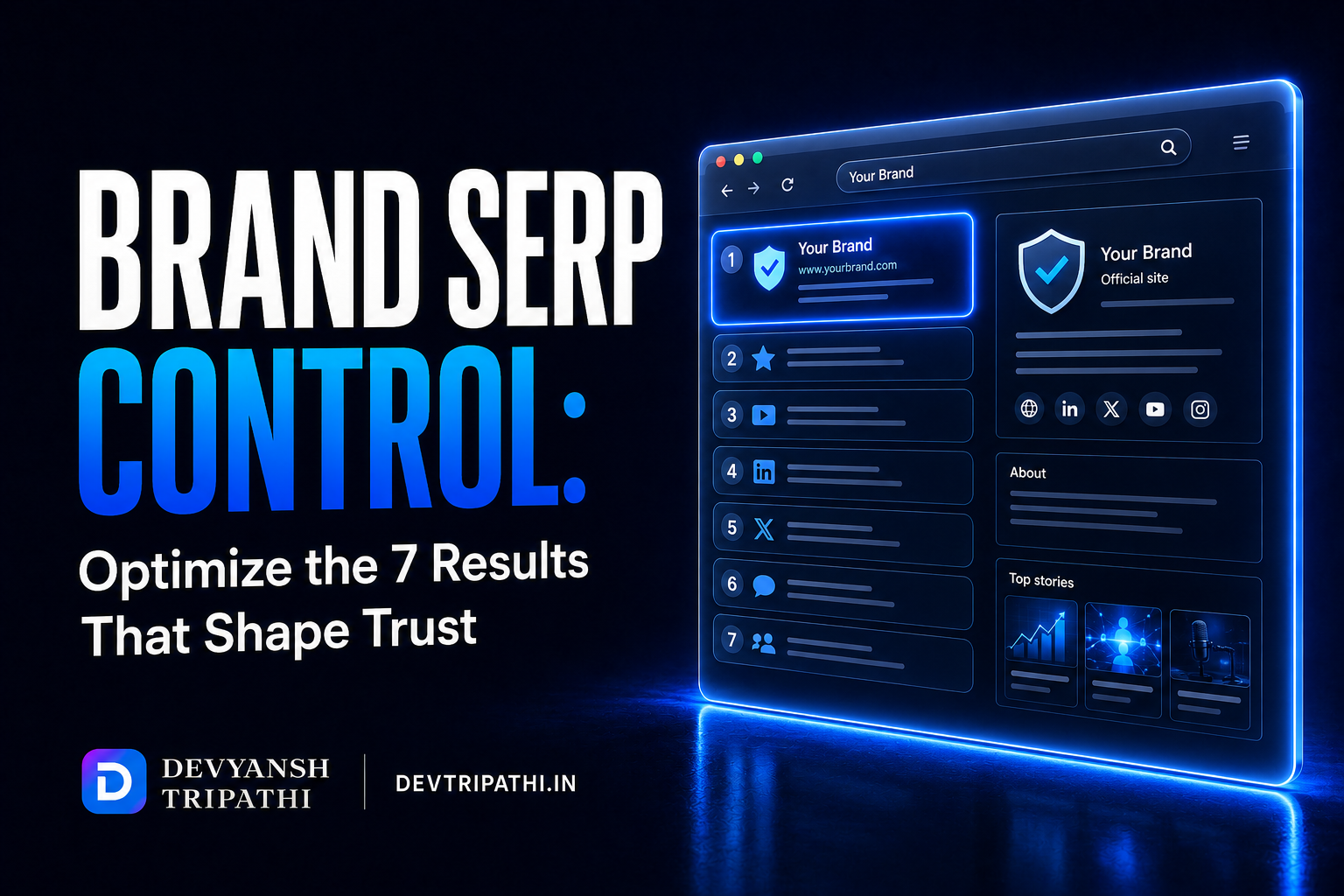
The 7 Components of a Brand SERP and How to Optimize Each One
Component 1: Your Main Website Listing
Your official website should always rank first for your brand name search. For most brands this is automatic, but it can be disrupted by: weak domain authority, technical SEO issues preventing proper indexing, or competitor sites that have built high-authority pages targeting your brand name.
Optimize your main brand listing:
Ensure your homepage title tag includes your official brand name as the first element: “[Brand Name] — [Brief Value Proposition].”
Write a meta description that serves as a brand positioning statement: clear, specific, and compelling for the user who already knows your name.
Implement WebSite schema on your homepage with your official brand name, URL, and sameAs property linking to all major profile pages.
Build sufficient homepage authority through internal linking so that no third-party site can outrank your own homepage for your brand name.
Component 2: Sitelinks
Sitelinks are the six to eight sub-links that appear below your main website listing for well-established branded queries. They are Google’s way of surfacing your most important internal pages directly in the brand search results, giving users one-click access to your key content sections.
Sitelinks are generated algorithmically. You cannot force specific pages to appear as sitelinks, but you can strongly influence which pages are selected:
Internal link architecture: Pages that receive the most internal links from your navigation and other high-authority pages are most likely to be selected as sitelinks. Ensure your most important pages (About, Services, Blog, Contact, key product or pricing pages) are prominently linked in your main navigation and footer.
HTML sitemap: A clear HTML sitemap that Google can crawl reinforces the hierarchical importance of your key pages.
Page title clarity: Sitelink anchor text is typically derived from the page title. Use clear, specific, user-facing page titles for all key pages: “SEO Services,” “About Dev Tripathi,” “GEO Consulting,” rather than generic titles.
You can demote unwanted sitelinks through Google Search Console if specific pages are appearing as sitelinks but should not be. This is done under the Search Appearance section of GSC.
Component 3: Knowledge Panel
The Knowledge Panel is the most prominent element of any brand SERP and the clearest visible signal of Google’s entity recognition of your brand. It appears in the right sidebar on desktop results and near the top on mobile results for your brand name search.
The Knowledge Panel displays: your brand logo, a brief description pulled from Wikipedia or Google’s entity data, founding date and location, key people associated with your brand, social media profile links, and additional information based on your entity type.
How to build and optimize your Knowledge Panel:
Build the entity signals that trigger Knowledge Panel creation (see: Knowledge Graph Optimization: The Complete Guide at https://devtripathi.in/blogs/knowledge-graph-optimization-complete-guide/)
Once created, claim your panel through Google Search Console using the “Claim this knowledge panel” option
Verify and update the description to match your current brand positioning
Ensure all social profile links are accurate and active
Upload your current official logo
Check the displayed category and founding information for accuracy
The Knowledge Panel is not only an aesthetic asset. It is a trust signal that research confirms improves purchase intent, and it is a direct AI citation authority signal: brands with Knowledge Panels receive 2.8 times more AI citations than brands without.
Component 4: Social Media Profile Listings
Your active social media profiles should appear on page 1 of your brand SERP. LinkedIn, Twitter, Instagram, Facebook, and YouTube pages that are well-optimized with your exact brand name, consistent branding, and regular content activity rank well for branded queries and occupy valuable real estate on your brand SERP.
Social profiles on your brand SERP serve three functions: they demonstrate active brand presence across multiple channels, they provide additional positive brand touch points for users who see them, and they occupy positions that would otherwise be available for competitor pages, negative reviews, or unflattering press.
Optimizing social profiles for brand SERP:
Use your exact official brand name as the username or handle wherever possible.
Complete all biographical fields with accurate, keyword-relevant descriptions that include your brand name, category, and location.
Link to your official website from every social profile.
Maintain a consistent posting schedule: inactive profiles rank poorly for branded searches and signal abandonment.
Include your brand logo and cover images consistently across all platforms.
For LinkedIn specifically, implement your Organization schema sameAs property to include your LinkedIn Company Page URL. This explicitly signals to Google’s Knowledge Graph that your LinkedIn page represents the same entity as your website.
Component 5: Review Platform Listings
Review platform pages including Google Business Profile reviews, Trustpilot, G2, Clutch, and JustDial (for India-based brands) frequently appear on brand SERPs. For service businesses, these review listings are among the most influential elements of the brand SERP because they provide third-party social proof at exactly the moment when a user is evaluating trust.
Optimize your review platform presence:
Claim and complete your profiles on all major review platforms relevant to your industry.
Actively generate positive reviews by systematically asking satisfied clients for reviews immediately after delivering positive outcomes.
Respond professionally to all reviews, including negative ones. Professional, constructive responses to criticism demonstrate brand character and reduce the conversion damage of isolated negative reviews.
Monitor review platform pages in your brand SERP weekly. A sudden surge of negative reviews is both a reputation crisis and an SEO issue if it pushes negative content higher in your brand search results.
Component 6: News and Media Mentions
Recent press coverage and industry publication mentions frequently rank in brand SERPs, particularly for brands with active digital PR programs. Positive media coverage on your brand SERP reinforces credibility and provides third-party validation to users who search your brand name during the consideration process.
Media mention strategy for brand SERP:
Prioritize earning coverage in publications that rank well in Google searches. Articles from Search Engine Journal, Search Engine Land, Economic Times (for India-based brands), and similar recognized publications appear consistently in brand SERPs.
Issue press releases for significant brand milestones, research publications, and major client wins. Wire-distributed press releases index quickly and can appear in brand SERPs within days.
Monitor your brand SERP for unflattering or inaccurate media coverage. If negative coverage is ranking in your brand SERP, a proactive digital PR effort to generate more positive and authoritative coverage is the most effective suppression strategy.
Component 7: People Also Ask Boxes
PAA boxes in a brand SERP typically show questions like “Who is [brand]?”, “Is [brand] legitimate?”, “What does [brand] do?”, and “How much does [brand] cost?” These questions represent what users are most commonly asking about your brand, and the answers Google surfaces from web content shape brand perception for users who click to expand them.
Optimize for brand-query PAA boxes:
Create a dedicated FAQ page on your website that directly addresses the most common questions users have about your brand, formatted with question-format H2 headers and FAQPage schema.
Ensure your About page, Services page, and Pricing page provide clear, direct answers to the questions that appear in your brand PAA boxes.
If a PAA box is surfacing incorrect or unfavorable content about your brand, creating higher-quality, more clearly structured content that better answers that specific question is the most sustainable correction strategy.
Brand SERP Optimization and AI Search: The New Dimension
The relationship between Brand SERP Optimization and AI search has intensified significantly in 2026. For two reasons:
First, 65% of branded searches now result in zero clicks beyond the SERP itself, according to research from Elite Solution Expert. AI Overviews are appearing even for branded queries in some categories. This means your brand SERP is increasingly the entire purchase consideration experience, not just the gateway to your website.
Second, the entity signals that determine your brand SERP quality are the same signals that AI platforms use to build their understanding of and confidence in your brand. A brand with a well-optimized brand SERP: a claimed Knowledge Panel, complete social profiles, positive review listings, and strong sitelinks, has stronger entity clarity than a brand with a disorganized or neglected brand SERP. That entity clarity directly translates into higher AI citation rates.
According to GetReviewFast research, brands with optimized brand SERPs featuring consistent information, positive reviews, and Knowledge Panel entities receive 2.8 times more AI citations than brands without these signals. AI-referred visitors convert at 4.4 times higher rates than standard organic traffic.
Investing in brand SERP optimization is simultaneously a first-impression conversion optimization and an AI citation amplification strategy.
For the complete AI measurement framework that tracks how your improved brand SERP translates into AI citations, see: AI Visibility Tracking: The Complete Guide at https://devtripathi.in/blogs/ai-visibility-tracking-complete-guide/
Measuring Brand SERP Quality
Branded Search Click-Through Rate: Monitor in Google Search Console. The ratio of branded clicks to branded impressions measures how effectively your brand SERP converts searchers who already know your name into site visitors. Improving brand SERP quality (sitelinks, Knowledge Panel, review stars) directly improves branded CTR.
Knowledge Panel Presence: Binary check: does your brand name search display a Knowledge Panel? Its presence or absence is a direct measure of entity recognition status.
Brand SERP Negative Content Audit: Manually check your brand name search weekly for the presence of negative reviews, unflattering press, competitor ads, or inaccurate information in the top 10 results. Any negative element appearing in positions 1 through 5 represents a priority suppression target.
Review Rating in Brand SERP: If Google Business Profile review stars appear in your brand listing, monitor the star rating weekly. A rating below 4.2 stars is a known trust inhibitor for first-time brand searchers.
Social Profile Coverage: Count how many of your active social profiles appear in the first 10 results for your brand name. A target of 3 to 5 owned properties in the top 10 branded results provides strong brand SERP real estate control.
AI Citation Accuracy for Branded Queries: Test “[your brand name]” plus relevant category terms in ChatGPT, Perplexity, and Google AI Mode. Verify that AI systems describe your brand accurately and positively. Inaccurate or absent AI descriptions for branded queries indicate entity signal gaps that brand SERP optimization directly addresses.
Frequently Asked Questions About Brand SERP Optimization
What is brand SERP optimization and why does it matter?
Brand SERP optimization is the practice of deliberately managing and improving what appears when someone searches for your brand name on Google. It matters because 81% of consumers search a brand name before making a purchase decision. The brand SERP is often the most influential page of your brand’s entire digital presence, yet most brands leave it entirely unmanaged. Optimized brand SERPs show 35% higher click-through rates and significantly stronger customer trust than unmanaged brand SERPs.
How is a brand SERP different from a regular organic search result?
A regular organic search result is triggered by a topic or problem query where the user does not yet have a specific brand preference. A brand SERP is triggered by the user specifically searching your brand name, indicating prior awareness. Brand SERPs serve a different user intent (evaluation and trust verification) and should be optimized for trust signals, accurate information, and comprehensive brand presence rather than for keyword relevance or click competition.
How do I get sitelinks to appear under my main website listing?
Sitelinks are generated algorithmically by Google based on your site’s internal link architecture. You cannot manually select which pages appear as sitelinks, but you can influence the selection by: ensuring your most important pages are prominently linked in your main navigation and footer, using clear and specific page titles for all key pages, and submitting an HTML sitemap that clearly communicates your site’s page hierarchy. You can demote unwanted sitelinks through Google Search Console.
What should I do if negative content appears in my brand SERP?
First, assess whether the negative content is accurate or inaccurate. If inaccurate, address it at the source: contact the publisher for correction, update the relevant entity data on Wikidata or Wikipedia, or file a claim through Google Search Console if the inaccuracy appears in a Knowledge Panel. If the negative content is accurate but damaging, the most sustainable strategy is a proactive digital PR program that generates more authoritative positive coverage, systematically pushing the negative result lower in the brand SERP through organic displacement.
How do social media profiles help my brand SERP?
Social media profiles for your brand that appear in the top 10 brand SERP results provide additional positive brand touch points, demonstrate active multi-channel presence, and occupy real estate that would otherwise be available for competitor pages or negative content. Active LinkedIn, Twitter, Instagram, and YouTube profiles with consistent branding, complete descriptions, and regular posting frequency rank well for branded queries and are a cost-effective brand SERP real estate strategy.
How long does it take to see brand SERP improvements?
Some brand SERP improvements are immediate: updating your homepage title tag and meta description can reflect in Google search results within 2 to 7 days. Building a Knowledge Panel typically takes 3 to 12 months depending on existing entity signal strength. Social profile optimization and increased visibility in brand SERPs from content activity can take 4 to 8 weeks for new activity to rank. Review volume improvements are gradual and depend on your review generation cadence.
Does brand SERP optimization help with AI search visibility?
Yes, directly. Brands with optimized brand SERPs featuring consistent information, Knowledge Panels, and positive review signals receive 2.8 times more AI citations according to research from GetReviewFast. The entity signals that create a strong brand SERP: Knowledge Panel presence, consistent entity information, positive review sentiment, and active social profiles, are the same signals AI platforms use to build citation confidence in your brand.
What is brand SERP real estate and why does it matter?
Brand SERP real estate refers to how many of the top 10 results for your brand name search are owned or influenced by your brand. A brand that controls positions 1 through 7 with its own website, social profiles, and review platform listings has limited the space available for competitor pages, negative press, or unflattering content to appear prominently in the branded search experience. Maximizing owned and positive brand SERP real estate is a fundamental objective of any brand protection SEO strategy.
How does Google Business Profile affect my brand SERP?
Google Business Profile is a direct Knowledge Panel input source and review signal for brand SERPs. A complete, verified Google Business Profile contributes structured entity information (name, category, address, phone, hours, description) that feeds the Knowledge Panel displayed for branded searches. Review ratings from Google Business Profile appear as star ratings in search results, which are visible in the brand SERP and influence click-through rates and trust perception for users evaluating your brand.
What is the role of People Also Ask boxes in brand SERP optimization?
People Also Ask boxes in a brand SERP reveal the most common questions users have about your brand. These questions shape brand perception for users who expand the answers within the brand search experience. Optimizing your brand SERP for PAA means creating authoritative content on your own website that directly answers these questions with FAQPage schema, so Google surfaces your own accurate answers in the PAA boxes rather than third-party content that may be less favorable or less accurate.
Is brand SERP optimization different for personal brands versus company brands?
The objectives are the same but the specific components differ. Personal brand SERPs feature Knowledge Panels for individuals (Person schema rather than Organization schema), social profiles weighted more toward LinkedIn and Twitter, and PAA boxes focused on professional credentials and areas of expertise. Company brand SERPs feature Organization Knowledge Panels, Google Business Profile, review platforms, and news coverage more prominently. Both require the same foundational strategy: entity consistency, structured data, multi-platform presence, and proactive reputation monitoring.
Conclusion
Your brand SERP is your brand’s most important and most consistently overlooked digital asset. Every day that it is assembled by accident rather than managed by strategy, potential clients, investors, journalists, and job candidates form their first impression of your brand from content you have not curated and may not even be aware of.
The good news is that Brand SERP Optimization is one of the most directly actionable and measurable SEO disciplines available. The components are clearly defined, the optimization steps are accessible, and the outcomes are observable in real-time by simply searching your own brand name in Google.
Begin this week with a full brand SERP audit: search your official brand name in Google and document every element appearing in positions 1 through 10. Identify which elements you own and control, which you influence but do not fully control (review platforms, social profiles), and which are controlled entirely by third parties. Build a priority plan that claims your Knowledge Panel, completes your social profiles, generates your review base, and optimizes your homepage for maximum sitelink selection.
Then watch what happens when the next person who searches your brand name gets a first impression that is accurate, authoritative, and designed to build trust from the first search.
Google Business Profile Help Center: https://support.google.com/business/
Google Knowledge Panel Claims: https://support.google.com/knowledgepanel/
Google Search Console — Sitelinks: https://search.google.com/search-console/
Schema.org — Organization Schema: https://schema.org/Organization
Trustpilot — Business Profile Management: https://business.trustpilot.com/

Devyansh Tripathi
I’m Devyansh Tripathi, an SEO strategist and digital growth expert, helps businesses and individuals rank higher and drive organic traffic. Through DevTripathi., he shares cutting-edge SEO insights, content strategies, and marketing hacks. Passionate about digital success, he’s on a mission to make SEO simple, effective, and result-driven!
Posts
- What Google’s New AI Search Documentation Means for SEO Teams
- Google I/O 2026 Search: AI Agents, Gemini 3.5 and the Unified Box
- Google’s AI Optimization Guide: The Technical and Content Checklist
- July 2026 SEO Update: AI Overviews, llms.txt and Search Console
- Prompt Optimization Beyond Page One: The Position-21 Citation Opportunity
Categories
- AI Citation Optimization
- AI Search Optimization (AISEO)
- AI Visibility Tracking
- Answer Engine Optimization (AEO)
- Brand Authority SEO
- Brand SERP Optimization
- Community Signal SEO
- Conversational Search Optimization
- Generative Engine Optimization (GEO)
- Knowledge Graph Optimization
- Modern SEO Strategies
- Multimodal Search Optimization
- Prompt Optimization
- SEO Trends
- Social Search Optimization
- Topical Authority SEO
- Uncategorized
- Video Search SEO
- Visual Search Optimization
- Voice Engine Optimization (VEO)
- Zero Click Search Optimization
Latest News
Text Widget
Empowering brands with insights, strategies, and stories that drive digital growth.