Build an AI Visibility Dashboard Across ChatGPT, Gemini and Perplexity
28 June 2026
AI visibility tracking is the systematic process of monitoring how your brand, content, and expertise appear within AI generated responses across platforms such as Google AI Overviews, ChatGPT, Perplexity, and Gemini. Unlike traditional keyword rankings, it measures citation frequency, brand mention accuracy, and share of AI voice rather than page position in a results list.
As AI systems take over an increasing share of search queries, understanding where and how your brand appears in those responses becomes as critical as tracking Google rankings. AI visibility tracking provides a structured method for measuring your presence in AI generated answers, identifying which content earns citations, and quantifying your brand’s coverage compared to competitors. This guide covers the four core AI visibility metrics, practical tracking approaches for each major AI platform, available monitoring tools, how to build a tracking dashboard, how to translate tracking data into content action plans, and the most common AI visibility tracking mistakes that produce misleading results and poor optimization decisions.
Not Sure How Your Brand Appears in AI Search?
Get a professional AI visibility audit that maps your brand's presence across Google AI Overviews, ChatGPT, Perplexity, and Gemini. Understand exactly where your visibility gaps are before competitors close them.
Get Your AI Visibility AuditWhat Is AI Visibility Tracking
AI visibility tracking is the practice of systematically measuring how your brand and content appear within AI generated answers across search and chat platforms. It operates on fundamentally different principles than traditional SEO rank tracking, which measures keyword positions in a results list. AI visibility tracking measures whether AI systems choose your content as a source, how accurately they represent your brand, and how frequently your expertise is surfaced in generated responses across different query types.
The discipline emerged as a practical necessity when AI systems began handling queries that previously directed users to organic search results. A brand can receive substantial AI citations without generating any corresponding website traffic, and a brand can rank in position one on Google while receiving zero citations in AI generated responses for the same query topic. These two realities make AI visibility tracking a distinct measurement function rather than an extension of existing SEO analytics.
How AI Visibility Differs from Traditional SEO Metrics
Traditional SEO metrics such as keyword rankings, organic impressions, and click-through rates all depend on a user selecting your page from a list of results. AI visibility operates differently because AI systems generate responses using source content without always directing users to visit the cited page. A brand that earns consistent AI citations builds authority and recognition even in sessions where no website visit occurs.
AI visibility introduces new measurement dimensions that traditional tools cannot capture. Citation rate measures how often AI systems reference your content when answering relevant queries. Brand mention accuracy measures whether AI systems describe your products, services, and expertise correctly. Share of AI voice measures how your brand coverage compares against competitors across AI generated responses. Response sentiment measures whether the AI portrays your brand positively, neutrally, or inaccurately. All four dimensions require AI-specific tracking processes.
Why AI Visibility Tracking Matters in 2026
The scale of AI search adoption has made visibility tracking essential rather than optional for brands with serious search strategies. According to OpenAI, ChatGPT surpassed 200 million weekly active users in 2024, demonstrating the volume of queries now processed through AI systems rather than traditional search results. Gartner predicted that traditional search engine volume would decline by 25% by 2026 as AI assistants absorb an increasing share of informational and commercial queries.
Brands that cannot measure their AI visibility have no framework for improving it. Tracking also surfaces issues that traditional analytics cannot reveal. When an AI system answers a query about your industry without mentioning your brand, that represents a quantifiable visibility gap. When an AI system misrepresents your pricing, product features, or service scope, that represents a brand accuracy problem that influences user decisions without appearing in any standard analytics report.
The Core Metrics of AI Visibility Tracking
Measuring AI visibility requires a different set of metrics than traditional SEO. Four metrics form the foundation of any AI visibility tracking program: citation rate, brand mention frequency, AI answer share, and response accuracy score. Each provides distinct insight into how AI systems perceive and represent your brand across different query categories.
Citation Rate
Citation rate measures the percentage of relevant queries where an AI system references your content as a source or your brand as an authority. To calculate citation rate, compile a representative set of target queries for your topic categories, test each query across the AI platforms you are monitoring, and record how many responses reference your brand or content in any form. Divide the number of citations by the total number of queries tested to produce a citation rate percentage.
Citation rate varies significantly by platform and query type. Google AI Overviews draws primarily from indexed web content and favors pages that already demonstrate strong authority signals. ChatGPT and Claude base responses on training data combined with browsing capability when enabled, producing different citation patterns than retrieval-first systems. Understanding citation rate at the platform level reveals where your content authority is strongest and where it needs development.
Brand Mention Frequency
Brand mention frequency tracks how often your brand name, product names, or key team members appear in AI generated responses across a defined query set. This metric includes both direct citations and indirect references where AI systems describe your methodology, approach, or published research without naming you explicitly. Monitoring indirect mentions requires broader query testing that goes beyond brand-specific terms.
AI systems frequently mention brands when answering category queries, comparison questions, and queries about specific methodologies. A user asking about the best approach to AI search optimization may receive a response that names specific experts and agencies without the user searching for those names directly. Tracking these indirect mentions provides a significantly more complete picture of AI visibility than name-matching alone.
AI Answer Share
AI answer share is the percentage of AI generated responses about your category in which your brand appears, compared to the total responses tested. This metric functions like share of voice in traditional media monitoring but measured within AI search environments. Calculate AI answer share by testing a representative query set, recording which brands appear in each response, and dividing your appearance count by the total response count to produce a percentage.
AI answer share is most meaningful when calculated relative to your top three to five competitors. A share of 30% may represent leadership in a category where no competitor exceeds 25%, or a significant gap in a category where the dominant competitor holds 60%. Relative positioning reveals competitive standing more clearly than absolute numbers alone.
Response Accuracy Score
Response accuracy measures how correctly AI systems represent your brand when they mention it. This includes factual accuracy about your services, products, team expertise, geographic coverage, pricing approach, and published content. Inaccurate AI responses damage brand credibility even when favorable, because users act on AI provided information as though it were verified.
Test response accuracy by submitting queries that reliably produce brand mentions and comparing AI responses against your confirmed brand information. Document factual errors, outdated details, and misrepresentations in a tracking log. Response accuracy problems are often addressed through schema markup updates, Wikipedia profile corrections, and targeted content publishing that corrects the misinformation AI systems are drawing from.
| Metric | What It Measures | How to Calculate | Ideal Tracking Frequency |
|---|---|---|---|
| Citation Rate | Percentage of relevant queries where your brand or content is referenced by an AI system | Citations received divided by total queries tested, expressed as a percentage | Monthly for full query set, weekly for priority queries |
| Brand Mention Frequency | How often your brand name or product names appear across AI generated responses | Count of total brand appearances across all tested responses | Monthly with competitor comparison |
| AI Answer Share | Your brand's percentage of total AI citations in your category relative to competitors | Your citation count divided by total citations across all brands in tested query set | Monthly competitive report |
| Response Accuracy Score | Correctness of factual information AI systems provide about your brand when mentioning it | Verified accurate claims divided by total brand-related claims in tested responses | Quarterly or following significant brand changes |
How to Track AI Visibility Across Major Platforms
Each AI search platform has distinct architecture, source selection criteria, and response formats that require adapted tracking approaches. Building a platform-specific tracking process for the five major AI systems ensures comprehensive and comparable visibility measurement across the full AI search landscape.
Monitoring Google AI Overviews
Google AI Overviews appear above organic search results for a substantial portion of informational queries. According to Google for Developers, AI Overviews draw from the web’s most authoritative indexed content and are designed to synthesize information across multiple sources rather than cite a single page. Monitoring your visibility requires testing each target query in a signed-out private browser window to minimize personalization effects, recording whether an AI Overview appears, and noting whether your brand or content is referenced within the overview text.
Because AI Overviews vary by geographic location, device type, and individual personalization signals, establish consistent testing conditions from the start of your tracking program. Test from the same location using the same browser profile each time to ensure that observed changes reflect content and authority shifts rather than environmental variables. Document the full text of each AI Overview response for later comparison, not just whether a citation occurred.
Tracking Citations in ChatGPT and Claude
ChatGPT and Claude respond to conversational queries using a combination of training data and web browsing when enabled. These platforms require a different testing approach than retrieval-first systems because citations may not always be explicitly displayed. To track visibility, develop a set of conversational prompts that mirror how your target audience would ask about your category, test each prompt with and without browsing enabled, and record whether your brand appears, whether competitor brands receive more prominent mentions, and how accurately your brand is described in any response that includes it.
Query phrasing matters significantly in conversational AI systems. Test each query concept in five to eight different phrasings and record response variation. This prevents the common mistake of tracking a single phrasing that happens to consistently produce a citation and concluding that overall ChatGPT visibility is strong. Phrasing variation testing provides a more representative view of how AI systems handle your topic category across the full range of user expression styles.
Measuring Visibility in Perplexity AI
Perplexity AI provides explicit source citations alongside every response, making it the most directly trackable AI search platform for citation measurement. When you submit a query, Perplexity displays the source URLs used to generate the answer. Recording which sources Perplexity selects for your target queries reveals exactly which content earns citations, which domains dominate your topic area, and where competitor content consistently outperforms yours in source selection.
Build a dedicated Perplexity tracking log separate from your other platform logs. For each query, record the date, exact query text, all sources cited (not just yours), and the position and prominence of any brand mention within the response. The source URLs Perplexity selects reveal which specific pages earn citations, giving you precise data on which content types and structures perform best in retrieval-first AI systems.
Tracking Gemini AI Responses
Google Gemini operates with integration into both Google Search and standalone access through the Gemini interface. Gemini responses can differ materially from Google AI Overviews even for identical queries because the underlying retrieval and synthesis processes differ between the two Google products. Test your priority query set in the Gemini interface separately from AI Overview tests, recording brand citations, response accuracy, and which competitor brands appear with greater frequency or detail.
Gemini’s integration with Google Workspace and its ability to access real-time information makes it particularly important for brands in professional services, technology, and business-to-business markets where Gemini usage rates among target buyers are significant. For brands in generative engine optimization, Gemini represents one of the highest-priority platforms for tracking given its direct connection to Google’s search infrastructure.
Ready to Build Your AI Visibility Tracking System?
Dev Tripathi provides structured AI visibility tracking programs designed for businesses that need to monitor and systematically grow their brand presence across Google AI Overviews, ChatGPT, Perplexity, Gemini, and Claude.
Start Your AI Visibility ProgramAI Visibility Tracking Tools and Methods
Effective AI visibility tracking combines manual testing methods with appropriate platform tools to produce comprehensive, consistent data. The right approach depends on query volume, budget, the number of platforms you are monitoring, and whether you need real-time alerts in addition to periodic tracking reports.
Manual Query Testing Method
Manual query testing is currently the most reliable method for AI visibility tracking because it captures exactly what a real user experiences when submitting a query to an AI system. The process involves compiling a standardized query set representing your primary topic categories, testing each query across the target AI platforms on a consistent schedule, recording full response text in a structured log, and comparing results across testing periods to identify citation trends.
Design your query set to cover five to seven topic categories relevant to your brand, with four to six query variants per category covering different phrasing styles and user intent signals. This produces a total of 20 to 42 queries per full testing cycle. Test this complete set monthly. Test a subset of 10 to 15 highest-priority queries weekly. The consistency of the query set is what enables trend tracking, so maintain the same query text across testing periods and document any necessary changes when they occur.
Dedicated AI Monitoring Platforms
Specialized AI monitoring tools automate the manual testing process and provide dashboards for tracking citation trends over time. These platforms submit queries programmatically, record AI generated responses, and calculate citation rate and competitor benchmarks without requiring manual testing at scale. When evaluating AI monitoring tools, assess the number of AI platforms covered, refresh frequency, competitor benchmarking capability, response accuracy tracking, and whether the tool captures the full response text or only detects brand name presence.
Tools designed specifically for AI search visibility monitoring include Profound, Peec, and Brandwatch’s AI coverage module. Traditional SEO platforms such as Semrush and Moz have begun integrating AI overview tracking features for Google specifically. The appropriate tool depends on query volume, the number of AI platforms requiring coverage, and the budget available for ongoing monitoring infrastructure. Manual testing supplements any tool because automated systems cannot replicate the full nuance of conversational AI interaction.
Competitor Benchmarking in AI Search
Competitor benchmarking reveals how your AI visibility compares with brands competing for the same topic categories. Test the same query set used for brand tracking and record which competitor brands receive citations in each response. Calculate competitor citation rates using the same method used for your own citation rate. Gaps between your rate and competitor rates in specific topic categories identify where rivals have established stronger content authority in AI systems and where content investment will produce the greatest improvement in AI answer share.
According to BrightEdge research, organic search drives 53.3% of all website traffic, and brands that demonstrate strong content authority in organic search tend to also earn higher AI citation rates due to the correlation between page authority signals and AI source selection criteria. This means competitor benchmarking in AI search provides dual value: it identifies content gaps for AI visibility improvement and signals areas where traditional SEO authority building efforts will also produce AI citation gains.
Building an AI Visibility Tracking Dashboard
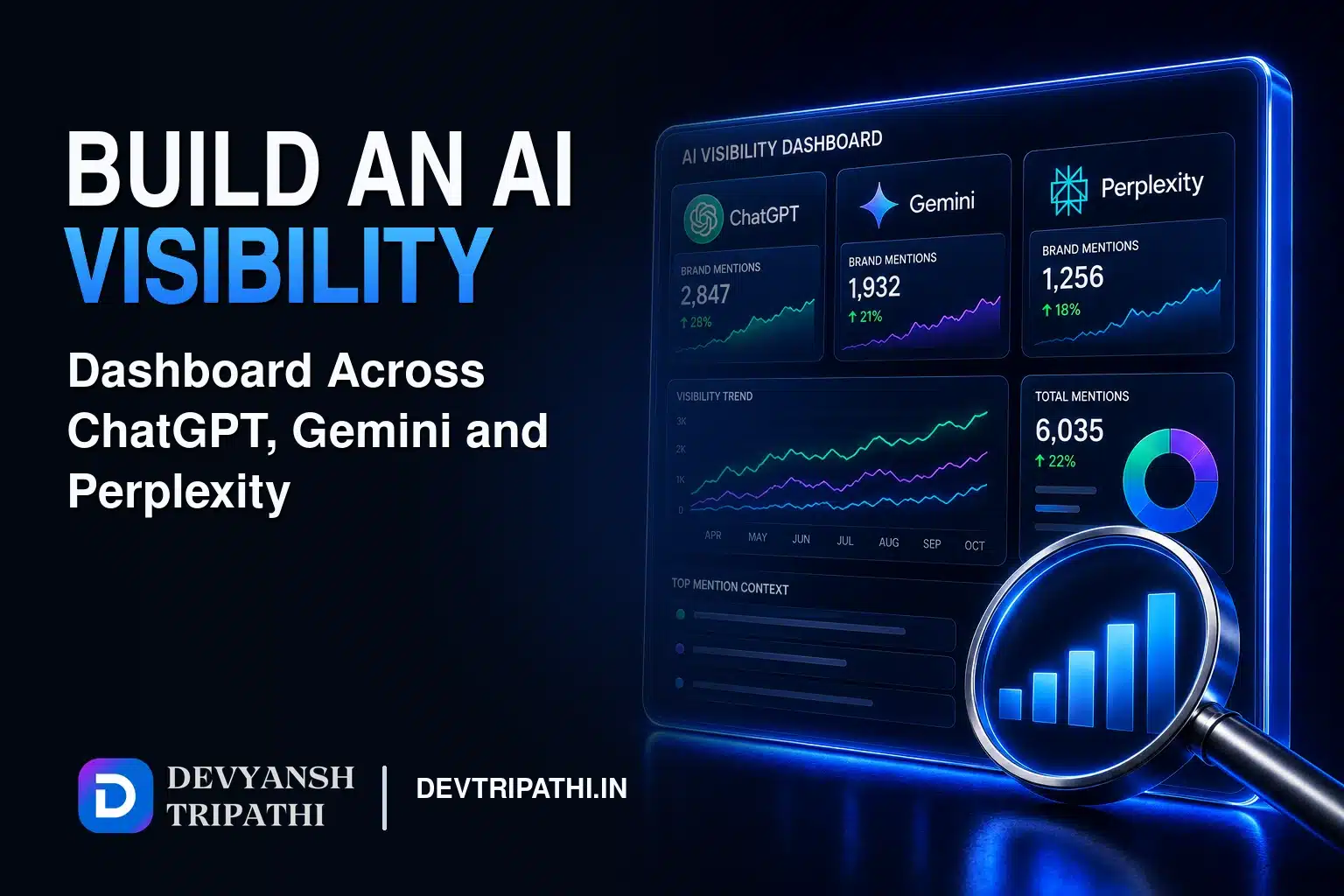
Organizing tracking data into a structured dashboard enables trend analysis, simplifies reporting, and makes the connection between content actions and visibility changes visible over time. A dashboard does not require complex software to be effective. A well-maintained spreadsheet with consistent recording practices provides sufficient structure for most businesses at the beginning of their AI tracking program and scales to accommodate growing query sets and platforms.
Key Performance Indicators to Track
Six KPIs form the core of an AI visibility tracking dashboard. The first is citation rate by platform, measured as a percentage for each AI system you monitor. The second is citation rate by topic category, which reveals which content areas drive your AI visibility and which are underperforming. The third is brand mention frequency, the total count of brand appearances across all tested responses in a reporting period. The fourth is AI answer share compared to your top three competitors. The fifth is response accuracy score. The sixth is the percentage of tested queries that generate any AI response at all, which measures the overall AI activity level in your topic categories.
For each KPI, record both the absolute number and the period-over-period change. A citation rate of 35% tells you your current position. Knowing whether that rate increased from 22% or decreased from 48% provides the context necessary for informed optimization decisions. Dashboards that track only point-in-time values produce static snapshots rather than actionable trend data.
Weekly Monitoring Framework
A weekly monitoring cycle focuses on the 10 to 15 highest-priority queries across your three to four most important AI platforms. Allocate 60 to 90 minutes weekly to test these queries, record responses, and flag any significant changes from the previous week. Weekly monitoring catches rapid changes following content updates, competitor publishing activity, or shifts in AI system source selection preferences that monthly-only monitoring would not detect until significant time had passed.
Create a simple weekly tracking sheet with columns for query text, platform, citation present (yes or no), brand accuracy (correct, partially correct, incorrect), and competitor citations. This format takes 90 seconds per query to complete and produces a running record that reveals patterns not visible in individual data points.
Monthly Reporting Structure
Monthly reports should consolidate weekly data and present period-over-period KPI changes for each metric in the dashboard. Structure monthly AI visibility reports in four sections. The first section covers citation rate trends by platform and category with comparisons to the previous three months. The second section covers competitor AI answer share analysis. The third section covers response accuracy findings and any brand misrepresentation issues discovered. The fourth section is the content action plan, which is the most critical output of the entire tracking program, translating gap data into specific content creation, optimization, and schema markup priorities for the coming month.
How to Improve AI Visibility Based on Tracking Data
Tracking data only generates value when it drives specific content and optimization decisions. A systematic process for translating tracking findings into improvement actions produces consistent AI visibility growth rather than periodic bursts of uncoordinated activity.
Closing Content Gaps
When tracking reveals that AI systems answer queries in your category without citing your brand, examine the content that does receive citations in those responses. Identify what those pages contain that yours do not. Common gaps include direct definitional content in 40 to 60 words, comprehensive FAQ sections with complete answers, statistical data from authoritative sources, numbered process explanations, and content that directly and completely addresses the specific query being tested rather than addressing a broader topic area of which the query is a part.
Content gap closure is most effective when prioritized by competitive gap size. Categories where competitors earn citations in 60% or more of tested queries while your citation rate is below 20% represent the highest-value improvement opportunities. The combination of high competitive citation presence and low brand citation rate confirms that AI systems consider the topic well covered by existing content and that new content created with appropriate structure will compete directly for citation selection. Our guide to answer engine optimization provides the content structuring framework that produces the citation-eligible format AI systems prefer.
Optimizing for Citation Eligibility
AI systems favor content with specific structural characteristics that make information directly extractable without requiring interpretation. Direct definitions in 40 to 60 words that fully answer a query without requiring additional context earn the highest citation rates across all major AI platforms. Comprehensive FAQ sections where each answer is a complete standalone response in 35 to 75 words are among the most consistently cited content formats in AI generated responses. Structured comparison tables, numbered process explanations with clear action verbs, and statistics from authoritative sources with inline source attribution all increase citation eligibility.
Audit your existing content against these structural criteria and identify pages in your priority topic categories that lack these elements. Adding a properly structured FAQ section to an existing pillar page, converting a paragraph-based process explanation to a numbered list with clear action verbs, or adding a direct definition to the opening of a section can produce measurable citation rate improvement without requiring new content creation. Structural optimization of existing pages typically shows citation improvement within 60 to 90 days of re-indexing.
Schema Markup for AI Accuracy
Schema markup communicates structured information about your brand, content, and services directly to search engines and AI systems in a machine-readable format. Article schema, FAQ schema, and Organization schema help AI systems accurately understand and represent your brand when citing your content. Implement schema on pages that tracking data identifies as most relevant to priority query categories. Verify schema implementation using Google’s rich results testing tool and monitor response accuracy scores for improvement following schema updates.
Organization schema is particularly important for brand accuracy because it provides AI systems with verified information about your brand name, service categories, geographic coverage, and official contact information. Brands that have implemented comprehensive Organization schema show lower rates of AI response inaccuracy compared to brands that rely on unstructured page content alone for AI comprehension. For technical implementation detail that connects zero-click search optimization with structured data, including the schema types most effective for AI citation eligibility, schema implementation should be treated as a dedicated workstream within the overall AI visibility program.
Common AI Visibility Tracking Mistakes
Several tracking approaches consistently produce misleading data and suboptimal optimization decisions. Understanding these mistakes enables brands entering AI visibility tracking to build accurate measurement systems from the start rather than discovering flawed methodology after months of unreliable data collection.
Relying on a Single Platform
Monitoring AI visibility on only one platform produces an incomplete and frequently misleading picture of your AI search presence. Each major AI platform uses different source selection criteria, retrieval mechanisms, response formats, and update frequencies. A brand with strong visibility in Perplexity for a given topic may have minimal visibility in Google AI Overviews for the same query because the two platforms draw from different source pools with different authority weighting. Testing across a minimum of three platforms is necessary to understand true AI search coverage and identify platform-specific opportunities.
Ignoring Competitor AI Share
Tracking your own citation rate in isolation removes the competitive context that makes the metric meaningful. A citation rate of 30% may represent category leadership or a significant disadvantage depending entirely on what competitors achieve for the same query set. Brands that track their own performance without tracking competitor performance cannot distinguish between strong absolute performance and strong relative performance, leading to misallocation of content investment toward categories that already show competitive strength while ignoring categories with large competitive gaps that represent the highest-value improvement opportunities.
Using Website Traffic as an AI Visibility Proxy
Google Search Console and GA4 do not capture the full scope of AI citation activity. According to SparkToro research, approximately 60% of Google searches end without a click to any third-party website, and AI Overviews increase this zero-click rate by providing more complete in-search answers. AI Overviews often generate brand exposure, credibility signals, and decision influence without producing website visits. Measuring website traffic as a proxy for AI visibility systematically underestimates the value and frequency of AI citations. Dedicated AI visibility tracking must operate independently of website traffic analytics to produce accurate measurement.
Treating All Query Types Identically
Different query types produce different AI citation patterns, and treating all queries as equivalent in a tracking program produces averages that obscure important performance differences. Definitional queries, comparison queries, procedural queries, and commercial queries each have distinct AI response formats and citation selection criteria. A comprehensive AI visibility tracking program segments query performance by type and tracks citation rate separately for each category. This reveals whether your content performs well for informational queries but poorly for comparison queries, or well for procedural content but poorly for definitional content, enabling targeted structural improvements rather than undifferentiated content production.
Frequently Asked Questions About AI Visibility Tracking
What is AI visibility tracking?
AI visibility tracking is the systematic process of measuring how often and how accurately your brand, content, and expertise appear within AI generated responses across platforms including Google AI Overviews, ChatGPT, Perplexity, Gemini, and Claude. It provides a structured measurement alternative to traditional rank tracking for brands that need to understand and improve their performance in AI powered search environments.
How is AI visibility tracking different from traditional SEO ranking monitoring?
Traditional SEO ranking tools measure the position of your web pages in a list of search results. AI visibility tracking measures whether AI systems select your content as a source for generated responses and how accurately they represent your brand in those responses. The two metrics can diverge significantly because AI systems can cite content from pages ranking outside the top three positions, and ranking first on Google does not guarantee AI citations for the same query topic.
Which AI platforms should I prioritize for tracking?
The five platforms that warrant systematic tracking are Google AI Overviews, ChatGPT, Perplexity AI, Google Gemini, and Claude. Google AI Overviews has the broadest query coverage due to Google's search volume. Perplexity provides the most transparent source citations. ChatGPT has the largest direct user base. Gemini integrates directly with Google's search ecosystem. Allocate tracking priority based on where your target audience is most active.
How often should I run AI visibility tracking queries?
A weekly testing cycle for 10 to 15 priority queries and a monthly testing cycle for the complete query set provides sufficient data frequency for most brands. Consistency matters more than frequency, because trend analysis requires comparable data points collected under the same conditions at regular intervals. Increase frequency temporarily following significant content updates or competitive activity that might affect citation patterns.
What metrics should my AI visibility tracking dashboard include?
Your dashboard should include citation rate by platform, citation rate by topic category, brand mention frequency, AI answer share relative to your top three competitors, response accuracy score, and the percentage of tested queries generating any AI response. These six metrics cover the dimensions of AI visibility performance that matter most for understanding competitive position and directing content improvement activity.
Can Google Search Console be used to track AI visibility?
Google Search Console provides some data on clicks and impressions from AI Overviews for pages that receive measurable click traffic. However, it does not capture citation frequency, brand mention accuracy, or visibility on non-Google AI platforms. Because AI Overviews frequently generate brand exposure without producing clicks, Search Console significantly underestimates actual AI citation activity. Dedicated AI tracking processes are necessary to produce accurate visibility measurement.
What tools are available for AI visibility tracking?
Dedicated AI visibility tools include Profound, Peec, and Brandwatch's AI module, which are designed specifically for monitoring brand citations across AI search platforms. Traditional SEO platforms are adding AI overview coverage features. For brands beginning AI visibility tracking, a structured manual testing process with a consistent query set provides sufficient data before committing to dedicated platform subscriptions, which represent a meaningful ongoing cost at scale.
How do I calculate my brand's AI answer share?
Calculate AI answer share by testing a representative query set for your topic category, recording which brands appear in each AI generated response, and dividing the number of responses containing your brand by the total number of responses tested. Calculate the same figure for each competitor you track. Your share relative to competitors provides the competitive context that makes the absolute citation count meaningful for optimization planning.
How long does it take to see AI visibility improvement after content changes?
Content published with AI optimized structure typically shows measurable citation improvement within 60 to 90 days of indexing for most AI platforms. Google AI Overviews reflect indexing changes relatively quickly because they draw from Google's live index. ChatGPT and Claude base responses on training data that updates less frequently, meaning improvements in those platforms may take longer to manifest in tracking data. Structural optimization of existing pages often produces faster results than new content creation.
What content types earn the highest AI citation rates?
Content that earns the highest AI citation rates consistently includes direct definitions in 40 to 60 words that fully answer a query without requiring additional context, comprehensive FAQ sections with complete answers in 35 to 75 words, numbered process explanations with clear action verbs, comparison tables, and statistical claims linked to authoritative sources. Pages structured for direct information extraction outperform pages that require reading multiple paragraphs to locate a single answer.
How should I handle AI response accuracy problems my tracking reveals?
Address AI response accuracy problems through three channels. Update schema markup on relevant pages to provide AI systems with correct structured information. Publish targeted content that directly addresses the specific claims being made inaccurately, providing AI systems with a higher-quality source for that information. For Google-specific accuracy issues, ensure your Google Business Profile and Knowledge Panel information is current and verified. Address the most impactful accuracy errors first based on the frequency of the affected query type.
What is the relationship between AI visibility tracking and brand authority SEO?
AI visibility tracking is the measurement component of a complete AI search strategy, while brand authority SEO builds the credibility signals that AI systems evaluate when selecting sources for generated responses. Tracking without authority building produces measurement without improvement capability. Authority building without tracking produces activity without measurable progress. The two practices are designed to work together within a unified AI search strategy, with tracking data directing where authority building efforts will produce the greatest visibility gains.
Build a Complete AI Search Strategy for Your Brand
AI visibility tracking provides the measurement foundation that every AI search optimization strategy requires. Work with Dev Tripathi to build a complete AI search program that tracks, optimizes, and systematically grows your brand presence across every major AI platform.
Build Your AI Search StrategyConclusion
AI visibility tracking provides the measurement infrastructure that every serious AI search strategy requires. Without it, there is no way to know whether your content earns citations, how accurately AI systems represent your brand, whether your optimization efforts are producing results, or how your AI search performance compares to competitors. The four core metrics of citation rate, brand mention frequency, AI answer share, and response accuracy score cover the dimensions that matter most for understanding and improving AI search performance.
A consistent testing schedule, platform-specific tracking approaches, a structured dashboard, and a systematic process for translating gap data into content action plans create the foundation for sustained AI visibility growth. As AI systems continue to handle an increasing share of search queries globally, brands with structured AI visibility tracking programs will be positioned to grow their AI search presence systematically while competitors without measurement frameworks remain unable to identify or close their visibility gaps.
For optimization frameworks that directly improve the metrics your tracking program measures, our guides to GEO advanced strategies and the fundamentals of zero-click search optimization provide the tactical content and structural approaches that tracking data should inform and validate.

Devyansh Tripathi
I’m Devyansh Tripathi, an SEO strategist and digital growth expert, helps businesses and individuals rank higher and drive organic traffic. Through DevTripathi., he shares cutting-edge SEO insights, content strategies, and marketing hacks. Passionate about digital success, he’s on a mission to make SEO simple, effective, and result-driven!
Posts
- What Google’s New AI Search Documentation Means for SEO Teams
- Google I/O 2026 Search: AI Agents, Gemini 3.5 and the Unified Box
- Google’s AI Optimization Guide: The Technical and Content Checklist
- July 2026 SEO Update: AI Overviews, llms.txt and Search Console
- Prompt Optimization Beyond Page One: The Position-21 Citation Opportunity
Categories
- AI Citation Optimization
- AI Search Optimization (AISEO)
- AI Visibility Tracking
- Answer Engine Optimization (AEO)
- Brand Authority SEO
- Brand SERP Optimization
- Community Signal SEO
- Conversational Search Optimization
- Generative Engine Optimization (GEO)
- Knowledge Graph Optimization
- Modern SEO Strategies
- Multimodal Search Optimization
- Prompt Optimization
- SEO Trends
- Social Search Optimization
- Topical Authority SEO
- Uncategorized
- Video Search SEO
- Visual Search Optimization
- Voice Engine Optimization (VEO)
- Zero Click Search Optimization
Latest News
Text Widget
Empowering brands with insights, strategies, and stories that drive digital growth.