Build Topical Authority with a 4-Part Content Architecture
24 May 2026
The March 2026 Google Core Update crystallized a shift that has been building since Google’s Helpful Content System launched in 2022. A site with 20 interconnected articles on a specific subject will consistently outrank a site with one 5,000-word guide on the same subject, even if the single article is technically superior in isolation. The reason is not the volume of content. It is the topical structure.
Google’s content quality systems now evaluate topical depth and breadth: how comprehensively and consistently you cover a subject area across an interconnected set of pages. This is topical authority, and it has become the dominant SEO signal in 2026.
Topical authority also directly feeds AI citation eligibility. Sites with high topical authority are cited disproportionately in Google AI Overviews, ChatGPT responses, and Perplexity answers. The March 2026 update made it plain: if you want to rank consistently and be cited by AI, you need to own a topic, not just a keyword.
This guide covers exactly what topical authority is, how Google evaluates it, and the specific implementation steps that build it systematically.
What Is Topical Authority in SEO?
Topical authority is the depth and breadth of your content coverage on a specific subject, as recognized and rewarded by search engines and AI systems.
It is built when a website consistently publishes comprehensive, interconnected content that covers every important aspect of a specific topic: the foundational definitions, the how-to guides, the comparisons, the case studies, the FAQs, the tool reviews, and the emerging developments. When your coverage is complete enough that Google has no reason to send a searcher to a competing domain for any question within your topic area, you have achieved topical authority.
Think of Wikipedia as the clearest reference point. Wikipedia ranks for nearly any informational query not because of its backlink profile alone, but because it has complete, interlinked coverage of virtually every topic. No important question is left unanswered. That is topical authority in its most developed form.
For a site like devtripathi.in, topical authority means becoming the most comprehensive, most consistently updated, and most interconnected resource on GEO, AEO, AI Search Optimization, and the full range of modern search disciplines. Every subtopic within those areas should have a dedicated, high-quality page that links to and from related pages in a coherent structure.
For the broader SEO and AI search context that makes topical authority essential, see: GEO vs SEO: What Is the Difference and Why You Need Both in 2026 at https://devtripathi.in/blogs/geo-vs-seo-difference-2026/ and SEO Trends in 2026: What Is Changing at https://devtripathi.in/blogs/seo-trends-2026-what-is-changing/
Why Topical Authority Is the Dominant SEO Signal in 2026
Three major developments have made topical authority the primary content quality signal for SEO professionals to focus on in 2026.
Development 1: Google’s Helpful Content System Now Evaluates Entire Domains
Since Google’s Helpful Content updates of 2022 to 2024, Google has evaluated site-level helpfulness rather than only page-level quality. A domain with many thin or unhelpful pages sees ranking suppression across its entire content library, including individually strong pages. Topical completeness is the direct antidote: filling every important subtopic within your area of expertise removes the content gap signals that suppress domain-level authority.
Development 2: The March 2026 Google Core Update Reinforced Topical Depth
The March 2026 Core Update, which caused nearly 80% of top-three positions to change and dropped 24.1% of top-10 pages out of the top 100 entirely, consistently rewarded sites with deep, structured topical coverage and penalized sites with scattered, keyword-driven content without coherent topical architecture. According to research from Involve Digital, the update crystallized topical authority as the dominant SEO signal following several years of algorithmic progression in this direction.
Development 3: AI Overviews and AI Citation Systems Favor Topical Authority Domains
Google AI Overviews, ChatGPT, and Perplexity all favor domains with strong topical authority when selecting citation sources. Sites that comprehensively cover a subject area are cited disproportionately compared to sites that have one strong individual article surrounded by unrelated or thin content. Topical authority is not only a traditional search ranking signal. It is an AI citation eligibility signal.
For detailed context on how the March 2026 update impacted rankings, see: SEO Trends in 2026: What Is Changing at https://devtripathi.in/blogs/seo-trends-2026-what-is-changing/
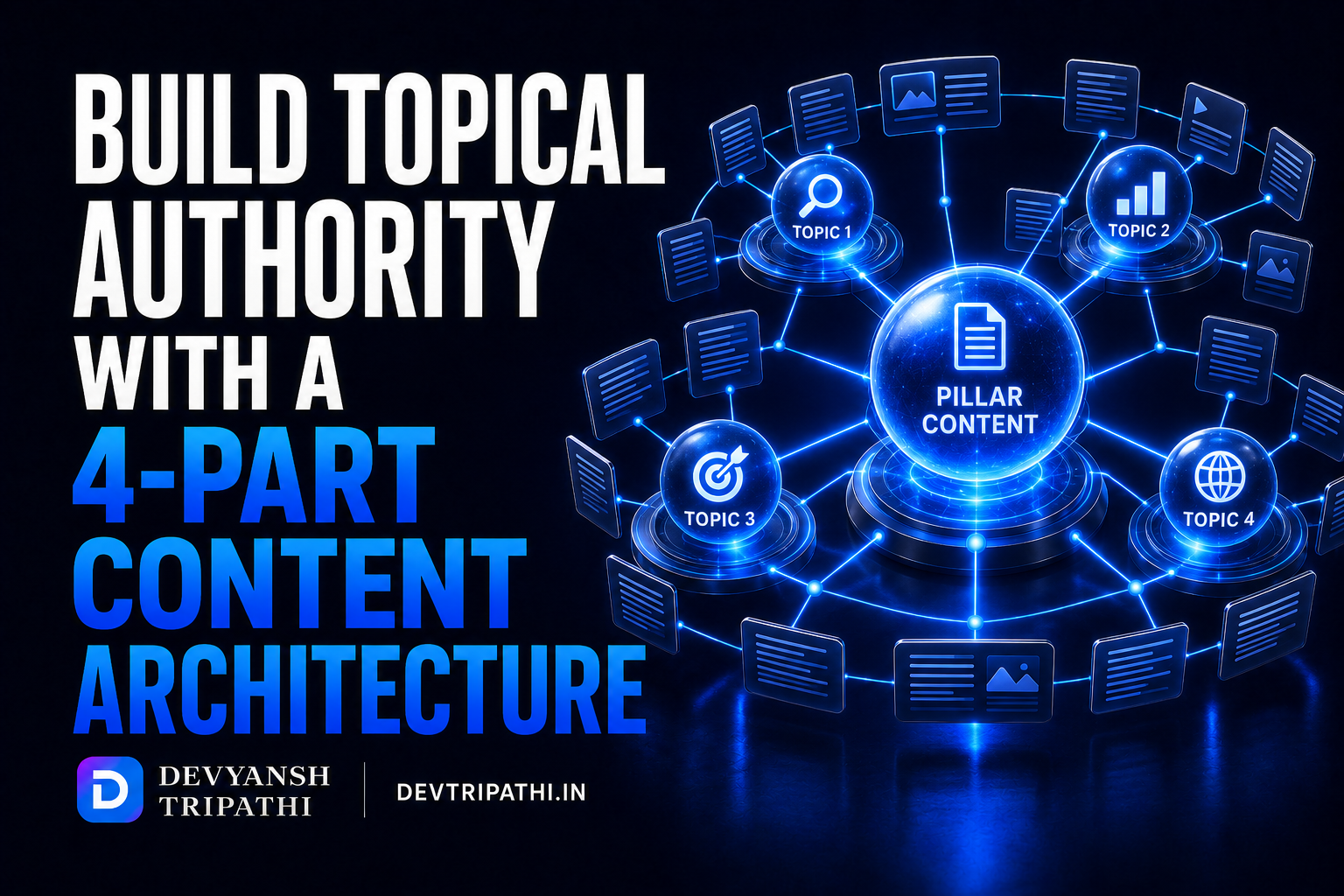
The 4-Component Topical Authority Architecture
Component 1: The Pillar Page
A pillar page is a comprehensive, definitive overview of a major topic that covers the subject at a high level and links to all cluster pages within that topic’s content silo. It is the hub of the hub-and-spoke model.
A strong pillar page is typically 3,000 to 5,000 words. It covers the definition, importance, history, key concepts, and practical overview of the topic. It does not go deep on every subtopic, because that depth is handled by the cluster pages it links to. Its job is to be the definitive starting point for the entire topic and the clearest authority signal to Google that your domain owns this subject.
Example pillar page structure for an SEO domain: “The Complete Guide to Generative Engine Optimization (GEO)” — covers what GEO is, why it matters, how it works at a high level, key strategies at a summary level, measurement overview, and links to dedicated cluster pages for each subtopic.
Component 2: Cluster Pages
Cluster pages are dedicated, in-depth articles covering specific subtopics within a pillar’s topic area. Each cluster page goes deep on one aspect of the broader topic that the pillar page covers at a summary level.
Cluster pages typically range from 1,500 to 3,000 words. They target specific long-tail keywords within the broader topic. They link back to the pillar page and to adjacent cluster pages that are topically related. The internal link structure of the cluster is as important as the content itself: it is what signals to Google that these pages belong to a coherent topical structure rather than being isolated articles.
Example cluster pages under a GEO pillar: “How to Optimize for ChatGPT Search,” “How to Write FAQ Sections for AI Overviews,” “GEO vs SEO: What Is the Difference,” “How Generative Engines Work: The RAG Pipeline Explained,” “GEO Checklist Before Publishing a Blog Post.”
The majority of these cluster pages already exist on devtripathi.in, demonstrating topical authority in action.
Component 3: The Topical Map
A topical map is a structured inventory of every important question, subtopic, and use case within your target topic area. It is the planning document that ensures your content cluster has no significant gaps.
Building a topical map involves:
Starting with the core topic and listing all major subtopics.
For each subtopic, listing all the specific questions, comparisons, how-tos, and use cases that users search for.
Identifying which of these topics you have already covered with existing content.
Identifying which topics remain uncovered (content gaps).
Prioritizing content creation to fill the highest-value gaps first.
Tools for building topical maps: Ahrefs Site Explorer (analyze competitor content gaps), Google’s People Also Ask box (surface real user questions by subtopic), Search Console query report (identify impression-generating questions you lack dedicated pages for), and AnswerThePublic for question-format query research.
Component 4: Internal Link Architecture
Internal linking is the structural element that converts individual pages into a topical authority system. Without strong internal linking, even a complete set of cluster pages fails to communicate topical structure to Google effectively.
Internal link best practices for topical authority:
Every cluster page links back to its pillar page using descriptive anchor text that includes the pillar’s primary keyword.
Every cluster page links to at least two to four adjacent cluster pages within the same topical silo using descriptive anchor text.
The pillar page links to every cluster page within its silo.
Anchor text uses descriptive, entity-focused language rather than generic phrases like “click here” or “read more.”
Links are placed naturally within the content body, not only in sidebars or footers.
Strong internal linking creates what SEO researchers call a topical graph: a visible network of related pages that Google’s crawl systems can traverse to understand the full scope of your expertise on a subject.
For a detailed guide on how entity-first content structure and internal linking reinforce topical authority signals, read: Entity SEO, GEO, and Topic Authority in AI Search at https://devtripathi.in/blogs/entity-seo-geo-topic-authority-ai-search/
How to Build Topical Authority: The 6-Step Implementation Process
Step 1: Choose a Focused Niche
Topical authority requires focus. A website that covers SEO, content marketing, social media, PPC, email marketing, and web development simultaneously spreads its topical signals too thin. Google needs to be able to identify clearly what subject area your site specializes in.
For a new or growing site, the strongest strategy is to niche down within a broader field. Instead of “digital marketing,” focus on “AI search optimization.” Instead of “SEO,” focus on “GEO and AEO for B2B brands.” A narrow, deep focus builds topical authority faster than a broad shallow approach, and narrow authority in a specific area is often enough to generate significant organic traffic and AI citation frequency.
Step 2: Build Your Topical Map
Before writing any new content, map the full landscape of your target topic. List every major subtopic, every common user question, and every search intent variant within your chosen niche.
Use these sources for topical map research: Google’s People Also Ask box for user questions, Ahrefs Content Gap analysis to find topics competitors cover that you do not, Google Search Console query report to find impression-generating queries you lack dedicated pages for, Reddit and Quora threads where your target audience discusses their problems, and AnswerThePublic for question-format query research across all five W questions.
Prioritize by search volume, user importance, and content gap size. Start with the subtopics that have both high search volume and no existing coverage on your site.
Step 3: Create the Pillar Page First
Before building cluster pages, create the pillar page for your primary topic. The pillar page establishes the topical hub and provides the internal link destination that all future cluster pages will reference.
A strong pillar page includes: a clear definition of the topic, an explanation of why it matters, an overview of the key strategies or concepts, a summary table or comparison, a quick-start action plan, and a structured FAQ section. It links explicitly to each cluster page you plan to create within the silo, even before those cluster pages exist (you can link to planned URL slugs and publish the cluster pages as you create them).
Step 4: Build Cluster Pages Systematically
Create cluster pages in order of priority from your topical map, publishing consistently rather than in bursts. Each cluster page should: target a specific long-tail keyword or user question from your topical map, go deep on its subtopic rather than covering it superficially, link back to the pillar page using descriptive anchor text, link to two to four adjacent cluster pages, and meet the GEO content standards that improve AI citation eligibility.
GEO content standards for every cluster page:
Direct answer block in the first 150 words
Question-format H2 and H3 headers
Expert quotes with full attribution
Specific statistics with source references
FAQ section with a minimum of 10 real questions
FAQPage, Article, and where relevant ItemList JSON-LD schema
Last updated timestamp visible on the page
For the complete GEO content checklist to apply to every published article, see: GEO Checklist Before Publishing a Blog Post at https://devtripathi.in/blogs/geo-checklist-before-publishing-blog-post/
Step 5: Fill Content Gaps Aggressively
Conduct a quarterly content gap audit. For each topical silo, identify which subtopics your competitors cover that you do not. These gaps reduce your topical authority score in Google’s evaluation because they signal that your coverage of the subject is incomplete.
Use Ahrefs Content Gap tool to identify keywords driving traffic to competitors that you rank for nothing on. Cross-reference these gaps with your topical map. Prioritize creating content for the highest-volume, highest-relevance gaps.
A website with 95% coverage of its topic area dramatically outperforms a website with 70% coverage in both traditional rankings and AI citation frequency. Completeness is the goal. Every unanswered question within your niche is an opportunity for a competitor to claim topical authority points you are leaving on the table.
Step 6: Update and Maintain Your Cluster
Topical authority is not static. Content decays, new subtopics emerge, and competitor sites fill gaps you previously owned. Establish a quarterly content maintenance cycle:
Refresh statistics and data points on all cluster pages older than 6 months.
Add new subtopic cluster pages as emerging questions appear in your Google Search Console query report.
Update internal links as new cluster pages are added to the silo.
Conduct a content quality audit to identify thin or underperforming cluster pages that need expansion or consolidation.
Monitor competitors’ topical coverage for new gaps you need to address.
For a complete approach to content freshness and its impact on AI citation eligibility, read: Generative Engine Optimization (GEO): Complete Strategy Guide at https://devtripathi.in/blogs/generative-engine-optimization-geo-strategy-guide/
Common Topical Authority Mistakes to Avoid
Publishing across too many unrelated topics: Trying to cover five different subject areas on one site confuses Google about what your domain specializes in. Niche down relentlessly. Topical authority in a specific area is more valuable than surface-level coverage of a broad field.
Ignoring internal linking: Even the best cluster content fails to communicate topical structure without proper internal linking. A content cluster without systematic internal links is just a collection of isolated articles. Internal linking is what creates the topical graph that signals authority to Google.
Prioritizing content volume over content depth: Ten deeply comprehensive articles covering every angle of a subtopic will outperform 100 thin posts covering ten different topics every time. Stop publishing filler content to meet a content calendar quota. Every published page should add genuine coverage value to your topical structure.
Skipping content audits: Old, outdated, or thin content actively hurts topical authority by signaling incomplete or low-quality coverage of a topic. Audit your content quarterly and update aggressively. Remove or consolidate pages that no longer add topical value.
Measuring rankings instead of authority signals: Traditional keyword rankings are a lagging indicator of topical authority success. Track leading indicators: topical coverage percentage compared to competitors, cluster internal link completeness, AI citation frequency for cluster topics, and content freshness scores across the silo.
Building clusters in isolation from E-E-A-T: A topically complete cluster built on anonymous, unverified content still fails to reach its ranking potential. Each cluster page should have a credentialed author, verifiable expertise signals, and structured data that communicates E-E-A-T to Google’s quality evaluation systems.
Measuring Topical Authority Progress
Topical Coverage Score: Map your content against your full topical map quarterly. Calculate the percentage of identified subtopics that have dedicated, quality pages. Track this percentage over time. A rising topical coverage score is the leading indicator of topical authority growth.
Cluster Traffic and Ranking Velocity: Monitor how quickly new cluster pages begin ranking after publication. Sites with strong established topical authority see new pages in their topic area rank faster than sites without it, because the domain already has topical authority credit to share with new additions.
AI Citation Frequency: Test your target topic cluster keywords in ChatGPT, Perplexity, and Google AI Mode weekly. Count how many responses cite pages from your cluster. Strong topical authority produces disproportionate AI citation rates compared to competitors with equal individual article quality but weaker cluster structure.
People Also Ask and Featured Snippet Ownership: Track how many PAA boxes and featured snippets your cluster pages own for target queries. High ownership rates in these SERP features are strong indicators of recognized topical authority.
Branded Search Volume Growth: Growing branded query volume over time confirms that your topical authority is translating into real-world brand recognition and user preference.
Frequently Asked Questions About Topical Authority SEO
What is topical authority in SEO and why does it matter?
Topical authority is the depth and breadth of your content coverage on a specific subject, as recognized and rewarded by Google and AI search systems. It matters because Google’s Helpful Content System now evaluates site-level expertise, not just individual page quality. A domain that comprehensively covers a subject area with interconnected, high-quality content consistently outranks competitors with isolated pages, even if those individual pages are technically well-optimized.
How is topical authority different from domain authority?
Domain Authority (DA) is a third-party metric from Moz that estimates ranking potential based primarily on backlink profile strength. Topical authority is a content-based signal Google evaluates based on how comprehensively and consistently your site covers a specific subject area. Both matter for rankings, but they are independent signals. A site can have low domain authority but high topical authority in a narrow niche, and rank extremely well within that niche.
How many pages do I need to build topical authority?
There is no universal minimum, but research and practitioner experience consistently show that meaningful topical authority requires at least 15 to 20 well-structured, interconnected pages covering a topic cluster comprehensively. The quality and interconnectedness of the pages matters more than the raw count. Ten deeply comprehensive, well-linked cluster pages outperform 50 thin, disconnected articles every time.
How long does it take to build topical authority?
Building meaningful topical authority in a competitive niche typically takes 6 to 18 months of consistent content investment. The timeline depends on: the competitiveness of your niche, the current state of your content library, the publication frequency you can sustain, and the quality and depth of each piece you publish. The compounding nature of topical authority means that progress accelerates over time rather than being linear.
Does topical authority help with AI search citations?
Yes, significantly. Sites with high topical authority are cited disproportionately in AI Overviews, ChatGPT, and Perplexity responses compared to sites with equivalent individual article quality but weaker cluster structure. AI retrieval systems evaluate topical coverage as a proxy for domain expertise. A domain that has answered every important question in a topic area is a more reliable citation source than a domain that has answered one question well.
What is a topical map and how do I build one?
A topical map is a structured inventory of every important subtopic, question, and use case within your target topic area. It serves as the planning foundation for your content cluster. Build it using: Google’s People Also Ask box for user questions, Ahrefs Content Gap tool to find competitor topics you lack, Google Search Console query data for impression-generating queries you have not targeted, Reddit and Quora for natural language question research, and AnswerThePublic for comprehensive question-format query research.
How does internal linking support topical authority?
Internal linking is the mechanism that converts individual pages into a topical authority system. Without systematic internal linking, even a complete set of cluster pages fails to communicate topical structure to Google. Every cluster page should link to its pillar using descriptive anchor text, link to adjacent cluster pages, and receive inbound links from the pillar and adjacent pages. This three-way linking structure creates the topical graph that Google’s crawl systems traverse to understand and evaluate your domain’s subject matter expertise.
Can I build topical authority in a highly competitive niche?
Yes, but the strategy requires extreme focus. In highly competitive niches, broad topical authority is very difficult to build quickly against established players. The more effective approach is to identify a specific angle, audience segment, or subtopic within the broader niche where you can achieve comprehensive coverage faster than competitors. Establishing authority in a well-defined sub-niche first and then expanding outward is the most efficient path in competitive markets.
What is the biggest topical authority mistake most SEO professionals make?
The most common mistake is treating topical authority as a content volume play rather than a content architecture play. Many SEO professionals respond by publishing more articles without structuring them into clusters, linking them systematically, or ensuring they collectively cover a topic comprehensively. More unstructured content without internal linking architecture provides minimal topical authority benefit. The structure and interconnection of the content matters as much as the content itself.
How does topical authority interact with E-E-A-T?
Topical authority and E-E-A-T are complementary and mutually reinforcing. Topical authority signals that your site comprehensively covers a subject area. E-E-A-T signals that the people behind the content have genuine expertise in it. Together, they create the combination Google rewards most: a site that is both comprehensively structured around a topic and demonstrably expert in it. Building topical authority without E-E-A-T leaves authority on the table. Building E-E-A-T without topical structure limits how many queries that expertise can rank for.
Is topical authority the same as semantic SEO?
They are related but distinct concepts. Semantic SEO is the broader practice of optimizing content for meaning and conceptual relevance rather than keyword frequency, covering entity optimization, natural language processing alignment, and intent-based content design. Topical authority is a specific outcome of semantic SEO: it is the recognition by Google’s systems that your domain comprehensively and authoritatively covers a specific subject area. All topical authority-building involves semantic SEO principles, but semantic SEO encompasses strategies beyond topical authority alone.
Conclusion
Topical authority is the most durable and scalable SEO strategy available in 2026. It cannot be shortcut by buying links or cramming keywords. It is built through consistent, structured, comprehensive content investment that leaves no important question in your niche unanswered.
The March 2026 Google Core Update confirmed what leading SEO practitioners have been observing for years: Google rewards domains that own topics, not pages that target keywords. Sites with 20 interconnected articles demonstrating comprehensive expertise consistently outrank sites with one strong isolated page, even when that single page is technically superior.
Topical authority also directly amplifies every other SEO and GEO strategy. Strong topical coverage improves AI citation frequency, supports featured snippet ownership, enhances E-E-A-T signals, strengthens internal PageRank distribution, and makes new content rank faster because it is published onto a domain that Google already trusts for the subject.
Start by building your topical map. Audit your existing content against it. Identify your three largest content gaps. Create a pillar page if you do not already have one. Build cluster pages in order of priority. Link them systematically. Update them quarterly.
The brands that own topics will own search, in traditional rankings and in the AI-generated answers that are increasingly where discovery begins.
Google Search Central — Helpful Content System: https://developers.google.com/search/docs/fundamentals/creating-helpful-content
Ahrefs — Content Gap Tool: https://ahrefs.com/site-explorer/content-gap
Involve Digital — Topical Authority Guide: https://www.involvedigital.com/insights/topical-authority-building-guide-2026
AnswerThePublic: https://answerthepublic.com/
Princeton GEO Research (for AI citation context): https://arxiv.org/abs/2311.09735

Devyansh Tripathi
I’m Devyansh Tripathi, an SEO strategist and digital growth expert, helps businesses and individuals rank higher and drive organic traffic. Through DevTripathi., he shares cutting-edge SEO insights, content strategies, and marketing hacks. Passionate about digital success, he’s on a mission to make SEO simple, effective, and result-driven!
Posts
- What Google’s New AI Search Documentation Means for SEO Teams
- Google I/O 2026 Search: AI Agents, Gemini 3.5 and the Unified Box
- Google’s AI Optimization Guide: The Technical and Content Checklist
- July 2026 SEO Update: AI Overviews, llms.txt and Search Console
- Prompt Optimization Beyond Page One: The Position-21 Citation Opportunity
Categories
- AI Citation Optimization
- AI Search Optimization (AISEO)
- AI Visibility Tracking
- Answer Engine Optimization (AEO)
- Brand Authority SEO
- Brand SERP Optimization
- Community Signal SEO
- Conversational Search Optimization
- Generative Engine Optimization (GEO)
- Knowledge Graph Optimization
- Modern SEO Strategies
- Multimodal Search Optimization
- Prompt Optimization
- SEO Trends
- Social Search Optimization
- Topical Authority SEO
- Uncategorized
- Video Search SEO
- Visual Search Optimization
- Voice Engine Optimization (VEO)
- Zero Click Search Optimization
Latest News
Text Widget
Empowering brands with insights, strategies, and stories that drive digital growth.